
Lisp and Scheme I Versions of LISP LISP
![Defining Functions (define (function_name [parameter]*) [s-expr]+ ) Examples: (define (square n) (* n n))](https://slidetodoc.com/presentation_image_h2/d0ec7810a70afa67443a5102317cee92/image-44.jpg "Defining Functions (define (function_name [parameter]*) [s-expr]+ ) Examples: (define (square n) (* n n))")
- Slides: 50
Lisp and Scheme I
Versions of LISP • LISP is an acronym for LISt Processing language • Lisp (b. 1958) is an old language with many variants – Fortran is the only older language still in wide use – Lisp is alive and well today • Most modern versions are based on Common Lisp • Scheme is one of the major variants – We'll use Scheme, not Lisp, in this class – Scheme is used for CS 101 in some universities • The essentials haven't changed much
Why Study Lisp? • It's a simple, elegant, yet powerful language • You will learn a lot about PLs from studying it • We'll look at how to implement a Scheme interpreter in Scheme and Python • Many features, once unique to Lisp, are now in mainstream PLs: Python, Javascript, Perl – Some still have not, e. g. , macros • It will expand your notion of what a PL can be • Lisp is considered hip and esoteric among computer scientists
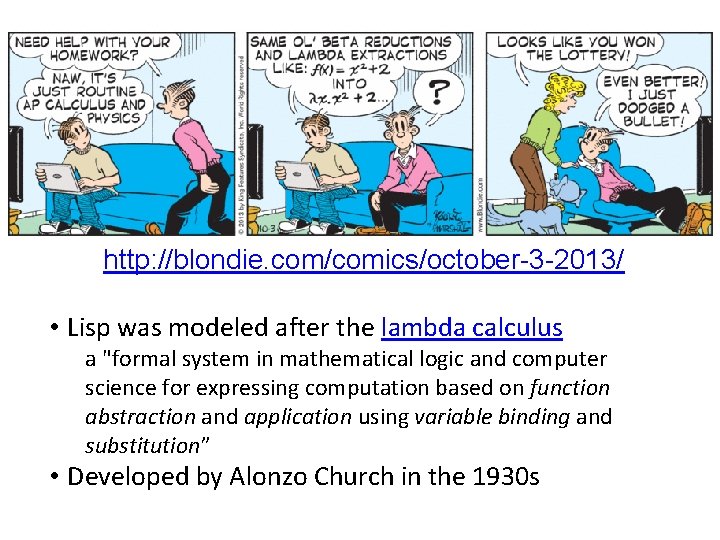
http: //blondie. com/comics/october-3 -2013/ • Lisp was modeled after the lambda calculus a "formal system in mathematical logic and computer science for expressing computation based on function abstraction and application using variable binding and substitution” • Developed by Alonzo Church in the 1930 s
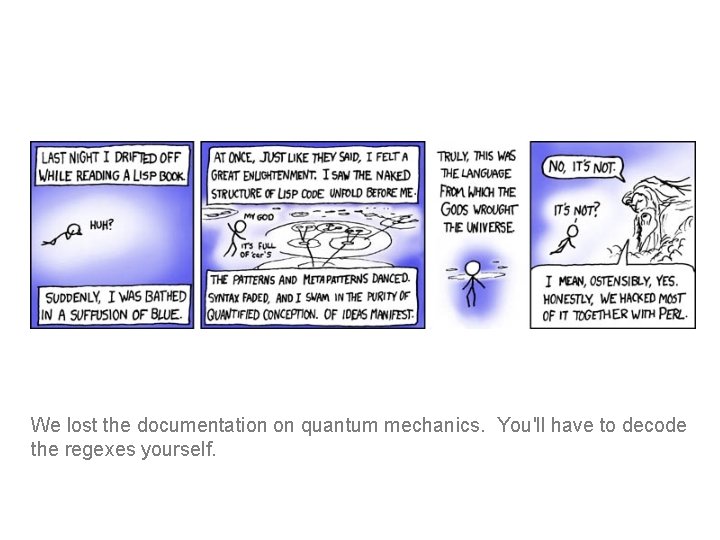
We lost the documentation on quantum mechanics. You'll have to decode the regexes yourself.
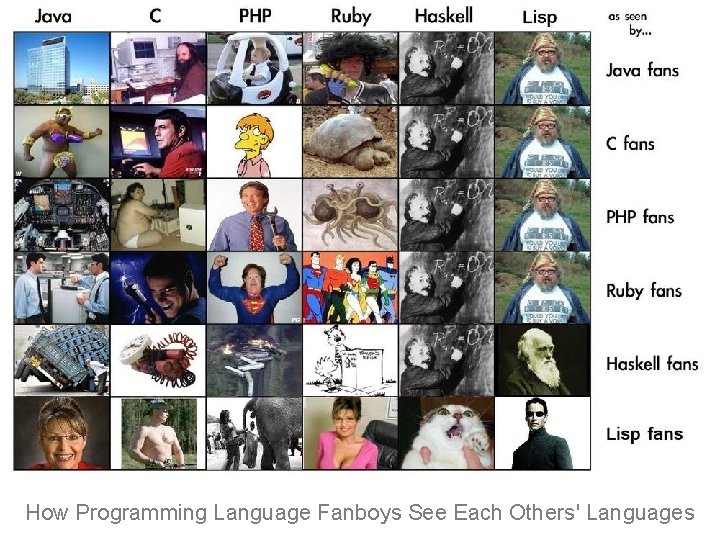
How Programming Language Fanboys See Each Others' Languages
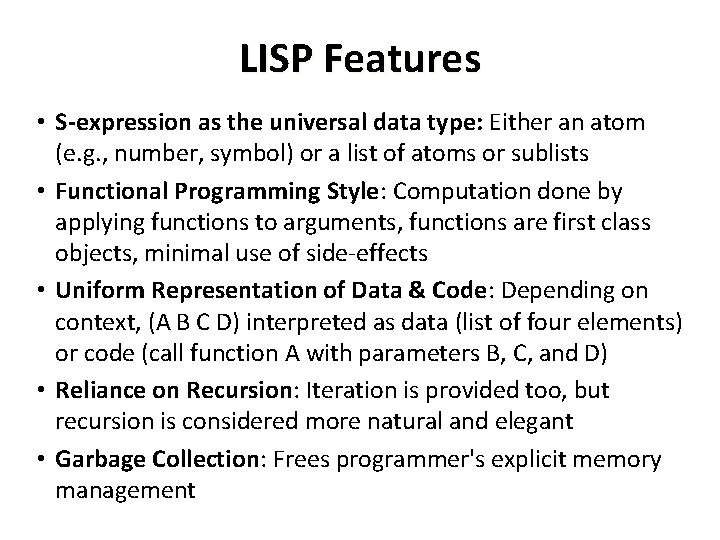
LISP Features • S-expression as the universal data type: Either an atom (e. g. , number, symbol) or a list of atoms or sublists • Functional Programming Style: Computation done by applying functions to arguments, functions are first class objects, minimal use of side-effects • Uniform Representation of Data & Code: Depending on context, (A B C D) interpreted as data (list of four elements) or code (call function A with parameters B, C, and D) • Reliance on Recursion: Iteration is provided too, but recursion is considered more natural and elegant • Garbage Collection: Frees programmer's explicit memory management
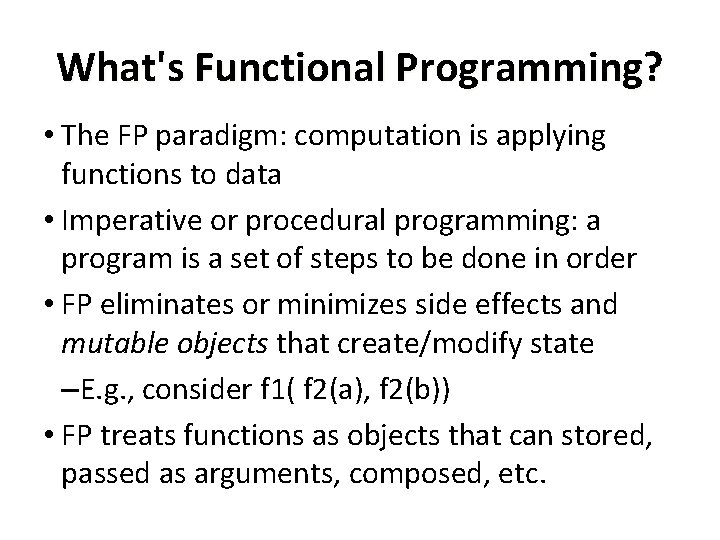
What's Functional Programming? • The FP paradigm: computation is applying functions to data • Imperative or procedural programming: a program is a set of steps to be done in order • FP eliminates or minimizes side effects and mutable objects that create/modify state –E. g. , consider f 1( f 2(a), f 2(b)) • FP treats functions as objects that can stored, passed as arguments, composed, etc.
Pure Lisp and Common Lisp • Lisp has a small and elegant conceptual core that has not changed much in almost 50 years. • Mc. Carthy's original Lisp paper defined all of Lisp using just seven primitive functions and two special forms • Common Lisp, developed in the 1980 s as an ANSI standard, is large (>800 builtin functions), has most modern data-types, good programming environments, and good compilers
�Scheme • Scheme is a dialect of Lisp that is favored by people who teach and study programming languages – It's simpler and more elegant than Lisp – It's pioneered many new programming language ideas (e. g. , continuations, call/cc) – It's influenced Lisp (e. g. , adoption of lexical scoping of variables) – It's still evolving, so it's a good vehicle for new ideas
But I want to learn Lisp! • Lisp is used in many practical systems, but Scheme is not • Learning Scheme is a good introduction to Lisp • We can only give you a brief introduction to either language, and at the core, Scheme and Lisp are the same • We'll point out some differences along the way
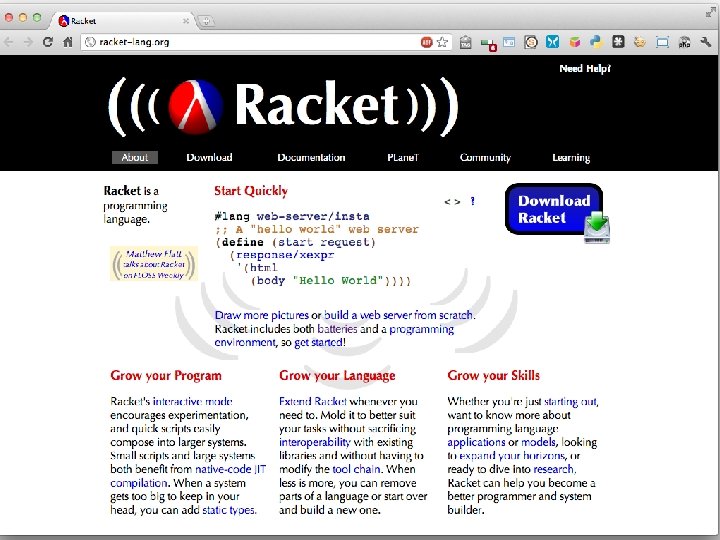
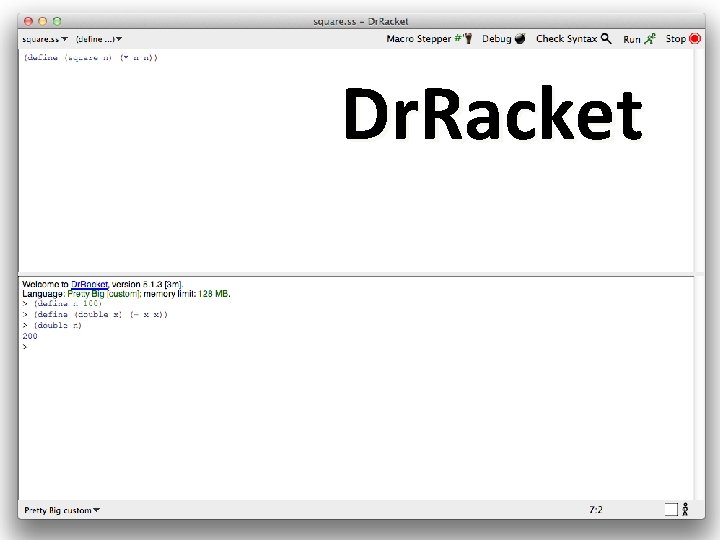
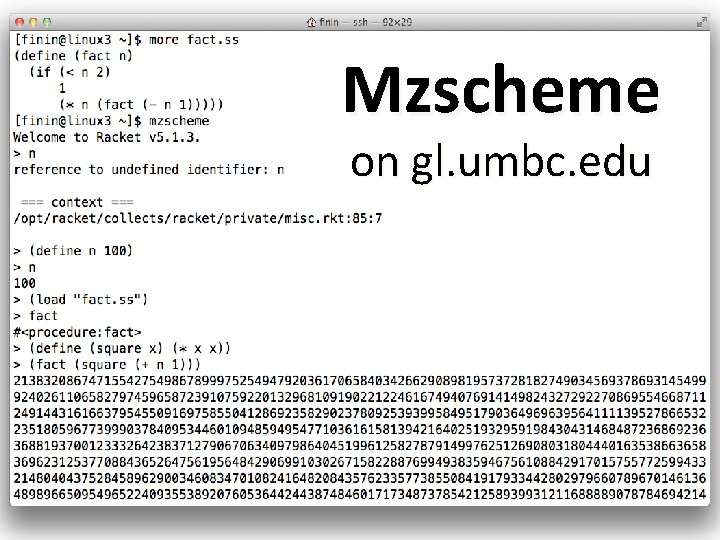
Scheme and Racket • We'll use the Racket Scheme dialect developed by a group of academics (Brown, Northeastern, Chicago, Utah) • It's most used for teaching introductory CS courses • Mz. Scheme is the basic scheme engine and can be called from the command line and assumes a terminal style interface • Dr. Scheme is a graphical programming environment for Scheme
Dr. Racket
Mzscheme on gl. umbc. edu
Informal Scheme/Lisp Syntax • An atom can be an integer, or an identifier, or a string, or… • A list is a left parenthesis, followed by zero or more S-expressions, followed by a right parenthesis • An S-expression is an atom or a list • Example: () • (A (B 3) (C) ( ( ) ) )
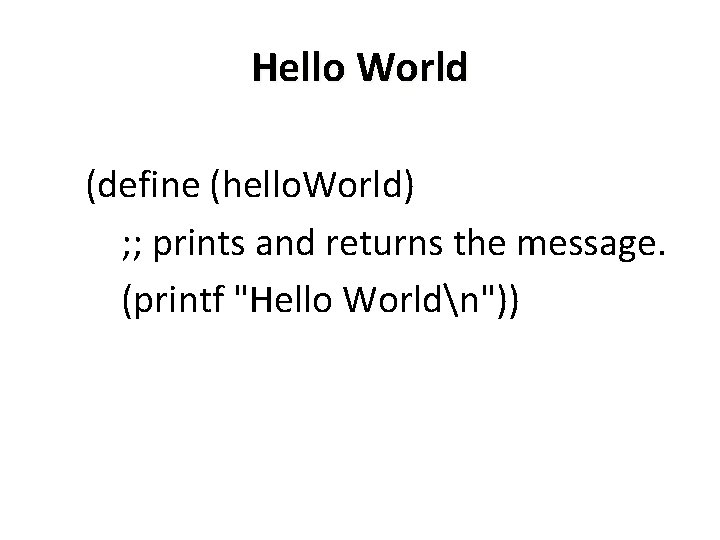
Hello World (define (hello. World) ; ; prints and returns the message. (printf "Hello Worldn"))
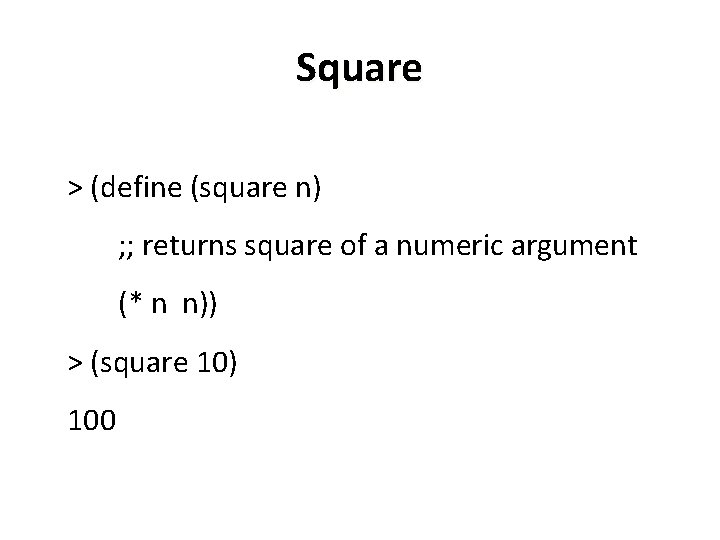
Square > (define (square n) ; ; returns square of a numeric argument (* n n)) > (square 10) 100
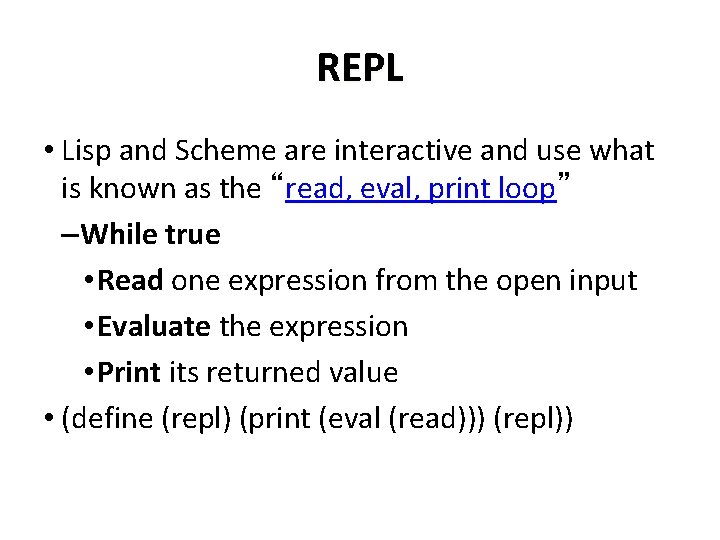
REPL • Lisp and Scheme are interactive and use what is known as the “read, eval, print loop” –While true • Read one expression from the open input • Evaluate the expression • Print its returned value • (define (repl) (print (eval (read))) (repl))
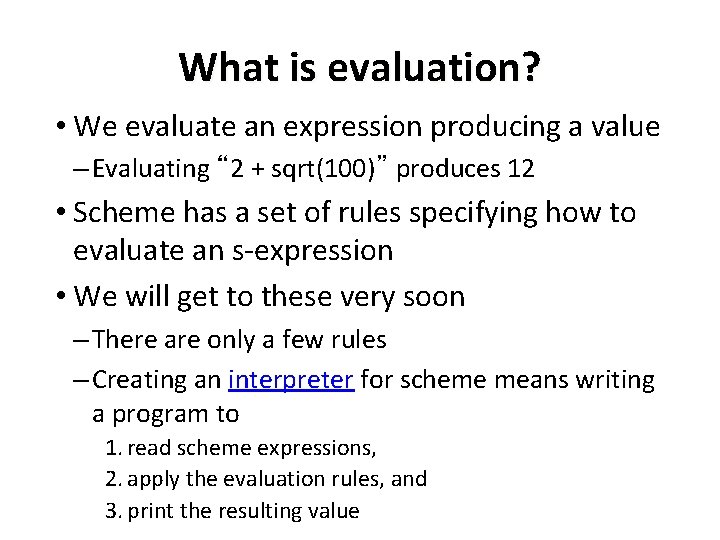
What is evaluation? • We evaluate an expression producing a value – Evaluating “ 2 + sqrt(100)” produces 12 • Scheme has a set of rules specifying how to evaluate an s-expression • We will get to these very soon – There are only a few rules – Creating an interpreter for scheme means writing a program to 1. read scheme expressions, 2. apply the evaluation rules, and 3. print the resulting value
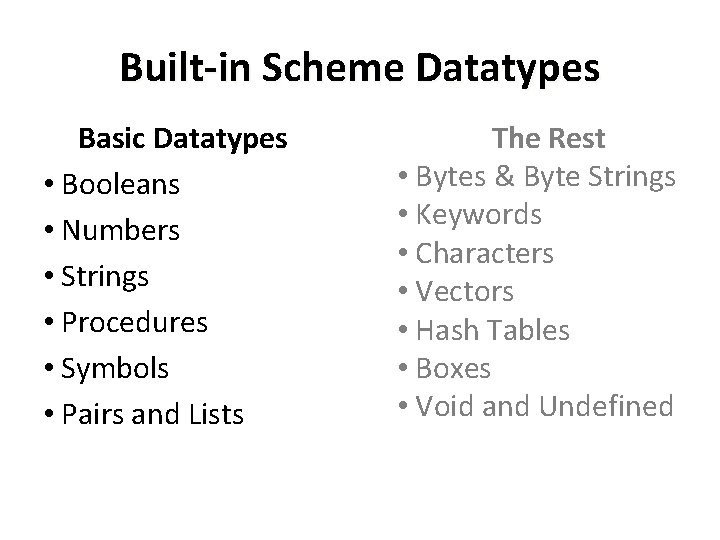
Built-in Scheme Datatypes Basic Datatypes • Booleans • Numbers • Strings • Procedures • Symbols • Pairs and Lists The Rest • Bytes & Byte Strings • Keywords • Characters • Vectors • Hash Tables • Boxes • Void and Undefined
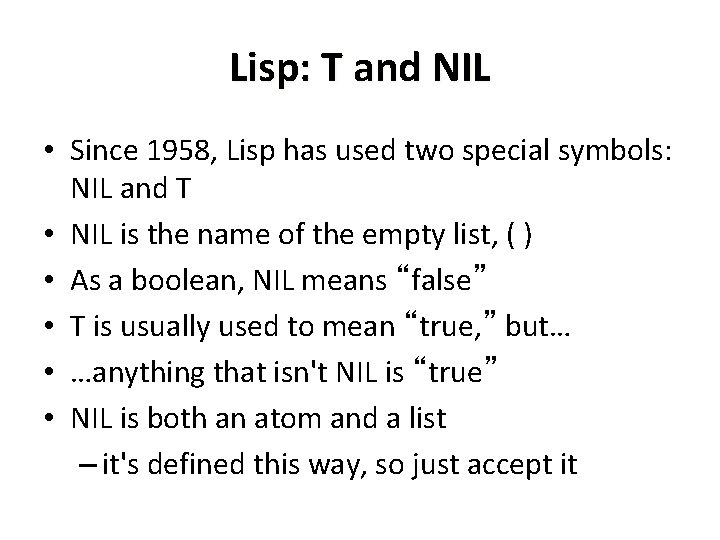
Lisp: T and NIL • Since 1958, Lisp has used two special symbols: NIL and T • NIL is the name of the empty list, ( ) • As a boolean, NIL means “false” • T is usually used to mean “true, ” but… • …anything that isn't NIL is “true” • NIL is both an atom and a list – it's defined this way, so just accept it
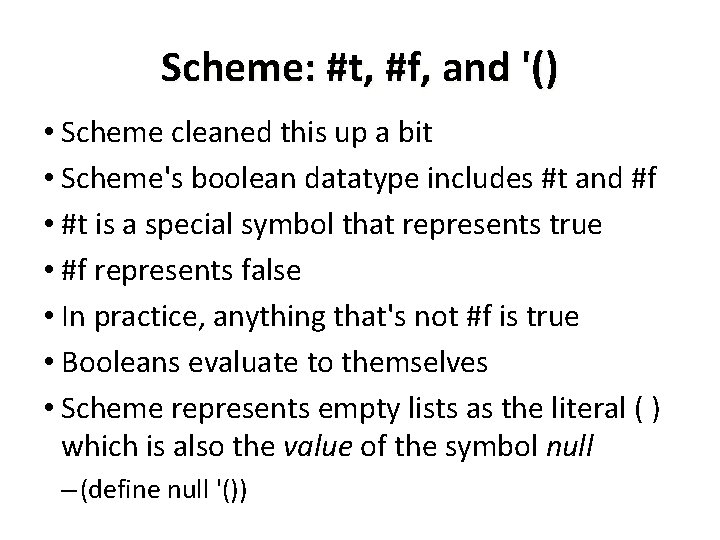
Scheme: #t, #f, and '() • Scheme cleaned this up a bit • Scheme's boolean datatype includes #t and #f • #t is a special symbol that represents true • #f represents false • In practice, anything that's not #f is true • Booleans evaluate to themselves • Scheme represents empty lists as the literal ( ) which is also the value of the symbol null – (define null '())
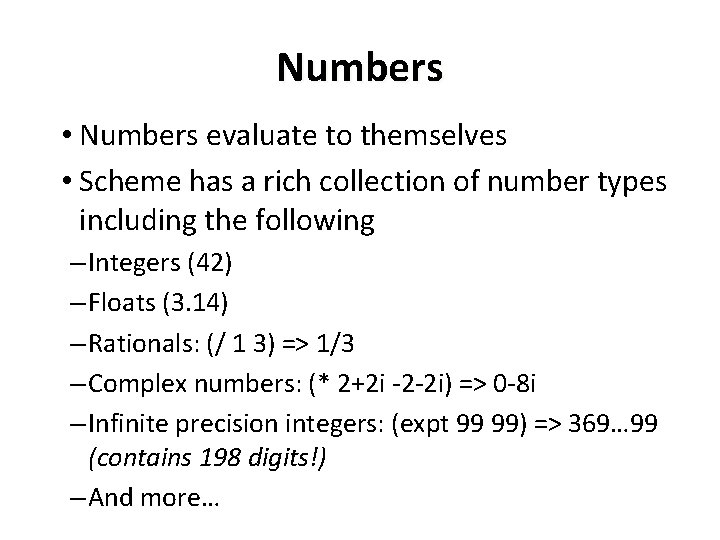
Numbers • Numbers evaluate to themselves • Scheme has a rich collection of number types including the following – Integers (42) – Floats (3. 14) – Rationals: (/ 1 3) => 1/3 – Complex numbers: (* 2+2 i -2 -2 i) => 0 -8 i – Infinite precision integers: (expt 99 99) => 369… 99 (contains 198 digits!) – And more…
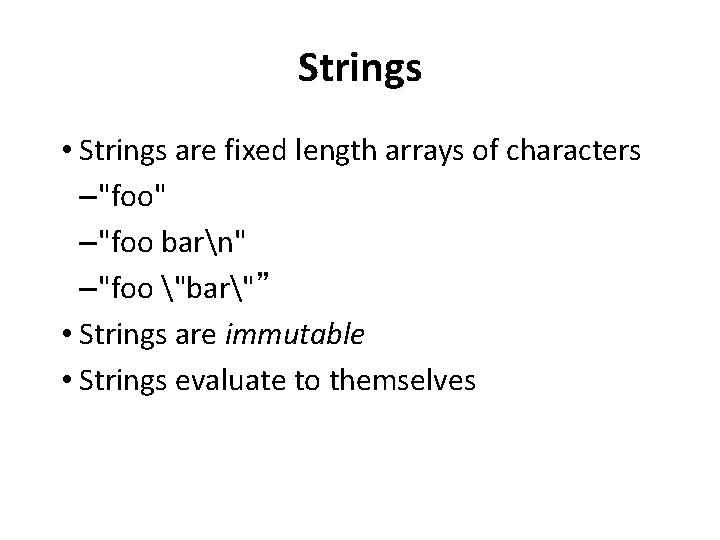
Strings • Strings are fixed length arrays of characters –"foo" –"foo barn" –"foo "bar"” • Strings are immutable • Strings evaluate to themselves
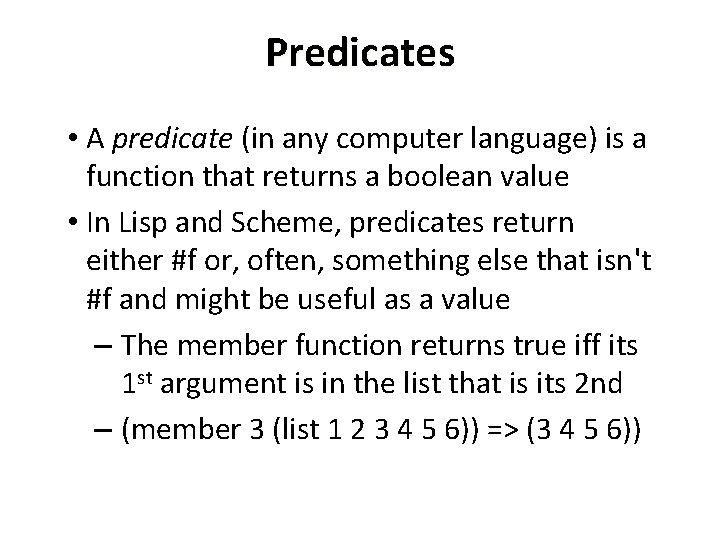
Predicates • A predicate (in any computer language) is a function that returns a boolean value • In Lisp and Scheme, predicates return either #f or, often, something else that isn't #f and might be useful as a value – The member function returns true iff its 1 st argument is in the list that is its 2 nd – (member 3 (list 1 2 3 4 5 6)) => (3 4 5 6))
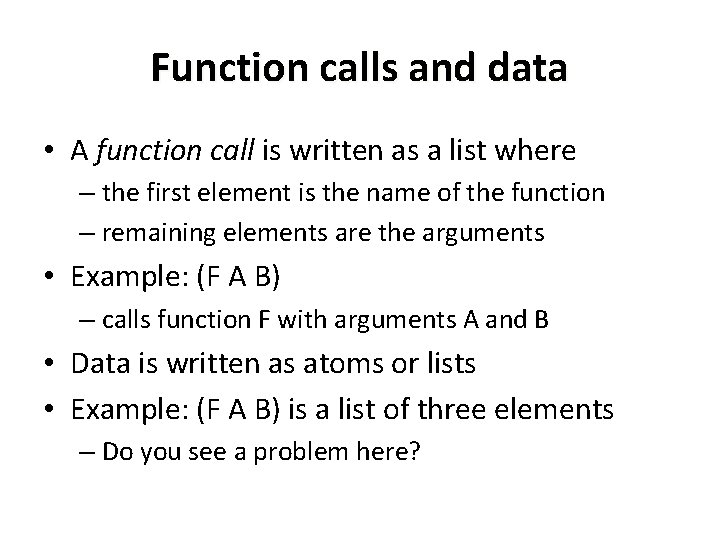
Function calls and data • A function call is written as a list where – the first element is the name of the function – remaining elements are the arguments • Example: (F A B) – calls function F with arguments A and B • Data is written as atoms or lists • Example: (F A B) is a list of three elements – Do you see a problem here?
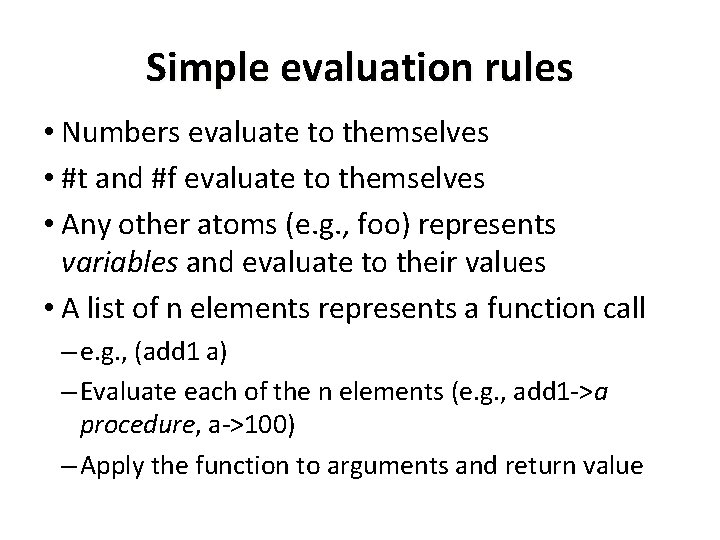
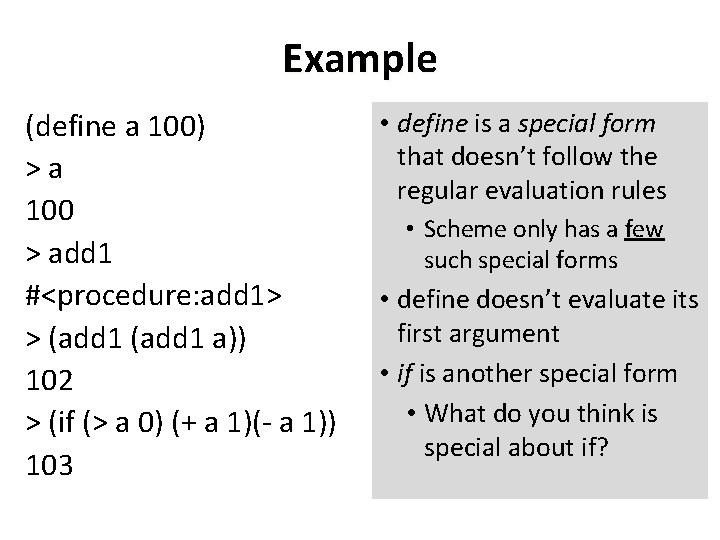
Simple evaluation rules • Numbers evaluate to themselves • #t and #f evaluate to themselves • Any other atoms (e. g. , foo) represents variables and evaluate to their values • A list of n elements represents a function call – e. g. , (add 1 a) – Evaluate each of the n elements (e. g. , add 1 ->a procedure, a->100) – Apply the function to arguments and return value
Example (define a 100) >a 100 > add 1 #<procedure: add 1> > (add 1 a)) 102 > (if (> a 0) (+ a 1)(- a 1)) 103 • define is a special form that doesn’t follow the regular evaluation rules • Scheme only has a few such special forms • define doesn’t evaluate its first argument • if is another special form • What do you think is special about if?
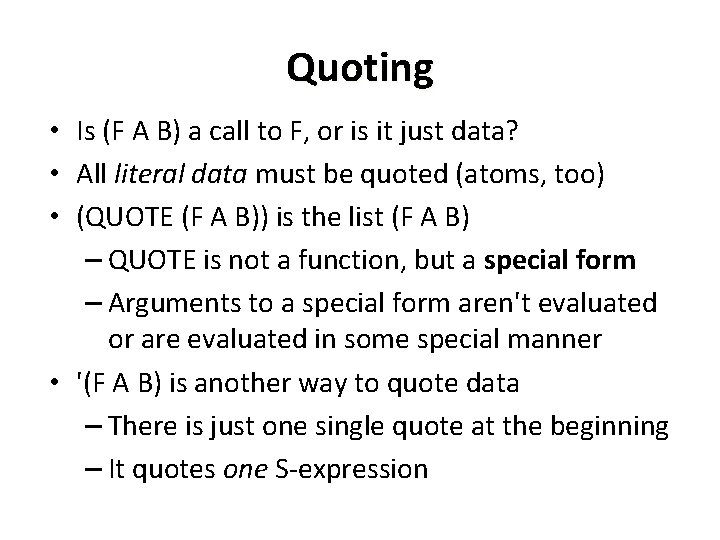
Quoting • Is (F A B) a call to F, or is it just data? • All literal data must be quoted (atoms, too) • (QUOTE (F A B)) is the list (F A B) – QUOTE is not a function, but a special form – Arguments to a special form aren't evaluated or are evaluated in some special manner • '(F A B) is another way to quote data – There is just one single quote at the beginning – It quotes one S-expression
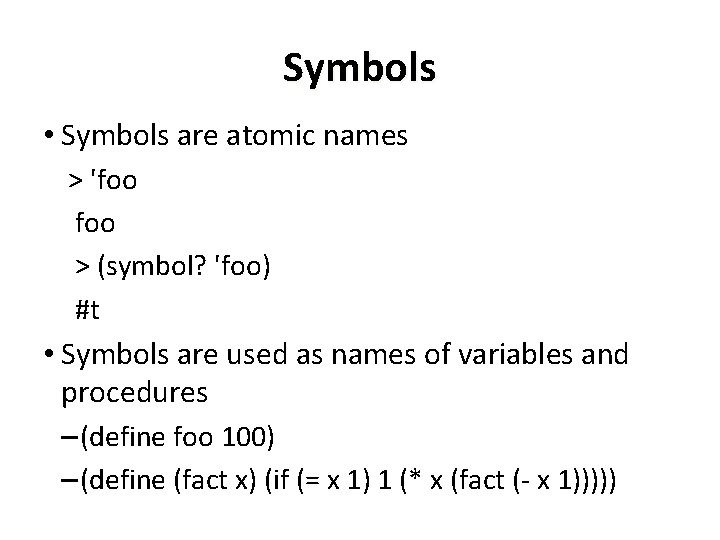
Symbols • Symbols are atomic names > 'foo > (symbol? 'foo) #t • Symbols are used as names of variables and procedures – (define foo 100) – (define (fact x) (if (= x 1) 1 (* x (fact (- x 1)))))
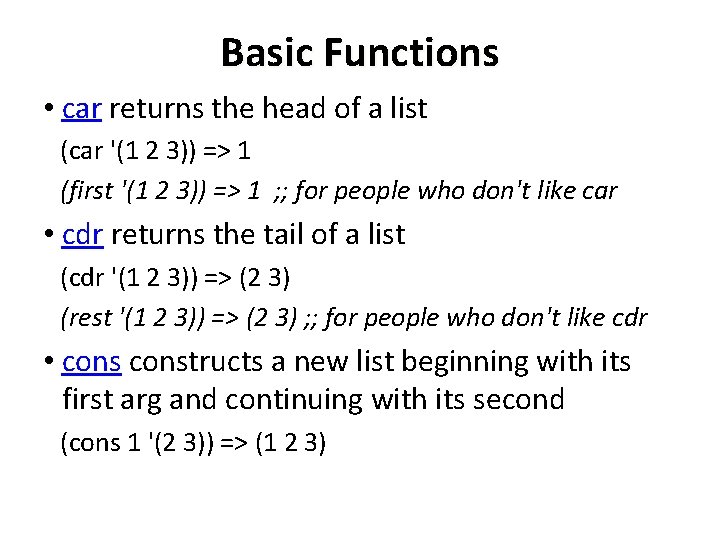
Basic Functions • car returns the head of a list (car '(1 2 3)) => 1 (first '(1 2 3)) => 1 ; ; for people who don't like car • cdr returns the tail of a list (cdr '(1 2 3)) => (2 3) (rest '(1 2 3)) => (2 3) ; ; for people who don't like cdr • constructs a new list beginning with its first arg and continuing with its second (cons 1 '(2 3)) => (1 2 3)
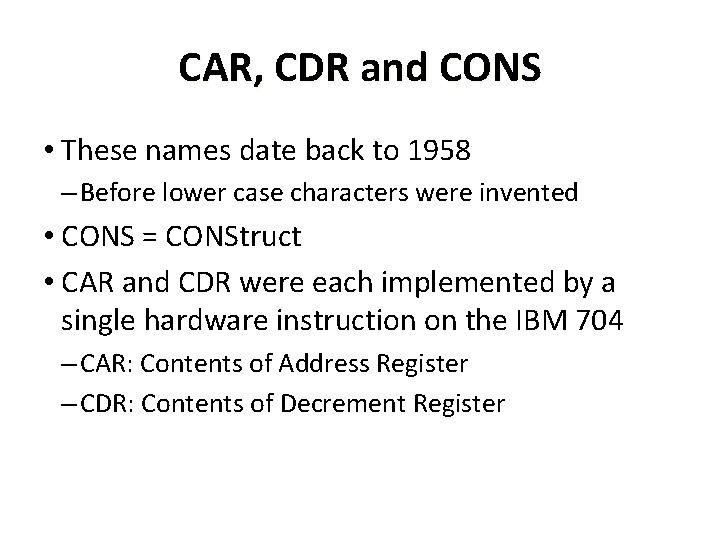
CAR, CDR and CONS • These names date back to 1958 – Before lower case characters were invented • CONS = CONStruct • CAR and CDR were each implemented by a single hardware instruction on the IBM 704 – CAR: Contents of Address Register – CDR: Contents of Decrement Register
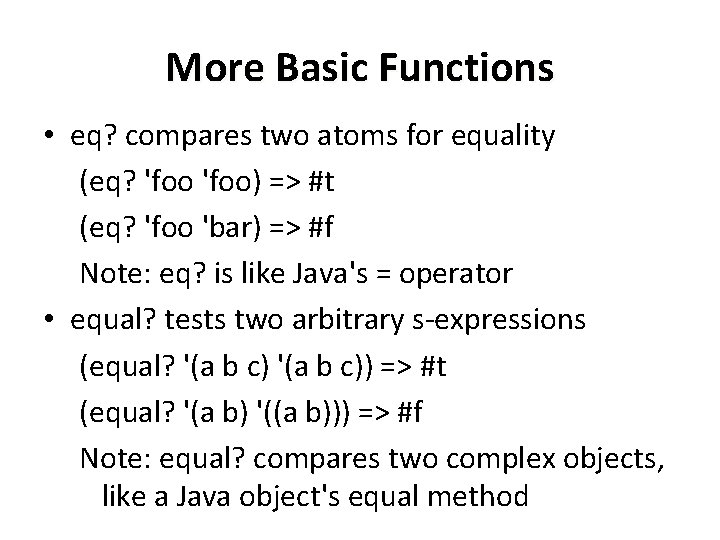
More Basic Functions • eq? compares two atoms for equality (eq? 'foo) => #t (eq? 'foo 'bar) => #f Note: eq? is like Java's = operator • equal? tests two arbitrary s-expressions (equal? '(a b c)) => #t (equal? '(a b) '((a b))) => #f Note: equal? compares two complex objects, like a Java object's equal method
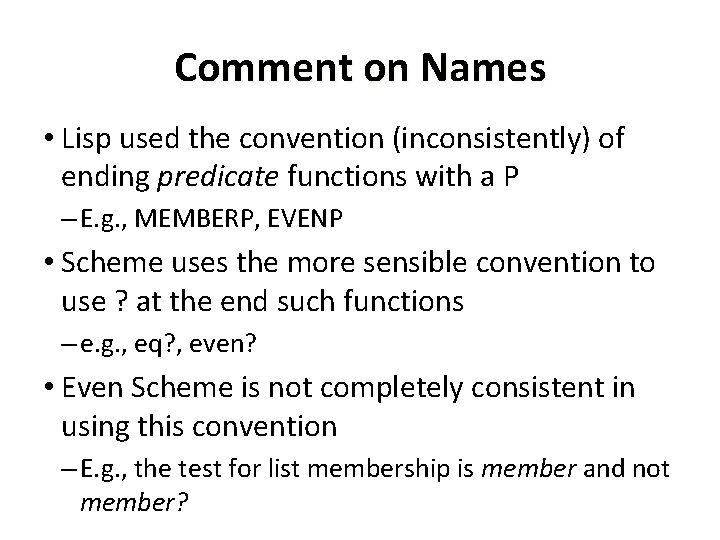
Comment on Names • Lisp used the convention (inconsistently) of ending predicate functions with a P – E. g. , MEMBERP, EVENP • Scheme uses the more sensible convention to use ? at the end such functions – e. g. , eq? , even? • Even Scheme is not completely consistent in using this convention – E. g. , the test for list membership is member and not member?
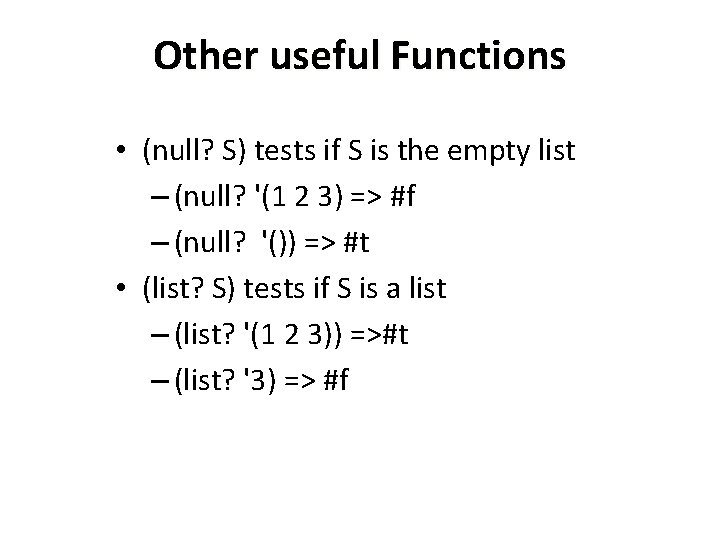
Other useful Functions • (null? S) tests if S is the empty list – (null? '(1 2 3) => #f – (null? '()) => #t • (list? S) tests if S is a list – (list? '(1 2 3)) =>#t – (list? '3) => #f
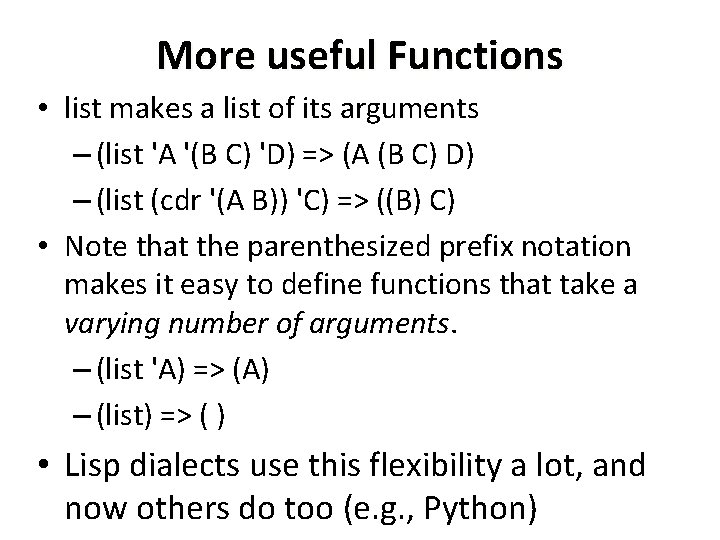
More useful Functions • list makes a list of its arguments – (list 'A '(B C) 'D) => (A (B C) D) – (list (cdr '(A B)) 'C) => ((B) C) • Note that the parenthesized prefix notation makes it easy to define functions that take a varying number of arguments. – (list 'A) => (A) – (list) => ( ) • Lisp dialects use this flexibility a lot, and now others do too (e. g. , Python)
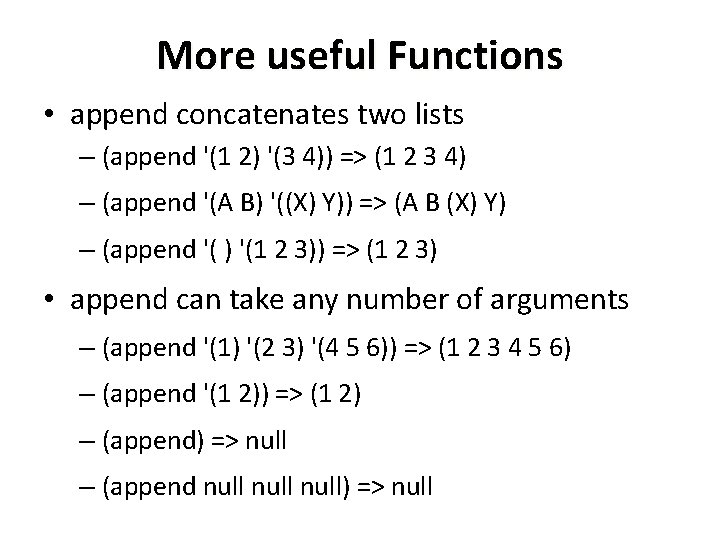
More useful Functions • append concatenates two lists – (append '(1 2) '(3 4)) => (1 2 3 4) – (append '(A B) '((X) Y)) => (A B (X) Y) – (append '( ) '(1 2 3)) => (1 2 3) • append can take any number of arguments – (append '(1) '(2 3) '(4 5 6)) => (1 2 3 4 5 6) – (append '(1 2)) => (1 2) – (append) => null – (append null) => null
Conditionals • Conditional expressions are essential in a programming language – A feature not typical in other formal notations (e. g. , mathematics, logic) that set PLs apart • The basic conditional in most PLs is the if-thenelse statement • Mc. Carthy's original Lisp didn’t include IF, but used a more versatile conditional: COND • Modern Lisp's have IF, of course, so we'll start with that See racket’s conditionals
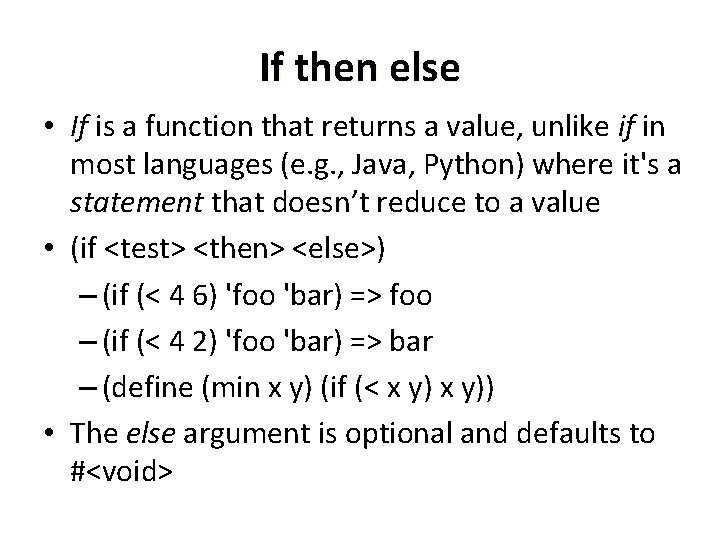
If then else • If is a function that returns a value, unlike if in most languages (e. g. , Java, Python) where it's a statement that doesn’t reduce to a value • (if <test> <then> <else>) – (if (< 4 6) 'foo 'bar) => foo – (if (< 4 2) 'foo 'bar) => bar – (define (min x y) (if (< x y)) • The else argument is optional and defaults to #<void>
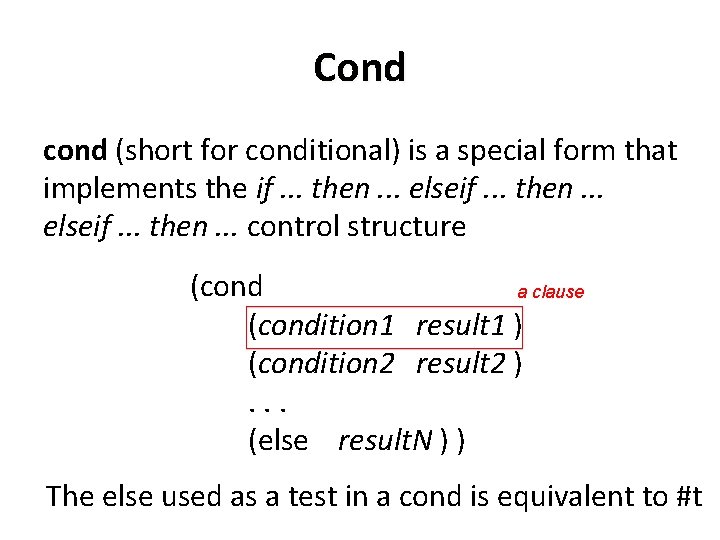
Cond cond (short for conditional) is a special form that implements the if. . . then. . . elseif. . . then. . . control structure (cond a clause (condition 1 result 1 ) (condition 2 result 2 ). . . (else result. N ) ) The else used as a test in a cond is equivalent to #t
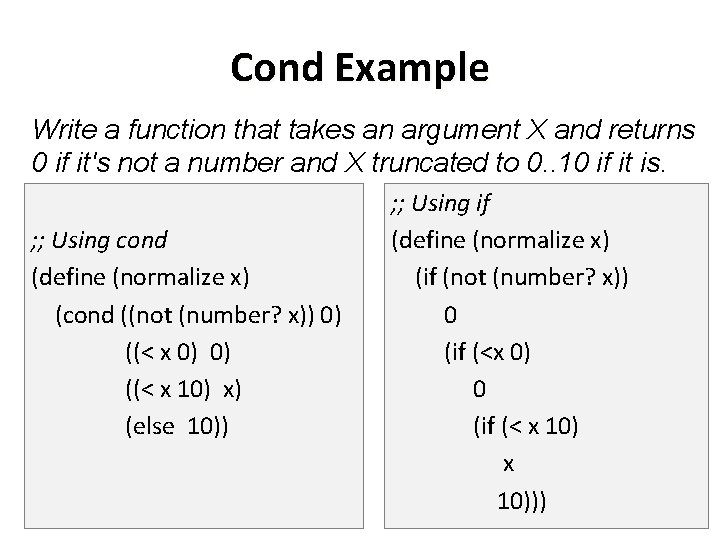
Cond Example Write a function that takes an argument X and returns 0 if it's not a number and X truncated to 0. . 10 if it is. ; ; Using cond (define (normalize x) (cond ((not (number? x)) 0) ((< x 0) 0) ((< x 10) x) (else 10)) ; ; Using if (define (normalize x) (if (not (number? x)) 0 (if (<x 0) 0 (if (< x 10)))
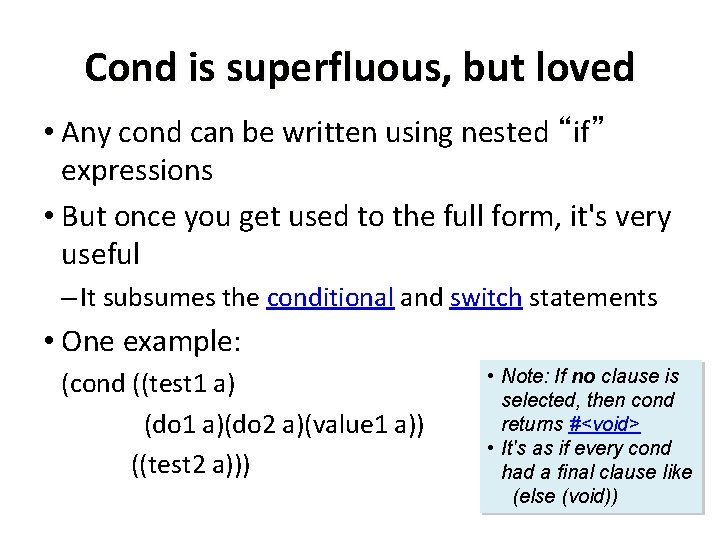
Cond is superfluous, but loved • Any cond can be written using nested “if” expressions • But once you get used to the full form, it's very useful – It subsumes the conditional and switch statements • One example: (cond ((test 1 a) (do 1 a)(do 2 a)(value 1 a)) ((test 2 a))) • Note: If no clause is selected, then cond returns #<void> • It's as if every cond had a final clause like (else (void))
Defining Functions (define (function_name [parameter]*) [s-expr]+ ) Examples: (define (square n) (* n n)) (define (diff x y) (if (> x y) (- y x))) (define (warn msg) (printf "***** ”) (printf msg) #t)
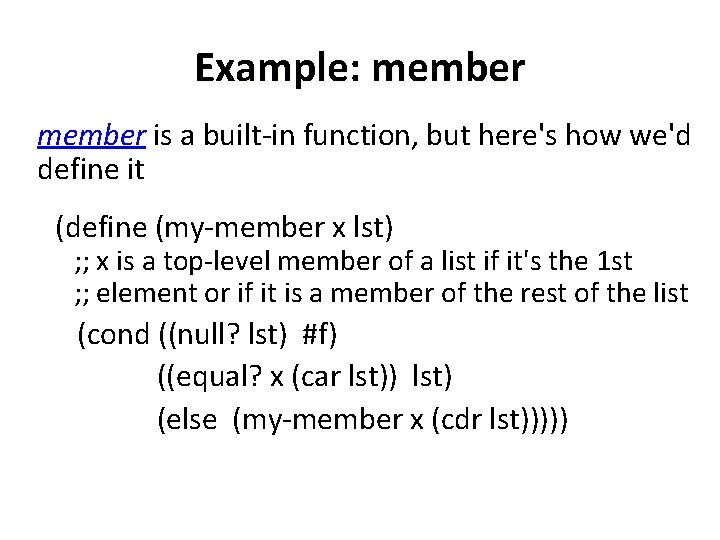
Example: member is a built-in function, but here's how we'd define it (define (my-member x lst) ; ; x is a top-level member of a list if it's the 1 st ; ; element or if it is a member of the rest of the list (cond ((null? lst) #f) ((equal? x (car lst)) lst) (else (my-member x (cdr lst)))))
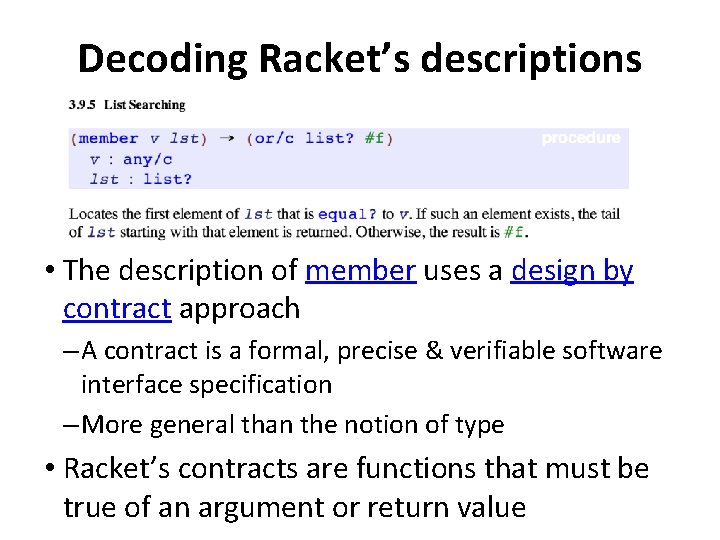
Decoding Racket’s descriptions • The description of member uses a design by contract approach – A contract is a formal, precise & verifiable software interface specification – More general than the notion of type • Racket’s contracts are functions that must be true of an argument or return value
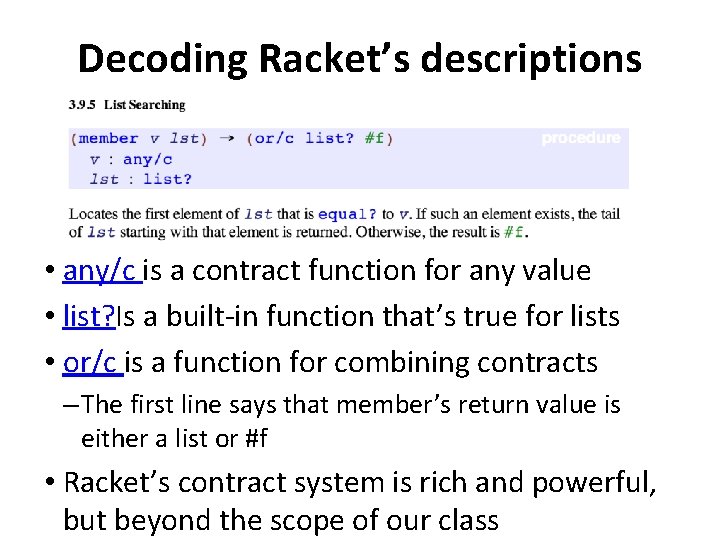
Decoding Racket’s descriptions • any/c is a contract function for any value • list? Is a built-in function that’s true for lists • or/c is a function for combining contracts – The first line says that member’s return value is either a list or #f • Racket’s contract system is rich and powerful, but beyond the scope of our class
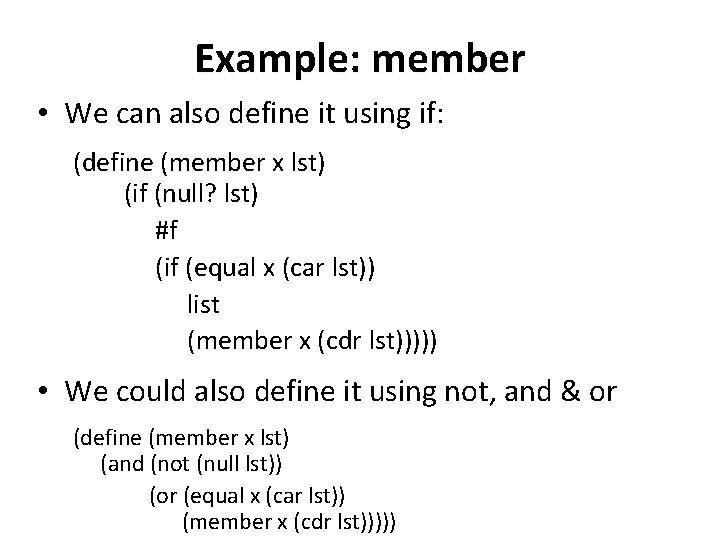
Example: member • We can also define it using if: (define (member x lst) (if (null? lst) #f (if (equal x (car lst)) list (member x (cdr lst))))) • We could also define it using not, and & or (define (member x lst) (and (not (null lst)) (or (equal x (car lst)) (member x (cdr lst)))))
Programs on file • Use any text editor to create your program • Save your program on a file with the extension. ss • (Load “foo. ss”) loads foo. ss • (load “foo. bar”) loads foo. bar • Each s-expression in the file is read and evaluated.
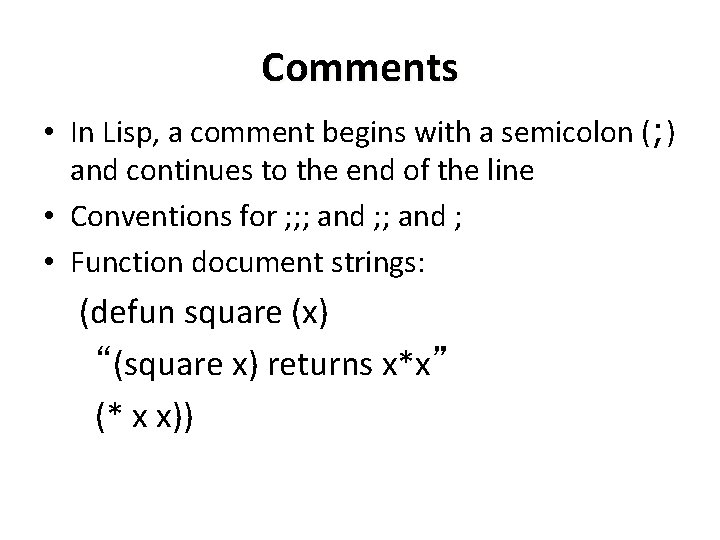
Comments • In Lisp, a comment begins with a semicolon (; ) and continues to the end of the line • Conventions for ; ; ; and ; • Function document strings: (defun square (x) “(square x) returns x*x” (* x x))