
LIS 618 lecture 2 the Boolean model Thomas
LIS 618 lecture 2 the Boolean model Thomas Krichel 2011 -04 -21
reading • We follow Manning, Raghavan and Schuetze here, chapter one. • I leave out stuff that relates to running things on a computer in an efficient way. • I add some more basic mathematical theory that we need.
the Boolean model • The Boolean retrieval model is being able to ask a query that is a Boolean expression. • Primary commercial retrieval tool for 3 decades. • Many search systems you still use are Boolean. • It is a preferred tool for expert searchers. • It leaves non-experts baffled.
what is Boolean? • A Boolean variable is a variable that takes only two values. You can label that as you like – ‘true’ ‘false’ – ‘black’ ‘white’ – ‘ 1’ ‘ 0’ • I will use 0 and 1 here.
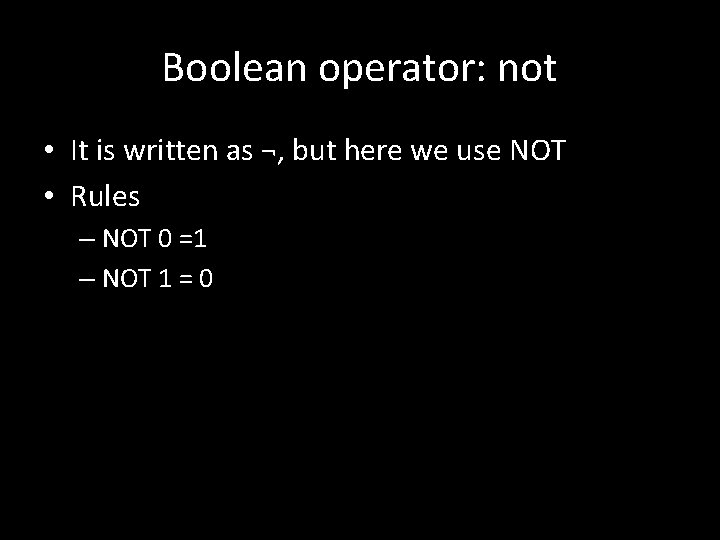
Boolean operator: not • It is written as ¬, but here we use NOT • Rules – NOT 0 =1 – NOT 1 = 0
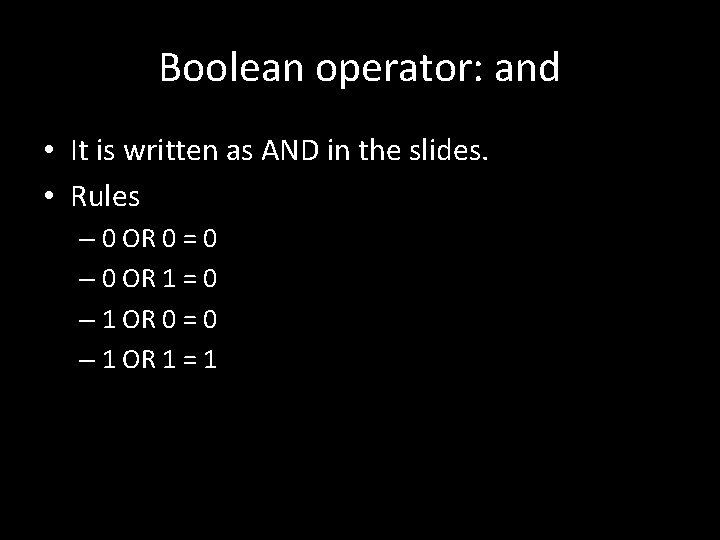
Boolean operator: and • It is written as AND in the slides. • Rules – 0 OR 0 = 0 – 0 OR 1 = 0 – 1 OR 0 = 0 – 1 OR 1 = 1
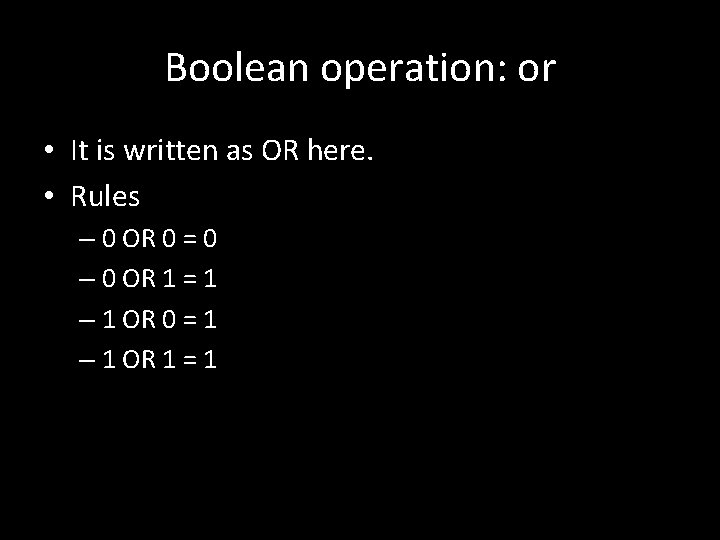
Boolean operation: or • It is written as OR here. • Rules – 0 OR 0 = 0 – 0 OR 1 = 1 – 1 OR 0 = 1 – 1 OR 1 = 1
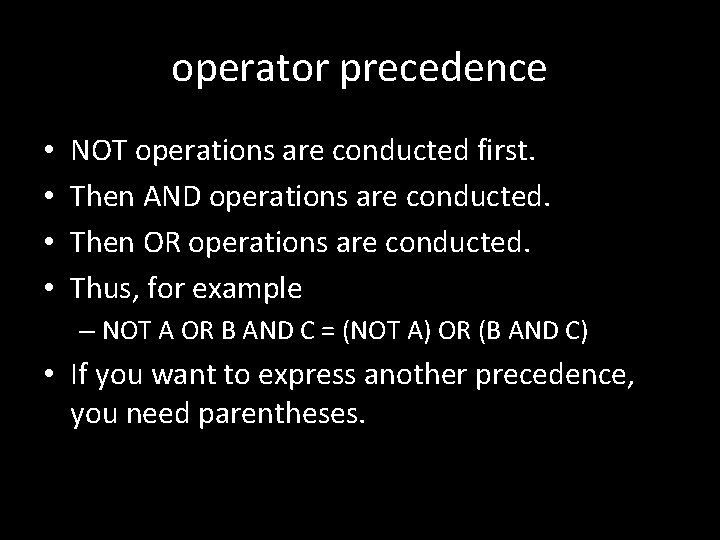
operator precedence • • NOT operations are conducted first. Then AND operations are conducted. Then OR operations are conducted. Thus, for example – NOT A OR B AND C = (NOT A) OR (B AND C) • If you want to express another precedence, you need parentheses.
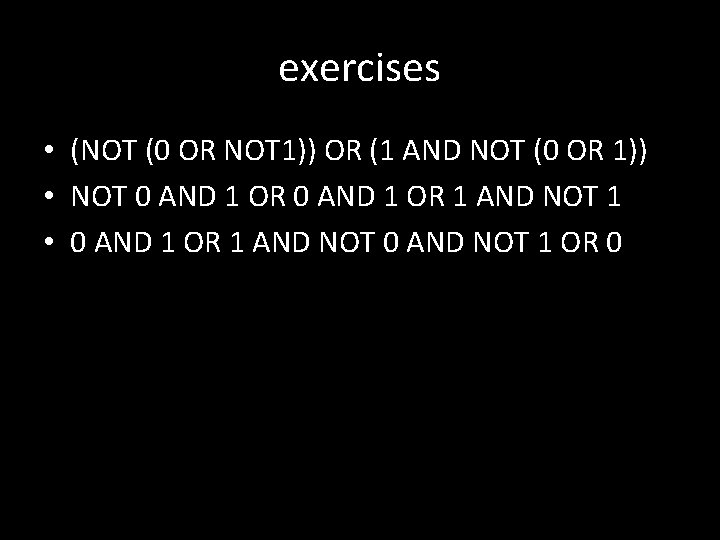
exercises • (NOT (0 OR NOT 1)) OR (1 AND NOT (0 OR 1)) • NOT 0 AND 1 OR 1 AND NOT 1 • 0 AND 1 OR 1 AND NOT 0 AND NOT 1 OR 0
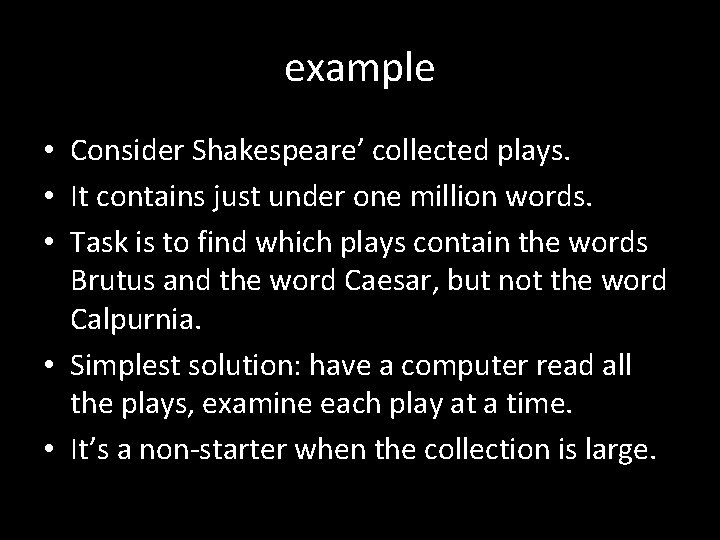
example • Consider Shakespeare’ collected plays. • It contains just under one million words. • Task is to find which plays contain the words Brutus and the word Caesar, but not the word Calpurnia. • Simplest solution: have a computer read all the plays, examine each play at a time. • It’s a non-starter when the collection is large.
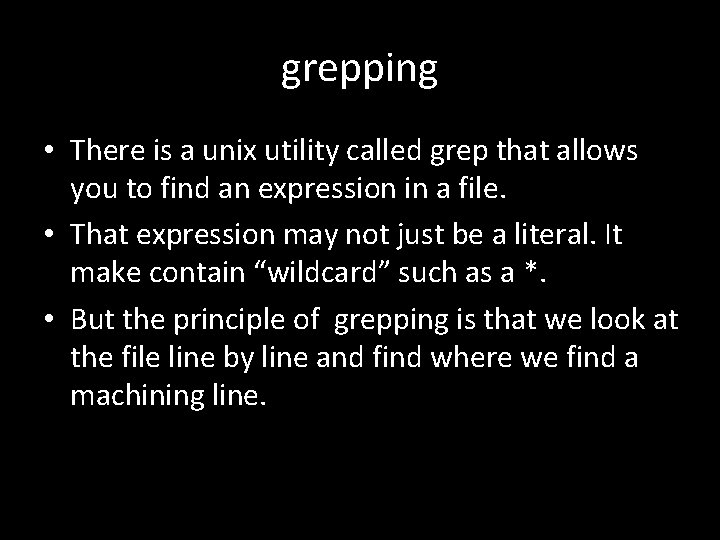
grepping • There is a unix utility called grep that allows you to find an expression in a file. • That expression may not just be a literal. It make contain “wildcard” such as a *. • But the principle of grepping is that we look at the file line by line and find where we find a machining line.
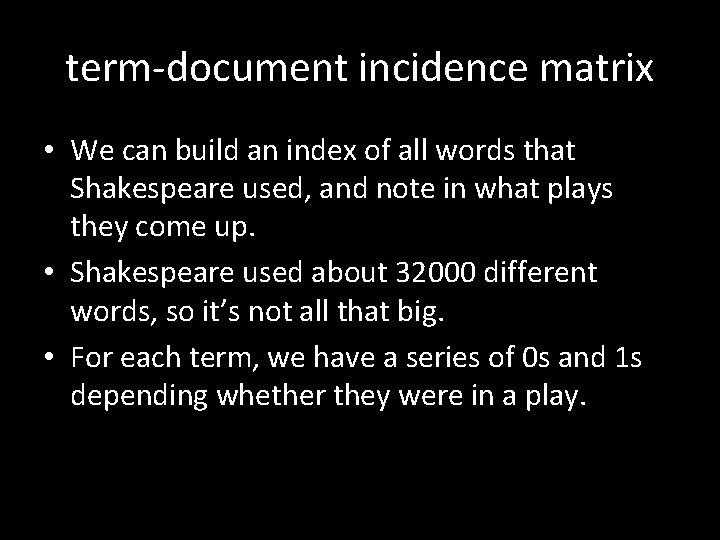
term-document incidence matrix • We can build an index of all words that Shakespeare used, and note in what plays they come up. • Shakespeare used about 32000 different words, so it’s not all that big. • For each term, we have a series of 0 s and 1 s depending whether they were in a play.
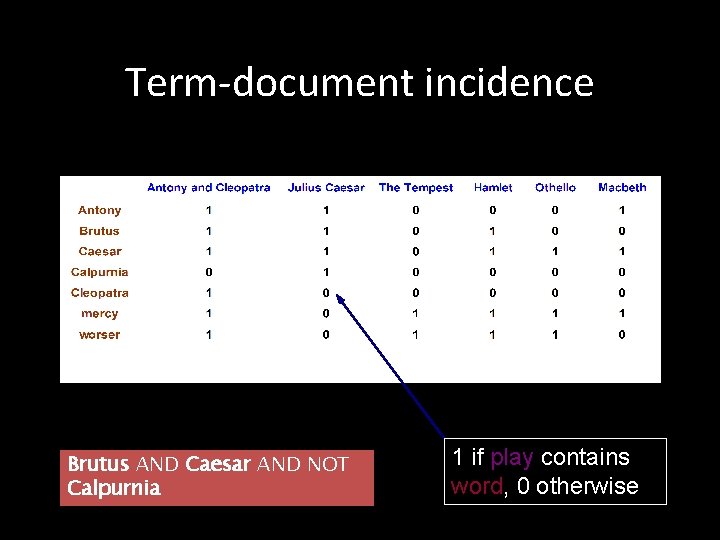
Term-document incidence Brutus AND Caesar AND NOT Calpurnia 1 if play contains word, 0 otherwise
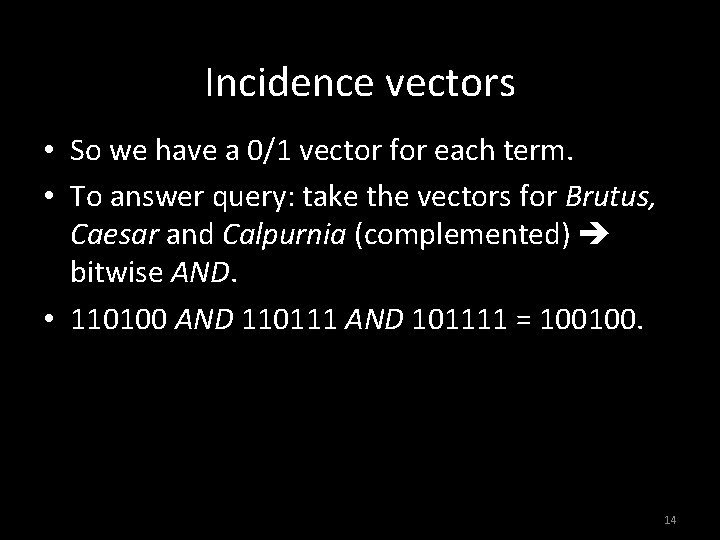
Incidence vectors • So we have a 0/1 vector for each term. • To answer query: take the vectors for Brutus, Caesar and Calpurnia (complemented) bitwise AND. • 110100 AND 110111 AND 101111 = 100100. 14
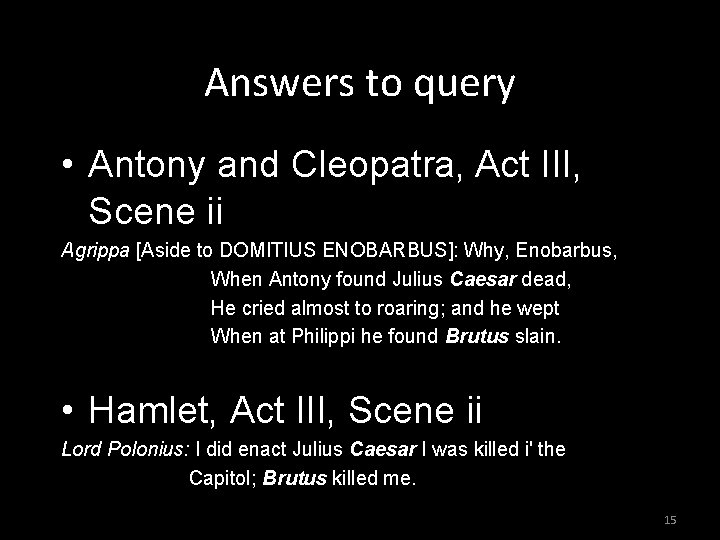
Answers to query • Antony and Cleopatra, Act III, Scene ii Agrippa [Aside to DOMITIUS ENOBARBUS]: Why, Enobarbus, When Antony found Julius Caesar dead, He cried almost to roaring; and he wept When at Philippi he found Brutus slain. • Hamlet, Act III, Scene ii Lord Polonius: I did enact Julius Caesar I was killed i' the Capitol; Brutus killed me. 15
some requirements • We need to look at large documents. The amount of digital data grows at least as the speed of computers. • It would be difficult to do more complicated operations such as allowing for proximity. • Allowing for ranking of retrieval result.
indexing • The term/document incidence matrix only works for a small number of documents containing a small number of terms. • We need a different tool and that is some form of index. • An index can take many forms, in fact.
document handle • We assume that we have a bunch of documents of interest. • Each document has some identifier. • This is called the doc. ID in the following. • Example – file name on disk – URL on web (URLs can point to parts of a page)
document part of interest • There may only be one part of the document that you would think that a user would want to retrieve. • But that part depends critically on the type of documents you use. • Examples…
document types • • • A collection of poems. A set of email files. The books of the bible. The plays of Shakespeare A set of Power. Point slides.
prep work • We split the text into a series of tokens that we allow to search for. • We normalize the tokens in some fashion by linguistic processing. • Let us think of the normalized tokens as words.
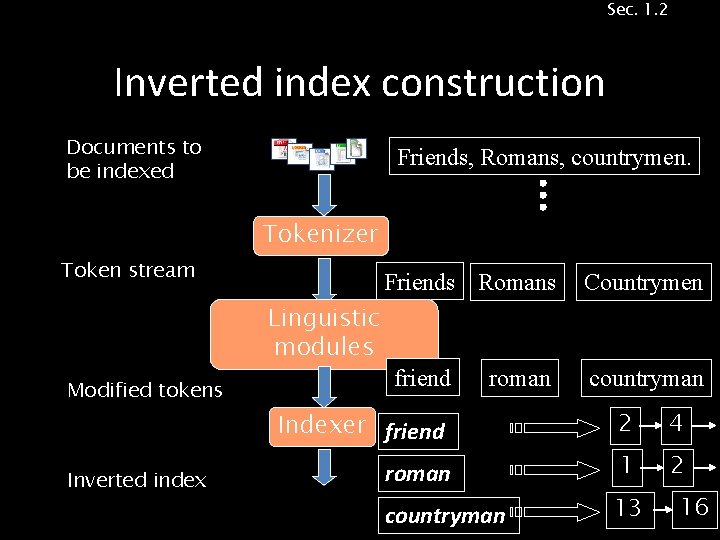
Sec. 1. 2 Inverted index construction Documents to be indexed Friends, Romans, countrymen. Tokenizer Token stream Friends Romans Linguistic modules Modified tokens Inverted index friend roman Countrymen countryman Indexer friend 2 4 roman 1 2 countryman 13 16
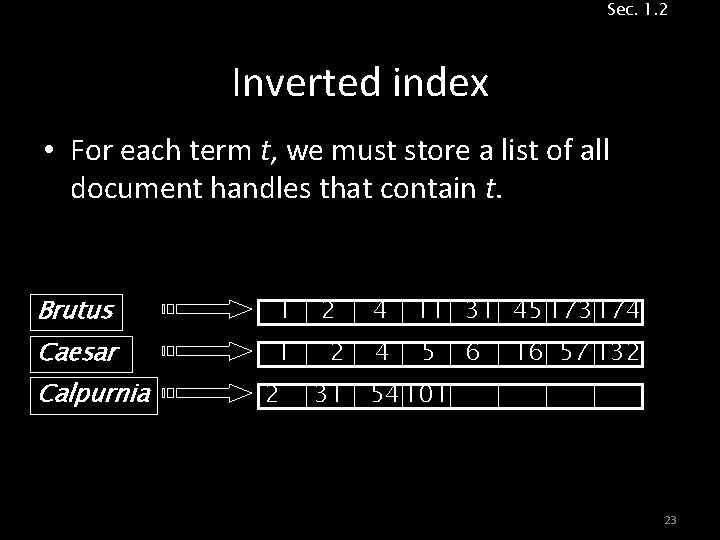
Sec. 1. 2 Inverted index • For each term t, we must store a list of all document handles that contain t. Brutus 1 Caesar 1 Calpurnia 2 2 2 31 4 11 31 45 173 174 4 5 6 16 57 132 54 101 23
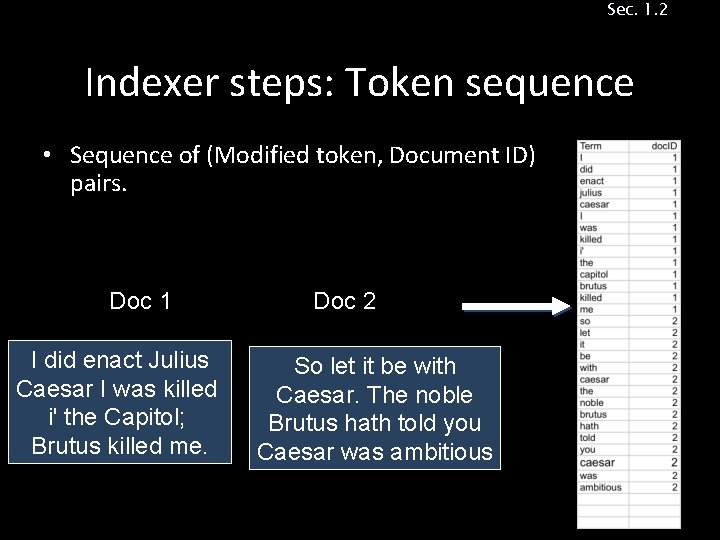
Sec. 1. 2 Indexer steps: Token sequence • Sequence of (Modified token, Document ID) pairs. Doc 1 I did enact Julius Caesar I was killed i' the Capitol; Brutus killed me. Doc 2 So let it be with Caesar. The noble Brutus hath told you Caesar was ambitious
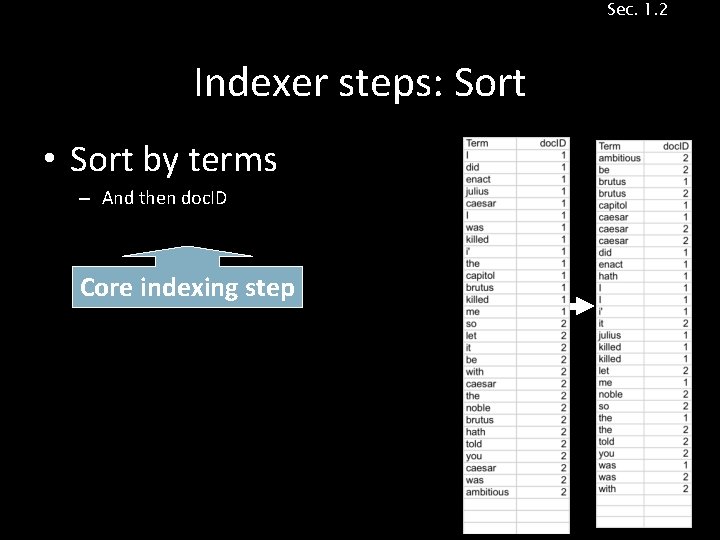
Sec. 1. 2 Indexer steps: Sort • Sort by terms – And then doc. ID Core indexing step
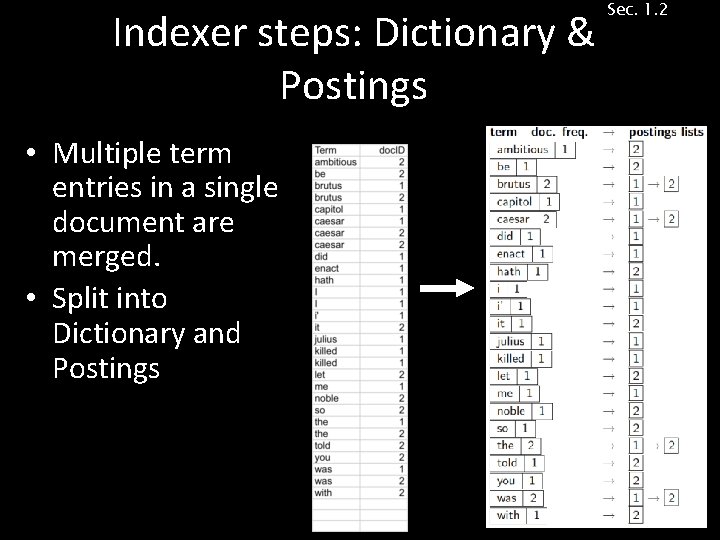
Indexer steps: Dictionary & Postings • Multiple term entries in a single document are merged. • Split into Dictionary and Postings Sec. 1. 2
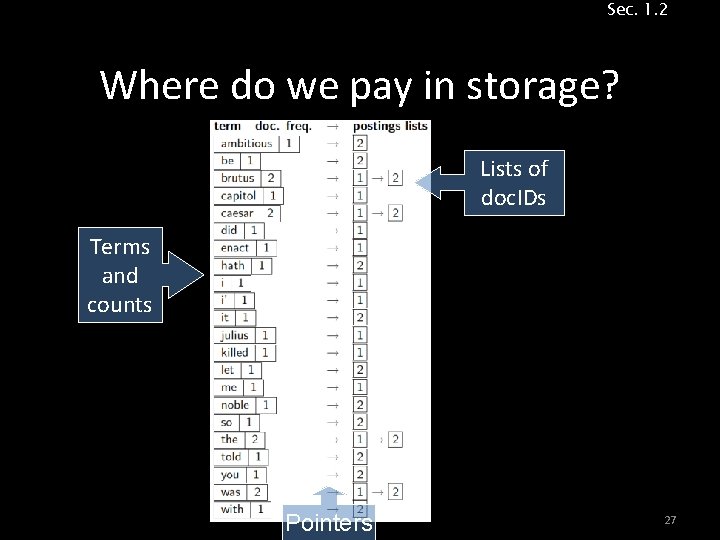
Sec. 1. 2 Where do we pay in storage? Lists of doc. IDs Terms and counts Pointers 27
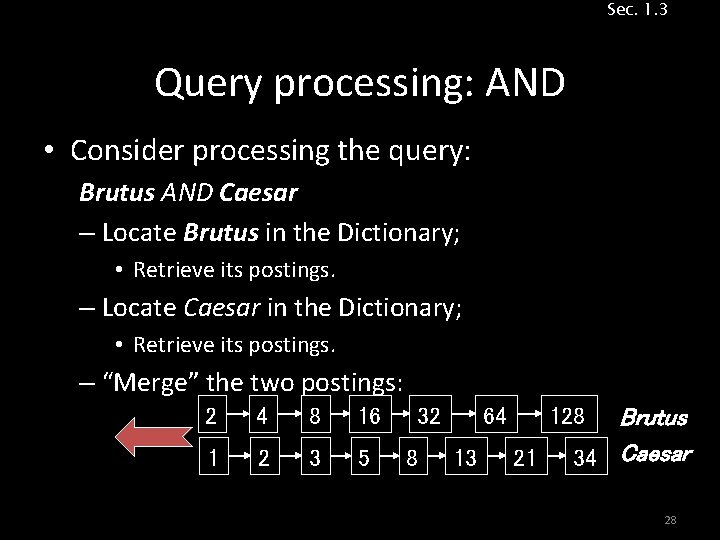
Sec. 1. 3 Query processing: AND • Consider processing the query: Brutus AND Caesar – Locate Brutus in the Dictionary; • Retrieve its postings. – Locate Caesar in the Dictionary; • Retrieve its postings. – “Merge” the two postings: 2 4 8 16 1 2 3 5 32 8 64 13 128 21 Brutus 34 Caesar 28
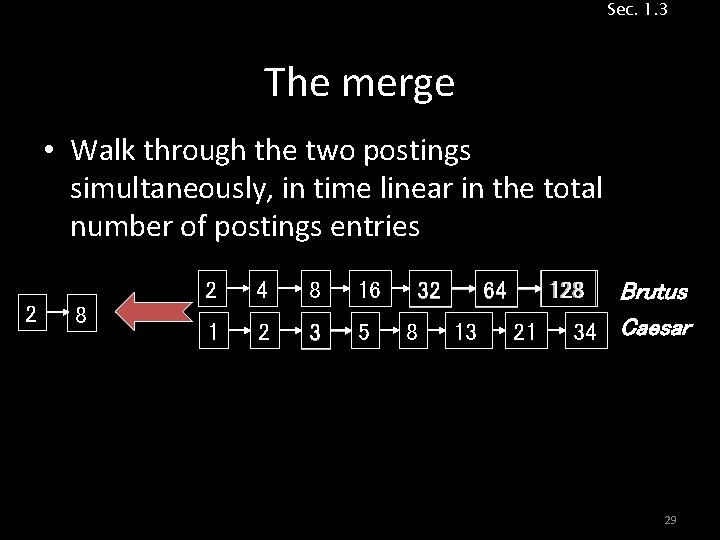
Sec. 1. 3 The merge • Walk through the two postings simultaneously, in time linear in the total number of postings entries 2 8 2 4 8 16 1 2 3 5 32 8 13 Brutus 34 Caesar 128 64 21 29
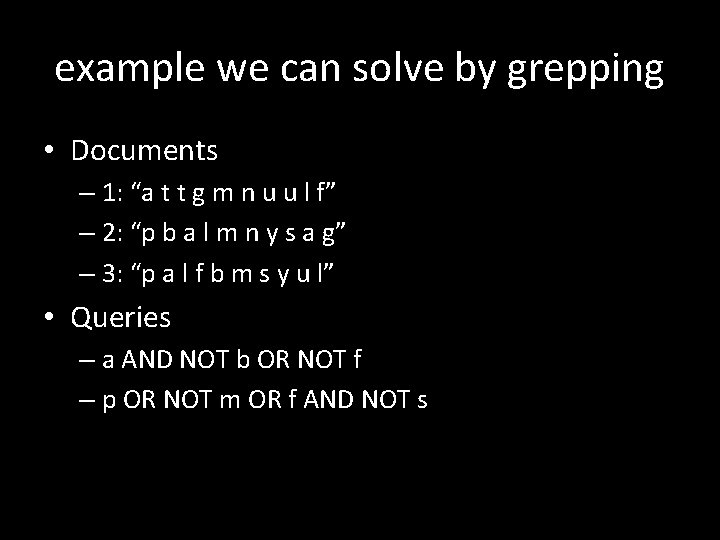
example we can solve by grepping • Documents – 1: “a t t g m n u u l f” – 2: “p b a l m n y s a g” – 3: “p a l f b m s y u l” • Queries – a AND NOT b OR NOT f – p OR NOT m OR f AND NOT s
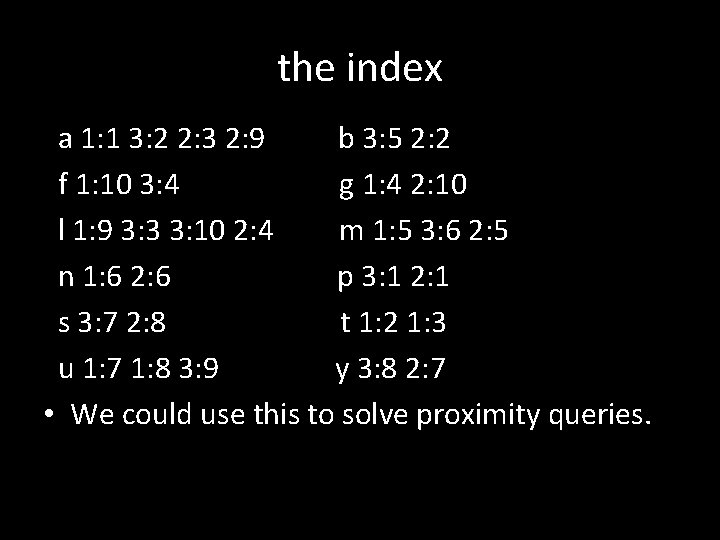
the index a 1: 1 3: 2 2: 3 2: 9 b 3: 5 2: 2 f 1: 10 3: 4 g 1: 4 2: 10 l 1: 9 3: 3 3: 10 2: 4 m 1: 5 3: 6 2: 5 n 1: 6 2: 6 p 3: 1 2: 1 s 3: 7 2: 8 t 1: 2 1: 3 u 1: 7 1: 8 3: 9 y 3: 8 2: 7 • We could use this to solve proximity queries.
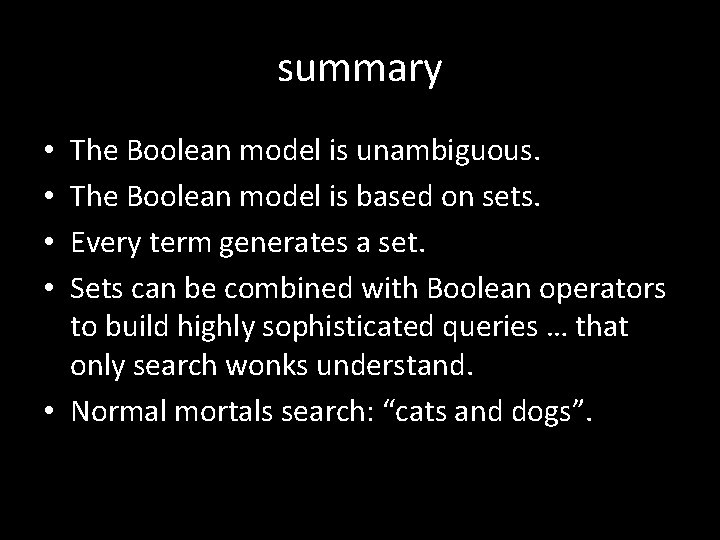
summary The Boolean model is unambiguous. The Boolean model is based on sets. Every term generates a set. Sets can be combined with Boolean operators to build highly sophisticated queries … that only search wonks understand. • Normal mortals search: “cats and dogs”. • •
http: //openlib. org/home/krichel Please shutdown the computers when you are done. Thank you for your attention!
- Slides: 33