
Liquid Nitrogen Dewar Filling Station for safe use
- Slides: 1
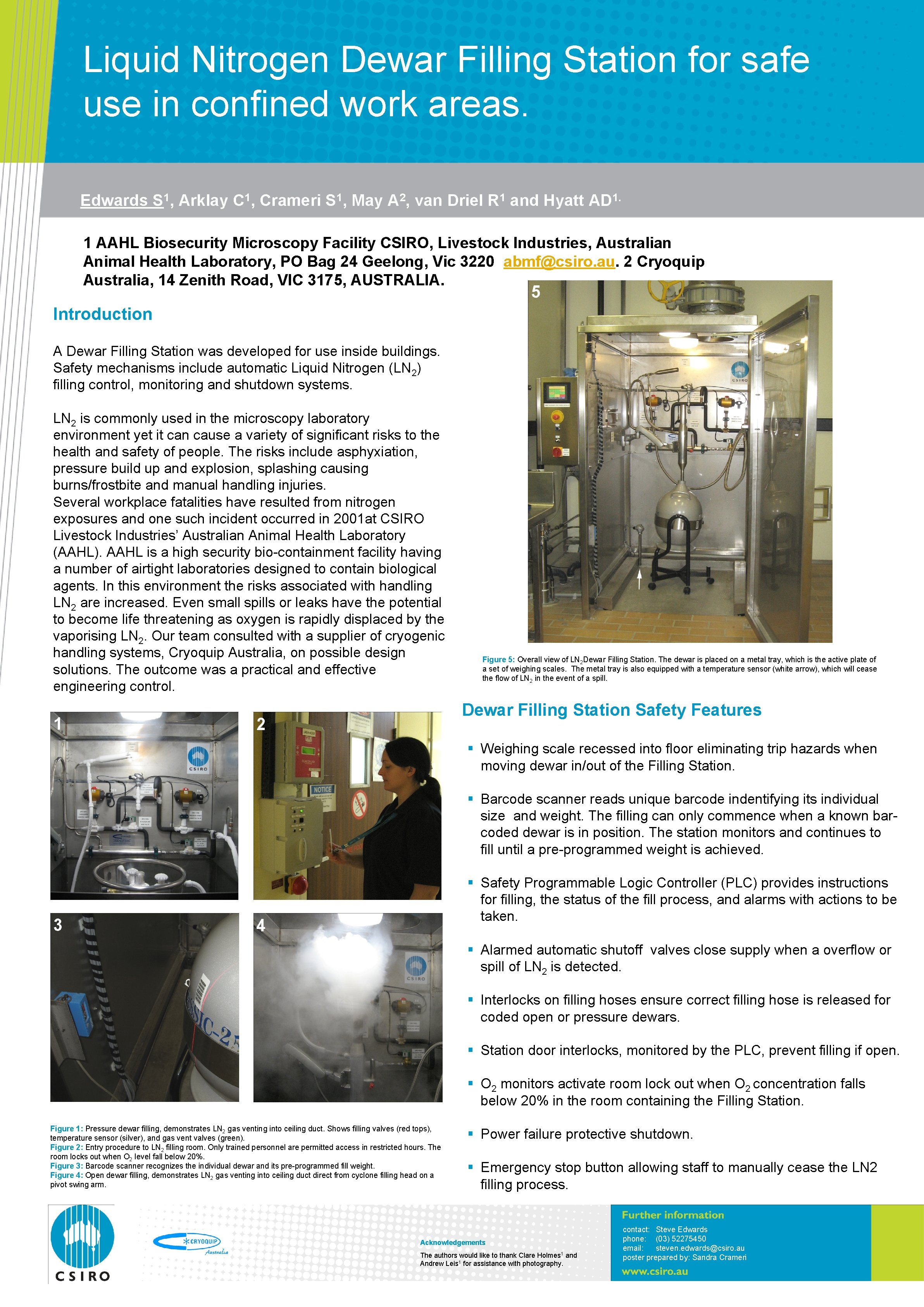
Liquid Nitrogen Dewar Filling Station for safe use in confined work areas. Edwards S 1, Arklay C 1, Crameri S 1, May A 2, van Driel R 1 and Hyatt AD 1. 1 AAHL Biosecurity Microscopy Facility CSIRO, Livestock Industries, Australian Animal Health Laboratory, PO Bag 24 Geelong, Vic 3220 abmf@csiro. au. 2 Cryoquip Australia, 14 Zenith Road, VIC 3175, AUSTRALIA. 5 Introduction A Dewar Filling Station was developed for use inside buildings. Safety mechanisms include automatic Liquid Nitrogen (LN 2) filling control, monitoring and shutdown systems. LN 2 is commonly used in the microscopy laboratory environment yet it can cause a variety of significant risks to the health and safety of people. The risks include asphyxiation, pressure build up and explosion, splashing causing burns/frostbite and manual handling injuries. Several workplace fatalities have resulted from nitrogen exposures and one such incident occurred in 2001 at CSIRO Livestock Industries’ Australian Animal Health Laboratory (AAHL). AAHL is a high security bio-containment facility having a number of airtight laboratories designed to contain biological agents. In this environment the risks associated with handling LN 2 are increased. Even small spills or leaks have the potential to become life threatening as oxygen is rapidly displaced by the vaporising LN 2. Our team consulted with a supplier of cryogenic handling systems, Cryoquip Australia, on possible design solutions. The outcome was a practical and effective engineering control. 1 Figure 5: Overall view of LN 2 Dewar Filling Station. The dewar is placed on a metal tray, which is the active plate of a set of weighing scales. The metal tray is also equipped with a temperature sensor (white arrow), which will cease the flow of LN 2 in the event of a spill. Dewar Filling Station Safety Features 2 § Weighing scale recessed into floor eliminating trip hazards when moving dewar in/out of the Filling Station. § Barcode scanner reads unique barcode indentifying its individual size and weight. The filling can only commence when a known barcoded dewar is in position. The station monitors and continues to fill until a pre-programmed weight is achieved. 3 § Safety Programmable Logic Controller (PLC) provides instructions for filling, the status of the fill process, and alarms with actions to be taken. 4 § Alarmed automatic shutoff valves close supply when a overflow or spill of LN 2 is detected. § Interlocks on filling hoses ensure correct filling hose is released for coded open or pressure dewars. § Station door interlocks, monitored by the PLC, prevent filling if open. § O 2 monitors activate room lock out when O 2 concentration falls below 20% in the room containing the Filling Station. Figure 1: Pressure dewar filling, demonstrates LN 2 gas venting into ceiling duct. Shows filling valves (red tops), temperature sensor (silver), and gas vent valves (green). Figure 2: Entry procedure to LN 2 filling room. Only trained personnel are permitted access in restricted hours. The room locks out when O 2 level fall below 20%. Figure 3: Barcode scanner recognizes the individual dewar and its pre-programmed fill weight. Figure 4: Open dewar filling, demonstrates LN 2 gas venting into ceiling duct direct from cyclone filling head on a pivot swing arm. § Power failure protective shutdown. § Emergency stop button allowing staff to manually cease the LN 2 filling process. Acknowledgements The authors would like to thank Clare Holmes 1 and Andrew Leis 1 for assistance with photography. contact: Steve Edwards phone: (03) 52275450 email: steven. edwards@csiro. au poster prepared by: Sandra Crameri