
Liquid Metal Fast Breeder Reactors Martin W Metzner
Liquid Metal Fast Breeder Reactors Martin W. Metzner November 19, 2007
Overview of Fast Breeder Reactors Produce more fissile material than is consumed Technology first developed in the 1950’s Utilize uranium 60 times as efficienctly as PWRs Cooled by liquid metal
Fast Breeder Reactors vs. Pressurized Water Reactors FBR n Fuel is enriched to 1520% n Moderator: none n Heat transfer by liquid metal or metal alloys Typically sodium n n Reactor under low pressure ~1. 2 fissile atoms produced per fission PWR n Fuel is enriched to 35% n Moderator: water n Heat transfer by water n Reactor under high pressure n Fissile material is only consumed
Breeding Fuel Theory n Each fission produces on average 2. 4 neutrons Fissile material: U-235, Pu-239 or Pu-241 n Critical reaction One neutron per fission causes another fission n 1. 4 neutrons are left over to enrich depleted fuel Practice n n Typical FBR produces about 1. 2 fissile atoms per consumed fissile atom Can produce enough fissile material in 10 years to replace spent fuel and enough to power another reactor for 10 years

FBR Design 1) Highly enriched uranium or plutonium 2) Control rods (same material as core) 3) Depleted uranium 4) Heat is transferred from primary to secondary sodium 5) Heat is transferred from secondary sodium to water Figure: Baksiden, modified by Martin Metzner
Nuclear Fuel Initially FBRs were designed to use pure uranium oxide fuel Eventually switched to MOX n Mixed oxide fuel (MOX): Mixture of UO 2 and Pu. O 2 Already an existing source of fissile plutonium n Nuclear warheads Highly enriched, former USSR and USA currently dismantling arsenals n Depleted PWR fuel Low enrichment caused by the fusion of U-238 and a neutron Must be processed before it can be used
Liquid Metal Coolant Typical metal used is sodium n Some reactors use lead, lead-bismuth alloy, or sodium fluoride salt Advantages of sodium n n Low melting temperature (98°C) High boiling temperature (892°C) High heat capacity System can run at low pressure Risks of sodium n n Burns when it comes in contact with air or water Poisonous fumes
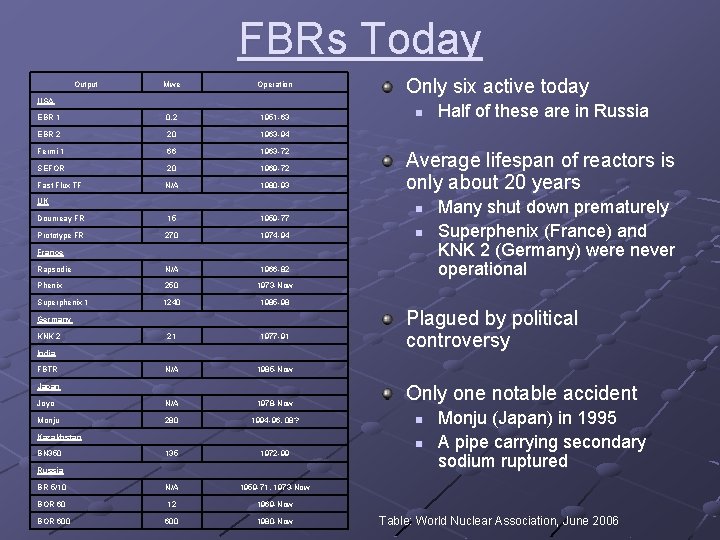
FBRs Today Output USA Mwe Operation EBR 1 0. 2 1951 -63 EBR 2 20 1963 -94 Fermi 1 66 1963 -72 SEFOR 20 1969 -72 Fast Flux TF N/A 1980 -93 Dounreay FR 15 1959 -77 Prototype FR 270 1974 -94 Rapsodie N/A 1966 -82 Phenix 250 1973 -Now Superphenix 1 1240 1985 -98 KNK 2 21 1977 -91 India FBTR N/A 1985 -Now Japan Joyo N/A 1978 -Now Monju 280 1994 -96, 08? BN 350 135 1972 -99 Russia BR 5/10 N/A 1959 -71, 1973 -Now BOR 60 12 1969 -Now BOR 600 1980 -Now UK France Germany Kazakhstan Only six active today n Half of these are in Russia Average lifespan of reactors is only about 20 years n n Many shut down prematurely Superphenix (France) and KNK 2 (Germany) were never operational Plagued by political controversy Only one notable accident n n Monju (Japan) in 1995 A pipe carrying secondary sodium ruptured Table: World Nuclear Association, June 2006
Future of Fast Breeders Next generation may use noble gases such as helium or argon instead of sodium Increase in the breeding ratio n Believed that a ratio of 1. 3 will be possible Smaller reactors n Lower maintenance and repair costs Higher reactor temperatures n Can be used for thermochemical hydrogen production
References Conflict. Baksiden. 16 Nov. 2007 <http: //www. baksiden. net/atomreaktorinnforing. htm>. For image on slide 4. Fast Breeder Reactors. Georgia State University. 16 Nov. 2007 <http: //hyperphysics. phyastr. gsu. edu/hbase/nucene/fasbre. html>. Fast Neutron Reactors. June 2006. World Nuclear Association. 16 Nov. 2007 <http: //www. world-nuclear. org/info/inf 98. html>. Guidez, J, et al. Phenix: The Irradiation Program for Transmutation Experiments. Nuclear Energy Agency. 31 Aug. 2004. 15 Nov. 2007 <http: //www. nea. fr/html/pt/docs/iem/lasvegas 04/ 10_Session_IV/S 4_01. pdf>. Mixed Oxide Fuel (MOX). Sept. 2007. Uranium Information Centre. 16 Nov. 2007 <http: //www. uic. com. au/nip 42. htm>.
- Slides: 10