
Liquid Crystal Displays By Farrell Rogers Materials Research
Liquid Crystal Displays By Farrell Rogers Materials Research Science and Engineering Center (MRSEC) Interdisciplinary Education Group (IEG) University of Wisconsin Madison, Wisconsin RET Program Summer 2006
Nano. Science Nanoscience involves the study and creation of materials, devices, and systems through the manipulation of individual atoms and molecules. o Describes research where the characteristic dimension of 1 or more plane is less than about 100 nanometers(. 1 micron). o Manufactured products are made from atoms. The properties of those products depend on how those atoms are arranged. o If we rearrange the atoms in…. o coal we get diamonds or graphite. o sand (adding a few other trace elements) we get computer chips. o dirt, water and air we can make potatoes. Unlike their larger or “macro” counterparts, nanoparticles often display unique properties that may be of use for various applications(Rattner & Rattner, 2003).
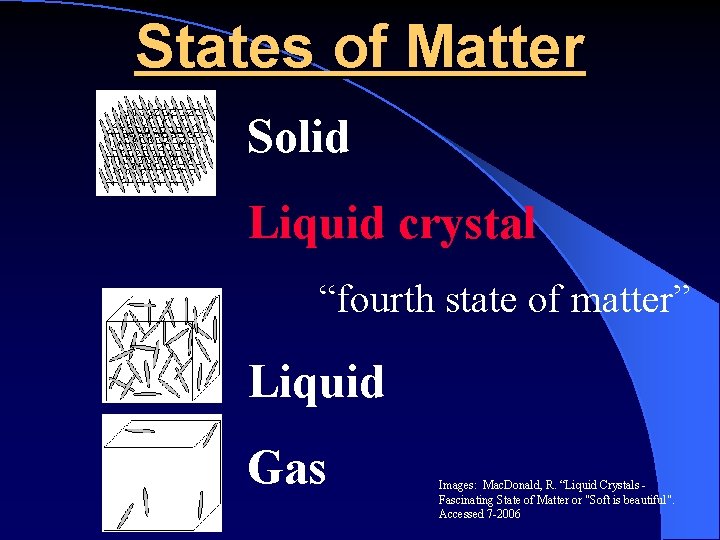
States of Matter Solid Liquid crystal “fourth state of matter” Liquid Gas Images: Mac. Donald, R. “Liquid Crystals Fascinating State of Matter or "Soft is beautiful". Accessed 7 -2006
What is a Liquid Crystal? Liquid Crystal – a stable phase of matter characterized by anisotropic properties without the existence of a 3 -dimensional crystal lattice – generally lying between the solid and isotropic (“liquid”) phase.
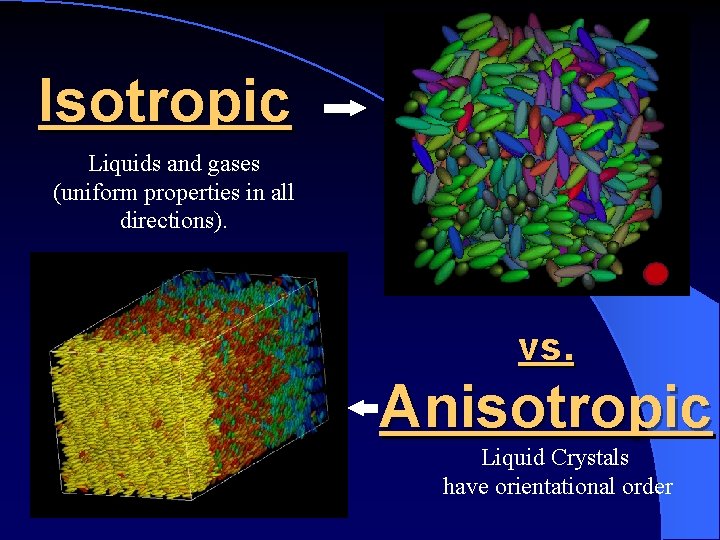
Isotropic Liquids and gases (uniform properties in all directions). vs. Anisotropic Liquid Crystals have orientational order
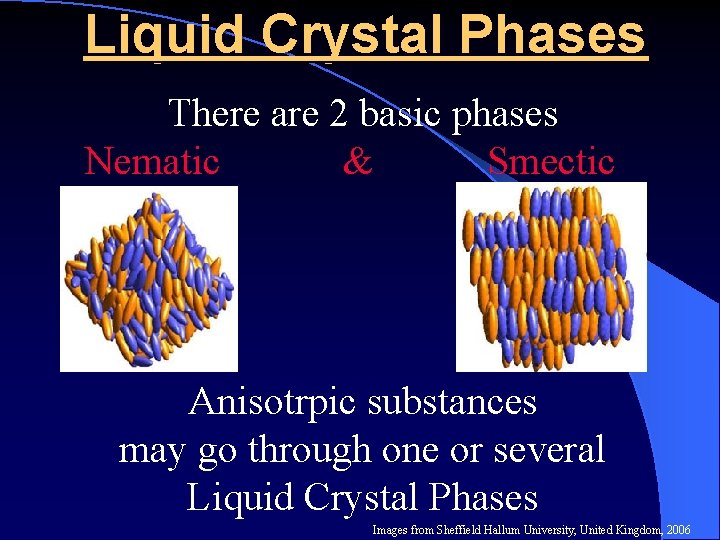
Liquid Crystal Phases There are 2 basic phases Nematic & Smectic Anisotrpic substances may go through one or several Liquid Crystal Phases Images from Sheffield Hallum University, United Kingdom, 2006
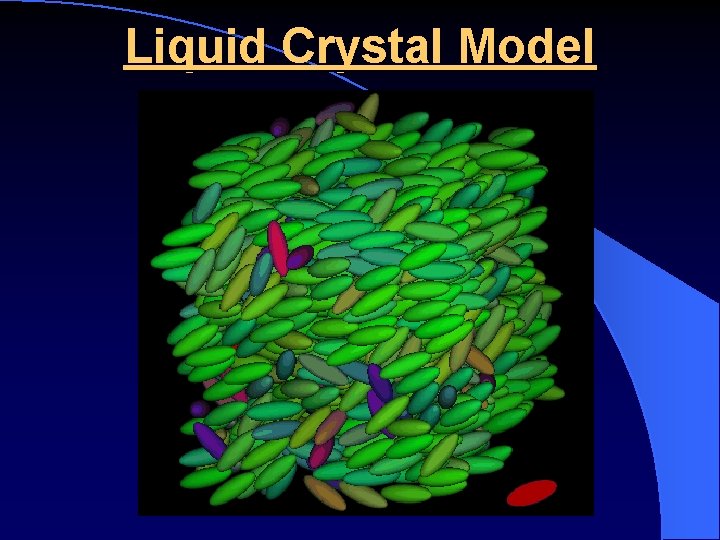
Liquid Crystal Model
Phase Transitions Molecular Expressions, NHMFL-FSU( accessed, 2006. ) http: //micro. magnet. fsu. edu
Project Goals My Curriculum Research Project focused on Liquid Crystal Explaining Liquid Crystals l Explaining Polarization l Adapting the LCD Watch Dissection for my students l l Designing a middle grade activity to create a simple LCD Panel
Activity #1 Introducing Liquid Crystals After reading a brief history and description of Liquid Crystals, students will answer some questions and use drawings to compare the 4 states of matter. I designed a questionaire for this activity.
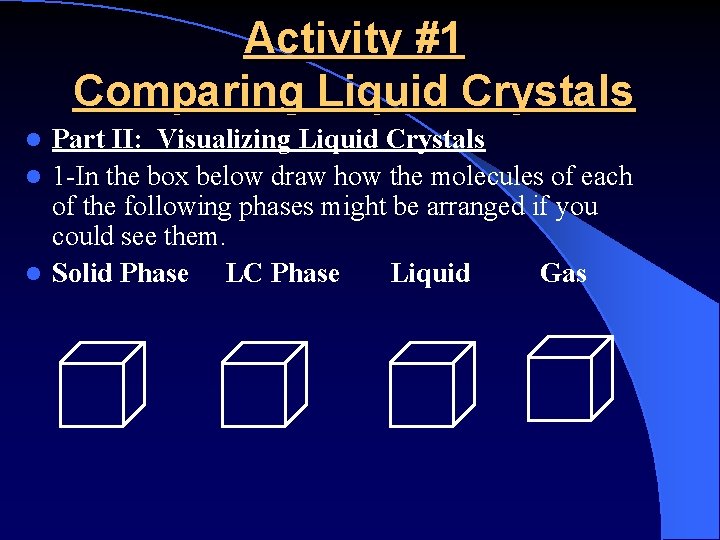
Activity #1 Comparing Liquid Crystals Part II: Visualizing Liquid Crystals l 1 -In the box below draw how the molecules of each of the following phases might be arranged if you could see them. l Solid Phase LC Phase Liquid Gas l
Activity #2 Part 1: Polarized Light This activity involved having kids explore the properties of light using 2 polarized lenses. They will compare light from an CRT TV, LCD Screen and from an incandescent bulb.
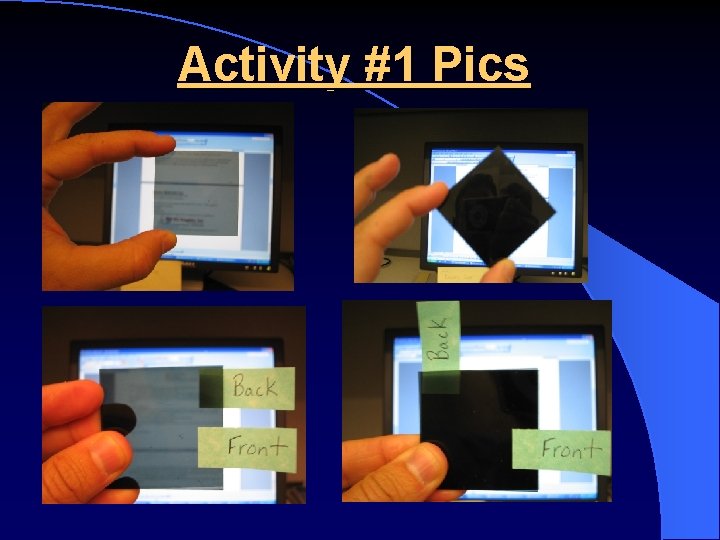
Activity #1 Pics
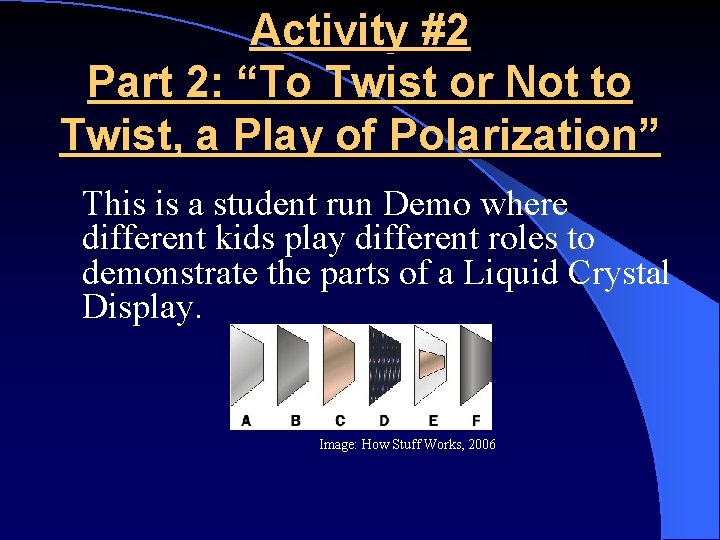
Activity #2 Part 2: “To Twist or Not to Twist, a Play of Polarization” This is a student run Demo where different kids play different roles to demonstrate the parts of a Liquid Crystal Display. Image: How Stuff Works, 2006
Activity #3 Adapting the LCD Watch Dissection MRSEC/IEG already has an excellent lab for this at http: //mrsec. wisc. edu/Edetc/nanolab/watch/ind ex. html The only thing I would add would be testing to see if Dry Ice was cold enough to solidify the LC and prevent the LCD Panel from Functioning. (Maybe Next Year? Please : o)
Activity #4 Making a Liquid Crystal Display Everything seems easier once you figure it out. I had a few obstacles such as… Which LC, How much LC, How thick the spacers should be, How much voltage, Do I need an orientational polymer, How do I apply the chemicals, etc.
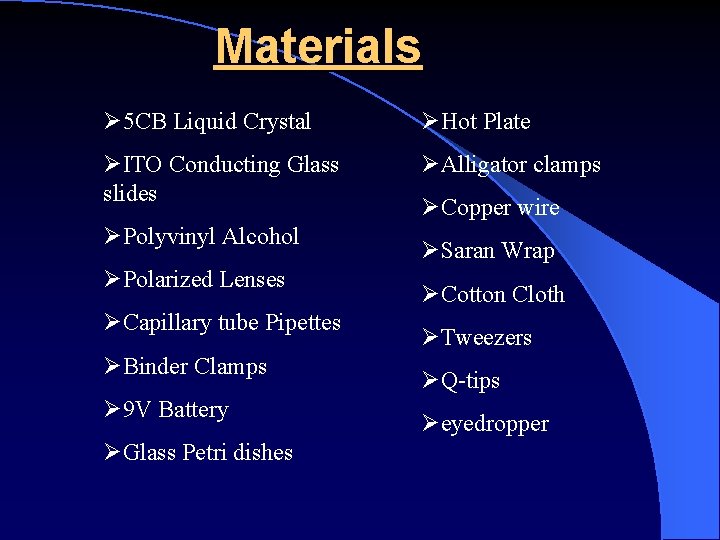
Materials Ø 5 CB Liquid Crystal ØHot Plate ØITO Conducting Glass slides ØAlligator clamps ØPolyvinyl Alcohol ØPolarized Lenses ØCapillary tube Pipettes ØBinder Clamps Ø 9 V Battery ØGlass Petri dishes ØCopper wire ØSaran Wrap ØCotton Cloth ØTweezers ØQ-tips Øeyedropper
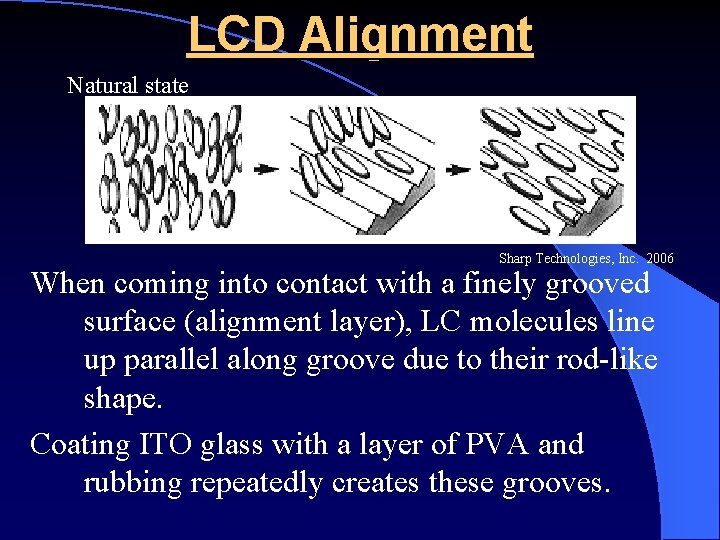
LCD Alignment Natural state Sharp Technologies, Inc. 2006 When coming into contact with a finely grooved surface (alignment layer), LC molecules line up parallel along groove due to their rod-like shape. Coating ITO glass with a layer of PVA and rubbing repeatedly creates these grooves.
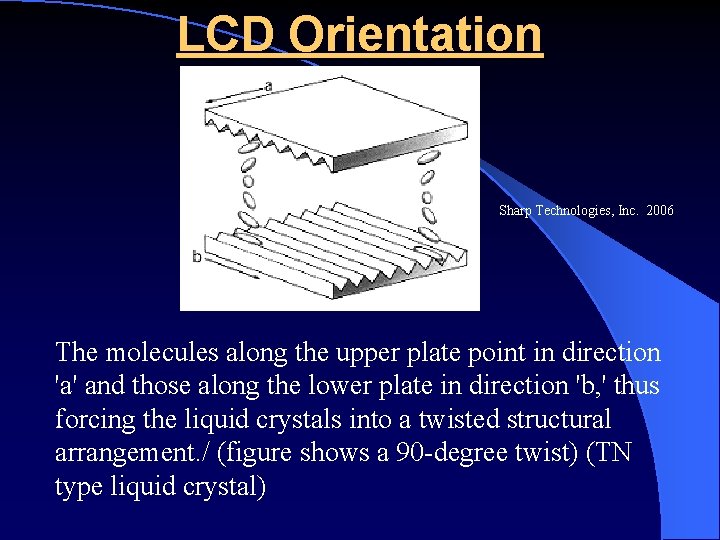
LCD Orientation Sharp Technologies, Inc. 2006 The molecules along the upper plate point in direction 'a' and those along the lower plate in direction 'b, ' thus forcing the liquid crystals into a twisted structural arrangement. / (figure shows a 90 -degree twist) (TN type liquid crystal)
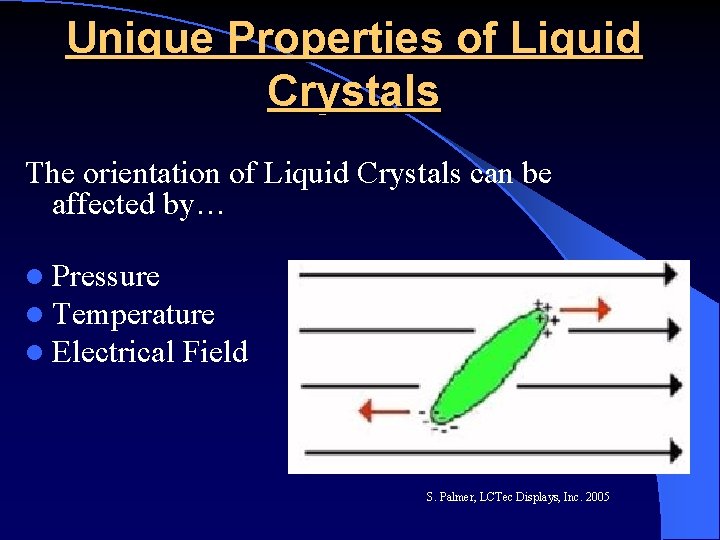
Unique Properties of Liquid Crystals The orientation of Liquid Crystals can be affected by… l Pressure l Temperature l Electrical Field S. Palmer, LCTec Displays, Inc. 2005
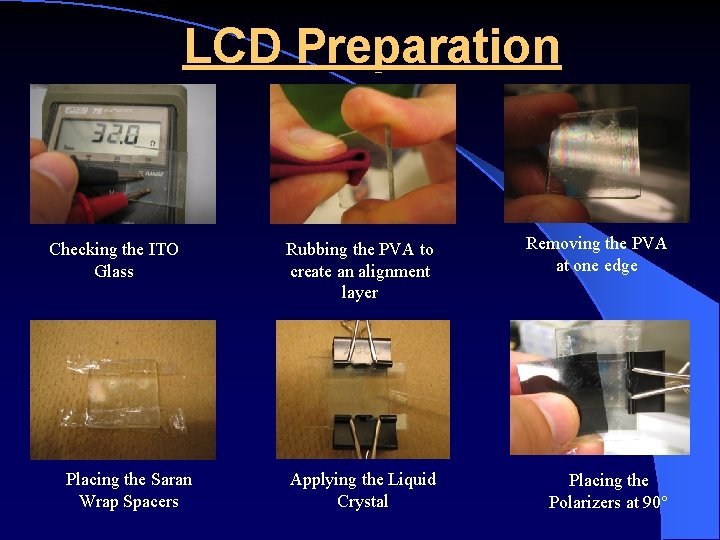
LCD Preparation Checking the ITO Glass Placing the Saran Wrap Spacers Rubbing the PVA to create an alignment layer Removing the PVA at one edge Applying the Liquid Crystal Placing the Polarizers at 90°
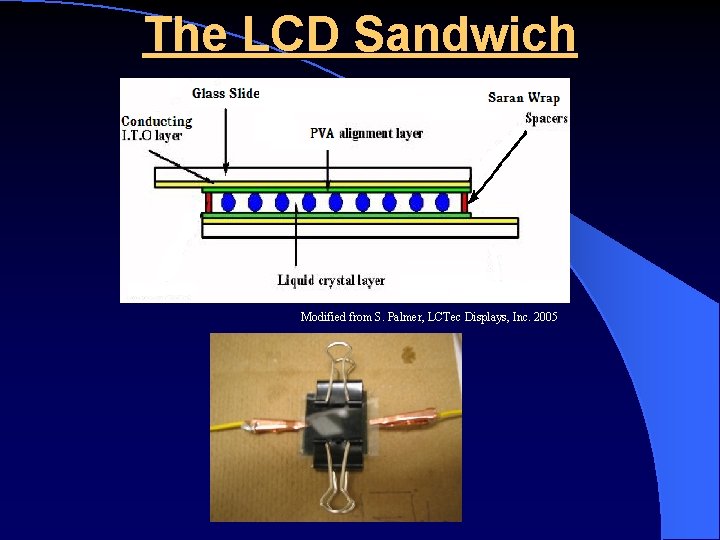
The LCD Sandwich Modified from S. Palmer, LCTec Displays, Inc. 2005
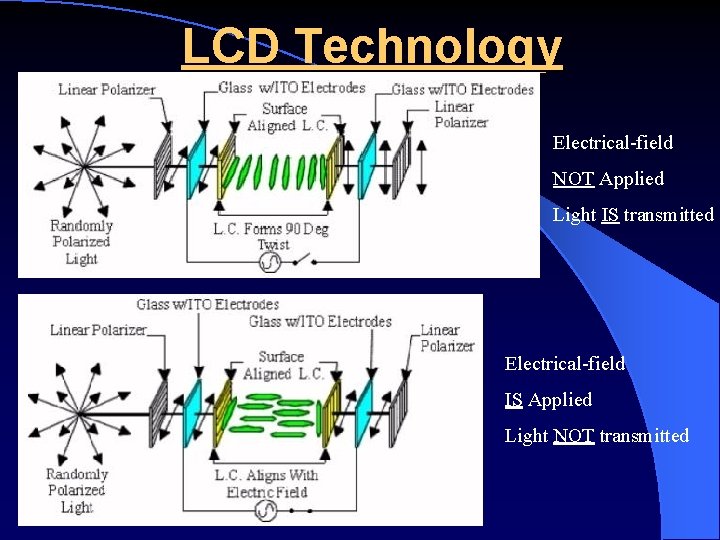
LCD Technology Electrical-field NOT Applied Light IS transmitted Electrical-field IS Applied Light NOT transmitted
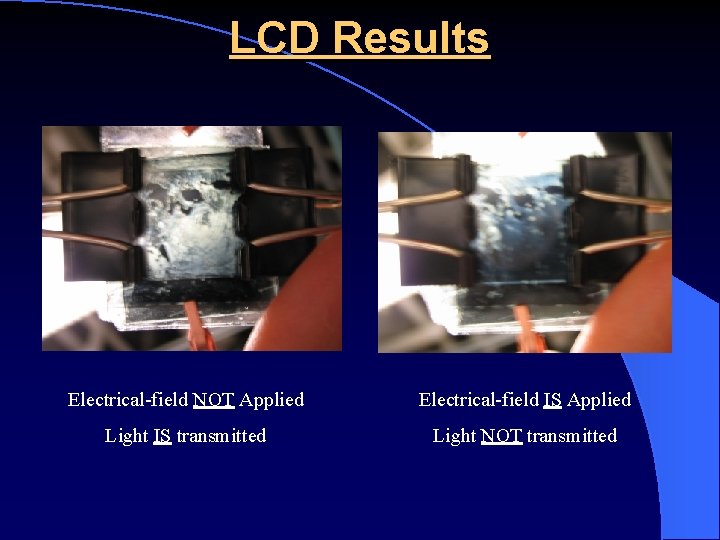
LCD Results Electrical-field NOT Applied Electrical-field IS Applied Light IS transmitted Light NOT transmitted
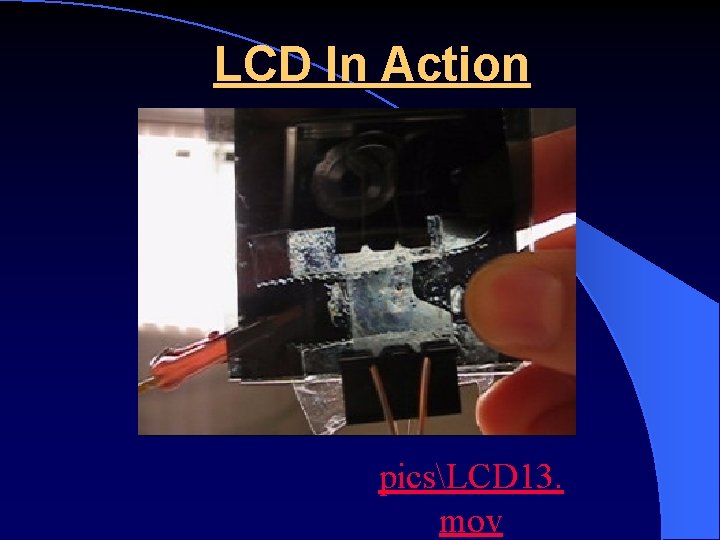
LCD In Action picsLCD 13. mov
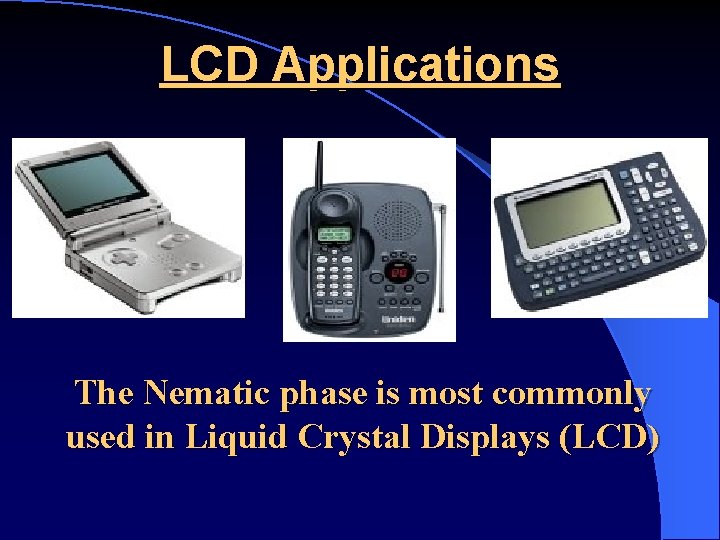
LCD Applications The Nematic phase is most commonly used in Liquid Crystal Displays (LCD)
Prior Knowledge and Timing LC’s can be discussed during any of the following units: – States of Matter/Phase Changes – Properties of Light – Electricity Possibly make it a long term activity discussing what an LC is during Matter, then doing the Watch Dissection & LCD Fabrication during the other Units?
Standards Addressed Science Ø Nature of Science Ø History of Science Ø Variables and Experimentation Ø Language Arts Main Idea Ø Using Context Clues Ø Chemistry Ø Matter Ø Physical Science Ø Waves Ø Energy Ø Electricity Ø Technology & Society These activities would be appropriate for Science students in grades 8 -12.
References: 1 -Rudy, Lisa Jo. “Between the Boundaries of the Known The Molecular World between Solid and Liquid”. Copyright © 2004 University of Pennsylvania. School of Arts and Sciences Updated September 1, 2004. http: //www. sas. upenn. edu/sasalum/newsltr/spring 04/between_boundries. html Accesses 6 -25 -2006 2 -How Stuff Works. Building Your Own LCD. July 2006. http: //electronics. howstuffworks. com/lcd 4. htm Accesses 6 -25 -2006 3 - The University of Wisconsin. Materials Research Science and Engineering Center (MRSEC)Interdisciplinary Education Group (IEG) Engineering Centers Building http: //mrsec. wisc. edu/Edetc/nanolab/index. html Accesses 6 -25 -2006 4 -Ratner, M. & Ratner, D. Nanotechnology, A Gentle Introduction to the Next Big Idea, 2003. Pearson Education, Inc. 5 - Kent State University. Liquid Crystal Institute, http: //www. lci. kent. edu/ Accessed 7 -6 -2006 6 - Macdonald, R. , “Liquid Crystals - Fascinating State of Matter or "Soft is beautiful". Optical Institute of the Technical University of Berlin Straße des 17. Juni 135, 10623 Berlin, Germany Accessed 7 -6 -2006 7 -Touch Screen info http: //www. reedlink. com/Product. Info~Productid~142231~Product. Name~Touch-Screen-Displays. html Accesses 7 -6 -2006 8 -Universität Hamburg Liquid Crystal Database http: //liqcryst. chemie. uni-hamburg. de/lcionline/liqcryst/lchistory/topics/c 13 b 5. html Accesses 7 -6 -2006 9 -Waclawik, Eric R. “Liquid-Crystal Displays: Fabrication and Measurement of a Twisted Nemetic Liquid Crystal Cell”. Journal of Chem. Engineering 81, no. 6, (2004) 854 -858. 10 -Ondris-Crawford, R. , Crawford, G. P. , and Doane, J. W. “Liquid-Crystals, Phases of the Future”. The Physics Teacher 30, Sept. (2004) 332 -339. 11 -Sadlej-Sosnowska, Nina. “Imposed Orientation of Dye Molecules by Liquid Crystals and an Electric Field”. Journal of Chem. Ed. 57, no. 3 (1980) 223 -224. 12 -Daigle, Stephen M. . “Investigating the Bistibility of 4’-octyl-4 -Biphenylcarbonitrile”. Liquid Crystal Institute, Kent State University (July 2004). http: //clcse. lci. kent. edu/students. htm Accesses 7 -12 -2006 13 - Sharp Technologies, Inc 1. The Principles of LCD Technology http: //sharp-world. com/sc/library/lcd_e/s 2_1_1 e. htm Accesses 7 -12 -2006
Thank you l l l l Wendy Crone, Ph. D. : MRSEC Director of Education, University of Wisconsin Greta Zenner, Ph. D. : MRSEC Assistant Director of Education, University of Wisconsin MRSEC-RET program Dana Horoszewski , Ph. D. : IEG Mentor Ken Gentry, Ph. D. : IEG Mentor Dr. George Lisensky, Ph. D. : IEG Mentor, Professor of Chemistry, Beloit College University of Wisconsin NSF, Research Experiences for Teachers(RET Programs) "We are grateful to the National Science Foundation through the Materials Research Science and Engineering Center (MRSEC) on Nanostructured Interfaces (DMR-0079983 and DMR-0520527) at the University of Wisconsin-Madison”
- Slides: 30