
Lipids are a diverse group of hydrophobic molecules
Lipids are a diverse group of hydrophobic molecules • Lipids are the one class of large biological molecules that do not form polymers • Lipids are hydrophobic (water fearing) because they consist mostly of hydrocarbons, which form nonpolar covalent bonds • The most biologically important lipids are fats, phospholipids, and steroids © 2011 Pearson Education, Inc.
Fats-store energy • Fats are constructed from two types of smaller molecules: glycerol and fatty acids • Glycerol is a three-carbon alcohol with a hydroxyl group attached to each carbon • A fatty acid consists of a carboxyl group attached to a long carbon skeleton • Triglyceride- glycerol + 3 fatty acids • Saturated fatty acids have the maximum number of hydrogen atoms possible and no double bonds • Unsaturated fatty acids have one or more double bonds © 2011 Pearson Education, Inc.

Figure 5. 10 Fatty acid (in this case, palmitic acid) Glycerol (a) One of three dehydration reactions in the synthesis of a fat Ester linkage (b) Fat molecule (triacylglycerol)

Figure 5. 11 (a) Saturated fat Structural formula of a saturated fat molecule Space-filling model of stearic acid, a saturated fatty acid (b) Unsaturated fat Structural formula of an unsaturated fat molecule Space-filling model of oleic acid, an unsaturated fatty acid Cis double bond causes bending.
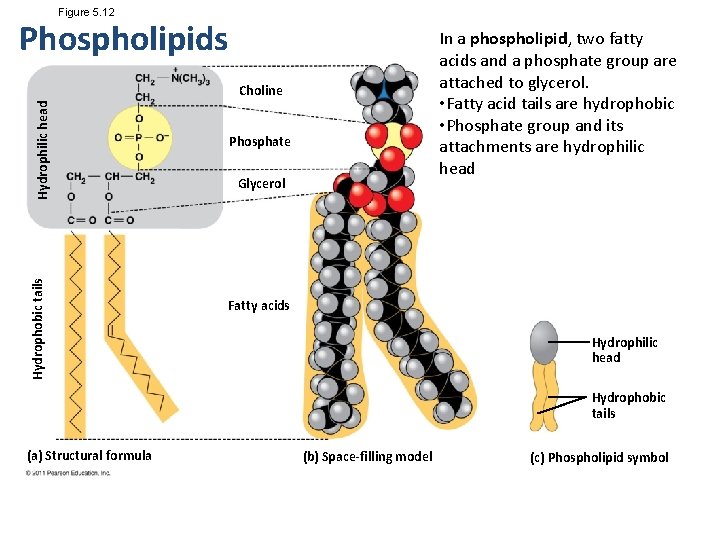
Figure 5. 12 Phospholipids In a phospholipid, two fatty acids and a phosphate group are attached to glycerol. • Fatty acid tails are hydrophobic • Phosphate group and its attachments are hydrophilic head Hydrophobic tails Hydrophilic head Choline Phosphate Glycerol Fatty acids Hydrophilic head Hydrophobic tails (a) Structural formula (b) Space-filling model (c) Phospholipid symbol

• When phospholipids are added to water, they selfassemble into a bilayer, with the hydrophobic tails pointing toward the interior • The structure of phospholipids results in a bilayer arrangement found in cell membranes • Phospholipids are the major component of all cell membranes © 2011 Pearson Education, Inc.

Figure 5. 13 Hydrophilic head Hydrophobic tail WATER

Steroids • Steroids are lipids characterized by a carbon skeleton consisting of four fused rings • Cholesterol, an important steroid, is a component in animal cell membranes • Although cholesterol is essential in animals, high levels in the blood may contribute to cardiovascular disease © 2011 Pearson Education, Inc.

Figure 5. 14

Nucleic acids store, transmit, and help express hereditary information • The amino acid sequence of a polypeptide is programmed by a unit of inheritance called a gene • Genes are made of DNA, a nucleic acid made of monomers called nucleotides © 2011 Pearson Education, Inc.

The Roles of Nucleic Acids • There are two types of nucleic acids – Deoxyribonucleic acid (DNA) – Ribonucleic acid (RNA) • DNA provides directions for its own replication • DNA directs synthesis of messenger RNA (m. RNA) and, through m. RNA, controls protein synthesis • Protein synthesis occurs on ribosomes © 2011 Pearson Education, Inc.

Figure 5. 25 -3 DNA 1 Synthesis of m. RNA NUCLEUS CYTOPLASM m. RNA 2 Movement of m. RNA into cytoplasm Ribosome 3 Synthesis of protein Polypeptide Amino acids

The Components of Nucleic Acids • Nucleic acids are polymers called polynucleotides • Each polynucleotide is made of monomers called nucleotides • Each nucleotide consists of a nitrogenous base, a pentose sugar, and one or more phosphate groups • The portion of a nucleotide without the phosphate group is called a nucleoside © 2011 Pearson Education, Inc.

Figure 5. 26 5 end Sugar-phosphate backbone Nitrogenous bases Pyrimidines 5 C 3 C Nucleoside Nitrogenous base Cytosine (C) Thymine (T, in DNA) Uracil (U, in RNA) Purines 5 C 1 C 5 C 3 C Phosphate group 3 C Sugar (pentose) Guanine (G) Adenine (A) (b) Nucleotide Sugars 3 end (a) Polynucleotide, or nucleic acid Deoxyribose (in DNA) (c) Nucleoside components Ribose (in RNA)

Components of Nucleic Acids

Double Helix and Bonding

• Nucleoside = nitrogenous base + sugar • There are two families of nitrogenous bases – Pyrimidines (cytosine, thymine, and uracil) have a single six-membered ring – Purines (adenine and guanine) have a sixmembered ring fused to a five-membered ring • In DNA, the sugar is deoxyribose; in RNA, the sugar is ribose • Nucleotide = nucleoside + phosphate group © 2011 Pearson Education, Inc.

Nucleotide Polymers • Nucleotide polymers are linked together to build a polynucleotide • Adjacent nucleotides are joined by covalent bonds that form between the —OH group on the 3 carbon of one nucleotide and the phosphate on the 5 carbon on the next • These links create a backbone of sugar-phosphate units with nitrogenous bases as appendages • The sequence of bases along a DNA or m. RNA polymer is unique for each gene © 2011 Pearson Education, Inc.

The Structures of DNA and RNA Molecules • RNA molecules usually exist as single polypeptide chains • DNA molecules have two polynucleotides spiraling around an imaginary axis, forming a double helix • In the DNA double helix, the two backbones run in opposite 5 → 3 directions from each other, an arrangement referred to as antiparallel • One DNA molecule includes many genes © 2011 Pearson Education, Inc.

• The nitrogenous bases in DNA pair up and form hydrogen bonds: adenine (A) always with thymine (T), and guanine (G) always with cytosine (C) • Called complementary base pairing • Complementary pairing can also occur between two RNA molecules or between parts of the same molecule • In RNA, thymine is replaced by uracil (U) so A and U pair © 2011 Pearson Education, Inc.
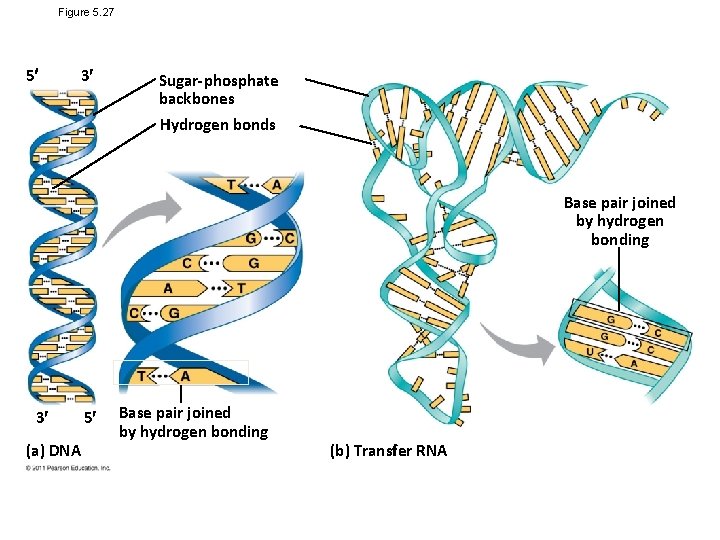
Figure 5. 27 5 3 Sugar-phosphate backbones Hydrogen bonds Base pair joined by hydrogen bonding 3 (a) DNA 5 Base pair joined by hydrogen bonding (b) Transfer RNA

DNA and Proteins as Tape Measures of Evolution • The linear sequences of nucleotides in DNA molecules are passed from parents to offspring • Two closely related species are more similar in DNA than are more distantly related species • Molecular biology can be used to assess evolutionary kinship © 2011 Pearson Education, Inc.

The Theme of Emergent Properties in the Chemistry of Life: A Review • Higher levels of organization result in the emergence of new properties • Organization is the key to the chemistry of life © 2011 Pearson Education, Inc.
- Slides: 23