
Lipid Transport Lipoprotein Structure Function and Metabolism Objectives
Lipid Transport Lipoprotein Structure, Function, and Metabolism
Objectives n n n Function of lipids. Lipoprotein structures. Types of Lipoproteins: Function & structure.
Introduction • Fats are triacylglycerol containing saturated fatty acids - solid at room temp - usually from animal source (however, coconut & palm oil are saturated). • Oils are triacylglycerol containing mono- or polyunsaturated fatty acids - liquid at room temp - usually from plant sources (however, fish oils are polyunsaturated). • Phospholipids are triacylglycerol that have had a FA containing phosphate group. • The major dietary sterol is cholesterol.
Health issues • Excessive dietary fat intake is associated with obesity, diabetes, cancer, hypertension and atherosclerosis. • Not more than 35% of energy intake should come from fat. Saturated fat should not make up more than 15% of the total fat intake. • Omega-3 fatty acids (20 carbons) from fish may protect against atherosclerosis. American Heart association recommends 2 -3 fish meals per week. Fish oil supplements should be avoided because they may be contain concentrated toxins accumulated by the fish.
FUNCTIONS OF LIPIDS: • Major components of cell membranes. • Biosynthesis of fat soluble vitamins (A, E, D, K). • Biosynthetic precursors (e. g. steroid hormones from cholesterol) • Protection (e. g. kidneys are shielded with fat in fed state) • Insulation
LIPID DIGESTION • Lingual lipase and gastric lipase attack triacylglycerol and hydrolyse a limited number of FA. • Small Intestine - acid chyme (stomach contents) stimulates mucosa cells to release hormone (choleocystokinin) which stimulates gall bladder and pancreas to release bile and digestive enzymes respectively (bile acids help emulsify fat droplets thus increasing surface area of absorption). • Other mucosa cells release secretin which causes pancreas to release bicarbonate rich fluid to neutralize chyme.
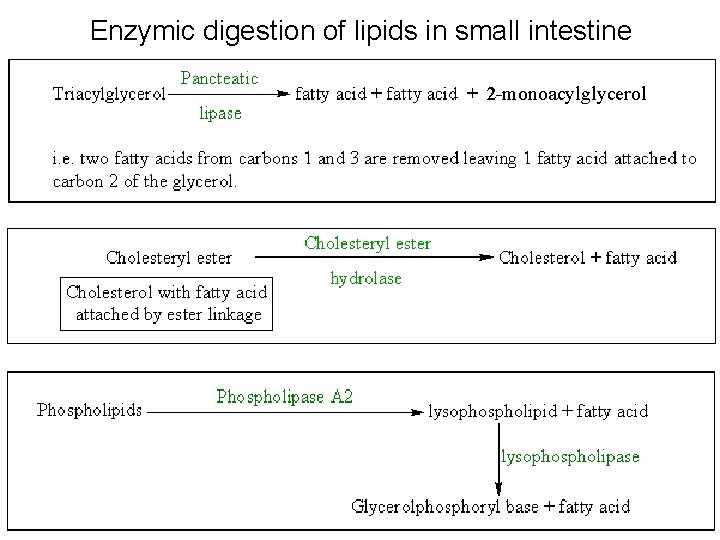
Enzymic digestion of lipids in small intestine 2 -monoacylglycerol
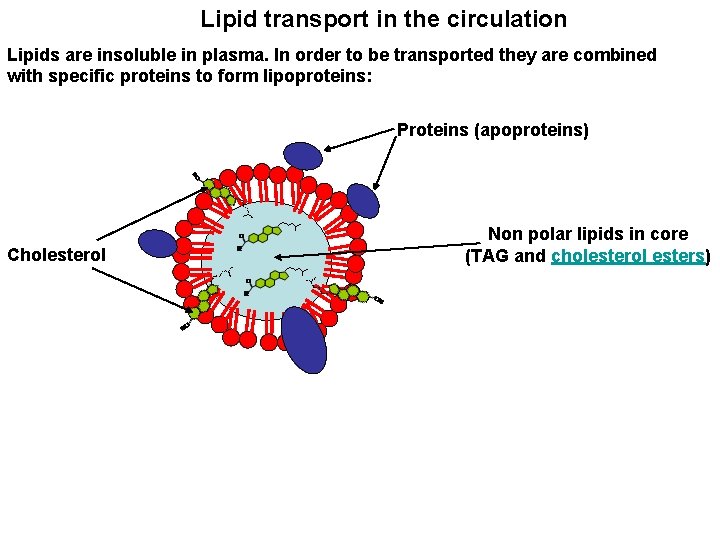
Lipid transport in the circulation Lipids are insoluble in plasma. In order to be transported they are combined with specific proteins to form lipoproteins: Proteins (apoproteins) Cholesterol Non polar lipids in core (TAG and cholesterol esters)

The four classes of lipoprotein Increasing density (all contain characteristic amounts TAG, cholesterol esters, phospholipids and apoproteins) Class Diameter (nm) Source and function Major apoliproteins Chylomicrons (CM) 500 Intestine. Transport of dietary TAG A, B 48, C(I, III) E Very low density lipoproteins (VLDL) 43 Liver. Transport of endogenously synthesised TAG B 100, C(I, III) , E Low density lipoproteins (LDL) 22 Delivers cholesterol to peripheral tissues B 100 High density lipoproteins (HDL) 8 Liver. Removes “used” cholesterol from tissues and takes it to liver. A, C(I, III), D, E
Apolipoproteins n n n Provide structural stability to LP Serve as ligands for interaction with LP receptors that help determine disposition of individual particles Act as cofactors for enzymes involved in plasma lipid and LP metabolism
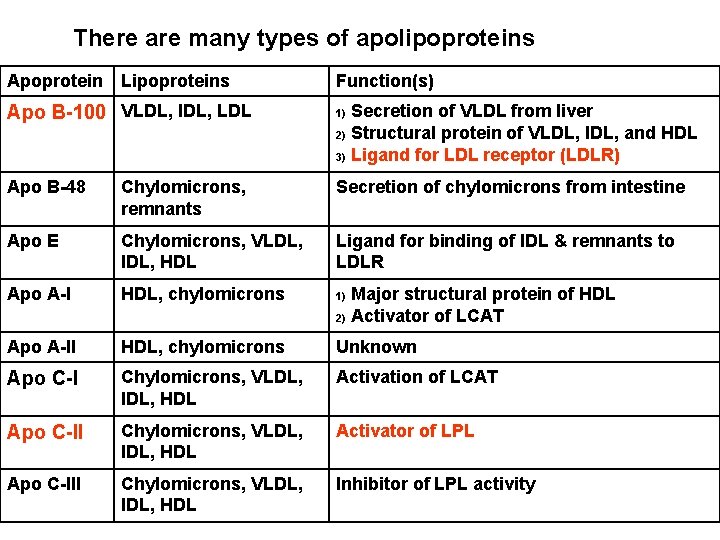
There are many types of apolipoproteins Apoprotein Lipoproteins Function(s) Apo B-100 VLDL, IDL, LDL 1) Apo B-48 Chylomicrons, remnants Secretion of chylomicrons from intestine Apo E Chylomicrons, VLDL, IDL, HDL Ligand for binding of IDL & remnants to LDLR Apo A-I HDL, chylomicrons 1) Apo A-II HDL, chylomicrons Unknown Apo C-I Chylomicrons, VLDL, IDL, HDL Activation of LCAT Apo C-II Chylomicrons, VLDL, IDL, HDL Activator of LPL Apo C-III Chylomicrons, VLDL, IDL, HDL Inhibitor of LPL activity Secretion of VLDL from liver 2) Structural protein of VLDL, IDL, and HDL 3) Ligand for LDL receptor (LDLR) Major structural protein of HDL 2) Activator of LCAT
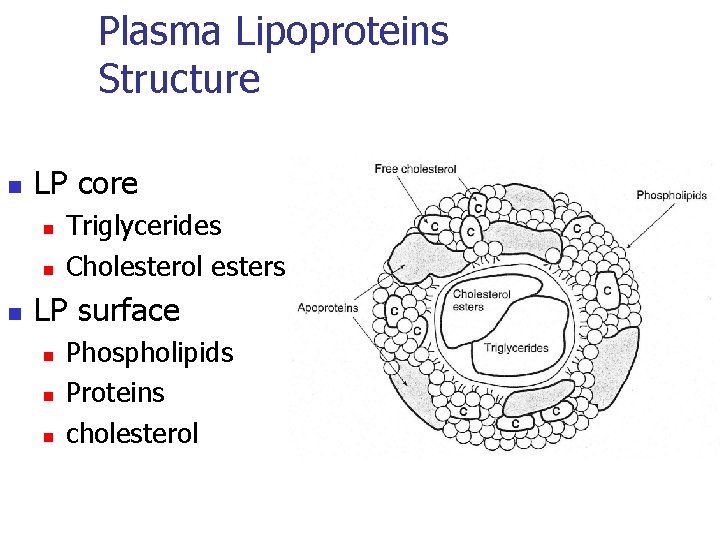
Plasma Lipoproteins Structure n LP core n n n Triglycerides Cholesterol esters LP surface n n n Phospholipids Proteins cholesterol
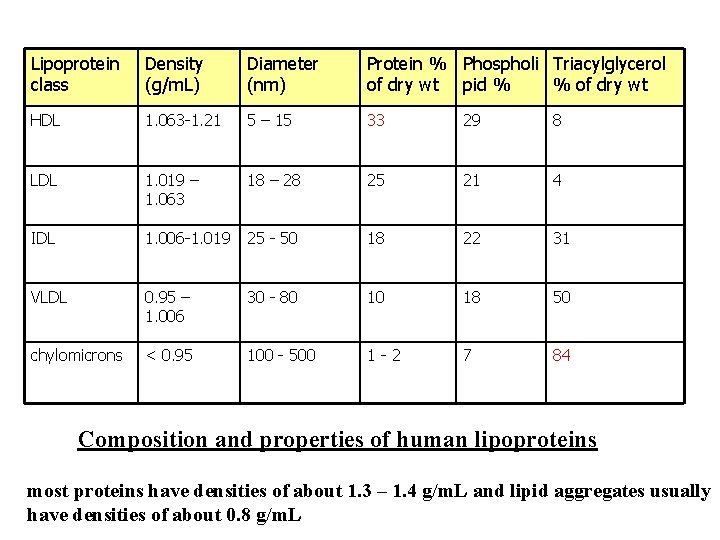
Lipoprotein class Density (g/m. L) Diameter (nm) Protein % Phospholi Triacylglycerol of dry wt pid % % of dry wt HDL 1. 063 -1. 21 5 – 15 33 29 8 LDL 1. 019 – 1. 063 18 – 28 25 21 4 IDL 1. 006 -1. 019 25 - 50 18 22 31 VLDL 0. 95 – 1. 006 30 - 80 10 18 50 chylomicrons < 0. 95 100 - 500 1 -2 7 84 Composition and properties of human lipoproteins most proteins have densities of about 1. 3 – 1. 4 g/m. L and lipid aggregates usually have densities of about 0. 8 g/m. L
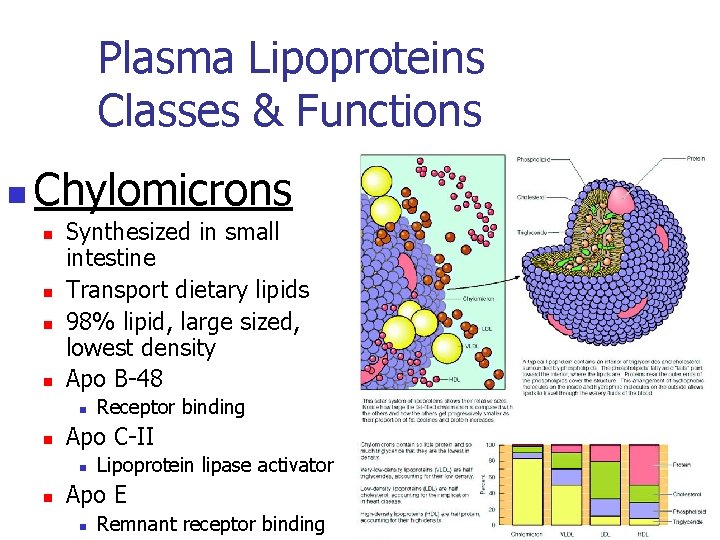
Plasma Lipoproteins Classes & Functions n Chylomicrons n n Synthesized in small intestine Transport dietary lipids 98% lipid, large sized, lowest density Apo B-48 n n Apo C-II n n Receptor binding Lipoprotein lipase activator Apo E n Remnant receptor binding
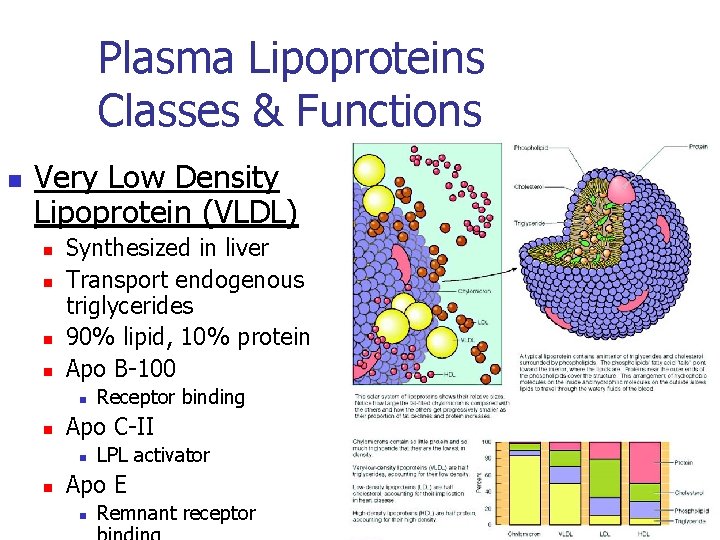
Plasma Lipoproteins Classes & Functions n Very Low Density Lipoprotein (VLDL) n n Synthesized in liver Transport endogenous triglycerides 90% lipid, 10% protein Apo B-100 n n Apo C-II n n Receptor binding LPL activator Apo E n Remnant receptor
Plasma Lipoproteins Classes & Functions n Intermediate Density Lipoprotein (IDL) n n n Synthesized from VLDL during VLDL degradation Triglyceride transport and precurser to LDL Apo B-100 n n Apo C-II n n Receptor binding LPL activator Apo E n Receptor binding
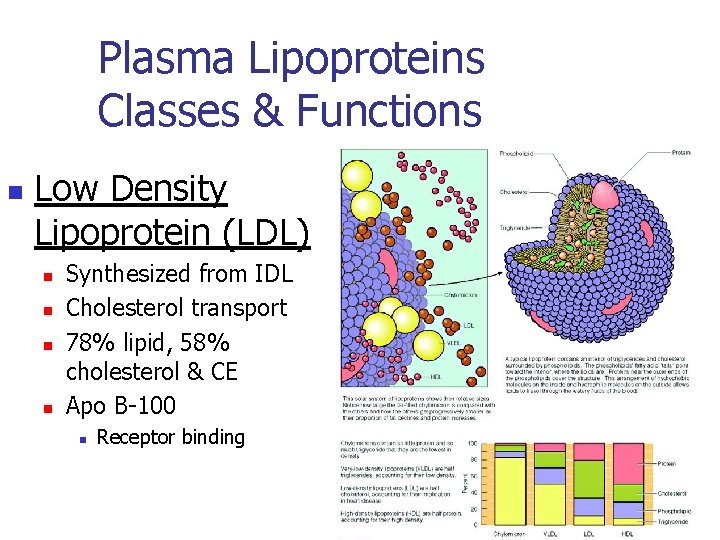
Plasma Lipoproteins Classes & Functions n Low Density Lipoprotein (LDL) n n Synthesized from IDL Cholesterol transport 78% lipid, 58% cholesterol & CE Apo B-100 n Receptor binding
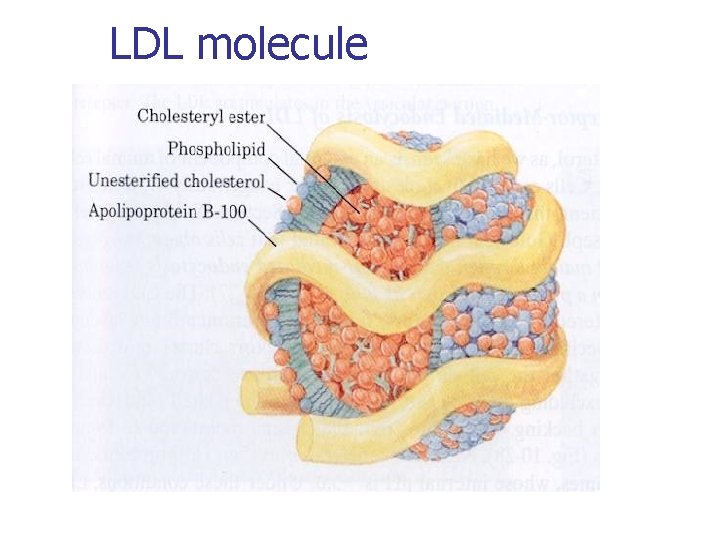
LDL molecule
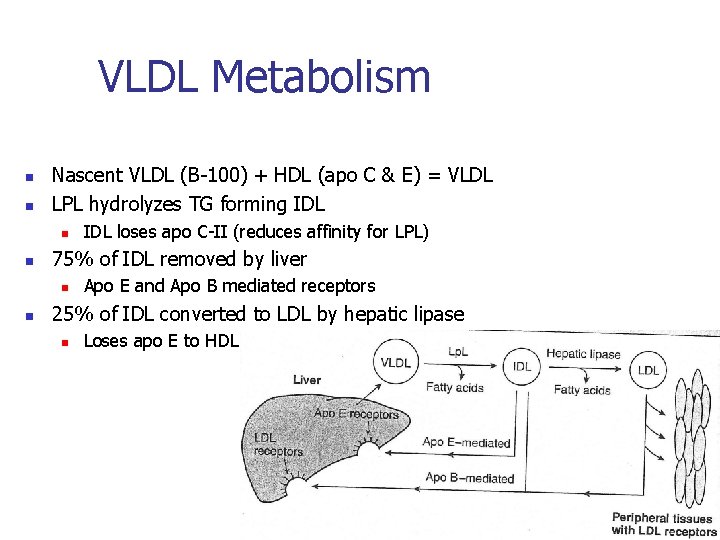
VLDL Metabolism n n Nascent VLDL (B-100) + HDL (apo C & E) = VLDL LPL hydrolyzes TG forming IDL n n 75% of IDL removed by liver n n IDL loses apo C-II (reduces affinity for LPL) Apo E and Apo B mediated receptors 25% of IDL converted to LDL by hepatic lipase n Loses apo E to HDL
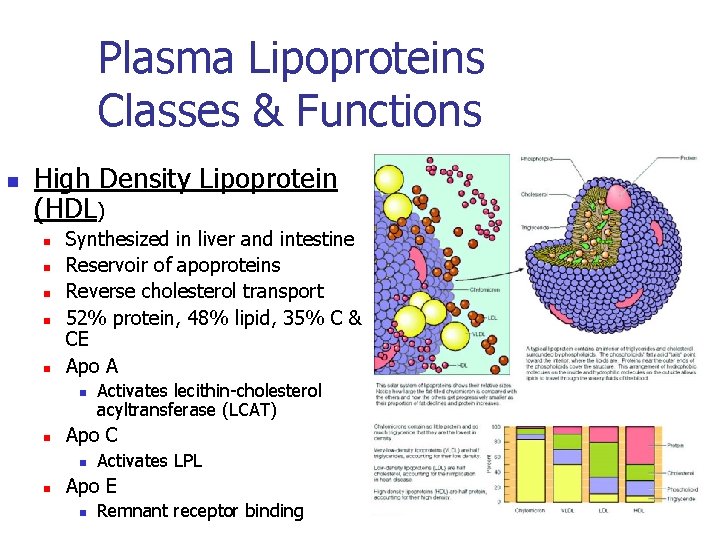
Plasma Lipoproteins Classes & Functions n High Density Lipoprotein (HDL) n n n Synthesized in liver and intestine Reservoir of apoproteins Reverse cholesterol transport 52% protein, 48% lipid, 35% C & CE Apo A n n Apo C n n Activates lecithin-cholesterol acyltransferase (LCAT) Activates LPL Apo E n Remnant receptor binding
Functions of HDL n n converts cholesterol to cholesterol esters via the LCAT reaction transfers cholesterol esters to other lipoproteins, which transport them to the liver (referred to as “reverse cholesterol transport)
- Slides: 21