
Lipid localization in bacterial membranes Ned Wingreen Boulder
Lipid localization in bacterial membranes Ned Wingreen Boulder Summer School 2007 Thanks to: Kerwyn Casey Huang and Ranjan Mukhopadhyay Support: NIH, HHWF(KCH)
Outline • Introduction -Protein localization at bacterial poles -Cardiolipin localization • Biophysics of lipid-cluster formation • Curvature-induced polar localization of lipid clusters • Future directions

Protein localization at bacterial poles • Protein-protein interactions • Curvature (? ) • Turing oscillations Harry & Lewis (2003) • Protein-lipid interactions (? ) Weis et al. (2004) Tsr micellar assemblies Div. IVA-GFP in B. subtilis outgrown from spores
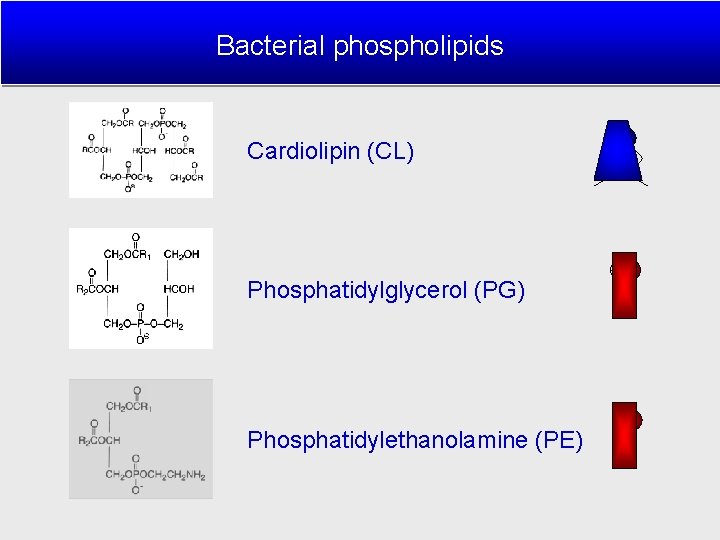
Bacterial phospholipids Cardiolipin (CL) Phosphatidylglycerol (PG) Phosphatidylethanolamine (PE) CL PG PE
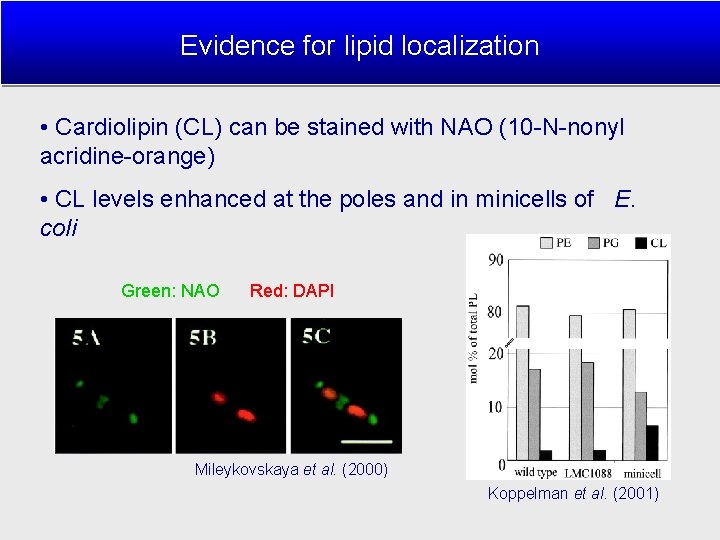
Evidence for lipid localization • Cardiolipin (CL) can be stained with NAO (10 -N-nonyl acridine-orange) • CL levels enhanced at the poles and in minicells of E. coli Green: NAO Red: DAPI Mileykovskaya et al. (2000) Koppelman et al. (2001)
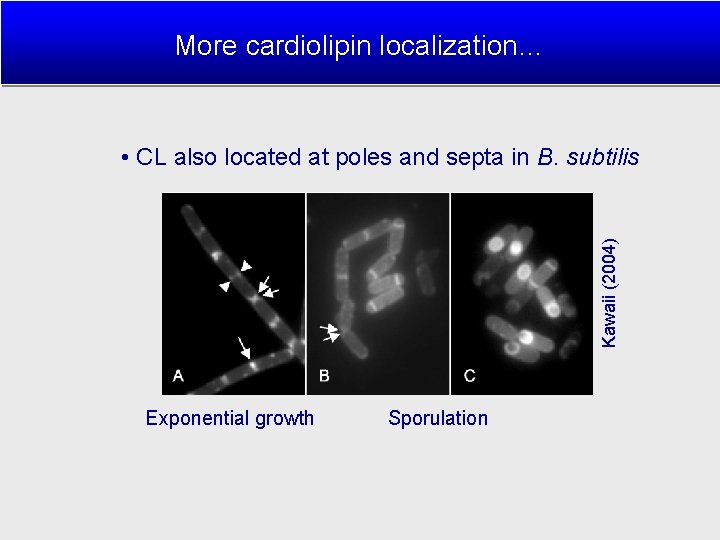
More cardiolipin localization… Kawaii (2004) • CL also located at poles and septa in B. subtilis Exponential growth Sporulation
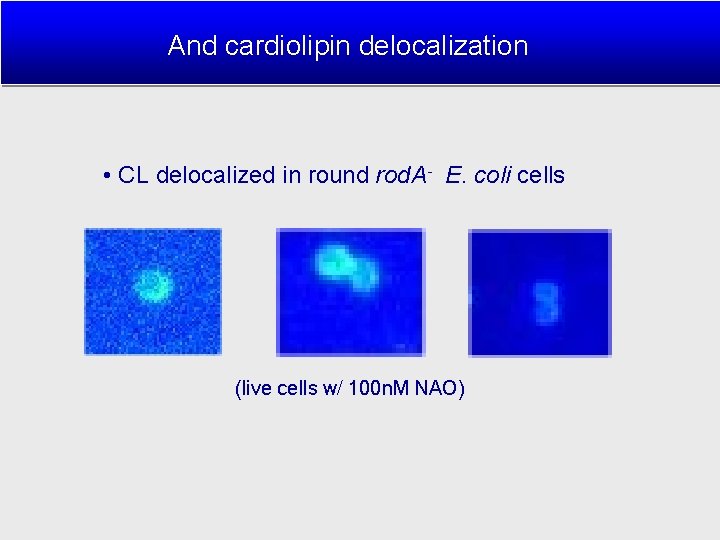
And cardiolipin delocalization • CL delocalized in round rod. A- E. coli cells (live cells w/ 100 n. M NAO)
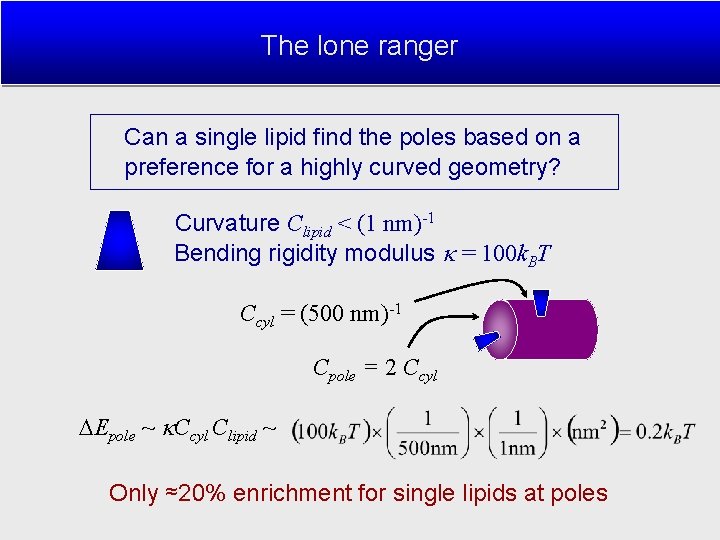
The lone ranger Can a single lipid find the poles based on a preference for a highly curved geometry? Curvature Clipid < (1 nm)-1 Bending rigidity modulus = 100 k. BT Ccyl = (500 nm)-1 Cpole = 2 Ccyl Epole ~ Ccyl Clipid ~ Only ≈20% enrichment for single lipids at poles
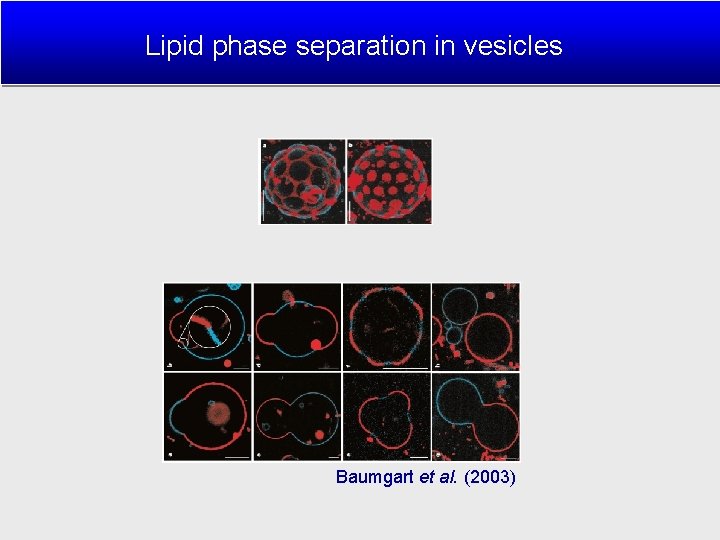
Lipid phase separation in vesicles Baumgart et al. (2003)
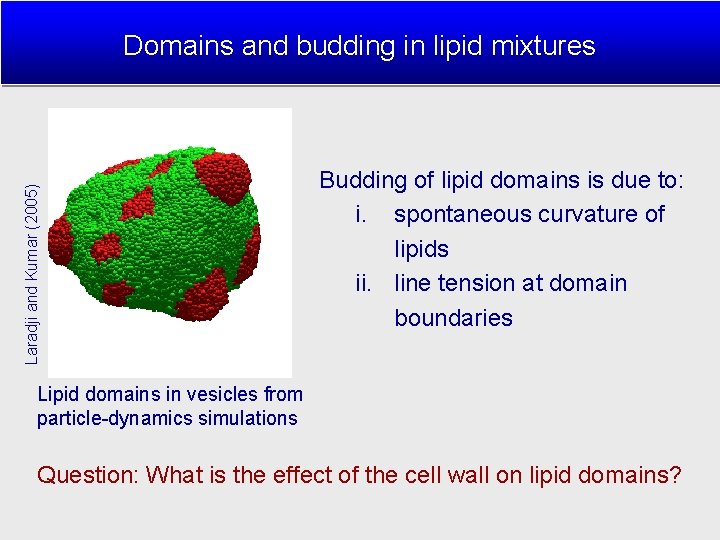
Laradji and Kumar (2005) Domains and budding in lipid mixtures Budding of lipid domains is due to: i. spontaneous curvature of lipids ii. line tension at domain boundaries Lipid domains in vesicles from particle-dynamics simulations Question: What is the effect of the cell wall on lipid domains?
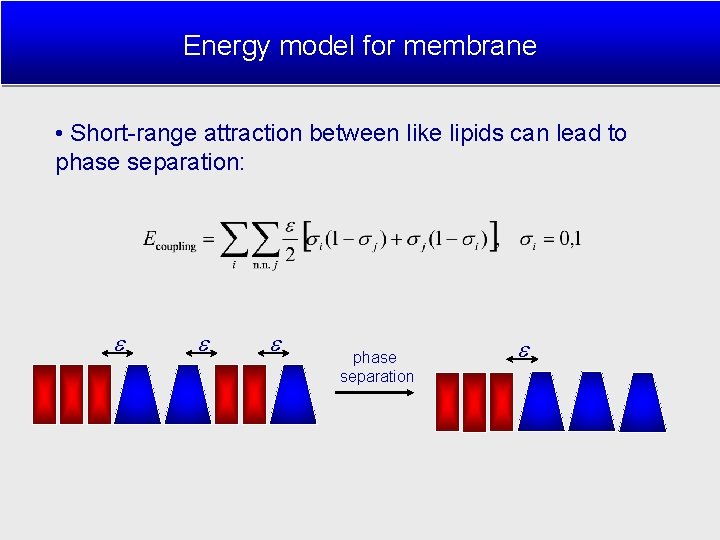
Energy model for membrane • Short-range attraction between like lipids can lead to phase separation: phase separation
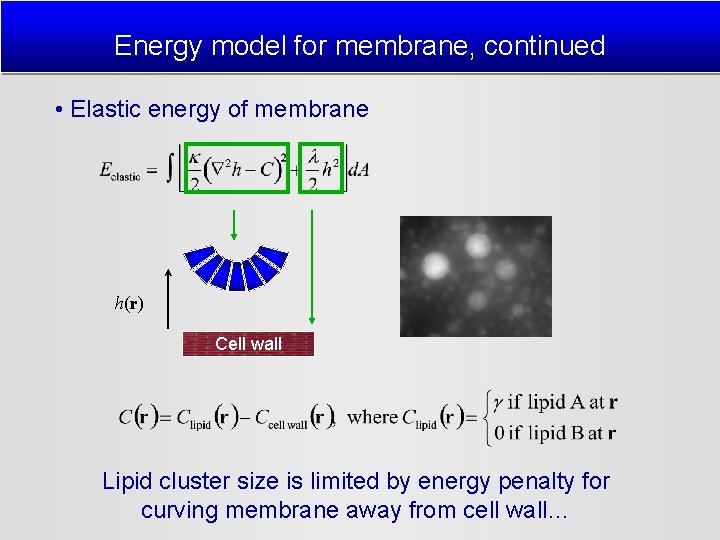
Energy model for membrane, continued • Elastic energy of membrane h(r) Cell wall Lipid cluster size is limited by energy penalty for curving membrane away from cell wall…
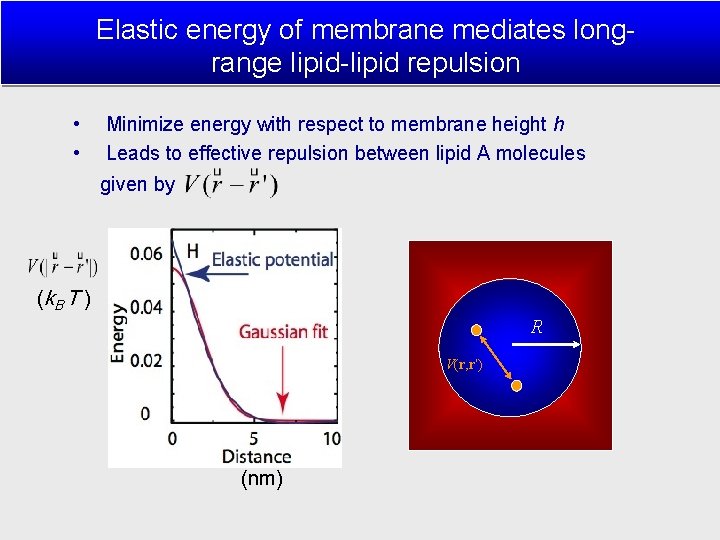
Elastic energy of membrane mediates longrange lipid-lipid repulsion • • Minimize energy with respect to membrane height h Leads to effective repulsion between lipid A molecules given by (k. B T ) R V(r, r’) (nm)
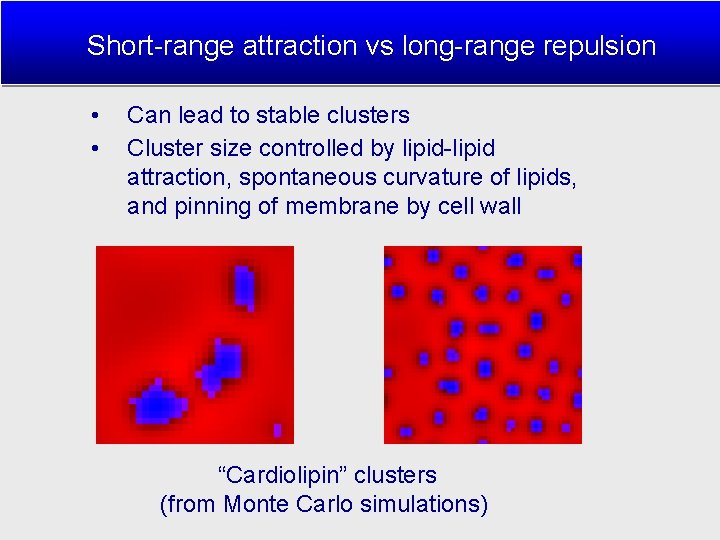
Short-range attraction vs long-range repulsion • • Can lead to stable clusters Cluster size controlled by lipid-lipid attraction, spontaneous curvature of lipids, and pinning of membrane by cell wall “Cardiolipin” clusters (from Monte Carlo simulations)
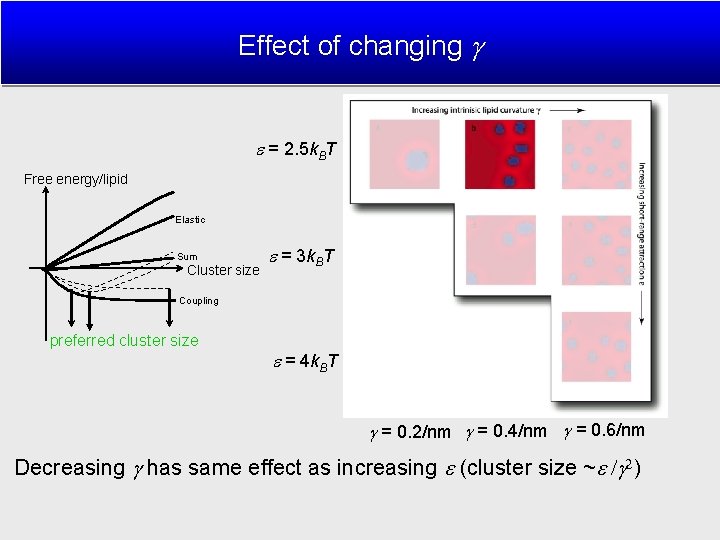
Effect of changing = 2. 5 k. BT Free energy/lipid Elastic Sum Cluster size = 3 k. BT Coupling preferred cluster size = 4 k. BT = 0. 2/nm = 0. 4/nm = 0. 6/nm Decreasing has same effect as increasing (cluster size ~ )
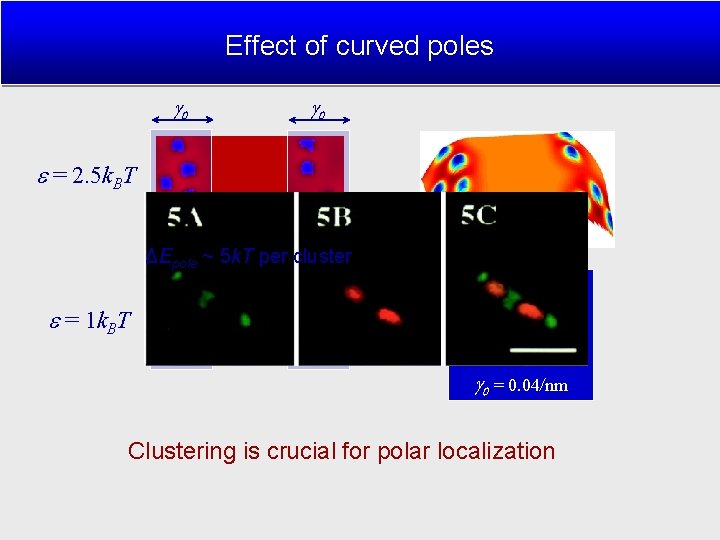
Effect of curved poles ΔEpole ~ 5 k. T per cluster (Mileykovskaya 2000) = 2. 5 k. BT = 25 k. BT = 1 k. BT = 0. 25 k. BT/nm 2 = 0. 4/nm = 0. 04/nm Clustering is crucial for polar localization
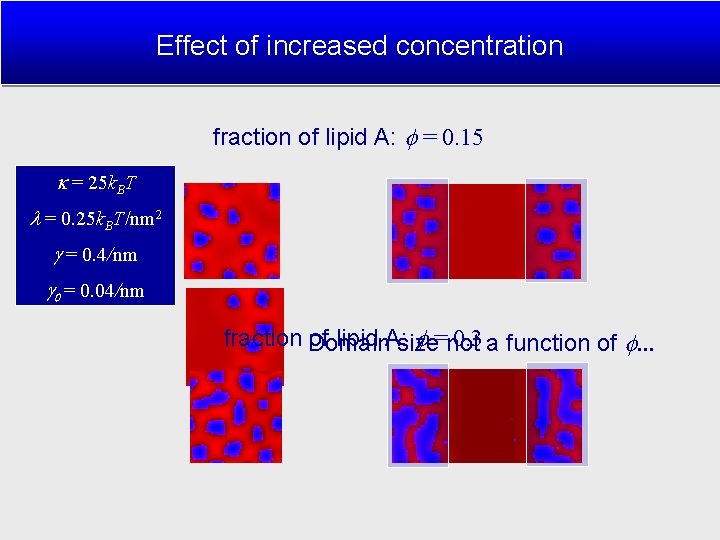
Effect of increased concentration fraction of lipid A: = 0. 15 = 25 k. BT = 0. 25 k. BT/nm 2 = 0. 4/nm = 0. 04/nm fraction Domain of lipid A: size =not 0. 3 a function of
Conclusions • Lipids can form clusters due to a competition between phase separation and pinning by the cell wall. • Clusters of high-curvature lipids can localize to both poles of the cell. • Cardiolipin may serve as a target for polar localization of proteins.
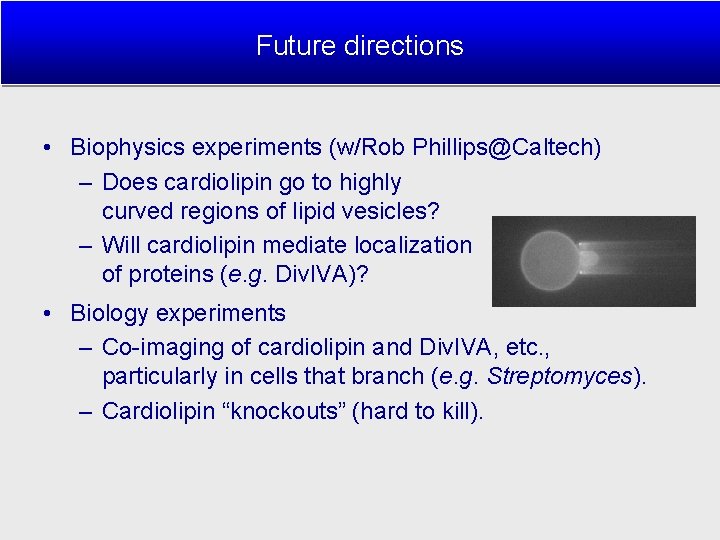
Future directions • Biophysics experiments (w/Rob Phillips@Caltech) – Does cardiolipin go to highly curved regions of lipid vesicles? – Will cardiolipin mediate localization of proteins (e. g. Div. IVA)? • Biology experiments – Co-imaging of cardiolipin and Div. IVA, etc. , particularly in cells that branch (e. g. Streptomyces). – Cardiolipin “knockouts” (hard to kill).
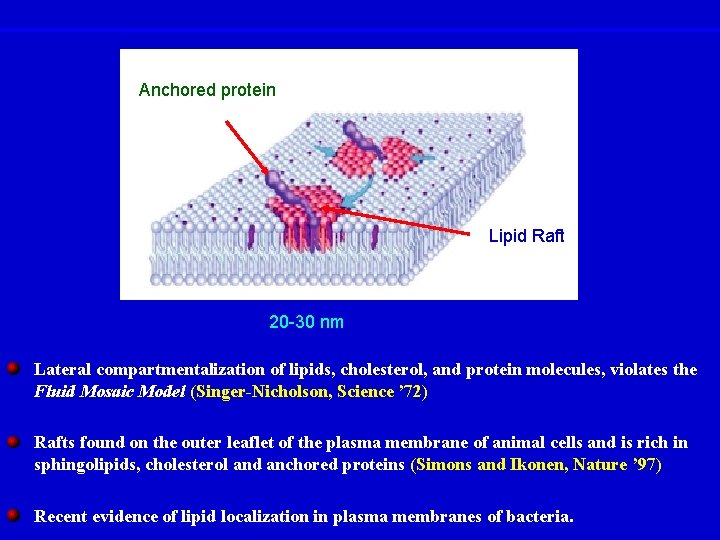
Anchored protein Lipid Raft 20 -30 nm Lateral compartmentalization of lipids, cholesterol, and protein molecules, violates the Fluid Mosaic Model (Singer-Nicholson, Science ’ 72) Rafts found on the outer leaflet of the plasma membrane of animal cells and is rich in sphingolipids, cholesterol and anchored proteins (Simons and Ikonen, Nature ’ 97) Recent evidence of lipid localization in plasma membranes of bacteria.
- Slides: 20