
Lipid extraction from animal and plant tissues Qualitative




- Slides: 18
동물 및 식물 조직으로부터의 지질추출 및 정성분석 Lipid extraction from animal and plant tissues & Qualitative analysis using TLC method
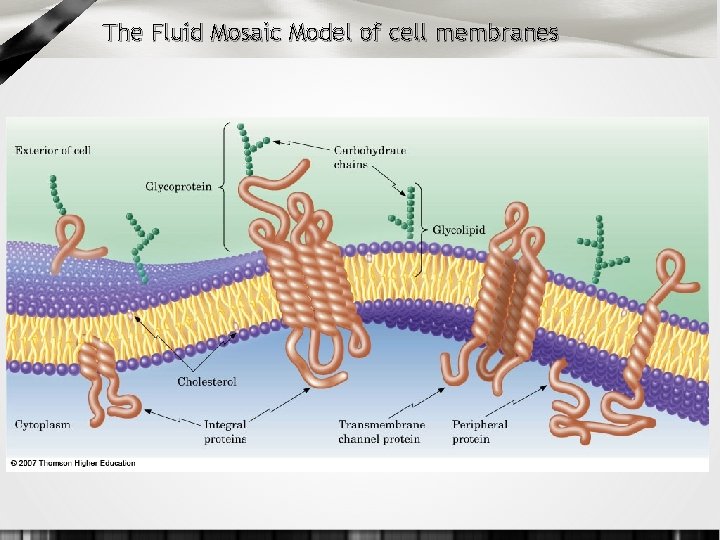
The Fluid Mosaic Model of cell membranes
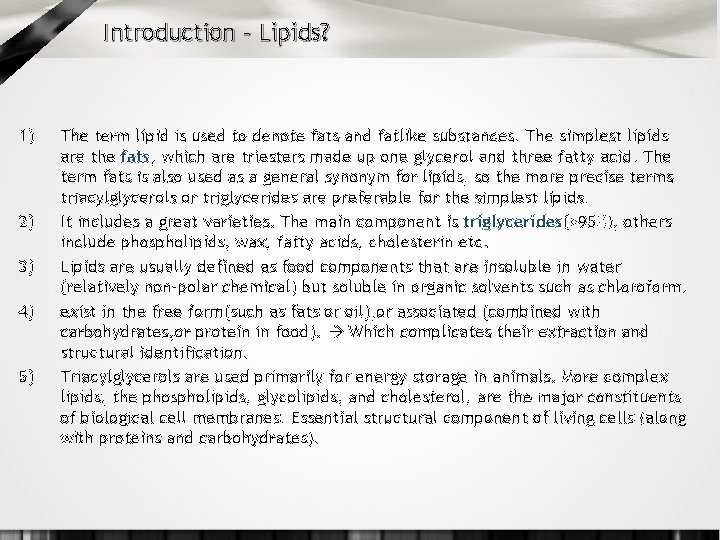
Introduction – Lipids? 1) 2) 3) 4) 5) The term lipid is used to denote fats and fatlike substances. The simplest lipids are the fats, which are triesters made up one glycerol and three fatty acid. The term fats is also used as a general synonym for lipids, so the more precise terms triacylglycerols or triglycerides are preferable for the simplest lipids. It includes a great varieties. The main component is triglycerides(>95%), others include phospholipids, wax, fatty acids, cholesterin etc. Lipids are usually defined as food components that are insoluble in water (relatively non-polar chemical) but soluble in organic solvents such as chloroform. exist in the free form(such as fats or oil), or associated (combined with carbohydrates, or protein in food). Which complicates their extraction and structural identification. Triacylglycerols are used primarily for energy storage in animals. More complex lipids, the phospholipids, glycolipids, and cholesterol, are the major constituents of biological cell membranes. Essential structural component of living cells (along with proteins and carbohydrates).
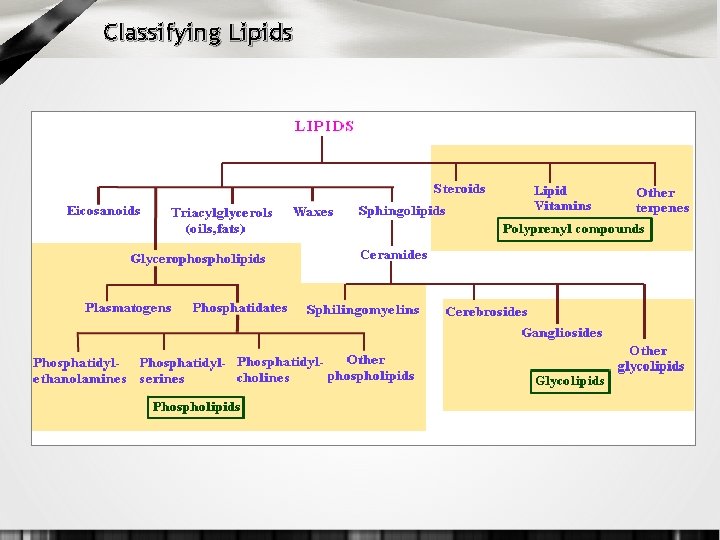
Classifying Lipids
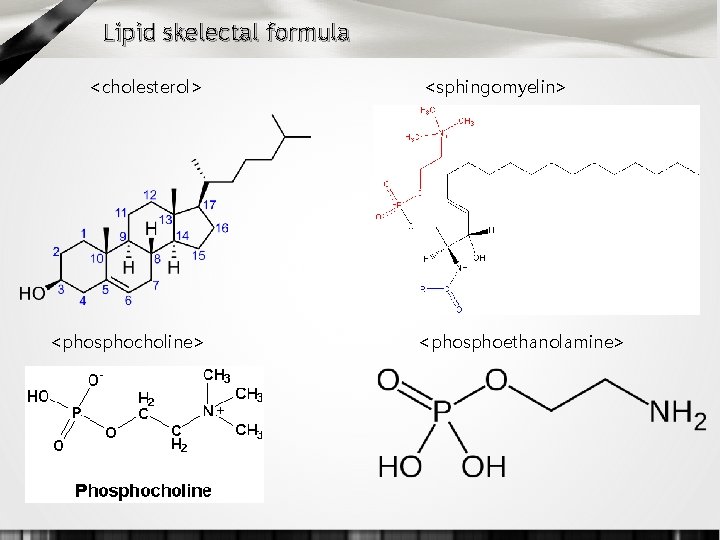
Lipid skelectal formula <cholesterol> <phosphocholine> <sphingomyelin> <phosphoethanolamine>
Fats and Oils • Triglycerides can be called fats or oils, depending upon the degree of unsaturation in the compound. • There are several ways of distinguishing between fats and oils: physical properties and structural formulas are two of them. • The physical distinction is that fats are solid at room temperature and oils are generally liquid at room temperature. The structural difference is that fats are saturated (they have single bonds between all the carbon atoms) and oils are unsaturated (they contain some double bonds between carbon atoms). A third common distinction is that fats come from animals and oils come from plants. Keep in mind that, although useful, these distinctions are generalities and there are exceptions. Fats solids saturated animal Oils liquids unsaturated plant
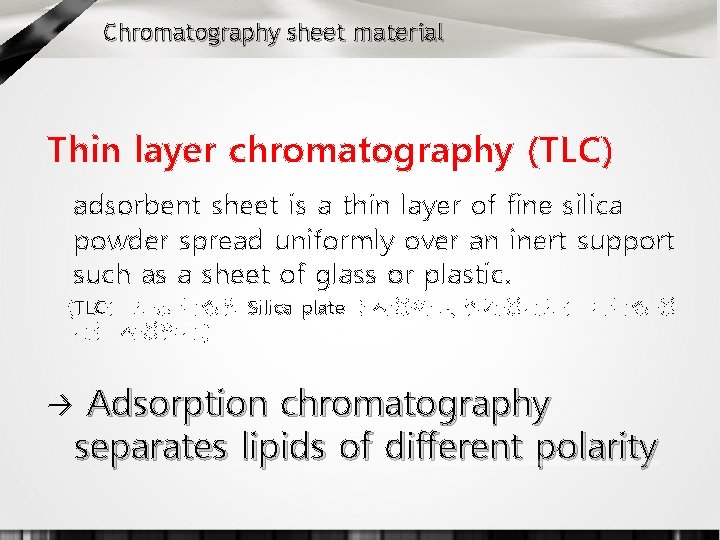
Chromatography sheet material Thin layer chromatography (TLC) adsorbent sheet is a thin layer of fine silica powder spread uniformly over an inert support such as a sheet of glass or plastic. (TLC는 보통 극성인 Silica plate를 사용하고, 전개용매로는 비극성 용 매를 사용한다. ) Adsorption chromatography separates lipids of different polarity
LIPID EXTRACTION • The Order of migration of lipids during chromatography depends primarily on polarity. • The less polar the lipid, the greater its affinity for the nonpolar solvent (compare the polar silica gel) and hence the greater the migration.
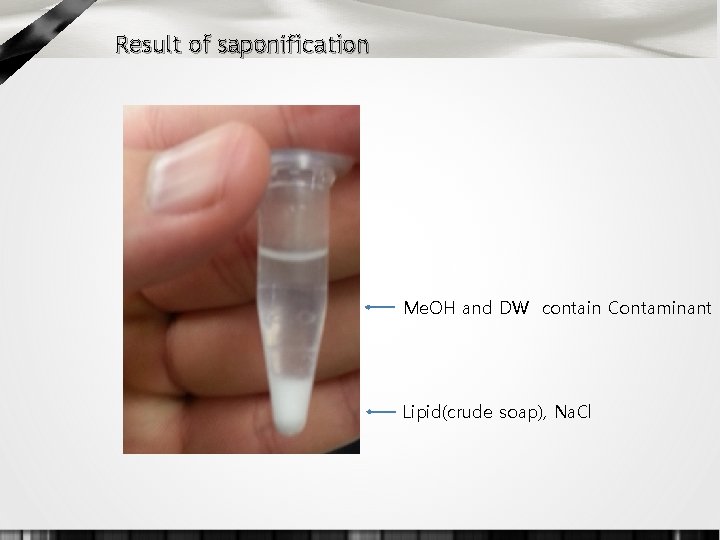
SAPONIFICATION • Saponification is a process that produces soap, usually from fats and lye. It involves a reaction between a base, usually sodium hydroxide (caustic soda), and an ester group on a compound. Triglycerides are an example, which is an ester of a fatty acid. The triglycerides are hydrolyzed to form the sodium salt of a carboxylate. In addition to soap, such traditional saponification processes produce glycerol. "Saponifiable substances" are those that can be converted into soap.
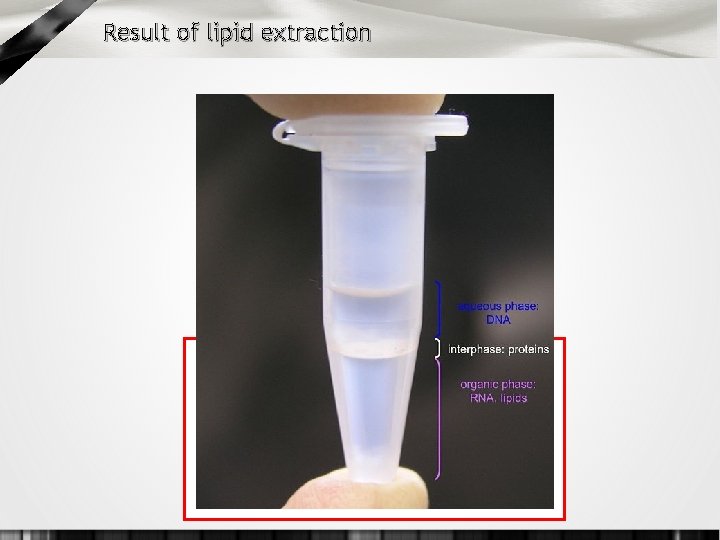
Procedure • Lipid Extraction from mammalian cells 1) Plate의 Medium 제거. 2) Trypsin-EDTA (TE buffer) 1 ml을 이용하여 plate에서 cell pellet을 얻은 후 1. 5 ml tube로 옮겨준다. 3) 1, 200~2000 rpm에서 5분간 원심 분리하고, 상층액은 제거하여 cell pellet을 얻는다. 4) Ice-cold PBS 1 ml로 pellet을 풀어준 후 1, 200~2, 000 rpm을 풀어 준 후 1, 200~2, 000 rpm에서 5분간 원심 분리 5) Pellet을 피해서 조심스럽게 상층액을 제거한다. 6) 얻어낸 pellet에 Chloroform : Me. OH (1: 2) 혼합액 (400 ul)을 넣고 Vortex 7) 동량의 Chloroform (400 ul) 을 넣고 다시 Vortex 8) 동량의 D. W. (400 ul) 를 넣고 다시 Vortex 9) 3, 000 ~ 4, 000 rpm에서 10분간 원심분리 10) 하층 (Chloroform)층을 조심스럽게 덜어 낸다
Result of lipid extraction
Procedure • Saponification 1) lipid 에 0. 5 M Na. OH (90 % Me. OH)을 700 ul을 넣는다. 2) 70 ℃ Heat Block에서 한 시간 가량 녹여준다. 3) Con. HCl을 100 ul 넣는다 4) Chloroform 400 ul 넣고 voltex 5) 하층을 새 1. 5 ml tube로 옮겨준다. 6) 질소가스를 이용하여 후드 안에서 말려준다 7) 50 ul chloroform으로 녹여준다.
Result of saponification Me. OH and DW contain Contaminant Lipid(crude soap), Na. Cl
Result {Assume adsorbent more polar than solvent} 1. Which band moved the fastest? 2. Which band has the relatively most polar molecules? 3. Which band had greater affinity for the mobile phase? Phosphocholine Sphingomyelin Cell Seed Chloroform : Methanol : Acetic Acid : D. W = 100 : 70 : 20 : 10