
Lipid Digestion Lipids are split into tiny droplets
- Slides: 18
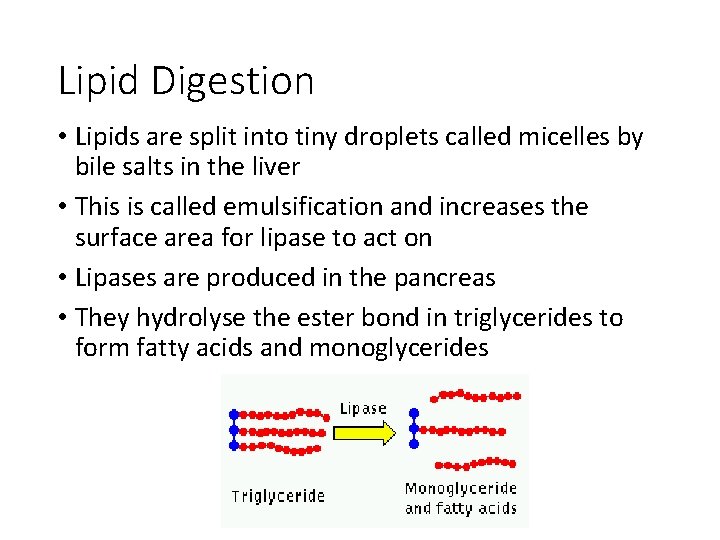
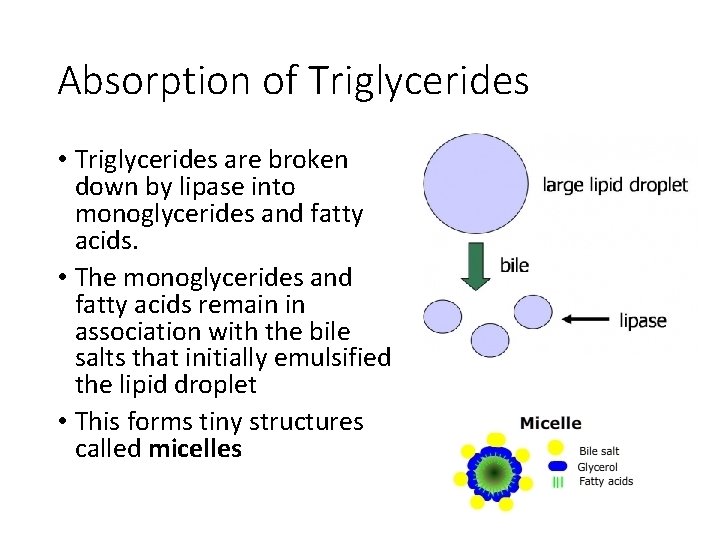
Lipid Digestion • Lipids are split into tiny droplets called micelles by bile salts in the liver • This is called emulsification and increases the surface area for lipase to act on • Lipases are produced in the pancreas • They hydrolyse the ester bond in triglycerides to form fatty acids and monoglycerides
Protein Digestion • Digested by enzymes called peptidases (proteases) • Endopeptidases hydrolyse peptide bonds in the middle of a protein molecule forming many peptides • Exopeptidases hydrolyse the peptide bond on the terminal amino acids of the peptide molecules – they progressively release dipeptides and single amino acids • Dipeptidases hydrolyse the peptide bond between amino acids in dipeptides. They are membrane bound as part of the cell surface membrane of the epithelial cells of the ileum.
Absorbing the products of digestion On your whiteboard… Draw a diagram or describe in words how the structure of the ileum is adapted to maximise absorption
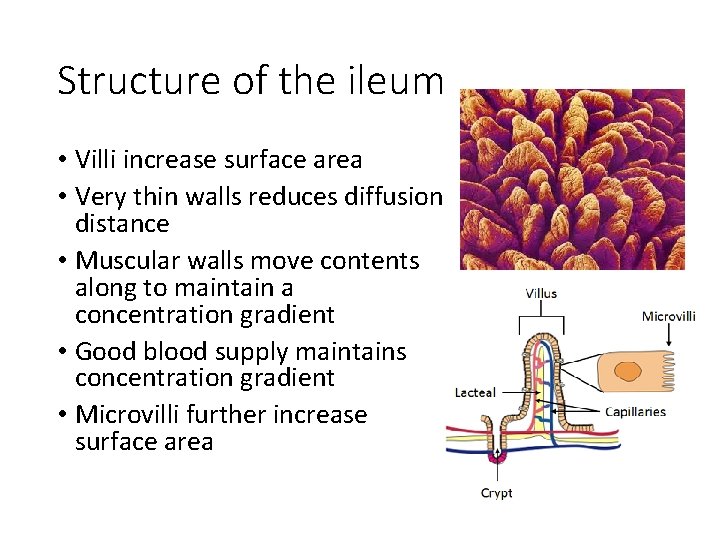
Structure of the ileum • Villi increase surface area • Very thin walls reduces diffusion distance • Muscular walls move contents along to maintain a concentration gradient • Good blood supply maintains concentration gradient • Microvilli further increase surface area
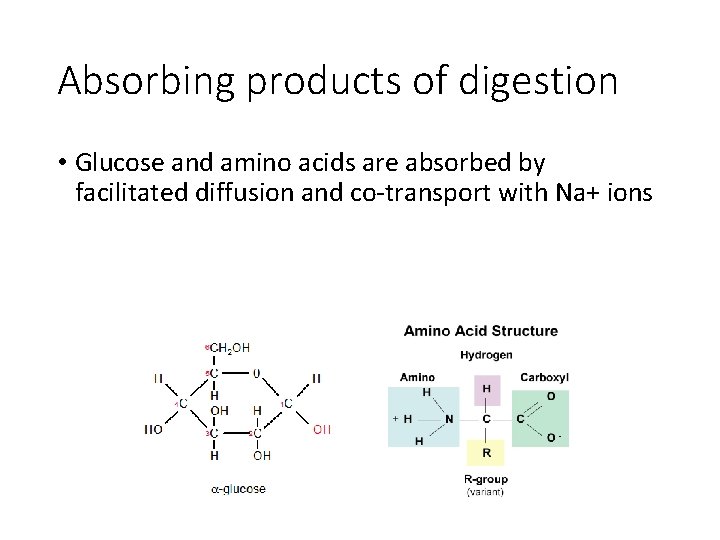
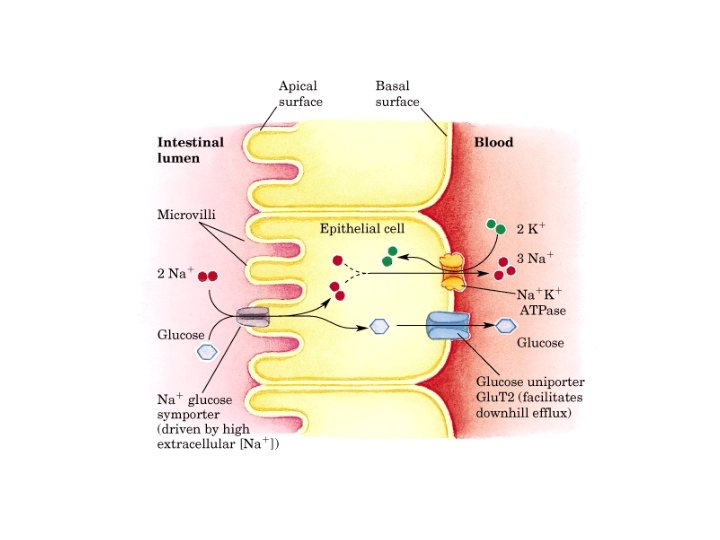
Absorbing products of digestion • Glucose and amino acids are absorbed by facilitated diffusion and co-transport with Na+ ions
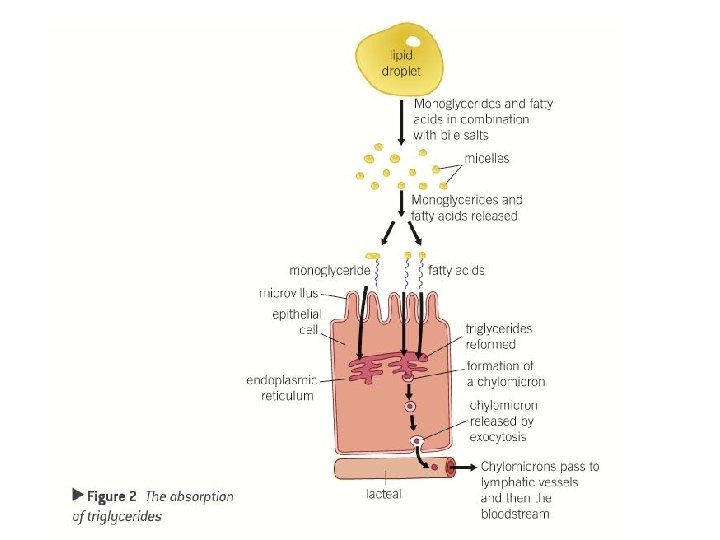
Absorption of Triglycerides • Triglycerides are broken down by lipase into monoglycerides and fatty acids. • The monoglycerides and fatty acids remain in association with the bile salts that initially emulsified the lipid droplet • This forms tiny structures called micelles
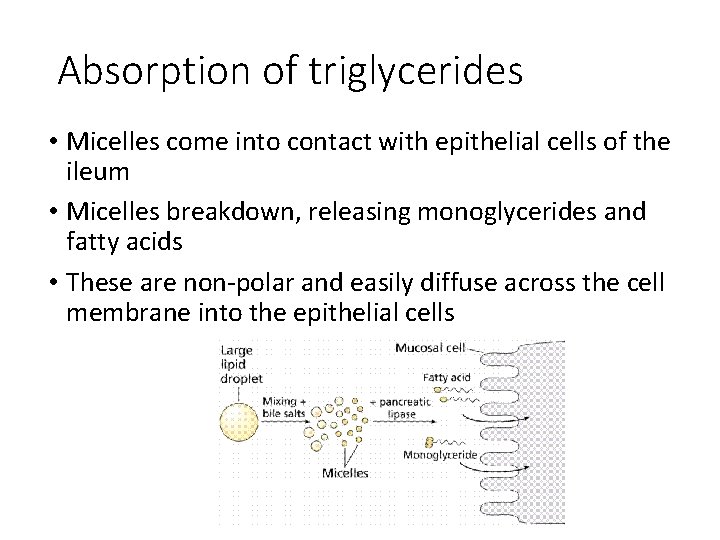
Absorption of triglycerides • Micelles come into contact with epithelial cells of the ileum • Micelles breakdown, releasing monoglycerides and fatty acids • These are non-polar and easily diffuse across the cell membrane into the epithelial cells
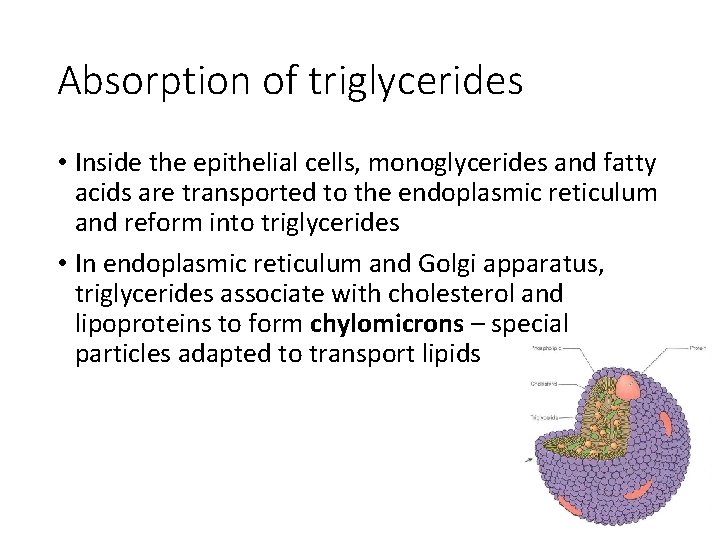
Absorption of triglycerides • Inside the epithelial cells, monoglycerides and fatty acids are transported to the endoplasmic reticulum and reform into triglycerides • In endoplasmic reticulum and Golgi apparatus, triglycerides associate with cholesterol and lipoproteins to form chylomicrons – special particles adapted to transport lipids
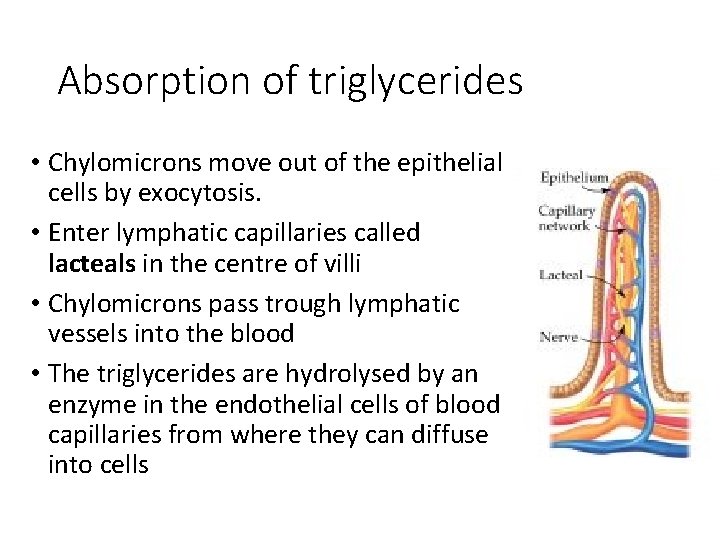
Absorption of triglycerides • Chylomicrons move out of the epithelial cells by exocytosis. • Enter lymphatic capillaries called lacteals in the centre of villi • Chylomicrons pass trough lymphatic vessels into the blood • The triglycerides are hydrolysed by an enzyme in the endothelial cells of blood capillaries from where they can diffuse into cells
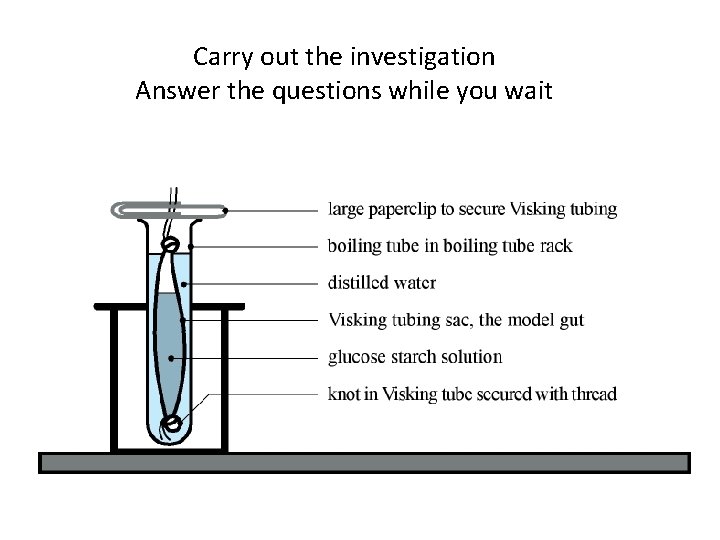
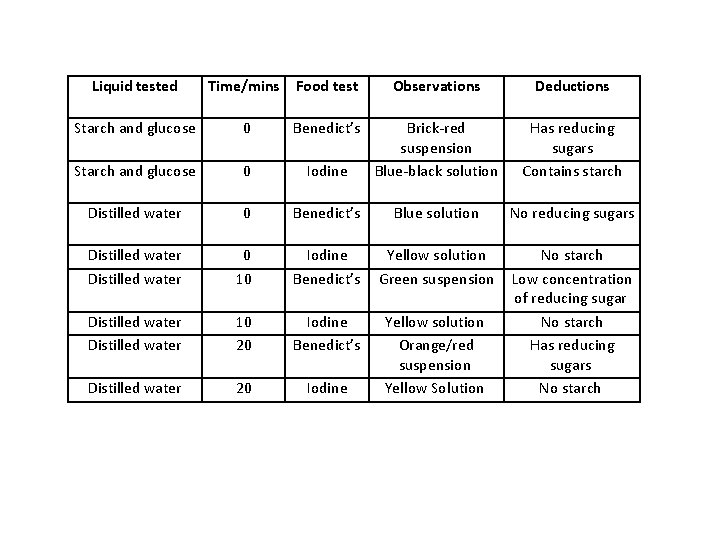
Carry out the investigation Answer the questions while you wait
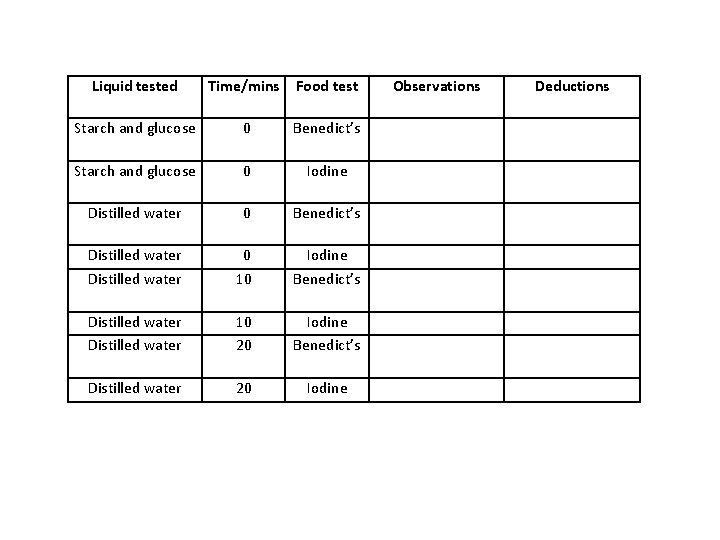
Liquid tested Time/mins Food test Starch and glucose 0 Benedict’s Starch and glucose 0 Iodine Distilled water 0 Benedict’s Distilled water 0 10 Iodine Benedict’s Distilled water 10 20 Iodine Benedict’s Distilled water 20 Iodine Observations Deductions
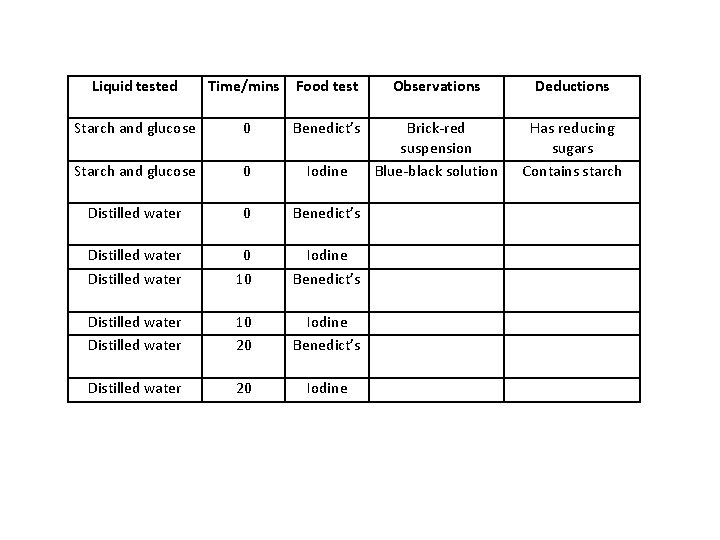
Liquid tested Time/mins Food test Observations Deductions Starch and glucose 0 Benedict’s Starch and glucose 0 Iodine Brick-red suspension Blue-black solution Has reducing sugars Contains starch Distilled water 0 Benedict’s Distilled water 0 10 Iodine Benedict’s Distilled water 10 20 Iodine Benedict’s Distilled water 20 Iodine
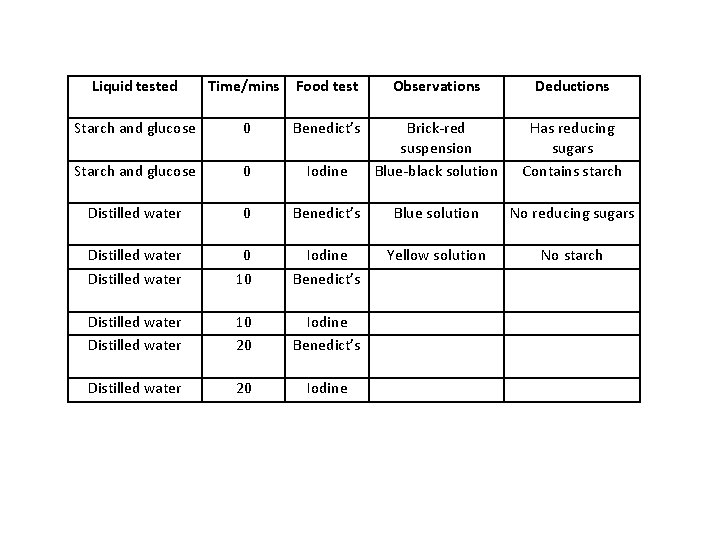
Liquid tested Time/mins Food test Observations Deductions Starch and glucose 0 Benedict’s Starch and glucose 0 Iodine Brick-red suspension Blue-black solution Has reducing sugars Contains starch Distilled water 0 Benedict’s Blue solution No reducing sugars Distilled water 0 10 Iodine Benedict’s Yellow solution No starch Distilled water 10 20 Iodine Benedict’s Distilled water 20 Iodine
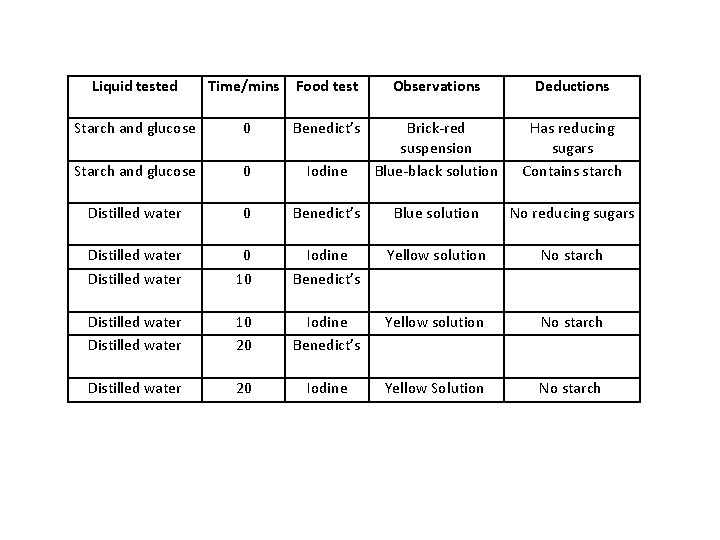
Liquid tested Time/mins Food test Observations Deductions Starch and glucose 0 Benedict’s Starch and glucose 0 Iodine Brick-red suspension Blue-black solution Has reducing sugars Contains starch Distilled water 0 Benedict’s Blue solution No reducing sugars Distilled water 0 10 Iodine Benedict’s Yellow solution No starch Distilled water 10 20 Iodine Benedict’s Yellow solution No starch Distilled water 20 Iodine Yellow Solution No starch
Liquid tested Time/mins Food test Observations Deductions Starch and glucose 0 Benedict’s Starch and glucose 0 Iodine Brick-red suspension Blue-black solution Has reducing sugars Contains starch Distilled water 0 Benedict’s Blue solution No reducing sugars Distilled water 0 10 Iodine Benedict’s Yellow solution Green suspension Distilled water 10 20 Iodine Benedict’s Distilled water 20 Iodine Yellow solution Orange/red suspension Yellow Solution No starch Low concentration of reducing sugar No starch Has reducing sugars No starch
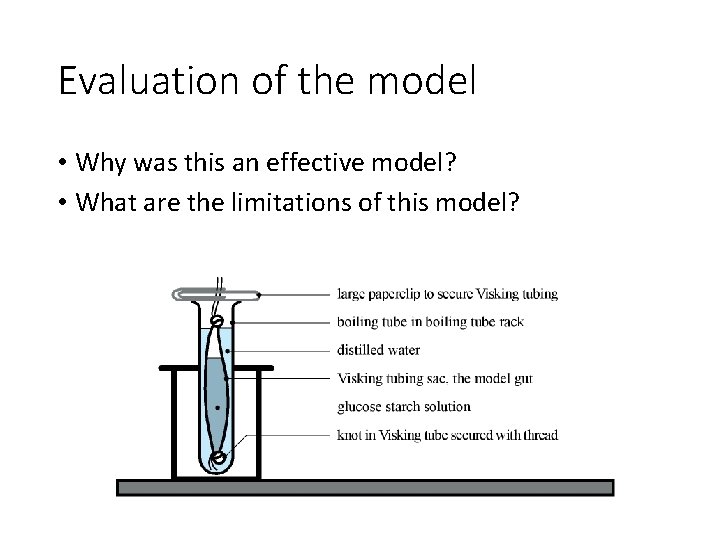
Evaluation of the model • Why was this an effective model? • What are the limitations of this model?