
Lip BalmHand Salve Production Line Ohimai Aisiku Stephanie

Lip Balm/Hand Salve Production Line Ohimai Aisiku Stephanie Bloechl Kenneth Costello Jessica Dill Jeff Lariviere 1

Agenda Problem Definition Problem Statement, Customer Requirements, Engineering Requirements, House of Quality System Design Functional Decomposition, Morphological Chart, Concepts, Pugh Chart, Selected Concept, Risk Assessment Detailed Design Feasibility Test Plan Questions 2

Problem Definition 3
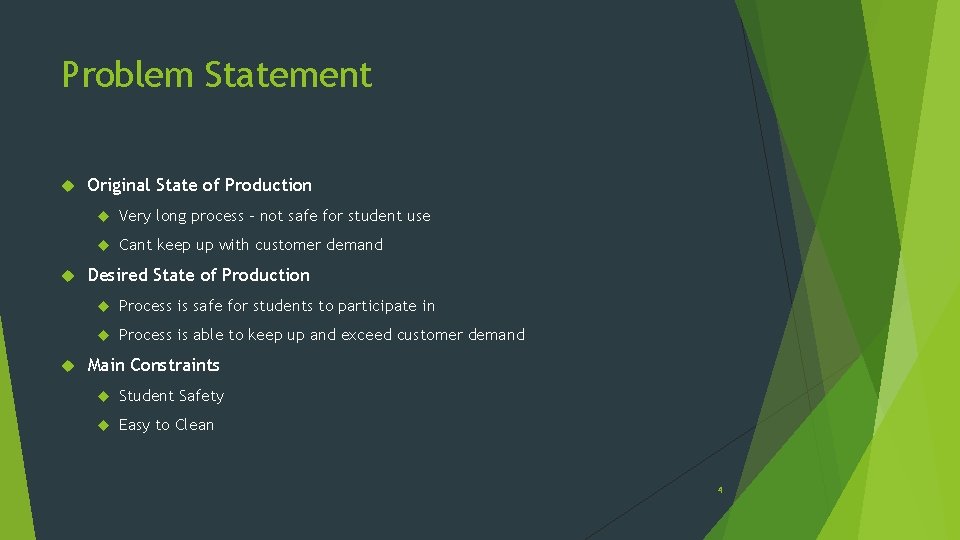
Problem Statement Original State of Production Very long process – not safe for student use Cant keep up with customer demand Desired State of Production Process is safe for students to participate in Process is able to keep up and exceed customer demand Main Constraints Student Safety Easy to Clean 4
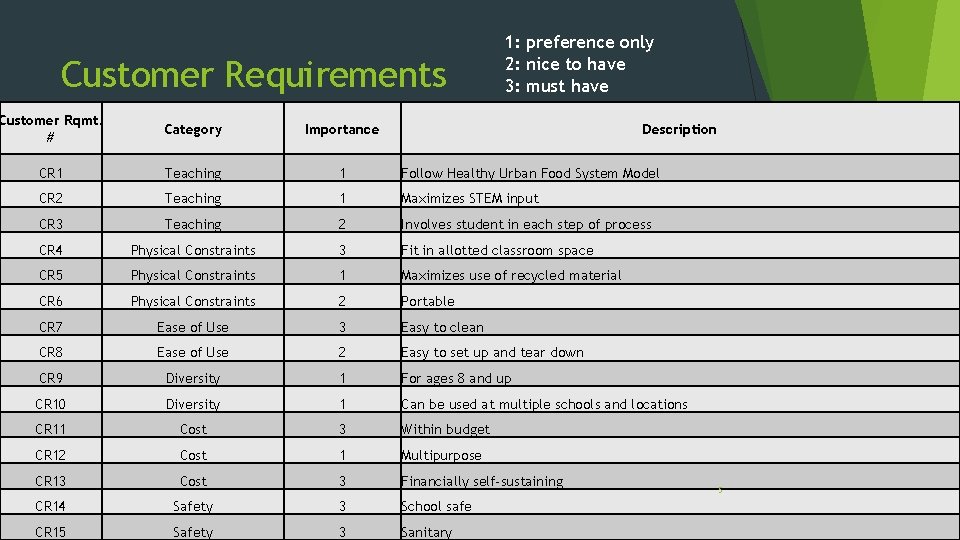
Customer Requirements 1: preference only 2: nice to have 3: must have Customer Rqmt. # Category Importance CR 1 Teaching 1 Follow Healthy Urban Food System Model CR 2 Teaching 1 Maximizes STEM input CR 3 Teaching 2 Involves student in each step of process CR 4 Physical Constraints 3 Fit in allotted classroom space CR 5 Physical Constraints 1 Maximizes use of recycled material CR 6 Physical Constraints 2 Portable CR 7 Ease of Use 3 Easy to clean CR 8 Ease of Use 2 Easy to set up and tear down CR 9 Diversity 1 For ages 8 and up CR 10 Diversity 1 Can be used at multiple schools and locations CR 11 Cost 3 Within budget CR 12 Cost 1 Multipurpose CR 13 Cost 3 Financially self-sustaining CR 14 Safety 3 School safe CR 15 Safety 3 Sanitary Description 5
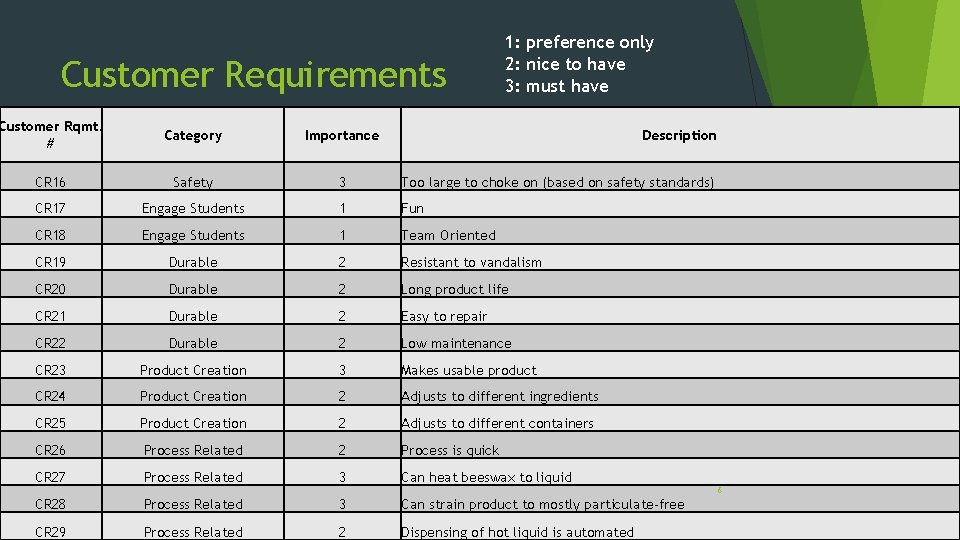
Customer Requirements 1: preference only 2: nice to have 3: must have Customer Rqmt. # Category Importance CR 16 Safety 3 Too large to choke on (based on safety standards) CR 17 Engage Students 1 Fun CR 18 Engage Students 1 Team Oriented CR 19 Durable 2 Resistant to vandalism CR 20 Durable 2 Long product life CR 21 Durable 2 Easy to repair CR 22 Durable 2 Low maintenance CR 23 Product Creation 3 Makes usable product CR 24 Product Creation 2 Adjusts to different ingredients CR 25 Product Creation 2 Adjusts to different containers CR 26 Process Related 2 Process is quick CR 27 Process Related 3 Can heat beeswax to liquid CR 28 Process Related 3 Can strain product to mostly particulate-free CR 29 Process Related 2 Dispensing of hot liquid is automated Description 6
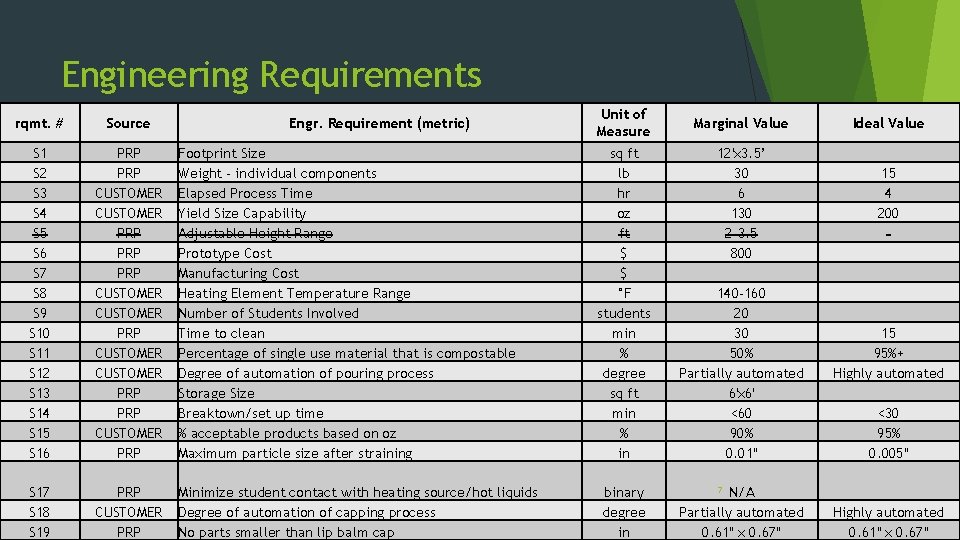
Engineering Requirements rqmt. # Source Engr. Requirement (metric) S 1 S 2 S 3 S 4 S 5 S 6 S 7 S 8 S 9 S 10 S 11 S 12 S 13 S 14 S 15 S 16 PRP PRP CUSTOMER PRP CUSTOMER PRP Footprint Size Weight - individual components Elapsed Process Time Yield Size Capability Adjustable Height Range Prototype Cost Manufacturing Cost Heating Element Temperature Range Number of Students Involved Time to clean Percentage of single use material that is compostable Degree of automation of pouring process Storage Size Breaktown/set up time % acceptable products based on oz Maximum particle size after straining S 17 S 18 S 19 PRP CUSTOMER PRP Minimize student contact with heating source/hot liquids Degree of automation of capping process No parts smaller than lip balm cap Unit of Measure Marginal Value Ideal Value sq ft lb hr oz ft $ $ °F students min % degree sq ft min % in 12'x 3. 5’ 30 6 130 2 -3. 5 800 140 -160 20 30 50% Partially automated 6'x 6' <60 90% 0. 01" 15 4 200 15 95%+ Highly automated <30 95% 0. 005" binary degree in N/A Partially automated 0. 61" x 0. 67" Highly automated 0. 61" x 0. 67" 7
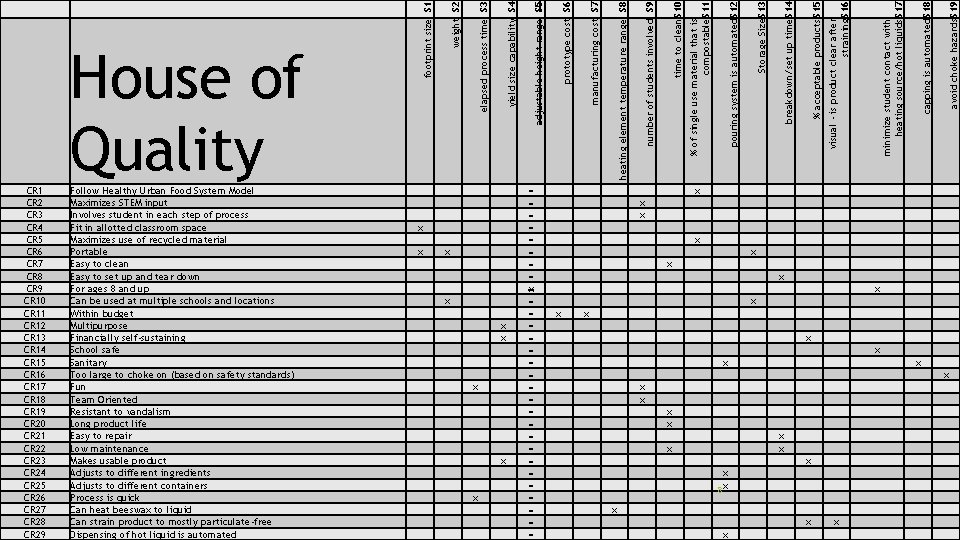
CR 1 CR 2 CR 3 CR 4 CR 5 CR 6 CR 7 CR 8 CR 9 CR 10 CR 11 CR 12 CR 13 CR 14 CR 15 CR 16 CR 17 CR 18 CR 19 CR 20 CR 21 CR 22 CR 23 CR 24 CR 25 CR 26 CR 27 CR 28 CR 29 Follow Healthy Urban Food System Model Maximizes STEM input Involves student in each step of process Fit in allotted classroom space Maximizes use of recycled material Portable Easy to clean Easy to set up and tear down For ages 8 and up Can be used at multiple schools and locations Within budget Multipurpose Financially self-sustaining School safe Sanitary Too large to choke on (based on safety standards) Fun Team Oriented Resistant to vandalism Long product life Easy to repair Low maintenance Makes usable product Adjusts to different ingredients Adjusts to different containers Process is quick Can heat beeswax to liquid Can strain product to mostly particulate-free Dispensing of hot liquid is automated x x x x x x x x x x x x x x 8 x x x x x x x avoid choke hazards S 19 capping is automated S 18 minimize student contact with heating source/hot liquids S 17 % acceptable products S 15 x x visual - is product clear after straining S 16 breakdown/set up time S 14 Storage Size S 13 pouring system is automated S 12 % of single use material that is compostable S 11 time to clean S 10 number of students involved S 9 heating element temperature range S 8 manufacturing cost S 7 prototype cost S 6 adjustable height range S 5 yield size capability S 4 elapsed process time S 3 weight S 2 footprint size S 1 House of Quality x

System Design 9
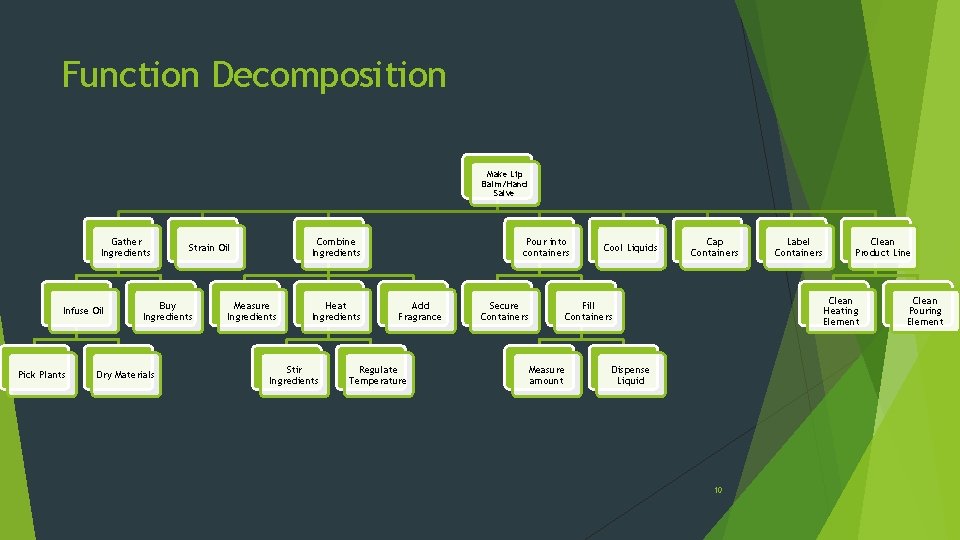
Function Decomposition Make Lip Balm/Hand Salve Gather Ingredients Infuse Oil Pick Plants Buy Ingredients Dry Materials Combine Ingredients Strain Oil Measure Ingredients Heat Ingredients Stir Ingredients Pour into containers Add Fragrance Regulate Temperature Secure Containers Cool Liquids Cap Containers Clean Product Line Clean Heating Element Fill Containers Measure amount Label Containers Dispense Liquid 10 Clean Pouring Element
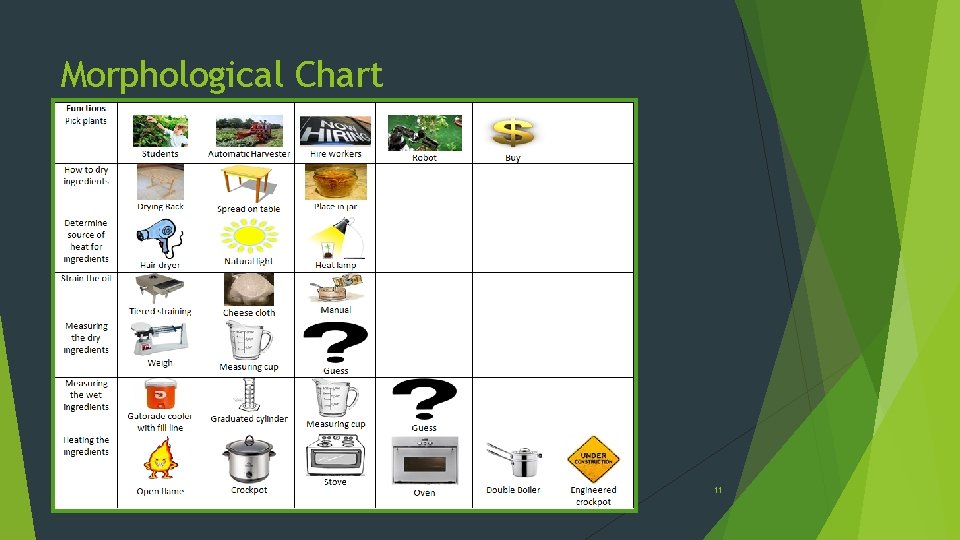
Morphological Chart 11
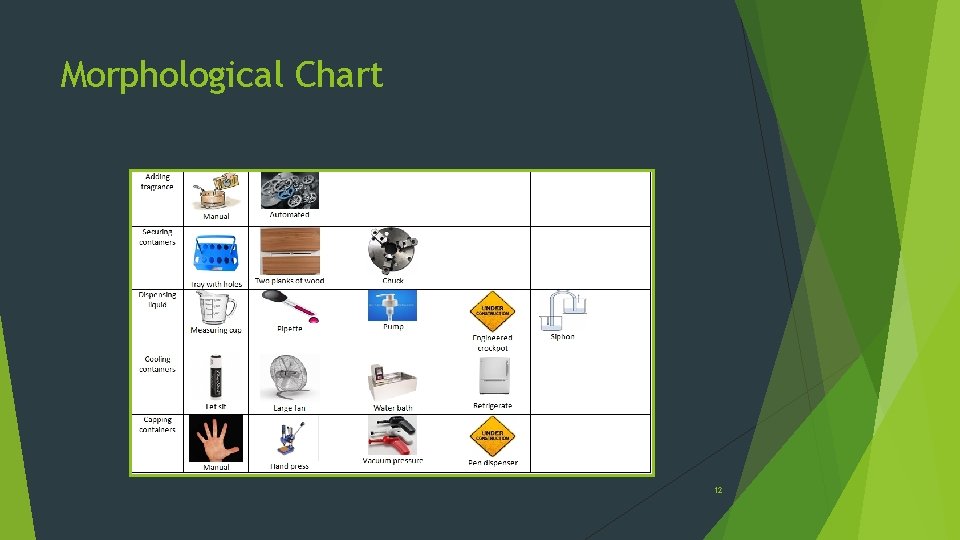
Morphological Chart 12
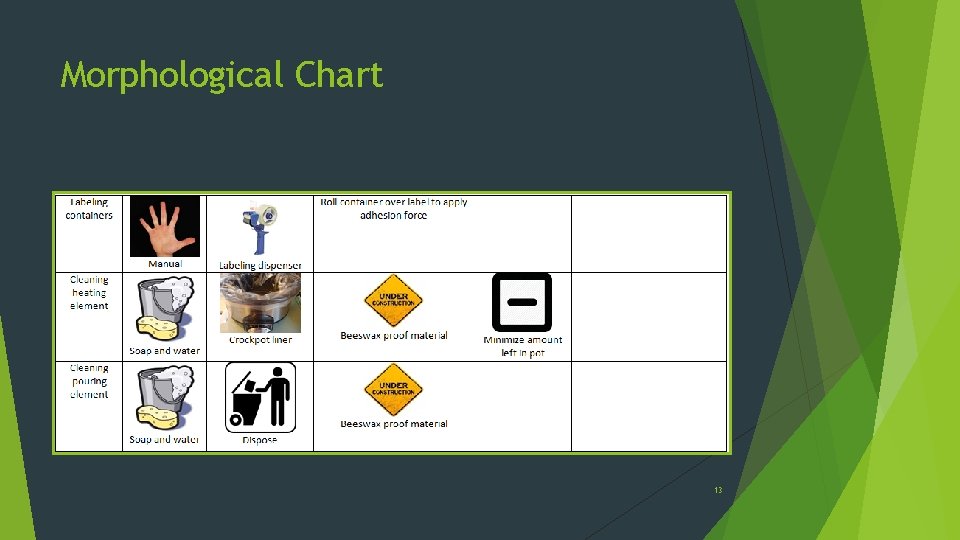
Morphological Chart 13
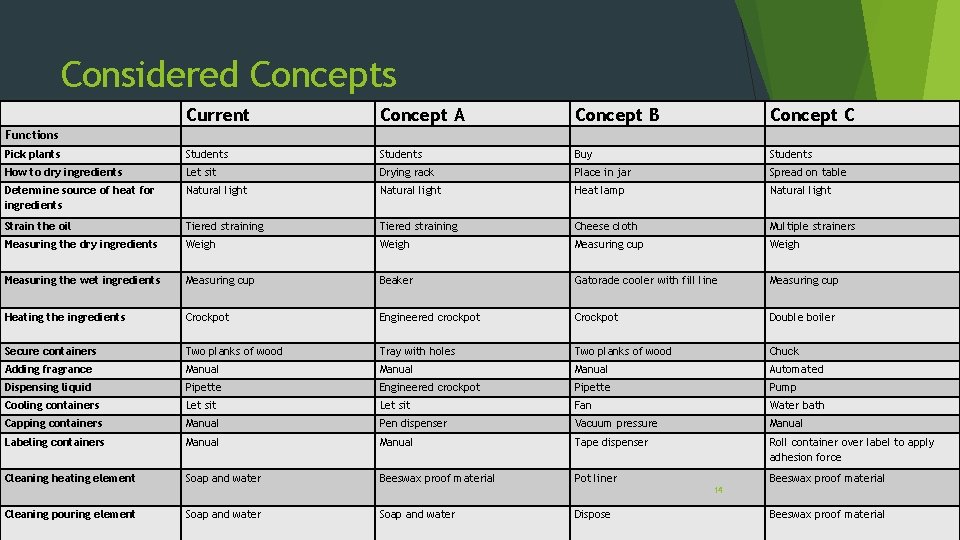
Considered Concepts Current Concept A Concept B Concept C Functions Pick plants Students Buy Students How to dry ingredients Let sit Drying rack Place in jar Spread on table Determine source of heat for ingredients Natural light Heat lamp Natural light Strain the oil Tiered straining Cheese cloth Multiple strainers Measuring the dry ingredients Weigh Measuring cup Weigh Measuring the wet ingredients Measuring cup Beaker Gatorade cooler with fill line Measuring cup Heating the ingredients Crockpot Engineered crockpot Crockpot Double boiler Secure containers Two planks of wood Tray with holes Two planks of wood Chuck Adding fragrance Manual Automated Dispensing liquid Pipette Engineered crockpot Pipette Pump Cooling containers Let sit Fan Water bath Capping containers Manual Pen dispenser Vacuum pressure Manual Labeling containers Manual Tape dispenser Roll container over label to apply adhesion force Cleaning heating element Soap and water Beeswax proof material Pot liner Beeswax proof material 14 Cleaning pouring element Soap and water Dispose Beeswax proof material
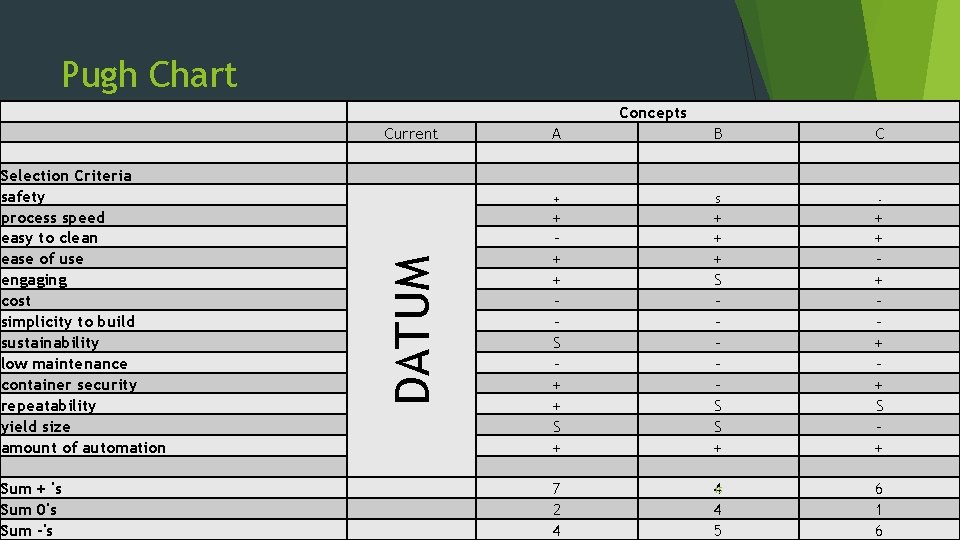
Pugh Chart Sum + 's Sum 0's Sum -'s Concepts Current DATUM Selection Criteria safety process speed easy to clean ease of use engaging cost simplicity to build sustainability low maintenance container security repeatability yield size amount of automation A B C + S - + + + S + 7 2 4 + + + S S S + 15 4 4 5 + + + S + 6 1 6
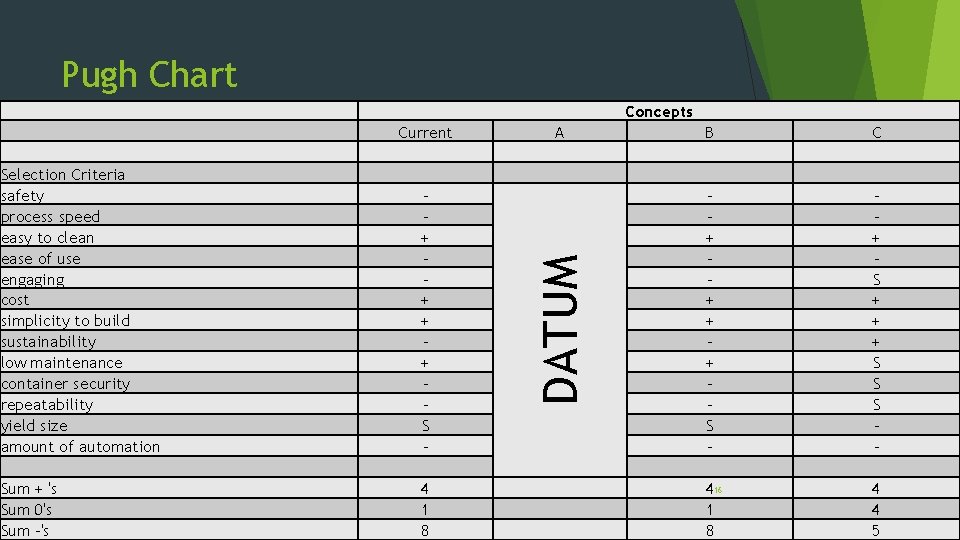
Pugh Chart Sum + 's Sum 0's Sum -'s Concepts Current + + S 4 1 8 A DATUM Selection Criteria safety process speed easy to clean ease of use engaging cost simplicity to build sustainability low maintenance container security repeatability yield size amount of automation B + + S 416 1 8 C + S + + + S S S 4 4 5
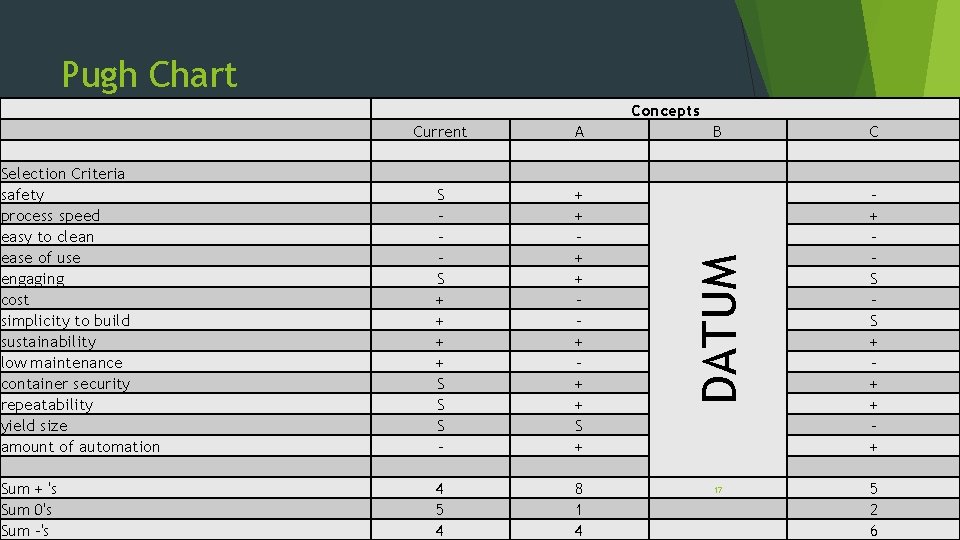
Pugh Chart Sum + 's Sum 0's Sum -'s Concepts Current S S + + S S S 4 5 4 A + + + + S + 8 1 4 B DATUM Selection Criteria safety process speed easy to clean ease of use engaging cost simplicity to build sustainability low maintenance container security repeatability yield size amount of automation 17 C + S S + + 5 2 6
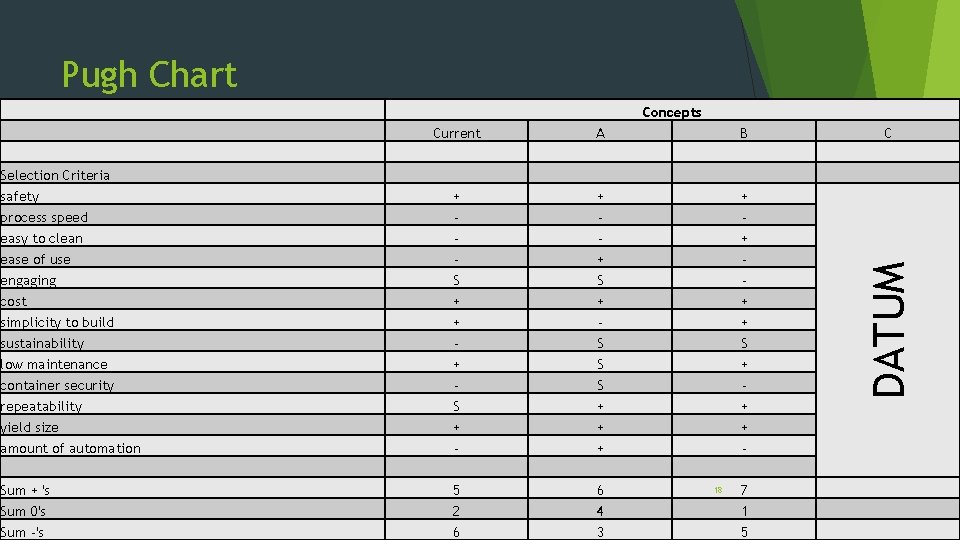
Pugh Chart Sum + 's Sum 0's Sum -'s Concepts Current + S + + + S + A + + S S S + + + 5 2 6 B + + S + + + - C DATUM Selection Criteria safety process speed easy to clean ease of use engaging cost simplicity to build sustainability low maintenance container security repeatability yield size amount of automation 6 4 3 18 7 1 5
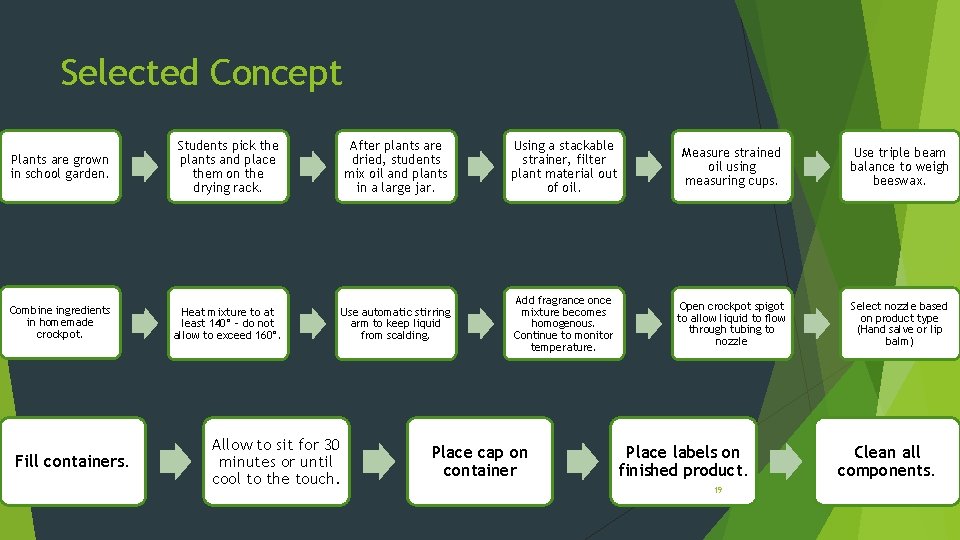
Selected Concept Plants are grown in school garden. Students pick the plants and place them on the drying rack. After plants are dried, students mix oil and plants in a large jar. Using a stackable strainer, filter plant material out of oil. Measure strained oil using measuring cups. Use triple beam balance to weigh beeswax. Combine ingredients in homemade crockpot. Heat mixture to at least 140° - do not allow to exceed 160°. Use automatic stirring arm to keep liquid from scalding. Add fragrance once mixture becomes homogenous. Continue to monitor temperature. Open crockpot spigot to allow liquid to flow through tubing to nozzle Select nozzle based on product type (Hand salve or lip balm) Fill containers. Allow to sit for 30 minutes or until cool to the touch. Place cap on container Place labels on finished product. 19 Clean all components.
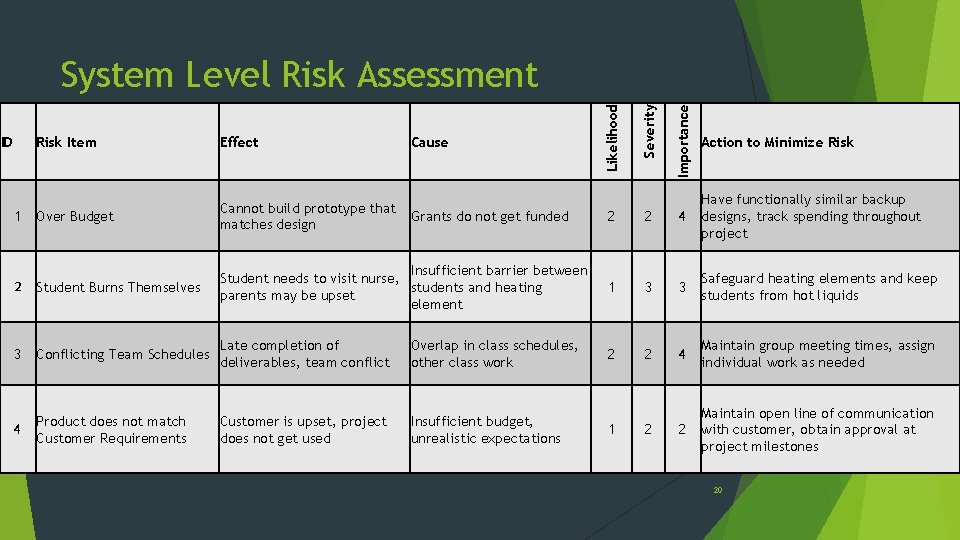
Effect Over Budget Cannot build prototype that matches design 2 Cause Importance Risk Item Severity ID Likelihood System Level Risk Assessment Action to Minimize Risk 2 2 4 Have functionally similar backup designs, track spending throughout project Student Burns Themselves Insufficient barrier between Student needs to visit nurse, students and heating parents may be upset element 1 3 3 Safeguard heating elements and keep students from hot liquids 3 Conflicting Team Schedules Late completion of deliverables, team conflict Overlap in class schedules, other class work 2 2 4 Maintain group meeting times, assign individual work as needed 4 Product does not match Customer Requirements Customer is upset, project does not get used Insufficient budget, unrealistic expectations 2 Maintain open line of communication with customer, obtain approval at project milestones 1 Grants do not get funded 1 2 20
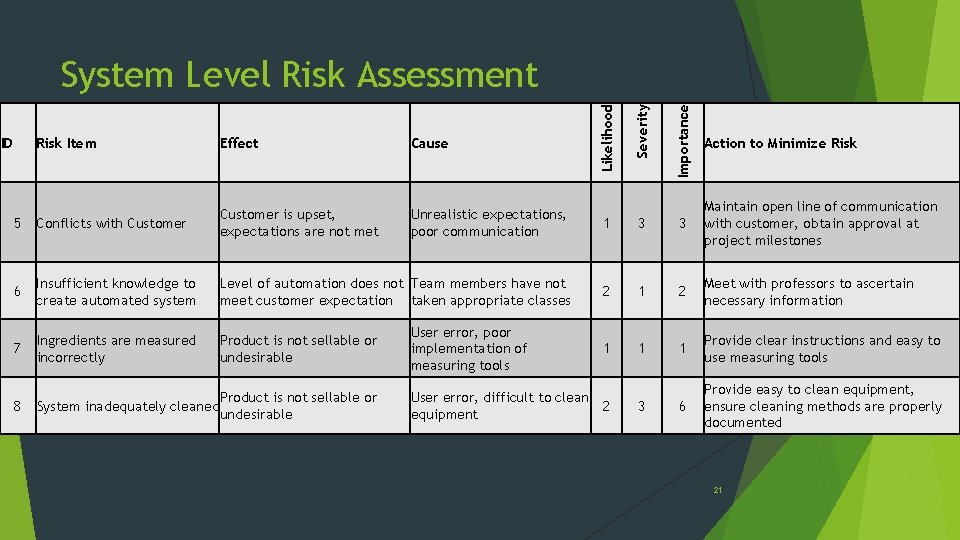
Importance Severity ID Likelihood System Level Risk Assessment Risk Item Effect Cause 5 Conflicts with Customer is upset, expectations are not met Unrealistic expectations, poor communication 1 3 3 Maintain open line of communication with customer, obtain approval at project milestones 6 Insufficient knowledge to create automated system Level of automation does not Team members have not meet customer expectation taken appropriate classes 2 1 2 Meet with professors to ascertain necessary information 7 Ingredients are measured incorrectly Product is not sellable or undesirable 1 1 1 Provide clear instructions and easy to use measuring tools 8 Product is not sellable or System inadequately cleaned undesirable 6 Provide easy to clean equipment, ensure cleaning methods are properly documented User error, poor implementation of measuring tools User error, difficult to clean equipment 2 3 Action to Minimize Risk 21

Detailed Design 22
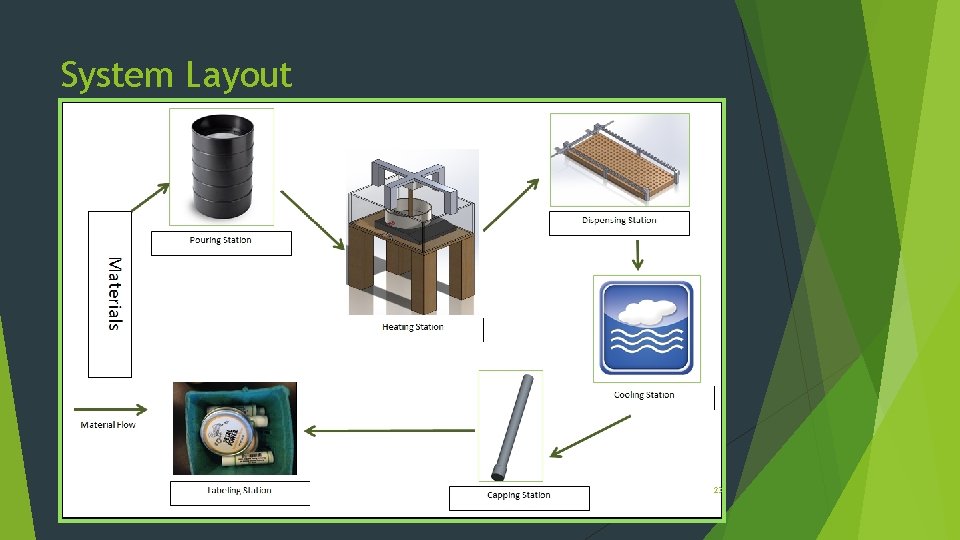
System Layout 23
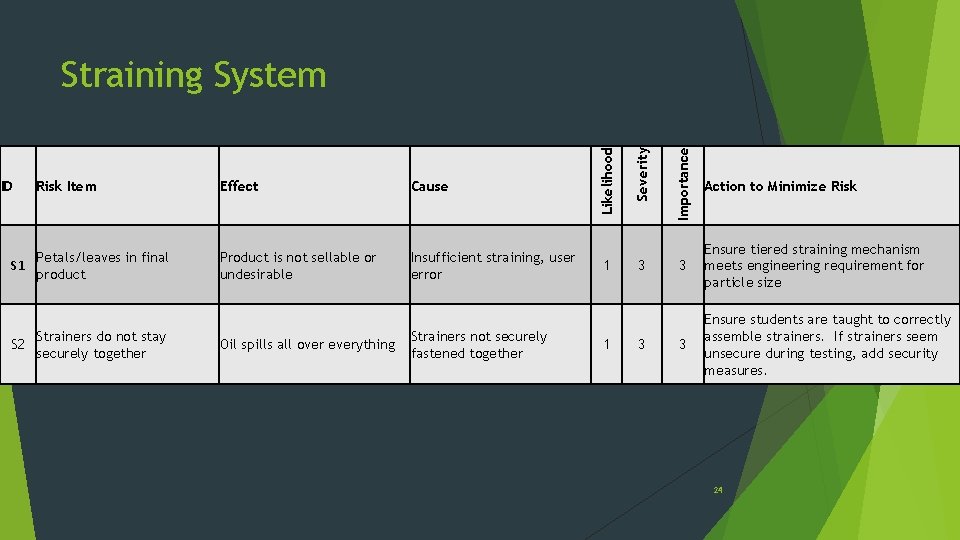
Petals/leaves in final S 1 product S 2 Strainers do not stay securely together Effect Cause Product is not sellable or undesirable Insufficient straining, user error Oil spills all over everything Strainers not securely fastened together 1 1 3 3 Importance Risk Item Severity ID Likelihood Straining System Action to Minimize Risk 3 Ensure tiered straining mechanism meets engineering requirement for particle size 3 Ensure students are taught to correctly assemble strainers. If strainers seem unsecure during testing, add security measures. 24
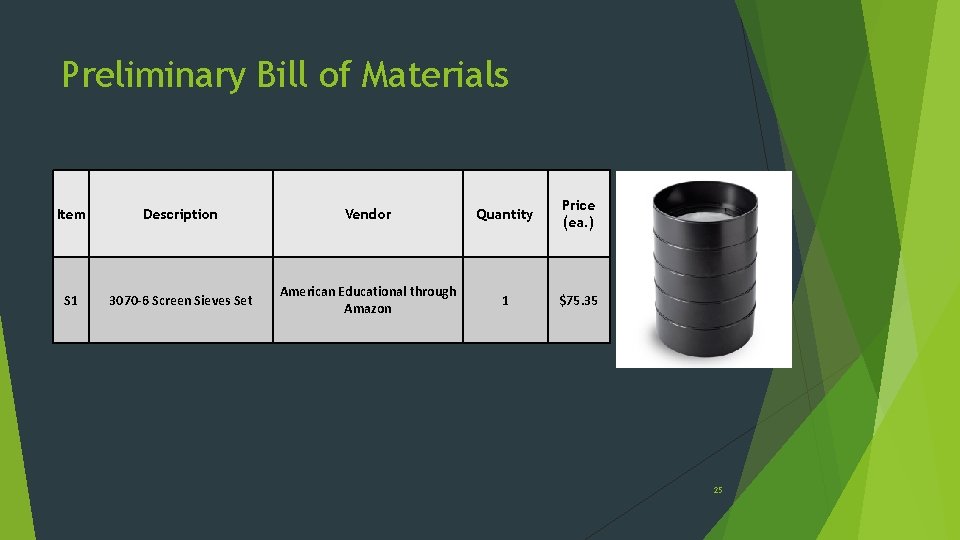
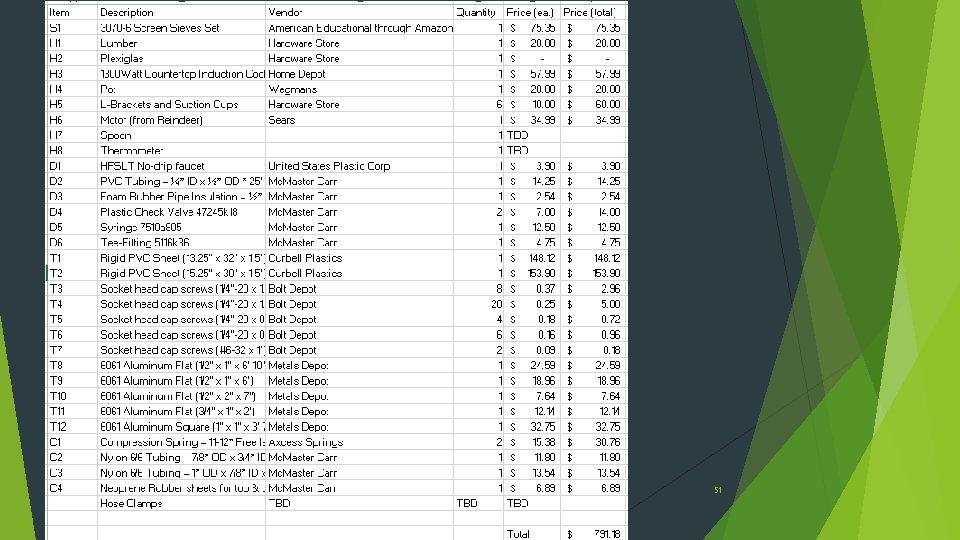
Preliminary Bill of Materials Item Description Vendor Quantity Price (ea. ) S 1 3070 -6 Screen Sieves Set American Educational through Amazon 1 $75. 35 25
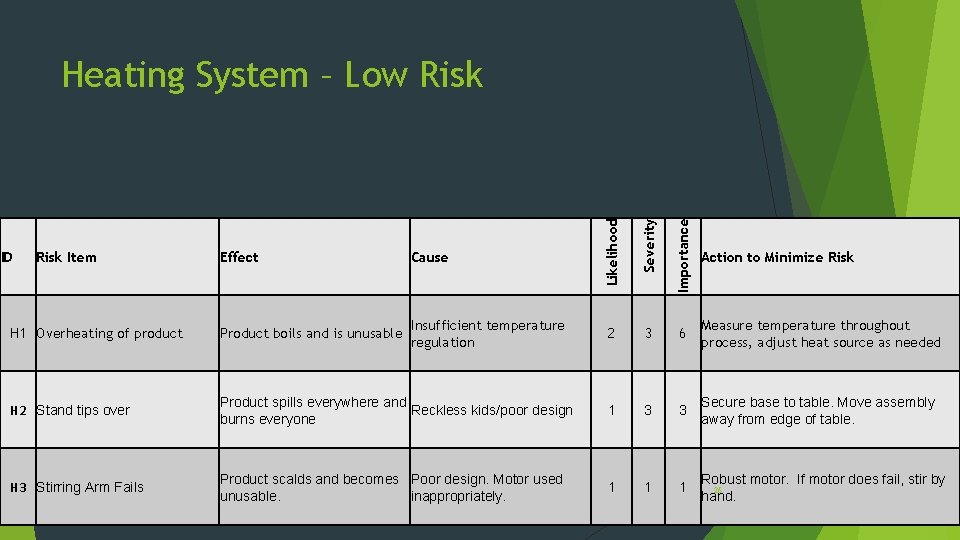
Importance Risk Item Severity ID Likelihood Heating System – Low Risk 2 3 6 Measure temperature throughout process, adjust heat source as needed Product spills everywhere and Reckless kids/poor design burns everyone 1 3 3 Secure base to table. Move assembly away from edge of table. Product scalds and becomes Poor design. Motor used unusable. inappropriately. 1 1 1 Robust motor. If motor does fail, stir by 26 hand. Effect Cause H 1 Overheating of product Product boils and is unusable Insufficient temperature regulation H 2 Stand tips over H 3 Stirring Arm Fails Action to Minimize Risk
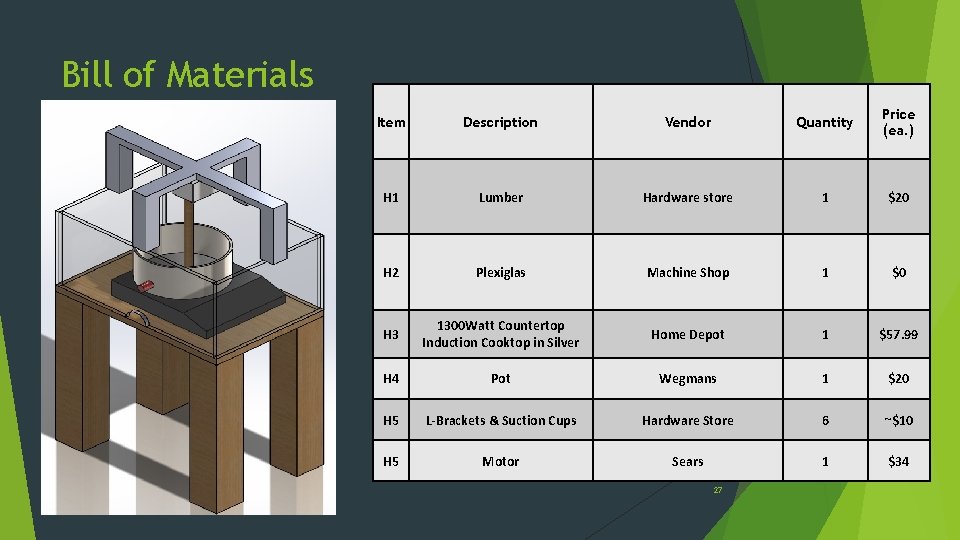
Bill of Materials Item Description Vendor Quantity Price (ea. ) H 1 Lumber Hardware store 1 $20 H 2 Plexiglas Machine Shop 1 $0 H 3 1300 Watt Countertop Induction Cooktop in Silver Home Depot 1 $57. 99 H 4 Pot Wegmans 1 $20 H 5 L-Brackets & Suction Cups Hardware Store 6 ~$10 H 5 Motor Sears 1 $34 27
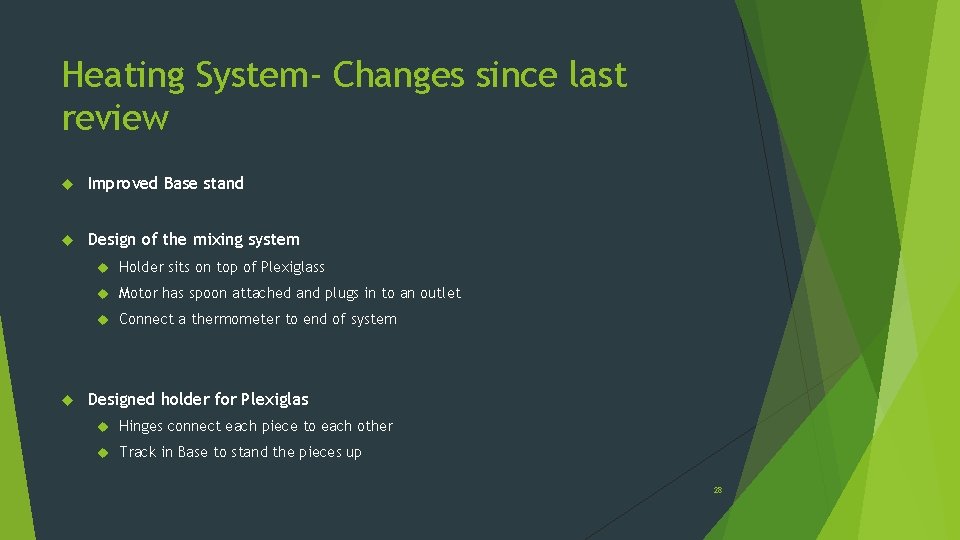
Heating System- Changes since last review Improved Base stand Design of the mixing system Holder sits on top of Plexiglass Motor has spoon attached and plugs in to an outlet Connect a thermometer to end of system Designed holder for Plexiglas Hinges connect each piece to each other Track in Base to stand the pieces up 28
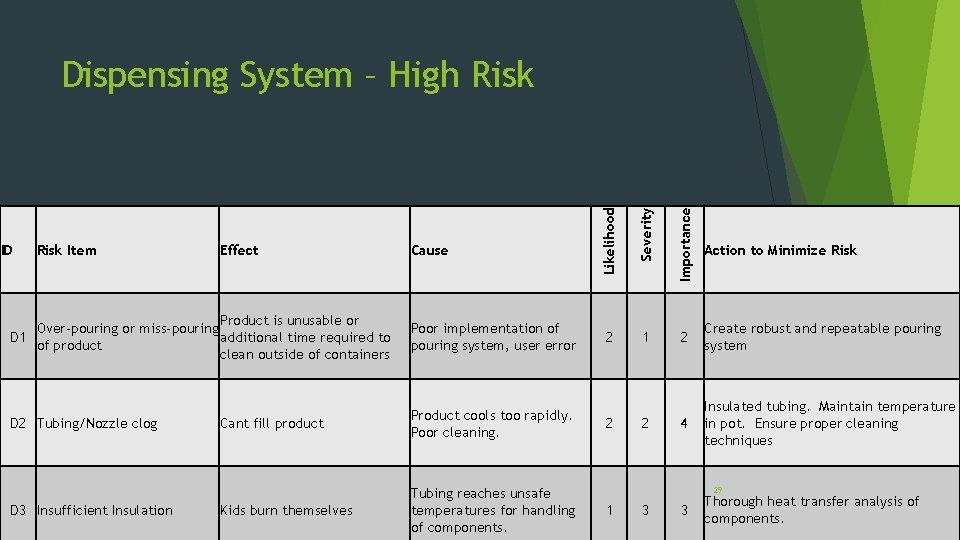
Effect Cause Product is unusable or Over-pouring or miss-pouring D 1 additional time required to of product clean outside of containers Poor implementation of pouring system, user error D 2 Tubing/Nozzle clog Cant fill product Product cools too rapidly. Poor cleaning. Kids burn themselves Tubing reaches unsafe temperatures for handling of components. D 3 Insufficient Insulation Importance Risk Item Severity ID Likelihood Dispensing System – High Risk 2 1 2 2 2 Action to Minimize Risk Create robust and repeatable pouring system 4 Insulated tubing. Maintain temperature in pot. Ensure proper cleaning techniques 3 Thorough heat transfer analysis of components. 29 1 3
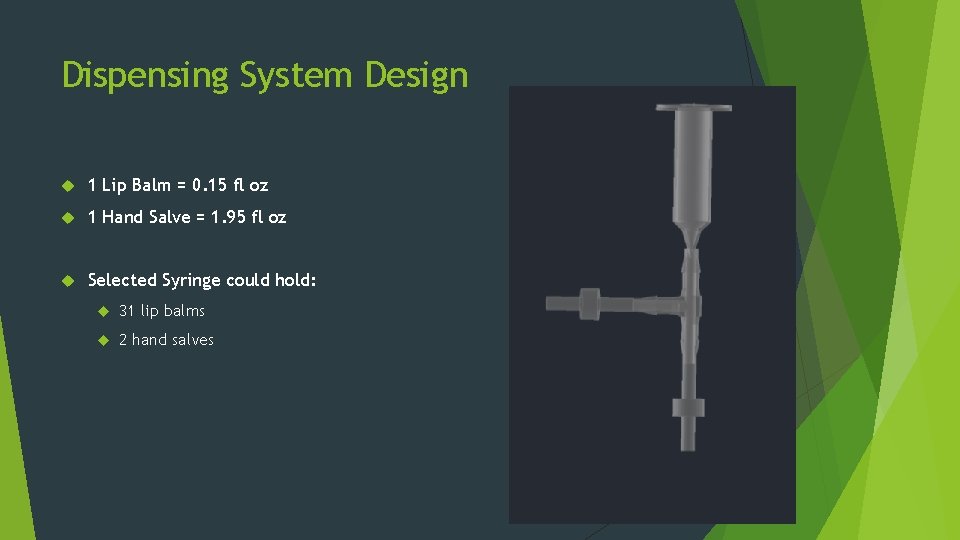
Dispensing System Design 1 Lip Balm = 0. 15 fl oz 1 Hand Salve = 1. 95 fl oz Selected Syringe could hold: 31 lip balms 2 hand salves 30
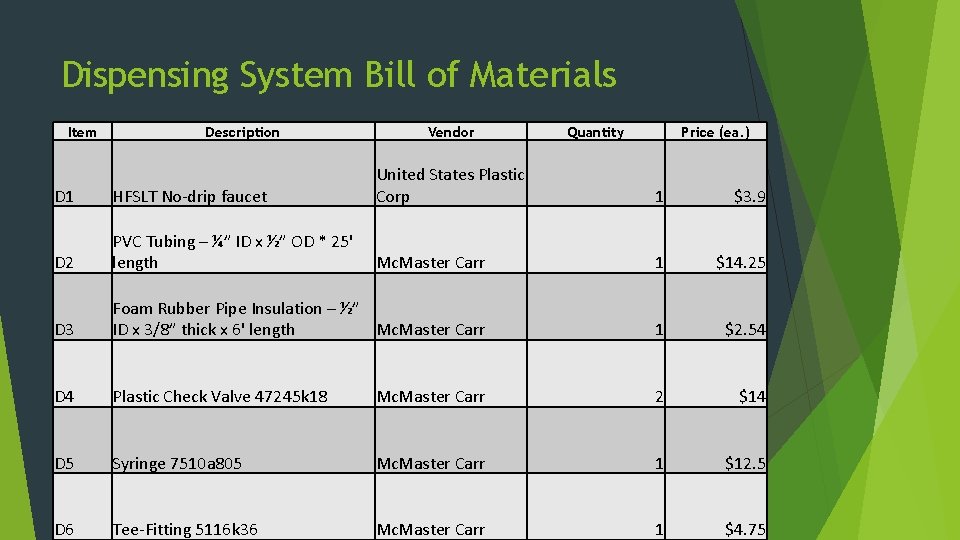
Dispensing System Bill of Materials Item Description Vendor Quantity Price (ea. ) D 1 HFSLT No-drip faucet United States Plastic Corp D 2 PVC Tubing – ¼” ID x ½” OD * 25' length Mc. Master Carr 1 $14. 25 D 3 Foam Rubber Pipe Insulation – ½” ID x 3/8” thick x 6' length Mc. Master Carr 1 $2. 54 D 4 Plastic Check Valve 47245 k 18 Mc. Master Carr 2 $14 D 5 Syringe 7510 a 805 Mc. Master Carr 1 $12. 5 1 $3. 9 31 D 6 Tee-Fitting 5116 k 36 Mc. Master Carr 1 $4. 75
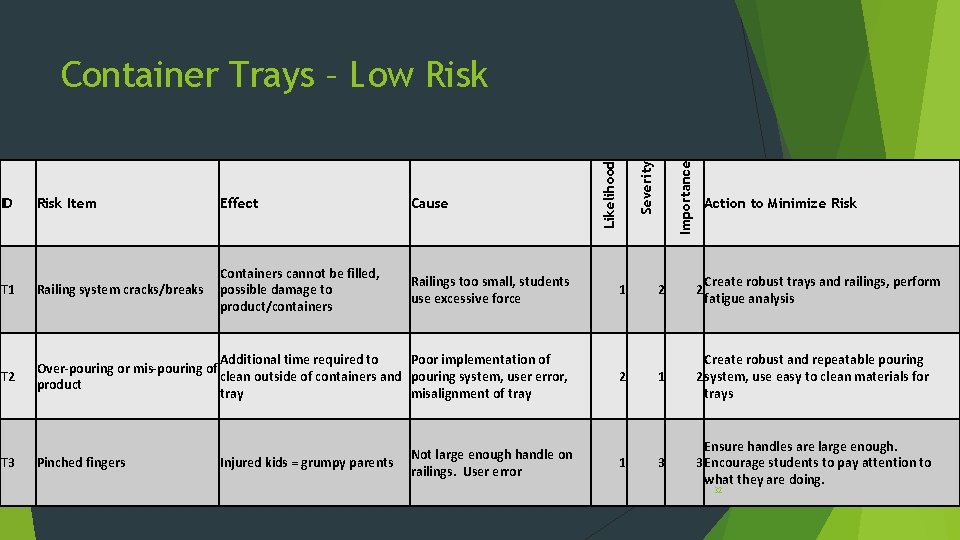
Effect Cause T 1 Railing system cracks/breaks Containers cannot be filled, possible damage to product/containers Railings too small, students use excessive force T 2 Additional time required to Poor implementation of Over-pouring or mis-pouring of clean outside of containers and pouring system, user error, product tray misalignment of tray T 3 Pinched fingers Injured kids = grumpy parents Not large enough handle on railings. User error 1 2 1 Importance Risk Item Likelihood ID Severity Container Trays – Low Risk Action to Minimize Risk Create robust trays and railings, perform fatigue analysis 2 2 1 Create robust and repeatable pouring 2 system, use easy to clean materials for trays 3 Ensure handles are large enough. 3 Encourage students to pay attention to what they are doing. 32
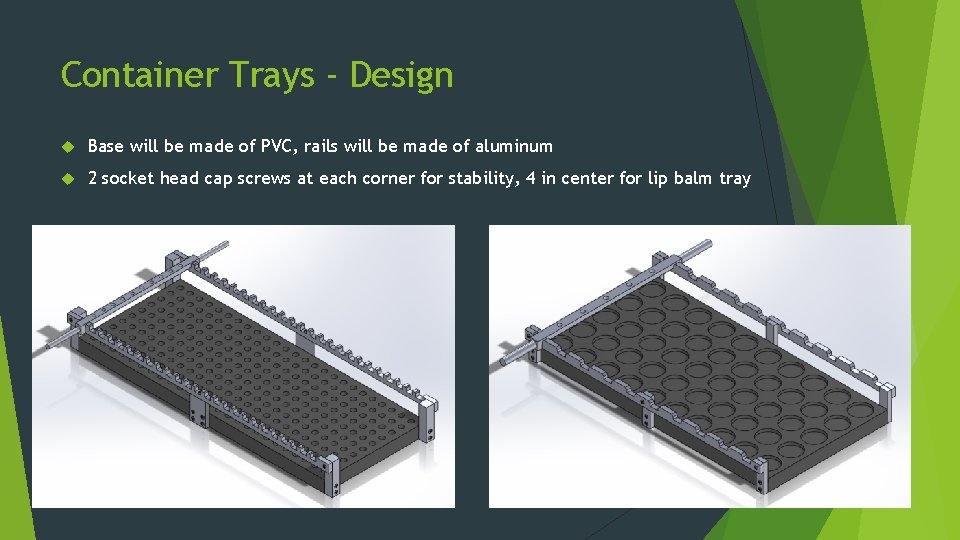
Container Trays - Design Base will be made of PVC, rails will be made of aluminum 2 socket head cap screws at each corner for stability, 4 in center for lip balm tray 33
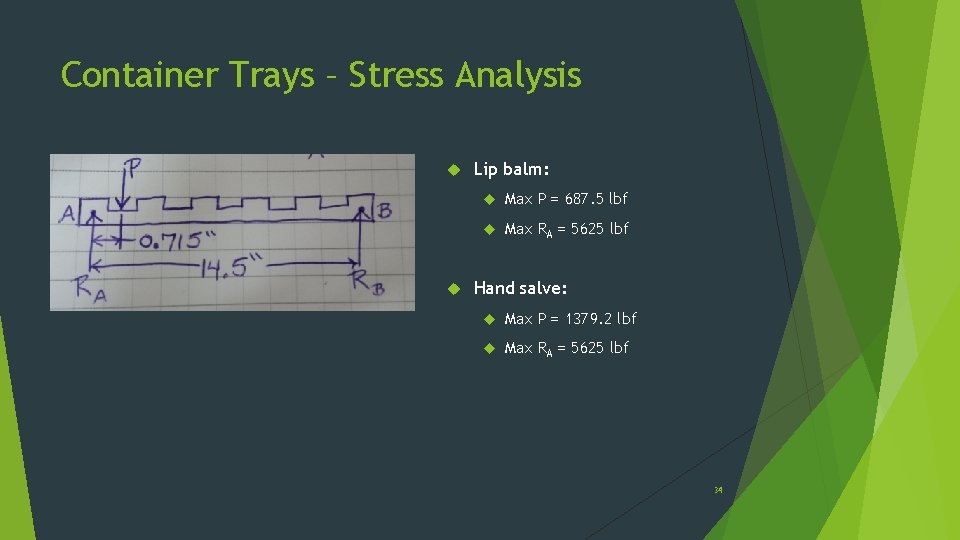
Container Trays – Stress Analysis Lip balm: Max P = 687. 5 lbf Max RA = 5625 lbf Hand salve: Max P = 1379. 2 lbf Max RA = 5625 lbf 34
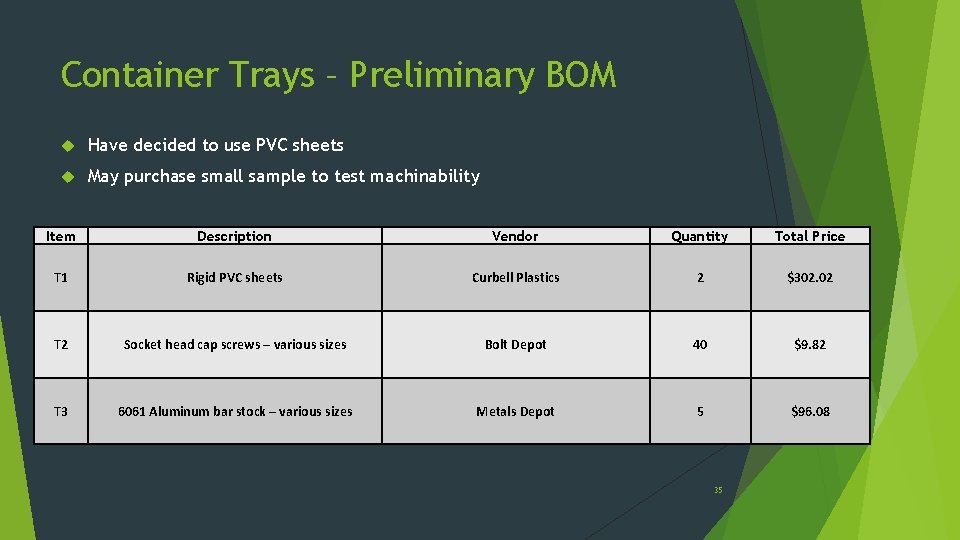
Container Trays – Preliminary BOM Have decided to use PVC sheets May purchase small sample to test machinability Item Description Vendor Quantity Total Price T 1 Rigid PVC sheets Curbell Plastics 2 $302. 02 T 2 Socket head cap screws – various sizes Bolt Depot 40 $9. 82 T 3 6061 Aluminum bar stock – various sizes Metals Depot 5 $96. 08 35
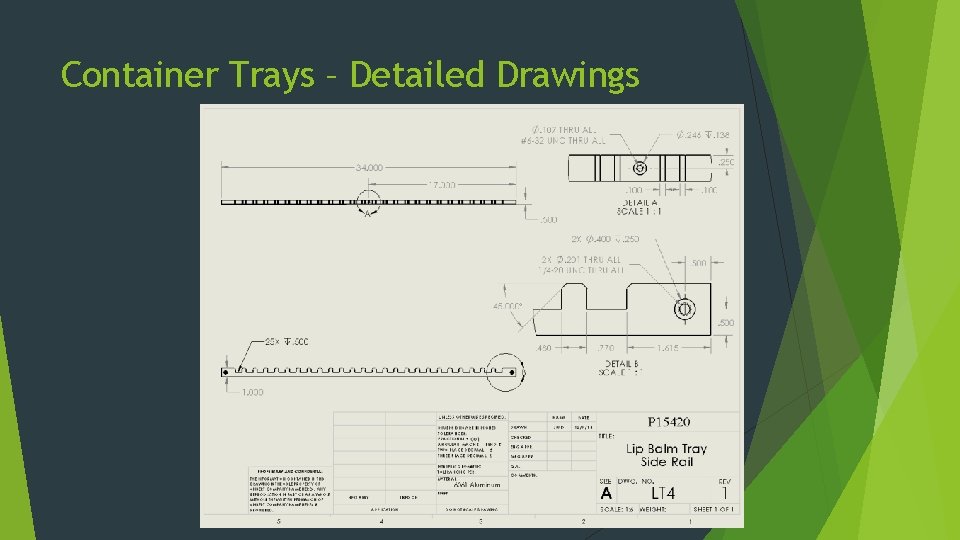
Container Trays – Detailed Drawings 36
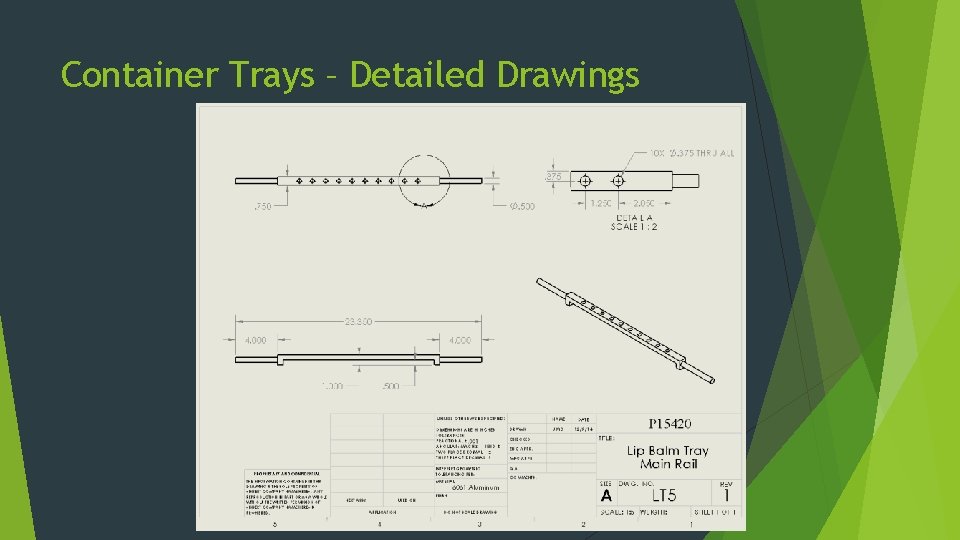
Container Trays – Detailed Drawings 37
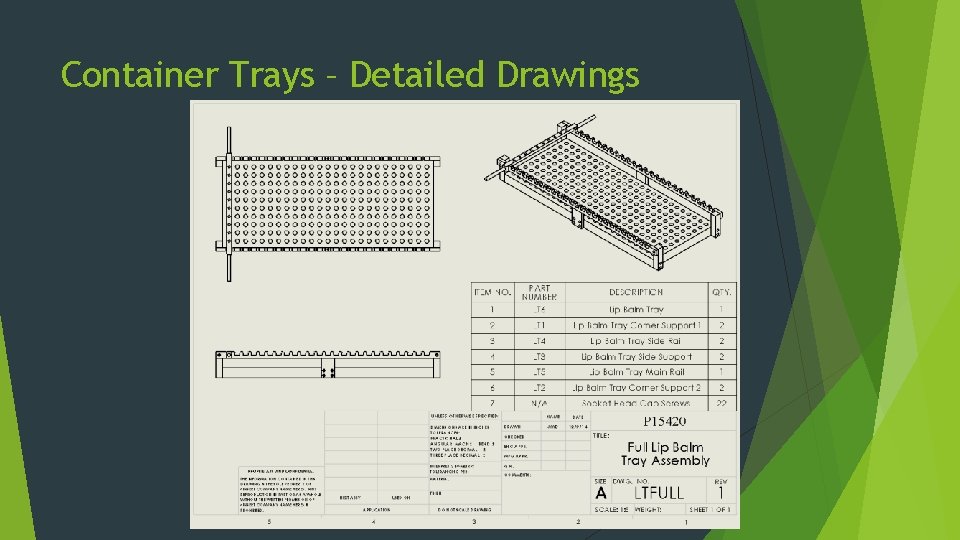
Container Trays – Detailed Drawings 38
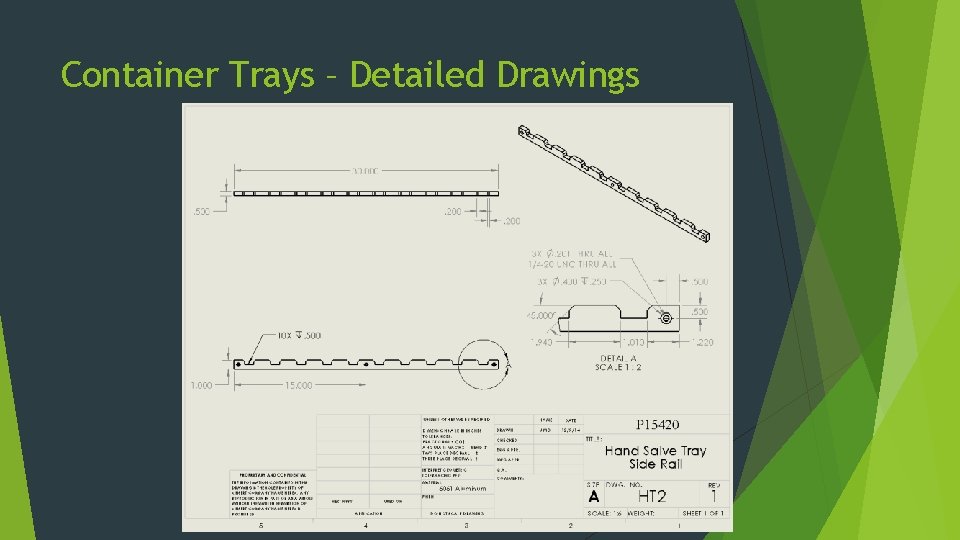
Container Trays – Detailed Drawings 39
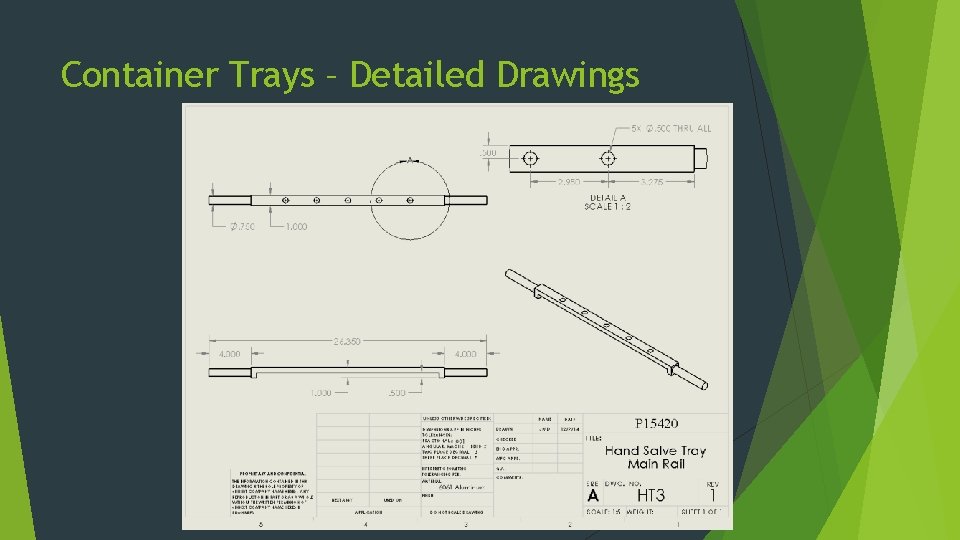
Container Trays – Detailed Drawings 40
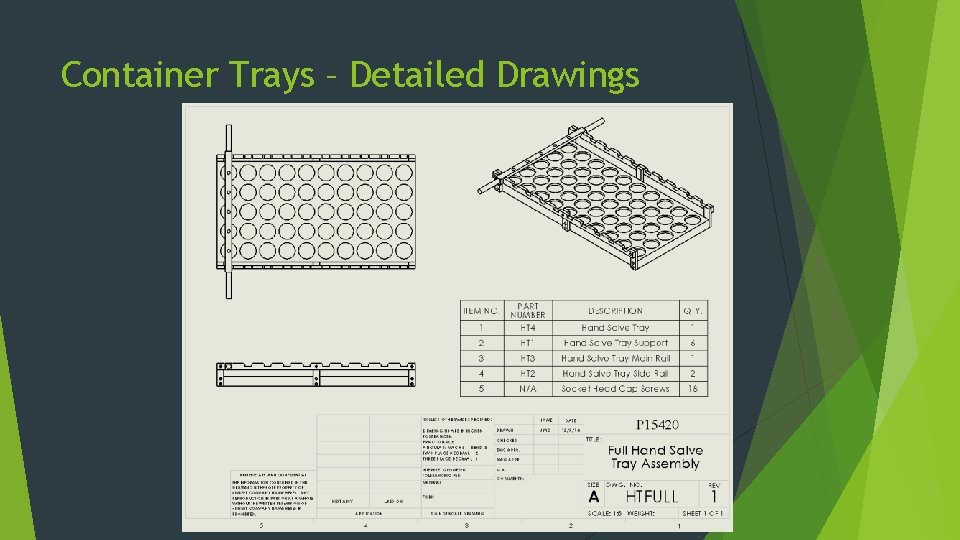
Container Trays – Detailed Drawings 41
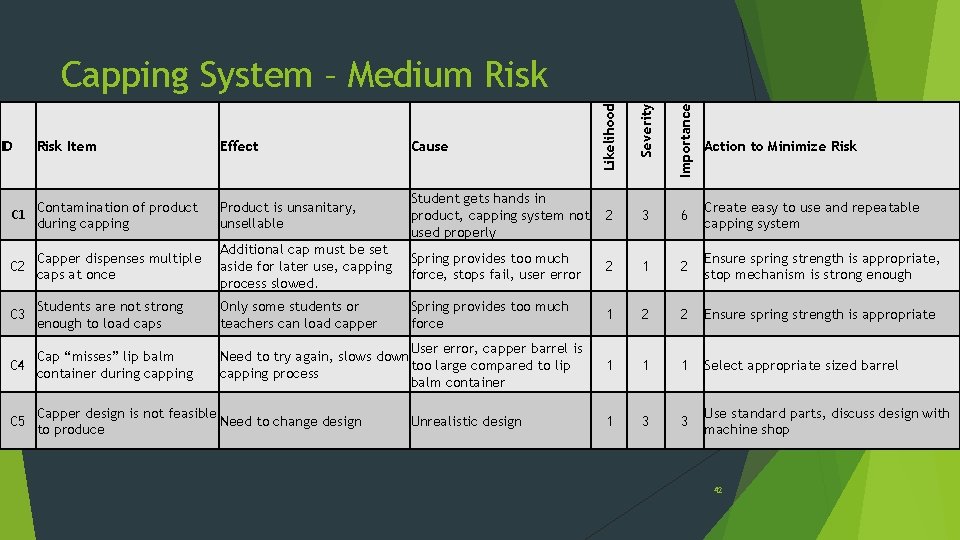
Effect Cause Likelihood Severity Importance Capping System – Medium Risk Contamination of product C 1 during capping Product is unsanitary, unsellable Student gets hands in product, capping system not used properly 2 3 6 Create easy to use and repeatable capping system Capper dispenses multiple C 2 caps at once Additional cap must be set aside for later use, capping process slowed. Spring provides too much force, stops fail, user error 2 1 2 Ensure spring strength is appropriate, stop mechanism is strong enough Only some students or teachers can load capper Spring provides too much force 1 2 2 Ensure spring strength is appropriate 1 1 1 Select appropriate sized barrel 1 3 3 Use standard parts, discuss design with machine shop ID C 3 Risk Item Students are not strong enough to load caps Cap “misses” lip balm C 4 container during capping C 5 User error, capper barrel is Need to try again, slows down too large compared to lip capping process balm container Capper design is not feasible Need to change design to produce Unrealistic design Action to Minimize Risk 42
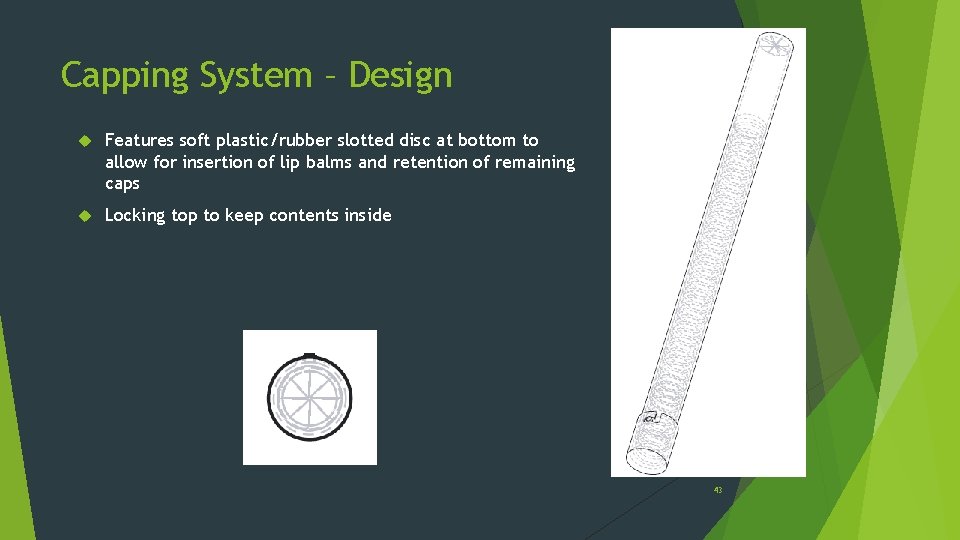
Capping System – Design Features soft plastic/rubber slotted disc at bottom to allow for insertion of lip balms and retention of remaining caps Locking top to keep contents inside 43
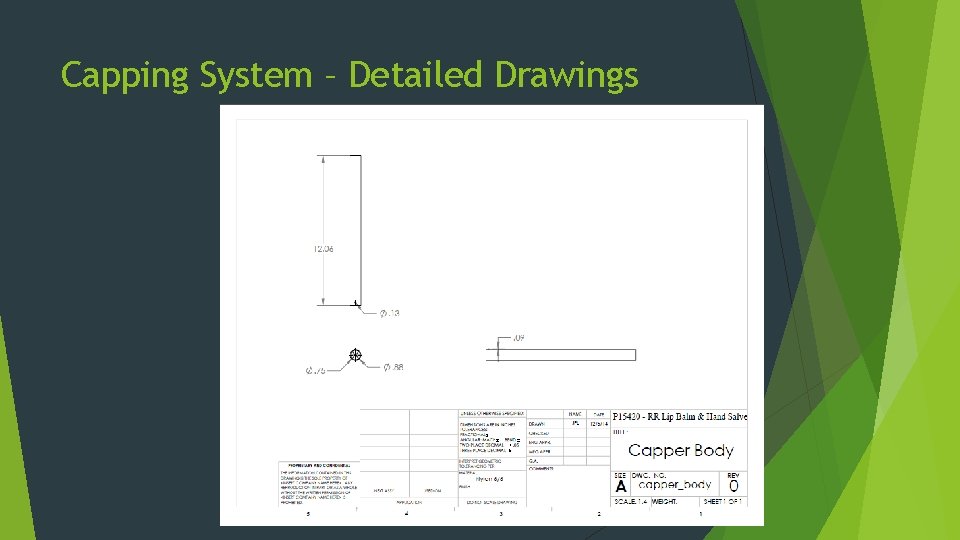
Capping System – Detailed Drawings 44
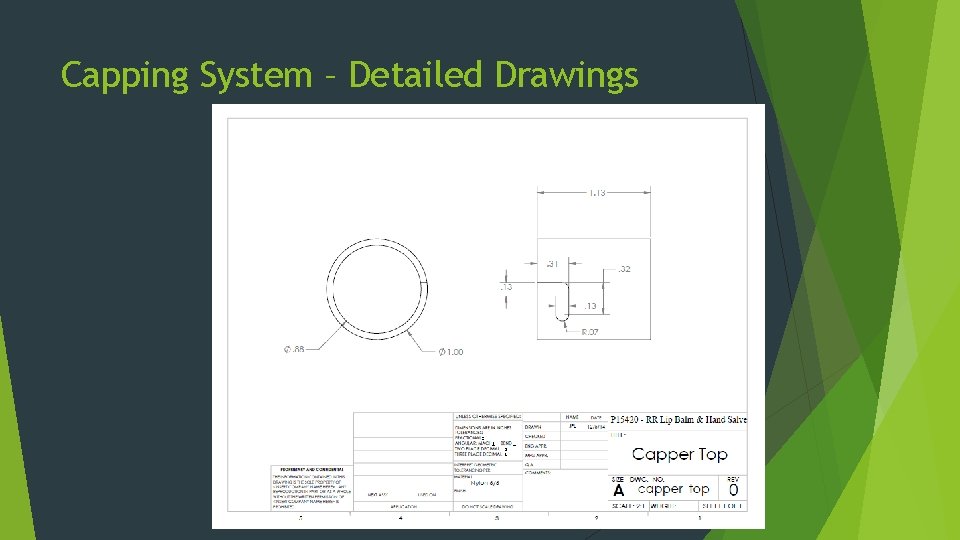
Capping System – Detailed Drawings 45
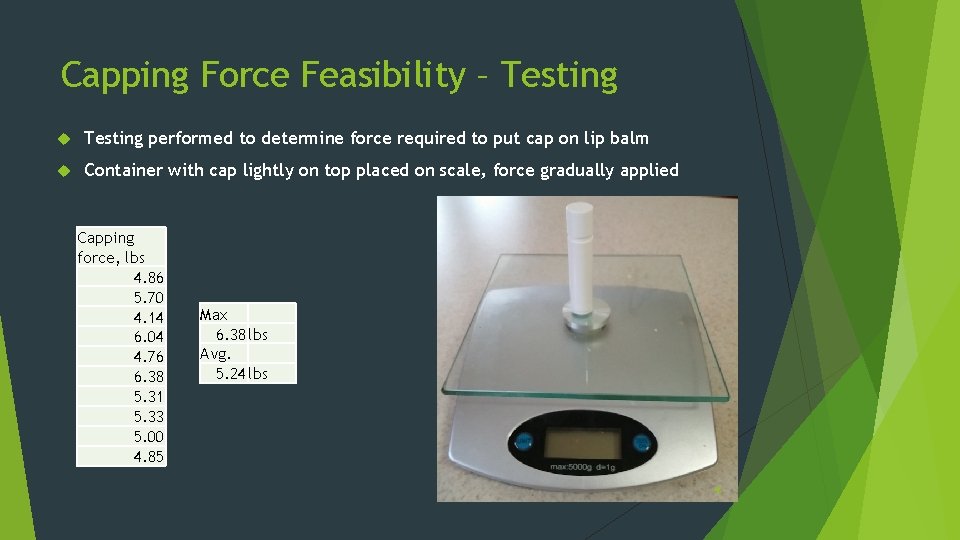
Capping Force Feasibility – Testing performed to determine force required to put cap on lip balm Container with cap lightly on top placed on scale, force gradually applied Capping force, lbs 4. 86 5. 70 4. 14 6. 04 4. 76 6. 38 5. 31 5. 33 5. 00 4. 85 Max 6. 38 lbs Avg. 5. 24 lbs 46
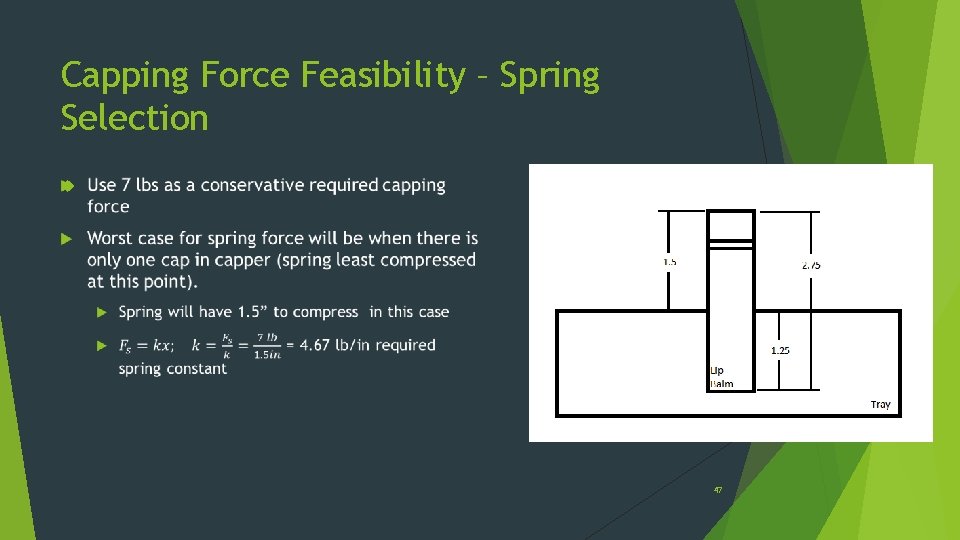
Capping Force Feasibility – Spring Selection 47
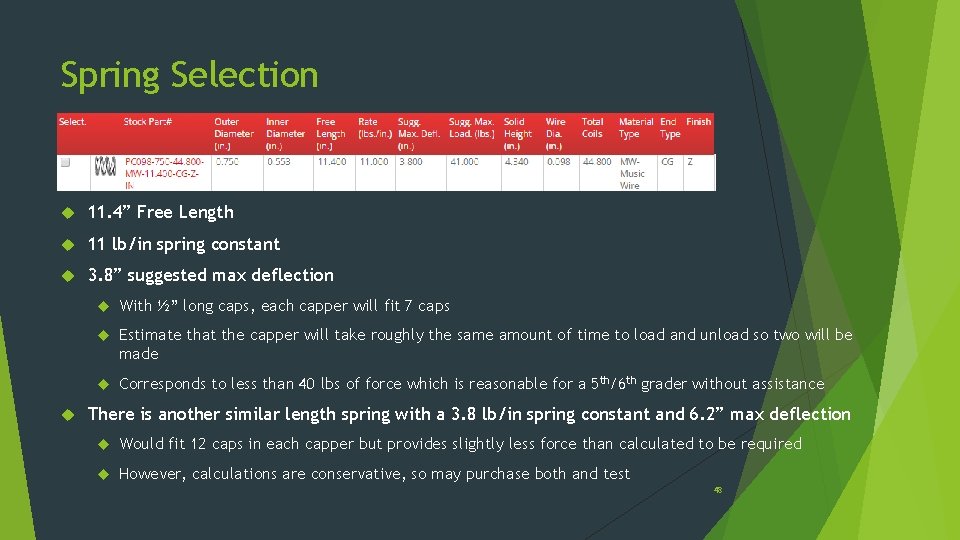
Spring Selection 11. 4” Free Length 11 lb/in spring constant 3. 8” suggested max deflection With ½” long caps, each capper will fit 7 caps Estimate that the capper will take roughly the same amount of time to load and unload so two will be made Corresponds to less than 40 lbs of force which is reasonable for a 5 th/6 th grader without assistance There is another similar length spring with a 3. 8 lb/in spring constant and 6. 2” max deflection Would fit 12 caps in each capper but provides slightly less force than calculated to be required However, calculations are conservative, so may purchase both and test 48
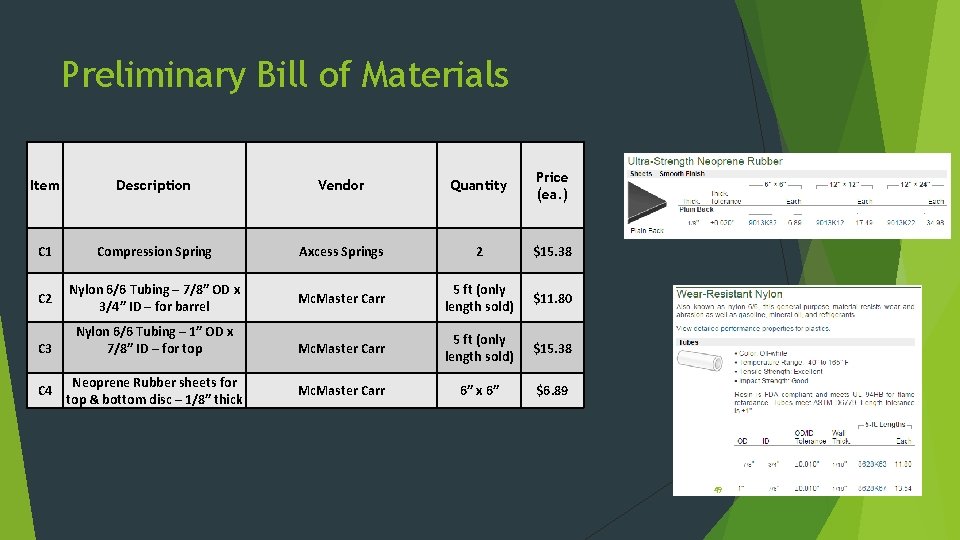
Preliminary Bill of Materials Item Description Vendor Quantity Price (ea. ) C 1 Compression Spring Axcess Springs 2 $15. 38 C 2 Nylon 6/6 Tubing – 7/8” OD x 3/4” ID – for barrel Mc. Master Carr 5 ft (only length sold) $11. 80 Mc. Master Carr 5 ft (only length sold) $15. 38 Mc. Master Carr 6” x 6” $6. 89 C 3 C 4 Nylon 6/6 Tubing – 1” OD x 7/8” ID – for top Neoprene Rubber sheets for top & bottom disc – 1/8” thick 49

Bill of Materials 50
51

Feasibility 52
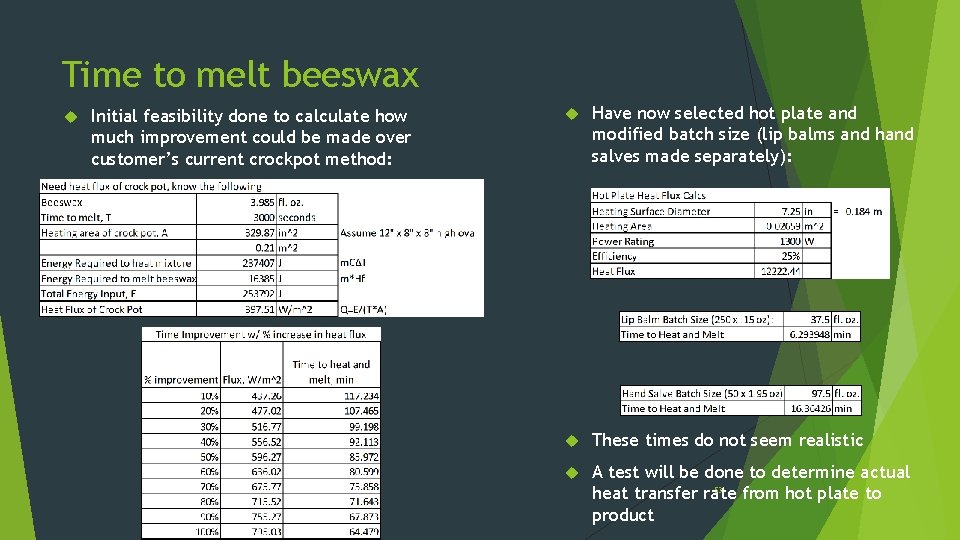
Time to melt beeswax Initial feasibility done to calculate how much improvement could be made over customer’s current crockpot method: Have now selected hot plate and modified batch size (lip balms and hand salves made separately): These times do not seem realistic A test will be done to determine actual 53 heat transfer rate from hot plate to product
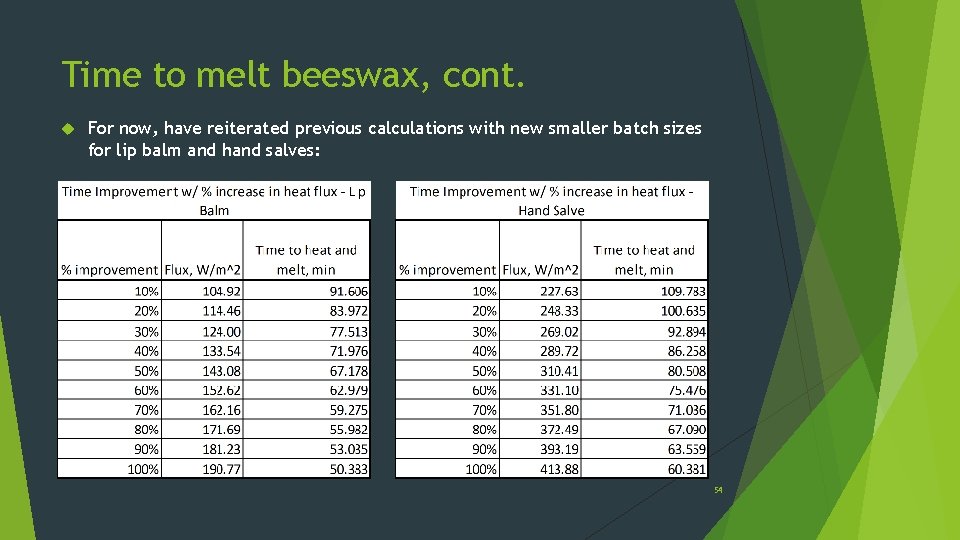
Time to melt beeswax, cont. For now, have reiterated previous calculations with new smaller batch sizes for lip balm and hand salves: 54
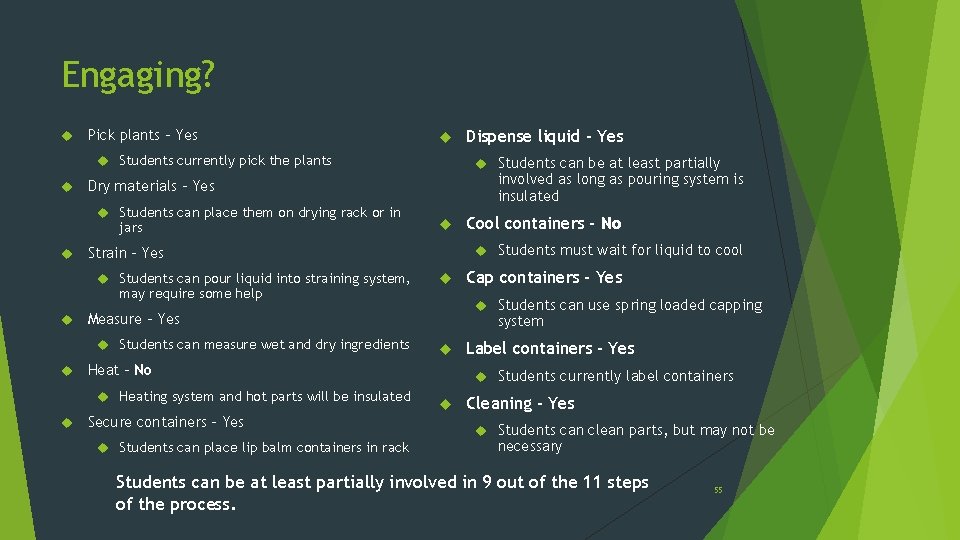
Engaging? Pick plants - Yes Students currently pick the plants jars may require some help Secure containers - Yes Students can place lip balm containers in rack Students can use spring loaded capping system Label containers - Yes Students must wait for liquid to cool Cap containers - Yes Heat - No Heating system and hot parts will be insulated Students can be at least partially involved as long as pouring system is insulated Cool containers - No Measure - Yes Students can measure wet and dry ingredients Strain - Yes Students can pour liquid into straining system, Dry materials - Yes Students can place them on drying rack or in Dispense liquid - Yes Students currently label containers Cleaning - Yes Students can clean parts, but may not be necessary Students can be at least partially involved in 9 out of the 11 steps of the process. 55
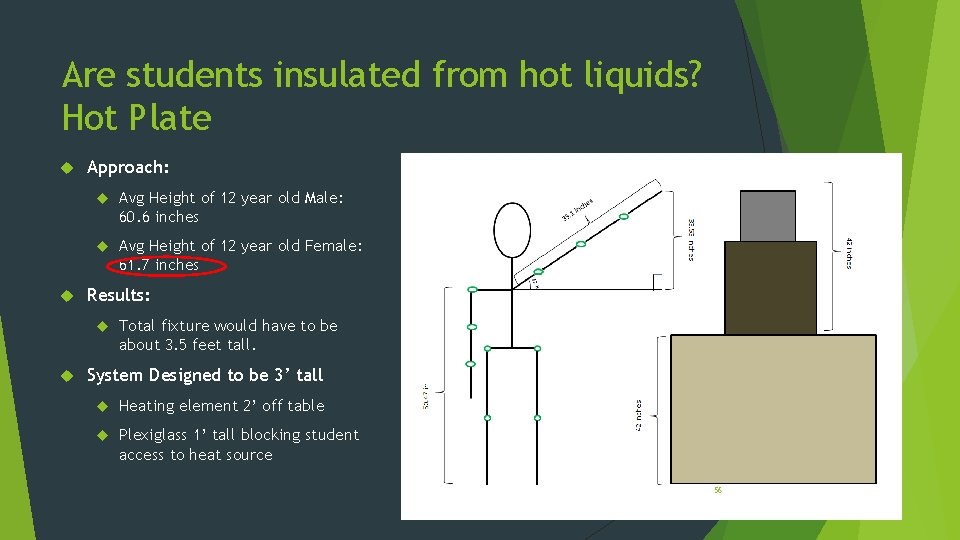
Are students insulated from hot liquids? Hot Plate Approach: Avg Height of 12 year old Male: 60. 6 inches Avg Height of 12 year old Female: 61. 7 inches Results: Total fixture would have to be about 3. 5 feet tall. System Designed to be 3’ tall Heating element 2’ off table Plexiglass 1’ tall blocking student access to heat source 56
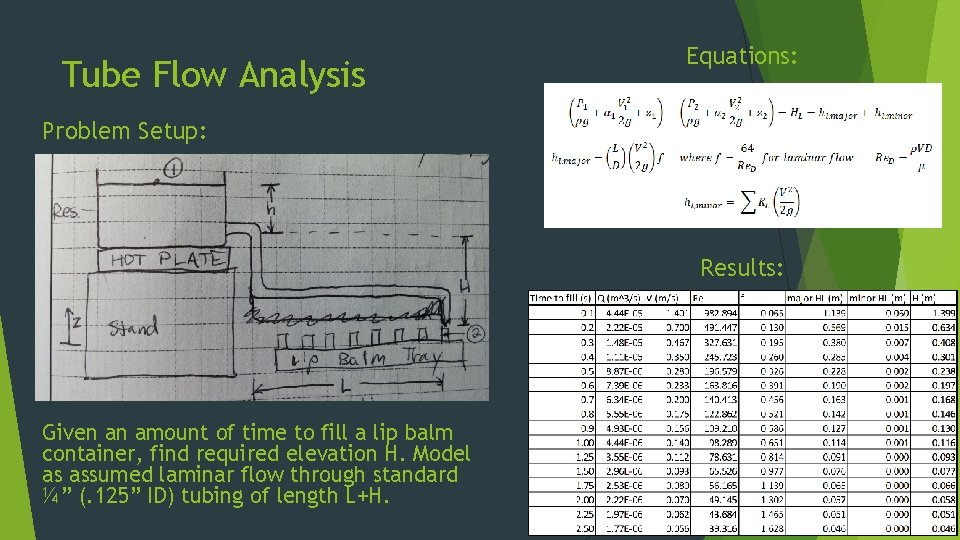
Tube Flow Analysis Equations: Problem Setup: Results: Given an amount of time to fill a lip balm container, find required elevation H. Model as assumed laminar flow through standard ¼” (. 125” ID) tubing of length L+H.
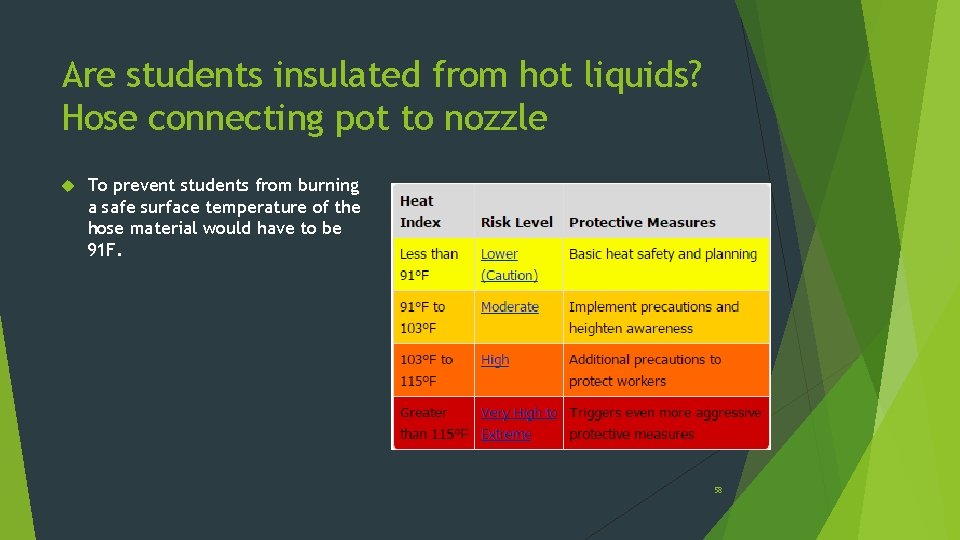
Are students insulated from hot liquids? Hose connecting pot to nozzle To prevent students from burning a safe surface temperature of the hose material would have to be 91 F. 58
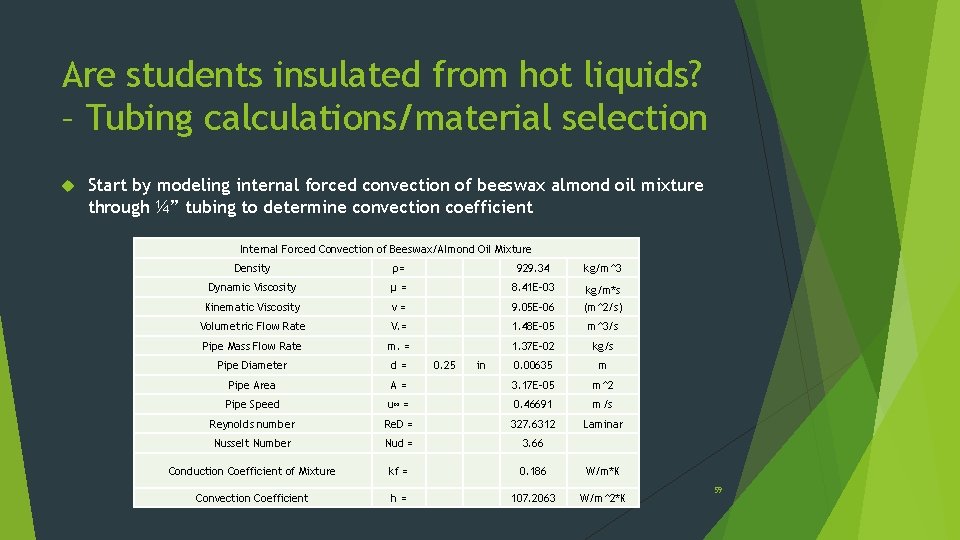
Are students insulated from hot liquids? – Tubing calculations/material selection Start by modeling internal forced convection of beeswax almond oil mixture through ¼” tubing to determine convection coefficient Internal Forced Convection of Beeswax/Almond Oil Mixture Density ρ= 929. 34 kg/m^3 Dynamic Viscosity μ= 8. 41 E-03 kg/m*s Kinematic Viscosity v= 9. 05 E-06 (m^2/s) Volumetric Flow Rate V. = 1. 48 E-05 m^3/s Pipe Mass Flow Rate m. = 1. 37 E-02 kg/s Pipe Diameter d= 0. 25 in 0. 00635 m Pipe Area A= 3. 17 E-05 m^2 Pipe Speed u∞ = 0. 46691 m/s Reynolds number Re. D = 327. 6312 Laminar Nusselt Number Nud = 3. 66 Conduction Coefficient of Mixture kf = 0. 186 W/m*K Convection Coefficient h= 107. 2063 W/m^2*K 59

Are students insulated from hot liquids? – Tubing calculations/material selection T 3 T 2 ho, To T 1 hi, Ti k. T k. I 60
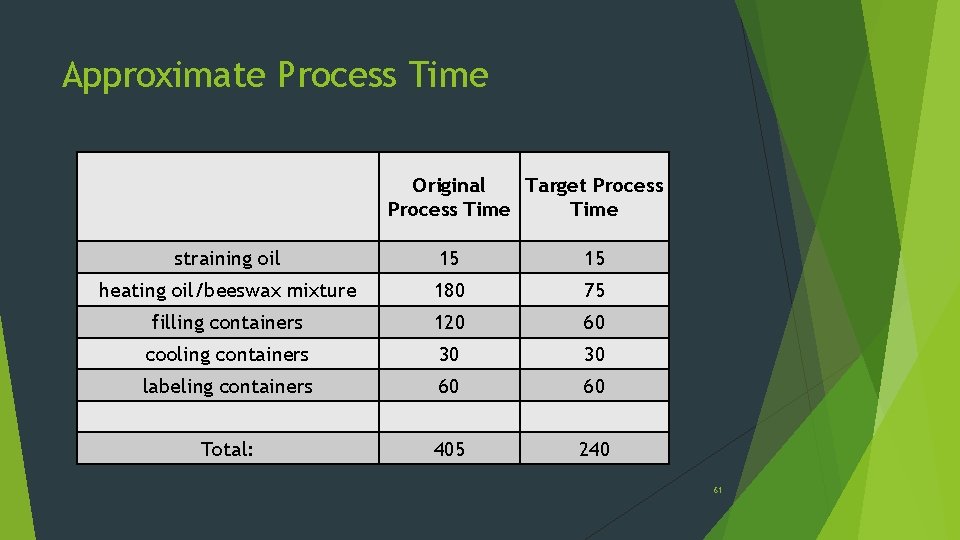
Approximate Process Time Original Target Process Time straining oil 15 15 heating oil/beeswax mixture 180 75 filling containers 120 60 cooling containers 30 30 labeling containers 60 60 Total: 405 240 61
Material Selection Tested: Steel, Pyrex, Stoneware, and Porcelain Compared room temperature wax removal to cooled ice removal Preferred method of cleaning pot Let residual mixture cool Use ice to loosen residual (edge of ice quickly loosens material) Wipe clean with paper towels Hand wash with cold water Tubing Run through with cold water Use bottle brush to clean out

Test Plan 63
Test Plan ER 1 – Footprint Size (Marginal 12’x 3. 5’ (double check number)) Set up entire process Measure dimensions of set up on lab bench ER 2 – Weight of individual components (marginal: <30 lbs; ideal < 15 lbs) Weigh each component to ensure meet engineering requirement ER 3 – Elapsed Process Time (marginal: 6 hrs, ideal: 4 hrs) Using a stopwatch measure time to make a batch from beginning to end Also measure time duration of each subsystem to identify any issues 64

Test Plan ER 4 – Yield Size Capacity ER 6 – Prototype Cost Not testing – used in design Not testing – monitor spending throughout process ER 7 – Manufacturing Cost Not testing 65

Test Plan ER 8 – Heating Element Temperature Range Obtain thermometer Compare thermometer readings with hot plate display Provide detailed list for users limiting which settings should be used ER 9 – Number of Students involved ER 10 – Time to clean Once process has been run to completion; time duration of cleaning 66
Test Plan ER 11 – Percentage of single use material that is compostable At current point, there are no single use materials If any begin to be used, record which type of materials are being used ER 12 – Degree of automation of pouring process Not testing – used in designed ER 13 – Storage Size Disassemble set up and measure space requirement for storage 67
Test Plan ER 14 – Breakdown/set up time Allow typical user to practice how to assemble components Time typical user setting up ER 15 – Percent acceptable products based on oz Allow users to become familiar with set up For each batch, record amount of product being placed in pot and number of ER 16 – Maximum particle size after straining Have students test each strainer to visually see what oil looks like after straining Design will include small enough holes to meet requirement 68
Test Plan ER 17 – Minimize student contact with heating source/hot liquids ER 18 – Degree of automation of capping process Not testing – used in design ER 19 – No parts smaller than lip balm cap Once system is in use, measure temperature at points of concern Measure any parts that appear smaller than safe for students Test heating element at various set points with set amount of water to determine flow of heat into system for use with feasibility analysis 69
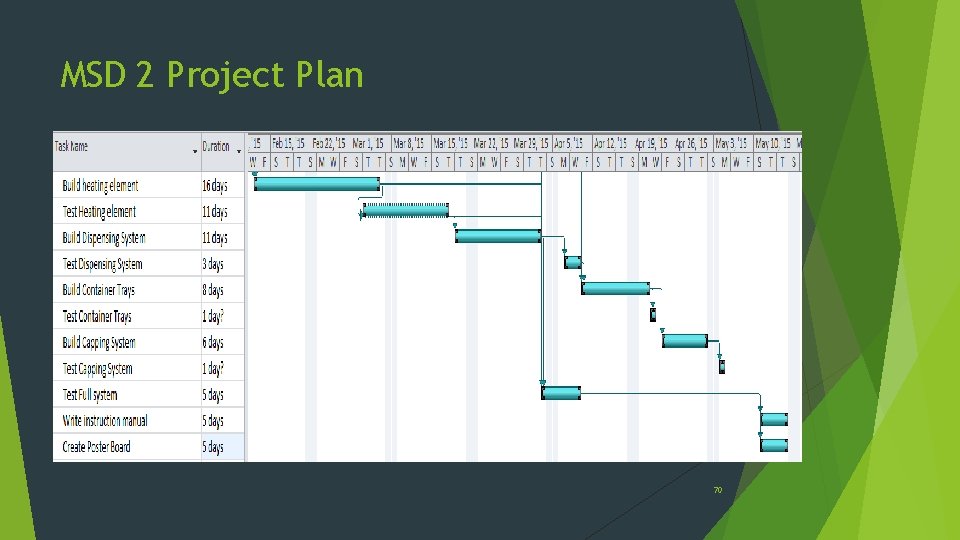
MSD 2 Project Plan 70

Questions? 71
- Slides: 71