
Linux Network Programming with P 4 Linux Plumbers
Linux Network Programming with P 4 Linux Plumbers 2018 Fabian Ruffy, William Tu, Mihai Budiu VMware Inc. and University of British Columbia
Outline • Introduction to P 4 • XDP and the P 4 Compiler • Testing • Example • Performance Results • Discussion Fabian William 2
What is P 4? • High-level programming language for network data planes • Allows for protocol flexibility • Specifies a packet processing pipeline • Compiled and loaded into target platform • Open and standardized P 4: Programming Protocol-Independent Packet Processors Pat Bosshart, Dan Daly, Glen Gibb, Martin Izzard, Nick Mc. Keown, Jennifer Rexford, Cole Schlesinger, Dan Talayco, Amin Vahdat, George Varghese, David Walker ACM SIGCOMM Computer Communications Review (CCR). Volume 44, Issue #3 (July 2014) 3
P 4 Essentials • C-like, strongly typed language • Type and memory-safe (no pointers) • Bounded execution (no loops) • Statically allocated (no malloc, no recursion) • Spec: http: //github. com/p 4 lang/p 4 -spec • Reference compiler implementation: http: //github. com/p 4 lang/p 4 c (Apache 2 license) 4
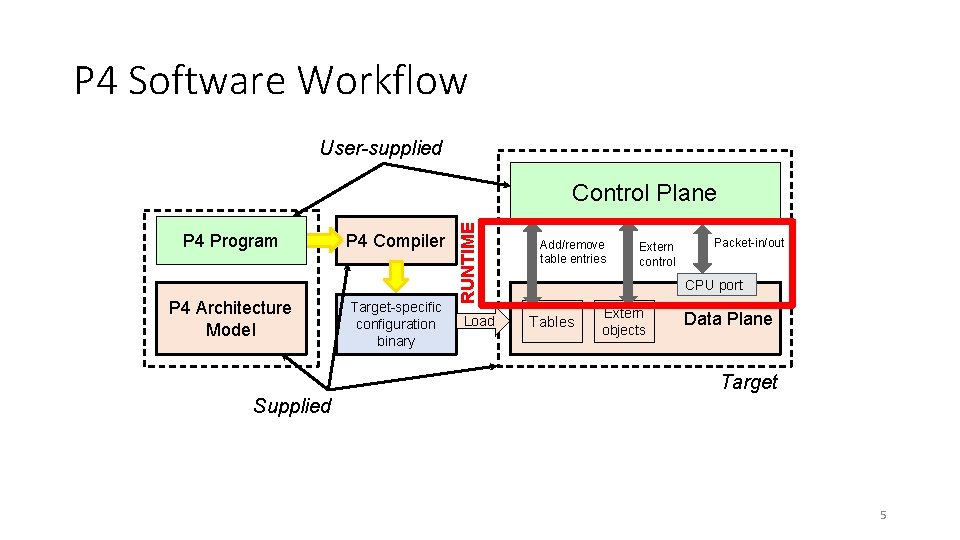
P 4 Software Workflow User-supplied P 4 Program P 4 Architecture Model P 4 Compiler Target-specific configuration binary RUNTIME Control Plane Load Add/remove table entries Extern control Packet-in/out CPU port Tables Extern objects Data Plane Target Supplied 5
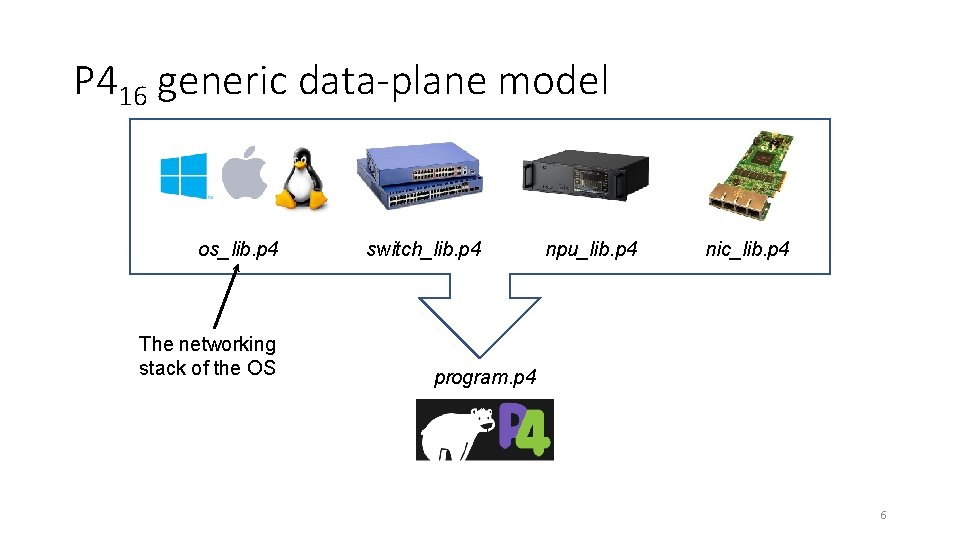
P 416 generic data-plane model os_lib. p 4 The networking stack of the OS switch_lib. p 4 npu_lib. p 4 nic_lib. p 4 program. p 4 6
P 4 and XDP 7
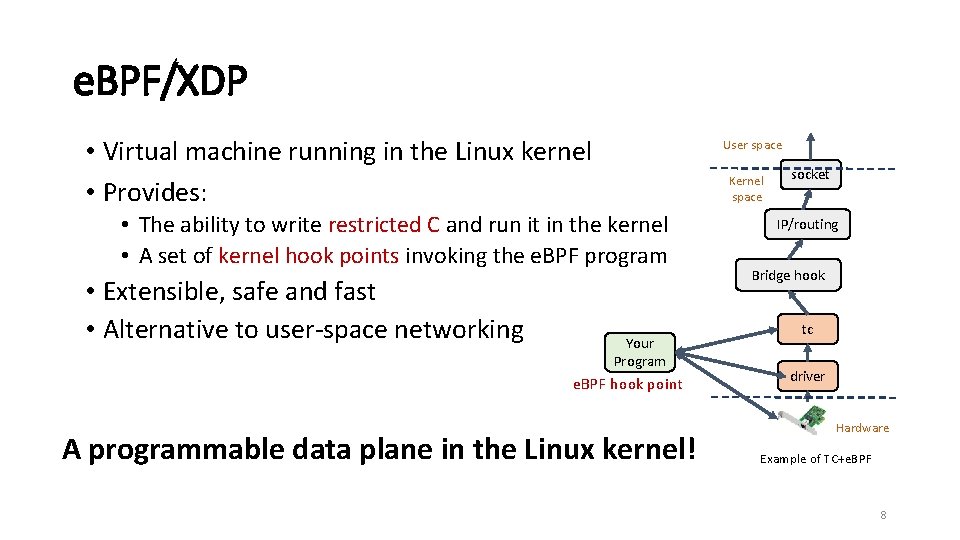
e. BPF/XDP • Virtual machine running in the Linux kernel • Provides: User space Kernel space • The ability to write restricted C and run it in the kernel • A set of kernel hook points invoking the e. BPF program • Extensible, safe and fast • Alternative to user-space networking Your Program e. BPF hook point A programmable data plane in the Linux kernel! socket IP/routing Bridge hook tc driver Hardware Example of TC+e. BPF 8
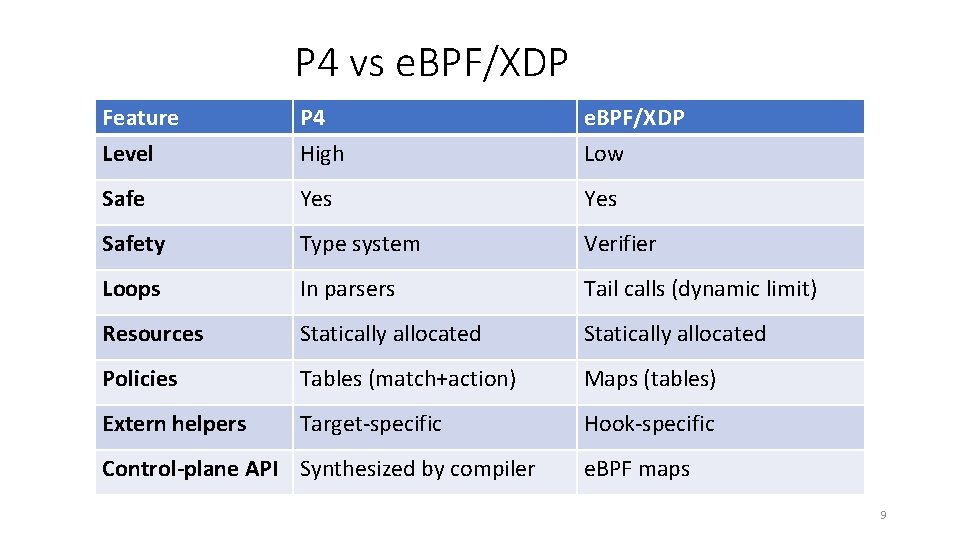
P 4 vs e. BPF/XDP Feature Level P 4 High e. BPF/XDP Low Safe Yes Safety Type system Verifier Loops In parsers Tail calls (dynamic limit) Resources Statically allocated Policies Tables (match+action) Maps (tables) Extern helpers Target-specific Hook-specific Control-plane API Synthesized by compiler e. BPF maps 9
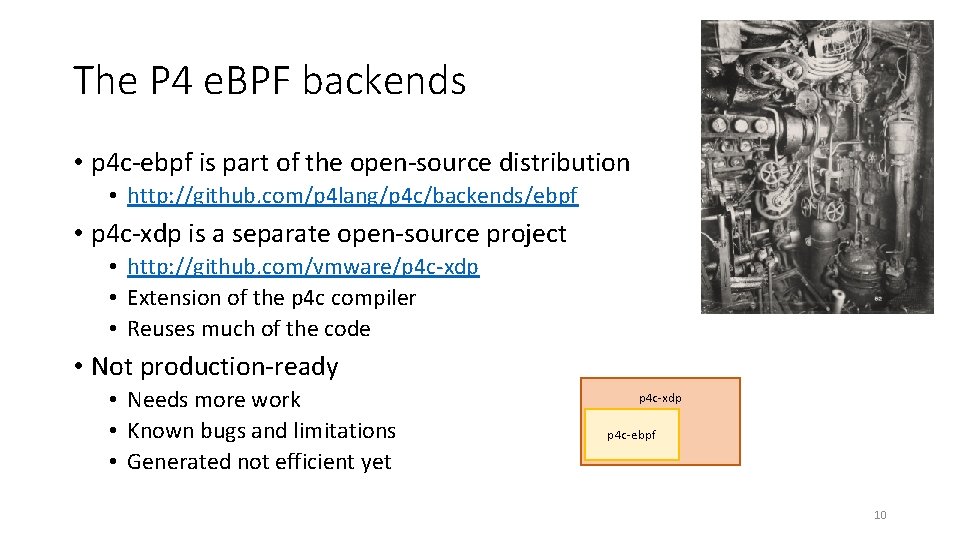
The P 4 e. BPF backends • p 4 c-ebpf is part of the open-source distribution • http: //github. com/p 4 lang/p 4 c/backends/ebpf • p 4 c-xdp is a separate open-source project • http: //github. com/vmware/p 4 c-xdp • Extension of the p 4 c compiler • Reuses much of the code • Not production-ready • Needs more work • Known bugs and limitations • Generated not efficient yet p 4 c-xdp p 4 c-ebpf 10

Generating XDP code 11
P 416 -> C -> e. BPF/XDP • Generates stylized C • No tail calls yet, all data on stack • e. BPF tables control/data-plane communication • Can do filtering, forwarding, encapsulation • Relies on Linux TC forwarding • We plan on switching to libbpf 12
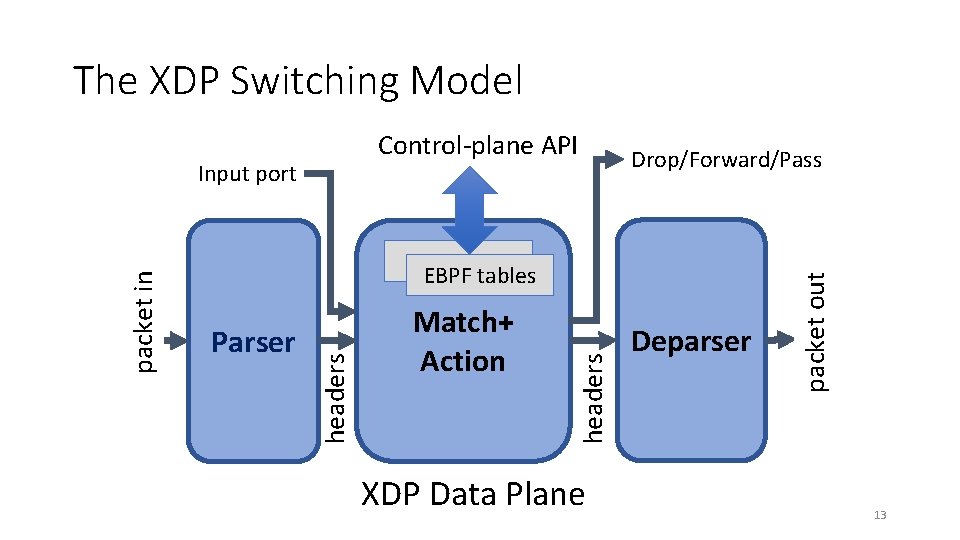
The XDP Switching Model Parser Match+ Action headers EBPF tables headers packet in Input port Drop/Forward/Pass XDP Data Plane Deparser packet out Control-plane API 13
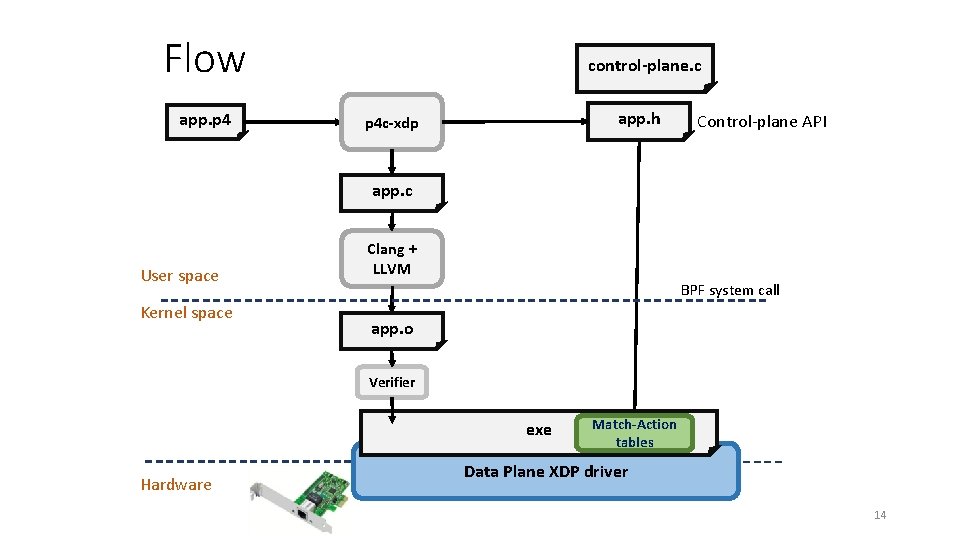
Flow app. p 4 control-plane. c app. h p 4 c-xdp Control-plane API app. c User space Kernel space Clang + LLVM BPF system call app. o Verifier exe Hardware Match-Action tables Data Plane XDP driver 14
Testing P 4 -XDP code 15
Test Frameworks • User-space testing • Isolates specification from implementation • Validates correctness of generated code • User-space wrappers around e. BPF tables and APIs • Reads and writes packets from capture files • Kernel-space testing • Loads e. BPF program into kernel • I/O connected to virtual interfaces • Writes capture files to interfaces in user-space • Records output using tcpdump 16
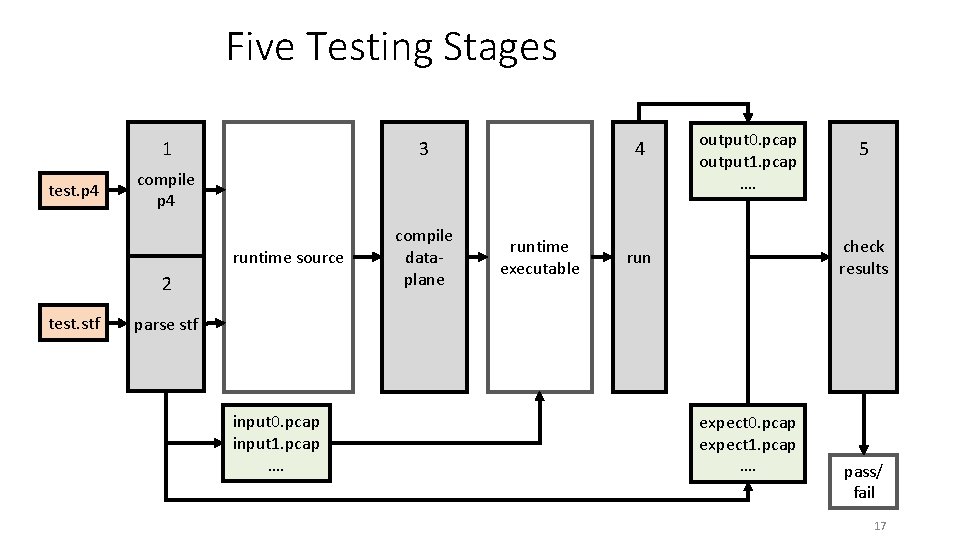
Five Testing Stages 1 test. p 4 3 compile p 4 runtime source 2 test. stf 4 compile dataplane runtime executable output 0. pcap output 1. pcap …. 5 check results run parse stf input 0. pcap input 1. pcap …. expect 0. pcap expect 1. pcap …. pass/ fail 17
A sample P 4 -XDP program 18
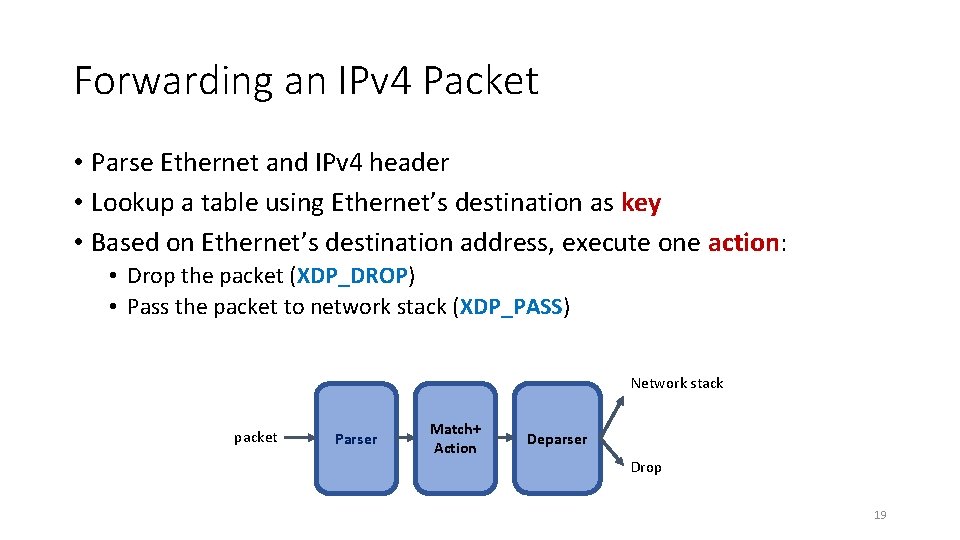
Forwarding an IPv 4 Packet • Parse Ethernet and IPv 4 header • Lookup a table using Ethernet’s destination as key • Based on Ethernet’s destination address, execute one action: • Drop the packet (XDP_DROP) • Pass the packet to network stack (XDP_PASS) Network stack packet Parser Match+ Action Deparser Drop 19
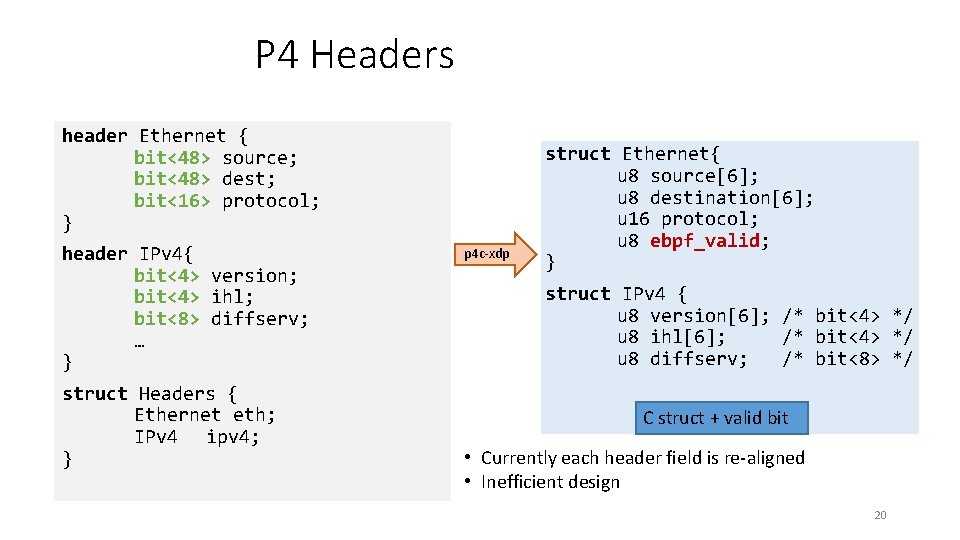
P 4 Headers header Ethernet { bit<48> source; bit<48> dest; bit<16> protocol; } header IPv 4{ bit<4> version; bit<4> ihl; bit<8> diffserv; … } struct Headers { Ethernet eth; IPv 4 ipv 4; } p 4 c-xdp struct Ethernet{ u 8 source[6]; u 8 destination[6]; u 16 protocol; u 8 ebpf_valid; } struct IPv 4 { u 8 version[6]; /* bit<4> */ u 8 ihl[6]; /* bit<4> */ u 8 diffserv; /* bit<8> */ C struct + valid bit • Currently each header field is re-aligned • Inefficient design 20
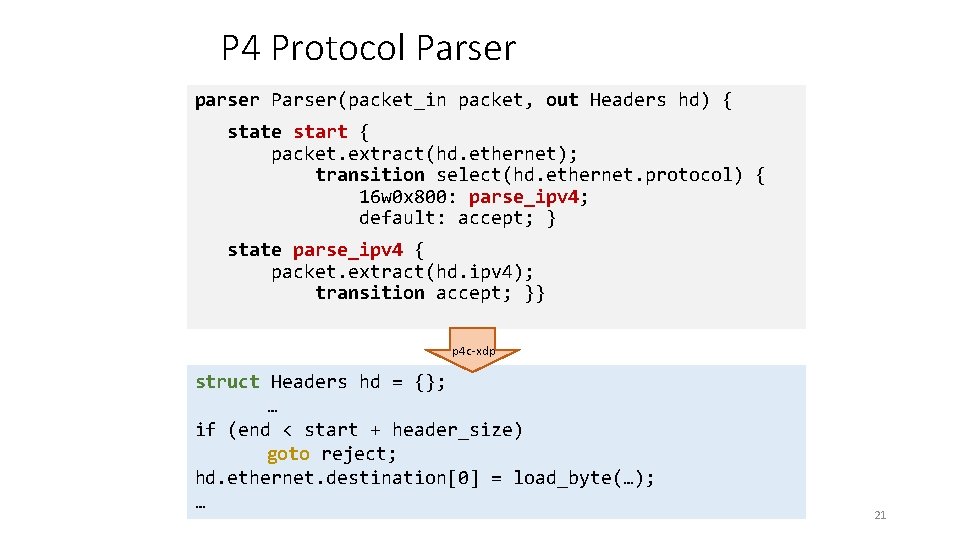
P 4 Protocol Parser parser Parser(packet_in packet, out Headers hd) { state start { packet. extract(hd. ethernet); transition select(hd. ethernet. protocol) { 16 w 0 x 800: parse_ipv 4; default: accept; } state parse_ipv 4 { packet. extract(hd. ipv 4); transition accept; }} p 4 c-xdp struct Headers hd = {}; … if (end < start + header_size) goto reject; hd. ethernet. destination[0] = load_byte(…); … 21
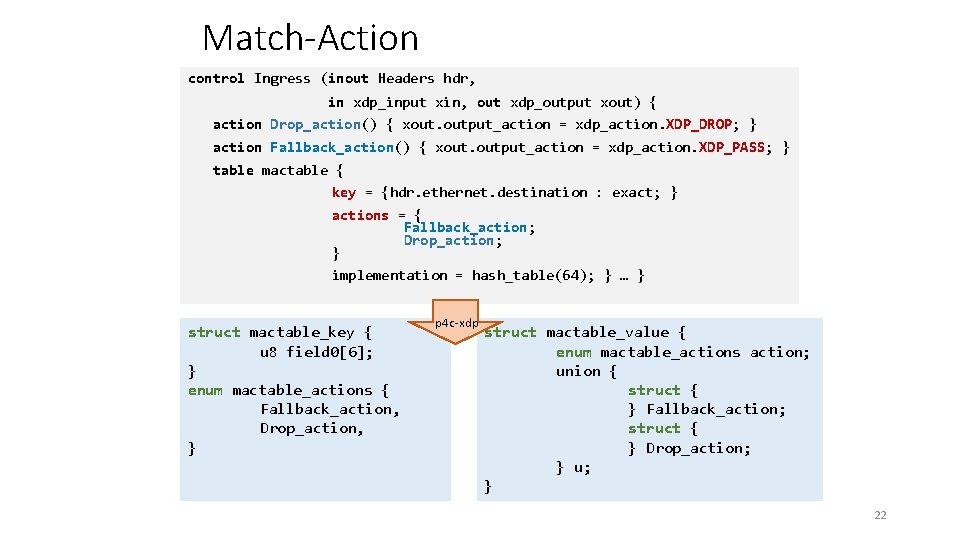
Match-Action control Ingress (inout Headers hdr, in xdp_input xin, out xdp_output xout) { action Drop_action() { xout. output_action = xdp_action. XDP_DROP; } action Fallback_action() { xout. output_action = xdp_action. XDP_PASS; } table mactable { key = {hdr. ethernet. destination : exact; } actions = { Fallback_action; Drop_action; } implementation = hash_table(64); } … } struct mactable_key { u 8 field 0[6]; } enum mactable_actions { Fallback_action, Drop_action, } p 4 c-xdp struct mactable_value { enum mactable_actions action; union { struct { } Fallback_action; struct { } Drop_action; } u; } 22
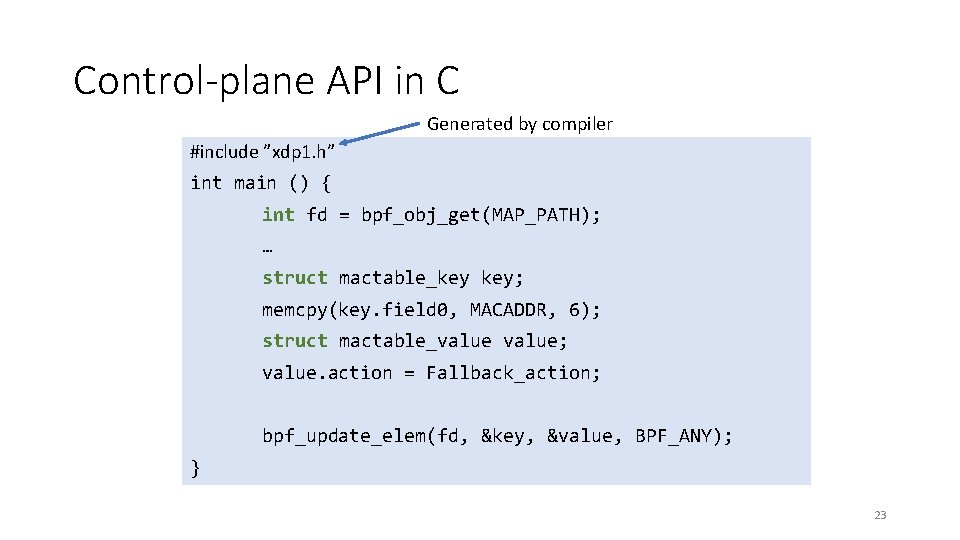
Control-plane API in C Generated by compiler #include ”xdp 1. h” int main () { int fd = bpf_obj_get(MAP_PATH); … struct mactable_key key; memcpy(key. field 0, MACADDR, 6); struct mactable_value; value. action = Fallback_action; bpf_update_elem(fd, &key, &value, BPF_ANY); } 23
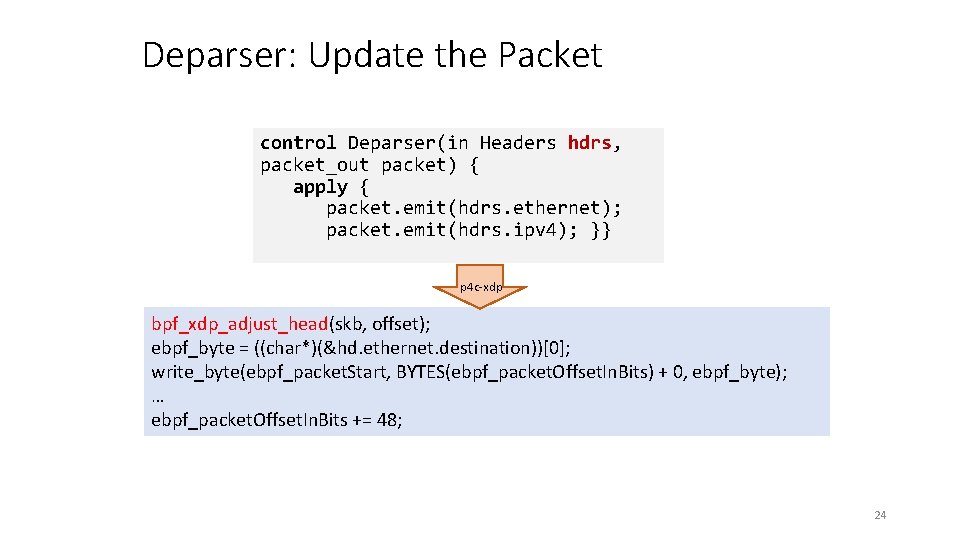
Deparser: Update the Packet control Deparser(in Headers hdrs, packet_out packet) { apply { packet. emit(hdrs. ethernet); packet. emit(hdrs. ipv 4); }} p 4 c-xdp bpf_xdp_adjust_head(skb, offset); ebpf_byte = ((char*)(&hd. ethernet. destination))[0]; write_byte(ebpf_packet. Start, BYTES(ebpf_packet. Offset. In. Bits) + 0, ebpf_byte); … ebpf_packet. Offset. In. Bits += 48; 24
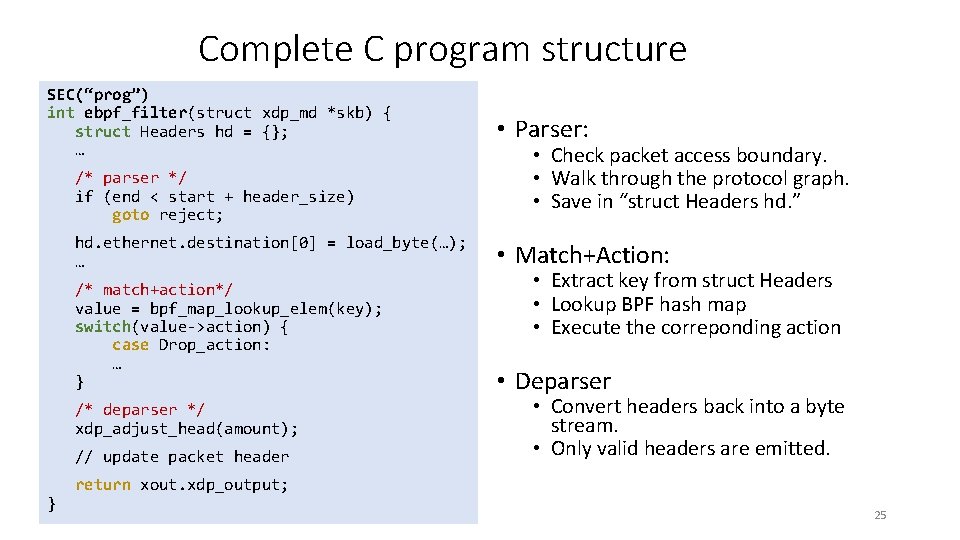
Complete C program structure SEC(“prog”) int ebpf_filter(struct xdp_md *skb) { struct Headers hd = {}; … /* parser */ if (end < start + header_size) goto reject; • Check packet access boundary. • Walk through the protocol graph. • Save in “struct Headers hd. ” hd. ethernet. destination[0] = load_byte(…); … • Match+Action: /* match+action*/ value = bpf_map_lookup_elem(key); switch(value->action) { case Drop_action: … } • Deparser /* deparser */ xdp_adjust_head(amount); // update packet header } • Parser: • Extract key from struct Headers • Lookup BPF hash map • Execute the correponding action • Convert headers back into a byte stream. • Only valid headers are emitted. return xout. xdp_output; 25
Performance Benchmarks 26
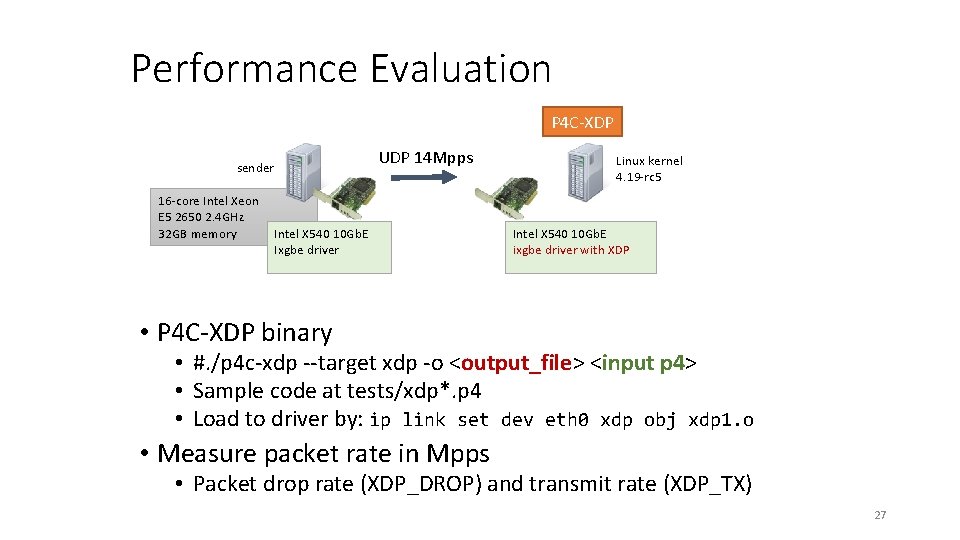
Performance Evaluation P 4 C-XDP UDP 14 Mpps sender 16 -core Intel Xeon E 5 2650 2. 4 GHz 32 GB memory Intel X 540 10 Gb. E Ixgbe driver Linux kernel 4. 19 -rc 5 Intel X 540 10 Gb. E ixgbe driver with XDP • P 4 C-XDP binary • #. /p 4 c-xdp --target xdp -o <output_file> <input p 4> • Sample code at tests/xdp*. p 4 • Load to driver by: ip link set dev eth 0 xdp obj xdp 1. o • Measure packet rate in Mpps • Packet drop rate (XDP_DROP) and transmit rate (XDP_TX) 27
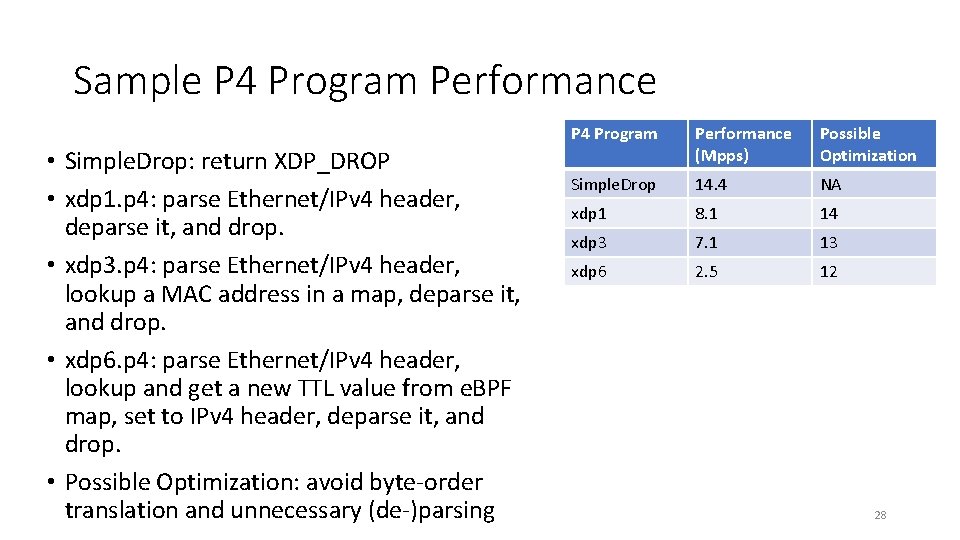
Sample P 4 Program Performance • Simple. Drop: return XDP_DROP • xdp 1. p 4: parse Ethernet/IPv 4 header, deparse it, and drop. • xdp 3. p 4: parse Ethernet/IPv 4 header, lookup a MAC address in a map, deparse it, and drop. • xdp 6. p 4: parse Ethernet/IPv 4 header, lookup and get a new TTL value from e. BPF map, set to IPv 4 header, deparse it, and drop. • Possible Optimization: avoid byte-order translation and unnecessary (de-)parsing P 4 Program Performance (Mpps) Possible Optimization Simple. Drop 14. 4 NA xdp 1 8. 1 14 xdp 3 7. 1 13 xdp 6 2. 5 12 28
Limitations 29
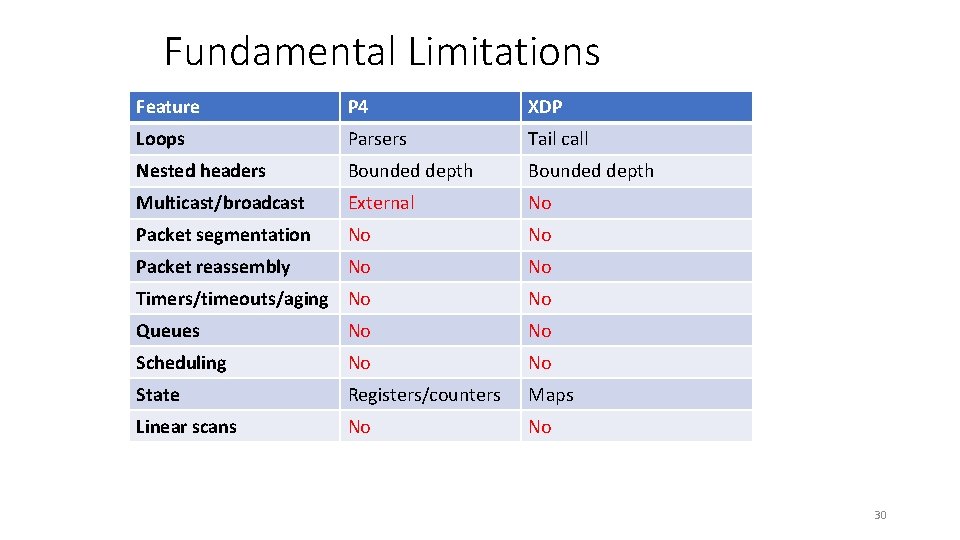
Fundamental Limitations Feature P 4 XDP Loops Parsers Tail call Nested headers Bounded depth Multicast/broadcast External No Packet segmentation No No Packet reassembly No No Timers/timeouts/aging No No Queues No No Scheduling No No State Registers/counters Maps Linear scans No No 30
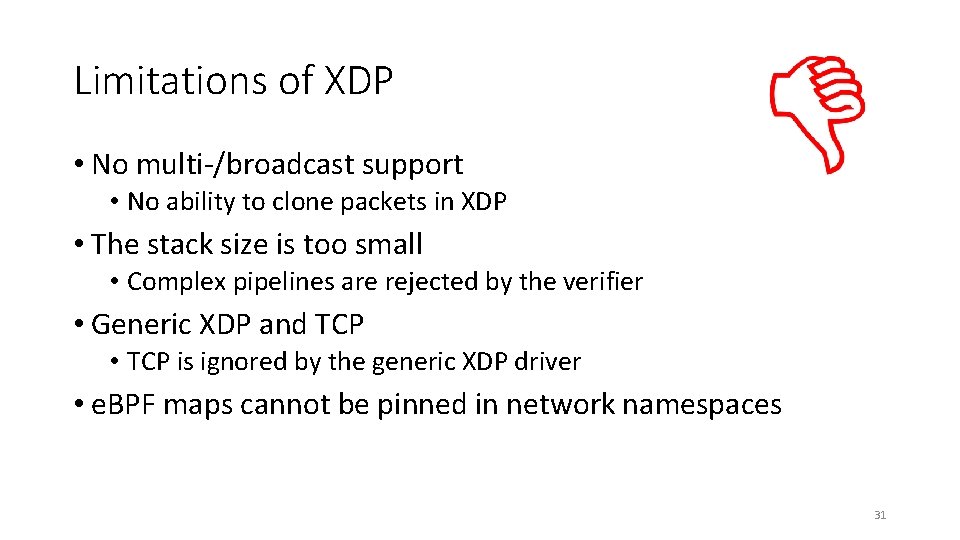
Limitations of XDP • No multi-/broadcast support • No ability to clone packets in XDP • The stack size is too small • Complex pipelines are rejected by the verifier • Generic XDP and TCP • TCP is ignored by the generic XDP driver • e. BPF maps cannot be pinned in network namespaces 31
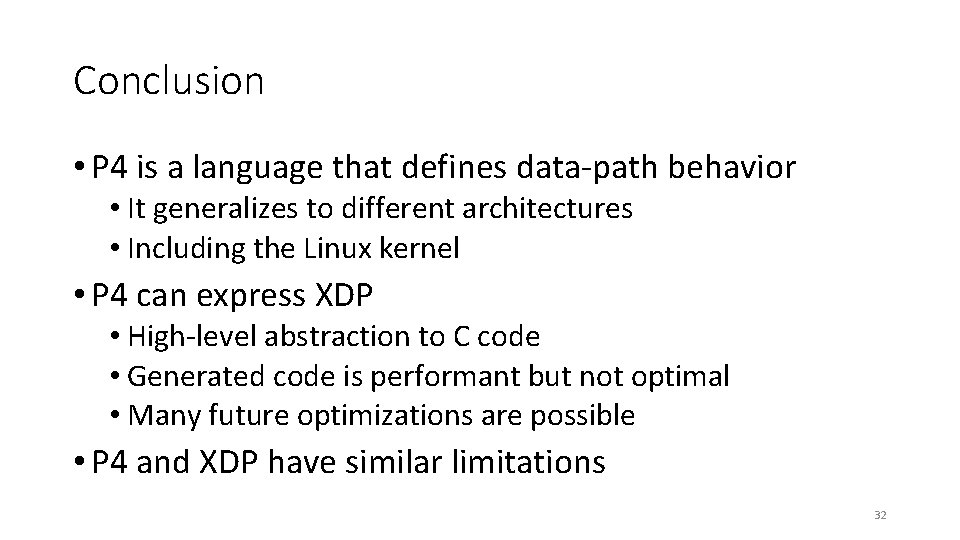
Conclusion • P 4 is a language that defines data-path behavior • It generalizes to different architectures • Including the Linux kernel • P 4 can express XDP • High-level abstraction to C code • Generated code is performant but not optimal • Many future optimizations are possible • P 4 and XDP have similar limitations 32
- Slides: 32