
Linux Kernel Introduction to Memory Management Outline 4











- Slides: 31
Linux Kernel Introduction to Memory Management 黃偉修
Outline 4 Virtual memory model 4 Caches 4 Page allocation and Deallcation 4 Swapping Out and Discarding pages
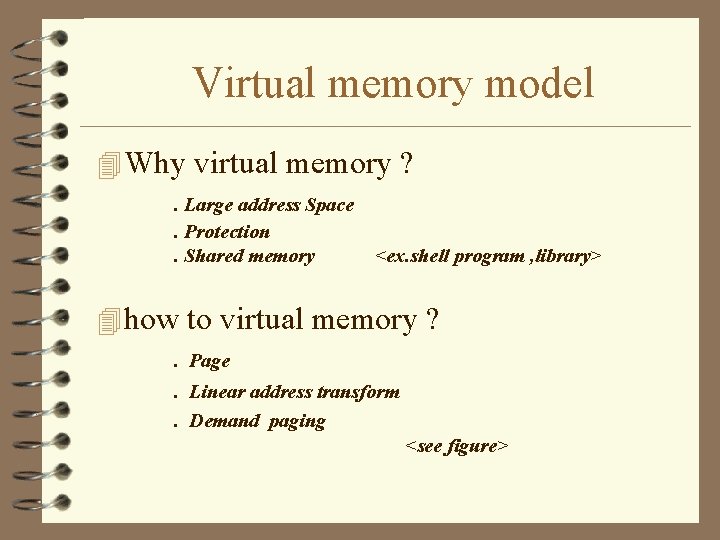
Virtual memory model 4 Why virtual memory ? . Large address Space. Protection. Shared memory <ex. shell program , library> 4 how to virtual memory ? . Page. Linear address transform. Demand paging <see figure>
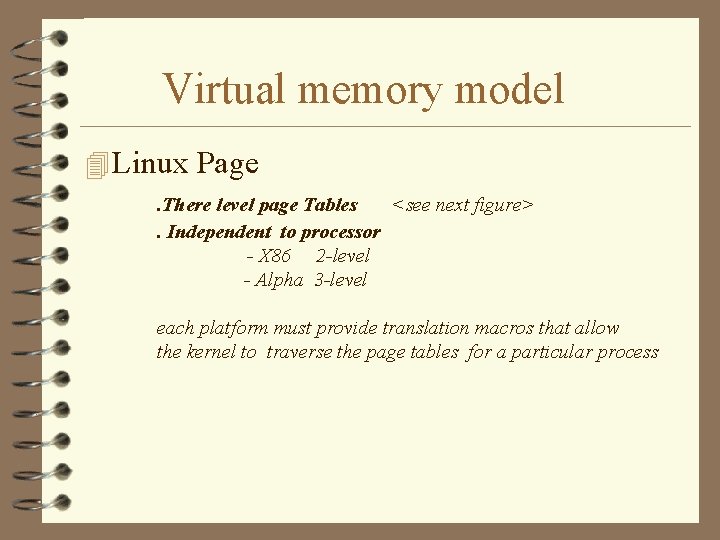
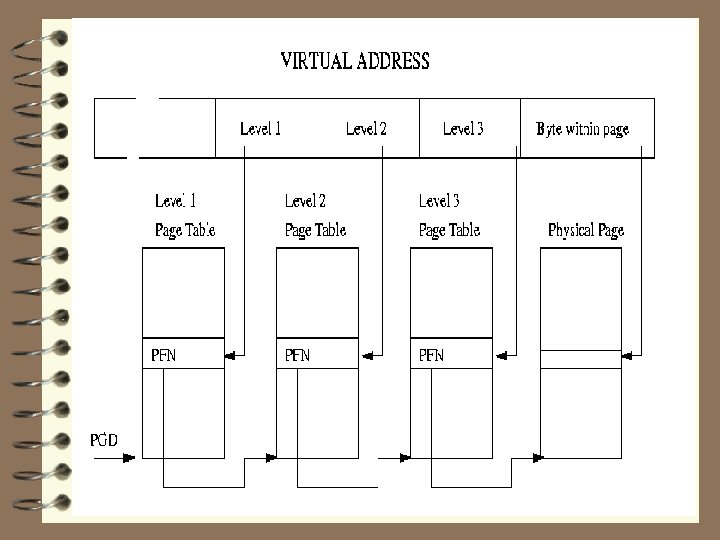
Virtual memory model 4 Linux Page. There level page Tables <see next figure>. Independent to processor - X 86 2 -level - Alpha 3 -level each platform must provide translation macros that allow the kernel to traverse the page tables for a particular process
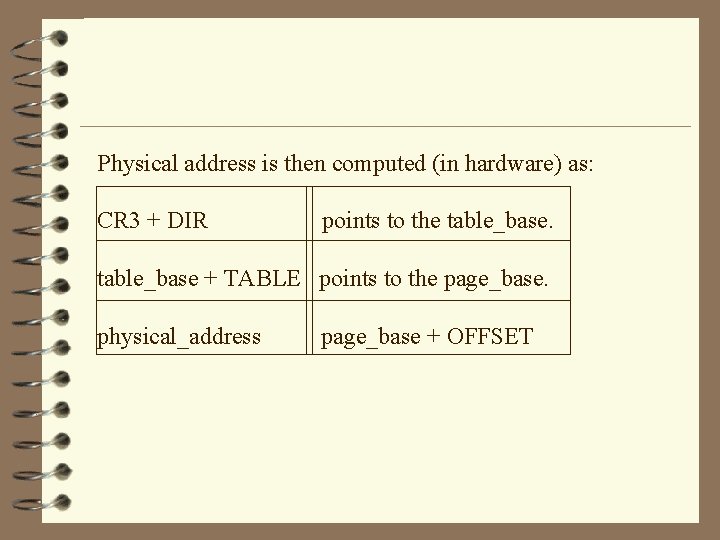
Virtual memory model 4 Address Transfer . Ex: 386 processor <see next table> A 32 -bit Linear address is divided as follows: 31. . . 22 21. . . 12 11. . . 0 DIR TABLE OFFSET
Physical address is then computed (in hardware) as: CR 3 + DIR points to the table_base + TABLE points to the page_base. physical_address page_base + OFFSET
Format for Page directory and Page table entry: 31. . . 12 11. . 9 8 7 6 5 4 3 2 1 0 ADDRESS OS 0 0 D A 0 0 U/S R/W P D 1 means page is dirty (undefined for page directory entry). R/W 0 means readonly for user. U/S 1 means user page. P 1 means page is present in memory. A 1 means page has been accessed (set to 0 by aging). OS bits can be used for LRU etc, and are defined by the OS. I. e : When a page is swapped, bits 1 -31 are used to mark where a page is stored in swap (bit 0 must be 0).
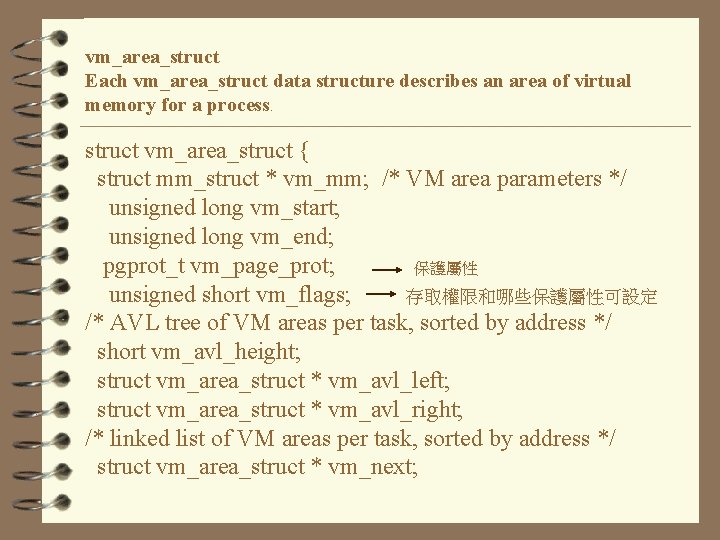
Virtual memory model 4 Memory Mapping. The link of an image into a processes virtual address space is known as mapping . Every process virtual memory is represent by an mm_struct data structure - information about image - points to a number of . Vm_area_struct vm_area_struct data struct <see figure and detail>
mm_struct the mm_struct data structure is used to describe the virtual memory of a task or process. struct mm_struct { int count; pgd_t * pgd; unsigned long context; unsigned long start_code, end_code, start_data, end_data; unsigned long start_brk, start_stack, start_mmap; unsigned long arg_start, arg_end, env_start, env_end; unsigned long rss, total_vm, locked_vm; unsigned long def_flags; struct vm_area_struct * mmap_avl; struct semaphore mmap_sem; };
vm_area_struct Each vm_area_struct data structure describes an area of virtual memory for a process. struct vm_area_struct { struct mm_struct * vm_mm; /* VM area parameters */ unsigned long vm_start; unsigned long vm_end; pgprot_t vm_page_prot; 保護屬性 unsigned short vm_flags; 存取權限和哪些保護屬性可設定 /* AVL tree of VM areas per task, sorted by address */ short vm_avl_height; struct vm_area_struct * vm_avl_left; struct vm_area_struct * vm_avl_right; /* linked list of VM areas per task, sorted by address */ struct vm_area_struct * vm_next;
/* for areas with inode, the circular list inode->i_mmap */ /* for shm areas, the circular list of attaches */ /* otherwise unused */ struct vm_area_struct * vm_nextt_share; struct vm_area_struct * vm_prev_share; /* more */ struct vm_operations_struct * vm_ops; 運算函數位址 unsigned long vm_offset; 作memory mapping struct inode * vm_inode; unsigned long vm_pte; /* shared mem */ };
Virtual memory model 4 Demand paging. Access not valid page table entry. Page fault report address and access type. Search vm_area_struct in a AVL tree to check illegal or legal virtual address (send SIGSEGV signal to process). If legal virtual address then check type. Else the page fault is legal case note: differentiate between swap file and somewhere on disk
Virtual memory model 4 How about O. S ? . Physical mode V. S Virtual addressing mode. Physical mode : no page tables / addr transfer. Linux OS run in physical mode
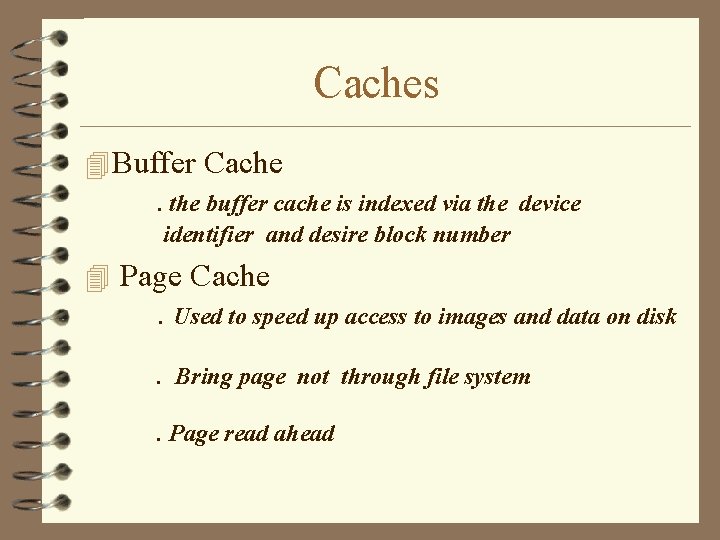
Caches 4 Buffer Cache. the buffer cache is indexed via the device identifier and desire block number 4 Page Cache . Used to speed up access to images and data on disk. Bring page not through file system. Page read ahead
Caches 4 Swap Cache. Only dirty pages are saved in swap file. no need to write it to the swap file if the page is already in the swap file
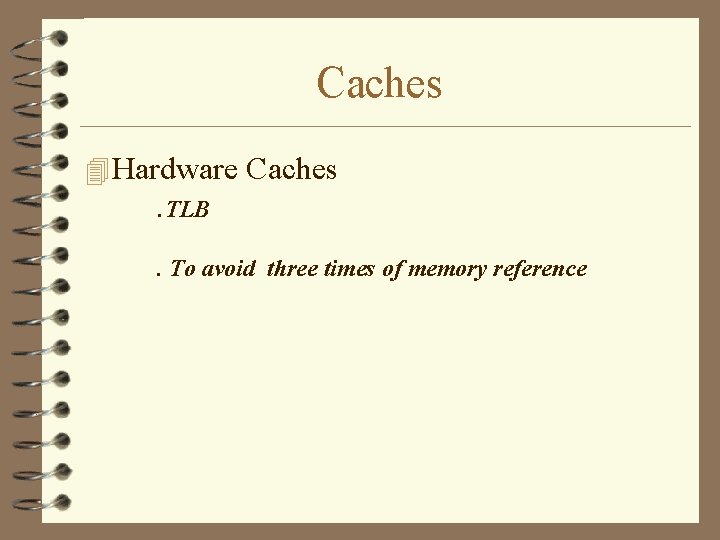
Caches 4 Hardware Caches . TLB. To avoid three times of memory reference
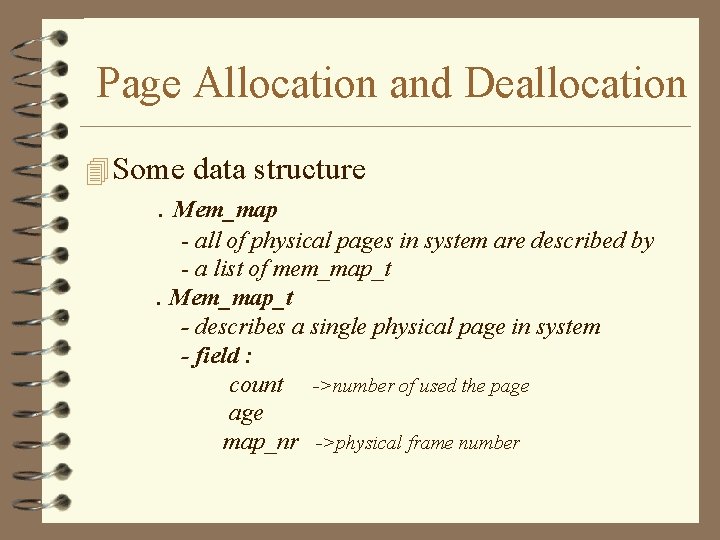
Page Allocation and Deallocation 4 Some data structure . Mem_map - all of physical pages in system are described by - a list of mem_map_t. Mem_map_t - describes a single physical page in system - field : count ->number of used the page map_nr ->physical frame number
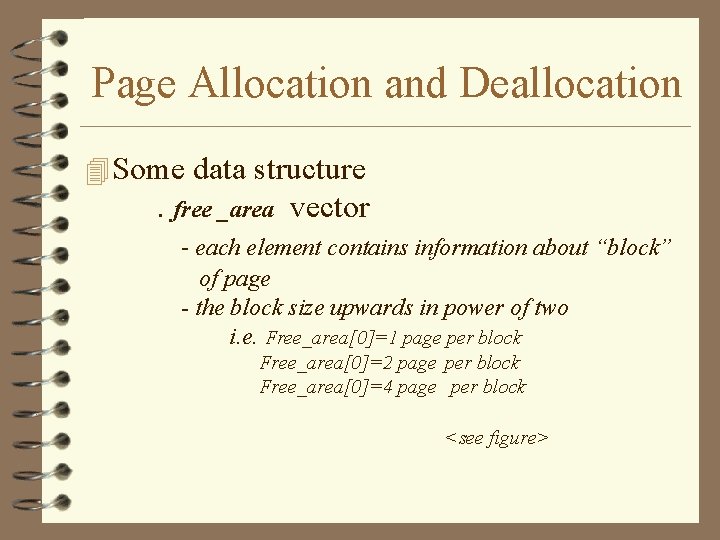
Page Allocation and Deallocation 4 Some data structure . free _area vector - each element contains information about “block” of page - the block size upwards in power of two i. e. Free_area[0]=1 page per block Free_area[0]=2 page per block Free_area[0]=4 page per block <see figure>
bit N is set if the N’th block is free Map is a point to bitmap to which keeps to track of allocated groups of page of this size
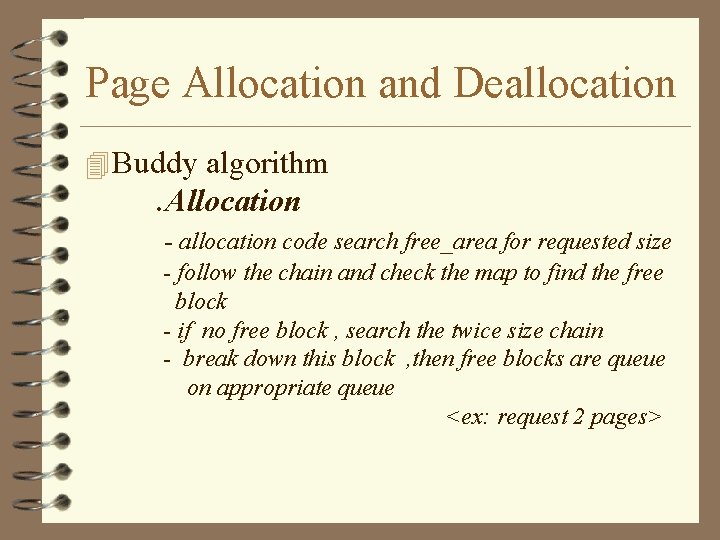
Page Allocation and Deallocation 4 Buddy algorithm . Allocation - allocation code search free_area for requested size - follow the chain and check the map to find the free block - if no free block , search the twice size chain - break down this block , then free blocks are queue on appropriate queue <ex: request 2 pages>
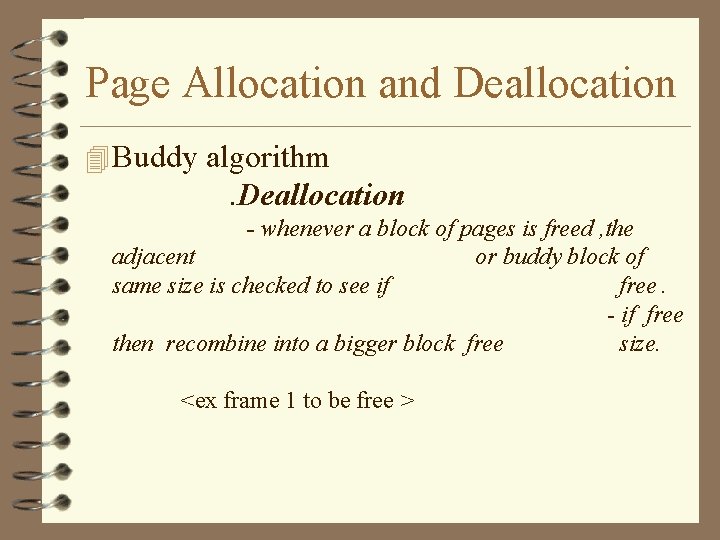
Page Allocation and Deallocation 4 Buddy algorithm . Deallocation - whenever a block of pages is freed , the adjacent or buddy block of same size is checked to see if free. - if free then recombine into a bigger block free size. <ex frame 1 to be free >
Page Allocation and Deallocation 4 Buddy algorithm . one “bigger” . Conclude allocation tends to fragment memory to ”small” deallocation tends to recombines pages into one
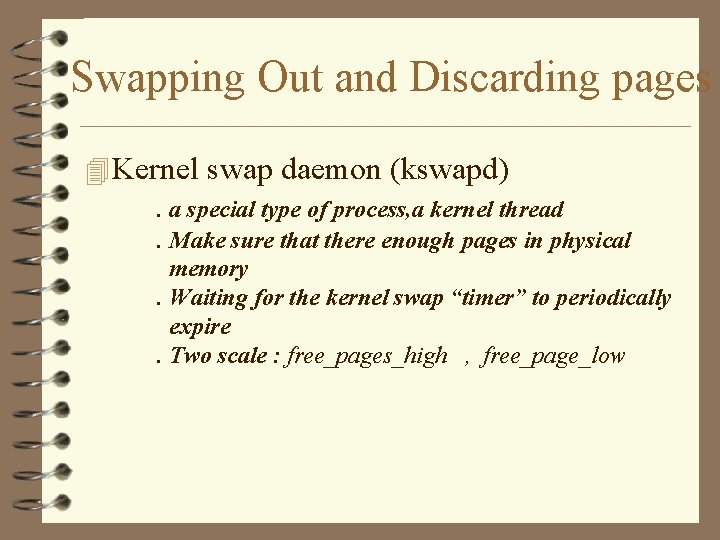
Swapping Out and Discarding pages 4 Kernel swap daemon (kswapd). a special type of process, a kernel thread. Make sure that there enough pages in physical memory. Waiting for the kernel swap “timer” to periodically expire. Two scale : free_pages_high , free_page_low
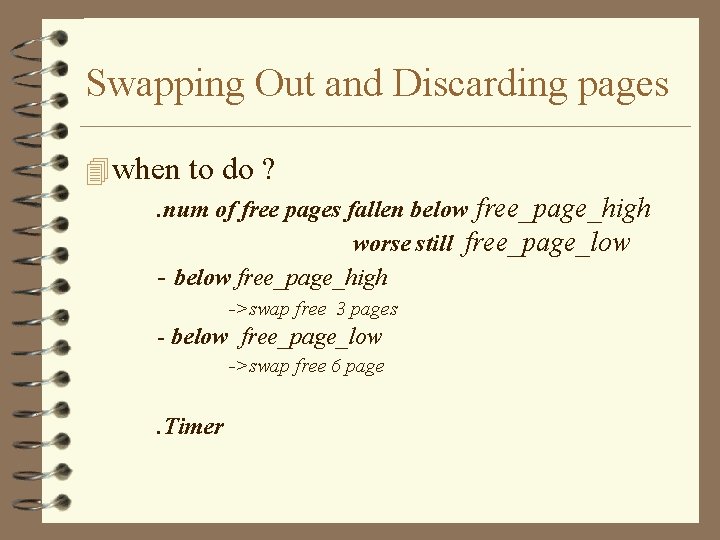
Swapping Out and Discarding pages 4 when to do ? . num of free pages fallen below free_page_high worse still free_page_low - below free_page_high ->swap free 3 pages - below free_page_low ->swap free 6 page . Timer
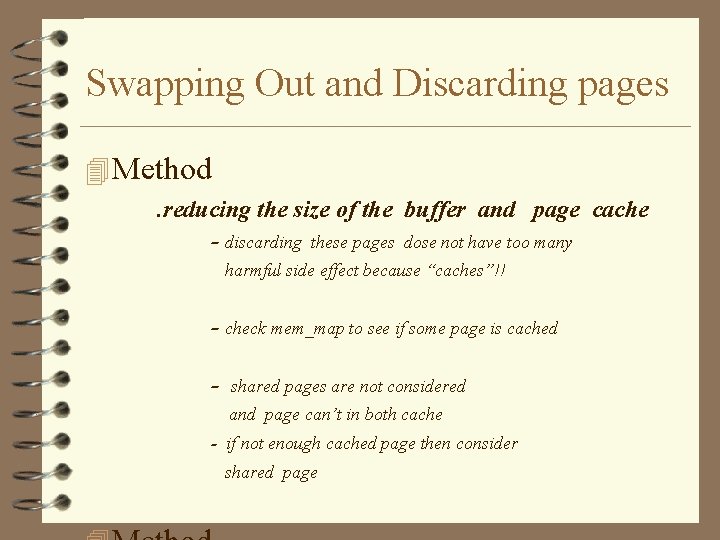
Swapping Out and Discarding pages 4 Method. reducing the size of the buffer and page cache - discarding these pages dose not have too many harmful side effect because “caches”!! - check mem_map to see if some page is cached - shared pages are not considered and page can’t in both cache - if not enough cached page then consider shared page
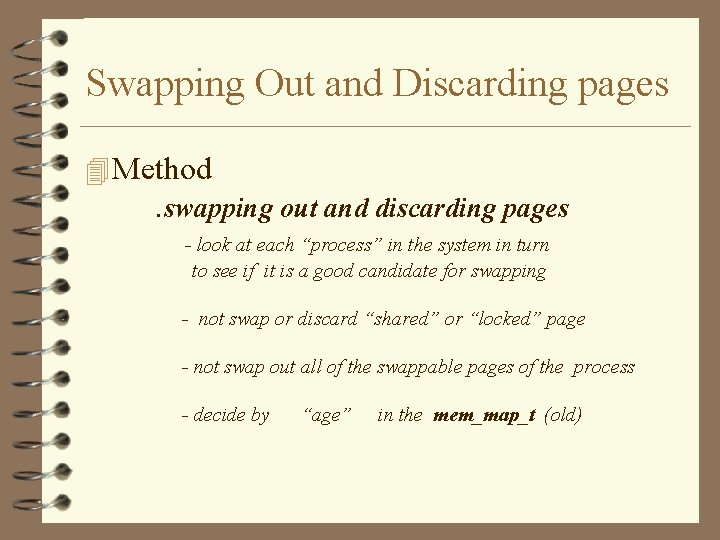
Swapping Out and Discarding pages 4 Method. swapping out and discarding pages - look at each “process” in the system in turn to see if it is a good candidate for swapping - not swap or discard “shared” or “locked” page - not swap out all of the swappable pages of the process - decide by “age” in the mem_map_t (old)
Swapping Out and Discarding pages 4 Method . Swapping Out System V shared i. e. Memory pages kswapd remember which method that it used last time successfully