
Linux Kernel Crash Dumps Matt D Robinson and

Linux Kernel Crash Dumps Matt D. Robinson and Tom Morano Silicon Graphics Computer Systems
Linux Kernel Crash Dumps Contents • Objectives • LKCD Components • Kernel Design Considerations • Kernel Initiating Dumps • Kernel Dumping Hooks/Execution • Dump Initiation Code/Layout • Dump Tunables • Introduction to LCRASH

Linux Kernel Crash Dumps Objectives • LKCD created for Linux customers, support personnel and Linux kernel engineers • LKCD reduces MTBF and MTTR statistics • Kernel problems are resolved more quickly • As the Linux kernel becomes more complex, the need for LKCD increases
Linux Kernel Crash Dumps LKCD Components • Kernel changes to configure, catch kernel failures, and save crash dumps • User level scripts to save and configure system memory to a crash dump • LCRASH, the kernel crash dump analyzer

Linux Kernel Crash Dumps Kernel Design Considerations The biggest design considerations were: • Dump Save Mechanism • Raw I/O vs. Buffer Cache I/O • Kernel Code Location • Dump Storage NOTE: Other crash dump products available for Linux may use different dumping methods than those described here
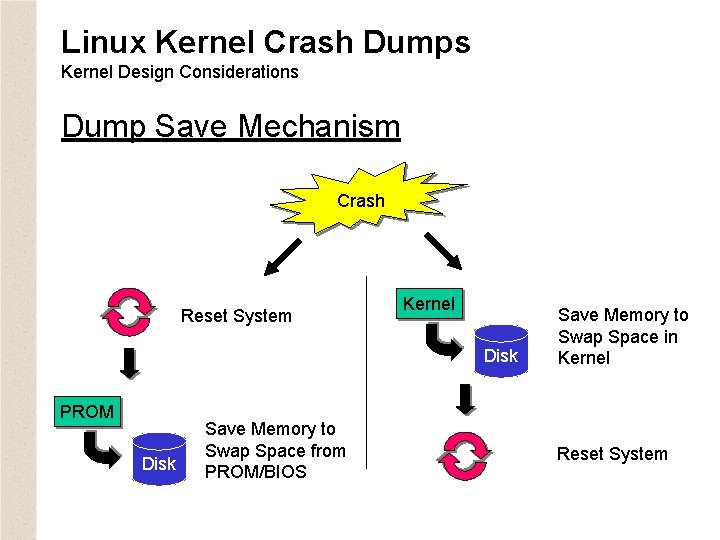
Linux Kernel Crash Dumps Kernel Design Considerations Dump Save Mechanism Crash Reset System Kernel Disk PROM Disk Save Memory to Swap Space from PROM/BIOS Save Memory to Swap Space in Kernel Reset System
Linux Kernel Crash Dumps Kernel Design Considerations Kernel save method chosen because: • PROM/BIOS is too architecture-specific • reset/power-off may clear memory • kernel disk driver restrictions • no disk to filesystem validation at PROM • code can be modified in kernel; PROM code is difficult to make changes for (backwards compatibility issues)
Linux Kernel Crash Dumps Kernel Design Considerations Raw I/O vs. Buffer Cache I/O • Buffer cache locking prevents handling dump workaround without major performance hit on basic I/O • Re-entry interrupt locking problem • Raw I/O is not fully supported in Linux yet (in the kernel) - kiobuf code needs more work • IDE, RAID, etc. , drivers need raw I/O hooks (current plan is to create driver layer above to avoid necessary locking)
Linux Kernel Crash Dumps Kernel Design Considerations Kernel Code Location • Code changes are separated into generic and architecture-specific files – kernel/vmdump. c – arch/<arch>/kernel/vmdump. c • Additional modifications made to linux/include/sysctl. h, kernel/sysctl. c, and kernel crash hook functions
Linux Kernel Crash Dumps Kernel Design Considerations Dump Storage • Memory dumps are saved to swap space • Swapping during boot-up is an issue • Disk partition tables in memory -- could this cause a data corruption problem? • Cannot assume filesystem layer will be available during crash
Linux Kernel Crash Dumps Kernel Initiating Dumps Initiating Dump Process • Change to /proc/sys/vmdump/dumpdev calls dump_open() in kernel • dump_open() checks to ensure the – device specified is a block device – device points to a valid swap partition – device has valid character device file_operations table (currently SCSI only, due to lack of raw I/O capability for IDE disks)
Linux Kernel Crash Dumps Kernel Initiating Dumps • Errors in dump_open() are logged to system log buffer • Changes needed for 2. 3 (without devfs) due to mismatch between block and character major/minor pairs for the same disk device • Success of dump_open() displays: dump_open(): dump device opened: 0 x 803 [sd(8, 3)]
Linux Kernel Crash Dumps Kernel Dumping Hooks Kernel Hooks for Executing Crash Dump • panic() was modified to perform SMP freeze and to call dump_execute() • die_if_kernel() or die() calls dump_execute() after KDB, GDB, and show_registers() are done • NMI (Non-Maskable Interrupt) hooks still needed for systems that support the capability in hardware
Linux Kernel Crash Dumps Kernel Dumping Hooks Kernel Hooks and Parameters • panic(): register state is not saved, panic string is saved • die_if_kernel() or die(): registers are saved, panic string is generic (for now) • Interrupt handlers vs. non I/O request lock dumping needs to be differentiated
Linux Kernel Crash Dumps Kernel Dump Execution • dump_execute() checks to see if dumping is turned on • If DUMP_NONE is set, it returns immediately • __dump_execute(), which is architecturespecific, is called to save the dump • Within __dump_execute(), dump header values are saved, memory pages are saved, and the function returns when complete
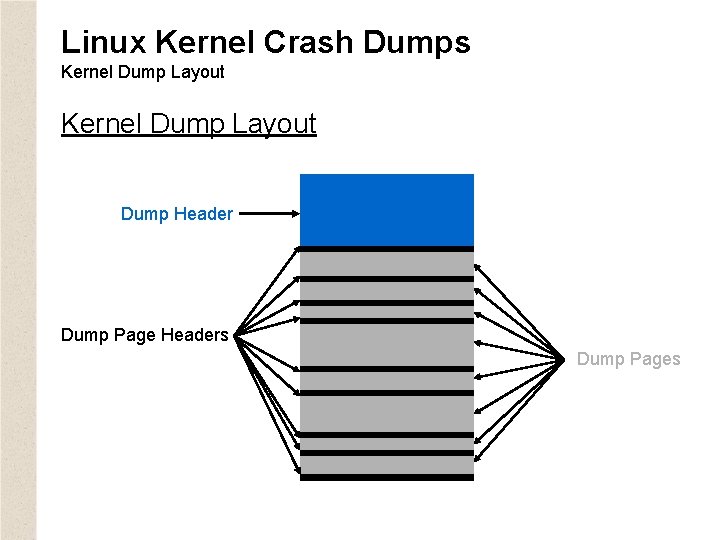
Linux Kernel Crash Dumps Kernel Dump Layout Dump Header Dump Page Headers Dump Pages
Linux Kernel Crash Dumps Kernel Dump Layout • Dump header is written out first; it contains basic information about dump • Memory pages are written next, each with a page header containing – virtual address of the page in memory – size of page (important if compressed) – page flags (compressed, raw, dump end) • The last step is a re-write of the dump header which updates the total number of pages written
Linux Kernel Crash Dumps Kernel Dump Limitations • Current interrupt crashes will lock up with reentry to disk driver function • Dump header needs to be written out more often • Raw I/O capabilities need to be added in kernel for more disk drivers (using kiobufs, scatter-gather lists, etc. ) • Page typing needed for ordered dumps • More architectures need to be supported
Linux Kernel Crash Dumps Kernel Recovery of Crash Dump Kernel Reboot After Crash • During early boot-up, the system runs the /etc/rc. d/rc. sysinit script, which in turn runs /sbin/vmdump • /sbin/vmdump runs with either the config or save option config save sets all dump tunables and attempts to open the dump device looks for a crash dump in dump device and saves it to disk (if requested)
Linux Kernel Crash Dumps Kernel /proc Tunables Kernel Tunables • /proc/sys/vmdump contains all LKCD kernel tunables • /proc/sys/kernel/panic is modified so that the system reboots after LKCD creates a crash dump • dumpdev holds the name of the dump device • dump_compress_pages determines if the memory pages should be compressed • dump_level indicates which pages to dump to disk (only three levels currently supported)
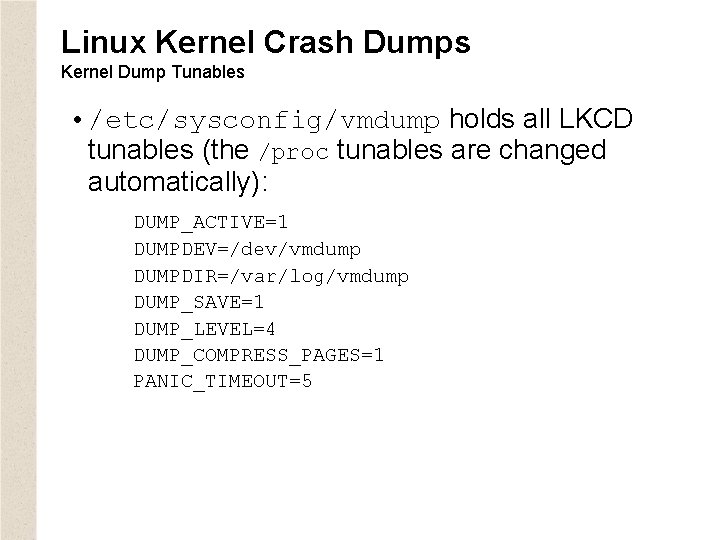
Linux Kernel Crash Dumps Kernel Dump Tunables • /etc/sysconfig/vmdump holds all LKCD tunables (the /proc tunables are changed automatically): DUMP_ACTIVE=1 DUMPDEV=/dev/vmdump DUMPDIR=/var/log/vmdump DUMP_SAVE=1 DUMP_LEVEL=4 DUMP_COMPRESS_PAGES=1 PANIC_TIMEOUT=5
Linux Kernel Crash Dumps Kernel Dump Tunables DUMP_ACTIVE Determines if the crash dump scripts should perform any actions; the default value is 1 (active). Set to 0 to not save or configure system for crash dumps
Linux Kernel Crash Dumps Kernel Dump Tunables DUMPDEV The name of the dump device; this typically is /dev/vmdump. NOTE: It is recommended to change what device /dev/vmdump points to rather than to change this value directly, as /dev/vmdump is normally a symbolic link.
Linux Kernel Crash Dumps Kernel Dump Tunables DUMPDIR The name of the directory to save dumps to; this typically is /var/log/vmdump. DUMP_SAVE Whether to save the crash dump to disk or not. The system will still be configured to save crash dumps regardless of the value of DUMP_SAVE.
Linux Kernel Crash Dumps Kernel Dump Tunables DUMP_LEVEL Determines how much memory (or not) should be saved in the crash dump. Default value is 4 (DUMP_ALL), although other values such as 0 (DUMP_NONE) and 1 (DUMP_HEADER) are also valid. This sets /proc/sys/vmdump/dump_level to the same value (/sbin/vmdump config).
Linux Kernel Crash Dumps Kernel Dump Tunables DUMP_COMPRESS_PAGES Determines whether to compress memory pages when saving memory image to disk. Defaults to 1 (compress). This sets /proc/sys/vmdump/dump_compress_pages to the same value (/sbin/vmdump config).
Linux Kernel Crash Dumps Kernel Dump Tunables PANIC_TIMEOUT Changes the amount of time to sleep before resetting the system after a software failure. Changes /proc/sys/kernel/panic to the same value (/sbin/vmdump config). NOTE: This value should always be non-zero; if zero, the system will spin indefinitely until it is reset by hand.
Linux Kernel Crash Dumps Kernel Dump Files • vmdump. N holds the crash dump data saved from DUMPDEV; it is a copy of the memory image at the time of the system crash • map. N is a copy of /boot/System. map • Both files needed to perform crash analysis; addresses in map. N point to values in vmdump. N; if the files do not come from the same kernel build, crash analysis may be inaccurate
Linux Kernel Crash Dumps Introduction to LCRASH Overview of LCRASH • Linux system crash dump analysis tool • Provides access to kernel data in LKCD crash dumps or live system memory • Displays detailed information about a system crash • Can be used interactively or to generate system crash dump reports
Linux Kernel Crash Dumps Introduction to LCRASH Crash Dump Report • General system information • Type of crash • Dump of the system log_buf • List of active tasks • Kernel stack trace showing the function calls leading up to the point of the crash
Linux Kernel Crash Dumps Introduction to LCRASH Interactive Commands • For a more detailed examination of the elements of a crash • Kernel data displayed in a clear, easy-to-read manner • Invoked via an ASCII command line user interface featuring command line editing and command history • Command output can be piped to utilities such as more and grep
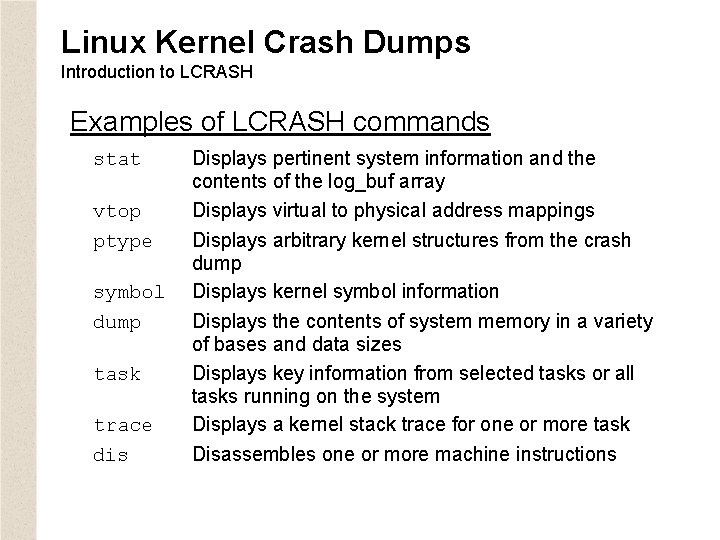
Linux Kernel Crash Dumps Introduction to LCRASH Examples of LCRASH commands stat vtop ptype symbol dump task trace dis Displays pertinent system information and the contents of the log_buf array Displays virtual to physical address mappings Displays arbitrary kernel structures from the crash dump Displays kernel symbol information Displays the contents of system memory in a variety of bases and data sizes Displays key information from selected tasks or all tasks running on the system Displays a kernel stack trace for one or more task Disassembles one or more machine instructions
Linux Kernel Crash Dumps Introduction to LCRASH The libklib Library of low-level functions providing access to the system dump and kernel symbol table • Translate virtual addresses into physical addresses • Determine the address of kernel symbols • Access memory pages in the dump or live system memory • Read in blocks of kernel data • Access kernel data type information
Linux Kernel Crash Dumps Introduction to LCRASH Accessing Kernel Symbol Information • The System. map file contains the virtual address of all kernel symbols (variables, functions, etc. ) • LCRASH parses the System. map file at startup and builds an internal table of kernel symbols • Functions determine the address of a kernel symbol, or locate a symbol matching a particular address
Linux Kernel Crash Dumps Introduction to LCRASH Reading in Blocks of Data from a Dump • LCRASH can’t access data in a system dump directly • Functions read in blocks of data from a system dump or live system memory – Kernel virtual addresses are translated into physical address – Memory pages in the dump are uncompressed automatically – The desired data is then copied into an LCRASH buffer
Linux Kernel Crash Dumps Introduction to LCRASH Accessing Kernel Type Information • Facilities provided for accessing extended information in the kernel symbol table (when built using the -gstabs compiler option) – Kernel data type definitions, including type and size of kernel structure members – Data types of global variables – Function parameters – Source code line numbers of kernel functions • Most production systems are not built with the -gstabs flag
Linux Kernel Crash Dumps Introduction to LCRASH Generating Kernel Stack Traces • LCRASH is able to generate kernel stack traces without using frame pointers – Various heuristics are applied to each stack frame to determine what the PC, RA, SP, and frame pointer should be – Derived values are sanity checked to ensure they are at least reasonable – The entire stack trace is constructed before it is displayed • Most x 86 kernels do not use frame pointers
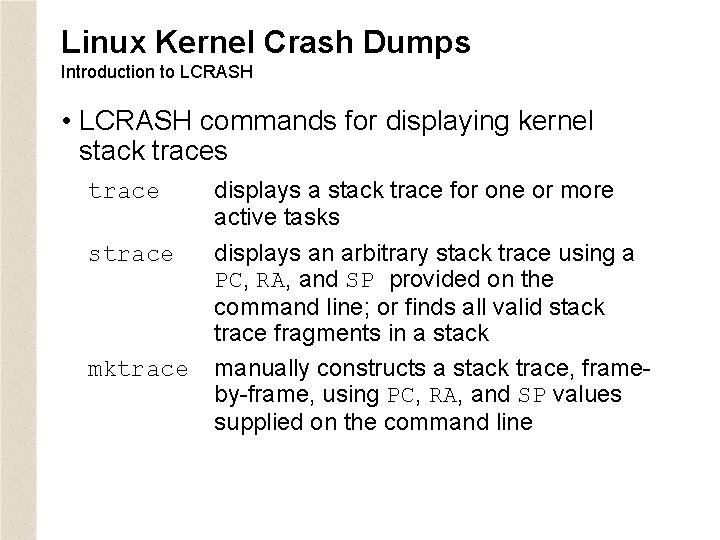
Linux Kernel Crash Dumps Introduction to LCRASH • LCRASH commands for displaying kernel stack traces trace strace mktrace displays a stack trace for one or more active tasks displays an arbitrary stack trace using a PC, RA, and SP provided on the command line; or finds all valid stack trace fragments in a stack manually constructs a stack trace, frameby-frame, using PC, RA, and SP values supplied on the command line
Linux Kernel Crash Dumps Introduction to LCRASH Location of LCRASH Source LCRASH source code was located in the kernel source tree to ensure that • LCRASH gets built along with the kernel • LCRASH uses the same configuration options and header files as the kernel • an LCRASH exists that can analyze crash dumps from a newly built kernel • any changes to kernel header files that break the LCRASH build get resolved quickly
Linux Kernel Crash Dumps Introduction to LCRASH Support for Multiple System Architectures • LCRASH impacted by differences in system architecture • Functionality and source code organized much like the Linux kernel • There architecture dependent and architecture independent sections in both LCRASH and libklib • At the present time, i 386 is fully supported (alpha and ia 64 are under development)
Linux Kernel Crash Dumps Introduction to LCRASH Adding New LCRASH Commands • LCRASH was designed to make it easy to add new commands • Access to raw data in the crash dump is made through calls to libklib API functions • Provisions made for both generic and architecture specific commands

Linux Kernel Crash Dumps Introduction to LCRASH For more information about LKCD, review the web site at: http: //oss. sgi. com/projects/lkcd
- Slides: 42