
Links between biology and math at Haverford College

Links between biology and math at Haverford College Phil Meneely (Biology) Rob Manning (Math)

Collaborative Research • We have a relatively large student-faculty research program, especially in biology (typical biology professor runs a lab with 4 -8 students during the academic year and summer). • Some projects have linked math & bio, often co-advised, e. g. , – Quantitative analysis of AFM images of myosin rod-domain filaments (Rigotti et al, Anal. Biochem. 346 (2005) 189. ) – Multiple alignments of chromosomal proteins in C. elegans – Network analysis of the C. elegans germline proteins – Elastic rod models of DNA cyclization experiments – Epidemiological modeling of the effect of various testing procedures on the spread of Ebola – Statistical analysis of flexibility of helix-pairs in the PDB
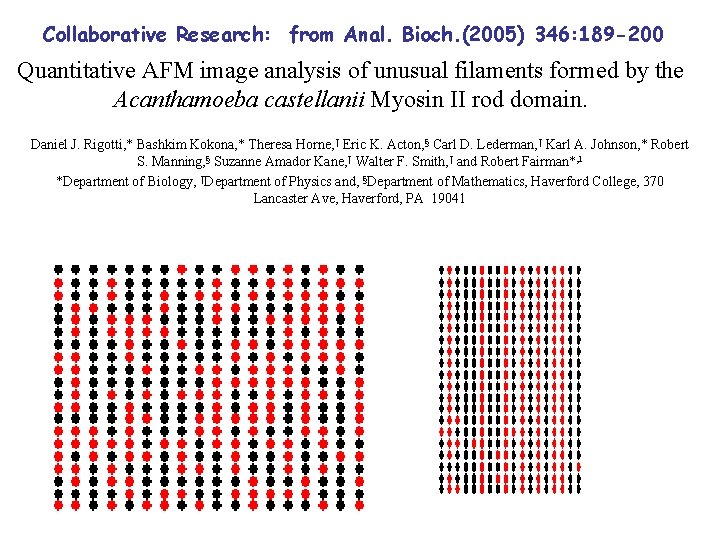
Collaborative Research: from Anal. Bioch. (2005) 346: 189 -200 Quantitative AFM image analysis of unusual filaments formed by the Acanthamoeba castellanii Myosin II rod domain. Daniel J. Rigotti, * Bashkim Kokona, * Theresa Horne, † Eric K. Acton, § Carl D. Lederman, † Karl A. Johnson, * Robert S. Manning, § Suzanne Amador Kane, † Walter F. Smith, † and Robert Fairman*, 1 *Department of Biology, †Department of Physics and, §Department of Mathematics, Haverford College, 370 Lancaster Ave, Haverford, PA 19041
Summer journal club • Weekly summer journal club for entire science division (for faculty and 50+ summer research students) • Many topics are interdisciplinary, often linking math, CS, & bio, e. g. , – “Evidence for dynamically organized modularity in the yeast protein-protein interaction network” – “Superfamilies of evolved and designed networks” – “Coupling between catalytic site and collective dynamics: A Requirement for Mechanochemical Activity of Enzymes”
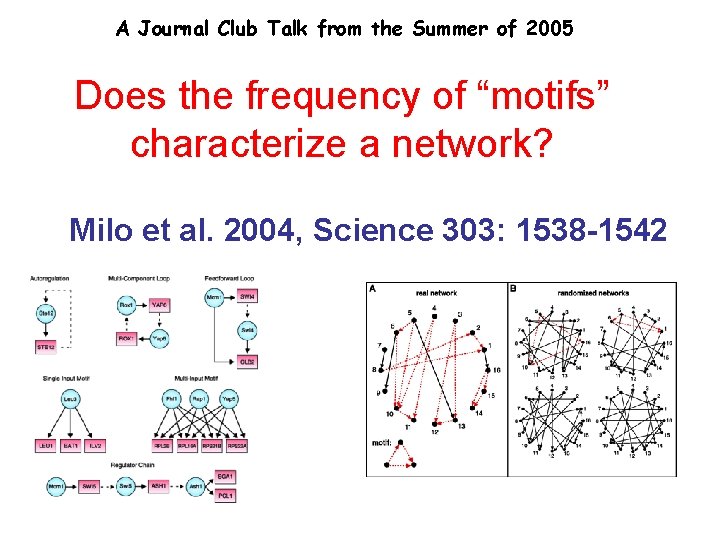
A Journal Club Talk from the Summer of 2005 Does the frequency of “motifs” characterize a network? Milo et al. 2004, Science 303: 1538 -1542
Faculty Development • Series of HHMI faculty seminars involving 6 -12 faculty from multiple science departments (plus some social science and humanities): – Computing Across the Sciences (2000 -01) – Bioinformatics (2001 -02) – Science and Society (2002 -03) – Statistics Across the Curriculum (2003 -04) – Imaging (2007 -08)

Faculty Development (con’t) • Weekly presentations made by groups of 2 -3 faculty from different departments, e. g. , : – Computational techniques in genomics (math, biology) – Numerical methods in molecular mechanics (math, chemistry, physics) – Hypothesis testing (biology, economics) – Analysis of Variance (psychology, chemistry, math) – Drug development and public health (chemistry, biology, economics) – What is modeling? (physics, CS, math)
Faculty Development (con’t) • Concrete Goals – New course “Computing Across the Sciences”, and production of “course modules” in scientific computation by seminar participants – New course “Computational Genomics” and outside experts for specific technical training in bioinformatics • Intangible Goals – For many, best part of seminar was chance to work with faculty from another department and division – Great way to see firsthand some differences between departments: terminology, level of mathematical formalism, what do students “need to know”, etc.
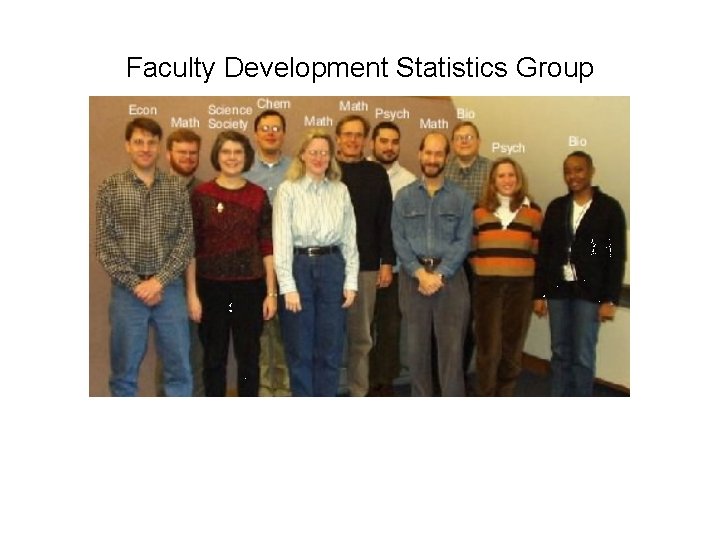
Faculty Development Statistics Group
Curriculum: Math in Biology Challenges • A distinctive constraint: our biology department is entirely molecular/cellular, so some familiar applications of mathematical biology such as population dynamics are not in our curriculum (but others, like bioinformatics and network biology, fit naturally). • Due to limited number of courses in liberal arts curriculum (32 in 4 years, including distribution requirements, and several chemistry prereqs for biology major), no math course required for biology major
Curriculum: Math in Biology (cont) • Biology 354: Computational Genomics – Junior/senior level course – Mostly biology or biochemistry students, few math students – Lecture and workshop format – Open-ended student projects and presentations
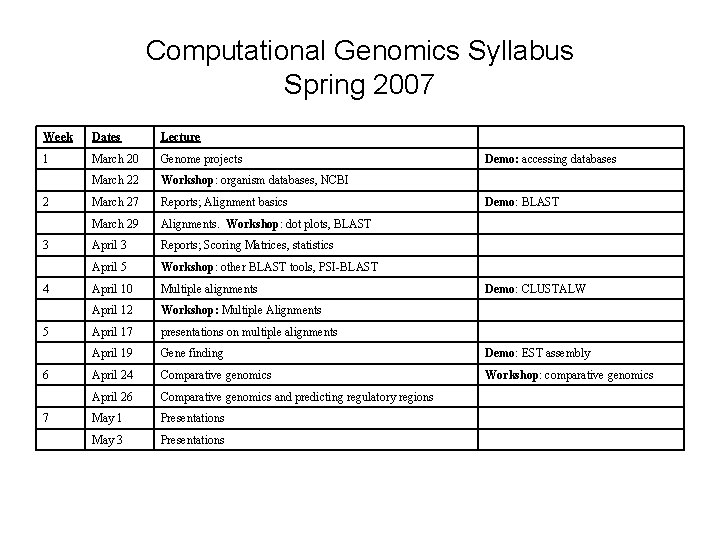
Computational Genomics Syllabus Spring 2007 Week Dates Lecture 1 March 20 Genome projects March 22 Workshop: organism databases, NCBI March 27 Reports; Alignment basics March 29 Alignments. Workshop: dot plots, BLAST April 3 Reports; Scoring Matrices, statistics April 5 Workshop: other BLAST tools, PSI-BLAST April 10 Multiple alignments April 12 Workshop: Multiple Alignments April 17 presentations on multiple alignments April 19 Gene finding Demo: EST assembly April 24 Comparative genomics Workshop: comparative genomics April 26 Comparative genomics and predicting regulatory regions May 1 Presentations May 3 Presentations 2 3 4 5 6 7 Demo: accessing databases Demo: BLAST Demo: CLUSTALW
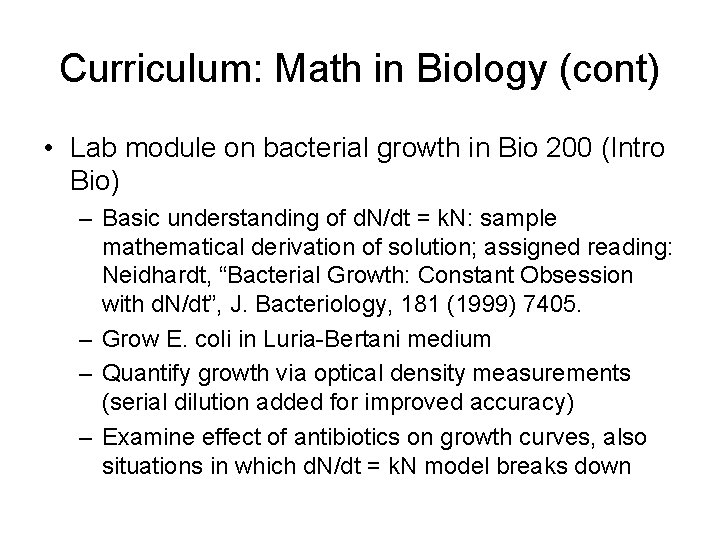
Curriculum: Math in Biology (cont) • Lab module on bacterial growth in Bio 200 (Intro Bio) – Basic understanding of d. N/dt = k. N: sample mathematical derivation of solution; assigned reading: Neidhardt, “Bacterial Growth: Constant Obsession with d. N/dt”, J. Bacteriology, 181 (1999) 7405. – Grow E. coli in Luria-Bertani medium – Quantify growth via optical density measurements (serial dilution added for improved accuracy) – Examine effect of antibiotics on growth curves, also situations in which d. N/dt = k. N model breaks down
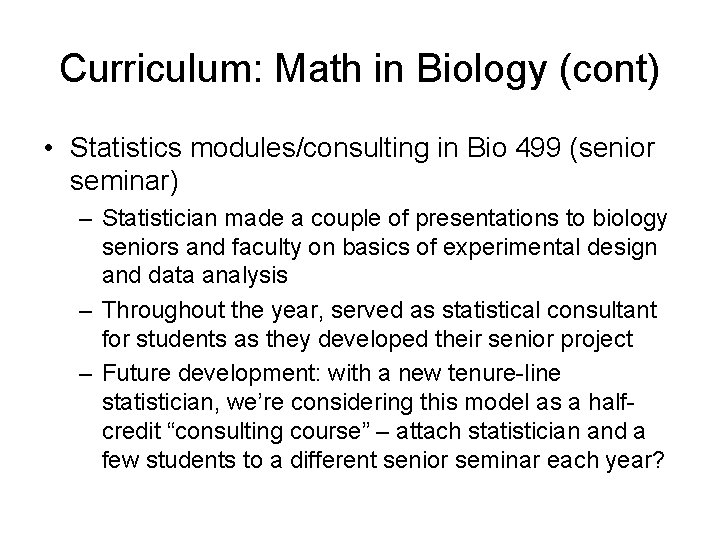
Curriculum: Math in Biology (cont) • Statistics modules/consulting in Bio 499 (senior seminar) – Statistician made a couple of presentations to biology seniors and faculty on basics of experimental design and data analysis – Throughout the year, served as statistical consultant for students as they developed their senior project – Future development: with a new tenure-line statistician, we’re considering this model as a halfcredit “consulting course” – attach statistician and a few students to a different senior seminar each year?
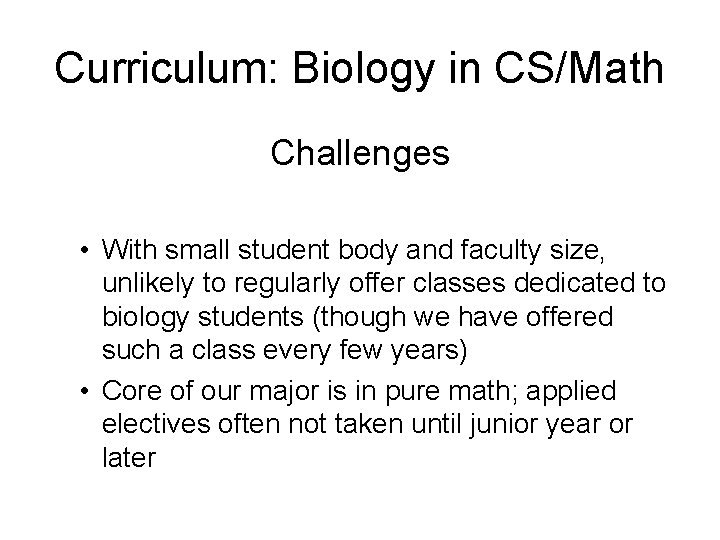
Curriculum: Biology in CS/Math Challenges • With small student body and faculty size, unlikely to regularly offer classes dedicated to biology students (though we have offered such a class every few years) • Core of our major is in pure math; applied electives often not taken until junior year or later
Curriculum: Biology in CS/Math • CS 185: Computing Across the Sciences Ø Co-taught by computer science and other faculty members (including biology) Ø Involves some programming with different scientific questions: the n-body problem, alignments, protein structure Ø BUT: enrollments have been small
Curriculum: Biology in CS/Math • Math 222: Introduction to Scientific Computing – “Look under the hood” at fundamental algorithms: nonlinear equations, optimization, random simulation, discretizations of differential equations – Lab-based (Mathematica): each problem offers students a choice between application in natural or social science – Some biological applications: bioinformatics, molecular mechanics, polymer statistics, reactiondiffusion equations, genetic algorithms
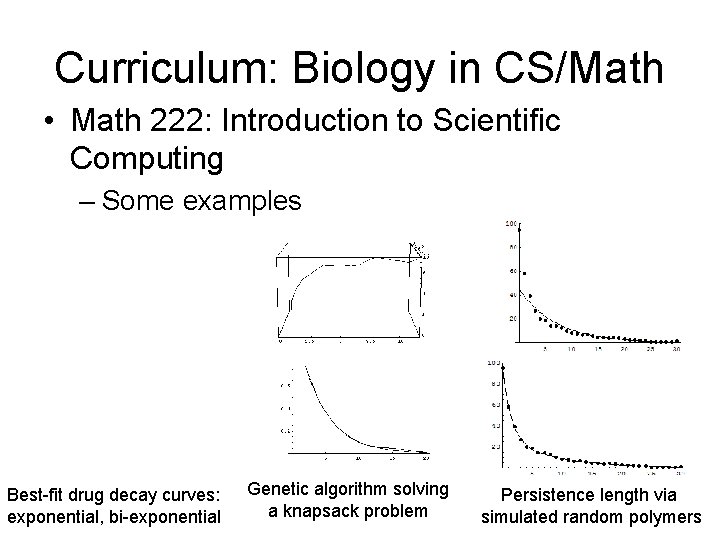
Curriculum: Biology in CS/Math • Math 222: Introduction to Scientific Computing – Some examples Best-fit drug decay curves: exponential, bi-exponential Genetic algorithm solving a knapsack problem Persistence length via simulated random polymers
Outreach • Haverford Summer Science Institute – For incoming science/premed students from high schools with no AP courses (this audience often struggles in 1 st year chemistry and calculus, never making it to biology) – 5 -week “boot camp” in chemistry, pre-calculus at a level representative of our intro courses – Weekly labs in each science discipline – Mentoring during the 1 st year – Research placement during summer after 1 st year – Develops peer group, relationships with science faculty
Future goals • Develop core set of mathematical/computational skills in biology students, tailored to some degree to our molecular/cellular specialization • Develop stronger curricular ties between math and biology at upper level • Minor in computational science – more bio majors taking advanced math/CS courses, and vice versa
- Slides: 20