
Linking With Meaning Ontological Hypertext and the Semantic
- Slides: 20
Linking With Meaning: Ontological Hypertext and the Semantic Web Hugh Davis Learning Societies Lab ECS The University of Southampton, UK All Notes on http: //www. ecs. soton. ac. uk/notes/comp 3016 Event
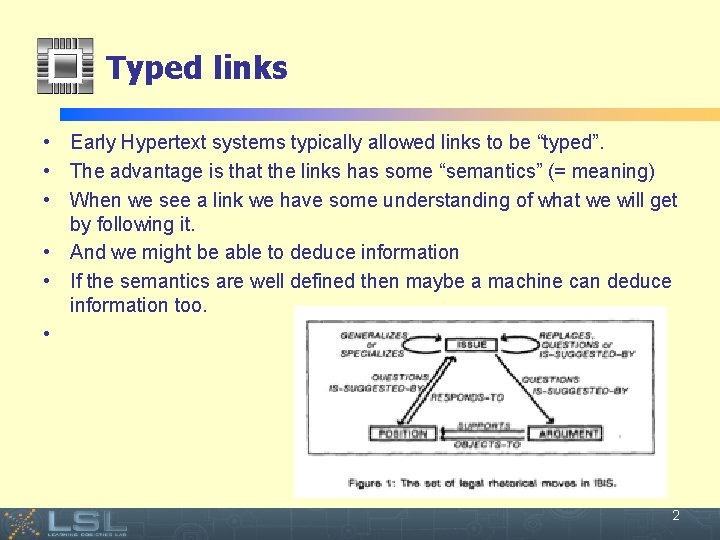
Typed links • Early Hypertext systems typically allowed links to be “typed”. • The advantage is that the links has some “semantics” (= meaning) • When we see a link we have some understanding of what we will get by following it. • And we might be able to deduce information • If the semantics are well defined then maybe a machine can deduce information too. • Event 2
What is Ontological Hypertext? • Ontological Hypertext = Hypertext + Ontologies • Ontology is the study of things that exist – Began as branch of philosophy – Popular in the field of knowledge management – Formal model that allows reasoning over concepts and objects that appear in the real world – An Ontology is a taxonomy (the classes within a domain and the relationship between them) and the inference rules Event 3
What is Ontological Hypertext? • Ontological Hypertext = Hypertext + Ontologies • As we know, hypertext is the study of what can be said using computer media, databases and links – Computer-mediated extensions to familiar textual communication Event 4
What is Ontological Hypertext? • Ontological Hypertext = Hypertext + Ontologies • Things that exist have complex relationships with each other – So complex structures are required for expressing and exploring these relationships – Ontologies formalise these complex structures • Ontological Hypertext is the kind of hypertext whose structure and links are derived from the relationships between objects in the real world – Hypertext with an underlying ontological model Event 5
Ontology Construction • We know various ways to construct a hypertext, but how to construct an ontology for a domain? – Get together a wide range of experts (domain experts, end-users, computer specialists) to ensure all aspects, issues and perspectives of the domain are covered – Iteratively refine and evaluate ontology – Document the construction process, including all assumptions made, in order to aid ongoing maintenance • Domains are not always static, need to incorporate new discoveries, ideas etc. Event 6
Ontology Formalisation • Once consensus reached, ontology must be formalised – Make the model machine-processable – Variety of different formalisation languages • RDFS • DAML -> OIL -> DAML+OIL -> OWL are more expressive, – Extended type systems – Constraint mechanisms and inference rules – http: //www. w 3. org/2001/sw/Web. Ont/ Event 7
Authoring Ontological Hypertext • Use formalised ontology as basis for authoring nodes and links in hypertext system – E. g. select type of node to create – Offer appropriate links to other nodes • Example GUIs coming up! Event 8
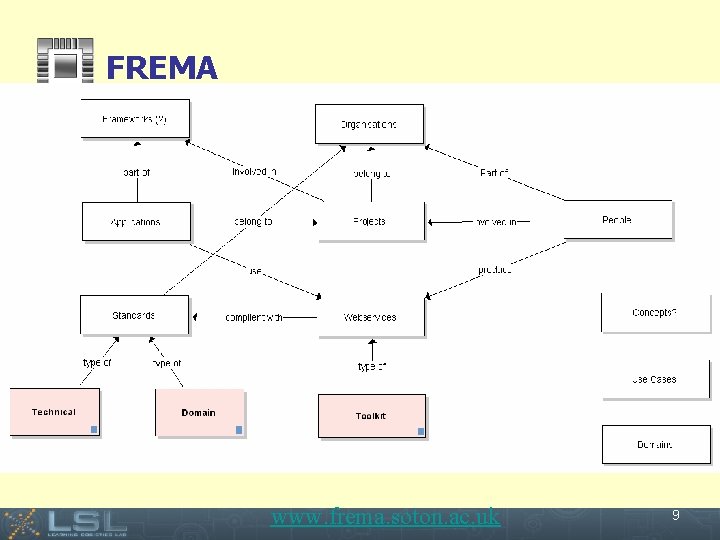
FREMA Event www. frema. soton. ac. uk 9
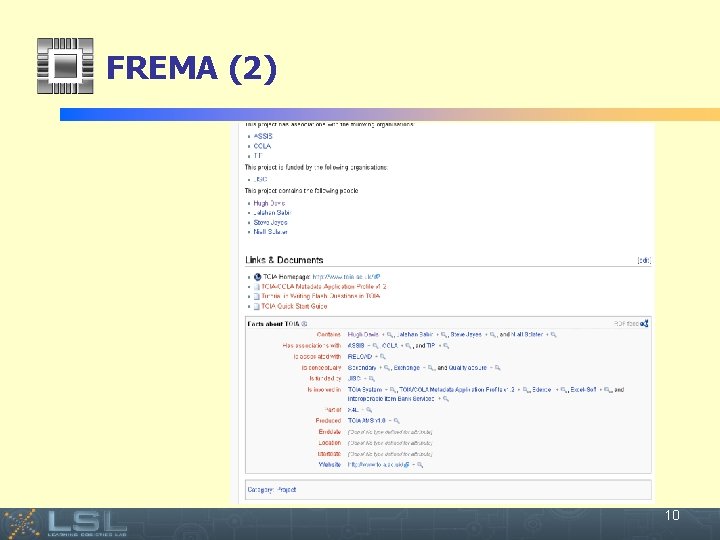
FREMA (2) Event 10
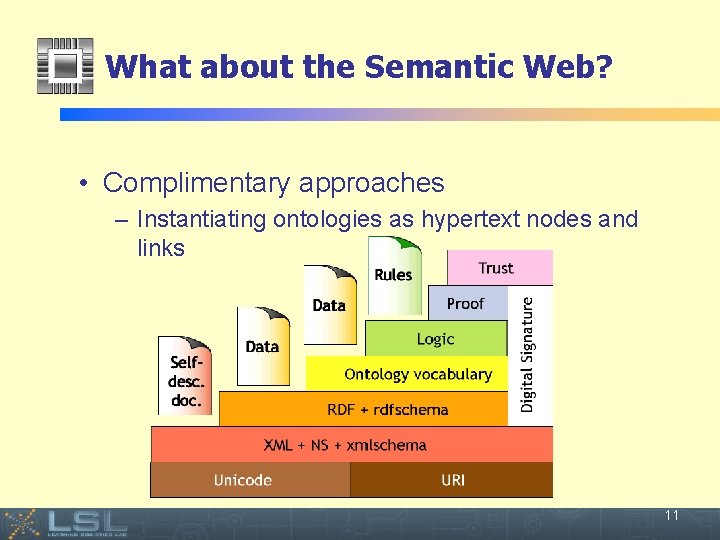
What about the Semantic Web? • Complimentary approaches – Instantiating ontologies as hypertext nodes and links Event 11
The Semantic Web Tim Berners-Lee (1999 WWW keynote) “ I have a dream for the Web [in which computers] become capable of analyzing all the data on the Web – the content, links, and transactions between people and computers. A ‘Semantic Web’, which should make this possible, has yet to emerge, but when it does, the day-to -day mechanisms of trade, bureaucracy and our daily lives will be handled by machines talking to machines. The ‘intelligent agents’ people have touted for ages will finally materialize. “ Event 12
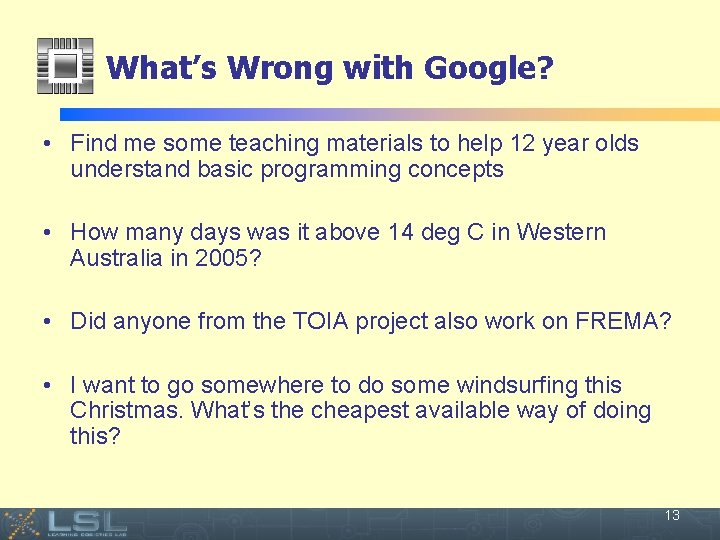
What’s Wrong with Google? • Find me some teaching materials to help 12 year olds understand basic programming concepts • How many days was it above 14 deg C in Western Australia in 2005? • Did anyone from the TOIA project also work on FREMA? • I want to go somewhere to do some windsurfing this Christmas. What’s the cheapest available way of doing this? Event 13
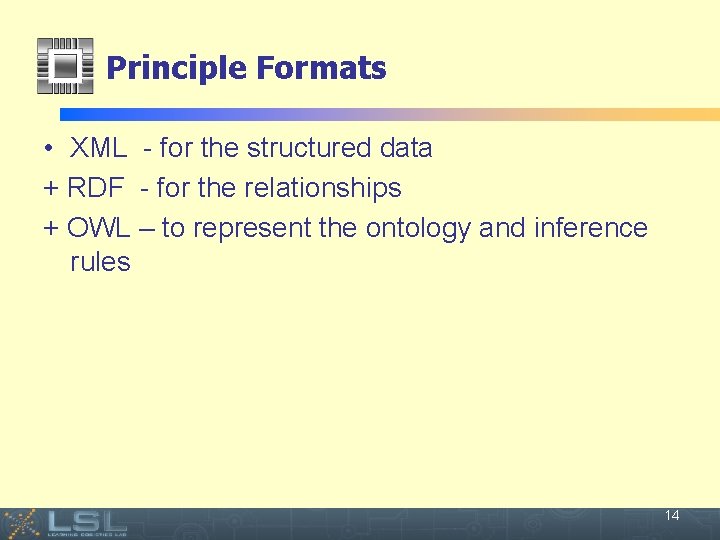
Principle Formats • XML - for the structured data + RDF - for the relationships + OWL – to represent the ontology and inference rules Event 14
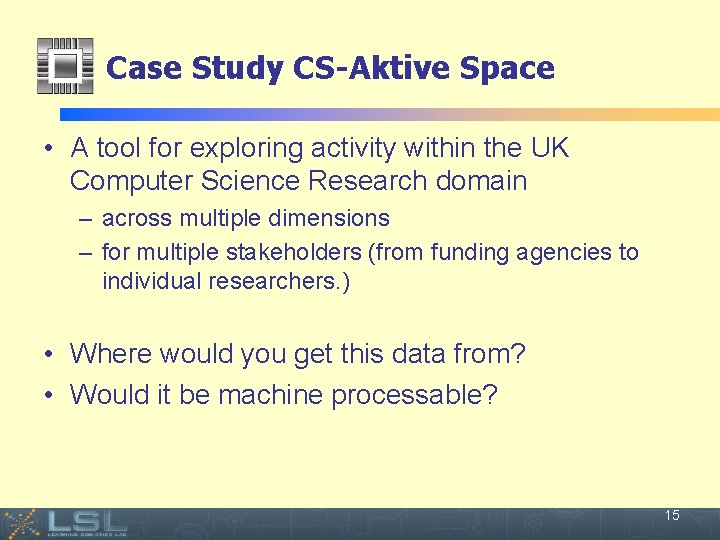
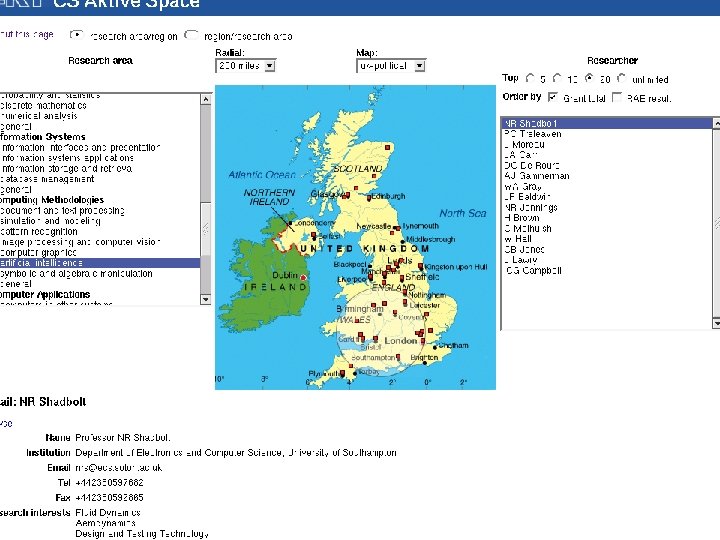
Case Study CS-Aktive Space • A tool for exploring activity within the UK Computer Science Research domain – across multiple dimensions – for multiple stakeholders (from funding agencies to individual researchers. ) • Where would you get this data from? • Would it be machine processable? Event 15
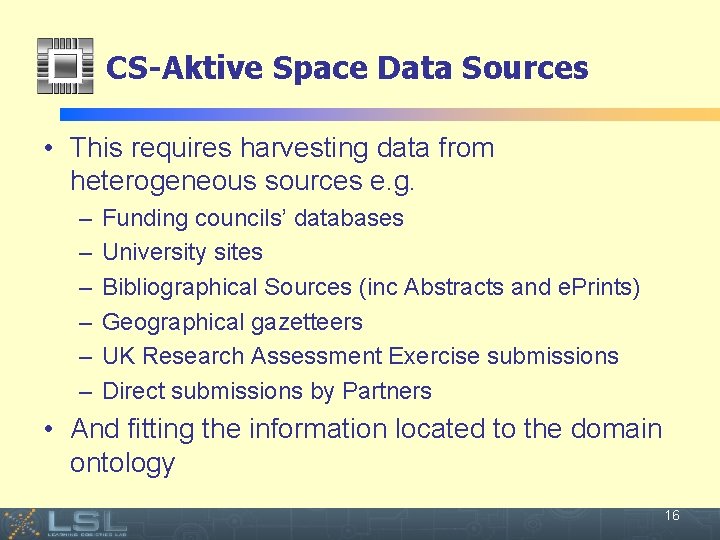
CS-Aktive Space Data Sources • This requires harvesting data from heterogeneous sources e. g. – – – Funding councils’ databases University sites Bibliographical Sources (inc Abstracts and e. Prints) Geographical gazetteers UK Research Assessment Exercise submissions Direct submissions by Partners • And fitting the information located to the domain ontology Event 16
Event 17
CS-Aktive Space Research Issues • how to best sustain an acquisition and harvesting activity? • how best to model the harvested content? • how to cope with large numbers of duplicate items that need to be recognized as referring to the same objects? • the degree to which inferential services can cope as more content becomes available; ? • how we present the content so that inherent patterns and trends can be directly discerned? • how trustworthy is the provenance and accuracy of the content? • how all this information is to be maintained and sustained as a social and community exercise? Event 18
Linked Data • The Web of Data • Tim Berners-Lee outlined four principles: – Use URIs to identify things. – Use HTTP URIs so that these things can be referred to and looked up ("dereference") by people and user agents. – Provide useful information (i. e. , a structured description — metadata) about the thing when its URI is dereferenced. – Include links to other, related URIs in the exposed data to improve discovery of other related information on the Web. e. G DBPedia Event 19
Some Issues for the Semantic Web • It hasn’t really happened yet – but maybe linked data is taking off (2009) • Link and Data. We really need to be able to get semantic data from textual data -> RDFa and GRDDL. • The Semantic Gap – whose ontology? • If it did work would we be happy – or in control of the data – c. f. the Facebook API Event 20