
Linking Regime Shifts to Carbon Dynamics in Lake
Linking Regime Shifts to Carbon Dynamics in Lake Erie A new NSERC-Strategic Project (2013 -16)
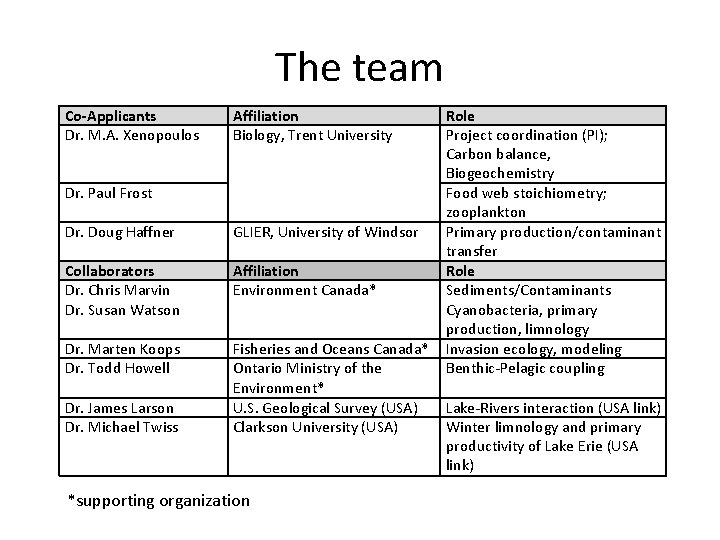
The team Co-Applicants Dr. M. A. Xenopoulos Affiliation Biology, Trent University Dr. Paul Frost Dr. Doug Haffner GLIER, University of Windsor Collaborators Dr. Chris Marvin Dr. Susan Watson Affiliation Environment Canada* Dr. Marten Koops Dr. Todd Howell Fisheries and Oceans Canada* Ontario Ministry of the Environment* U. S. Geological Survey (USA) Clarkson University (USA) Dr. James Larson Dr. Michael Twiss *supporting organization Role Project coordination (PI); Carbon balance, Biogeochemistry Food web stoichiometry; zooplankton Primary production/contaminant transfer Role Sediments/Contaminants Cyanobacteria, primary production, limnology Invasion ecology, modeling Benthic-Pelagic coupling Lake-Rivers interaction (USA link) Winter limnology and primary productivity of Lake Erie (USA link)
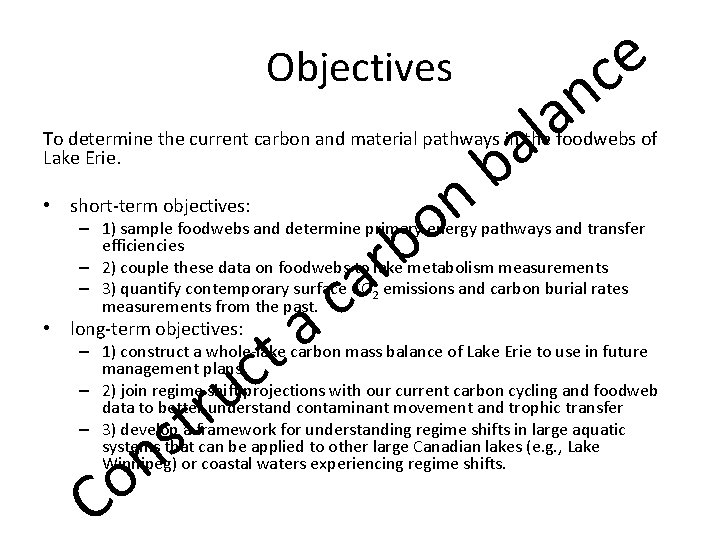
Objectives e c n a l a b To determine the current carbon and material pathways in the foodwebs of Lake Erie. n o b r • short-term objectives: – 1) sample foodwebs and determine primary energy pathways and transfer efficiencies – 2) couple these data on foodwebs to lake metabolism measurements – 3) quantify contemporary surface CO 2 emissions and carbon burial rates measurements from the past. t c u r t • long-term objectives: a c a – 1) construct a whole-lake carbon mass balance of Lake Erie to use in future management plans – 2) join regime shift projections with our current carbon cycling and foodweb data to better understand contaminant movement and trophic transfer – 3) develop a framework for understanding regime shifts in large aquatic systems that can be applied to other large Canadian lakes (e. g. , Lake Winnipeg) or coastal waters experiencing regime shifts. o C s n
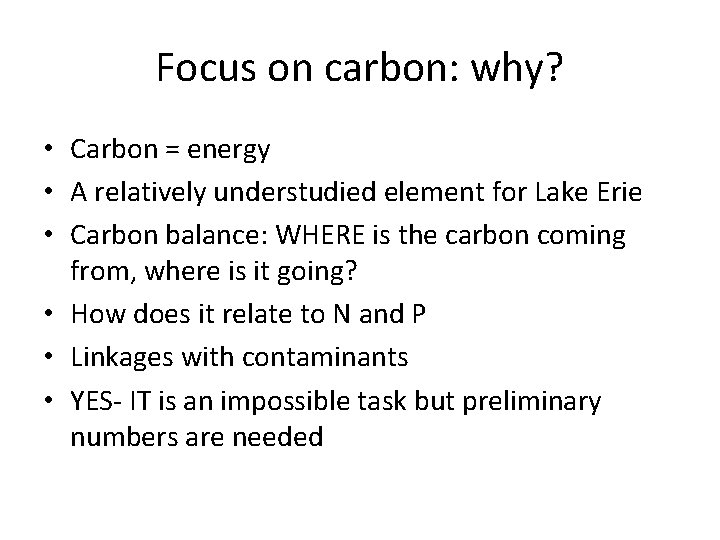
Focus on carbon: why? • Carbon = energy • A relatively understudied element for Lake Erie • Carbon balance: WHERE is the carbon coming from, where is it going? • How does it relate to N and P • Linkages with contaminants • YES- IT is an impossible task but preliminary numbers are needed

WHY REGIME SHIFTS?
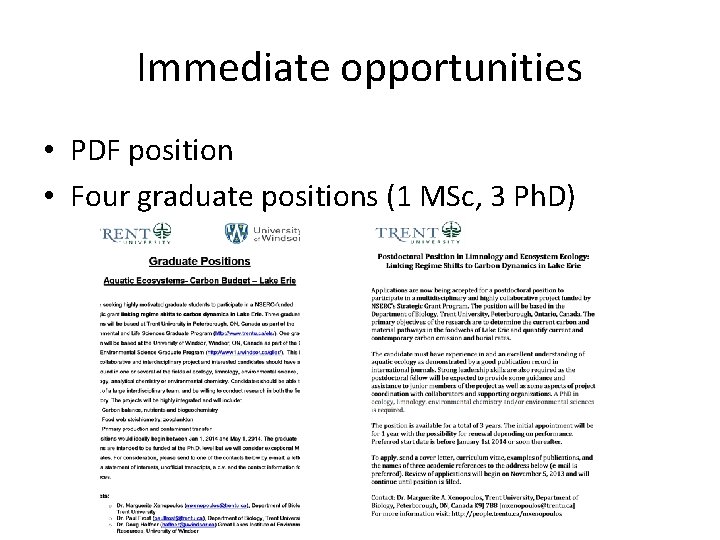
Immediate opportunities • PDF position • Four graduate positions (1 MSc, 3 Ph. D)
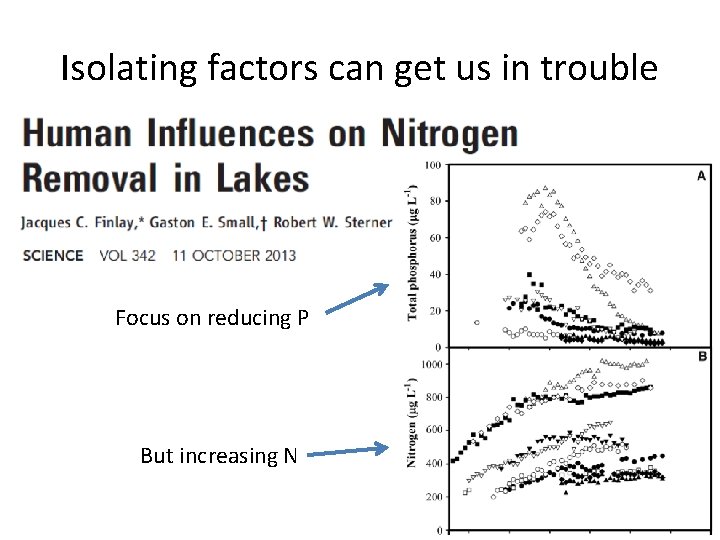
Isolating factors can get us in trouble Focus on reducing P But increasing N
Other opportunities • Proposal weakness – Biological/food web measurements • • Temporal resolution Spatial resolution offshore vs nearshore Mussel biomass/ fish (will have to rely on collaborators) – Storm events? • Input/output of C
Short-term Timeline • Now-May 2014: Complete recruitment of HQP • Winter 2014: Winter Carbon Budgets on CCGS Griffin • May 2014, August 2014 and October 2014: Field work on CCGS Limnos
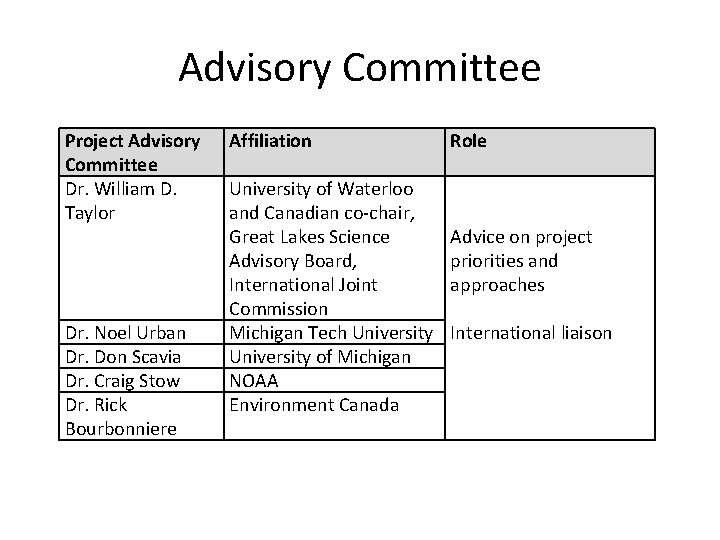
Advisory Committee Project Advisory Committee Dr. William D. Taylor Dr. Noel Urban Dr. Don Scavia Dr. Craig Stow Dr. Rick Bourbonniere Affiliation University of Waterloo and Canadian co-chair, Great Lakes Science Advisory Board, International Joint Commission Michigan Tech University of Michigan NOAA Environment Canada Role Advice on project priorities and approaches International liaison
Contact us • Maggie Xenopoulos (mxenopoulos@trentu. ca) • Andrew Scott (andrewscott@trentu. ca)
- Slides: 11