
Linking Libraries Literacy Learning Session 1 1 2
Linking Libraries, Literacy & Learning
Session 1 1. 2. 3. 4. 5. 6. Linking Libraries, Literacy & Learning Housekeeping The role of the library Beginning with the end in mind What is literacy? Setting your benchmarks and goals Recommended reads & research Session 2 1. Building relationships 2. Developing the collection 3. Creating the environment Session 3 1. 2. 3. 4. Free Voluntary Reading Celebrations Enabling individuals Fundraising
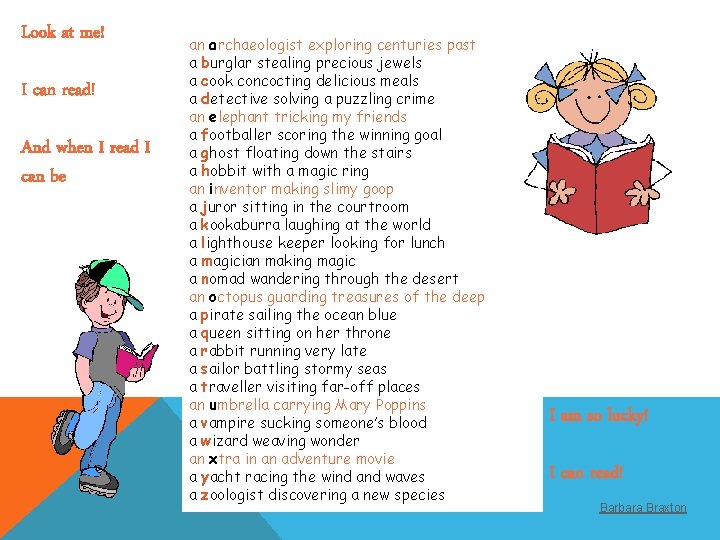
Look at me! I can read! And when I read I can be an archaeologist exploring centuries past a burglar stealing precious jewels a cook concocting delicious meals a detective solving a puzzling crime an elephant tricking my friends a footballer scoring the winning goal a ghost floating down the stairs a hobbit with a magic ring an inventor making slimy goop a juror sitting in the courtroom a kookaburra laughing at the world a lighthouse keeper looking for lunch a magician making magic a nomad wandering through the desert an octopus guarding treasures of the deep a pirate sailing the ocean blue a queen sitting on her throne a rabbit running very late a sailor battling stormy seas a traveller visiting far-off places an umbrella carrying Mary Poppins a vampire sucking someone’s blood a wizard weaving wonder an xtra in an adventure movie a yacht racing the wind and waves a zoologist discovering a new species I am so lucky! I can read! Barbara Braxton
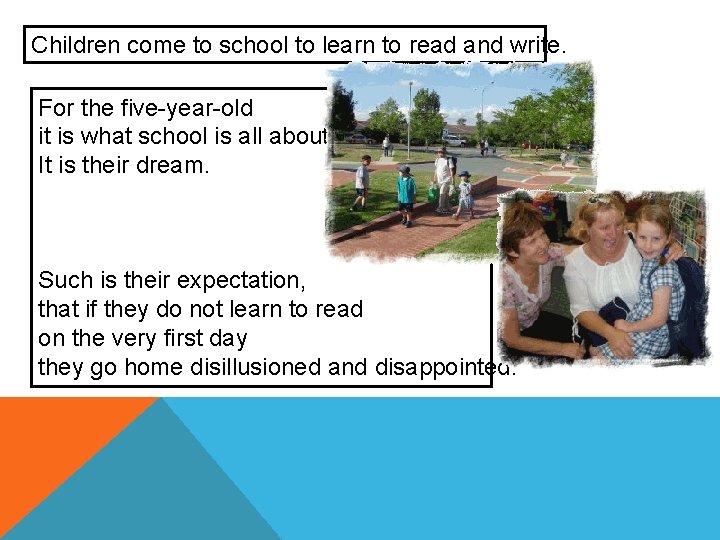
Children come to school to learn to read and write. . For the five-year-old it is what school is all about. It is their dream. Such is their expectation, that if they do not learn to read on the very first day they go home disillusioned and disappointed.
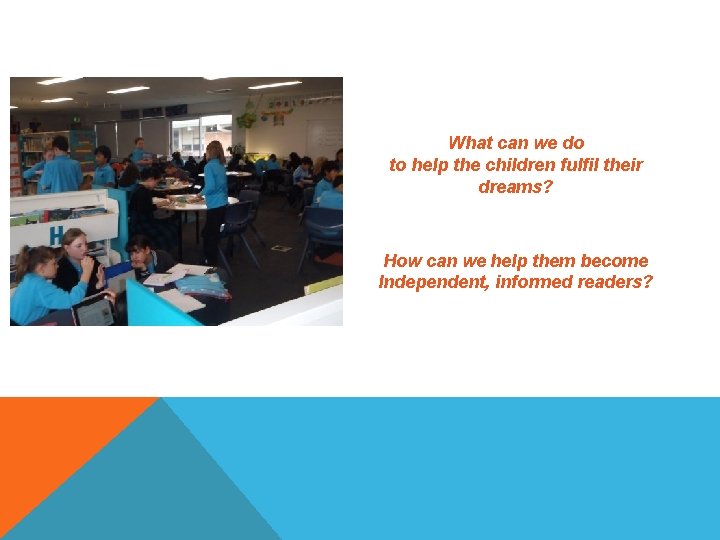
What can we do to help the children fulfil their dreams? How can we help them become Independent, informed readers?
By Year 6 many students view reading as a means to an end, need to complete an assignment, improve a grade or please a teacher.
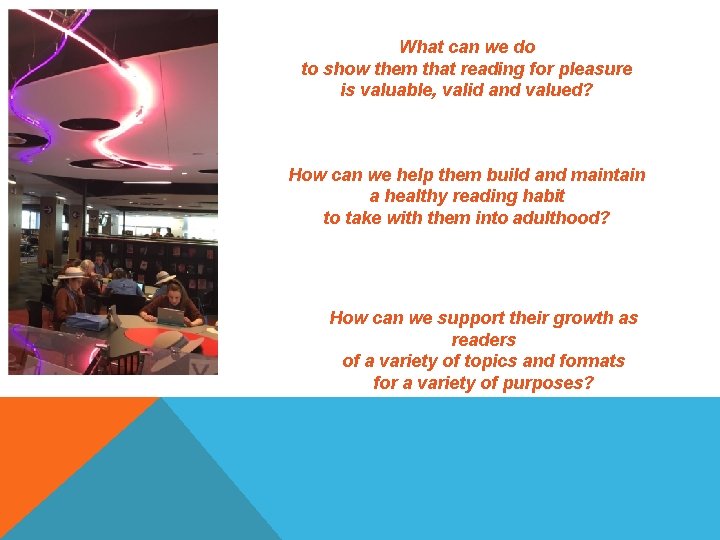
What can we do to show them that reading for pleasure is valuable, valid and valued? How can we help them build and maintain a healthy reading habit to take with them into adulthood? How can we support their growth as readers of a variety of topics and formats for a variety of purposes?

Linking Libraries, Literacy & Learning Providing Leadership in Literacy from the Librar
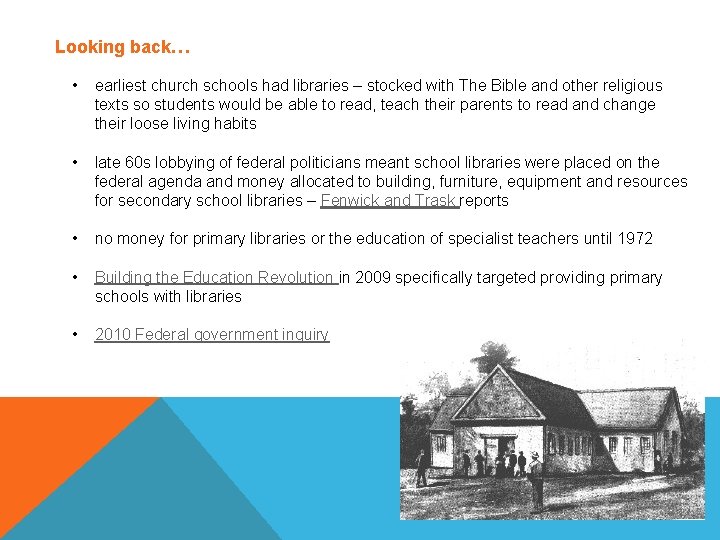
Looking back… • earliest church schools had libraries – stocked with The Bible and other religious texts so students would be able to read, teach their parents to read and change their loose living habits • late 60 s lobbying of federal politicians meant school libraries were placed on the federal agenda and money allocated to building, furniture, equipment and resources for secondary school libraries – Fenwick and Trask reports • no money for primary libraries or the education of specialist teachers until 1972 • Building the Education Revolution in 2009 specifically targeted providing primary schools with libraries • 2010 Federal government inquiry
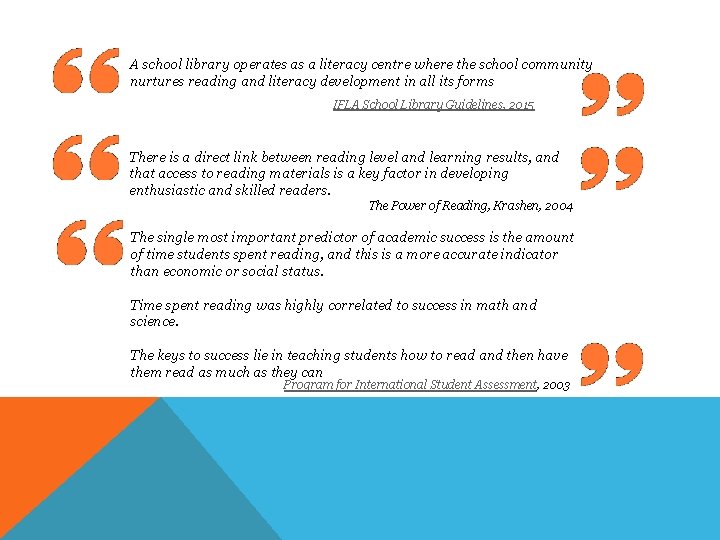
A school library operates as a literacy centre where the school community nurtures reading and literacy development in all its forms IFLA School Library Guidelines, 2015 There is a direct link between reading level and learning results, and that access to reading materials is a key factor in developing enthusiastic and skilled readers. The Power of Reading, Krashen, 2004 The single most important predictor of academic success is the amount of time students spent reading, and this is a more accurate indicator than economic or social status. Time spent reading was highly correlated to success in math and science. The keys to success lie in teaching students how to read and then have them read as much as they can Program for International Student Assessment, 2003
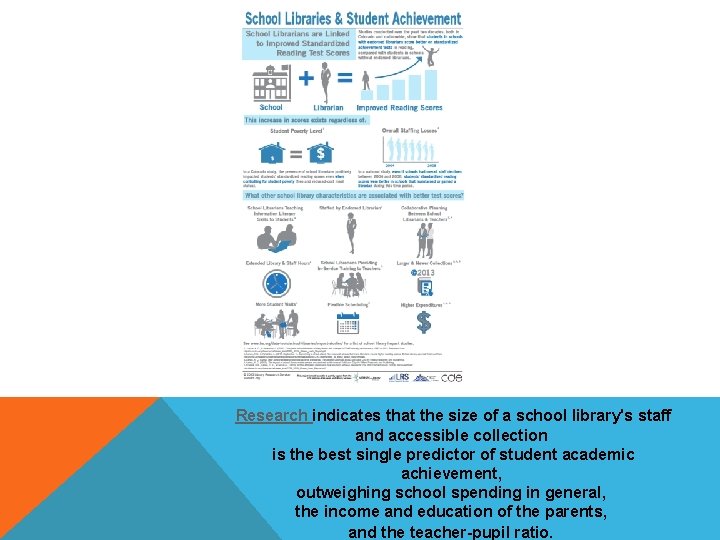
Research indicates that the size of a school library's staff and accessible collection is the best single predictor of student academic achievement, outweighing school spending in general, the income and education of the parents, and the teacher-pupil ratio.
Beginning with the end in mind To begin with the end in mind means to start with a clear understanding of your destination. It means to know where you are going so that you better understand where you are now so that the steps that you take are always in the right direction
At the end of today you will be expected to have • written a brief statement that encapsulates your role as a literacy leader in your school and how it might be in the future. • developed some goals that will inform an action plan for the future • identified four things that you will put in place before the end of the 2016 school year • identified four things that you will work towards putting in place in 2017 • mapped your future learning journey Today is not just about today. It’s about giving you something to build on for the next 12 months or more. You should be able to use it to satisfy your formal professional learning requirements by creating your plan for your future personal development.
Questions to ponder… What is literacy? How does the library currently contribute to literacy and learning in my sc What can be done to make it the centre of literacy and learning? What is my role in achieving this?
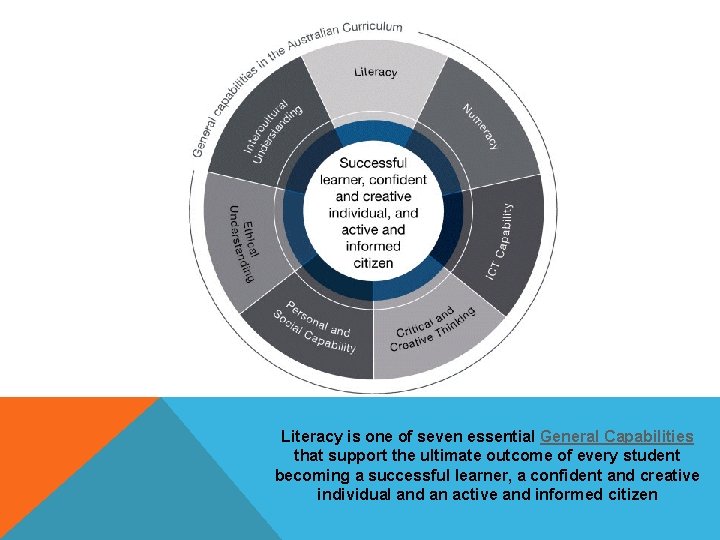
Literacy is one of seven essential General Capabilities that support the ultimate outcome of every student becoming a successful learner, a confident and creative individual and an active and informed citizen
Students become literate as they develop the knowledge, skills and dispositions to interpret and use language confidently for learning and communicating in and out of school and for participating effectively in society. Literacy involves students listening to, reading, viewing, speaking, writing and creating oral, print, visual and digital texts, and using and modifying language for different purposes in a range of contexts Literacy encompasses the knowledge and skills students need to access, understand, analyse and evaluate information, make meaning, express thoughts and emotions, present ideas and opinions, interact with others and participate in activities at school and in their lives beyond school.
Literacy is underpinned by genre theory and pedagogy • means using language for purposes such as explaining, describing, arguing, recounting, reviewing, reflecting and storytelling • includes speaking, listening, reading, writing and viewing • assumes that learners will succeed and achieve mastery • depends on explicit teaching of the language needed to achieve the learning outcomes of the school curriculum • involves both modelling and scaffolding, practice and feedback • acknowledges learning occurs through social interaction • is most successful embedded in real life and purposeful contexts • depends on the individual’s circumstances, exposure and needs • is the basis of NAPLAN writing tests which focus on either imaginative, informative or persuasive text types.
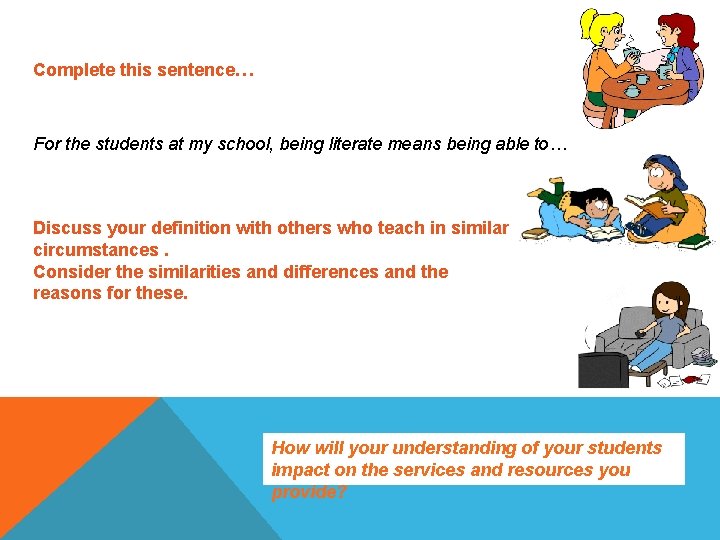
Complete this sentence… For the students at my school, being literate means being able to… Discuss your definition with others who teach in similar circumstances. Consider the similarities and differences and the reasons for these. How will your understanding of your students impact on the services and resources you provide?
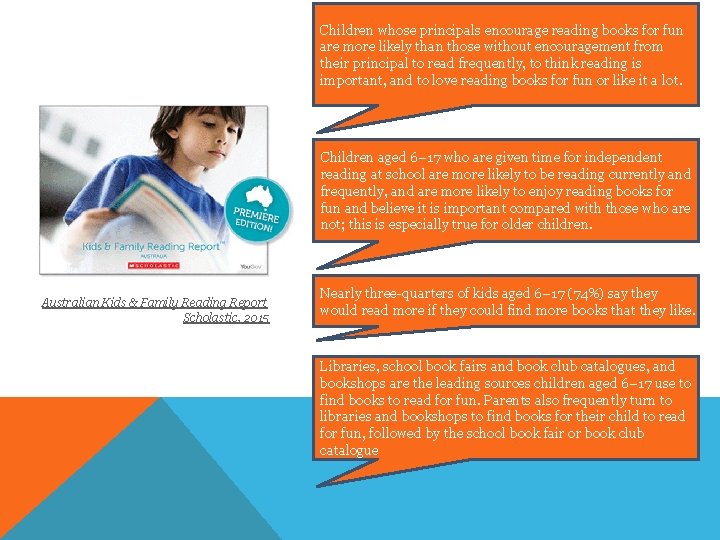
Children whose principals encourage reading books for fun are more likely than those without encouragement from their principal to read frequently, to think reading is important, and to love reading books for fun or like it a lot. Children aged 6– 17 who are given time for independent reading at school are more likely to be reading currently and frequently, and are more likely to enjoy reading books for fun and believe it is important compared with those who are not; this is especially true for older children. Australian Kids & Family Reading Report Scholastic, 2015 Nearly three-quarters of kids aged 6– 17 (74%) say they would read more if they could find more books that they like. Libraries, school book fairs and book club catalogues, and bookshops are the leading sources children aged 6– 17 use to find books to read for fun. Parents also frequently turn to libraries and bookshops to find books for their child to read for fun, followed by the school book fair or book club catalogue
where to from here? Use the Taking It Further planning sheet to • reflect on your current role • identify some areas that you already know you want to improve • identify some areas you know you need to investigate further
the current situation Establish your benchmarks • What does literacy look like at your school now? • What role do you have in being the literacy leader? • What role do your colleagues expect you to have as the reader leader? • How do the school library’s current resources and services support literacy development? Consider • Does literacy explicitly underpin every facet of the curriculum? • Are the library and its staff viewed as the hub of literacy in the school? • Do students read and research because they want to or because they have to? • What do you know about how children learn to read and like to read (at the level you serve) so your collection development is informed? • Are there particular programs the library must support? Identifying where you are now provides your starting point so you can map the journey and know when you have reached your destination.
moving forward Create your vision • What do you want literacy to look like at your school? • What do you need to know and do to achieve this? • How will you know that you have achieved your goals? Consider • Connecting with people • Developing the collection • Creating the environment Remember All that is done within the library must contribute positively to the teaching and learning in the school. It needs to support the staff and students in some way.
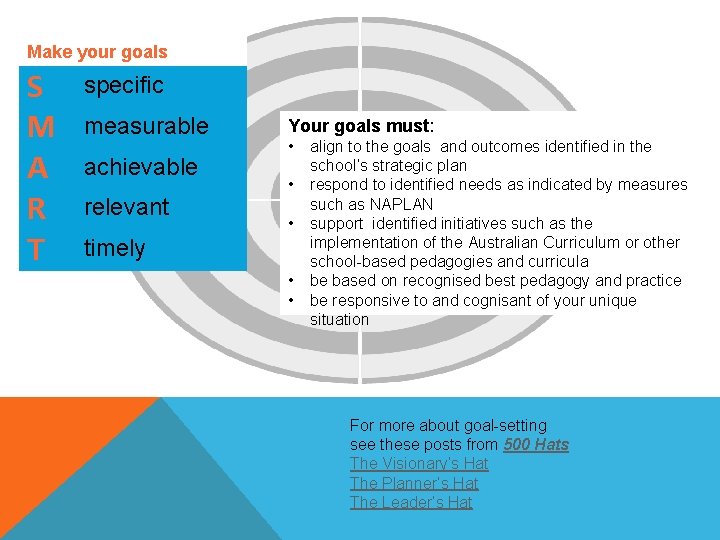
Make your goals S. M. A. R. T S M A R T specific measurable achievable relevant Your goals must: • • • timely • • align to the goals and outcomes identified in the school’s strategic plan respond to identified needs as indicated by measures such as NAPLAN support identified initiatives such as the implementation of the Australian Curriculum or other school-based pedagogies and curricula be based on recognised best pedagogy and practice be responsive to and cognisant of your unique situation For more about goal-setting see these posts from 500 Hats The Visionary’s Hat The Planner’s Hat The Leader’s Hat
Research you should know about read the research • School Libraries Work, 2016 (Scholastic, 2016) • Libraries Matter: The impact of libraries on literacy and education; community development and the economy (Collection of research from the ALA) • Reading Revolution: Online or in print? (Deam, 2015) • Guiding principles for supporting new literacies in the classroom (Reading Teacher. 2012) • The importance of free voluntary reading (Krashen, various) • Australian Kids & Family Reading Report (Scholastic, 2015) • Children and Reading: A literature review (Dickenson, 2014) • Picture Books in the Digital Age (Serafini, Kachorsky, Aguilera, 2016) Research… • informs professional practice • challenges existing beliefs • can establish common beliefs, benchmarks and goals • provides evidence for decision-making • provides a platform for further investigations
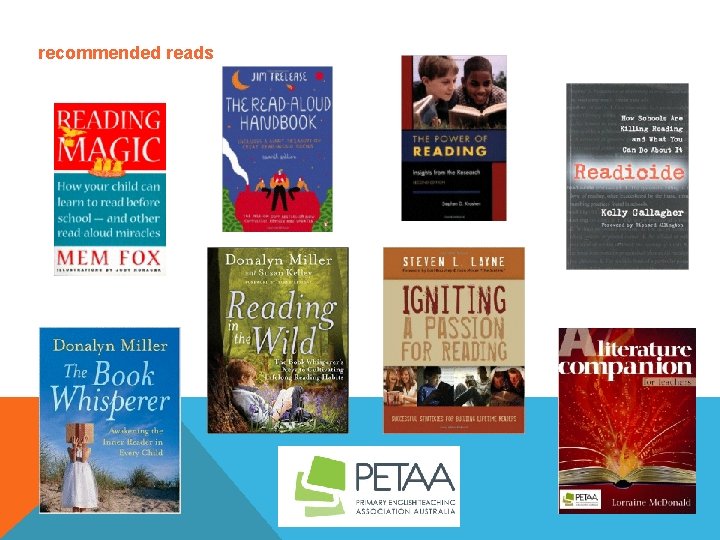
recommended reads
If you do what you’ve always done, you will get what you’ve always got. Henry Ford Old ways won’t open new doors If you want something you’ve never had, then do something you’ve never done.
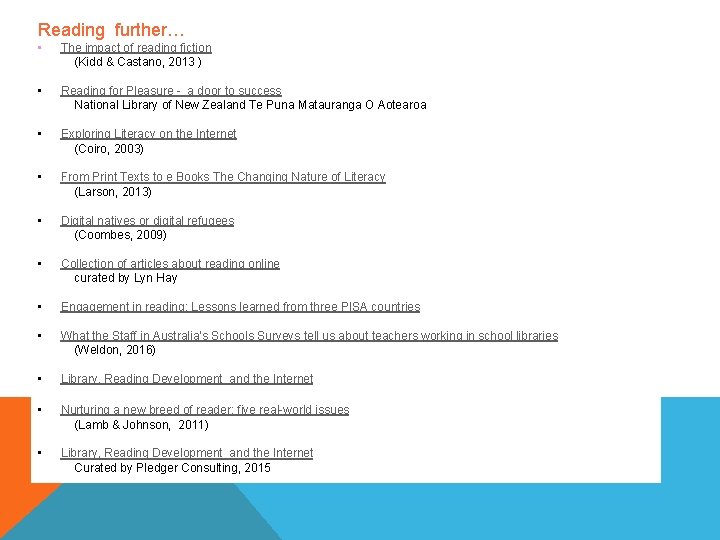
Reading further… • The impact of reading fiction (Kidd & Castano, 2013 ) • Reading for Pleasure - a door to success National Library of New Zealand Te Puna Matauranga O Aotearoa • Exploring Literacy on the Internet (Coiro, 2003) • From Print Texts to e Books The Changing Nature of Literacy (Larson, 2013) • Digital natives or digital refugees (Coombes, 2009) • Collection of articles about reading online curated by Lyn Hay • Engagement in reading: Lessons learned from three PISA countries • What the Staff in Australia's Schools Surveys tell us about teachers working in school libraries (Weldon, 2016) • Library, Reading Development and the Internet • Nurturing a new breed of reader: five real-world issues (Lamb & Johnson, 2011) • Library, Reading Development and the Internet Curated by Pledger Consulting, 2015
Presented by Barbara Braxton Teacher Librarian M. Ed. (TL), M. App. Sci. (TL), M. I. S. (Children's Services) Dromkeen Librarian's Award 2003 barbara. 288@bigpond. com 500 Hats The Bottom Shelf Together, we learn from each other June 2016
- Slides: 28