
Linking ISIC to other classifications United Nations Statistics

- Slides: 23
Linking ISIC to other classifications United Nations Statistics Division
What links are possible? o ISIC is used for statistics grouped by activities and most commonly statistics based on units (e. g. establishments) classified according to their main activity o Theoretically, any classification that can establish a connection to these concepts can be linked to ISIC
What links are possible? o Some classifications may link to the complete range of ISIC activities, while others can establish a meaningful link only to a subset of ISIC categories o Sometimes, categories in both classifications may look alike, but their context restricts the link n Example: ICATUS
How is the link defined? o The important question is: What criteria/concepts are used to link the two classifications?
How is the link defined? o Very common links n Other activity classifications n Product classifications n Criteria are typically clear in these cases o options for products still exist n We will look at the ISIC-CPC link later on
Example: ISCED n ISCED classifies programmes into levels according to set criteria n ISIC classifies units providing education services
Example: ISCED o A link between ISIC and ISCED can be established by linking units providing programmes at educational level n with educational programmes at level n in ISCED o Problem: the programmes are not defined at unit level (e. g. schools) and a unit can carry out multiple programmes n Keep in mind when comparing data
Example: ICNPO o ICNPO also classifies activities o Categories of ICNPO and ISIC often line up or can be aggregated to matching levels n Discussed in Part 4 of the ISIC Rev. 4 publication o Data conversion issue: n While definitions of activity categories are comparable, the ISIC classes cover non-profit and for-profit institutions
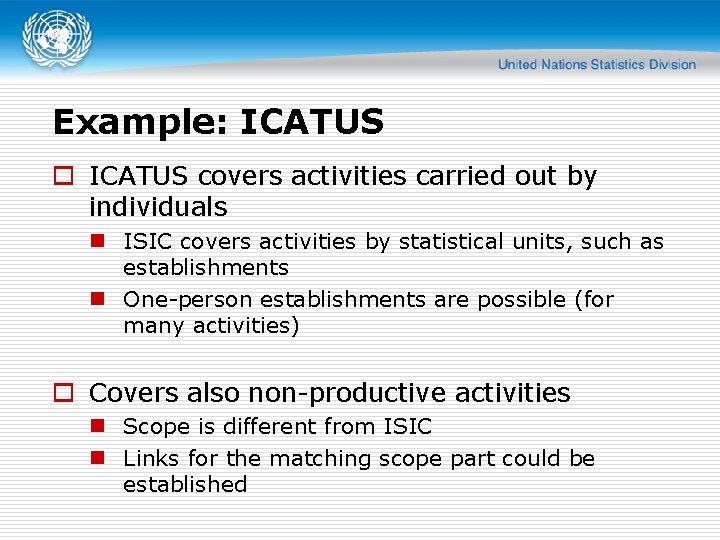
Example: ICATUS o ICATUS covers activities carried out by individuals n ISIC covers activities by statistical units, such as establishments n One-person establishments are possible (for many activities) o Covers also non-productive activities n Scope is different from ISIC n Links for the matching scope part could be established
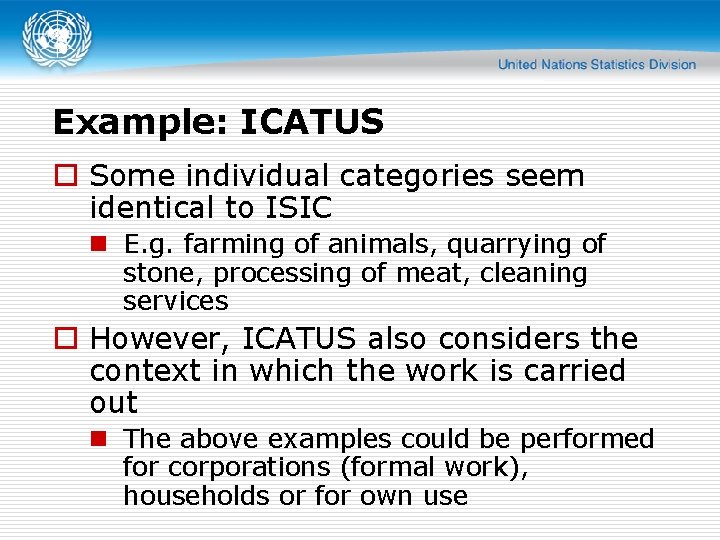
Example: ICATUS o Some individual categories seem identical to ISIC n E. g. farming of animals, quarrying of stone, processing of meat, cleaning services o However, ICATUS also considers the context in which the work is carried out n The above examples could be performed for corporations (formal work), households or for own use
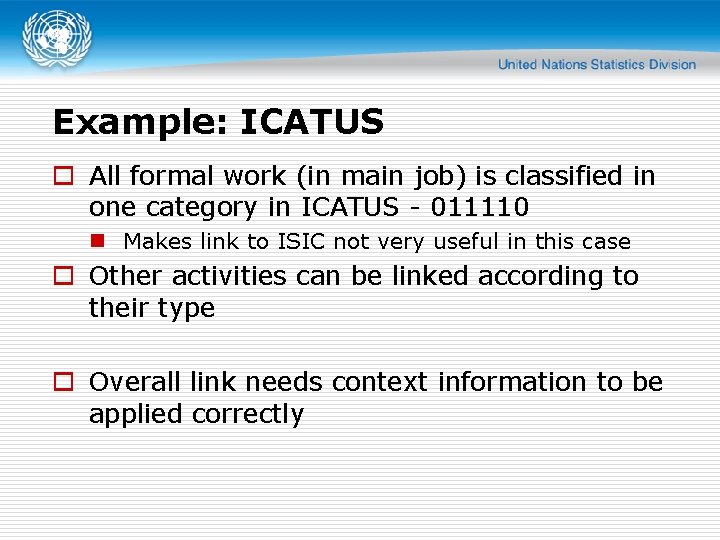
Example: ICATUS o All formal work (in main job) is classified in one category in ICATUS - 011110 n Makes link to ISIC not very useful in this case o Other activities can be linked according to their type o Overall link needs context information to be applied correctly
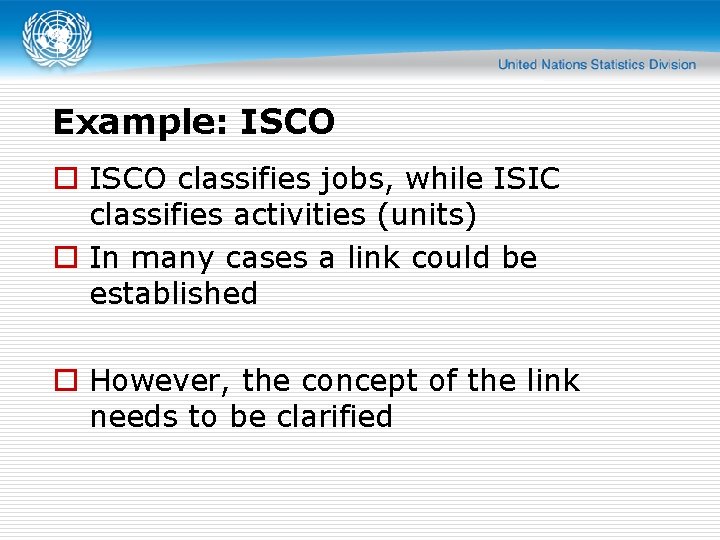
Example: ISCO o ISCO classifies jobs, while ISIC classifies activities (units) o In many cases a link could be established o However, the concept of the link needs to be clarified
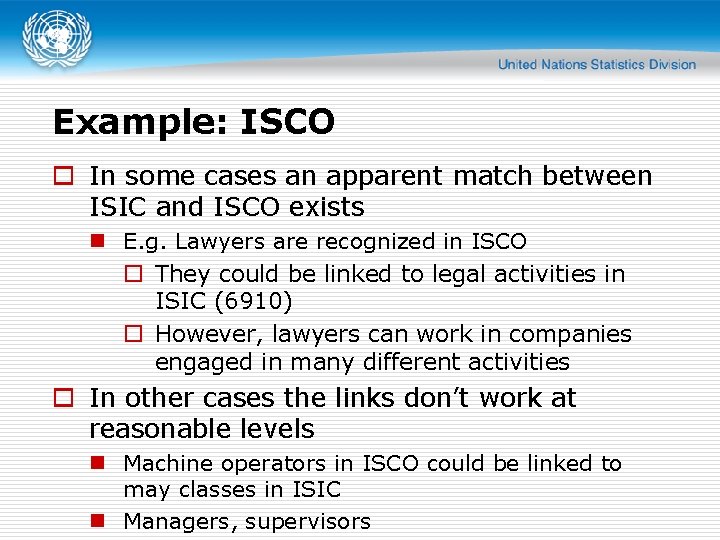
Example: ISCO o In some cases an apparent match between ISIC and ISCO exists n E. g. Lawyers are recognized in ISCO o They could be linked to legal activities in ISIC (6910) o However, lawyers can work in companies engaged in many different activities o In other cases the links don’t work at reasonable levels n Machine operators in ISCO could be linked to may classes in ISIC n Managers, supervisors
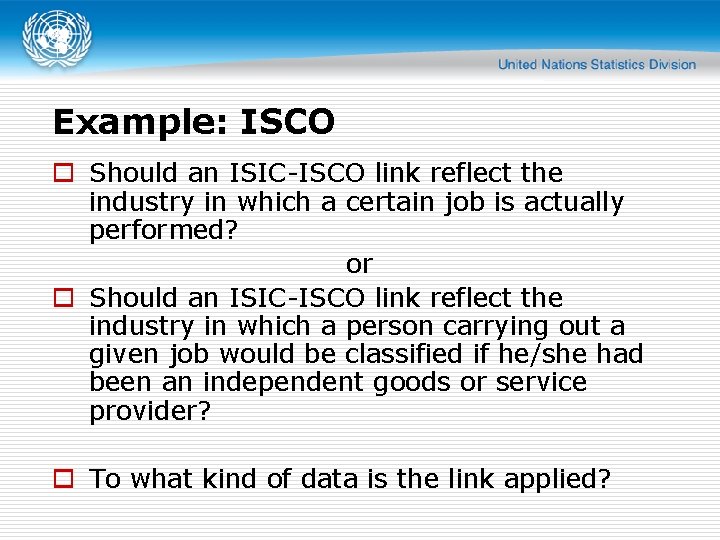
Example: ISCO o Should an ISIC-ISCO link reflect the industry in which a certain job is actually performed? or o Should an ISIC-ISCO link reflect the industry in which a person carrying out a given job would be classified if he/she had been an independent goods or service provider? o To what kind of data is the link applied?
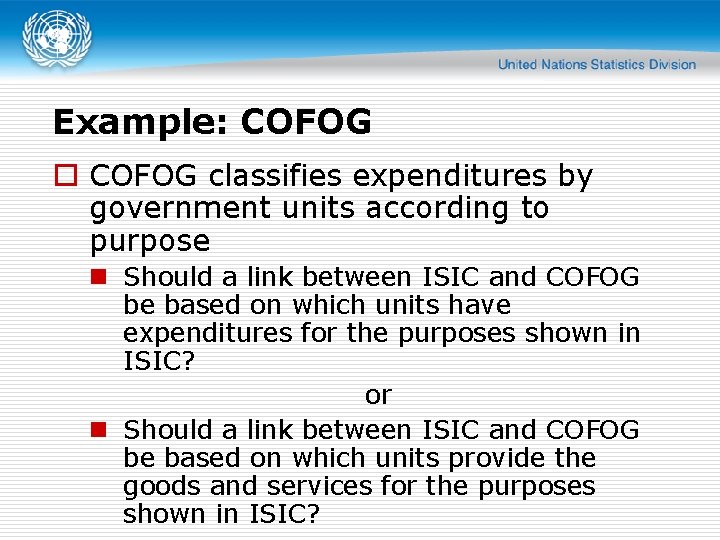
Example: COFOG o COFOG classifies expenditures by government units according to purpose n Should a link between ISIC and COFOG be based on which units have expenditures for the purposes shown in ISIC? or n Should a link between ISIC and COFOG be based on which units provide the goods and services for the purposes shown in ISIC?
CPC Ver. 2 - ISIC Rev. 4
CPC-ISIC link o CPC classifies products, ISIC classifies activities/units o What concept is used for the link? o Most common: Link CPC products to the ISIC activities that produce them n Other options: link to activities that use them; link to ISIC industries that produce these products o Problem with latter: secondary production
CPC-ISIC link o In most cases, a product can be attributed to a single activity that produces it o There are exceptions, which complicate the link: n Products assigned to multiple activities n Products assigned to many/all activities/industries n Products assigned to no activity (not outputs of production) o Note: although the link is to “activity” the above exceptions may go beyond that for practical reasons n E. g. trademarks, leasing of rights to use patents
CPC – ISIC link o Products with multiple activity/industry links n Examples: o Mushrooms (output of growing or gathering) o Oysters (output of aquaculture or fishing) o Glycerol (output of different chemical processes) o Electrical capacitors (electric vs. electronic) o Sale of advertising space in print media (different media) o Internet access services (different providers)
CPC – ISIC link n Reasons for multiple links: o Insufficient product detail n (could be fixed) o One product (with unique characteristics) can be produced by different industries n Subdividing these would create “artificial products”; goods not compatible with HS n Forcing a single link may result in loss of data o Depends on application of this link for data collection and display
CPC – ISIC link o Total number of CPC products with multiple ISIC links: n 66 (out of 2730) = 2. 5% o For most products, a regrouping by industry is possible o No ISIC link shown for waste products n Could be produced by many industries, regardless of waste type n Some are not output of production
Summary o Links can be established between ISIC and many other classifications o It is important to agree on the concept that defines the link n This will depend on the type of data that is being considered