
Linking Climate Adaptation Bangladesh Case Study Floods in
Linking Climate Adaptation: Bangladesh Case Study Floods in Bangladesh – A Shift from Disaster Management to Preparedness Prepared by Bangladesh Centre for Advanced Studies House-10, Road-16 A, Gulshan-1, Dhaka LCA Side Event 21 May 2005 Bonn, Germany
The Case Study n n Bangladesh is a poor developing country Faces many natural disasters including severe floods, cyclone, riverbank erosion, drought and earthquakes Likely to face more natural disasters and adverse impacts of climate change in the form of severe floods, cyclones, sea level rise The case study: n n n focuses on the recent floods responses of various actors analysis of transition of Disaster Management Bureau (DMB) from conventional approach to preparedness
Country Profile: Geophysical Feature n n n Bangladesh is a low-lying country located between 20 O 34/ to 26 O 38/ north latitude and 88 O 01/ to 92 O 42/ east longitude It is a part of the Bengal Basin, which was filled by the sediments washed down from the Himalayan mountains, highlands and hills systems Bangladesh is one of the largest deltas; and most part of the country is active floodplain A huge network of rivers and their tributaries crisscross the country The country has a humid, warm and tropical climate; Monsoon rainfall has given a special character feature to the country, which shapes the lives and livelihoods of the common people The country faces frequent monsoon flood; currently it also experienced a number of pre-monsoon and post monsoon prolonged floods
Country Profile: Socio-economic Condition n n n Bangladesh is categorized as a LDC associated with a number of socio-economic problems and development challenges It has a large growing population with limited resources bases The country is faced with wide spread poverty, political instability, poor governance and frequent natural disasters like flood, cyclones and droughts These very often affect the livelihoods of the millions of poor and marginal people The socio-economic development process of the country is also badly affected by frequent natural disaster like floods, riverbank erosion and cyclones However, Bangladesh has achieved laudable success in population control, poverty reduction, spread of primary education and basic health services and supports in the recent decades
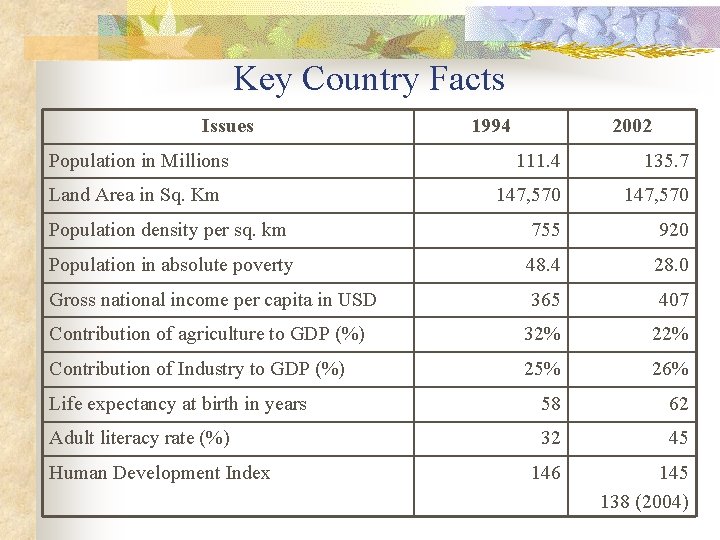
Key Country Facts Issues Population in Millions 1994 2002 111. 4 135. 7 147, 570 Population density per sq. km 755 920 Population in absolute poverty 48. 4 28. 0 Gross national income per capita in USD 365 407 Contribution of agriculture to GDP (%) 32% 22% Contribution of Industry to GDP (%) 25% 26% Life expectancy at birth in years 58 62 Adult literacy rate (%) 32 45 146 145 138 (2004) Land Area in Sq. Km Human Development Index
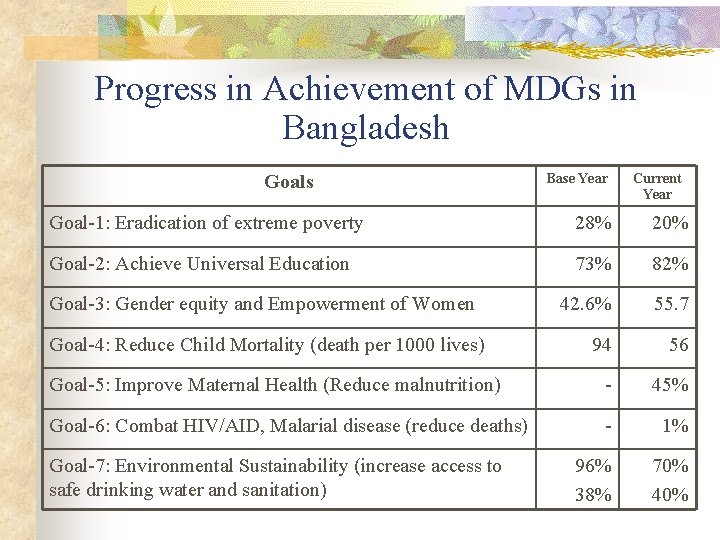
Progress in Achievement of MDGs in Bangladesh Goals Base Year Current Year Goal-1: Eradication of extreme poverty 28% 20% Goal-2: Achieve Universal Education 73% 82% 42. 6% 55. 7 94 56 Goal-5: Improve Maternal Health (Reduce malnutrition) - 45% Goal-6: Combat HIV/AID, Malarial disease (reduce deaths) - 1% 96% 38% 70% 40% Goal-3: Gender equity and Empowerment of Women Goal-4: Reduce Child Mortality (death per 1000 lives) Goal-7: Environmental Sustainability (increase access to safe drinking water and sanitation)
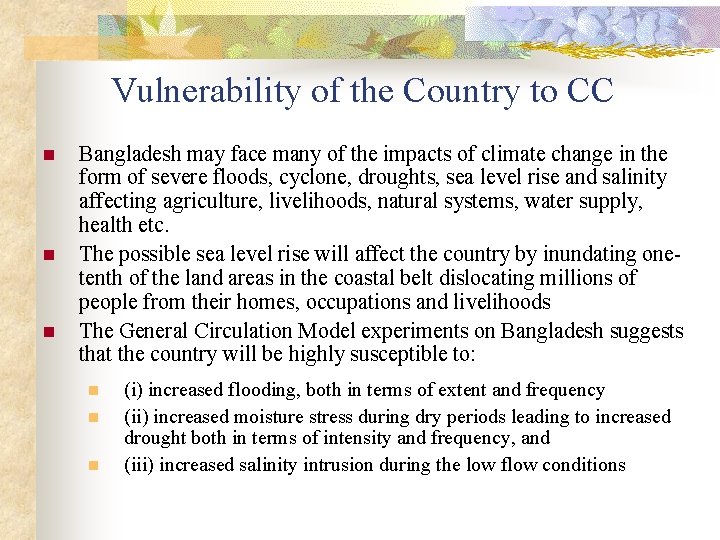
Vulnerability of the Country to CC n n n Bangladesh may face many of the impacts of climate change in the form of severe floods, cyclone, droughts, sea level rise and salinity affecting agriculture, livelihoods, natural systems, water supply, health etc. The possible sea level rise will affect the country by inundating onetenth of the land areas in the coastal belt dislocating millions of people from their homes, occupations and livelihoods The General Circulation Model experiments on Bangladesh suggests that the country will be highly susceptible to: n n n (i) increased flooding, both in terms of extent and frequency (ii) increased moisture stress during dry periods leading to increased drought both in terms of intensity and frequency, and (iii) increased salinity intrusion during the low flow conditions
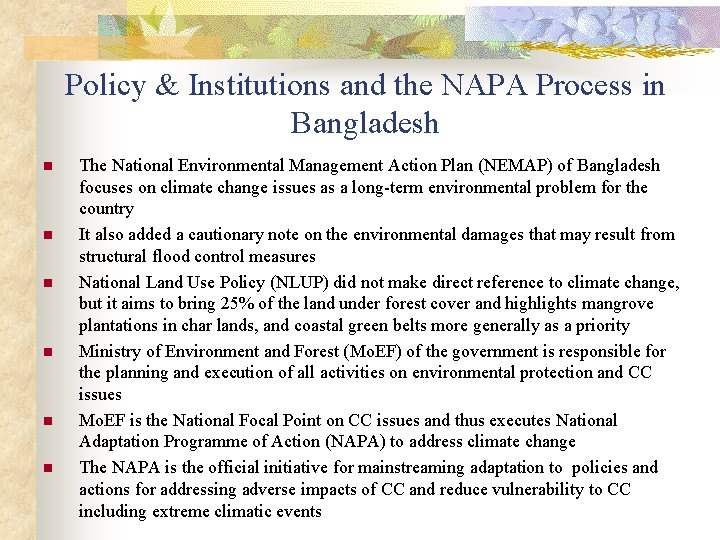
Policy & Institutions and the NAPA Process in Bangladesh n n n The National Environmental Management Action Plan (NEMAP) of Bangladesh focuses on climate change issues as a long-term environmental problem for the country It also added a cautionary note on the environmental damages that may result from structural flood control measures National Land Use Policy (NLUP) did not make direct reference to climate change, but it aims to bring 25% of the land under forest cover and highlights mangrove plantations in char lands, and coastal green belts more generally as a priority Ministry of Environment and Forest (Mo. EF) of the government is responsible for the planning and execution of all activities on environmental protection and CC issues Mo. EF is the National Focal Point on CC issues and thus executes National Adaptation Programme of Action (NAPA) to address climate change The NAPA is the official initiative for mainstreaming adaptation to policies and actions for addressing adverse impacts of CC and reduce vulnerability to CC including extreme climatic events
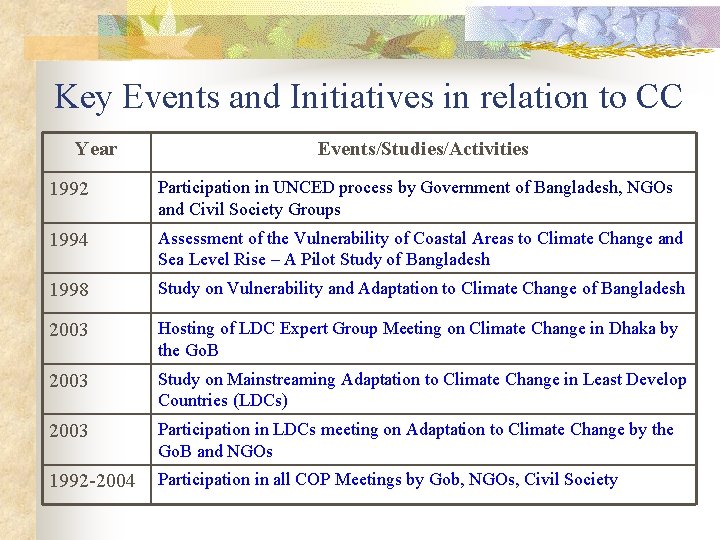
Key Events and Initiatives in relation to CC Year Events/Studies/Activities 1992 Participation in UNCED process by Government of Bangladesh, NGOs and Civil Society Groups 1994 Assessment of the Vulnerability of Coastal Areas to Climate Change and Sea Level Rise – A Pilot Study of Bangladesh 1998 Study on Vulnerability and Adaptation to Climate Change of Bangladesh 2003 Hosting of LDC Expert Group Meeting on Climate Change in Dhaka by the Go. B 2003 Study on Mainstreaming Adaptation to Climate Change in Least Develop Countries (LDCs) 2003 Participation in LDCs meeting on Adaptation to Climate Change by the Go. B and NGOs 1992 -2004 Participation in all COP Meetings by Gob, NGOs, Civil Society
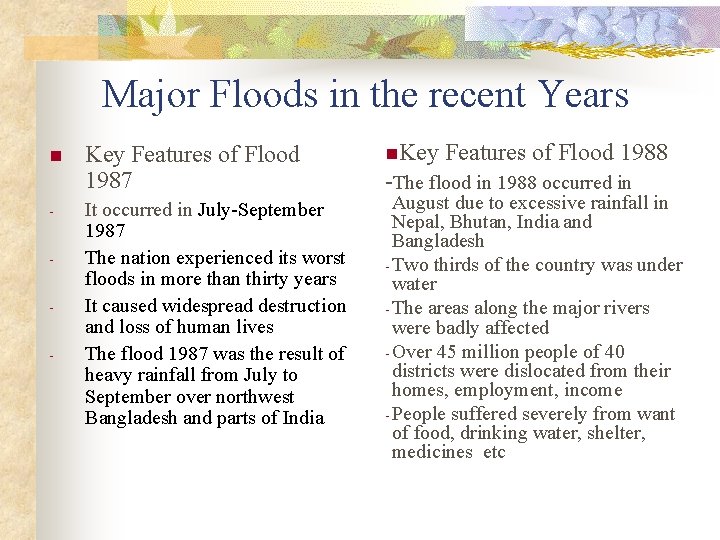
Major Floods in the recent Years n - Key Features of Flood 1987 It occurred in July-September 1987 The nation experienced its worst floods in more than thirty years It caused widespread destruction and loss of human lives The flood 1987 was the result of heavy rainfall from July to September over northwest Bangladesh and parts of India n. Key Features of Flood 1988 -The flood in 1988 occurred in August due to excessive rainfall in Nepal, Bhutan, India and Bangladesh - Two thirds of the country was under water - The areas along the major rivers were badly affected - Over 45 million people of 40 districts were dislocated from their homes, employment, income - People suffered severely from want of food, drinking water, shelter, medicines etc
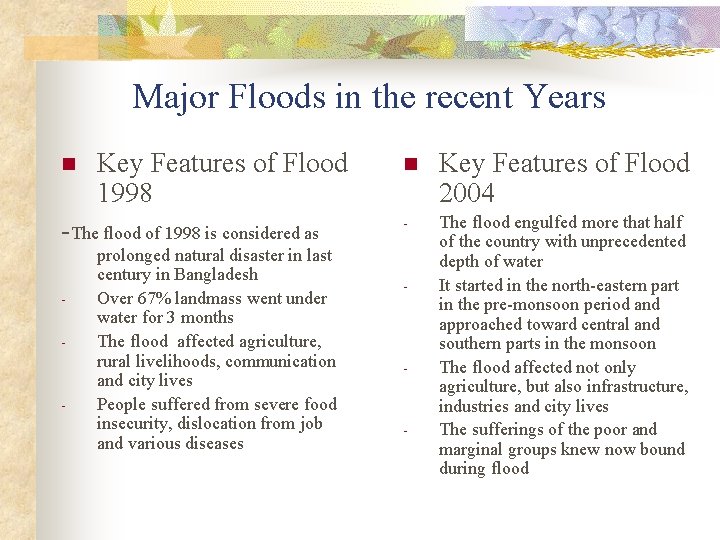
Major Floods in the recent Years n Key Features of Flood 1998 -The flood of 1998 is considered as - - prolonged natural disaster in last century in Bangladesh Over 67% landmass went under water for 3 months The flood affected agriculture, rural livelihoods, communication and city lives People suffered from severe food insecurity, dislocation from job and various diseases n Key Features of Flood 2004 - The flood engulfed more that half of the country with unprecedented depth of water It started in the north-eastern part in the pre-monsoon period and approached toward central and southern parts in the monsoon The flood affected not only agriculture, but also infrastructure, industries and city lives The sufferings of the poor and marginal groups knew now bound during flood - - -
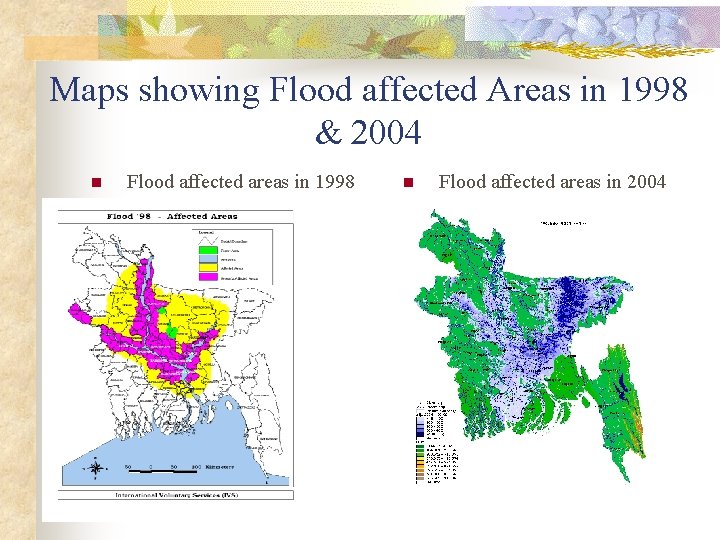
Maps showing Flood affected Areas in 1998 & 2004 n Flood affected areas in 1998 n Flood affected areas in 2004
Efforts for Flood Preparedness in Bangladesh § § § Country as a whole takes various preparedness measures (both structural and non-structural) to reduce adverse impacts on lives and livelihoods of the people and to live with flood disaster The government agencies in Bangladesh, NGOs, local community undertake various measures to mitigate impacts of flood on the people, economy and society The international developing agencies working in Bangladesh also provide support to manage disaster and build capacity at both national and community levels Bangladesh promotes the approach of capacity building and disaster preparedness; Few key policy planners and high government officials were also favoring this new thinking; The NGOs and CBOs are engaged to evolve the approach with community This was reflected in the recent policy, strategies and programmes of the Ministry of Disaster Management and Relief, Go. B The Ministry of Disaster Management established the Disaster Management Bureau (DMB) in 1993
The Government Efforts § The government set up a national Council and various Committees at national, district, Upzila and Union levels for overall disaster management/preparedness § The National Disaster Management Council is headed by the Prime Minister to review disaster management policies and programmes § There has been an Inter Ministerial Disaster Management Coordination Committee headed by the Prime Minister § There a set of other agencies of the government to help the Ministry and DMB § These are: the Bangladesh Meteorological Department, Space and Remote Sensing Organization (SPARSO) and Flood Forecasting and Warning Centre (FFWC)
NGOs Efforts for People’s Capacity Building § § § The NGOs and civil society groups always uphold the views of living with flood and increase people capacity to reduce flood impact through flood preparedness The NGOs such as BCAS, BDPC, Caritas Bangladesh, BRAC, Care Bangladesh, Proshika and Coalition of Environmental NGOs (CEN) work closely with the relevant government agencies and grassroots people to develop country’s capacity for disaster management in an integrated manner The NGOs try to enhance the coping mechanism and survival techniques of the common people, which are being practiced over hundreds of years The socio-economic development of the poor, women and vulnerable groups can enhance their capacity to respond to disaster in a sustained way In this light, Care Bangladesh and BCAS with local partner NGOs have undertaken a project to enhance people’s capacity to reduce flood vulnerability in some selected areas The participatory pilot project is known as Reducing Vulnerability to Climate Change (RVCC)
NGO Movement against FAP § § § The calamities of 1987 and 1988 flood raised fears and concerns that such flooding was to become the norm in Bangladesh The donor communities in Bangladesh soon dispatched teams of engineers and other consultants to study the problem The results of the international concern was the creation of Flood Action Plan (FAP), which suggested mainly structural solution of floods, an ambitious attempt to control floods by putting embankments across the major rivers in Bangladesh The NGOs and civil society groups were very critical against the structural interventions to control rivers and floodplains envisaged in FAP activities They were very active to influence policy and decision making process to remove anti-people and anti-environment nature of FAP through conducting study, consultation, advocacy and awareness raising among general mass This process influenced the public policy significantly and resulted in formation of WARPO and formulation NWP with a focus on water resources management involving people and other stakeholders at various levels
Creation of Disaster Management Bureau by the Government § § § § The DMB was created under the Ministry of Disaster management in 1993 Its general responsibilities are to advise the government on all matters relating to disaster management and to maintain liaison with different government agencies, NGOs and voluntary organizations and ensure their maximum cooperation and coordination in all matters of disaster management It has to undertake various activities for creating awareness among the people, government employees and people of other professions for reducing risk during disaster. Provide secretarial support to the national advisory committee to disasters Prepare guidelines for mitigation of disasters with the assistance of Planning Commission and other agencies for devising steps to reduce disaster risks During flood times, it has to ensure receipt of flood warning at different levels, assist the ministry on disaster management, relief and rehabilitation Currently, DMB is focusing on risk reduction through community mobilization, capacity building and linking risk reduction with socio-economic development of the grassroots people and vulnerable group The DMB, with support from UNDP and DFID has undertaken CDMP project to reduce vulnerability of the poor and common people due to climate change and climatic events in Bangladesh
DMB- A Shift from Relief to Disaster Preparedness - - There has been a transformation in policy and institutions in DMB towards disaster preparedness from their earlier approach of post flood relief and rehabilitation But it will take much time in a country like Bangladesh, where bureaucracy lacks skill, information, resources and worthy purposes It will also require true involvement and dedicated efforts by a set of people It has experienced two steps forward and sometimes one step back in the process and implementation Sometimes, the body politics within the structure and process and vested groups create barriers against such change and transformation However, DMB has initiated the change in its policy, strategies and programmes Few of their projects and programmes (such as CDMP) are giving some good results towards building people’s capacity for disaster preparedness
CDMP- Disaster preparedness and CC - - - The Comprehensive Disaster Management Program (CDMP) is a collaborative effort by the Go. B, UNDP and DFID CDMP aims at achieving disaster preparedness through the implementation of specific component strategies that will target the transition of the disaster management programme emphasizing on risk reduction from relief The components will address the mainstreaming of disaster management within development and investment programs The CDMP takes into consideration the vulnerability of the poor and common people due to climatic events like flood and cyclone and long-term climate change impacts. The government of Bangladesh has established a Climate Change Cell at the Department of Environment under the Ministry of Environment The CDPM has a link with the Climate Cell at the Department of Environment under the Mo. EF, which is the focal point of UNFCCC within government of Bangladesh
Community Responses: BCAS & RVCC Experiences § § § Natural disasters like flood very often inspire automatic response, assistance and collective actions at various levels People develop their own coping mechanism and survival strategies over time through trial and error These are based on their conventional and family wisdom and localized knowledge, which become very cost- effective and sustainable Local people of Bangladesh very often depend on their local knowledge to cope with the environmental problems and climatic events such as floods, cyclones, drought etc. They are accustomed to living with the natural disasters and they have developed a range of strategies to cope with floods
BCAS & RVCC Experiences - - - The BCAS component of RVCC has been working in floodplain in Gopalganj to understand the level of vulnerability of the local people to flood and the responses of the community The project with local community is trying to improve local responses strategies through awareness, flood preparedness and promotion of livelihoods in relation to flood impacts During the devastating flood of 2004, the project staffs observed the community responses and worked with them to reduce flood risk by mobilizing community with better flood preparedness efforts in project villages The community people take various measures for protection of house and homestead, agriculture, fisheries and livelihoods; preserve food, water and fuel and cooking; take care of children, women and old people They share information about floods and possible impacts at community level They utilize their social capital and networks to take flood preparedness and reduce vulnerability to flood disaster
The Key Learnings and Conclusion § § Disasters is not new in Bangladesh ! Multiple actors: § § § Many collective actions and community mobilization Progressive changes § § § key actor is the government - DMB NGOs are also playing important role All key actors should work together government policy, strategies and programmes But level of implementation is poor Integration of local need and priority is required for sustainability of the efforts – CDMP is a good initiative
The Key Learnings and Conclusion § Problem exists § § § § Lack of understanding link between CC and natural disaster Lack of coordination Lack of resources Lack of continuity and worthy purpose The DMB should take lead role and greater responsibilities in the context of enhanced climatic events Need for better integration of government institutes and effective collaboration among the key actors A shift in policy and programmes is evident towards right direction. Political influence is to be deemed for better implementation of programmes
The Key Learnings and Conclusion § Community people need flood information in their local context and languages in right time - CFIS is a good example § Key actors need to know the perspectives, needs and priorities of the local people to initiate effective programmes to reduce the vulnerability of the grassroots people and vulnerable groups § Need for action research and participatory research for developing pragmatic programmes § Structural measures are to be considered along with soft measures § Regional cooperation is needed § Sharing of data – Water level and rainfall etc § Sharing of knowledge and information § Watershade management § Sharing of good experiences
- Slides: 24