
Linking Aerosols to Climate Change and Air Quality





- Slides: 61
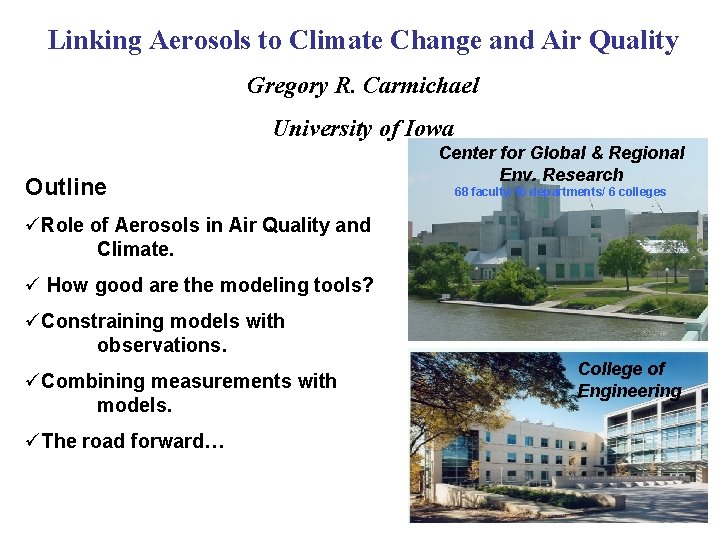
Linking Aerosols to Climate Change and Air Quality Gregory R. Carmichael University of Iowa Outline Center for Global & Regional Env. Research 68 faculty/16 departments/ 6 colleges üRole of Aerosols in Air Quality and Climate. ü How good are the modeling tools? üConstraining models with observations. üCombining measurements with models. üThe road forward… College of Engineering
Motivating Questions Ø What are the current and projected trends in energy and emissions? Ø How are these impacting human health? Ø What are the transboundary impacts of Asian emissions within Asia ? Ø What are the region-specific science issues that need to be addressed (e. g. , aerosol interactions)? Ø What are present and future impacts of Asian emissions on global air quality? on US air quality? Ø To what extent are air pollution and climate change issues linked? And how can these be exploited? Ø What cost-effective options are available to address these concerns?
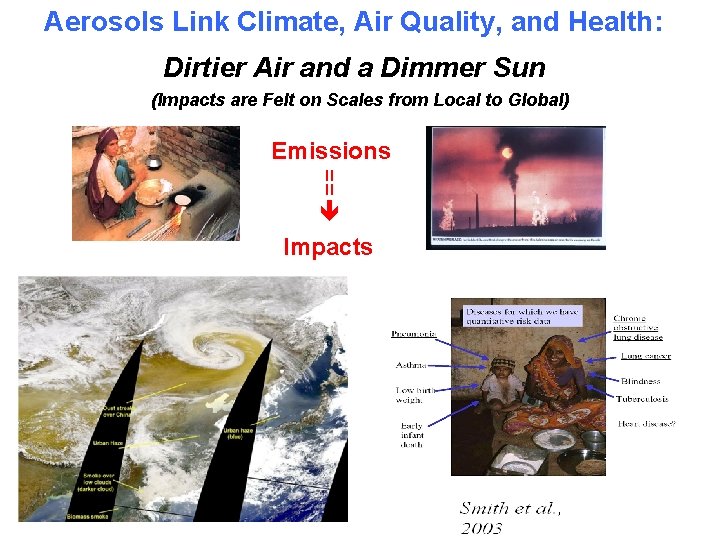
Aerosols Link Climate, Air Quality, and Health: Dirtier Air and a Dimmer Sun (Impacts are Felt on Scales from Local to Global) Emissions == Impacts
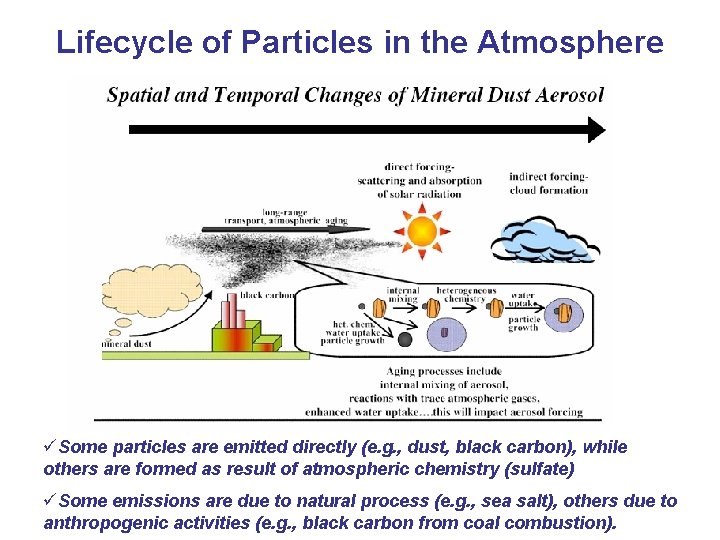
Lifecycle of Particles in the Atmosphere üSome particles are emitted directly (e. g. , dust, black carbon), while others are formed as result of atmospheric chemistry (sulfate) üSome emissions are due to natural process (e. g. , sea salt), others due to anthropogenic activities (e. g. , black carbon from coal combustion).
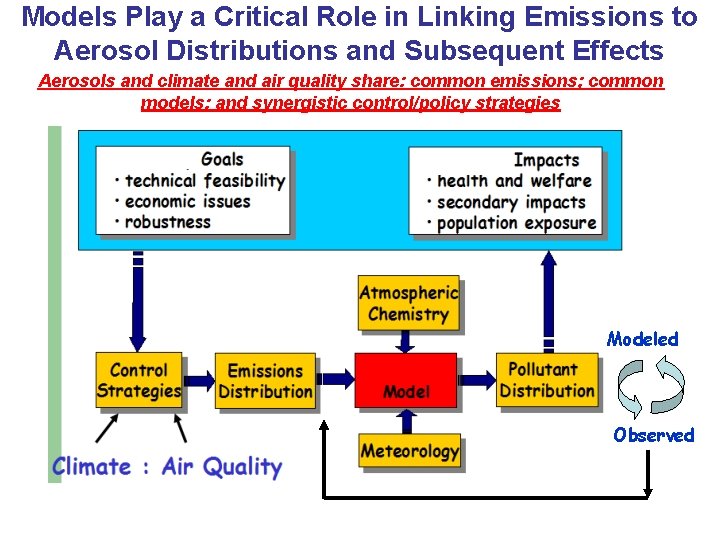
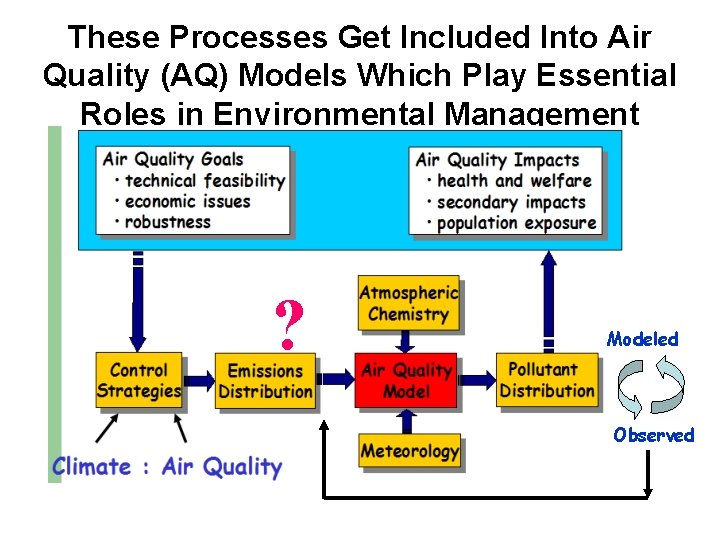
Models Play a Critical Role in Linking Emissions to Aerosol Distributions and Subsequent Effects Aerosols and climate and air quality share: common emissions; common models; and synergistic control/policy strategies Modeled Observed
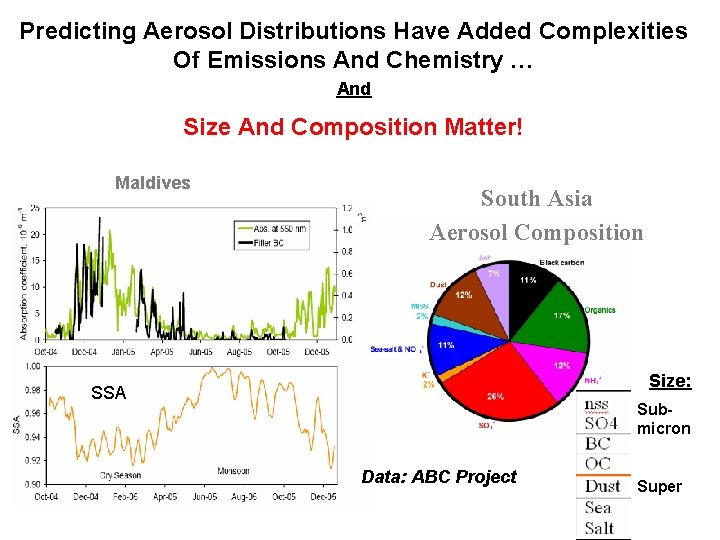
Predicting Aerosol Distributions Have Added Complexities Of Emissions And Chemistry … And Size And Composition Matter! Maldives South Asia Aerosol Composition Size: SSA Submicron Data: ABC Project Super
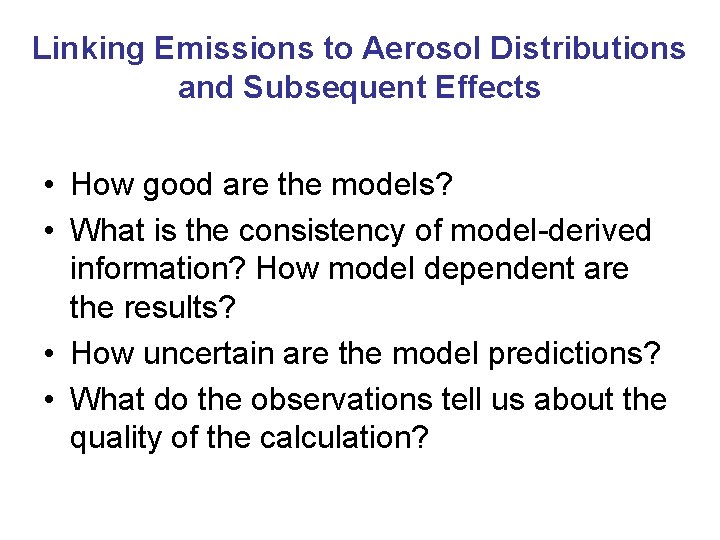
Linking Emissions to Aerosol Distributions and Subsequent Effects • How good are the models? • What is the consistency of model derived information? How model dependent are the results? • How uncertain are the model predictions? • What do the observations tell us about the quality of the calculation?
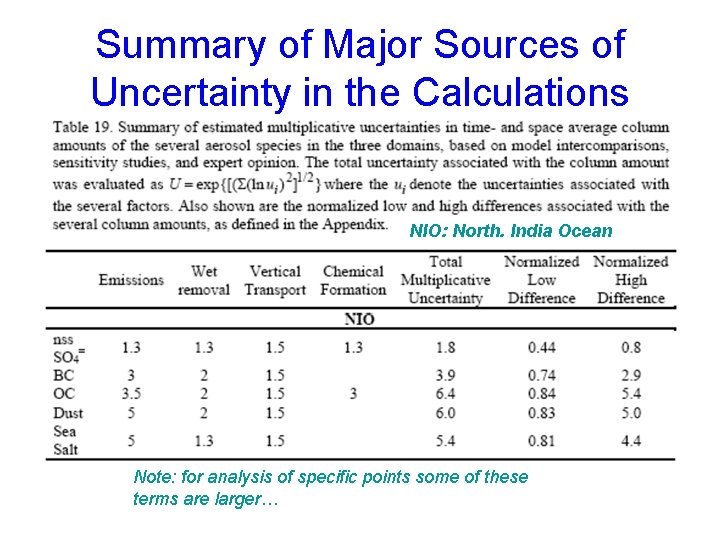
Summary of Major Sources of Uncertainty in the Calculations Summary of estimated relative uncertainties* for integrated aerosol quantities (column amounts, fluxes) *(uncertainty divided by mean value). NIO: North. India Ocean Note: for analysis of specific points some of these terms are larger…
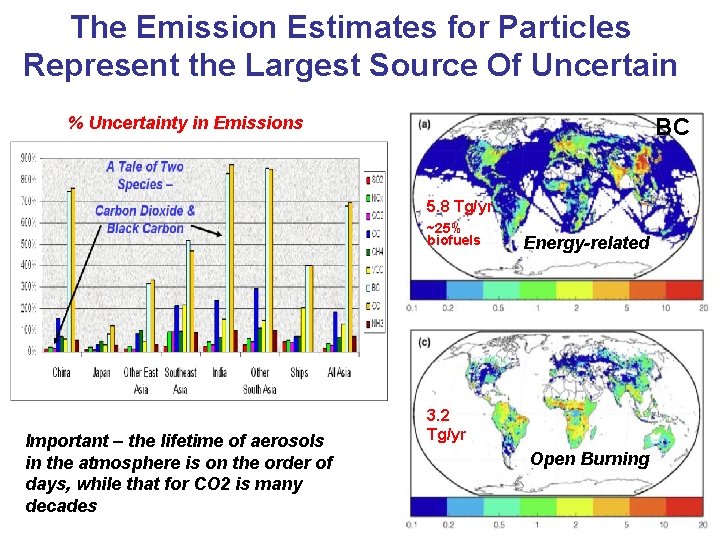
The Emission Estimates for Particles Represent the Largest Source Of Uncertain % Uncertainty in Emissions BC 5. 8 Tg/yr ~25% biofuels Important – the lifetime of aerosols in the atmosphere is on the order of days, while that for CO 2 is many decades Energy-related 3. 2 Tg/yr Open Burning
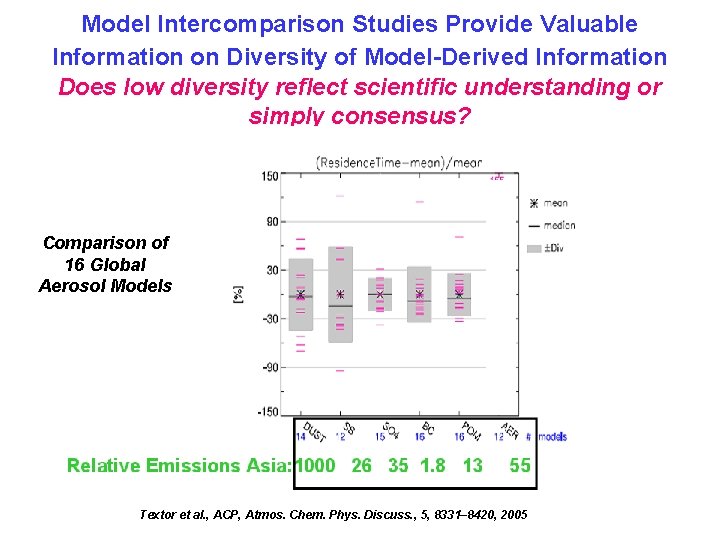
Model Intercomparison Studies Provide Valuable Information on Diversity of Model-Derived Information Does low diversity reflect scientific understanding or simply consensus? Comparison of 16 Global Aerosol Models Textor et al. , ACP, Atmos. Chem. Phys. Discuss. , 5, 8331– 8420, 2005
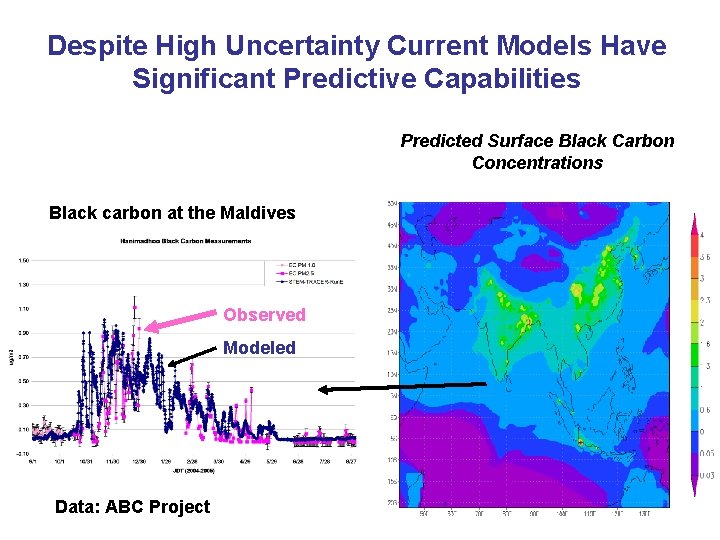
Despite High Uncertainty Current Models Have Significant Predictive Capabilities Predicted Surface Black Carbon Concentrations Black carbon at the Maldives Observed Modeled Data: ABC Project
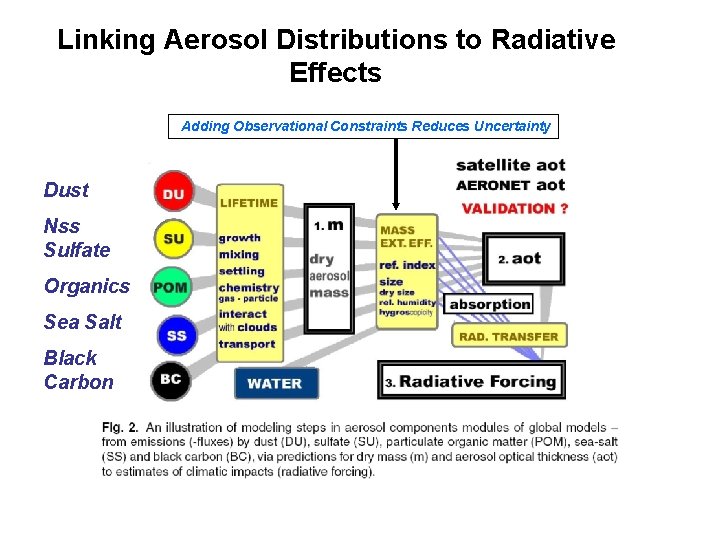
Linking Aerosol Distributions to Radiative Effects Adding Observational Constraints Reduces Uncertainty Dust Nss Sulfate Organics Sea Salt Black Carbon
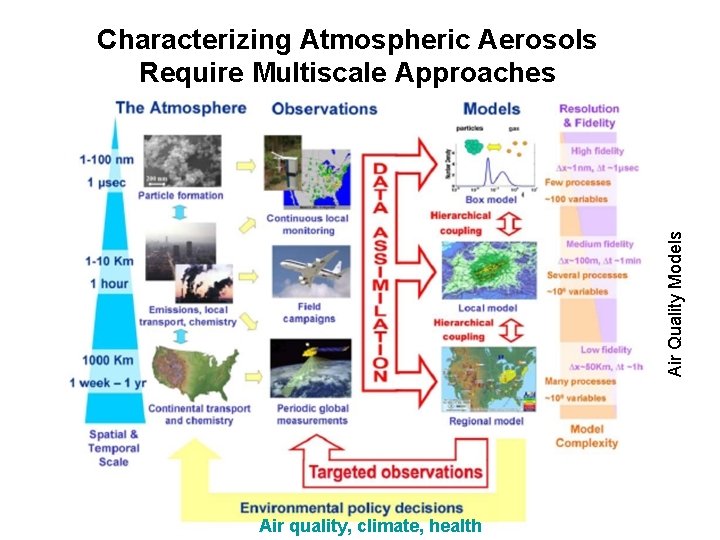
Air Quality Models Characterizing Atmospheric Aerosols Require Multiscale Approaches Air quality, climate, health
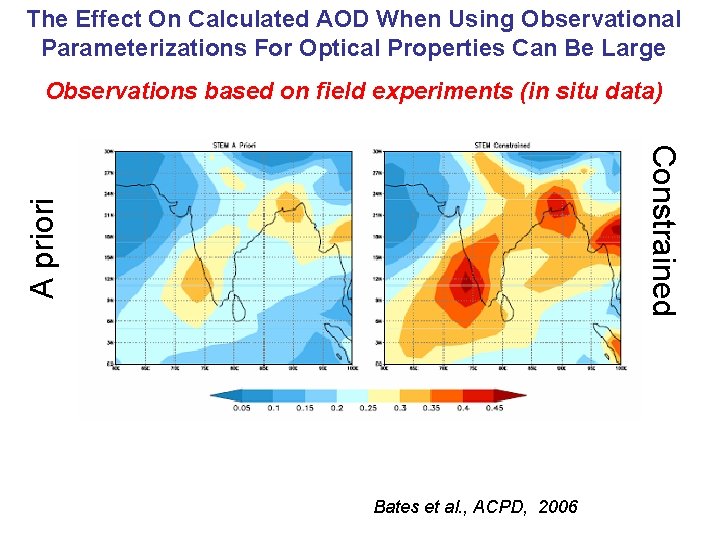
The Effect On Calculated AOD When Using Observational Parameterizations For Optical Properties Can Be Large Observations based on field experiments (in situ data) A priori Constrained Bates et al. , ACPD, 2006
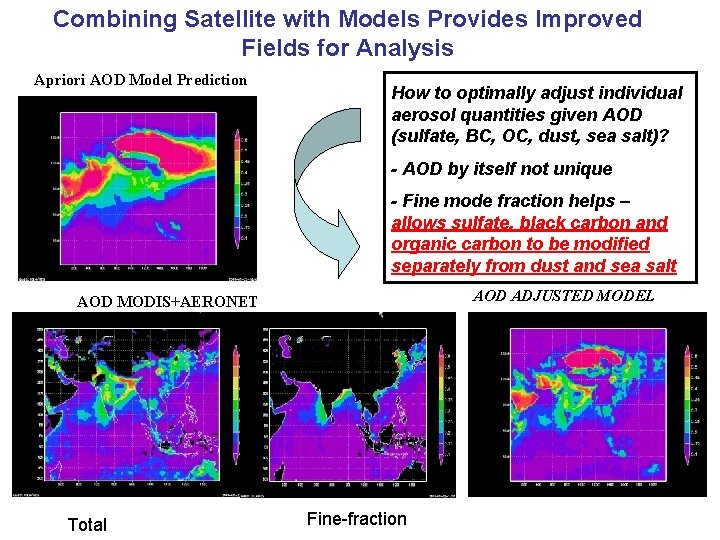
Combining Satellite with Models Provides Improved Fields for Analysis Apriori AOD Model Prediction How to optimally adjust individual aerosol quantities given AOD (sulfate, BC, OC, dust, sea salt)? - AOD by itself not unique - Fine mode fraction helps – allows sulfate, black carbon and organic carbon to be modified separately from dust and sea salt AOD ADJUSTED MODEL AOD MODIS+AERONET Total Fine fraction
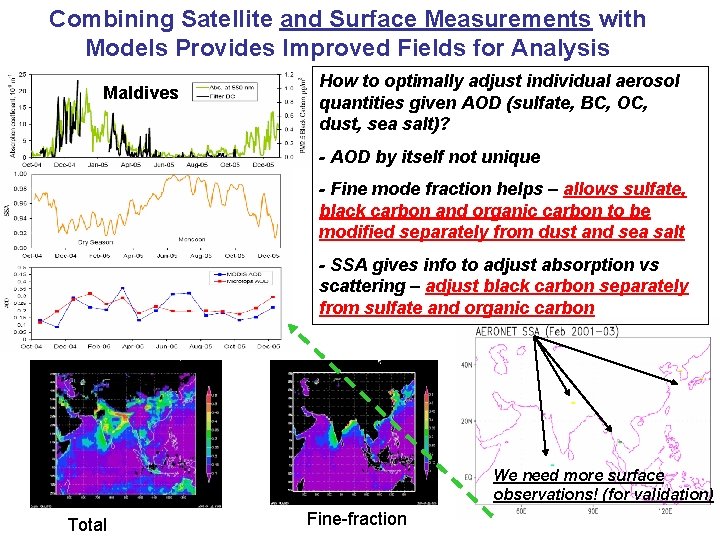
Combining Satellite and Surface Measurements with Models Provides Improved Fields for Analysis Maldives How to optimally adjust individual aerosol quantities given AOD (sulfate, BC, OC, dust, sea salt)? - AOD by itself not unique - Fine mode fraction helps – allows sulfate, black carbon and organic carbon to be modified separately from dust and sea salt AOD MODIS+AERONET - SSA gives info to adjust absorption vs scattering – adjust black carbon separately from sulfate and organic carbon We need more surface observations! (for validation) Total Fine fraction
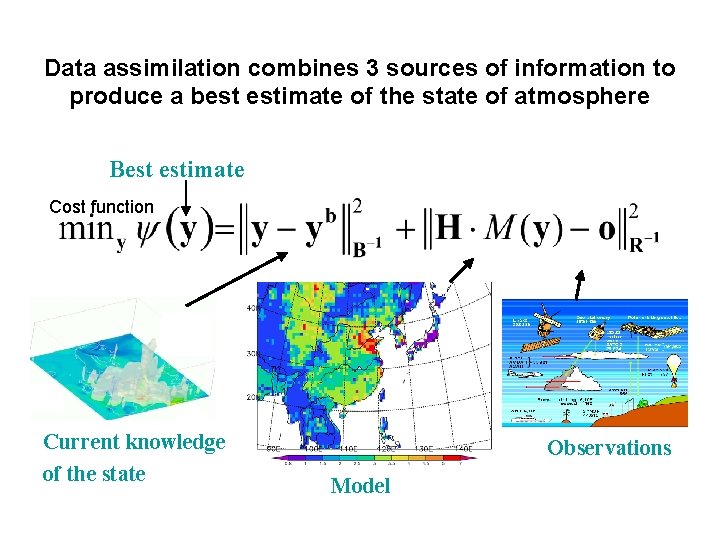
Data assimilation combines 3 sources of information to produce a best estimate of the state of atmosphere Best estimate Cost function Current knowledge of the state Observations Model
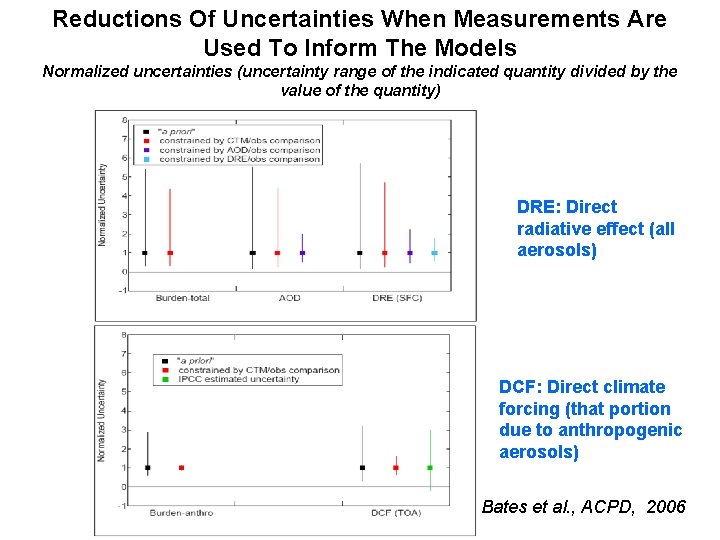
Reductions Of Uncertainties When Measurements Are Used To Inform The Models Normalized uncertainties (uncertainty range of the indicated quantity divided by the value of the quantity) DRE: Direct radiative effect (all aerosols) DCF: Direct climate forcing (that portion due to anthropogenic aerosols) Bates et al. , ACPD, 2006
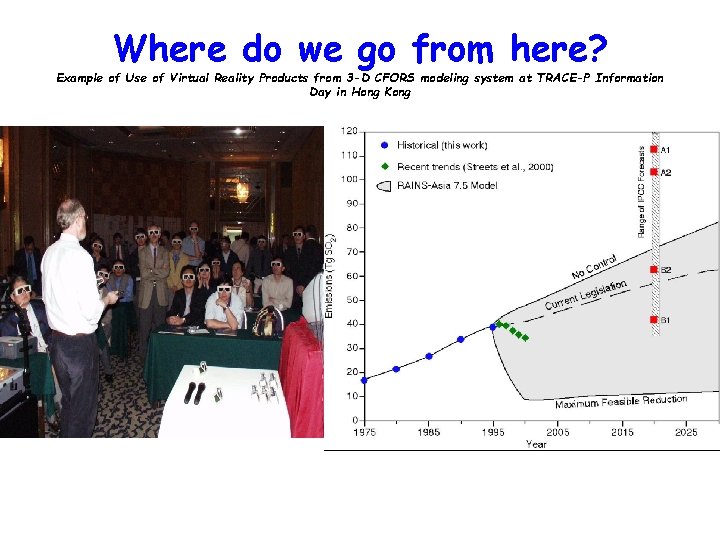
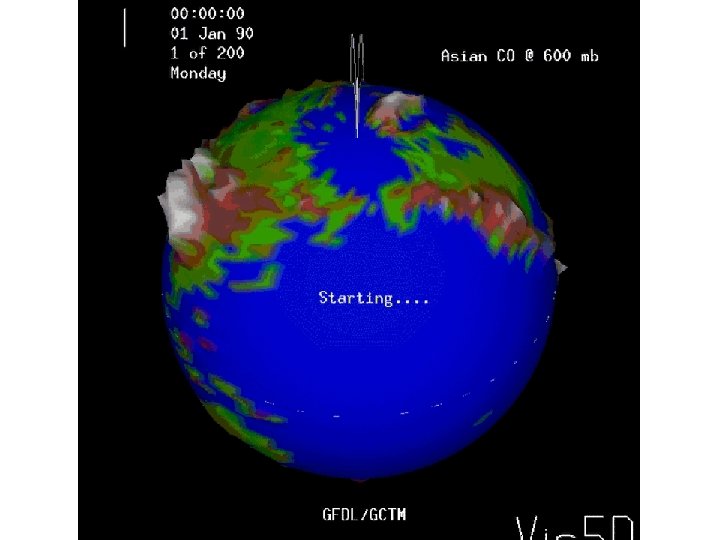
Where do we go from here? Example of Use of Virtual Reality Products from 3 -D CFORS modeling system at TRACE-P Information Day in Hong Kong
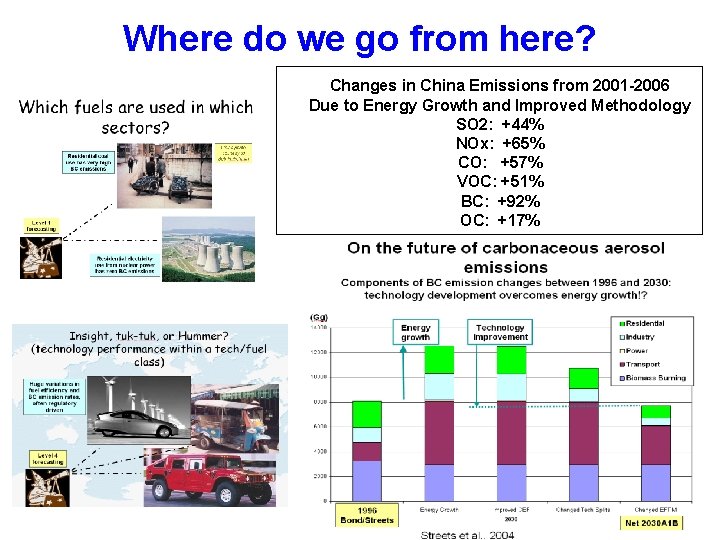
Where do we go from here? Changes in China Emissions from 2001 -2006 Due to Energy Growth and Improved Methodology SO 2: +44% NOx: +65% CO: +57% VOC: +51% BC: +92% OC: +17%
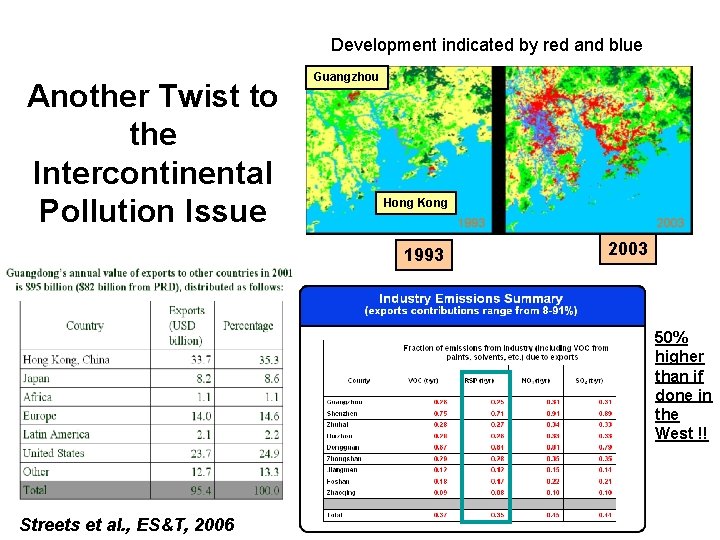
Development indicated by red and blue Another Twist to the Intercontinental Pollution Issue Guangzhou Hong Kong 1993 2003 50% higher than if done in the West !! Streets et al. , ES&T, 2006
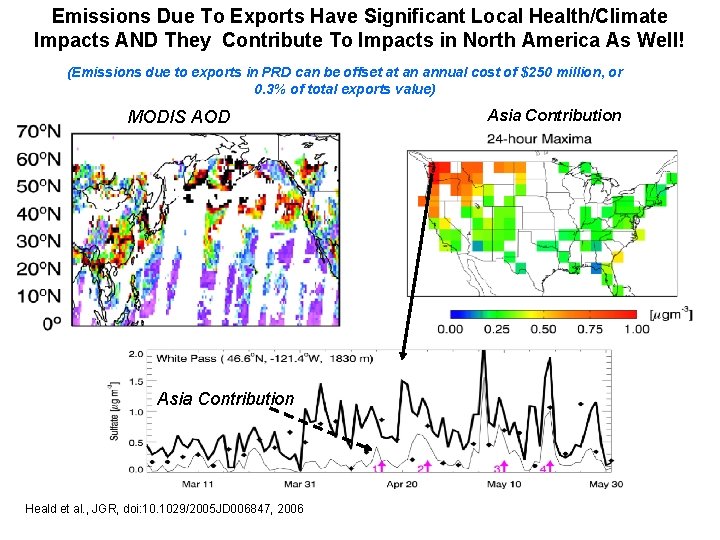
Emissions Due To Exports Have Significant Local Health/Climate Impacts AND They Contribute To Impacts in North America As Well! (Emissions due to exports in PRD can be offset at an annual cost of $250 million, or 0. 3% of total exports value) MODIS AOD Asia Contribution Heald et al. , JGR, doi: 10. 1029/2005 JD 006847, 2006 Asia Contribution
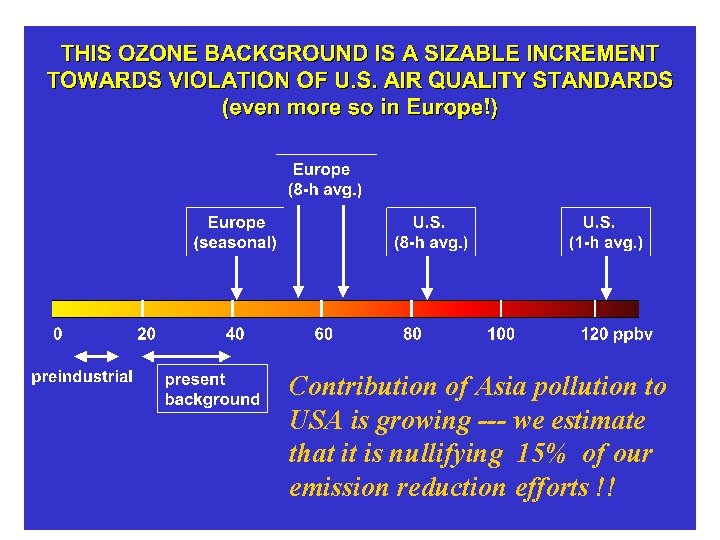
Contribution of Asia pollution to USA is growing --- we estimate that it is nullifying 15% of our emission reduction efforts !!
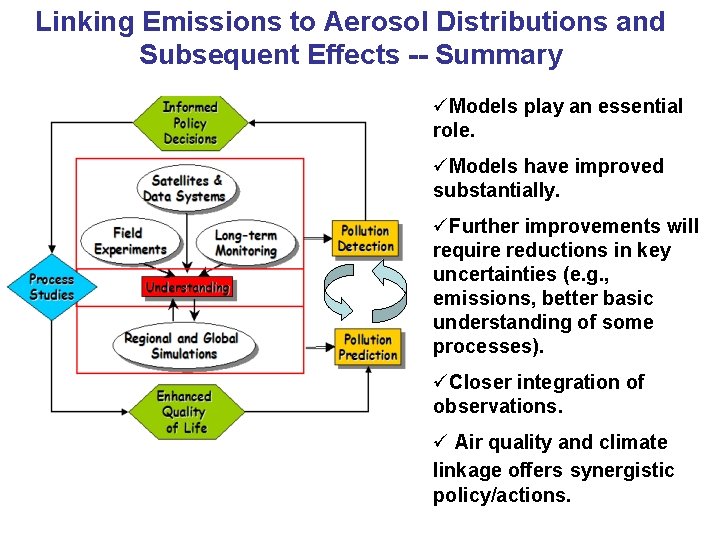
Linking Emissions to Aerosol Distributions and Subsequent Effects -- Summary üModels play an essential role. üModels have improved substantially. üFurther improvements will require reductions in key uncertainties (e. g. , emissions, better basic understanding of some processes). üCloser integration of observations. ü Air quality and climate linkage offers synergistic policy/actions.
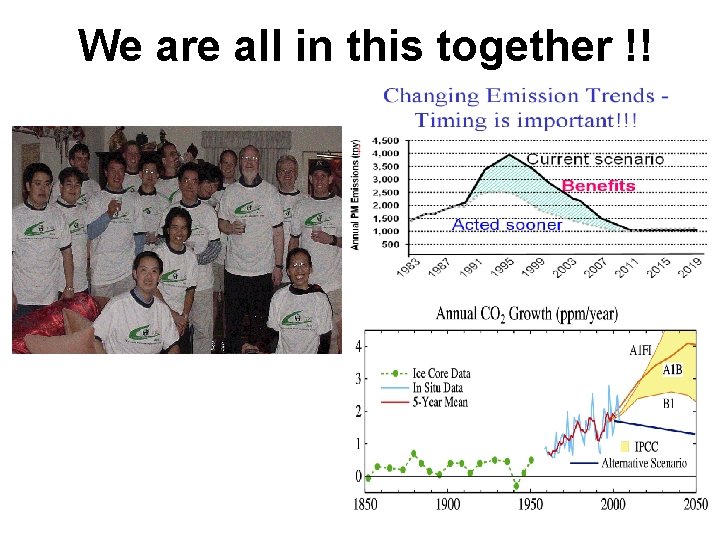
We are all in this together !!
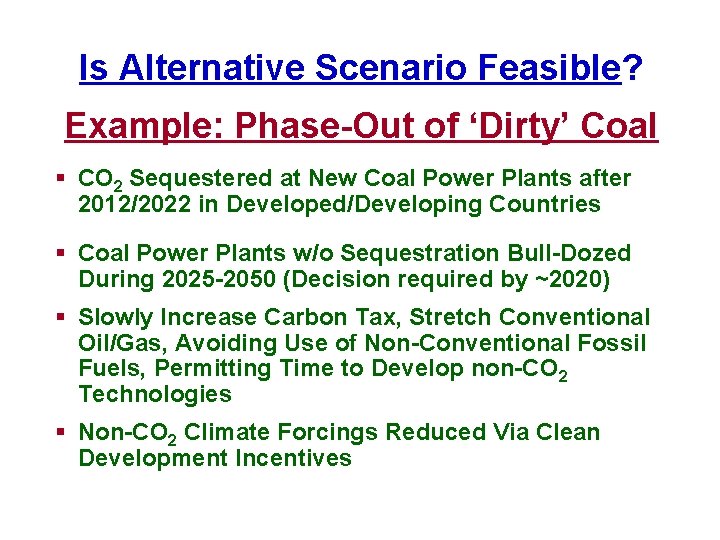
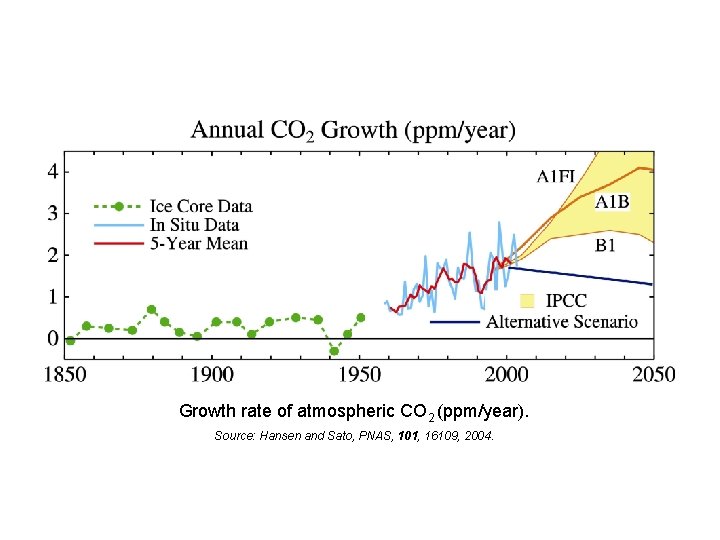
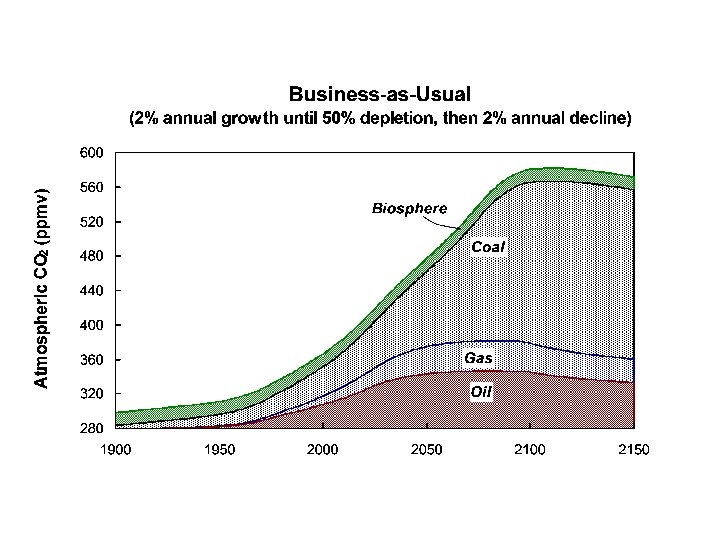
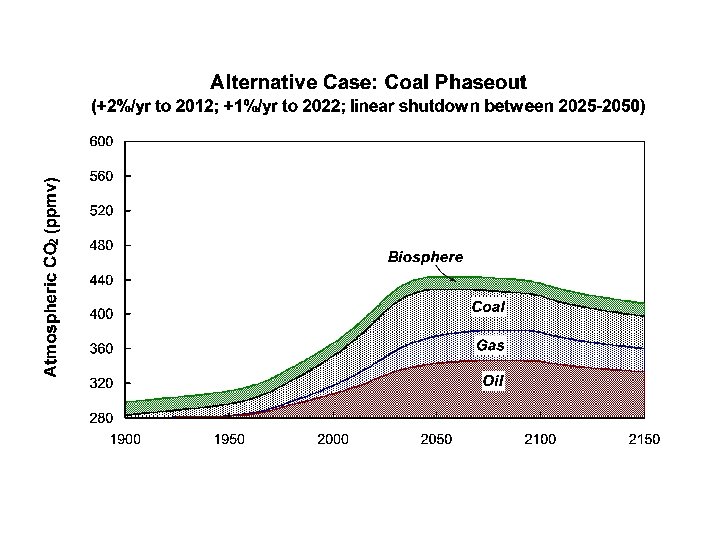
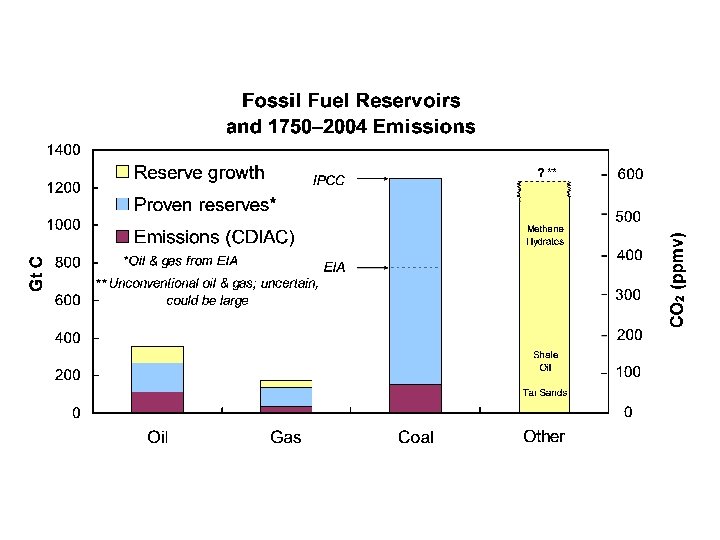
Is Alternative Scenario Feasible? Example: Phase-Out of ‘Dirty’ Coal § CO 2 Sequestered at New Coal Power Plants after 2012/2022 in Developed/Developing Countries § Coal Power Plants w/o Sequestration Bull-Dozed During 2025 -2050 (Decision required by ~2020) § Slowly Increase Carbon Tax, Stretch Conventional Oil/Gas, Avoiding Use of Non-Conventional Fossil Fuels, Permitting Time to Develop non-CO 2 Technologies § Non-CO 2 Climate Forcings Reduced Via Clean Development Incentives
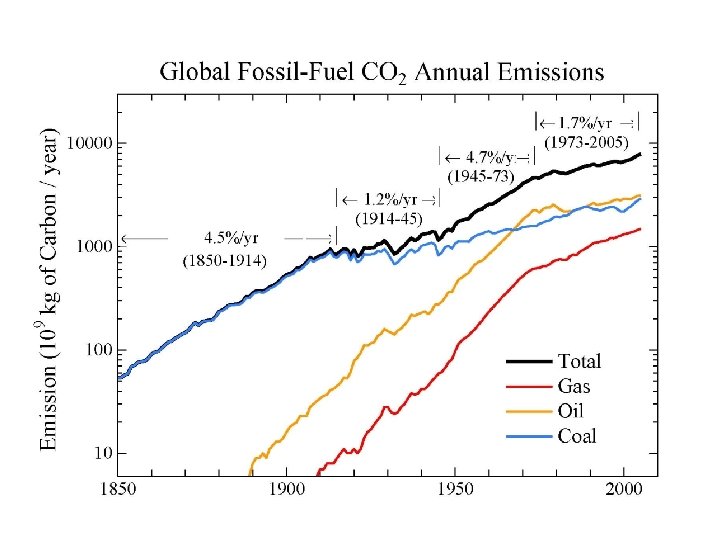
Growth rate of atmospheric CO 2 (ppm/year). Source: Hansen and Sato, PNAS, 101, 16109, 2004.
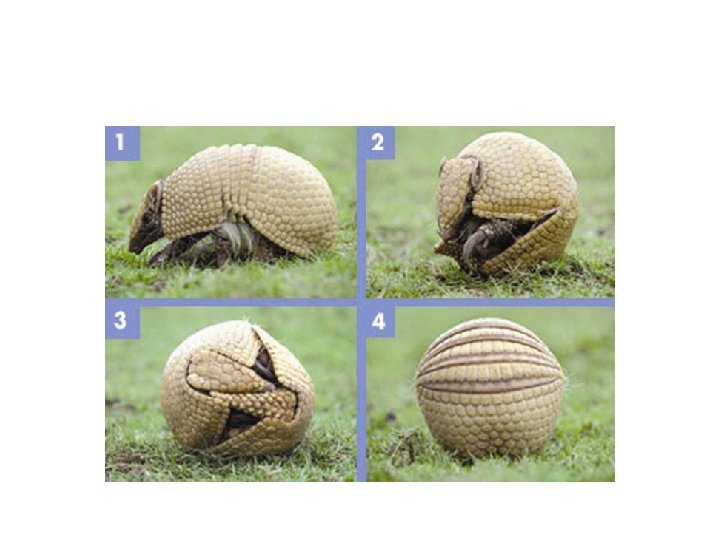
Armadillos: One of the Surviving Species? Photos © Mark Payne-Gill, naturepl. com; © 2005 National Geographic Society. All rights reserved.
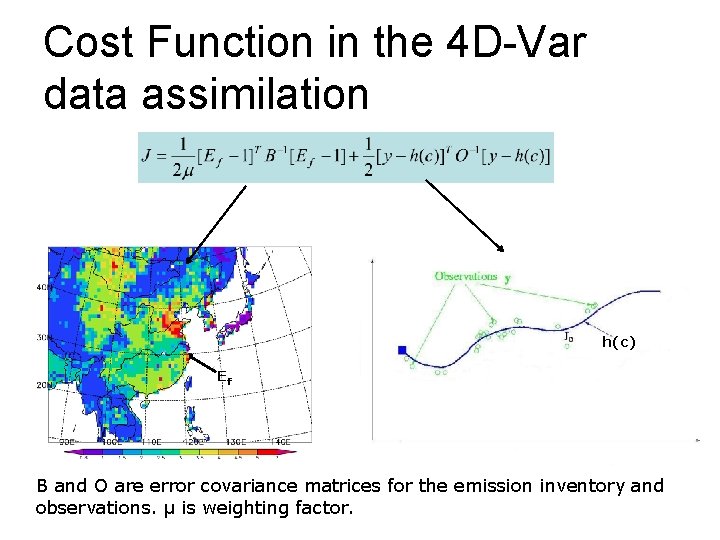
Cost Function in the 4 D Var data assimilation h(c) Ef B and O are error covariance matrices for the emission inventory and observations. µ is weighting factor.
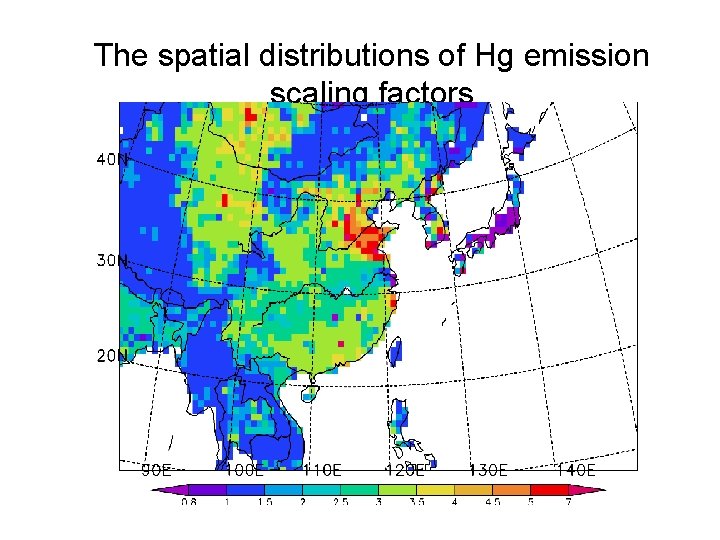
The spatial distributions of Hg emission scaling factors
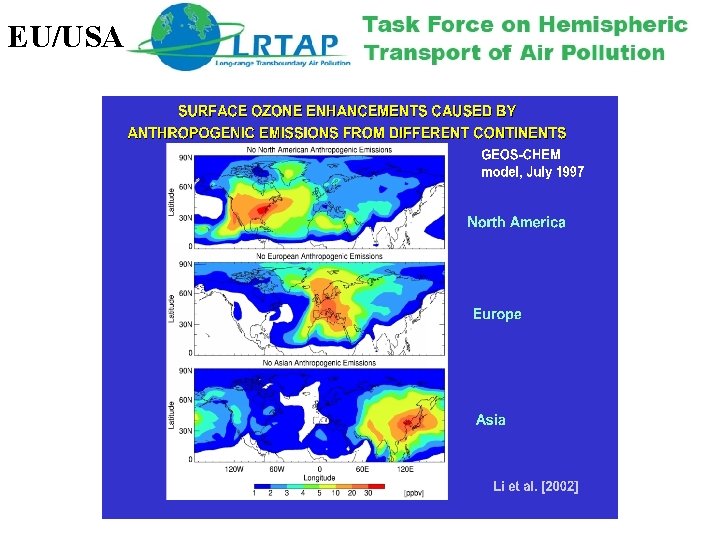
EU/USA
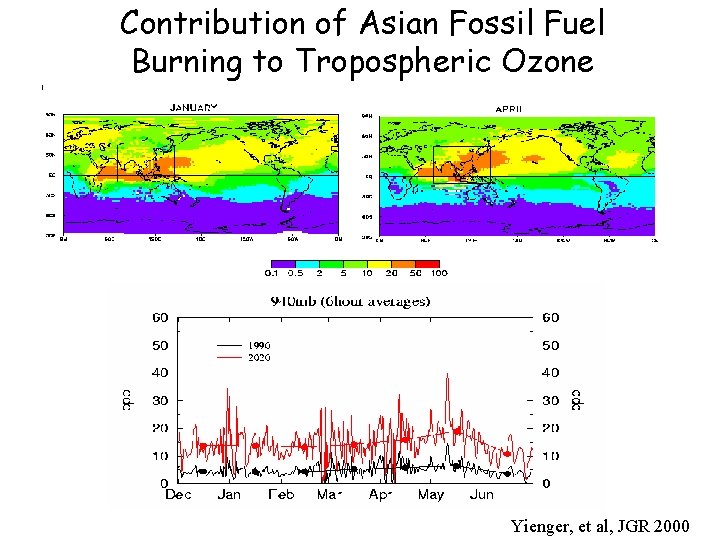
Contribution of Asian Fossil Fuel Burning to Tropospheric Ozone Yienger, et al, JGR 2000
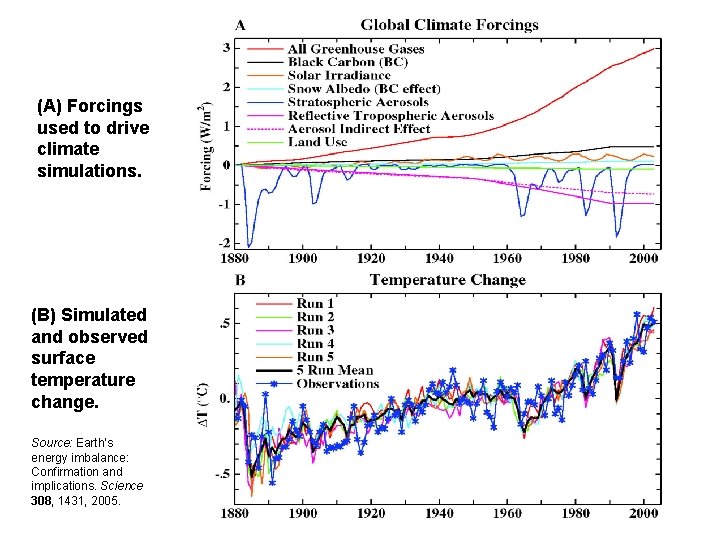
(A) Forcings used to drive climate simulations. (B) Simulated and observed surface temperature change. Source: Earth's energy imbalance: Confirmation and implications. Science 308, 1431, 2005.
Summary: Is There Still Time? Yes, But: § Alternative Scenario is Feasible, But It Is Not Being Pursued § Action needed now; a decade of BAU eliminates Alter. Scen. § Best Hope: Public Must Become Informed and Get Angry
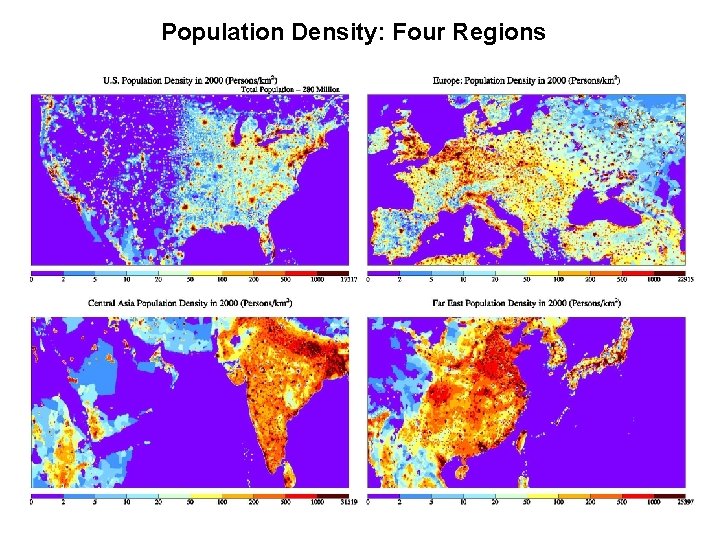
Population Density: Four Regions
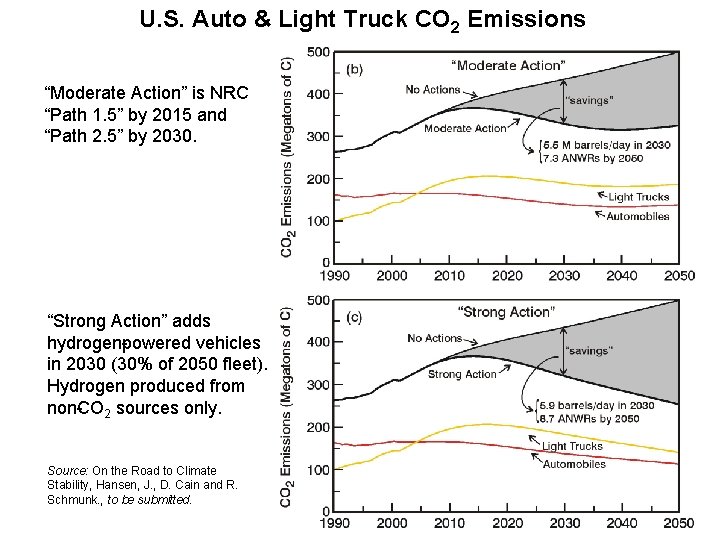
U. S. Auto & Light Truck CO 2 Emissions “Moderate Action” is NRC “Path 1. 5” by 2015 and “Path 2. 5” by 2030. “Strong Action” adds hydrogen powered vehicles in 2030 (30% of 2050 fleet). Hydrogen produced from non CO 2 sources only. Source: On the Road to Climate Stability, Hansen, J. , D. Cain and R. Schmunk. , to be submitted.
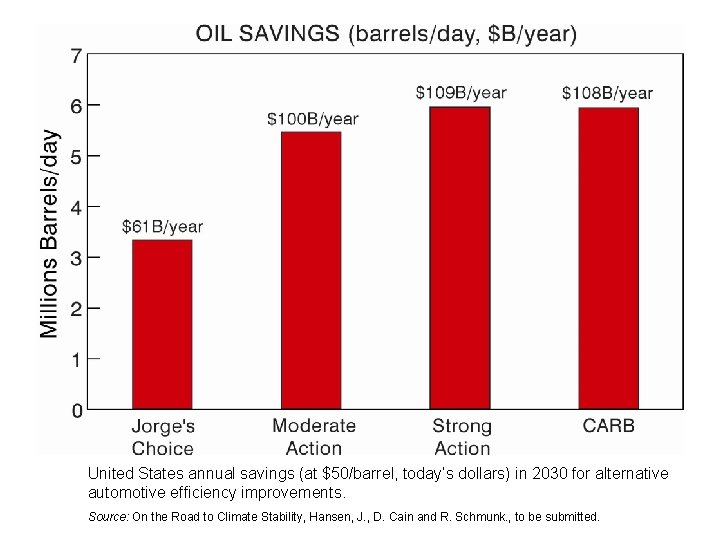
United States annual savings (at $50/barrel, today’s dollars) in 2030 for alternative automotive efficiency improvements. Source: On the Road to Climate Stability, Hansen, J. , D. Cain and R. Schmunk. , to be submitted.
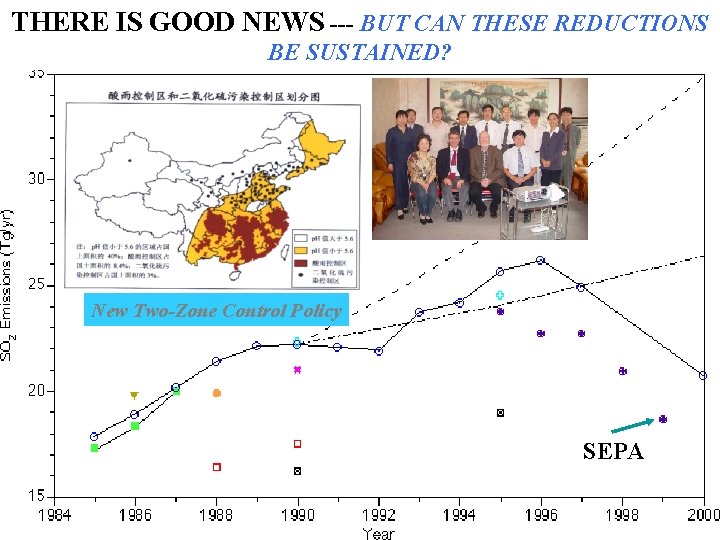
THERE IS GOOD NEWS --- BUT CAN THESE REDUCTIONS BE SUSTAINED? New Two-Zone Control Policy Streets et al. Atmos. Env. , 2000 SEPA
k n a Th ! ! ! u o Y
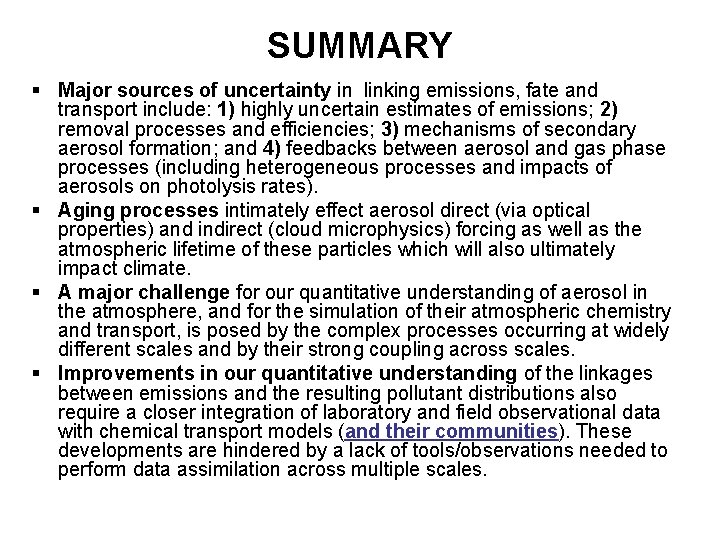
SUMMARY § Major sources of uncertainty in linking emissions, fate and transport include: 1) highly uncertain estimates of emissions; 2) removal processes and efficiencies; 3) mechanisms of secondary aerosol formation; and 4) feedbacks between aerosol and gas phase processes (including heterogeneous processes and impacts of aerosols on photolysis rates). § Aging processes intimately effect aerosol direct (via optical properties) and indirect (cloud microphysics) forcing as well as the atmospheric lifetime of these particles which will also ultimately impact climate. § A major challenge for our quantitative understanding of aerosol in the atmosphere, and for the simulation of their atmospheric chemistry and transport, is posed by the complex processes occurring at widely different scales and by their strong coupling across scales. § Improvements in our quantitative understanding of the linkages between emissions and the resulting pollutant distributions also require a closer integration of laboratory and field observational data with chemical transport models (and their communities). These developments are hindered by a lack of tools/observations needed to perform data assimilation across multiple scales.
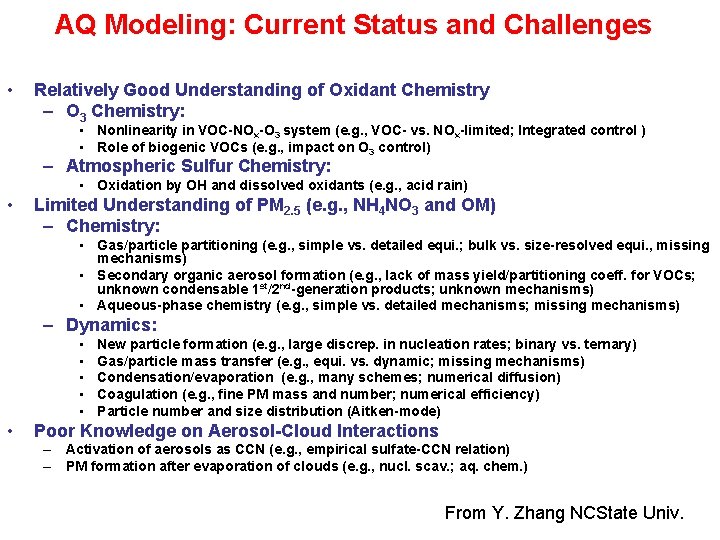
AQ Modeling: Current Status and Challenges • Relatively Good Understanding of Oxidant Chemistry – O 3 Chemistry: • Nonlinearity in VOC-NOx-O 3 system (e. g. , VOC- vs. NOx-limited; Integrated control ) • Role of biogenic VOCs (e. g. , impact on O 3 control) – Atmospheric Sulfur Chemistry: • Oxidation by OH and dissolved oxidants (e. g. , acid rain) • Limited Understanding of PM 2. 5 (e. g. , NH 4 NO 3 and OM) – Chemistry: • Gas/particle partitioning (e. g. , simple vs. detailed equi. ; bulk vs. size-resolved equi. , missing mechanisms) • Secondary organic aerosol formation (e. g. , lack of mass yield/partitioning coeff. for VOCs; unknown condensable 1 st/2 nd-generation products; unknown mechanisms) • Aqueous-phase chemistry (e. g. , simple vs. detailed mechanisms; missing mechanisms) – Dynamics: • • • New particle formation (e. g. , large discrep. in nucleation rates; binary vs. ternary) Gas/particle mass transfer (e. g. , equi. vs. dynamic; missing mechanisms) Condensation/evaporation (e. g. , many schemes; numerical diffusion) Coagulation (e. g. , fine PM mass and number; numerical efficiency) Particle number and size distribution (Aitken-mode) Poor Knowledge on Aerosol-Cloud Interactions – Activation of aerosols as CCN (e. g. , empirical sulfate-CCN relation) – PM formation after evaporation of clouds (e. g. , nucl. scav. ; aq. chem. ) From Y. Zhang NCState Univ.
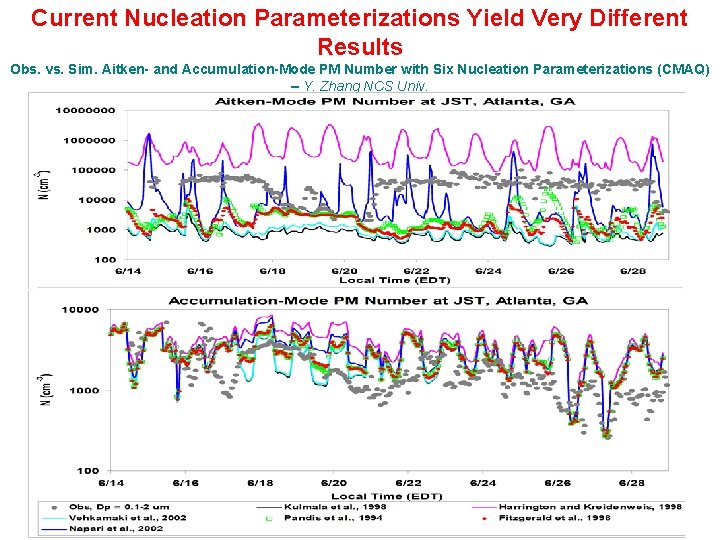
Current Nucleation Parameterizations Yield Very Different Results Obs. vs. Sim. Aitken- and Accumulation-Mode PM Number with Six Nucleation Parameterizations (CMAQ) – Y. Zhang NCS Univ.
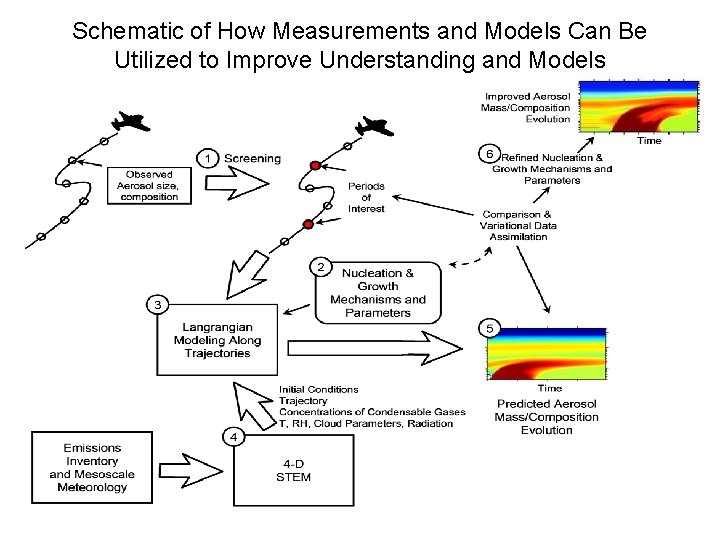
Schematic of How Measurements and Models Can Be Utilized to Improve Understanding and Models
These Processes Get Included Into Air Quality (AQ) Models Which Play Essential Roles in Environmental Management ? Modeled Observed
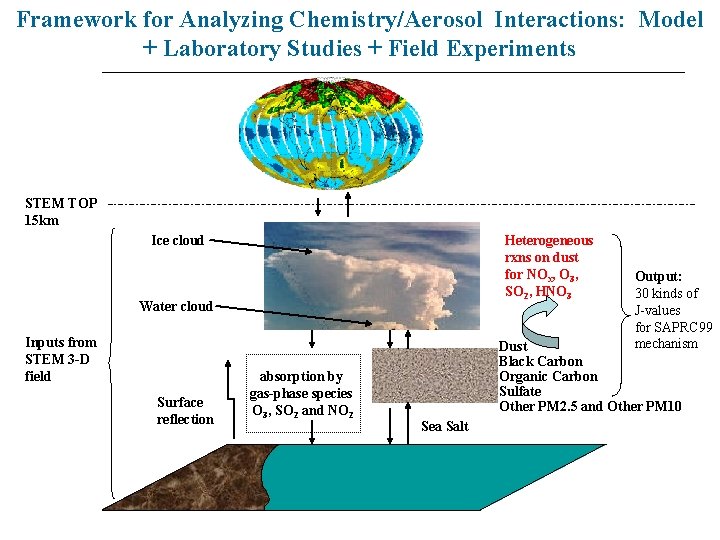
Framework for Analyzing Chemistry/Aerosol Interactions: Model + Laboratory Studies + Field Experiments STEM TOP 15 km Ice cloud Heterogeneous rxns on dust for NOx, O 3, SO 2, HNO 3 Water cloud Inputs from STEM 3 -D field Surface reflection absorption by gas-phase species O 3, SO 2 and NO 2 Output: 30 kinds of J-values for SAPRC 99 mechanism Dust Black Carbon Organic Carbon Sulfate Other PM 2. 5 and Other PM 10 Sea Salt
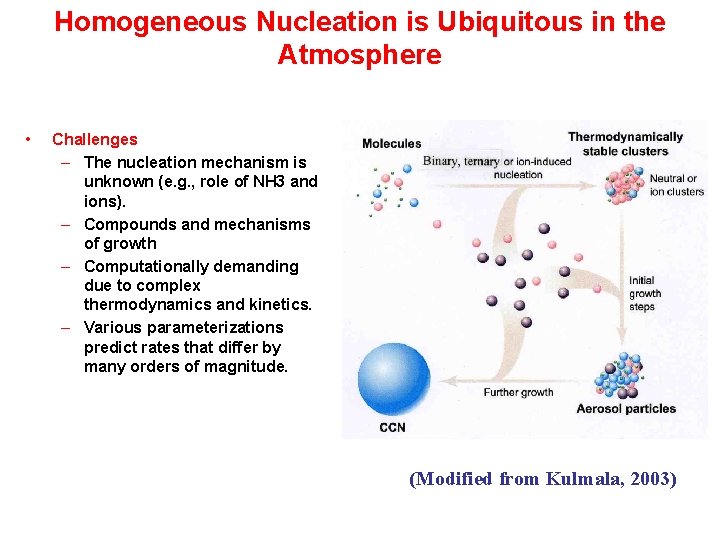
Homogeneous Nucleation is Ubiquitous in the Atmosphere • Challenges – The nucleation mechanism is unknown (e. g. , role of NH 3 and ions). – Compounds and mechanisms of growth – Computationally demanding due to complex thermodynamics and kinetics. – Various parameterizations predict rates that differ by many orders of magnitude. (Modified from Kulmala, 2003)