
Linkage Mapping Physical basis of linkage mapping B

Linkage Mapping Physical basis of linkage mapping B. Mapping by the 2 -factor testcross method C. Mapping by the 3 -factor testcross method A.
A. Physical Basis Ü If two genes are located on the same chromosome, their alleles can recombine only when there is crossing over during meiosis Ü The probability that crossover will occur is proportional to the distance between the genes Ü Typically, there are fewer recombinant (crossover) gametes than nonrecombinant gametes
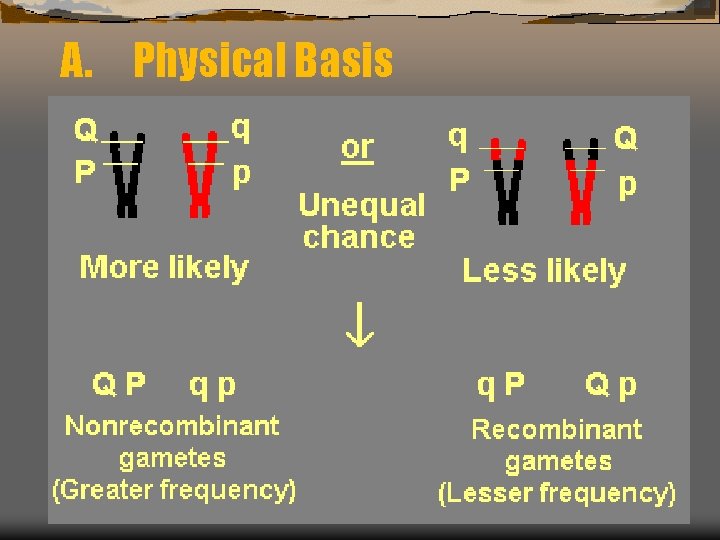
A. Physical Basis

A. Physical Basis Recombination Frequency µ Distance between the Genes Ü One “map unit” (or “morgan”) of distance is the distance that produces a recombination frequency of 1%; Therefore: Map distance (in map units) = recombination frequency X 100 = (# Recombinant gametes) X 100 (# Recombinant gametes) + (# nonrecombinant
B. 2 -factor Testcross ÜA testcross lets us “count” the number of recombinant and nonrecombinant gametes The phenotype of the testcross progeny is determined by the gametes from the heterozygous parent Each phenotype in a testcross has a unique genotype (unlike in the F 2 of dihybrid cross) Ü So, to map the distance between two genes: cross an individual that is heterozygous for each gene with an individual that is homozygous recessive for each gene
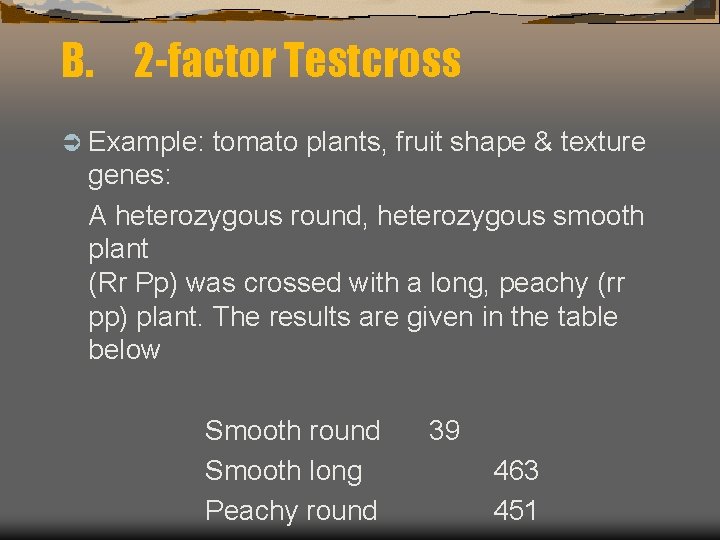
B. 2 -factor Testcross Ü Example: tomato plants, fruit shape & texture genes: A heterozygous round, heterozygous smooth plant (Rr Pp) was crossed with a long, peachy (rr pp) plant. The results are given in the table below Smooth round Smooth long Peachy round 39 463 451
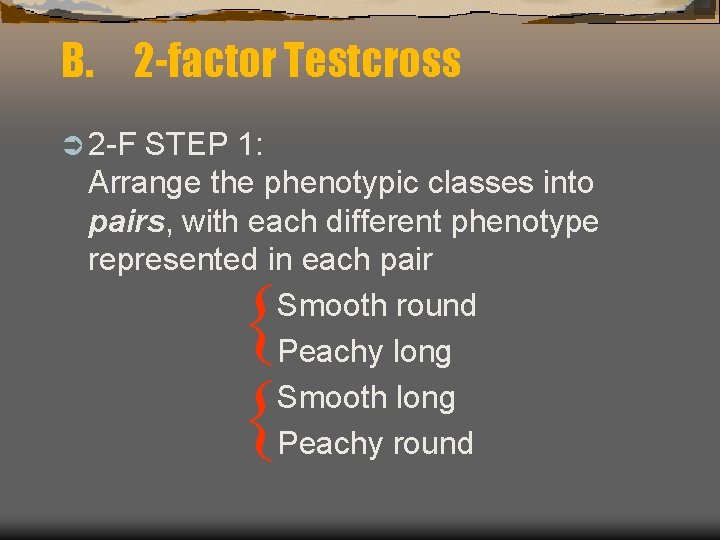
B. 2 -factor Testcross Ü 2 -F STEP 1: Arrange the phenotypic classes into pairs, with each different phenotype represented in each pair Smooth round Peachy long Smooth long Peachy round { {
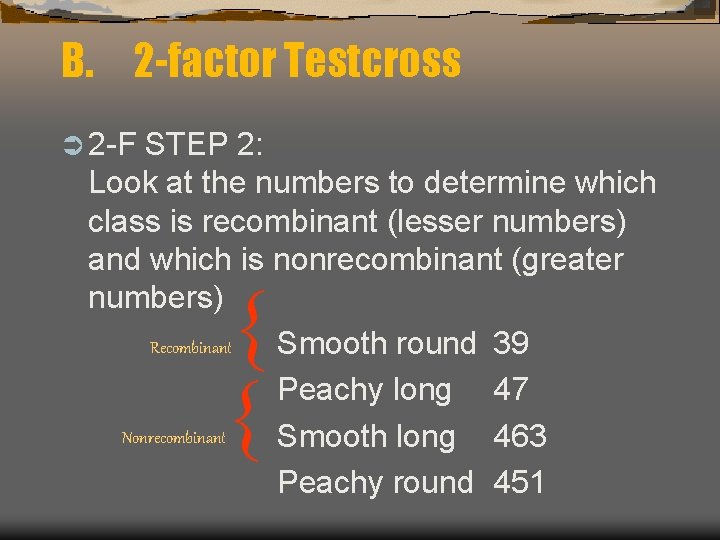
B. 2 -factor Testcross Ü 2 -F STEP 2: Look at the numbers to determine which class is recombinant (lesser numbers) and which is nonrecombinant (greater numbers) Recombinant Smooth round 39 Peachy long 47 Nonrecombinant Smooth long 463 Peachy round 451 { {
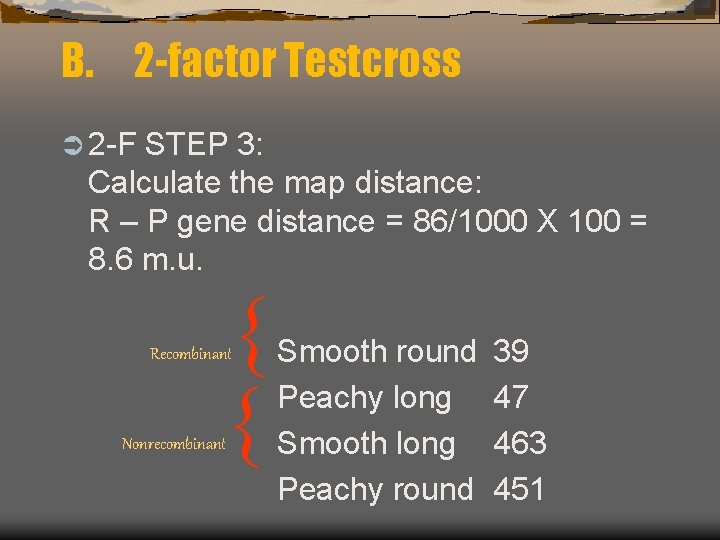
B. 2 -factor Testcross Ü 2 -F STEP 3: Calculate the map distance: R – P gene distance = 86/1000 X 100 = 8. 6 m. u. { { Recombinant Nonrecombinant Smooth round Peachy long Smooth long Peachy round 39 47 463 451
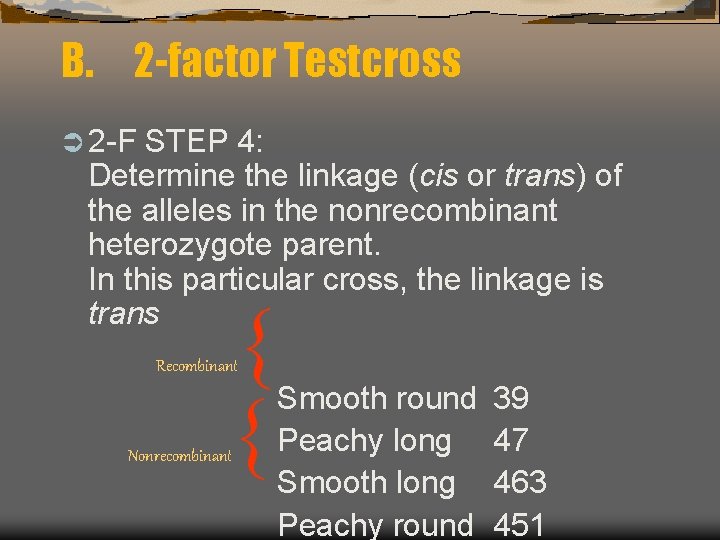
B. 2 -factor Testcross Ü 2 -F STEP 4: Determine the linkage (cis or trans) of the alleles in the nonrecombinant heterozygote parent. In this particular cross, the linkage is trans { { Recombinant Nonrecombinant Smooth round Peachy long Smooth long Peachy round 39 47 463 451
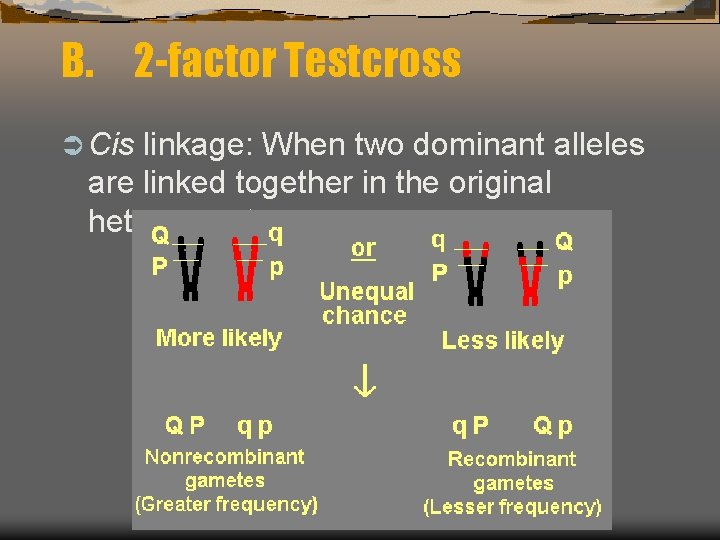
B. 2 -factor Testcross Ü Cis linkage: When two dominant alleles are linked together in the original heterozygote:
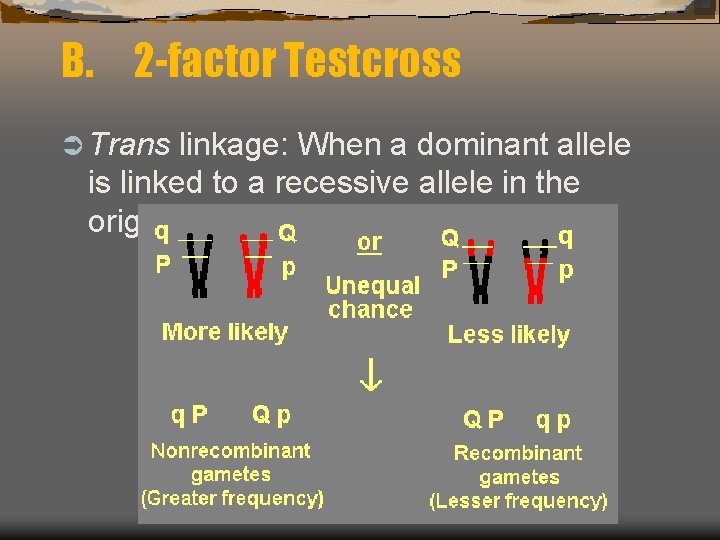
B. 2 -factor Testcross Ü Trans linkage: When a dominant allele is linked to a recessive allele in the original heterozygote:
B. 2 -factor Testcross Ü The double crossover problem: Double crossovers occur whenever two crossover events occur between two genes If this occurs, then the recombinant progeny will not be counted, because each allele “goes back” to its original linkage For this reason, the map distance given by a 2 -factor testcross often is too low
C. 3 -factor Testcross Ü By performing a testcross with 3 genes, we can estimate how many double crossovers are occurring Ü Example: Maize Green (Y) vs. yellow (y) plant color Full (S) vs. shrunken (s) seed shape Colored (C) vs. colorless (c) seed color Cross Yy Ss Cc X yy ss cc
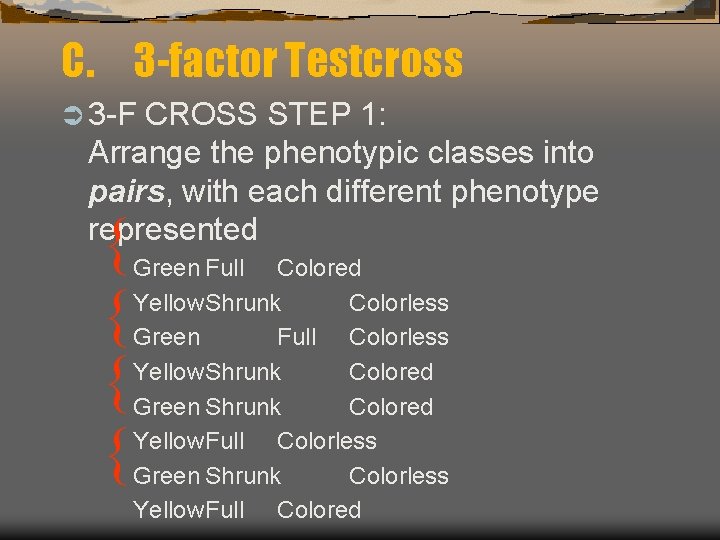
C. 3 -factor Testcross Ü 3 -F CROSS STEP 1: Arrange the phenotypic classes into pairs, with each different phenotype represented { { Green Full Colored Yellow. Shrunk Colorless Green Full Colorless Yellow. Shrunk Colored Green Shrunk Colored Yellow. Full Colorless Green Shrunk Colorless Yellow. Full Colored
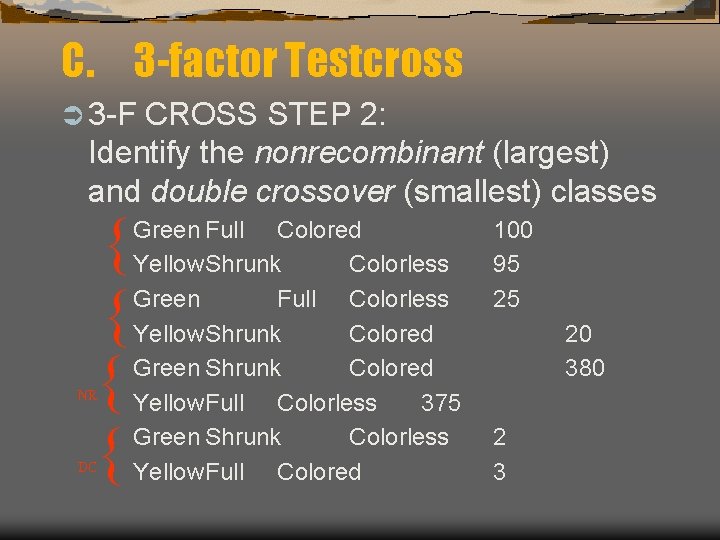
C. 3 -factor Testcross Ü 3 -F CROSS STEP 2: Identify the nonrecombinant (largest) and double crossover (smallest) classes NR { { DC Green Full Colored Yellow. Shrunk Colorless Green Full Colorless Yellow. Shrunk Colored Green Shrunk Colored Yellow. Full Colorless 375 Green Shrunk Colorless Yellow. Full Colored 100 95 25 20 380 2 3
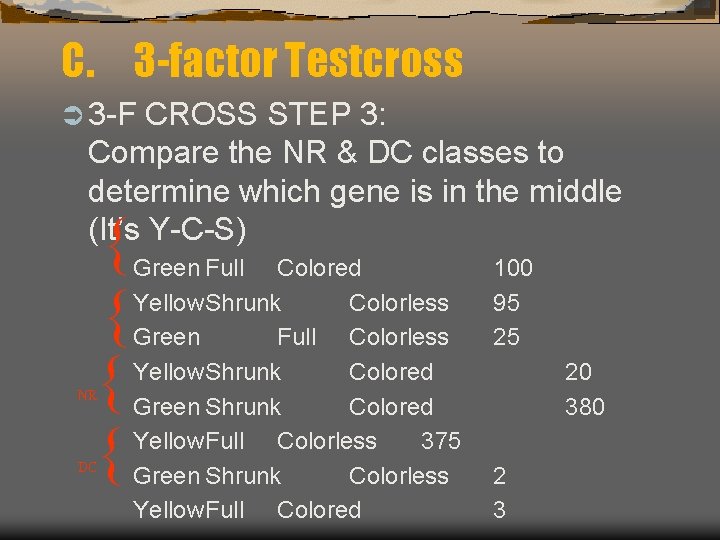
C. 3 -factor Testcross Ü 3 -F CROSS STEP 3: Compare the NR & DC classes to determine which gene is in the middle (It’s Y-C-S) NR { { DC Green Full Colored Yellow. Shrunk Colorless Green Full Colorless Yellow. Shrunk Colored Green Shrunk Colored Yellow. Full Colorless 375 Green Shrunk Colorless Yellow. Full Colored 100 95 25 20 380 2 3
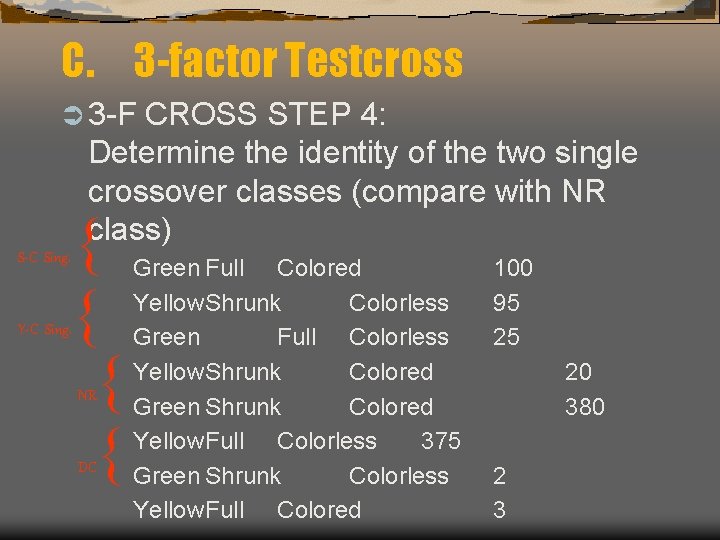
C. 3 -factor Testcross Ü 3 -F CROSS STEP 4: Determine the identity of the two single crossover classes (compare with NR class) S-C Sing. Y-C Sing. { { NR DC Green Full Colored Yellow. Shrunk Colorless Green Full Colorless Yellow. Shrunk Colored Green Shrunk Colored Yellow. Full Colorless 375 Green Shrunk Colorless Yellow. Full Colored 100 95 25 20 380 2 3
C. 3 -factor Testcross Ü 3 -F CROSS STEP 5: Calculate the distances between each pair of genes: Y-C distance = (25+20+2+3)/1000 X 100 = 5 m. u. S-C distance = (95+100+2+3)/1000 X 100 = 20 m. u.
C. 3 -factor Testcross Ü 3 -F CROSS STEP 6: Calculate: The expected double crossover frequency Expected d. c. freq. = (0. 05)(0. 2) = 0. 01 The obtained double crossover frequency Obtained d. c. freq. = (2+3)/1000 = 0. 005 The coefficient of coincidence Coincidence = (Obtained d. c. )/(Expected d. c. ) = 0. 005 / 0. 01 = 0. 5 Interference = 1 – Coincidence = 1 – 0. 5 = 0. 5
C. 3 -factor Testcross Ü Interference The occurrence of one crossover event may interfere with a second crossover event If the obtained d. c. = expected d. c. then: Coincidence = 1 Interference = 0 If the obtained d. c. < expected d. c. then: Coincidence < 1 Interference is a positive number If the obtained d. c. > expected d. c. then: Coincidence > 1 Interference is a negative number
- Slides: 21