
Linkage in Mx Merlin Meike Bartels Kate Morley

Linkage in Mx & Merlin Meike Bartels Kate Morley Hermine Maes Based on Posthuma et al. , Boulder & Egmond

Outline Summary of yesterday afternoon n Linkage in Merlin – Phi-Hat n Linkage in Mx – Mixture n
Summary Yesterday -Linkage Analysis n Where are the genes? ¨ Collect genotypic data on large number of markers ¨ Compare correlations by number of alleles identical by descent at a particular marker ¨ Partition/ Quantify variance in genetic (QTL) and environmental components ¨ Test significance of QTL effect
Summary Yesterday - Methods Partitioned Twin Analyses n Linkage using Pi-Hat n
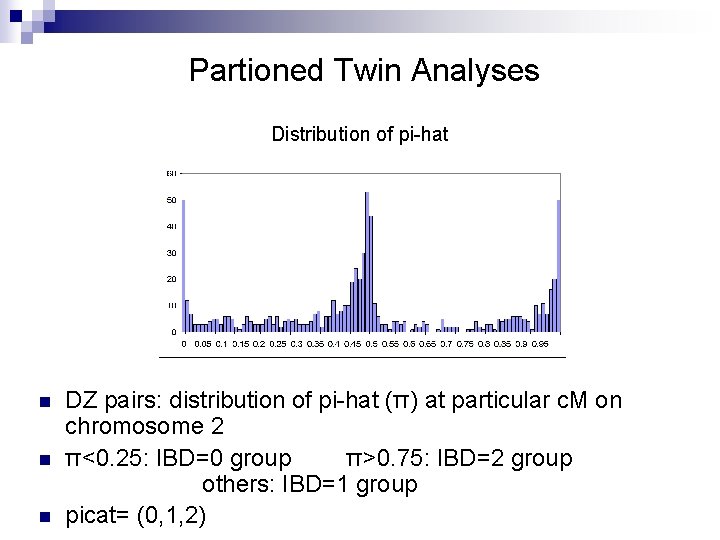
Partioned Twin Analyses Distribution of pi-hat n n n DZ pairs: distribution of pi-hat (π) at particular c. M on chromosome 2 π<0. 25: IBD=0 group π>0. 75: IBD=2 group others: IBD=1 group picat= (0, 1, 2)
Partioned Twin Analyses n Can resemblance (e. g. correlations, covariances) between sib pairs, or DZ twins, be modeled as a function of DNA marker sharing (IBD) at a particular chromosomal location? ¨ Estimate covariance by IBD state ¨ Impose genetic model and estimate model parameters
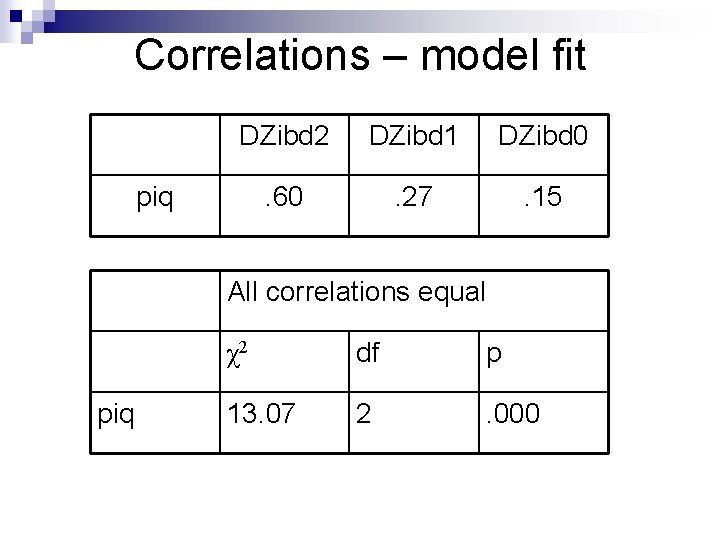
Correlations – model fit DZibd 2 DZibd 1 DZibd 0 . 60 . 27 . 15 piq All correlations equal piq χ2 df p 13. 07 2 . 000
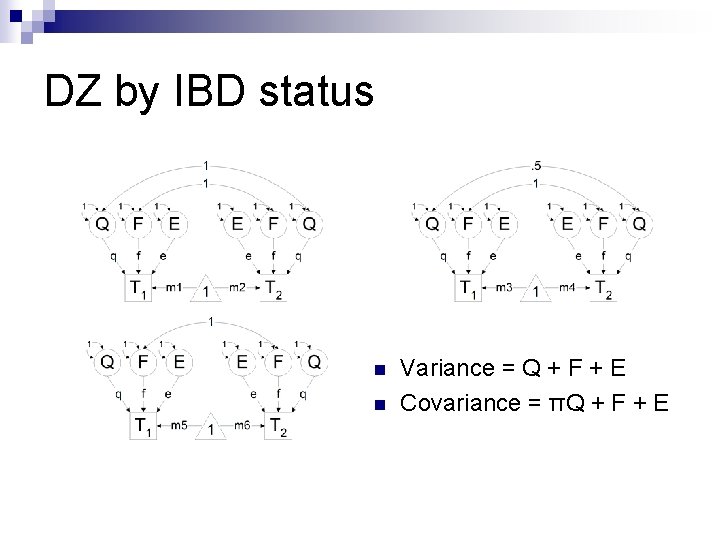
DZ by IBD status n n Variance = Q + F + E Covariance = πQ + F + E
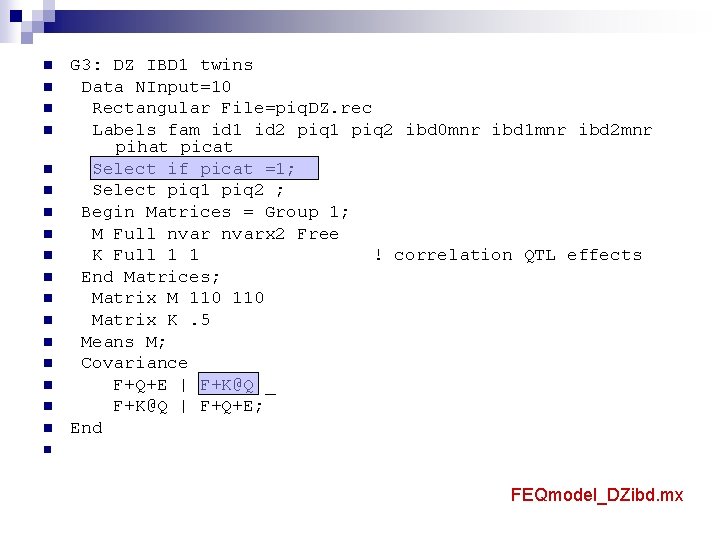
n n n n n G 3: DZ IBD 1 twins Data NInput=10 Rectangular File=piq. DZ. rec Labels fam id 1 id 2 piq 1 piq 2 ibd 0 mnr ibd 1 mnr ibd 2 mnr pihat picat Select if picat =1; Select piq 1 piq 2 ; Begin Matrices = Group 1; M Full nvarx 2 Free K Full 1 1 ! correlation QTL effects End Matrices; Matrix M 110 Matrix K. 5 Means M; Covariance F+Q+E | F+K@Q _ F+K@Q | F+Q+E; End n FEQmodel_DZibd. mx
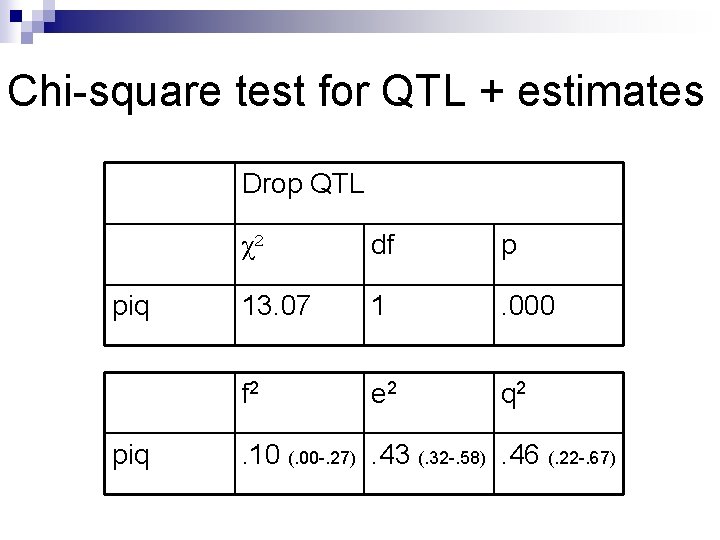
Chi-square test for QTL + estimates Drop QTL piq χ2 df p 13. 07 1 . 000 f 2 e 2 q 2 . 10 (. 00 -. 27). 43 (. 32 -. 58). 46 (. 22 -. 67)
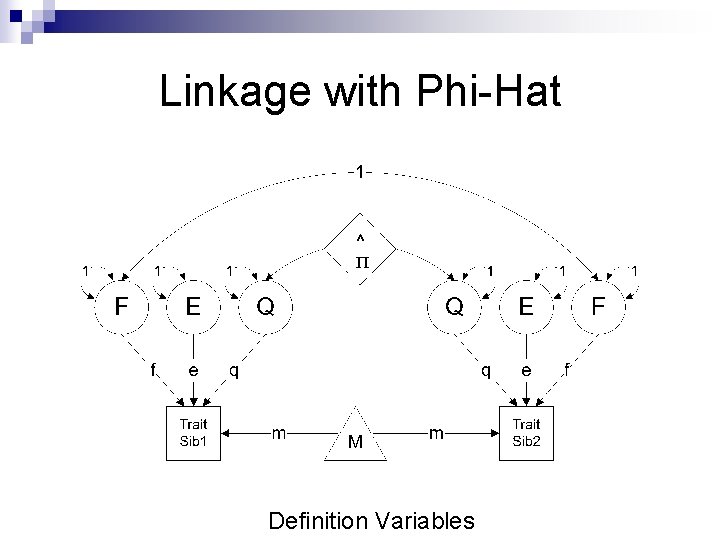
Linkage with Phi-Hat п Definition Variables
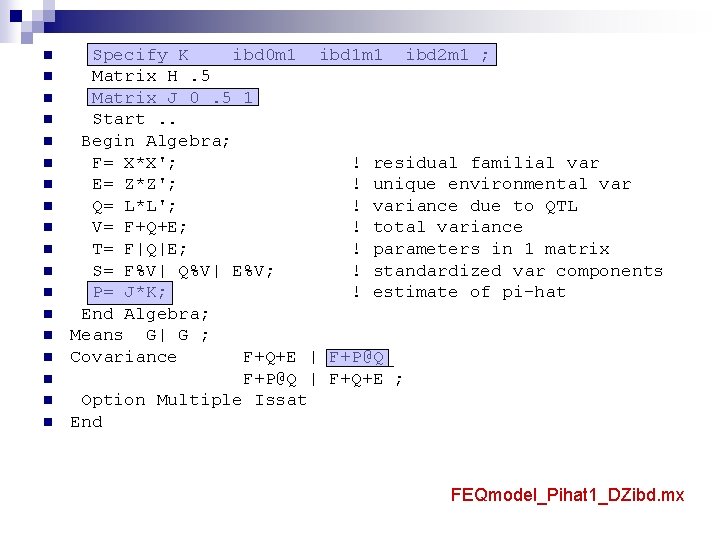
n n n n n Specify K ibd 0 m 1 ibd 1 m 1 ibd 2 m 1 ; Matrix H. 5 Matrix J 0. 5 1 Start. . Begin Algebra; F= X*X'; ! residual familial var E= Z*Z'; ! unique environmental var Q= L*L'; ! variance due to QTL V= F+Q+E; ! total variance T= F|Q|E; ! parameters in 1 matrix S= F%V| Q%V| E%V; ! standardized var components P= J*K; ! estimate of pi-hat End Algebra; Means G| G ; Covariance F+Q+E | F+P@Q_ F+P@Q | F+Q+E ; Option Multiple Issat End FEQmodel_Pihat 1_DZibd. mx
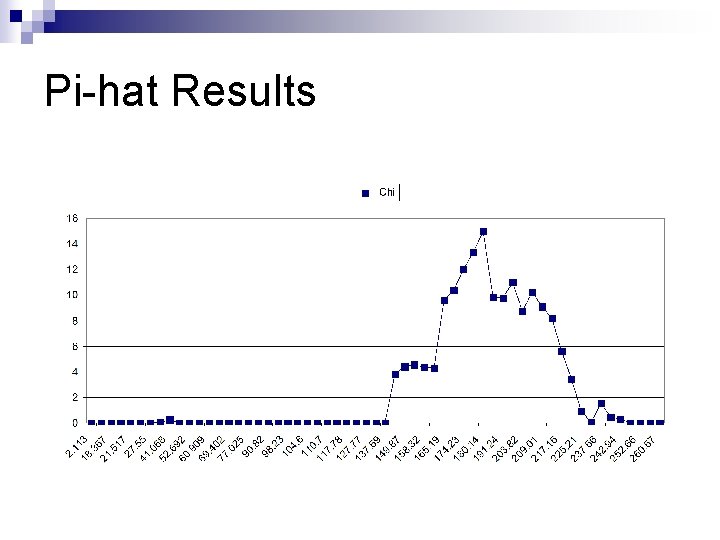
Pi-hat Results
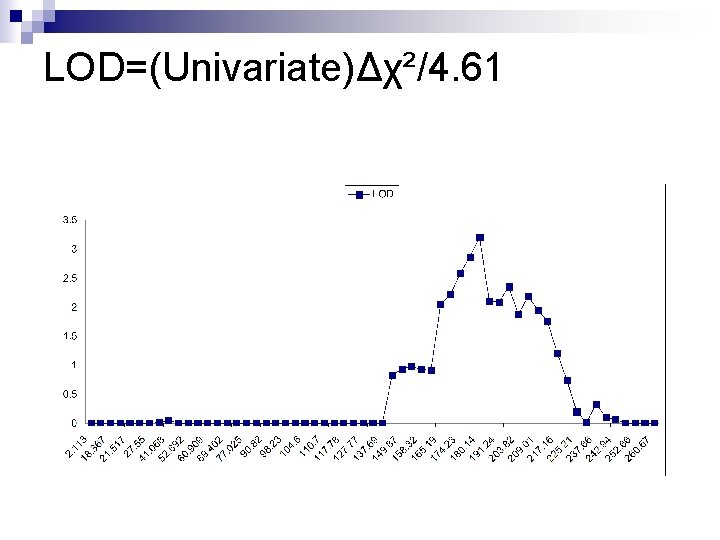
LOD=(Univariate)Δχ²/4. 61

Running a loop (Mx Manual page 52) n Include a loop function in your Mx script ¨ n Analyze all markers consecutively At the top of the loop ¨ #loop $<number> start stop increment n n Within the loop ¨ One file per chromosome, multiple markers n ¨ Select piq 1 piq 2 ibd 0 m$nr ibd 1 m$nr ibd 2 m$nr One file per marker, multiple files n n #loop $nr 1 59 1 Rectangular File =piq$nr. rec At the end of the loop ¨ #end loop
Outline Summary of yesterday afternoon n Linkage in Merlin – Phi-Hat > Kate n Linkage in Mx – Mixture > Meike n

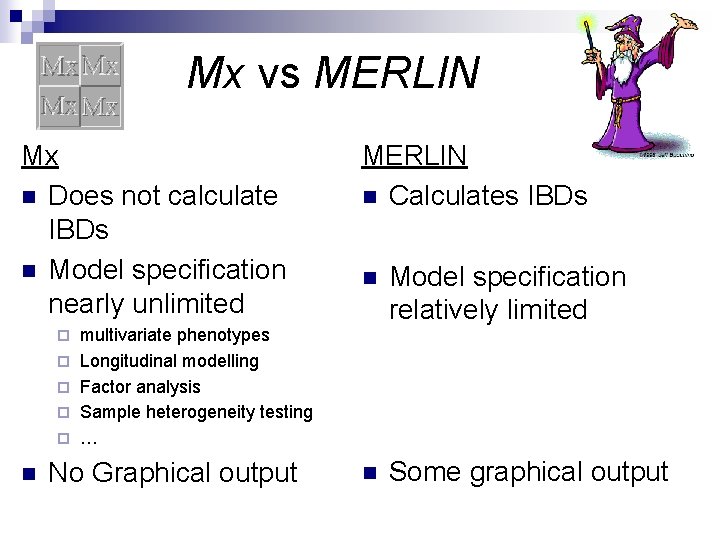
Mx vs MERLIN Mx n Does not calculate IBDs n Model specification nearly unlimited ¨ ¨ ¨ n MERLIN n Calculates IBDs n Model specification relatively limited n Some graphical output multivariate phenotypes Longitudinal modelling Factor analysis Sample heterogeneity testing … No Graphical output
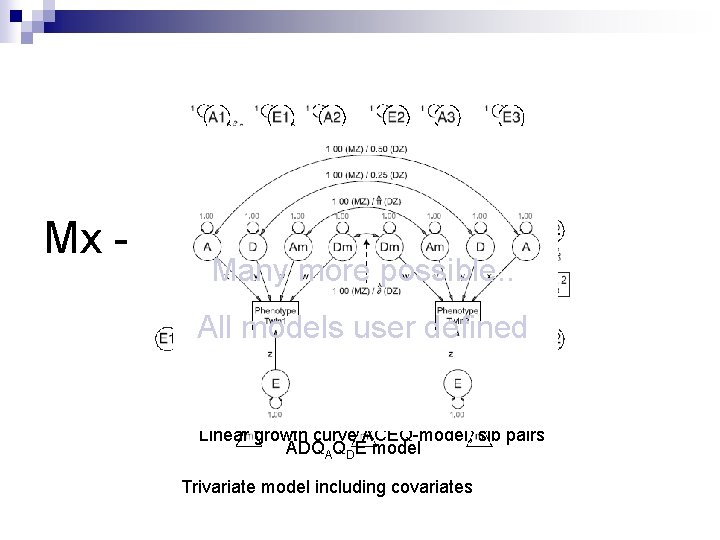
Mx - flexibility Many more possible. . All models user defined Univariate ADE model, three sibs sib pairs Linear growth curve ACEQ-model, Bivariate ADEADE ADQ model, QDthree E model sibs A Bivariate model Trivariate model including covariates
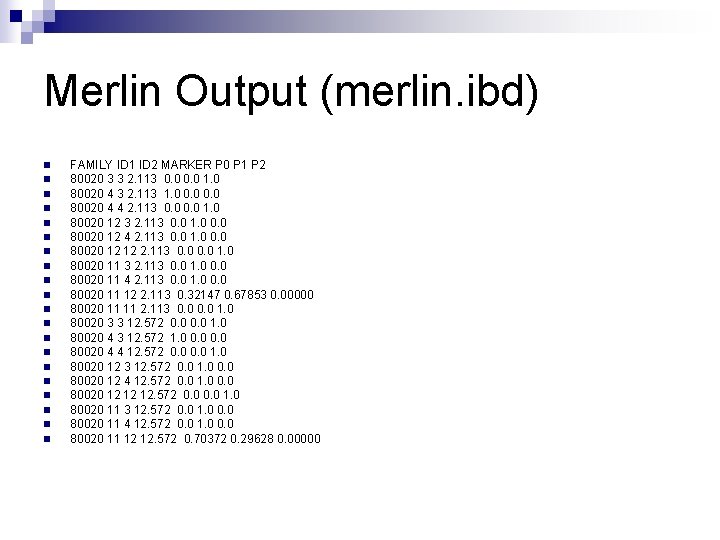
Merlin Output (merlin. ibd) n n n n n FAMILY ID 1 ID 2 MARKER P 0 P 1 P 2 80020 3 3 2. 113 0. 0 1. 0 80020 4 3 2. 113 1. 0 0. 0 80020 4 4 2. 113 0. 0 1. 0 80020 12 3 2. 113 0. 0 1. 0 0. 0 80020 12 4 2. 113 0. 0 1. 0 0. 0 80020 12 12 2. 113 0. 0 1. 0 80020 11 3 2. 113 0. 0 1. 0 0. 0 80020 11 4 2. 113 0. 0 1. 0 0. 0 80020 11 12 2. 113 0. 32147 0. 67853 0. 00000 80020 11 11 2. 113 0. 0 1. 0 80020 3 3 12. 572 0. 0 1. 0 80020 4 3 12. 572 1. 0 0. 0 80020 4 4 12. 572 0. 0 1. 0 80020 12 3 12. 572 0. 0 1. 0 0. 0 80020 12 4 12. 572 0. 0 1. 0 0. 0 80020 12 12 12. 572 0. 0 1. 0 80020 11 3 12. 572 0. 0 1. 0 0. 0 80020 11 4 12. 572 0. 0 1. 0 0. 0 80020 11 12 12. 572 0. 70372 0. 29628 0. 00000
Merlin Output (merlin. ibd) Merlin will output IBD estimates for all possible pairs that can be created within a single family. n Some of these IBD estimates are invariant for example: spouses will always be IBD = 0 parent-offspring relations will always be IBD = 1 n
Merlin Output (merlin. ibd) n In some cases, IBD estimates are not invariant by default, but may still follow an a priori pattern (i. e. for sibling pairs the probabilities for sharing 0, 1, or 2 alleles IBD will be ¼, ½, and ¼ respectively) >> The latter will happen when one or both members are not genotyped, or are genotyped for only a very small portion of all available genotypes.
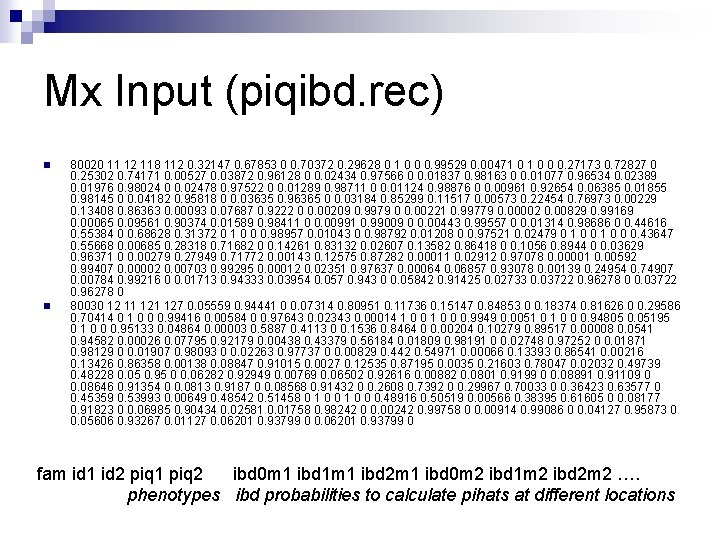
Mx Input (piqibd. rec) n n 80020 11 12 118 112 0. 32147 0. 67853 0 0. 70372 0. 29628 0 1 0 0 0. 99529 0. 00471 0 0 0. 27173 0. 72827 0 0. 25302 0. 74171 0. 00527 0. 03872 0. 96128 0 0. 02434 0. 97566 0 0. 01837 0. 98163 0 0. 01077 0. 96534 0. 02389 0. 01976 0. 98024 0 0. 02478 0. 97522 0 0. 01289 0. 98711 0 0. 01124 0. 98876 0 0. 00961 0. 92654 0. 06385 0. 01855 0. 98145 0 0. 04182 0. 95818 0 0. 03635 0. 96365 0 0. 03184 0. 85299 0. 11517 0. 00573 0. 22454 0. 76973 0. 00229 0. 13408 0. 86363 0. 00093 0. 07687 0. 9222 0 0. 00209 0. 9979 0 0. 00221 0. 99779 0. 00002 0. 00829 0. 99169 0. 00065 0. 09561 0. 90374 0. 01589 0. 98411 0 0. 00991 0. 99009 0 0. 00443 0. 99557 0 0. 01314 0. 98686 0 0. 44616 0. 55384 0 0. 68628 0. 31372 0 1 0 0 0. 98957 0. 01043 0 0. 98792 0. 01208 0 0. 97521 0. 02479 0 1 0 0 0. 43647 0. 55668 0. 00685 0. 28318 0. 71682 0 0. 14261 0. 83132 0. 02607 0. 13582 0. 86418 0 0. 1056 0. 8944 0 0. 03629 0. 96371 0 0. 00279 0. 27949 0. 71772 0. 00143 0. 12575 0. 87282 0. 00011 0. 02912 0. 97078 0. 00001 0. 00592 0. 99407 0. 00002 0. 00703 0. 99295 0. 00012 0. 02351 0. 97637 0. 00064 0. 06857 0. 93078 0. 00139 0. 24954 0. 74907 0. 00784 0. 99216 0 0. 01713 0. 94333 0. 03954 0. 057 0. 943 0 0. 05842 0. 91425 0. 02733 0. 03722 0. 96278 0 80030 12 11 127 0. 05559 0. 94441 0 0. 07314 0. 80951 0. 11736 0. 15147 0. 84853 0 0. 18374 0. 81626 0 0. 29586 0. 70414 0 1 0 0 0. 99416 0. 00584 0 0. 97643 0. 02343 0. 00014 1 0 0 0. 9949 0. 0051 0 0 0. 94805 0. 05195 0 1 0 0 0. 95133 0. 04864 0. 00003 0. 5887 0. 4113 0 0. 1536 0. 8464 0 0. 00204 0. 10279 0. 89517 0. 00008 0. 0541 0. 94582 0. 00026 0. 07795 0. 92179 0. 00438 0. 43379 0. 56184 0. 01809 0. 98191 0 0. 02748 0. 97252 0 0. 01871 0. 98129 0 0. 01907 0. 98093 0 0. 02263 0. 97737 0 0. 00829 0. 442 0. 54971 0. 00066 0. 13393 0. 86541 0. 00216 0. 13426 0. 86358 0. 00138 0. 08847 0. 91015 0. 0027 0. 12535 0. 87195 0. 0035 0. 21603 0. 78047 0. 02032 0. 49739 0. 48228 0. 05 0. 95 0 0. 06282 0. 92949 0. 00769 0. 06502 0. 92616 0. 00882 0. 0801 0. 9199 0 0. 08891 0. 91109 0 0. 08646 0. 91354 0 0. 0813 0. 9187 0 0. 08568 0. 91432 0 0. 2608 0. 7392 0 0. 29967 0. 70033 0 0. 36423 0. 63577 0 0. 45359 0. 53993 0. 00649 0. 48542 0. 51458 0 1 0 0 0. 48916 0. 50519 0. 00566 0. 38395 0. 61605 0 0. 08177 0. 91823 0 0. 06985 0. 90434 0. 02581 0. 01758 0. 98242 0 0. 00242 0. 99758 0 0. 00914 0. 99086 0 0. 04127 0. 95873 0 0. 05606 0. 93267 0. 01127 0. 06201 0. 93799 0 fam id 1 id 2 piq 1 piq 2 ibd 0 m 1 ibd 1 m 1 ibd 2 m 1 ibd 0 m 2 ibd 1 m 2 ibd 2 m 2 …. phenotypes ibd probabilities to calculate pihats at different locations
Once you have your data …. Incorporate QTL effects in ACE/ADE models n ‘Simple’ extension of path models and Mx scripts n
Alternative way to model linkage Rather than categorize or calculating pi-hat, we can fit three models (for ibd=0, 1, or 2) to the data and weight each model by its corresponding IBD probability for a pair of siblings: Full information approach aka Weighted likelihood or Mixture distribution approach
Mixture Distribution Approach In the mixture distribution approach to linkage, we fit three models (for IBD=0, IBD=1, IBD=2) for each sib pair, each weighted by their relative IBD probabilities.
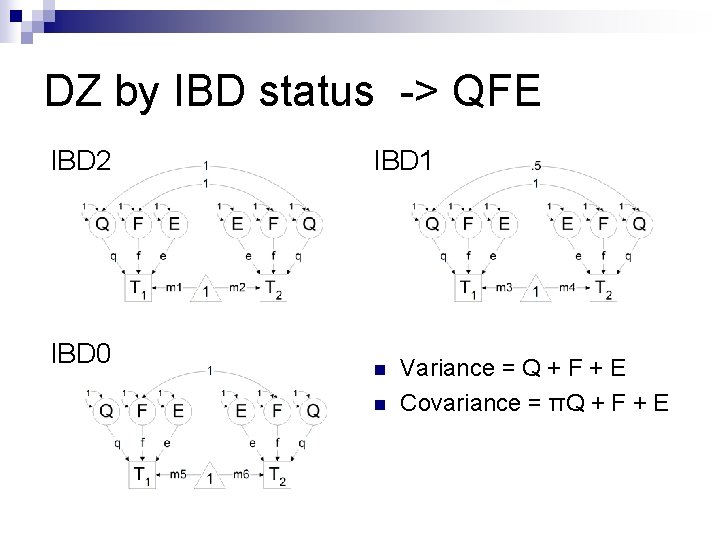
DZ by IBD status -> QFE IBD 2 IBD 0 IBD 1 n n Variance = Q + F + E Covariance = πQ + F + E
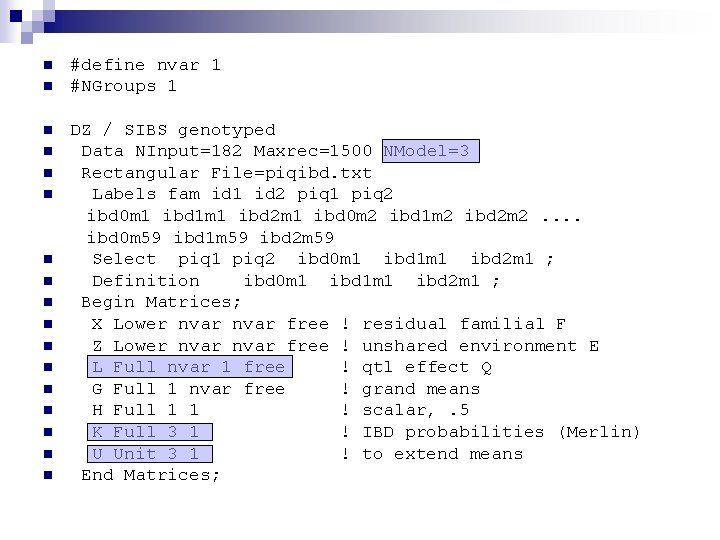
n n n n n #define nvar 1 #NGroups 1 DZ / SIBS genotyped Data NInput=182 Maxrec=1500 NModel=3 Rectangular File=piqibd. txt Labels fam id 1 id 2 piq 1 piq 2 ibd 0 m 1 ibd 1 m 1 ibd 2 m 1 ibd 0 m 2 ibd 1 m 2 ibd 2 m 2. . ibd 0 m 59 ibd 1 m 59 ibd 2 m 59 Select piq 1 piq 2 ibd 0 m 1 ibd 1 m 1 ibd 2 m 1 ; Definition ibd 0 m 1 ibd 1 m 1 ibd 2 m 1 ; Begin Matrices; X Lower nvar free ! residual familial F Z Lower nvar free ! unshared environment E L Full nvar 1 free ! qtl effect Q G Full 1 nvar free ! grand means H Full 1 1 ! scalar, . 5 K Full 3 1 ! IBD probabilities (Merlin) U Unit 3 1 ! to extend means End Matrices;
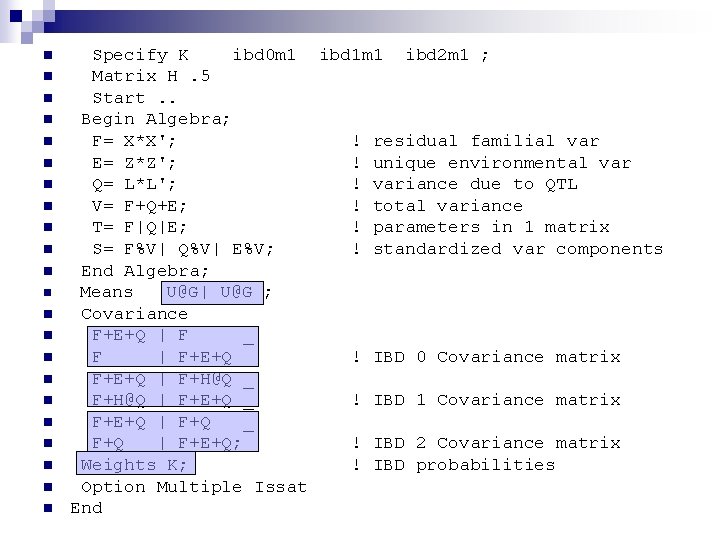
n n n n n n Specify K ibd 0 m 1 ibd 1 m 1 ibd 2 m 1 ; Matrix H. 5 Start. . Begin Algebra; F= X*X'; ! residual familial var E= Z*Z'; ! unique environmental var Q= L*L'; ! variance due to QTL V= F+Q+E; ! total variance T= F|Q|E; ! parameters in 1 matrix S= F%V| Q%V| E%V; ! standardized var components End Algebra; Means U@G| U@G ; Covariance F+E+Q | F _ F | F+E+Q _ ! IBD 0 Covariance matrix F+E+Q | F+H@Q _ F+H@Q | F+E+Q _ ! IBD 1 Covariance matrix F+E+Q | F+Q _ F+Q | F+E+Q; ! IBD 2 Covariance matrix Weights K; ! IBD probabilities Option Multiple Issat End

Practical Mixture n Mx script: mixture_piq_Prac. mx Fill in ? ? n Choose a position, run model n Calculate lod-score n faculty: meike2007mixture_piq_Prac. mx
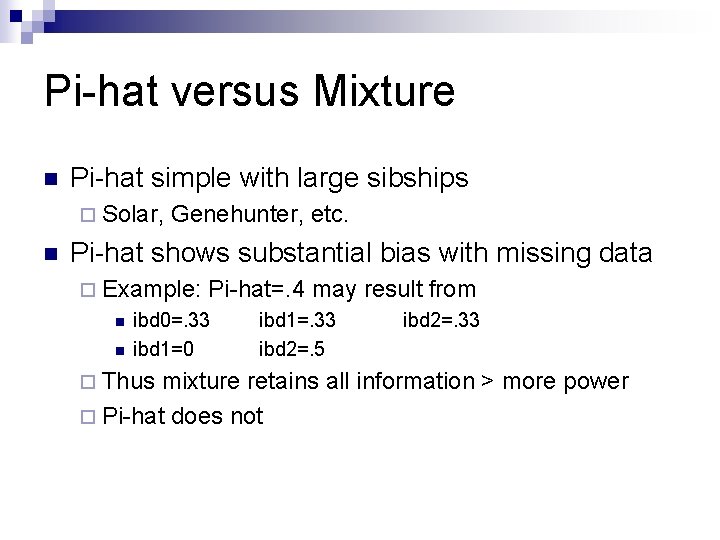
Pi-hat versus Mixture n Pi-hat simple with large sibships ¨ Solar, n Genehunter, etc. Pi-hat shows substantial bias with missing data ¨ Example: n n Pi-hat=. 4 may result from ibd 0=. 33 ibd 1=0 ¨ Thus ibd 1=. 33 ibd 2=. 5 ibd 2=. 33 mixture retains all information > more power ¨ Pi-hat does not
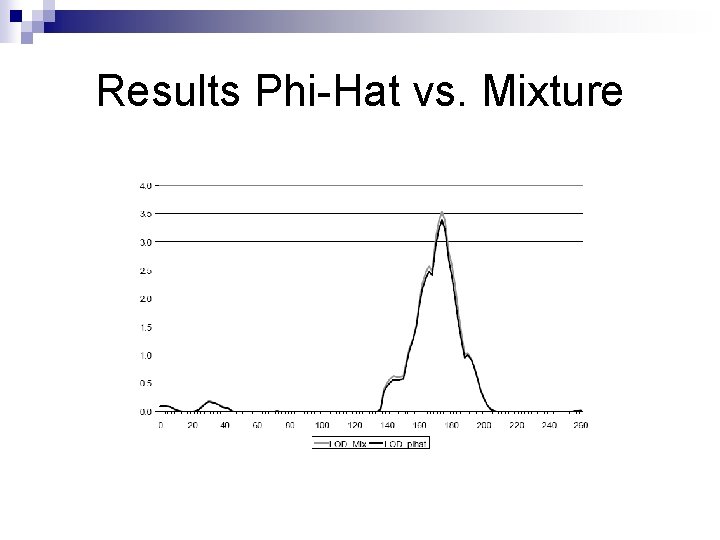
Results Phi-Hat vs. Mixture

http: //www. psy. vu. nl/mxbib/
Individual Likelihoods Mx allows to output the contribution to the 2 ll per family: n Raw data n Options Mx%p= file. out n Will output for each case in the data the contribution to the -2 ll as well as z-score statistic and Mahalanobis distance n
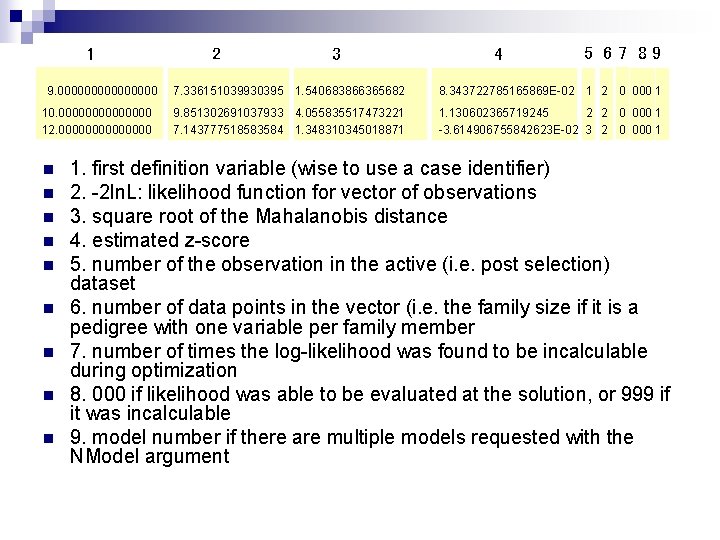
1 9. 00000000 10. 0000000 12. 0000000 n n n n n 2 3 4 5 67 89 7. 336151039930395 1. 540683866365682 8. 343722785165869 E-02 1 2 0 000 1 9. 851302691037933 4. 055835517473221 7. 143777518583584 1. 348310345018871 1. 130602365719245 2 2 0 000 1 -3. 614906755842623 E-02 3 2 0 000 1 1. first definition variable (wise to use a case identifier) 2. -2 ln. L: likelihood function for vector of observations 3. square root of the Mahalanobis distance 4. estimated z-score 5. number of the observation in the active (i. e. post selection) dataset 6. number of data points in the vector (i. e. the family size if it is a pedigree with one variable per family member 7. number of times the log-likelihood was found to be incalculable during optimization 8. 000 if likelihood was able to be evaluated at the solution, or 999 if it was incalculable 9. model number if there are multiple models requested with the NModel argument
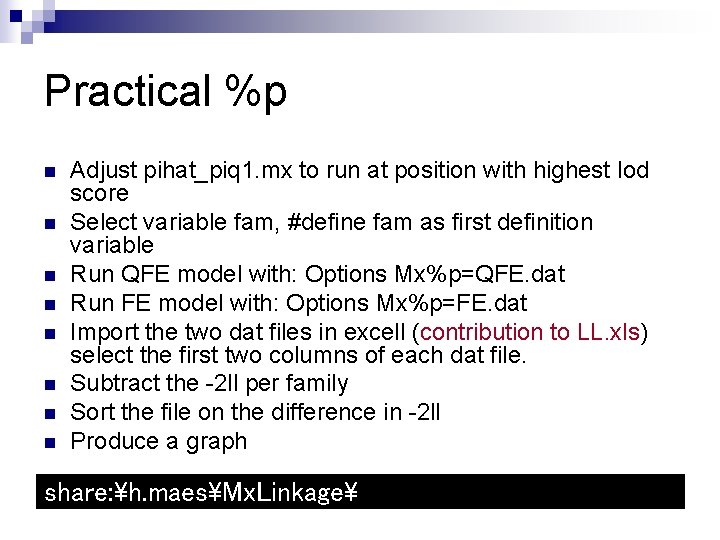
Practical %p n n n n Adjust pihat_piq 1. mx to run at position with highest lod score Select variable fam, #define fam as first definition variable Run QFE model with: Options Mx%p=QFE. dat Run FE model with: Options Mx%p=FE. dat Import the two dat files in excell (contribution to LL. xls) select the first two columns of each dat file. Subtract the -2 ll per family Sort the file on the difference in -2 ll Produce a graph share: h. maesMx. Linkage
%p Viewer n Java applet from QIMR to view the %p output in a convenient way n Open viewdist. jar, open QFE. dat
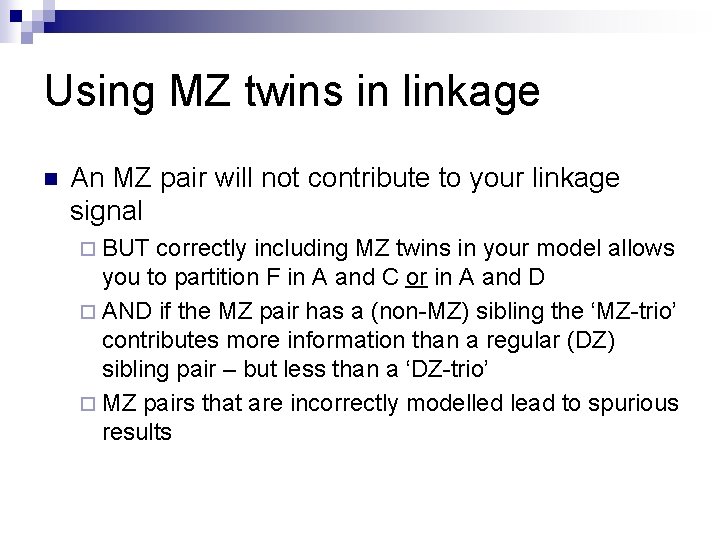
Using MZ twins in linkage n An MZ pair will not contribute to your linkage signal ¨ BUT correctly including MZ twins in your model allows you to partition F in A and C or in A and D ¨ AND if the MZ pair has a (non-MZ) sibling the ‘MZ-trio’ contributes more information than a regular (DZ) sibling pair – but less than a ‘DZ-trio’ ¨ MZ pairs that are incorrectly modelled lead to spurious results
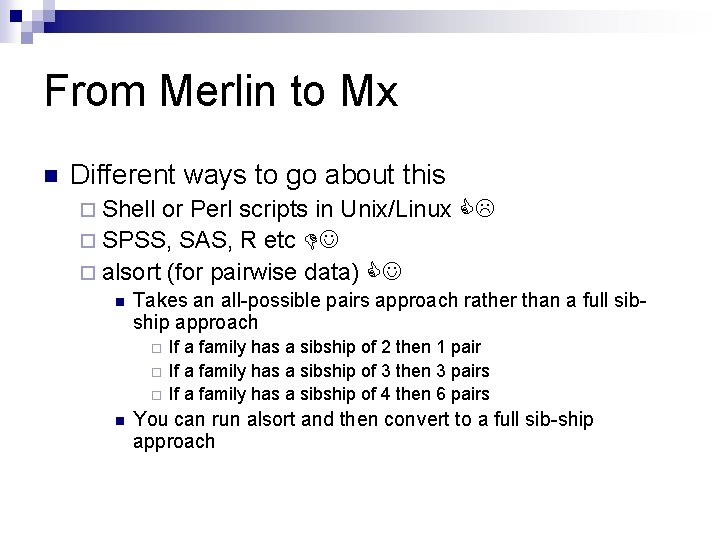
From Merlin to Mx n Different ways to go about this ¨ Shell or Perl scripts in Unix/Linux ¨ SPSS, SAS, R etc ¨ alsort (for pairwise data) n Takes an all-possible pairs approach rather than a full sibship approach ¨ ¨ ¨ n If a family has a sibship of 2 then 1 pair If a family has a sibship of 3 then 3 pairs If a family has a sibship of 4 then 6 pairs You can run alsort and then convert to a full sib-ship approach
![alsort. exe Usage: alsort <inputfile> <outpfile> [-vfpm] [-c] [-i] [-t] [-x <id 1>. .](http://slidetodoc.com/presentation_image_h2/9fd6b5d14a374c980237cc57f33ab52b/image-40.jpg "alsort. exe Usage: alsort <inputfile> <outpfile> [-vfpm] [-c] [-i] [-t] [-x <id 1>. .")
alsort. exe Usage: alsort <inputfile> <outpfile> [-vfpm] [-c] [-i] [-t] [-x <id 1>. . . ] -v -vf -vp -vm -c -i -x -t Verbose (implies -vfpm) Print family ID list Print marker positions Print missing p-values Create output file per chromosome Include 'self' values (id 1=id 2) Exclude list; id-values separated by spaces Write tab as separator character
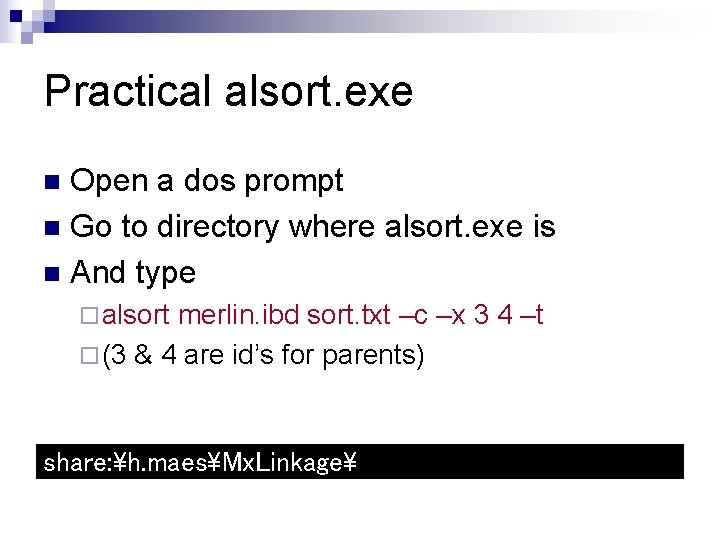
Practical alsort. exe Open a dos prompt n Go to directory where alsort. exe is n And type n ¨ alsort merlin. ibd sort. txt –c –x 3 4 –t ¨ (3 & 4 are id’s for parents) share: h. maesMx. Linkage
- Slides: 41