
Linkage between Summer Indian Ocean SST and the
Linkage between Summer Indian Ocean SST and the Decay of ENSO events Ren Rongcai(任荣彩) (rrc@lasg. iap. ac. cn) (LASG, Institute of the Atmospheric physics, Chinese Academy of Sciences, Beijing, China) Collaborators: SY Sun, Q Li, Y. Yang M Cai (FSU, USA); GX Wu
Outline Background Questions to address Main results Summary
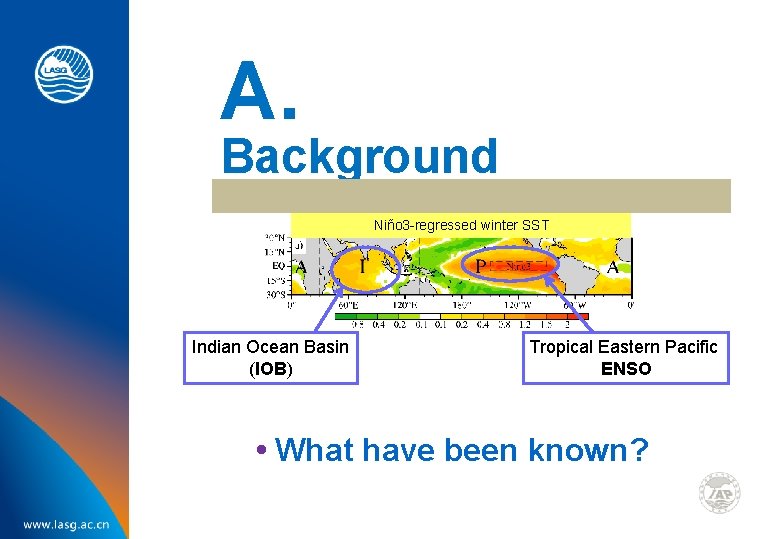
A. Background Niño 3 -regressed winter SST Indian Ocean Basin (IOB) Tropical Eastern Pacific ENSO What have been known?
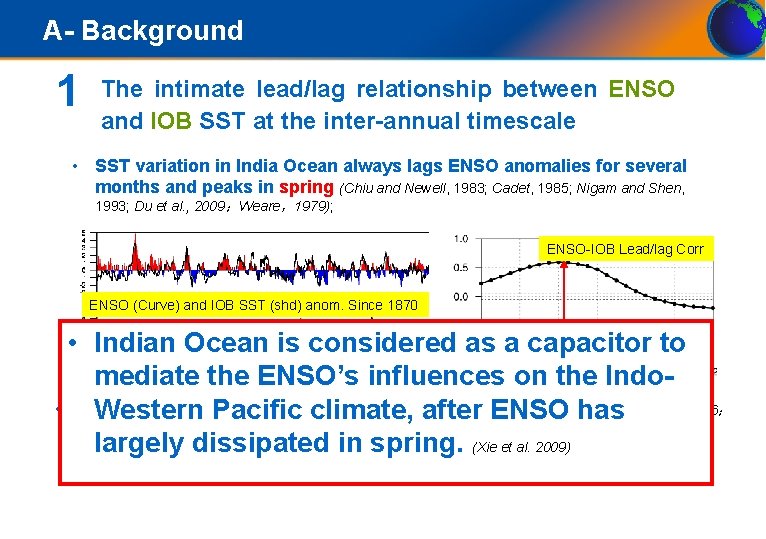
A- Background 1 The intimate lead/lag relationship between ENSO and IOB SST at the inter-annual timescale • SST variation in India Ocean always lags ENSO anomalies for several months and peaks in spring (Chiu and Newell, 1983; Cadet, 1985; Nigam and Shen, 1993; Du et al. , 2009;Weare,1979); ENSO-IOB Lead/lag Corr ENSO (Curve) and IOB SST (shd) anom. Since 1870 Li et al,2012 • Indian Ocean is considered as a capacitor to mediate the ENSO’s influences on the Indo • SST response in. Pacific India Ocean to ENSO isafter basin wide ! (Fieuxhas and Stommel,1976; Western climate, ENSO Brown and Havans,1981;Cadet and Diehl,1984;Shukla,1987;Rao and Goswami,1988) largely dissipated in spring. (Xie et al. 2009)
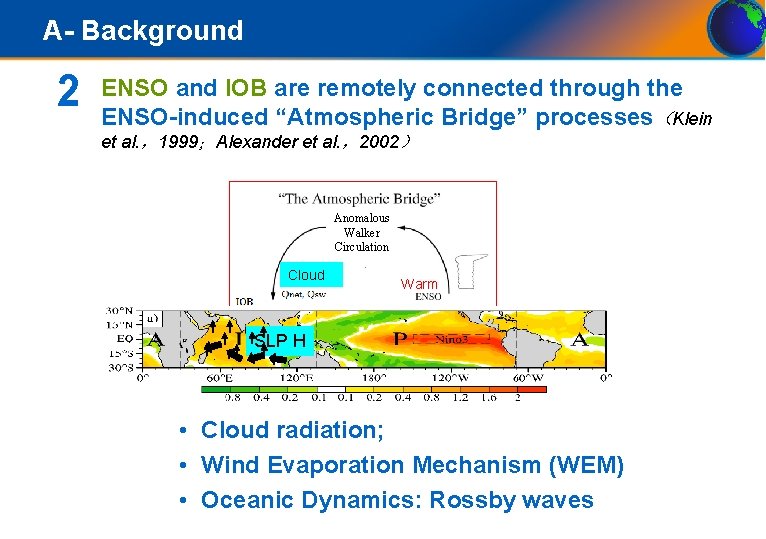
A- Background 2 ENSO and IOB are remotely connected through the ENSO-induced “Atmospheric Bridge” processes(Klein et al. ,1999;Alexander et al. ,2002) Anomalous Walker Circulation Cloud Warm SLP H • Cloud radiation; • Wind Evaporation Mechanism (WEM) • Oceanic Dynamics: Rossby waves
A- Background 3 Persistence of ENSO-related processes may affect the summer IOB • Besides that in spring, there exists a second warming peak of the North Indian Ocean SST in summer of El Niño decay years (Du et al. 2009); • The longer persistence of the WEM process over the IOB may have contributed to a summer warming of North Indian Ocean since 1970 s. (Du et al. 2009; Xie, 2009; 2010).
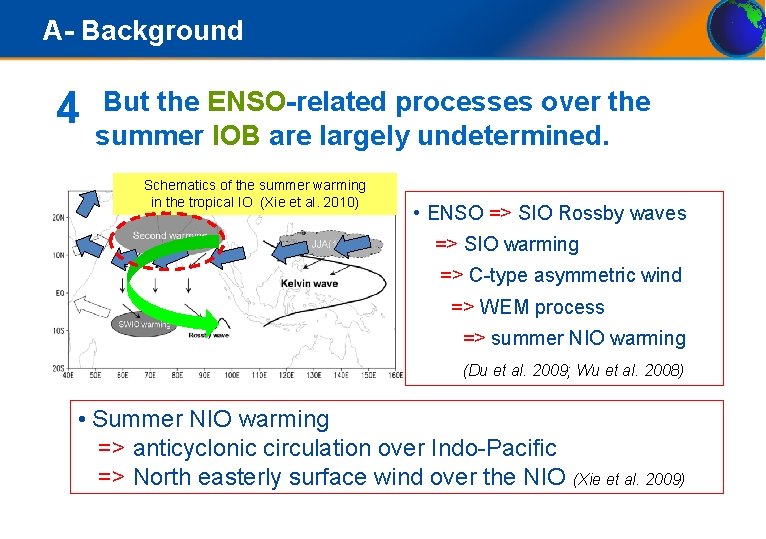
A- Background 4 But the ENSO-related processes over the summer IOB are largely undetermined. Schematics of the summer warming in the tropical IO (Xie et al. 2010) • ENSO => SIO Rossby waves => SIO warming => C-type asymmetric wind => WEM process => summer NIO warming (Du et al. 2009; Wu et al. 2008) • Summer NIO warming => anticyclonic circulation over Indo-Pacific => North easterly surface wind over the NIO (Xie et al. 2009)
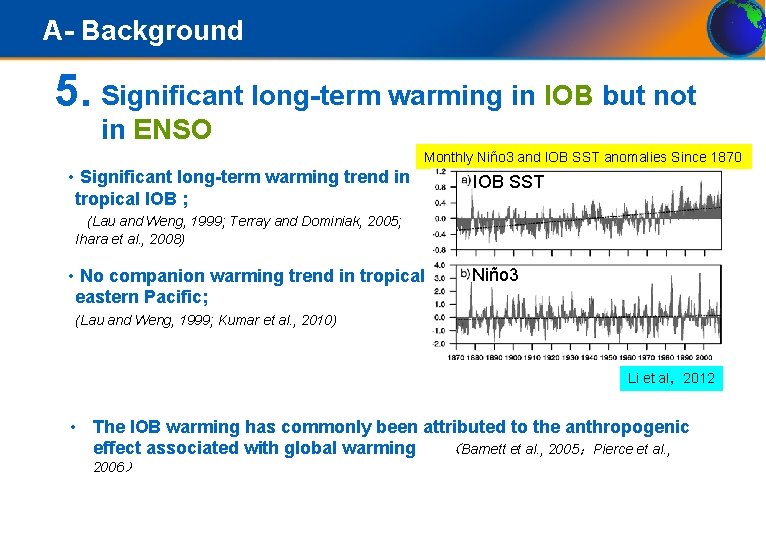
A- Background 5. Significant long-term warming in IOB but not in ENSO Monthly Niño 3 and IOB SST anomalies Since 1870 • Significant long-term warming trend in tropical IOB ; IOB SST (Lau and Weng, 1999; Terray and Dominiak, 2005; Ihara et al. , 2008) • No companion warming trend in tropical eastern Pacific; Niño 3 (Lau and Weng, 1999; Kumar et al. , 2010) Li et al,2012 • The IOB warming has commonly been attributed to the anthropogenic effect associated with global warming (Barnett et al. , 2005;Pierce et al. , 2006)
A- Background 6. Decadal changes of ENSO may have effects on the IOB • ENSO frequency becomes lower (Mantua et al. ,1997; An and Wang,2000) and ENSO amplitude becomes larger since 1970 s (Terray and Dominiak, 2005; Ihara et al. , 2008) ; • The relationship between ENSO and Indian Ocean SST is found stronger since 1970 s. (Xie et al. , 2010). • There exist epochal changes in the persistency of the El Niñorelated warmer SST over the North Indian Ocean (Chowdary et al. ,2012); • It is also not fully clear that “what have the decadal changes of ENSO particularly the delay of ENSO-decay resulted in for the IOB SST ? ”
B. Questions to address
B- Questions to address Ø How is the delay of ENSO-decay related to the IOB SST, in the Interannual and in decadal timescale? Ø How about the changes of the “atmosphericbridge” processes over the IOB due to the delay of ENSO-decay? Ø And their contributions to the SST changes over the summer IOB?
C. Data and method
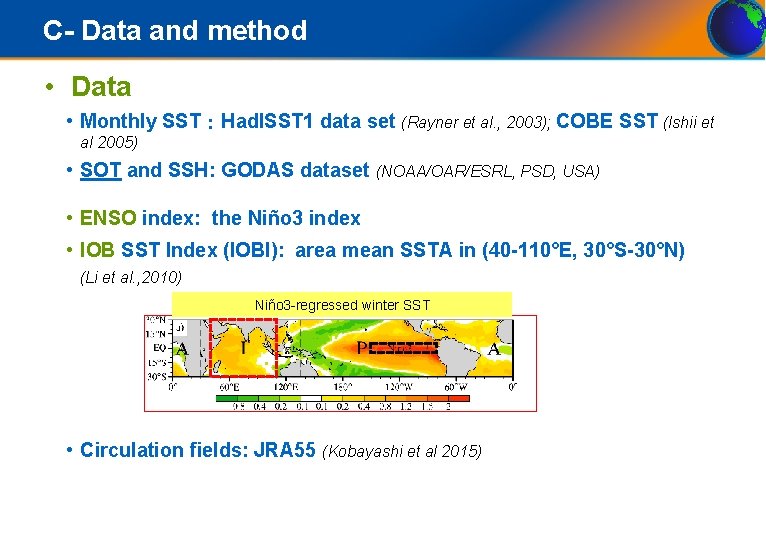
C- Data and method • Data • Monthly SST:Had. ISST 1 data set (Rayner et al. , 2003); COBE SST (Ishii et al 2005) • SOT and SSH: GODAS dataset (NOAA/OAR/ESRL, PSD, USA) • ENSO index: the Niño 3 index • IOB SST Index (IOBI): area mean SSTA in (40 -110°E, 30°S-30°N) (Li et al. , 2010) Niño 3 -regressed winter SST • Circulation fields: JRA 55 (Kobayashi et al 2015)
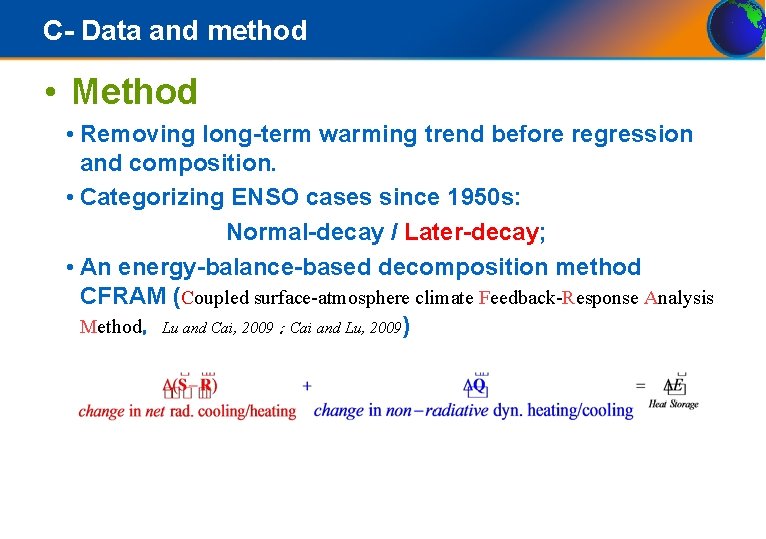
C- Data and method • Method • Removing long-term warming trend before regression and composition. • Categorizing ENSO cases since 1950 s: Normal-decay / Later-decay; • An energy-balance-based decomposition method CFRAM (Coupled surface-atmosphere climate Feedback-Response Analysis Method,Lu and Cai, 2009;Cai and Lu, 2009)
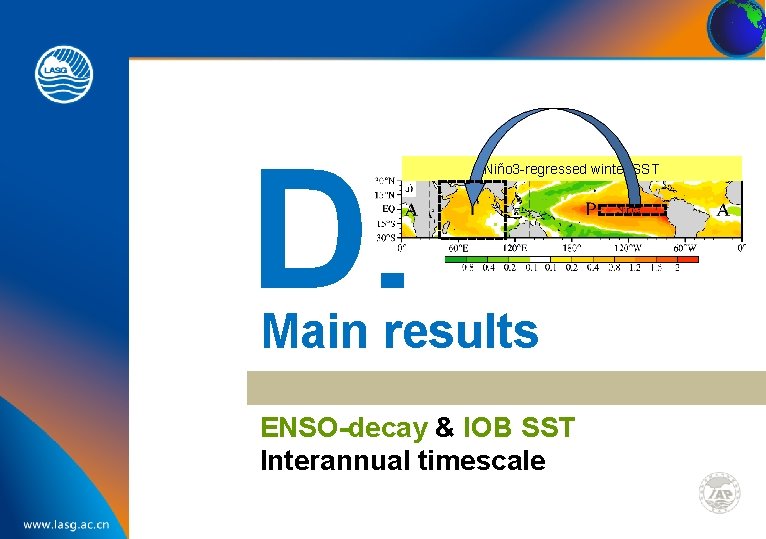
D. Niño 3 -regressed winter SST Main results ENSO-decay & IOB SST Interannual timescale
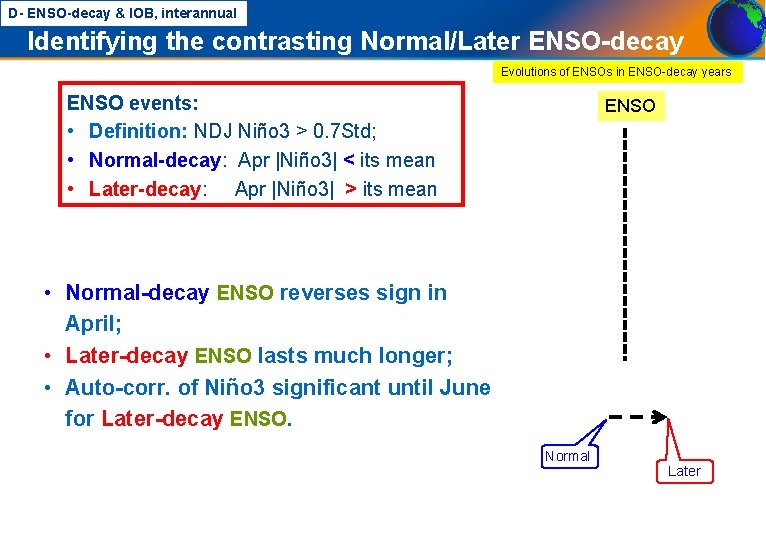
D- ENSO-decay & IOB, interannual Identifying the contrasting Normal/Later ENSO-decay Evolutions of ENSOs in ENSO-decay years ENSO events: • Definition: NDJ Niño 3 > 0. 7 Std; • Normal-decay: Apr |Niño 3| < its mean • Later-decay: Apr |Niño 3| > its mean ENSO • Normal-decay ENSO reverses sign in April; • Later-decay ENSO lasts much longer; • Auto-corr. of Niño 3 significant until June for Later-decay ENSO. Normal Later
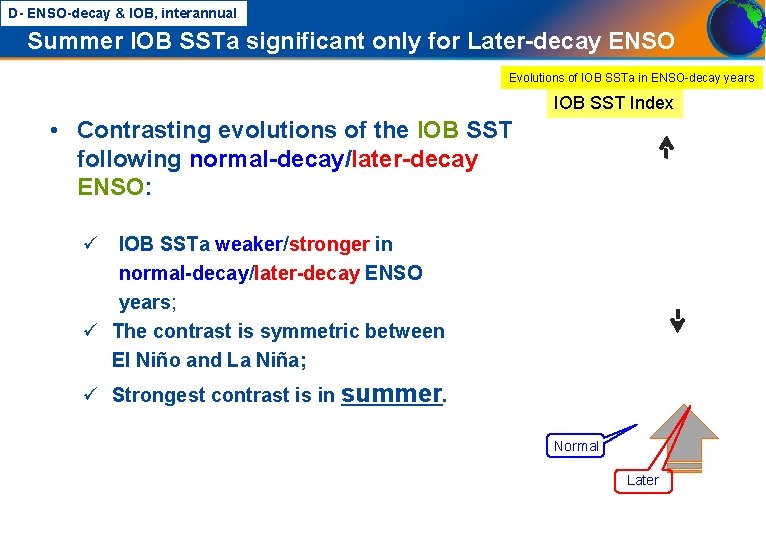
D- ENSO-decay & IOB, interannual Summer IOB SSTa significant only for Later-decay ENSO Evolutions of IOB SSTa in ENSO-decay years IOB SST Index • Contrasting evolutions of the IOB SST following normal-decay/later-decay ENSO: ü IOB SSTa weaker/stronger in normal-decay/later-decay ENSO years; ü The contrast is symmetric between El Niño and La Niña; ü Strongest contrast is in summer. Normal Later
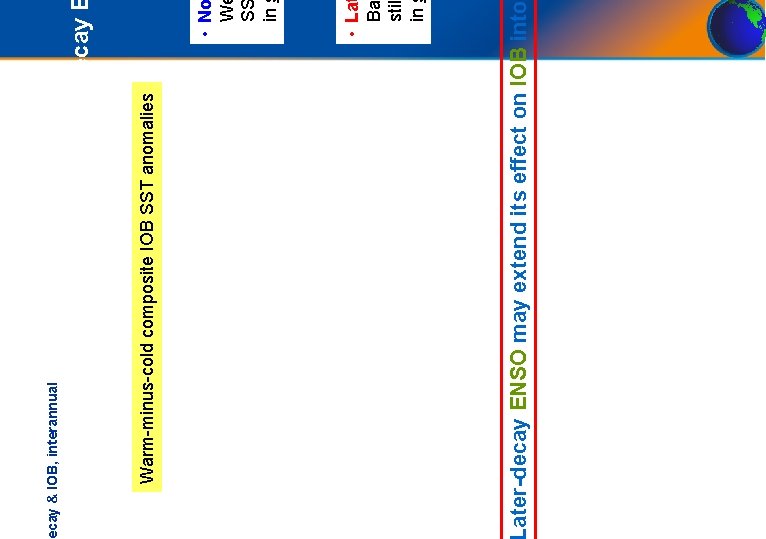
• La B sti in • N W S in ater-decay ENSO may extend its effect on IOB into Warm-minus-cold composite IOB SST anomalies er IOB SSTa significant only for Later-decay & IOB, interannual
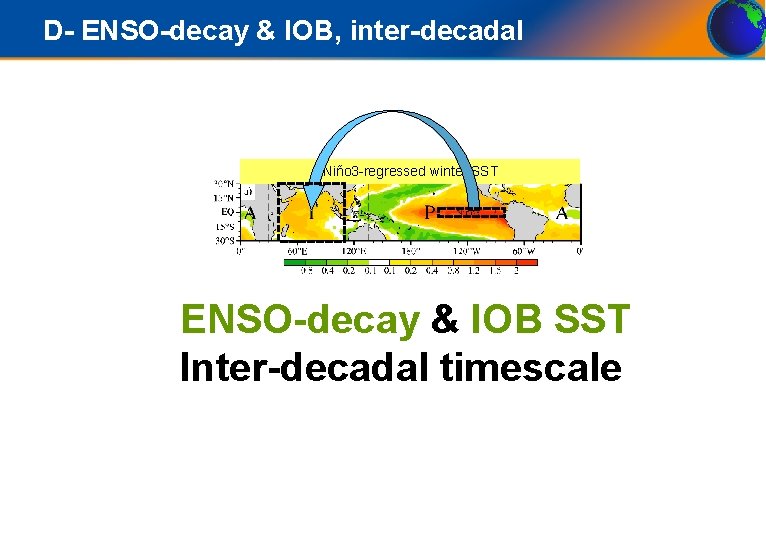
D- ENSO-decay & IOB, inter-decadal Niño 3 -regressed winter SST ENSO-decay & IOB SST Inter-decadal timescale
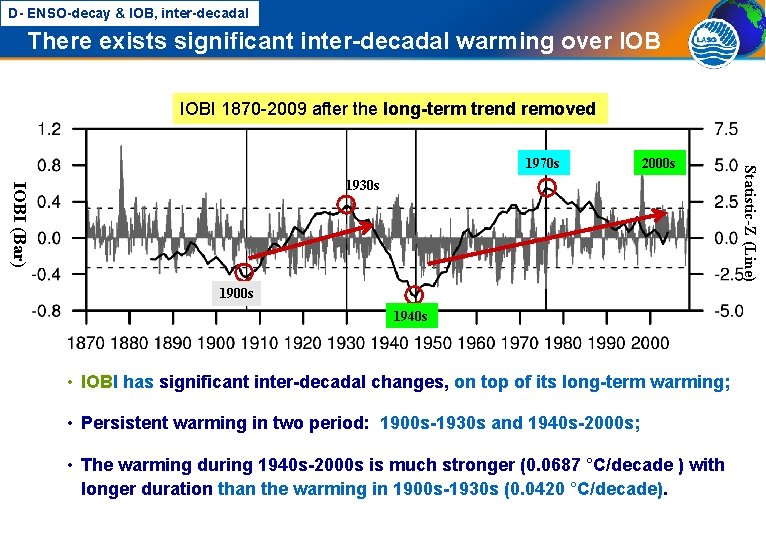
D- ENSO-decay & IOB, inter-decadal There exists significant inter-decadal warming over IOBI 1870 -2009 after the long-term trend removed 2000 s IOBI (Bar) 1930 s 1900 s 1940 s • IOBI has significant inter-decadal changes, on top of its long-term warming; • Persistent warming in two period: 1900 s-1930 s and 1940 s-2000 s; • The warming during 1940 s-2000 s is much stronger (0. 0687 °C/decade ) with longer duration than the warming in 1900 s-1930 s (0. 0420 °C/decade). Statistic-Z (Line) 1970 s
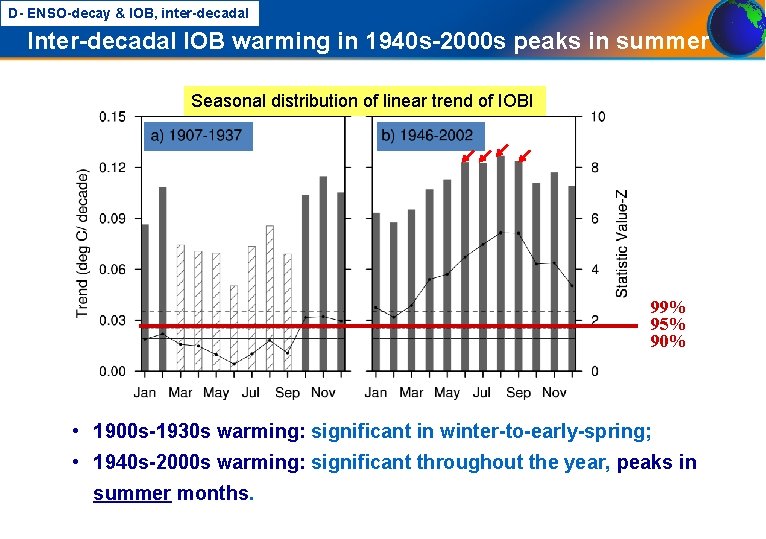
D- ENSO-decay & IOB, inter-decadal IOB warming in 1940 s-2000 s peaks in summer Inter-decadal summer IOB warming since 1970 s Seasonal distribution of linear trend of IOBI 99% 95% 90% • 1900 s-1930 s warming: significant in winter-to-early-spring; • 1940 s-2000 s warming: significant throughout the year, peaks in summer months.
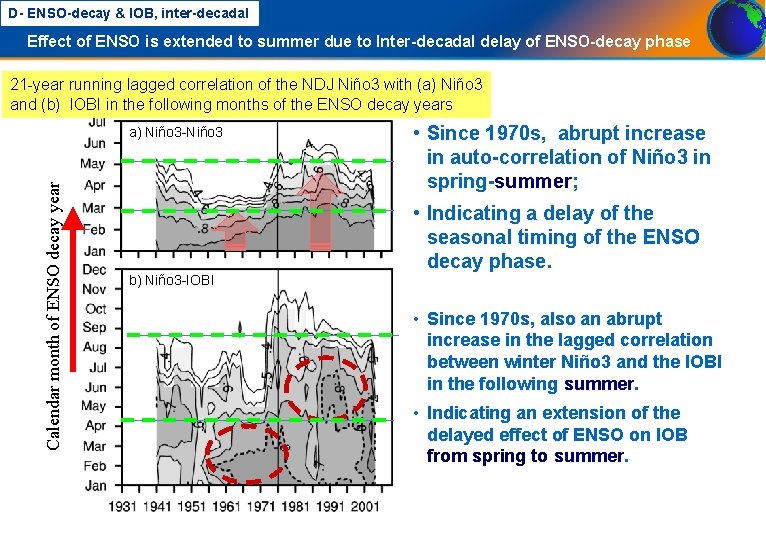
D- ENSO-decay & IOB, inter-decadal Effect of ENSO is extended to summer due to Inter-decadal delay of ENSO-decay phase 21 -year running lagged correlation of the NDJ Niño 3 with (a) Niño 3 and (b) IOBI in the following months of the ENSO decay years Calendar month of ENSO decay year a) Niño 3 -Niño 3 b) Niño 3 -IOBI • Since 1970 s, abrupt increase in auto-correlation of Niño 3 in spring-summer; • Indicating a delay of the seasonal timing of the ENSO decay phase. • Since 1970 s, also an abrupt increase in the lagged correlation between winter Niño 3 and the IOBI in the following summer. • Indicating an extension of the delayed effect of ENSO on IOB from spring to summer.
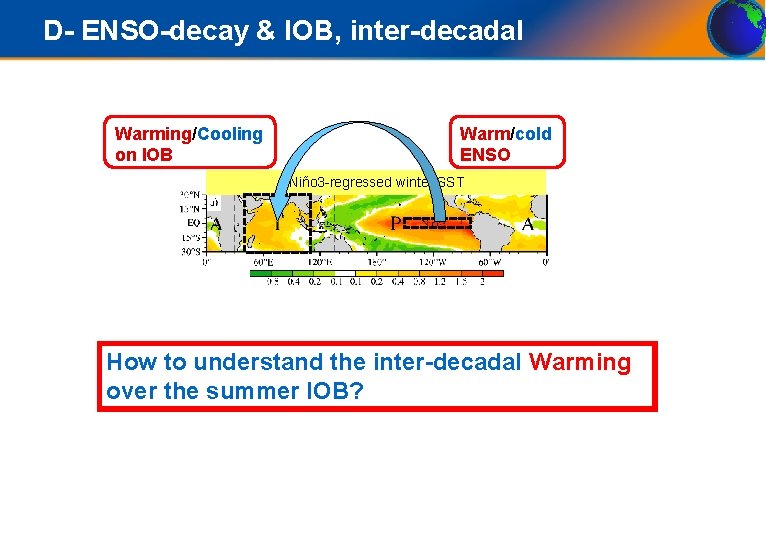
D- ENSO-decay & IOB, inter-decadal Warming/Cooling on IOB Warm/cold ENSO Niño 3 -regressed winter SST How to understand the inter-decadal Warming over the summer IOB?
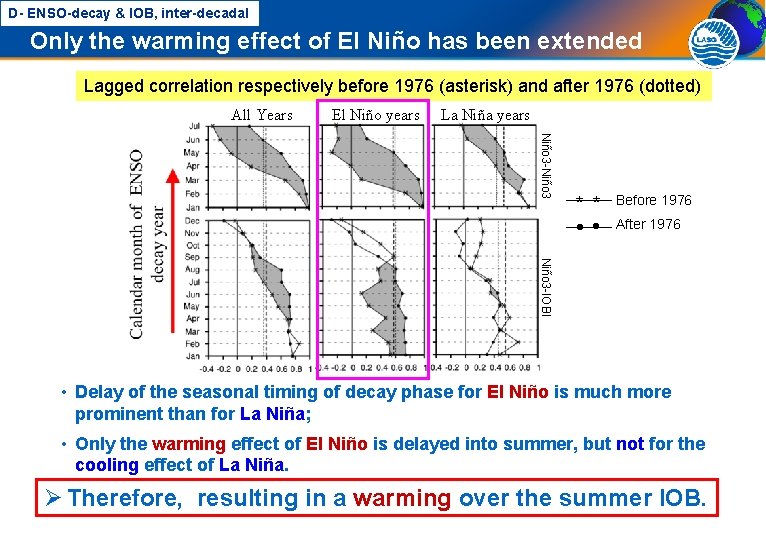
D- ENSO-decay & IOB, inter-decadal Only the warming effect of El Niño has been extended Lagged correlation respectively before 1976 (asterisk) and after 1976 (dotted) All Years El Niño years La Niña years Niño 3 -Niño 3 * * Before 1976 After 1976 Niño 3 -IOBI • Delay of the seasonal timing of decay phase for El Niño is much more prominent than for La Niña; • Only the warming effect of El Niño is delayed into summer, but not for the cooling effect of La Niña. Ø Therefore, resulting in a warming over the summer IOB.
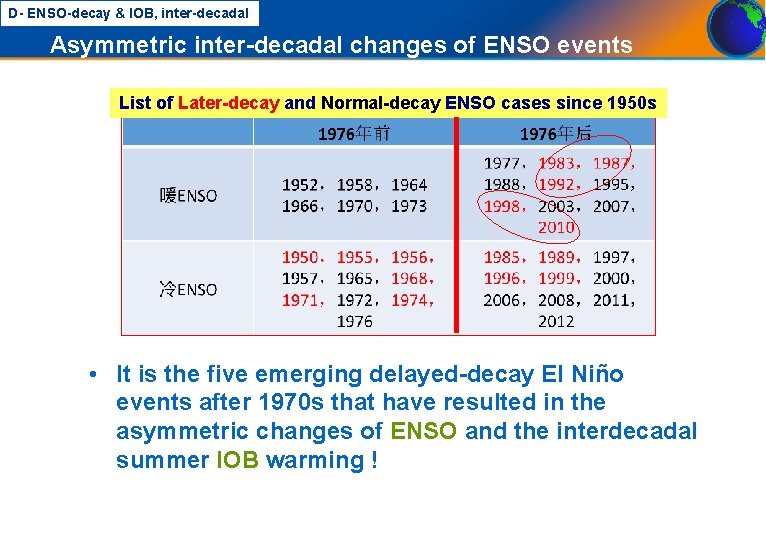
D- ENSO-decay & IOB, inter-decadal Asymmetric inter-decadal changes of ENSO events List of Later-decay and Normal-decay ENSO cases since 1950 s • It is the five emerging delayed-decay El Niño events after 1970 s that have resulted in the asymmetric changes of ENSO and the interdecadal summer IOB warming !
Wit -de All gged correlation before 1976 (asterisk) and after 1976 (dotted) The 5 delayed-decay El Niño events are crucial O-decay & IOB, inter-decadal
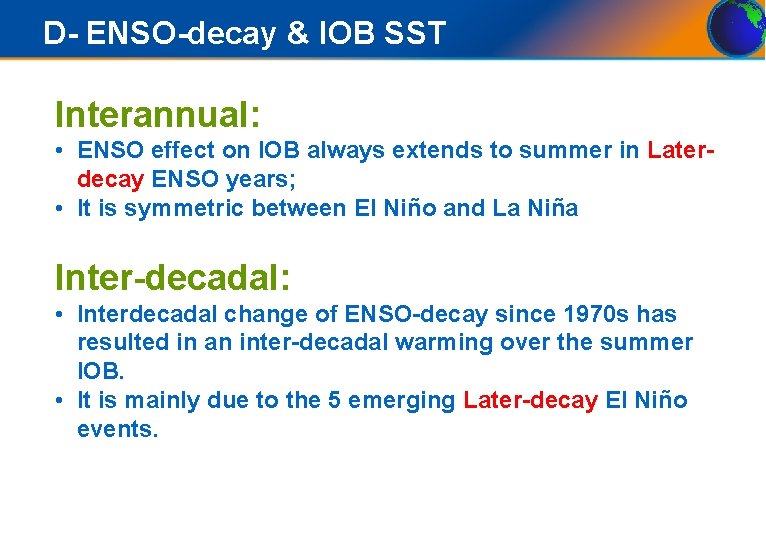
D- ENSO-decay & IOB SST Interannual: • ENSO effect on IOB always extends to summer in Laterdecay ENSO years; • It is symmetric between El Niño and La Niña Inter-decadal: • Interdecadal change of ENSO-decay since 1970 s has resulted in an inter-decadal warming over the summer IOB. • It is mainly due to the 5 emerging Later-decay El Niño events.
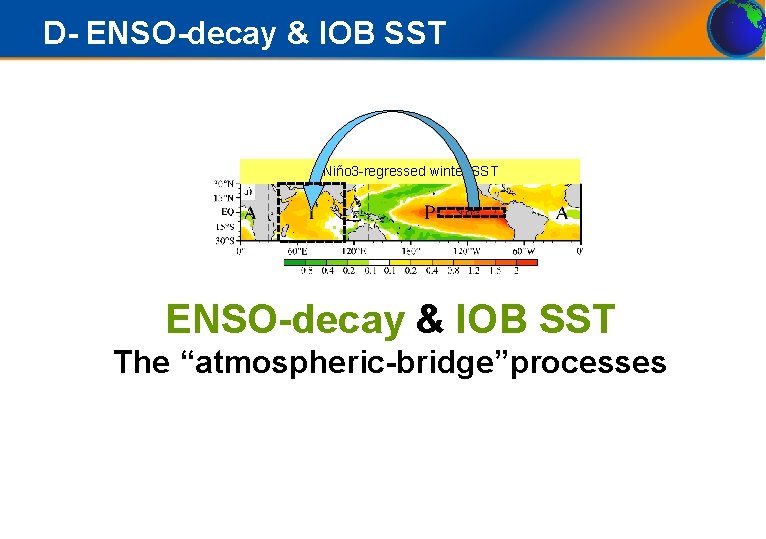
D- ENSO-decay & IOB SST Niño 3 -regressed winter SST ENSO-decay & IOB SST The “atmospheric-bridge”processes
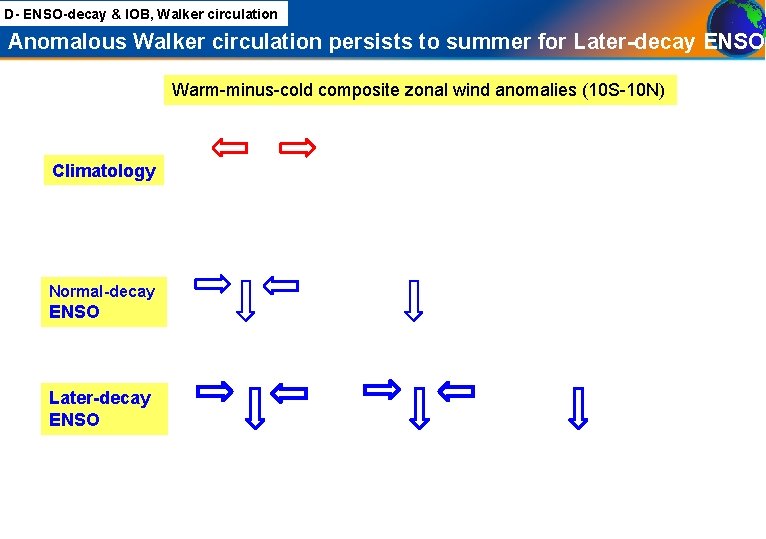
D- ENSO-decay & IOB, Walker circulation Anomalous Walker circulation persists to summer for Later-decay ENSO Warm-minus-cold composite zonal wind anomalies (10 S-10 N) Climatology Normal-decay ENSO Later-decay ENSO
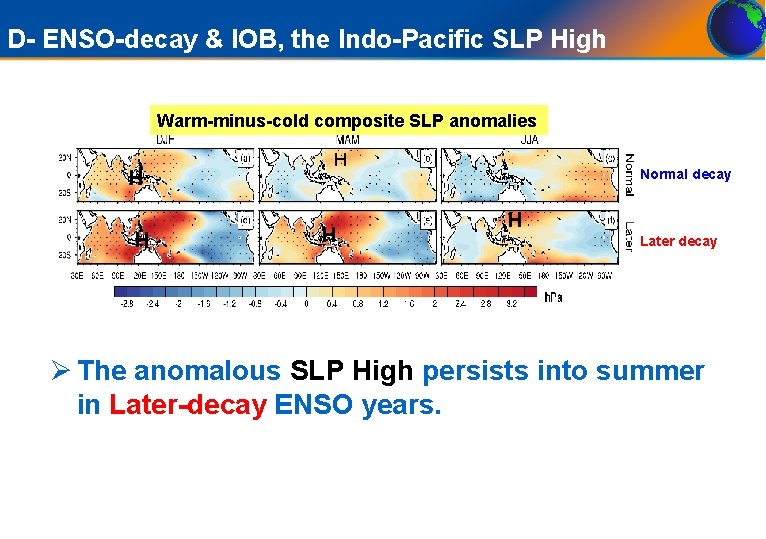
D- ENSO-decay & IOB, the Indo-Pacific SLP High Warm-minus-cold composite SLP anomalies H H Normal decay H Later decay Ø The anomalous SLP High persists into summer in Later-decay ENSO years.
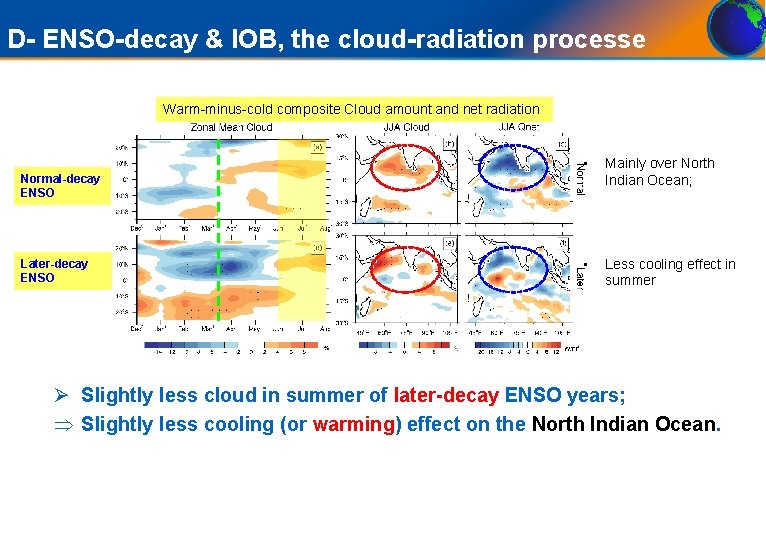
D- ENSO-decay & IOB, the cloud-radiation processe Warm-minus-cold composite Cloud amount and net radiation • Mainly over North Indian Ocean; • Less cooling effect in summer Normal-decay ENSO Later-decay ENSO Ø Slightly less cloud in summer of later-decay ENSO years; Slightly less cooling (or warming) effect on the North Indian Ocean.
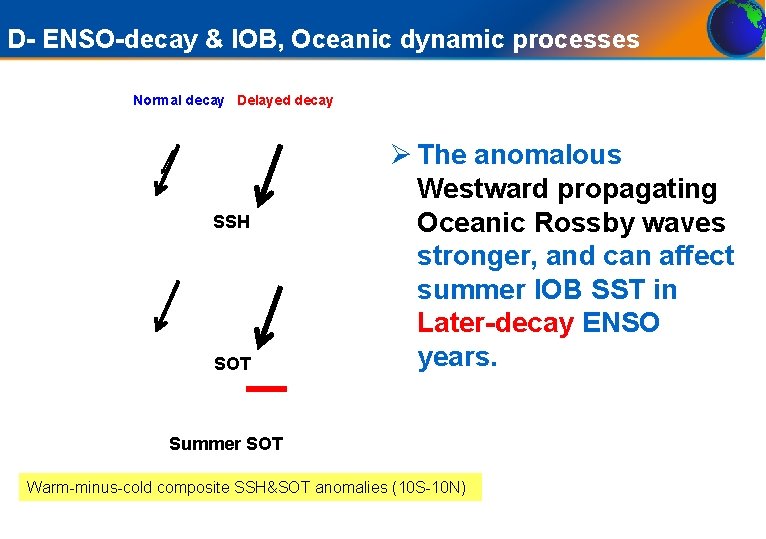
D- ENSO-decay & IOB, Oceanic dynamic processes Normal decay Delayed decay SSH SOT Ø The anomalous Westward propagating Oceanic Rossby waves stronger, and can affect summer IOB SST in Later-decay ENSO years. Summer SOT Warm-minus-cold composite SSH&SOT anomalies (10 S-10 N)
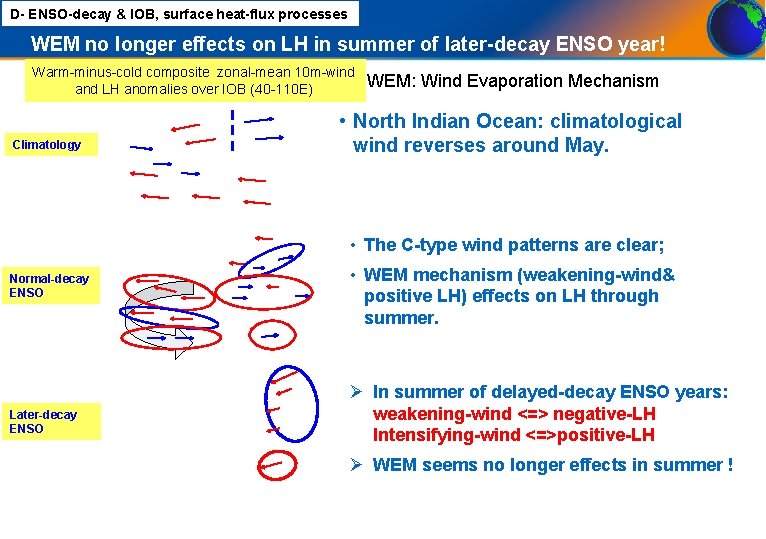
D- ENSO-decay & IOB, surface heat-flux processes WEM no longer effects on LH in summer of later-decay ENSO year! Warm-minus-cold composite zonal-mean 10 m-wind and LH anomalies over IOB (40 -110 E) Climatology WEM: Wind Evaporation Mechanism • North Indian Ocean: climatological wind reverses around May. • The C-type wind patterns are clear; Normal-decay ENSO Later-decay ENSO • WEM mechanism (weakening-wind& positive LH) effects on LH through summer. Ø In summer of delayed-decay ENSO years: weakening-wind <=> negative-LH Intensifying-wind <=>positive-LH Ø WEM seems no longer effects in summer !
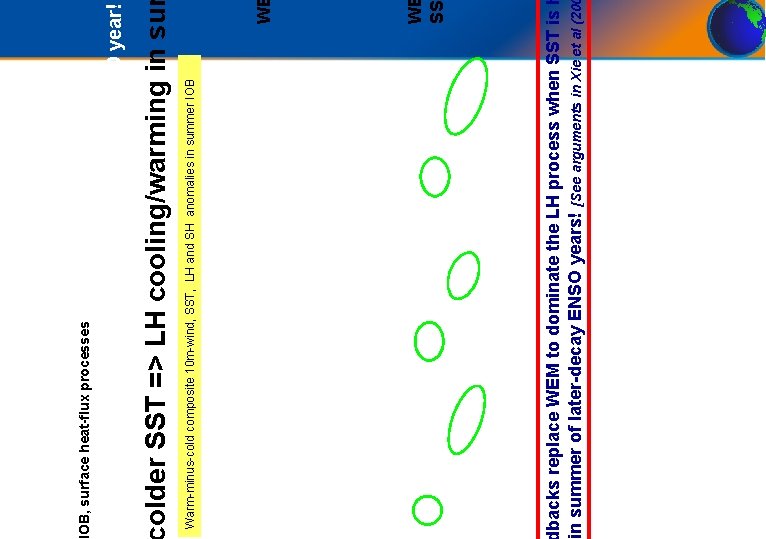
W S W backs replace WEM to dominate the LH process when SST is in summer of later-decay ENSO years! [See arguments in Xie et al (20 Warm-minus-cold composite 10 m-wind, SST, LH and SH anomalies in summer IOB older SST => LH cooling/warming in su nger effects on LH in summer of later-decay ENSO year! OB, surface heat-flux processes
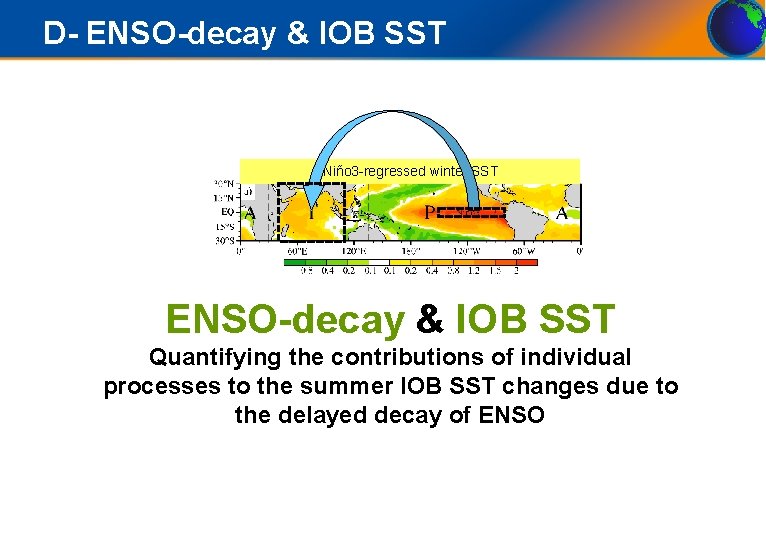
D- ENSO-decay & IOB SST Niño 3 -regressed winter SST ENSO-decay & IOB SST Quantifying the contributions of individual processes to the summer IOB SST changes due to the delayed decay of ENSO
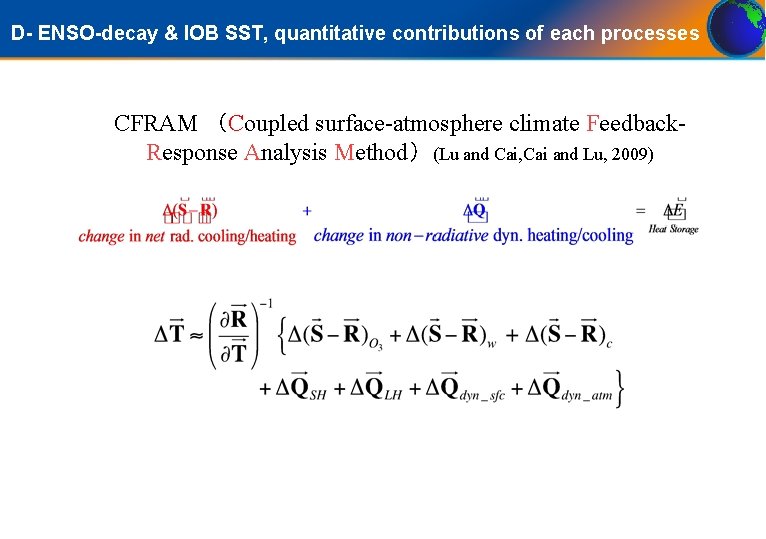
D- ENSO-decay & IOB SST, quantitative contributions of each processes CFRAM (Coupled surface-atmosphere climate Feedback. Response Analysis Method)(Lu and Cai, Cai and Lu, 2009)
• Individual non-radiative contributions much stronger, compensa another (Oceanic dynamics & LH+SH); • Generally the radiative processes (cloud, water vapor, ozone) ma contribute; non-radiative processes cool the IOB; ial contributions of radiative and non-radiative processes to the summer IOB SST war SO-decay & IOB SST, quantitative contributions of each
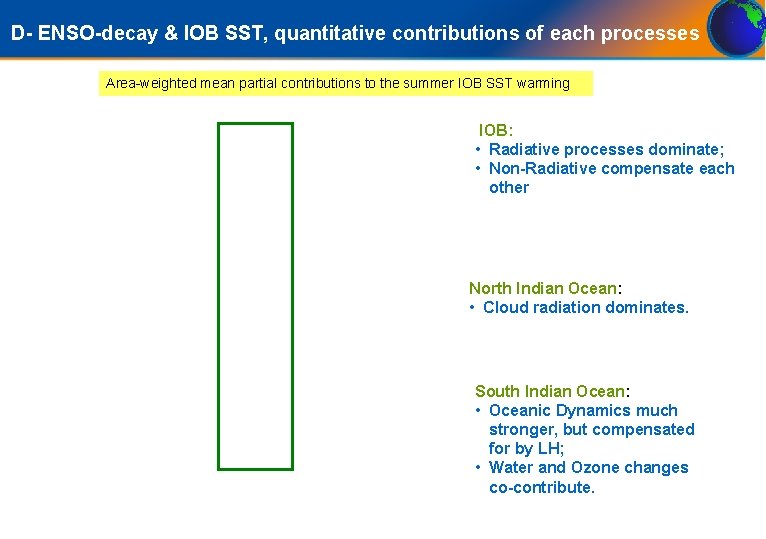
D- ENSO-decay & IOB SST, quantitative contributions of each processes Area-weighted mean partial contributions to the summer IOB SST warming IOB: • Radiative processes dominate; • Non-Radiative compensate each other North Indian Ocean: • Cloud radiation dominates. South Indian Ocean: • Oceanic Dynamics much stronger, but compensated for by LH; • Water and Ozone changes co-contribute.
E. Niño 3 -regressed winter SST Summary ENSO-decay & IOB SST
E- Summary • Later-decay of both El Niño and La Niña can extend their effects on IOB into summer; • The asymmetric changes of ENSO, or the 5 emerging Laterdecay El Niño events after 1970 s have resulted in the interdecadal warming over the summer IOB since 1970 s; • Most of the “atmospheric bridge” processes can extend to summer in Later-decay ENSO years, but WEM no longer contributes to LH because of the highly warmer SST then; • The extended radiative processes generally dominate the IOB SST changes due to Later-decay of ENSO, though the effect of the oceanic dynamic processes is the strongest which is however compensated for by surface heat-fluxes.
(rrc@lasg. iap. ac. cn) • Ren* R. -C. , SY Sun, Y. Yang and Q. Li, 2016: Summer SST anomalies in the Indian Ocean and the Seasonal timing of ENSO decay phase, Climate Dynamics, DOI: 10. 1007/s 00382 -015 -2935 -0. • Li, Qian, R. -C. Ren*, M. Cai and G. X. Wu, 2012: Attribution of the summer warming since 1970 s in Indian Ocean Basin to the inter-decadal change in the seasonal timing of El Niño decay phase, Geophys. Res. Lett. , VOL. 39, L 12702, 5 PP. , 2012, doi: 10. 1029/2012 GL 052150.
- Slides: 41