
Linkage Analysis and Mapping Three point crosses mapping
- Slides: 26
Linkage Analysis and Mapping Three point crosses • mapping • strategy • examples Mapping human genes
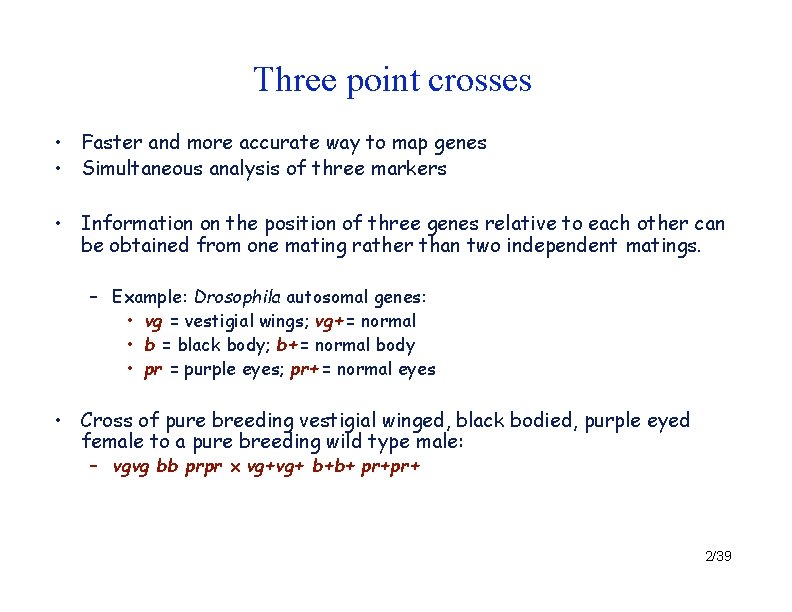
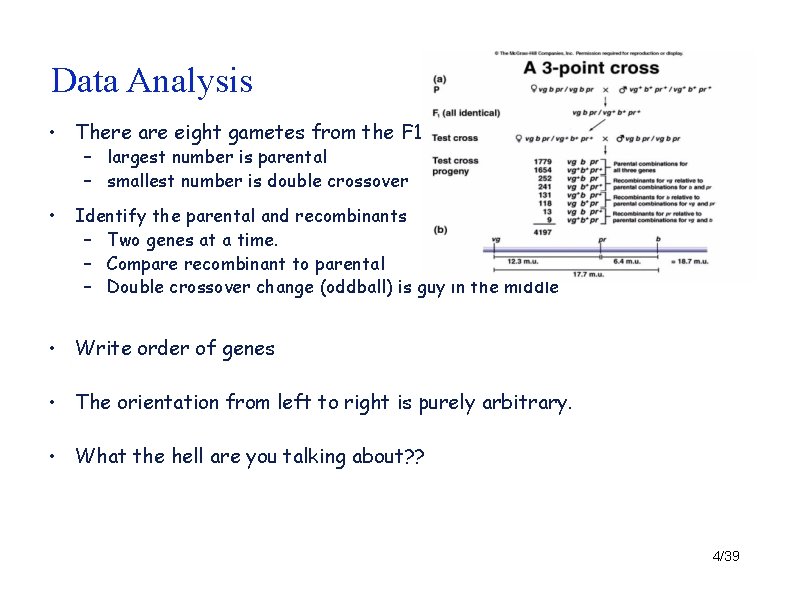
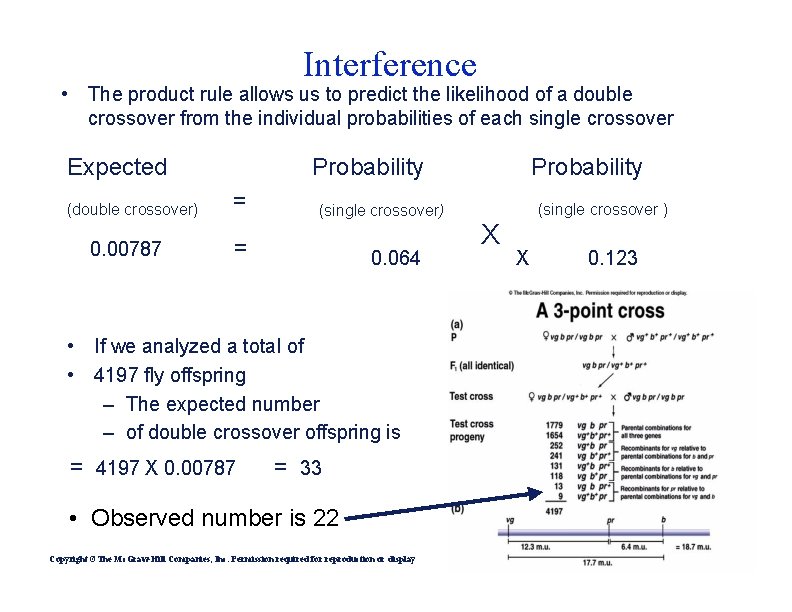
Three point crosses • Faster and more accurate way to map genes • Simultaneous analysis of three markers • Information on the position of three genes relative to each other can be obtained from one mating rather than two independent matings. – Example: Drosophila autosomal genes: • vg = vestigial wings; vg+ = normal • b = black body; b+ = normal body • pr = purple eyes; pr+ = normal eyes • Cross of pure breeding vestigial winged, black bodied, purple eyed female to a pure breeding wild type male: – vgvg bb prpr x vg+vg+ b+b+ pr+pr+ 2/39
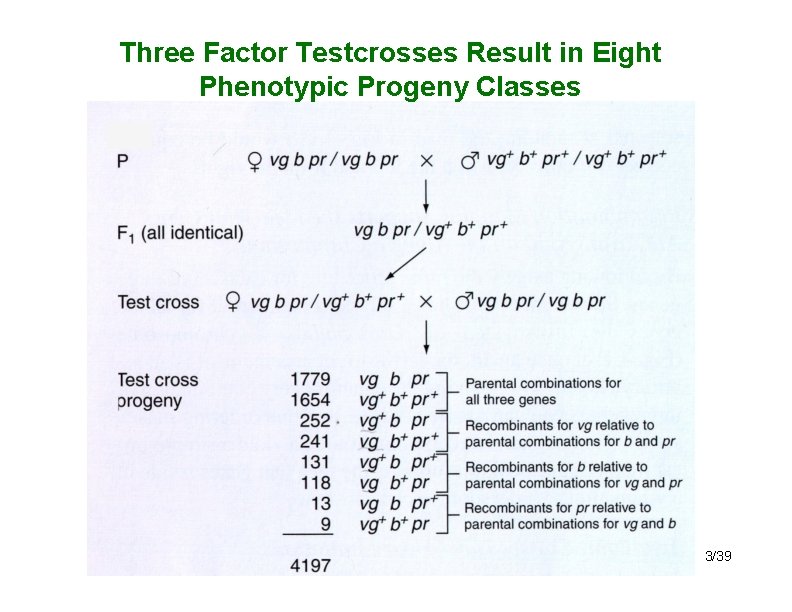
Three Factor Testcrosses Result in Eight Phenotypic Progeny Classes 3/39
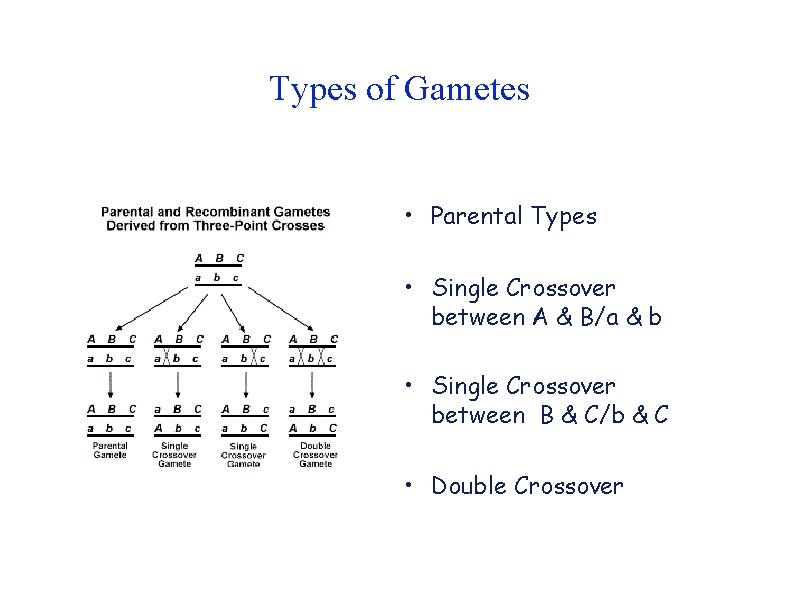
Types of Gametes • Parental Types • Single Crossover between A & B/a & b • Single Crossover between B & C/b & C • Double Crossover
Data Analysis • There are eight gametes from the F 1 – largest number is parental – smallest number is double crossover • Identify the parental and recombinants – Two genes at a time. – Compare recombinant to parental – Double crossover change (oddball) is guy in the middle • Write order of genes • The orientation from left to right is purely arbitrary. • What the hell are you talking about? ? 4/39
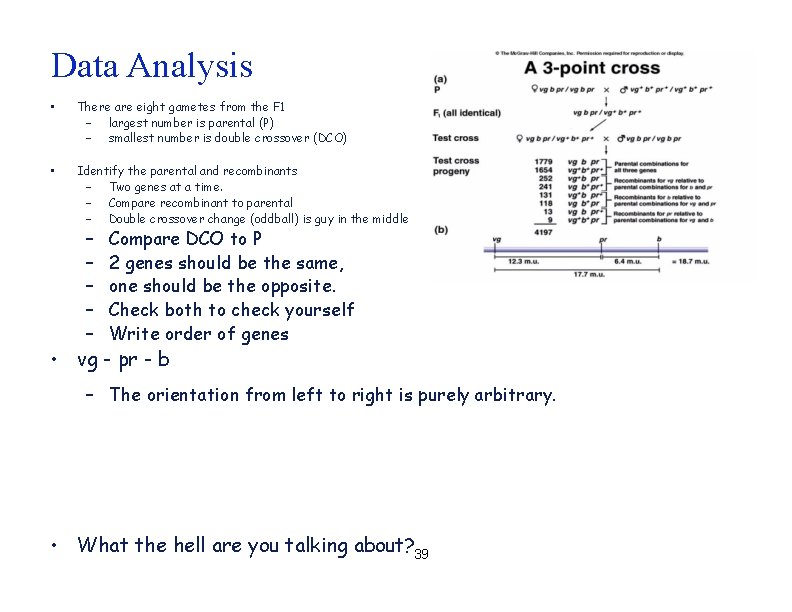
Data Analysis • There are eight gametes from the F 1 – largest number is parental (P) – smallest number is double crossover (DCO) • Identify the parental and recombinants – Two genes at a time. – Compare recombinant to parental – Double crossover change (oddball) is guy in the middle – – – Compare DCO to P 2 genes should be the same, one should be the opposite. Check both to check yourself Write order of genes • vg - pr - b – The orientation from left to right is purely arbitrary. • What the hell are you talking about? 39
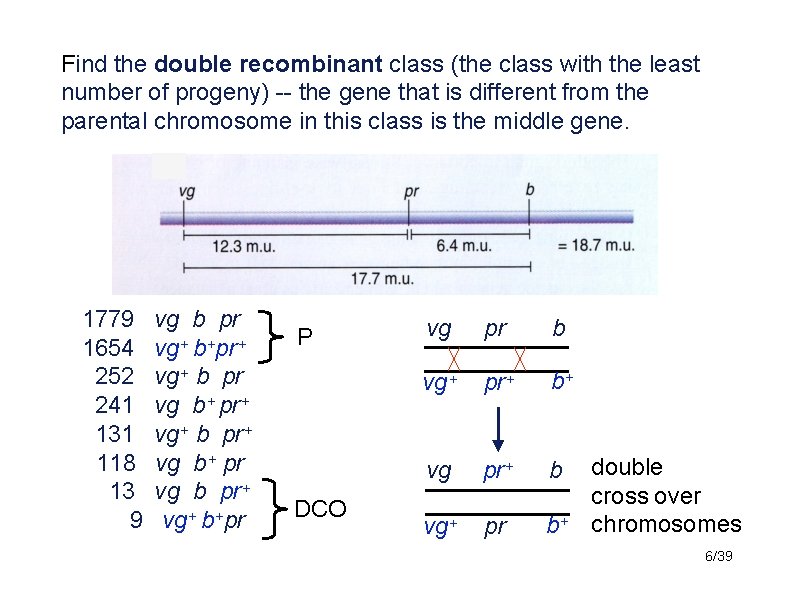
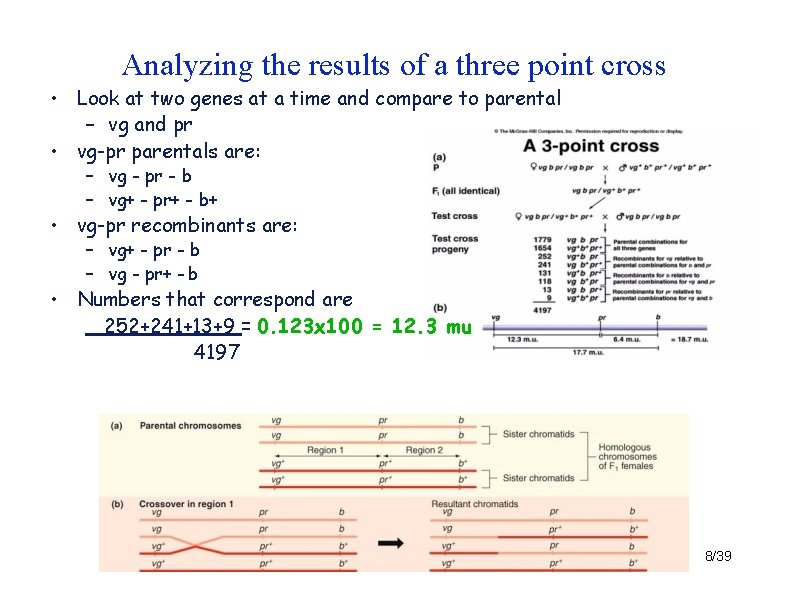
Find the double recombinant class (the class with the least number of progeny) -- the gene that is different from the parental chromosome in this class is the middle gene. 1779 1654 252 241 131 118 13 9 vg b pr vg+ b+pr+ vg+ b pr vg b+ pr+ vg+ b pr+ vg b+ pr vg b pr+ vg+ b+pr P DCO vg pr b vg+ pr+ b+ vg pr+ b vg+ pr b+ double cross over chromosomes 6/39
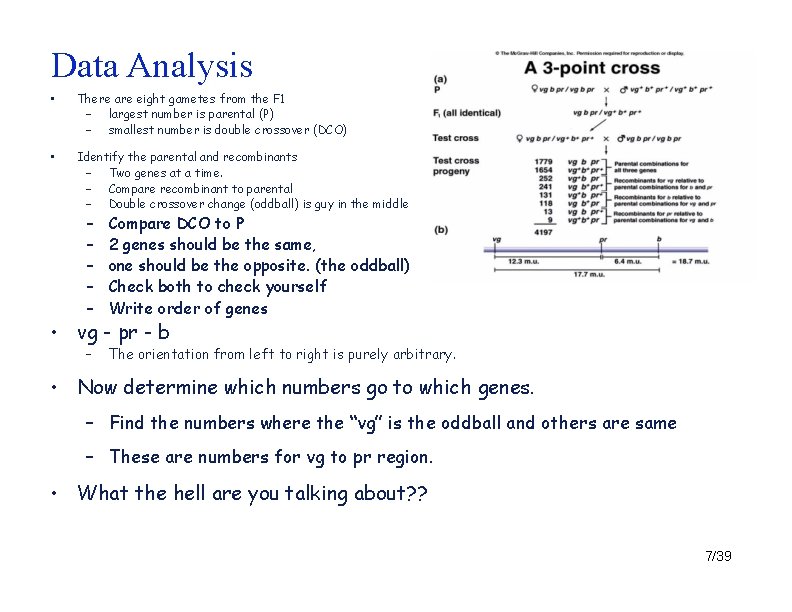
Data Analysis • There are eight gametes from the F 1 – largest number is parental (P) – smallest number is double crossover (DCO) • Identify the parental and recombinants – Two genes at a time. – Compare recombinant to parental – Double crossover change (oddball) is guy in the middle – – – Compare DCO to P 2 genes should be the same, one should be the opposite. (the oddball) Check both to check yourself Write order of genes – The orientation from left to right is purely arbitrary. • vg - pr - b • Now determine which numbers go to which genes. – Find the numbers where the “vg” is the oddball and others are same – These are numbers for vg to pr region. • What the hell are you talking about? ? 7/39
Analyzing the results of a three point cross • Look at two genes at a time and compare to parental – vg and pr • vg-pr parentals are: – vg - pr - b – vg+ - pr+ - b+ • vg-pr recombinants are: – vg+ - pr - b – vg - pr+ - b • Numbers that correspond are 252+241+13+9 = 0. 123 x 100 = 12. 3 mu 4197 8/39
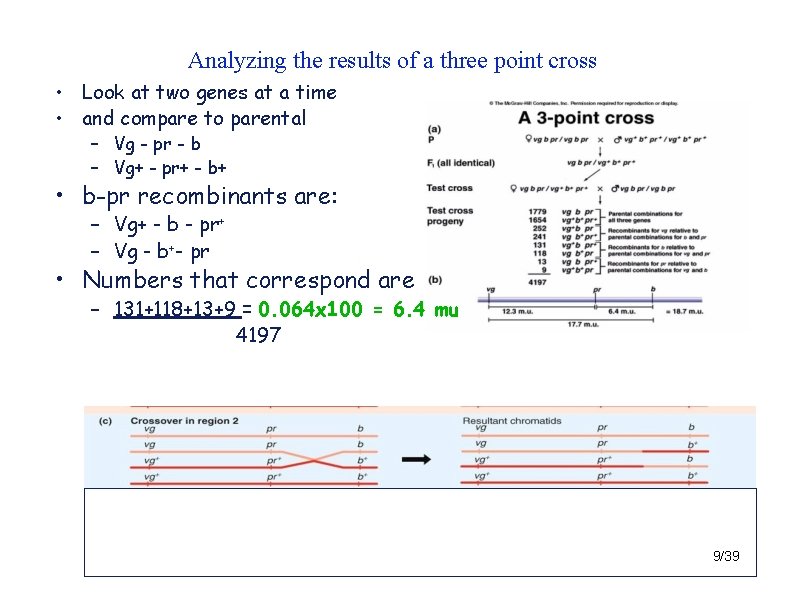
Analyzing the results of a three point cross • Look at two genes at a time • and compare to parental – Vg - pr - b – Vg+ - pr+ - b+ • b-pr recombinants are: – Vg+ - b - pr+ – Vg - b+- pr • Numbers that correspond are – 131+118+13+9 = 0. 064 x 100 = 6. 4 mu 4197 9/39
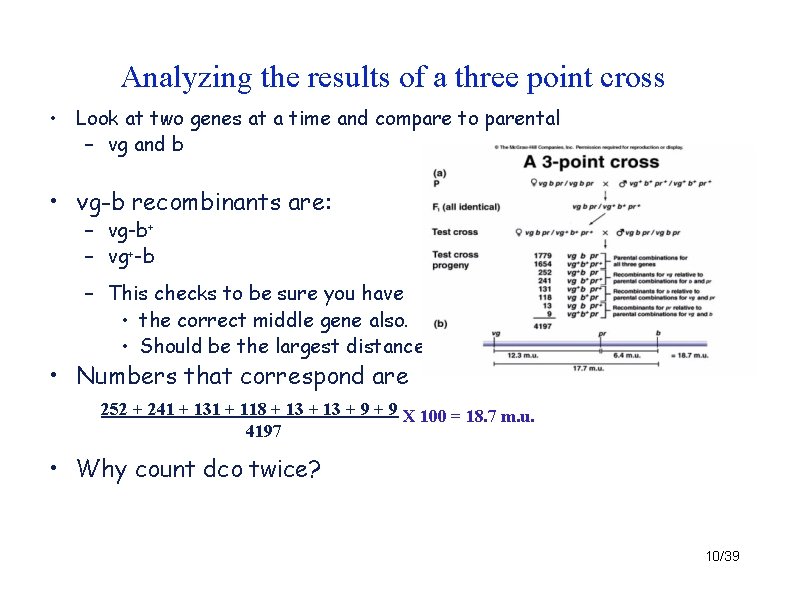
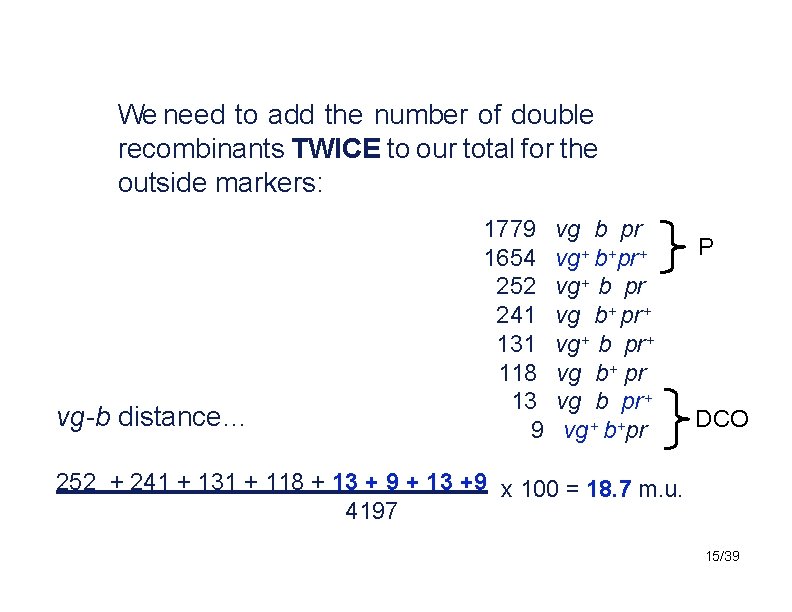
Analyzing the results of a three point cross • Look at two genes at a time and compare to parental – vg and b • vg-b recombinants are: – vg-b+ – vg+-b – This checks to be sure you have • the correct middle gene also. • Should be the largest distance …. • Numbers that correspond are 252 + 241 + 131 + 118 + 13 + 9 X 100 = 18. 7 m. u. 4197 • Why count dco twice? 10/39
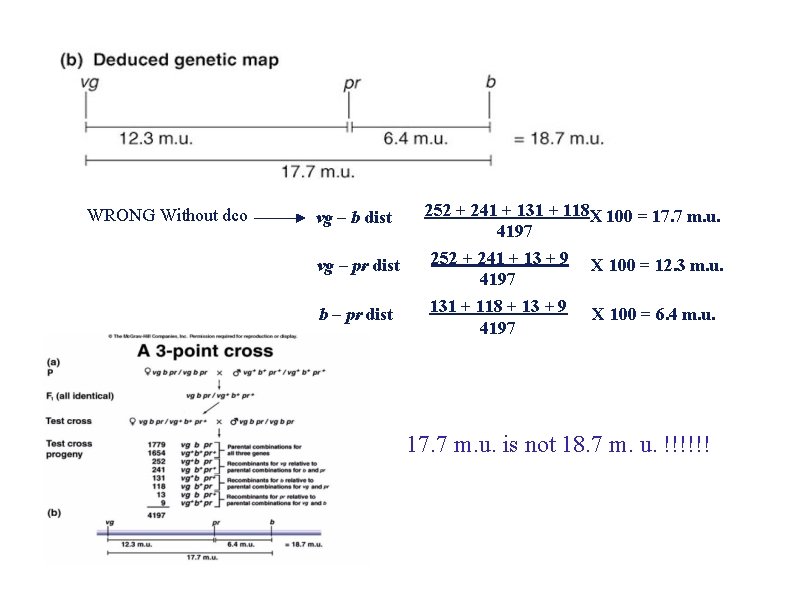
WRONG Without dco vg – b dist vg – pr dist b – pr dist 252 + 241 + 131 + 118 X 100 = 17. 7 m. u. 4197 252 + 241 + 13 + 9 X 100 = 12. 3 m. u. 4197 131 + 118 + 13 + 9 4197 X 100 = 6. 4 m. u. 17. 7 m. u. is not 18. 7 m. u. !!!!!!
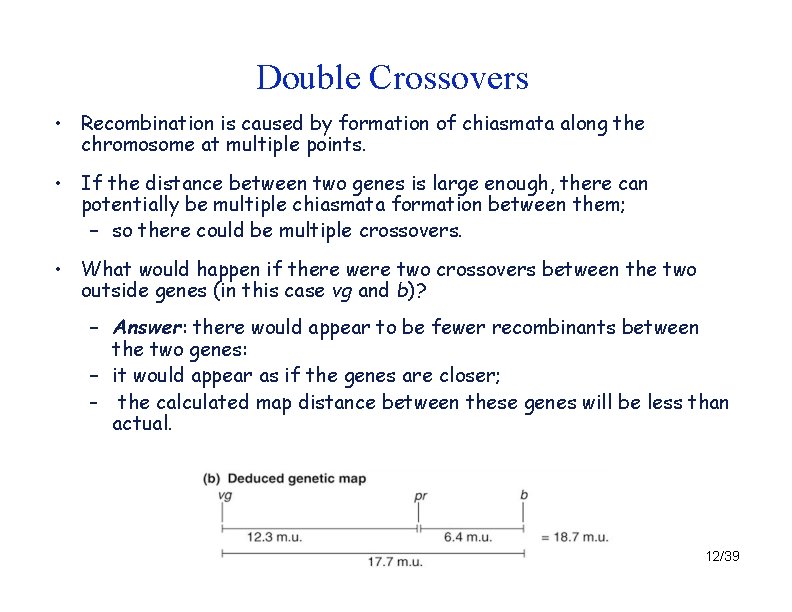
Double Crossovers • Recombination is caused by formation of chiasmata along the chromosome at multiple points. • If the distance between two genes is large enough, there can potentially be multiple chiasmata formation between them; – so there could be multiple crossovers. • What would happen if there were two crossovers between the two outside genes (in this case vg and b)? – Answer: there would appear to be fewer recombinants between the two genes: – it would appear as if the genes are closer; – the calculated map distance between these genes will be less than actual. 12/39
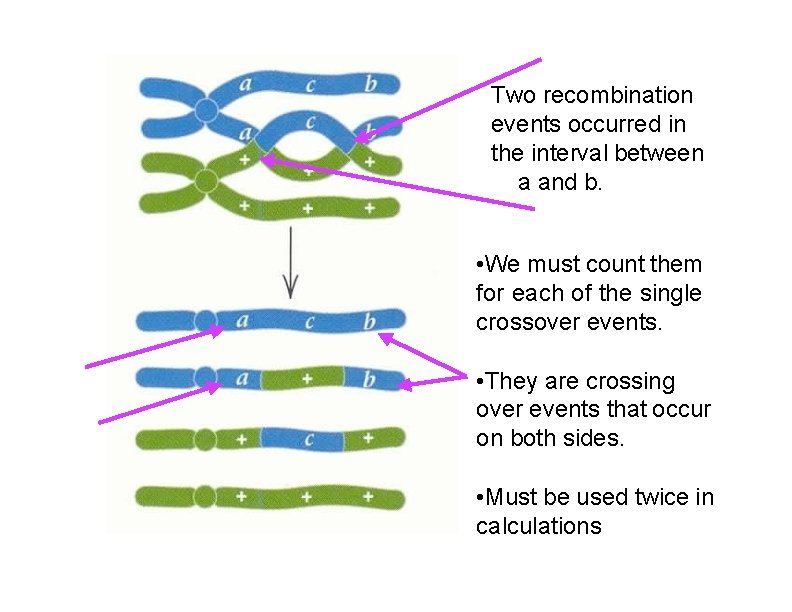
Two recombination events occurred in the interval between a and b. • We must count them for each of the single crossover events. • They are crossing over events that occur on both sides. • Must be used twice in calculations
We need to add the number of double recombinants TWICE to our total for the outside markers: vg-b distance… 1779 1654 252 241 131 118 13 9 vg b pr vg+ b+pr+ vg+ b pr vg b+ pr+ vg+ b pr+ vg b+ pr vg b pr+ vg+ b+pr P DCO 252 + 241 + 131 + 118 + 13 + 9 + 13 +9 x 100 = 18. 7 m. u. 4197 15/39
Question • Which type of class would you expect to account for the lowest frequency? 1) Parental 2) Single Recombinants 3) Double Recombinants 4) Middle class
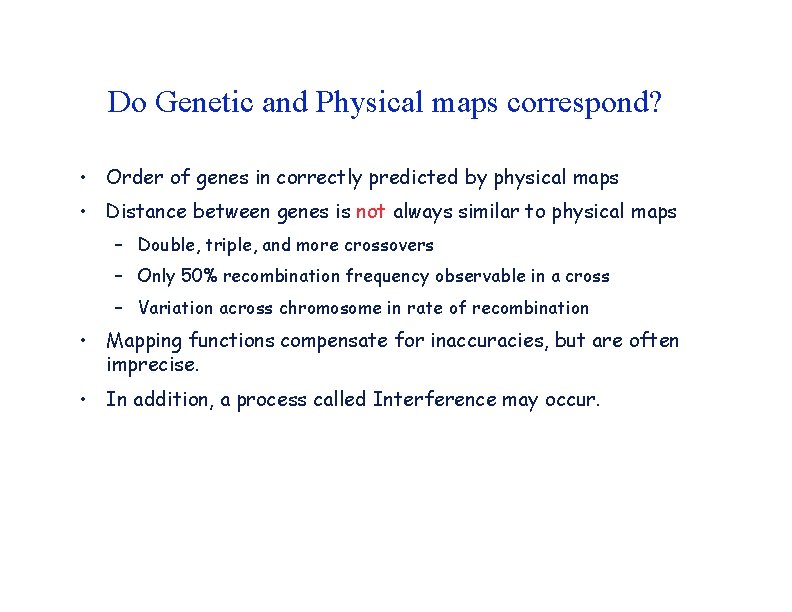
Do Genetic and Physical maps correspond? • Order of genes in correctly predicted by physical maps • Distance between genes is not always similar to physical maps – Double, triple, and more crossovers – Only 50% recombination frequency observable in a cross – Variation across chromosome in rate of recombination • Mapping functions compensate for inaccuracies, but are often imprecise. • In addition, a process called Interference may occur.
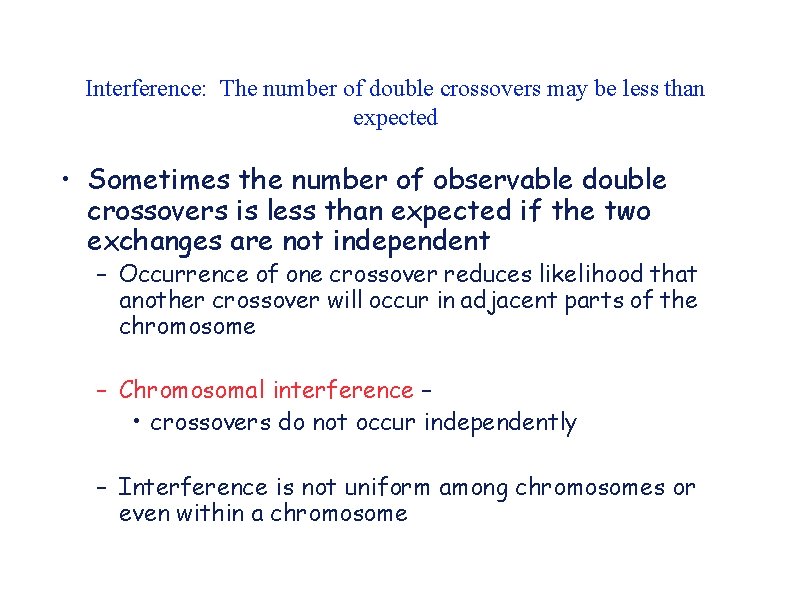
Interference: The number of double crossovers may be less than expected • Sometimes the number of observable double crossovers is less than expected if the two exchanges are not independent – Occurrence of one crossover reduces likelihood that another crossover will occur in adjacent parts of the chromosome – Chromosomal interference – • crossovers do not occur independently – Interference is not uniform among chromosomes or even within a chromosome
Interference • The product rule allows us to predict the likelihood of a double crossover from the individual probabilities of each single crossover Expected (double crossover) 0. 00787 Probability = (single crossover) = 0. 064 • If we analyzed a total of • 4197 fly offspring – The expected number – of double crossover offspring is = 4197 X 0. 00787 = 33 • Observed number is 22 Copyright ©The Mc. Graw-Hill Companies, Inc. Permission required for reproduction or display (single crossover ) X X 0. 123
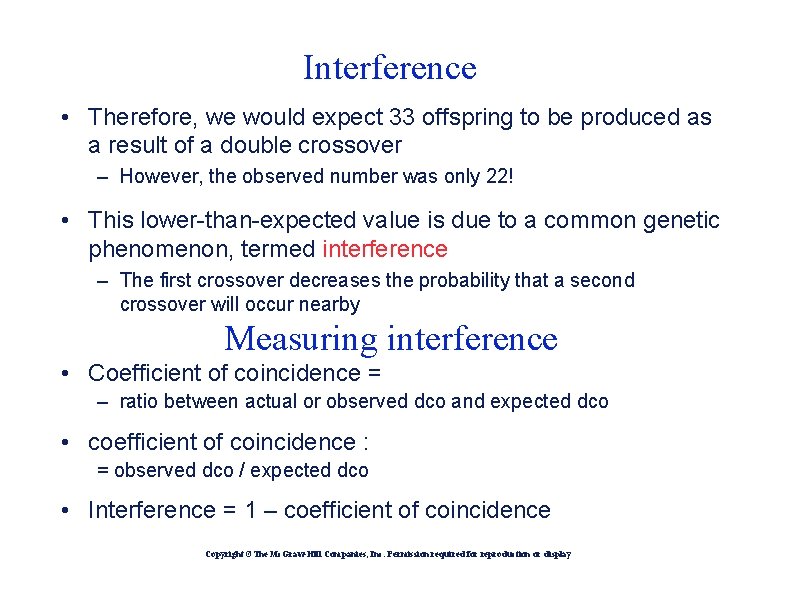
Interference • Therefore, we would expect 33 offspring to be produced as a result of a double crossover – However, the observed number was only 22! • This lower-than-expected value is due to a common genetic phenomenon, termed interference – The first crossover decreases the probability that a second crossover will occur nearby Measuring interference • Coefficient of coincidence = – ratio between actual or observed dco and expected dco • coefficient of coincidence : = observed dco / expected dco • Interference = 1 – coefficient of coincidence Copyright ©The Mc. Graw-Hill Companies, Inc. Permission required for reproduction or display
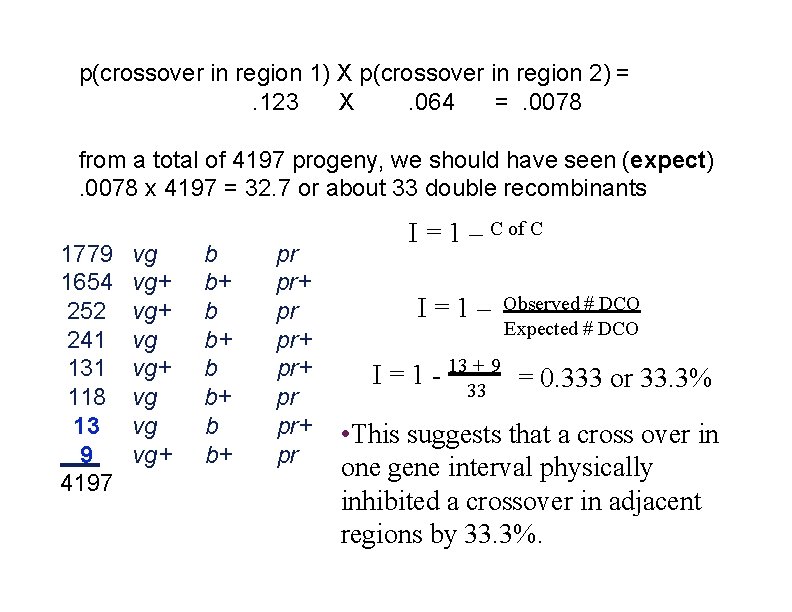
p(crossover in region 1) X p(crossover in region 2) =. 123 X. 064 =. 0078 from a total of 4197 progeny, we should have seen (expect). 0078 x 4197 = 32. 7 or about 33 double recombinants 1779 1654 252 241 131 118 13 9 4197 vg vg+ vg vg vg+ b b+ pr pr+ pr I = 1 – C of C I=1– Observed # DCO Expected # DCO I = 1 - 1333+ 9 = 0. 333 or 33. 3% • This suggests that a cross over in one gene interval physically inhibited a crossover in adjacent regions by 33. 3%.
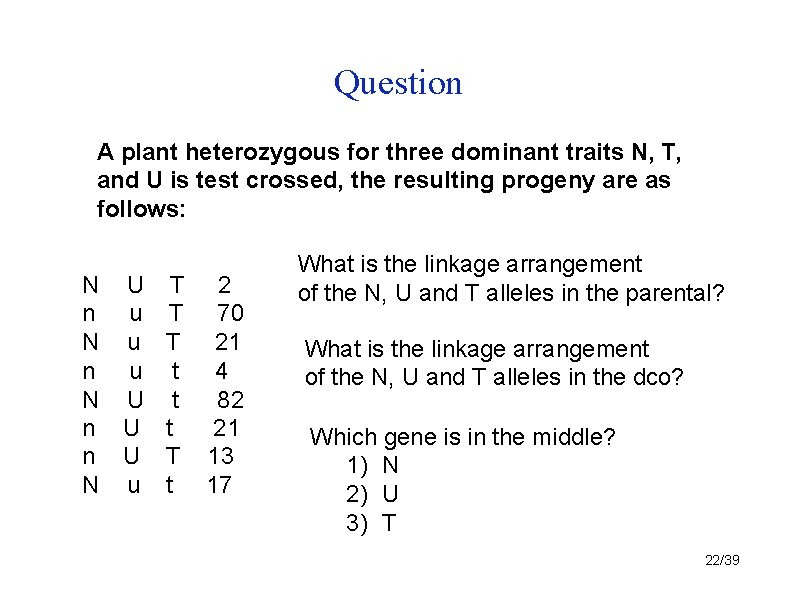
Question A plant heterozygous for three dominant traits N, T, and U is test crossed, the resulting progeny are as follows: N U n u N u n u N U n U N u T 2 T 70 T 21 t 4 t 82 t 21 T 13 t 17 What is the linkage arrangement of the N, U and T alleles in the parental? What is the linkage arrangement of the N, U and T alleles in the dco? Which gene is in the middle? 1) N 2) U 3) T 22/39
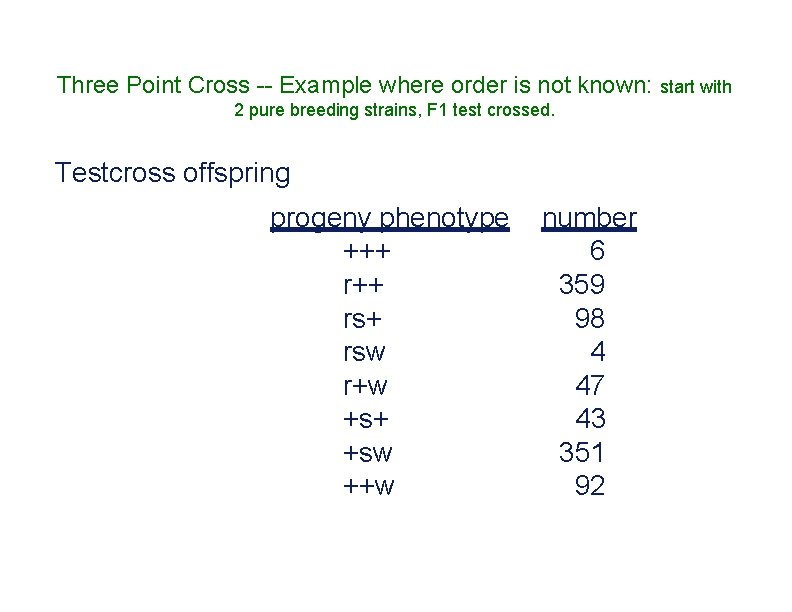
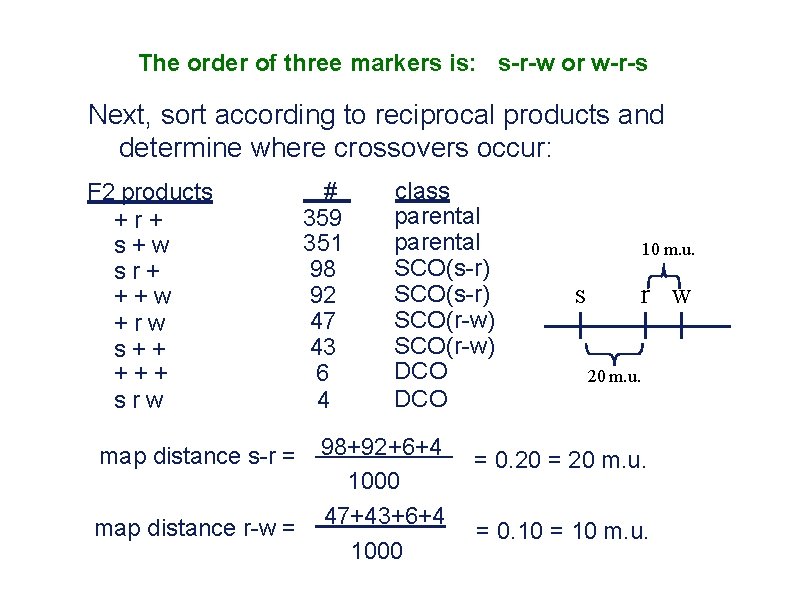
Three Point Cross -- Example where order is not known: start with 2 pure breeding strains, F 1 test crossed. Testcross offspring progeny phenotype +++ rs+ rsw r+w +s+ +sw ++w number 6 359 98 4 47 43 351 92
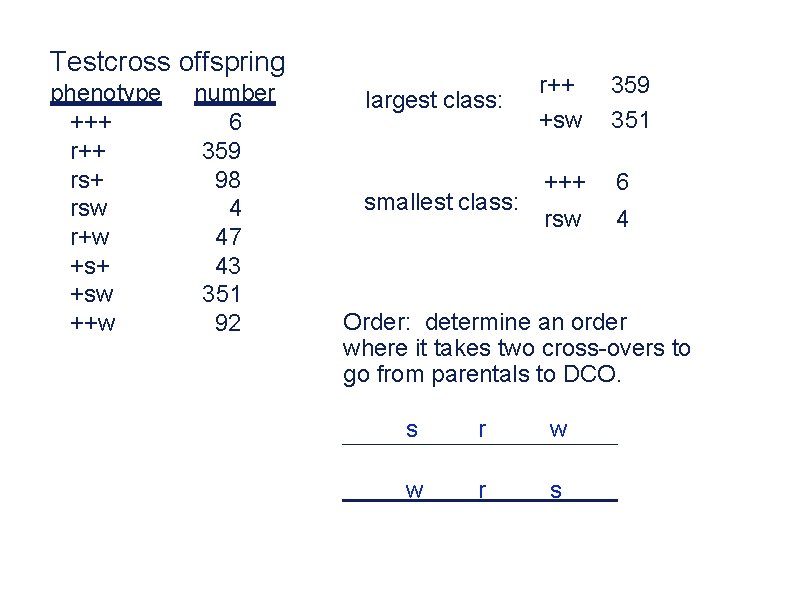
Testcross offspring phenotype +++ rs+ rsw r+w +s+ +sw ++w number 6 359 98 4 47 43 351 92 largest class: smallest class: r++ +sw 359 351 +++ 6 rsw 4 Order: determine an order where it takes two cross-overs to go from parentals to DCO. s r w w r s
The order of three markers is: s-r-w or w-r-s Next, sort according to reciprocal products and determine where crossovers occur: F 2 products +r+ s+w sr+ ++w +rw s++ +++ srw map distance s-r = map distance r-w = # 359 351 98 92 47 43 6 4 class parental SCO(s-r) SCO(r-w) DCO 98+92+6+4 1000 47+43+6+4 1000 10 m. u. s r w 20 m. u. = 0. 20 = 20 m. u. = 0. 10 = 10 m. u.
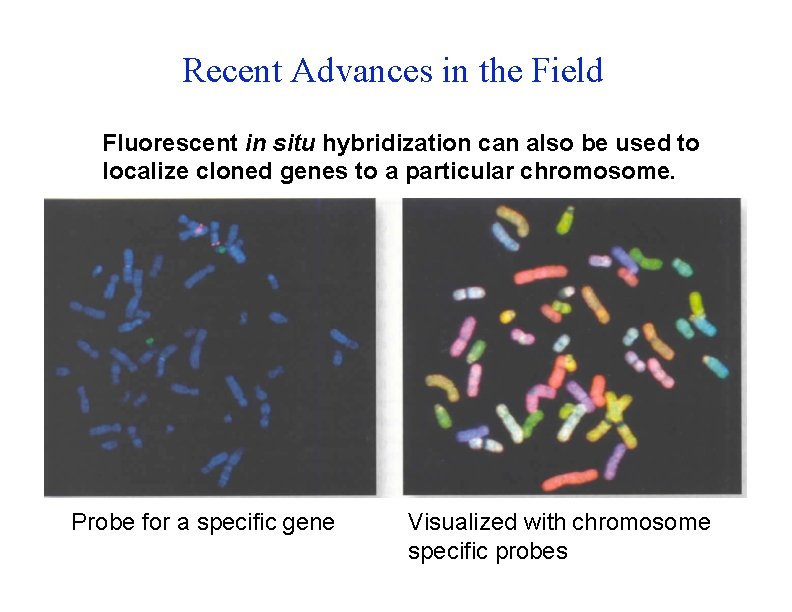
Recent Advances in the Field Fluorescent in situ hybridization can also be used to localize cloned genes to a particular chromosome. Probe for a specific gene Visualized with chromosome specific probes