
Link to video about division using Dienes blocks
Link to video about division using Dienes blocks and algebra tiles https: //www. youtube. com/watch? v=LHrh. FFEMEXo
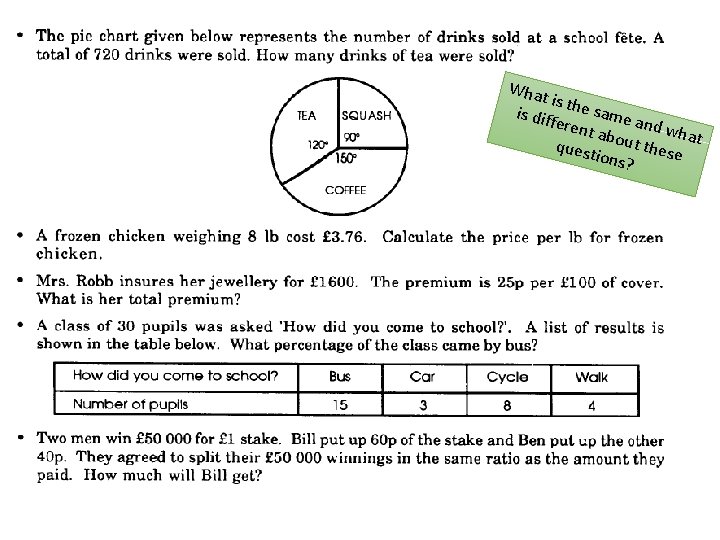
What is diff he same a erent n abou d what tt quest ions? hese
Knowing to … I can know-that something is true as a fact. I can know-how to do something. I can know-why those techniques work or why those facts are true. But these “knowings” when taught are hard to move beyond book-knowledge, knowledge-about. The knowingthat can be memorised; the knowing-how can be routine, and the knowing-why a collection of “incantations” and learned phrases. What really matters in our increasingly problemoriented culture is knowing-to use this or that technique, this or that way of thinking, this or that approach, in a given situation as and when it arises. (From “Questions and Prompts for Mathematical Thinking”, Watson and Mason, ATM, 1998). 3
Solving Problems Tom has 20 sweets and shares some of them with his sister. He gives his sister 5. How many does he have? 4
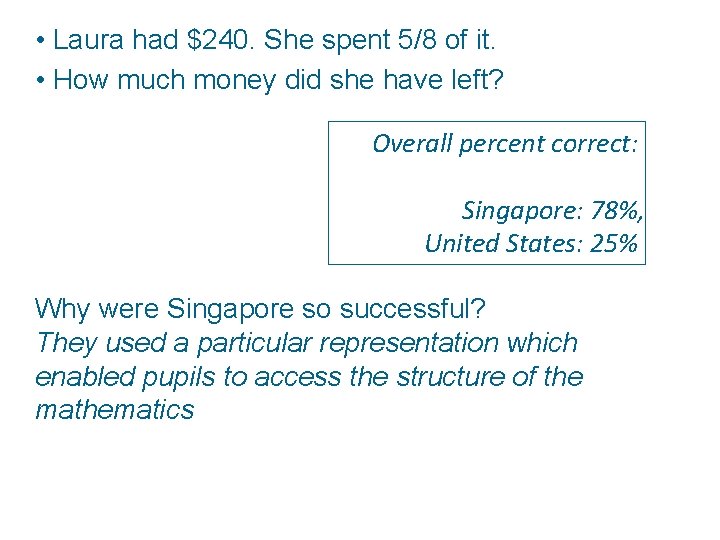
• Laura had $240. She spent 5/8 of it. • How much money did she have left? Overall percent correct: Singapore: 78%, United States: 25% Why were Singapore so successful? They used a particular representation which enabled pupils to access the structure of the mathematics
Introducing the bar model • The bar model is introduced within the context of part/whole relationships to solving problems involving the concepts of addition and subtraction. • It exposes the relationships within the structure of the mathematics, which are used to find the unknown elements and thus supports the development of algebraic thinking. 7
Addition and Subtraction
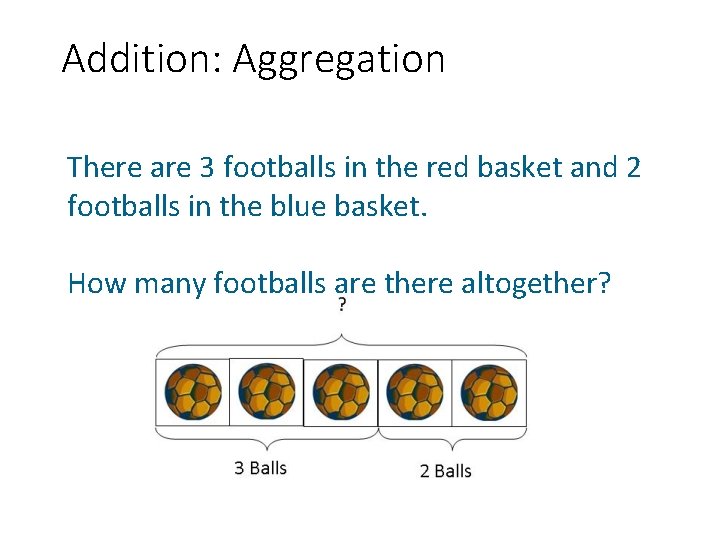
Addition: Aggregation There are 3 footballs in the red basket and 2 footballs in the blue basket. How many footballs are there altogether?
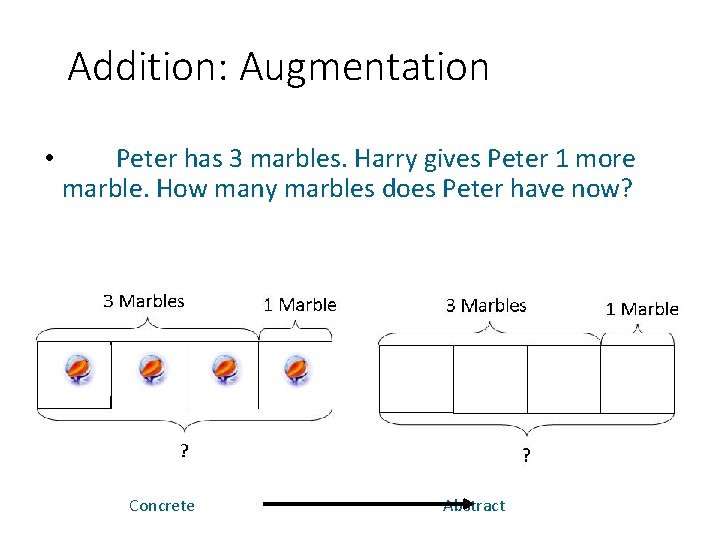
Addition: Augmentation • Peter has 3 marbles. Harry gives Peter 1 more marble. How many marbles does Peter have now? Concrete Abstract
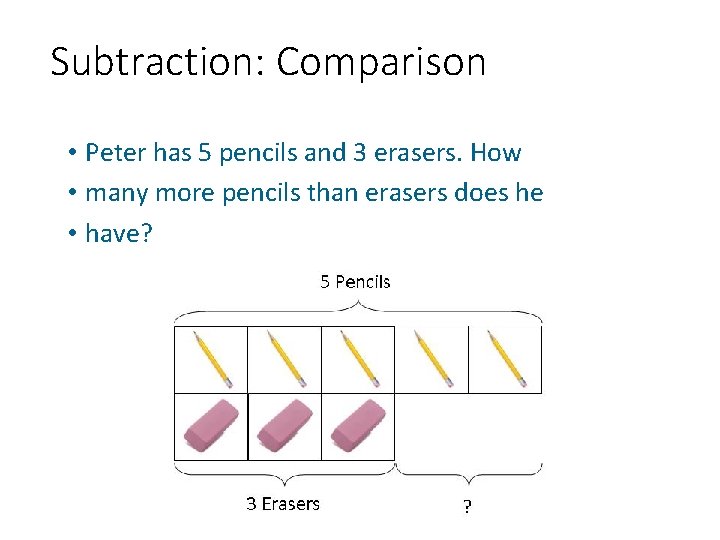
Subtraction: Comparison • Peter has 5 pencils and 3 erasers. How • many more pencils than erasers does he • have?
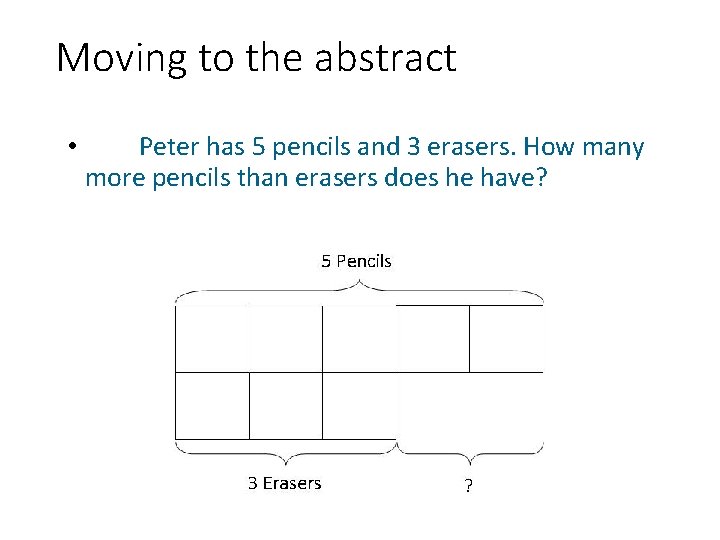
Moving to the abstract • Peter has 5 pencils and 3 erasers. How many more pencils than erasers does he have?
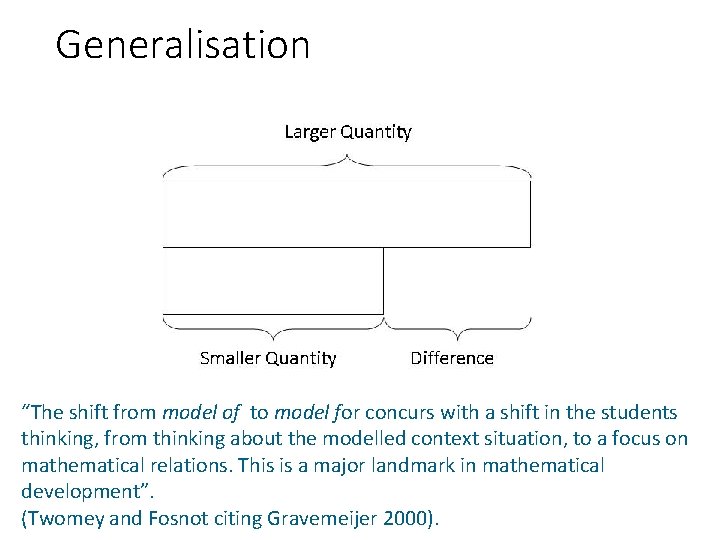
Generalisation “The shift from model of to model for concurs with a shift in the students thinking, from thinking about the modelled context situation, to a focus on mathematical relations. This is a major landmark in mathematical development”. (Twomey and Fosnot citing Gravemeijer 2000).
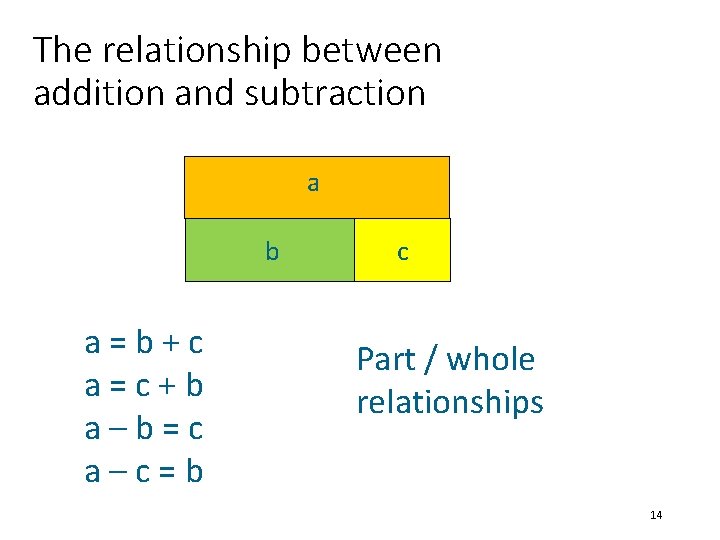
The relationship between addition and subtraction a b a=b+c a=c+b a–b=c a–c=b c Part / whole relationships 14
Problems to solve • Tom has a bag of 64 marbles. His friend gives him 28 more. • How many does he have now? • Kelsey was running a 26 mile marathon. After 18 miles she felt very tired. How many more miles did she have to run? • Carly bought an apple for 17 p and a banana for 26 p. • How much has she spent? • Ali had £ 10. He bought a DVD for £ 6. 70 and a CD for £ 2. 90. • How much money did he have left? •
Developing a sense of scale
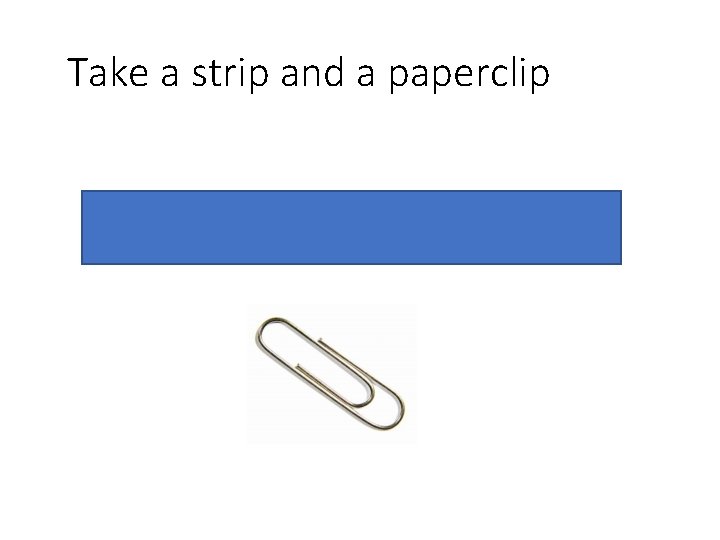
Take a strip and a paperclip
Your strip represents 10 p • Show me 5 p • Show me 2 p • Show me 8 p • Show me 7 p
Your strip represents £ 1 • Show me 50 p • Show me 20 p • Show me 80 p • Show me 70 p
Your strip represents 1 metre • Show me 50 cm • Show me half a metre • Show me 20 cm • Show me 80 cm • Show me 70 cm
Your strip represents £ 5 • Show me £ 3 • Show me £ 4 • Show me £ 3. 50 • Show me £ 3. 59 • What would the half way mark represent?
Multiplication, Ratio and Scaling
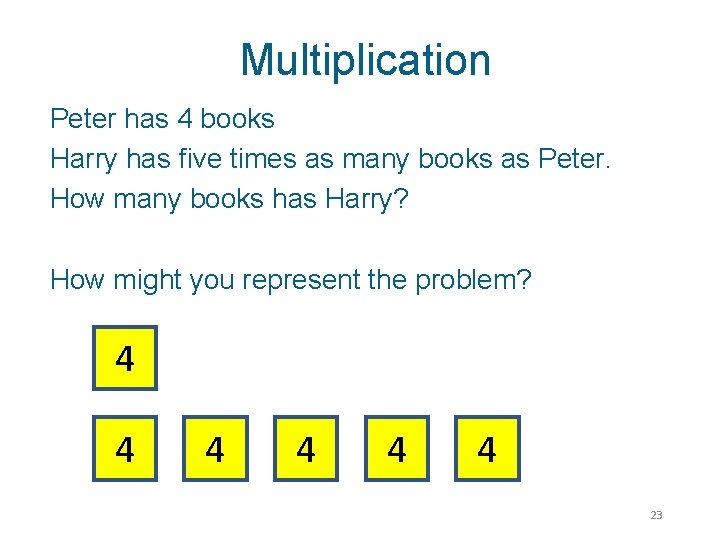
Multiplication Peter has 4 books Harry has five times as many books as Peter. How many books has Harry? How might you represent the problem? 4 4 4 23
Multiplication Problems Henry ate 10 meatballs at the Christmas party. Shane ate 3 times as many meatballs as Henry. How many meatballs did they eat altogether? Helen has 9 times as many football cards as Sam. Together they have 150 cards. How many more cards does Helen have than Sam? The sum of 2 numbers is 60. One number is 9 times as big as the other. What is the bigger number? The sum of 2 numbers is 64. One number is 7 times as big as the other. What is the smaller number?
• Sam had 5 times as many marbles as • Tom. • If Sam gives 26 marbles to Tom, the • two friends will have exactly the same • amount. • How many marbles do they have • altogether? 25
• Tim and Sally share marbles in the ratio of • 2: 3 • If Sally has 36 marbles, how many are • there altogether? 26
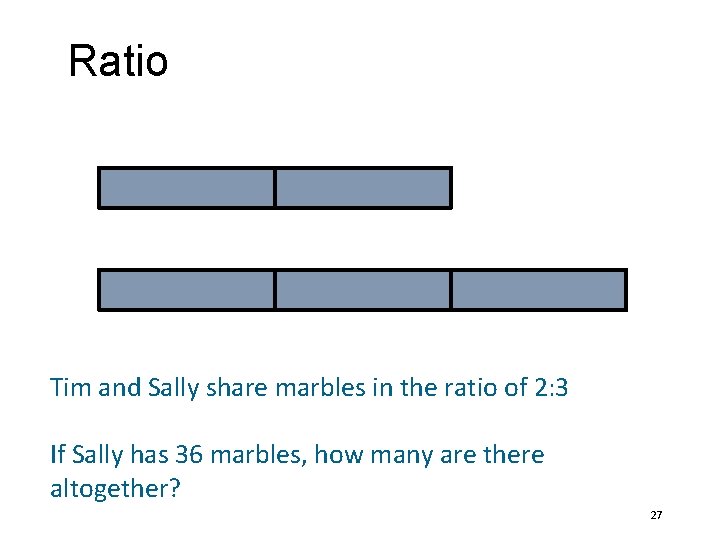
Ratio Tim and Sally share marbles in the ratio of 2: 3 If Sally has 36 marbles, how many are there altogether? 27
• A herbal skin remedy uses honey and yoghurt in the ratio • 3 : 4. How much honey is needed to mix with 120 g of • yoghurt? • A health bar sells desserts with chopped apricot and yoghurt • In the ratio 2 : 5. How much chopped apricot will be mixed • with 150 g of yoghurt? 28
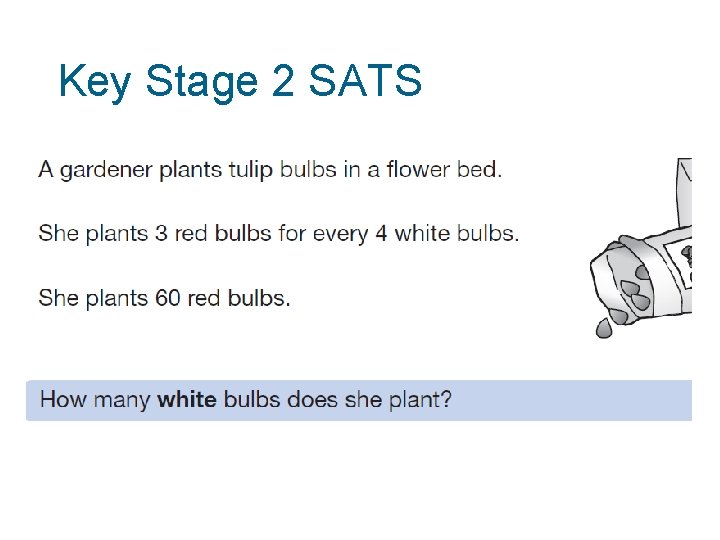
Key Stage 2 SATS
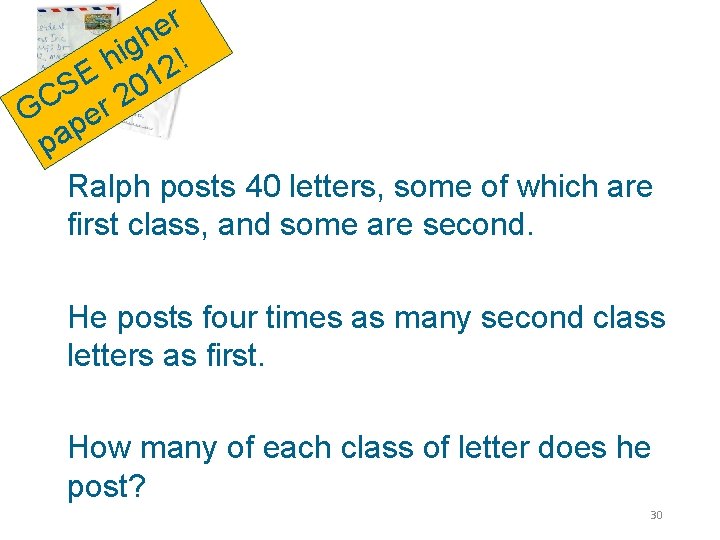
r e h g i ! h 2 E 01 S 2 C r G pe pa Ralph posts 40 letters, some of which are first class, and some are second. He posts four times as many second class letters as first. How many of each class of letter does he post? 30
Ratio, Multiplication or Scaling? The farmer has 24 animals There are three times as many sheep as cows. How many Sheep? How many cows? The farmer has 42 animals There are twice as many ducks as cows and three times as many sheep as cows. How many Sheep? How many cows? How many ducks
Farmer Brown has a third of the sheep that Farmer Giles has. After 12 of farmer Giles sheep escape into Farmer Browns field they have the same amount. How many sheep do they have in total?
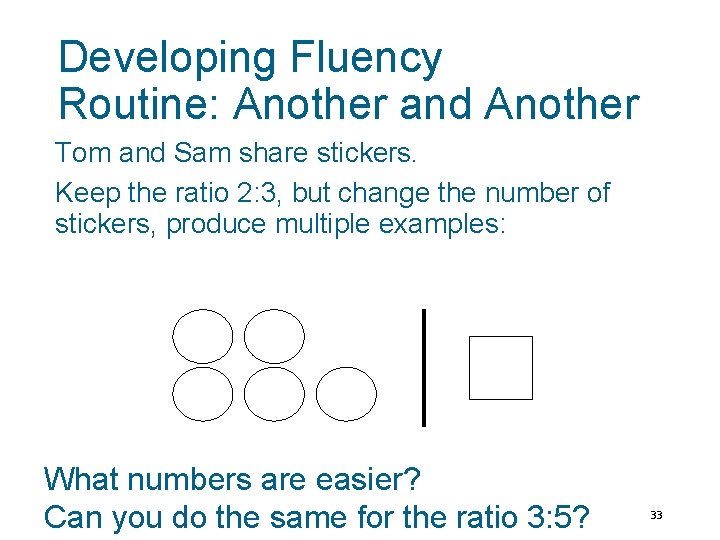
Developing Fluency Routine: Another and Another Tom and Sam share stickers. Keep the ratio 2: 3, but change the number of stickers, produce multiple examples: What numbers are easier? Can you do the same for the ratio 3: 5? 33
Division and Fractions
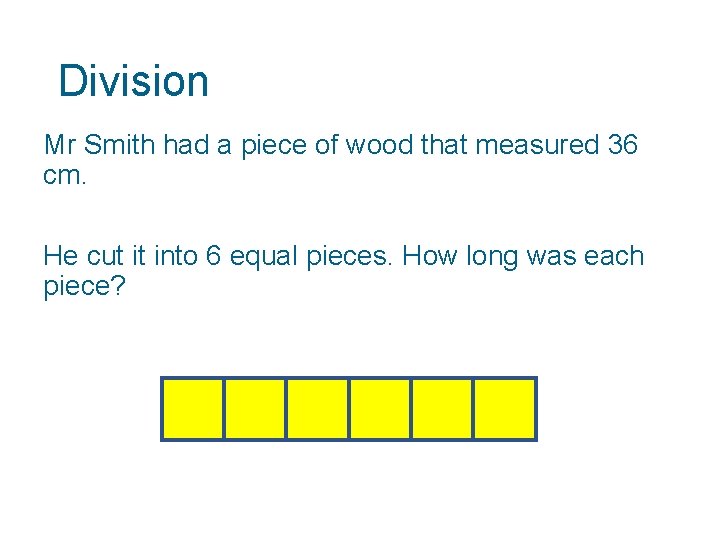
Division Mr Smith had a piece of wood that measured 36 cm. He cut it into 6 equal pieces. How long was each piece?
Division 24 cakes were shared between 6 children, how many did each receive? Sam likes to read fantasy stories. His new book is 48 pages long. Sam wants to finish the book in 4 days. How many pages should Sam read each day in order to reach his goal?
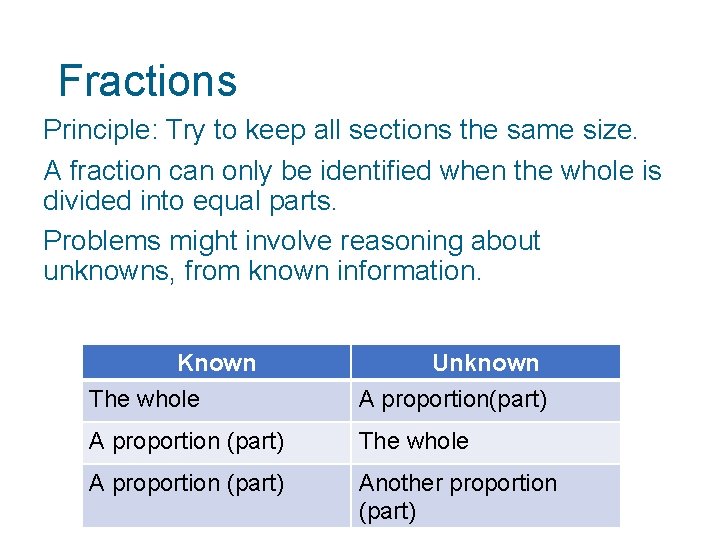
Fractions Principle: Try to keep all sections the same size. A fraction can only be identified when the whole is divided into equal parts. Problems might involve reasoning about unknowns, from known information. Known The whole Unknown A proportion(part) A proportion (part) The whole A proportion (part) Another proportion (part)
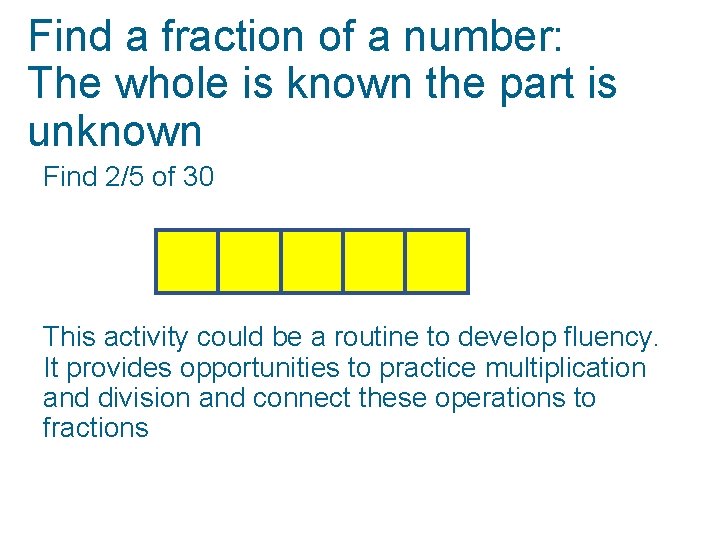
Find a fraction of a number: The whole is known the part is unknown Find 2/5 of 30 This activity could be a routine to develop fluency. It provides opportunities to practice multiplication and division and connect these operations to fractions
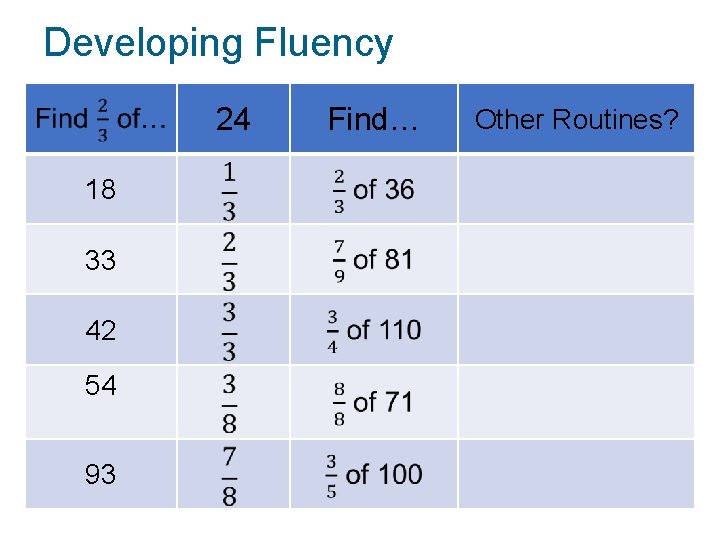
Developing Fluency 24 18 33 42 54 93 Find… Other Routines?
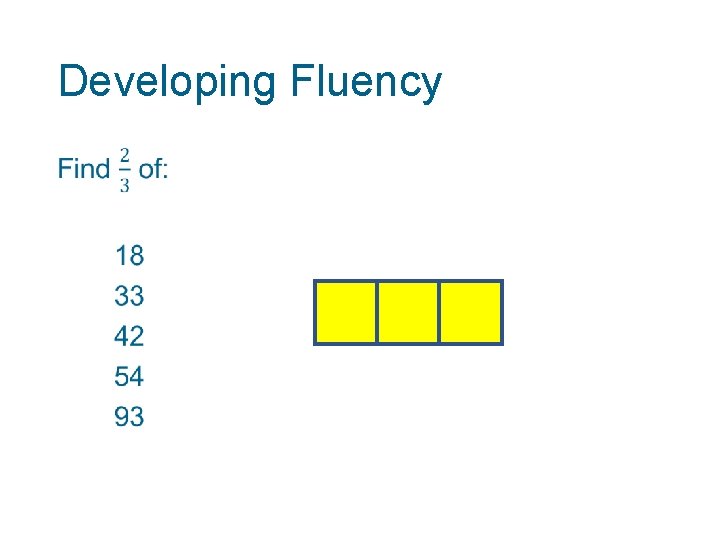
Developing Fluency •
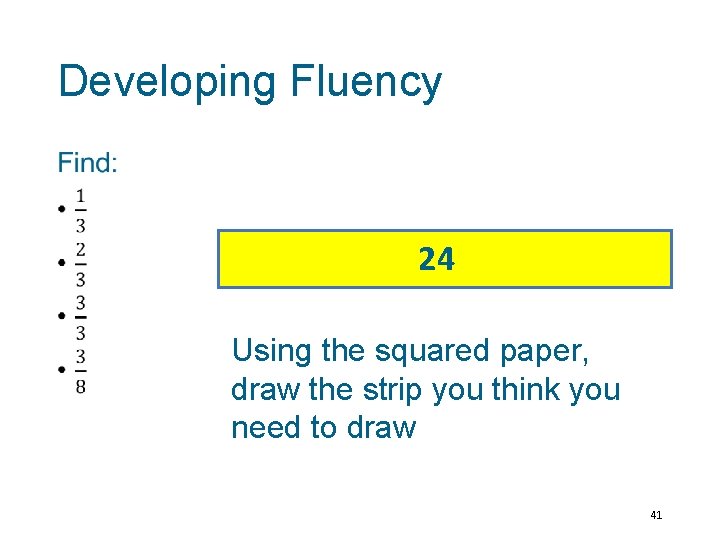
Developing Fluency • 24 Using the squared paper, draw the strip you think you need to draw 41
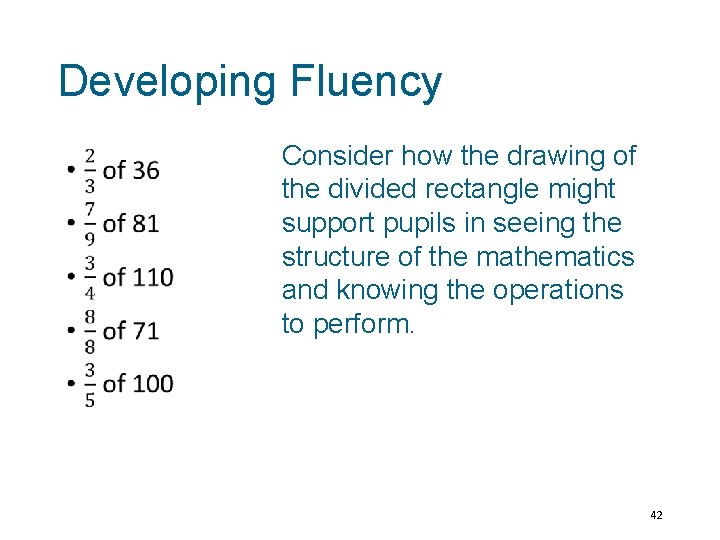
Developing Fluency • Consider how the drawing of the divided rectangle might support pupils in seeing the structure of the mathematics and knowing the operations to perform. 42
Part / whole and part / part relationships Sam has 24 cupcakes to sell. He sold half on Monday and half of the remainder on Tuesday. How many does he have left to sell? I cycled from home to Lea Valley Park, a distance of 24 miles. By 10 am I had cycled half way and at 11 am I had travelled two thirds of the remaining distance. How far had I left to travel?
Reflection on Problem solving Consider the need to: • Recognise relationships • Keep parts the same size • See and model the structure • Make connections • Reason from what I know
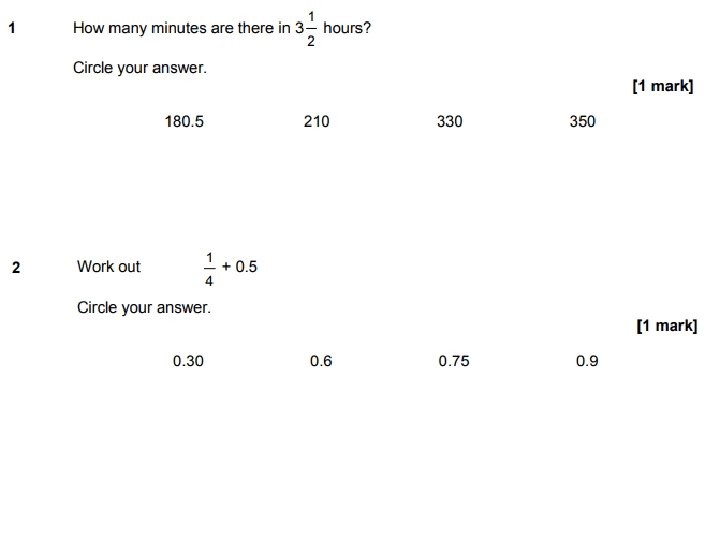
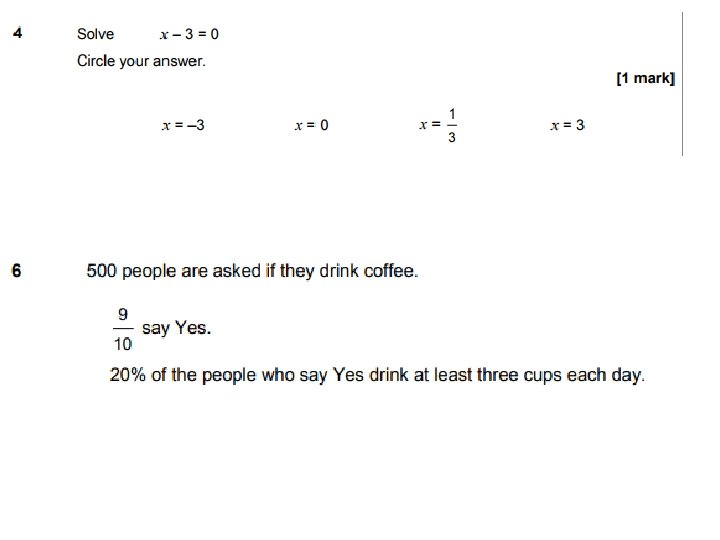
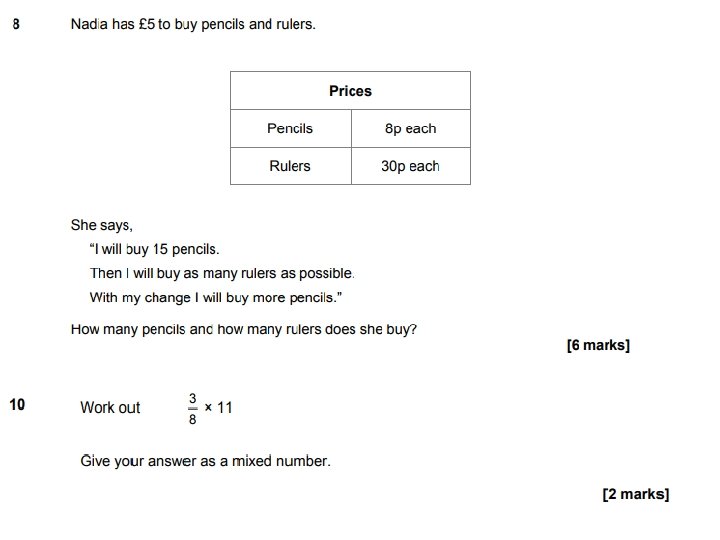
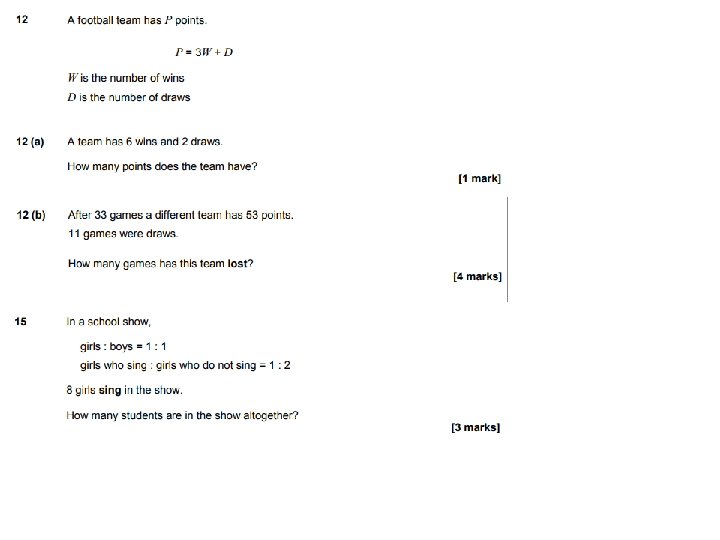
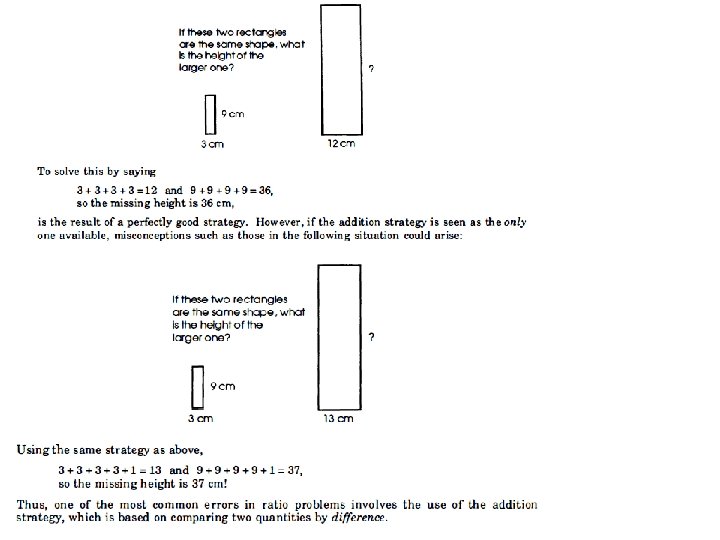
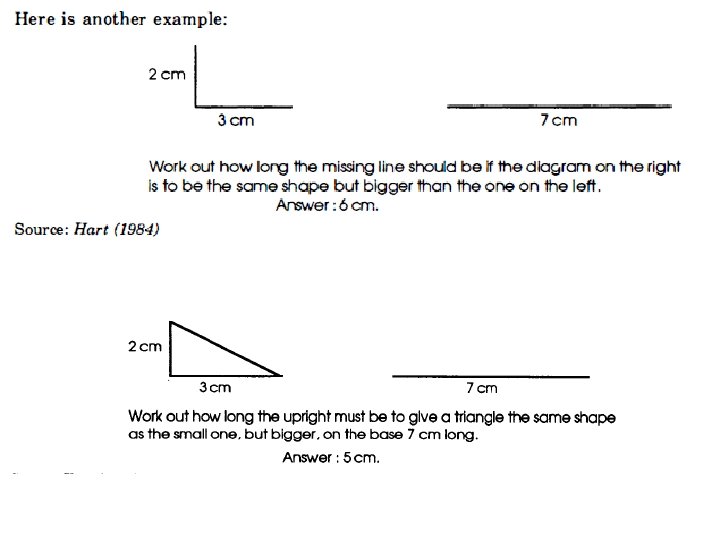
Being aware of standard misconceptions (such as acceptance only of an addition strategy) is very valuable in that it makes it possible to offer valuable comments and to respond to classroom situations with stimulating questions. Misconceptions or, possibly more correctly, conceptions that may lead to errors, can often provide the opportunity for rich learning experiences. They provide the motivation for devising activities which might bring pupils up against surprises or situations that seem to contradict their intuitions. Such questions and activities (known as probes) can help in revealing incorrect strategies and can offer the opportunity for pupils to analyse their own senses of ratio.
By developing multiplication solely as repeated addition there is therefore a danger of stunting pupils' awareness, and pupils' undeveloped sense of comparison by ratio may well be a result of this. For example, consider the following situation:
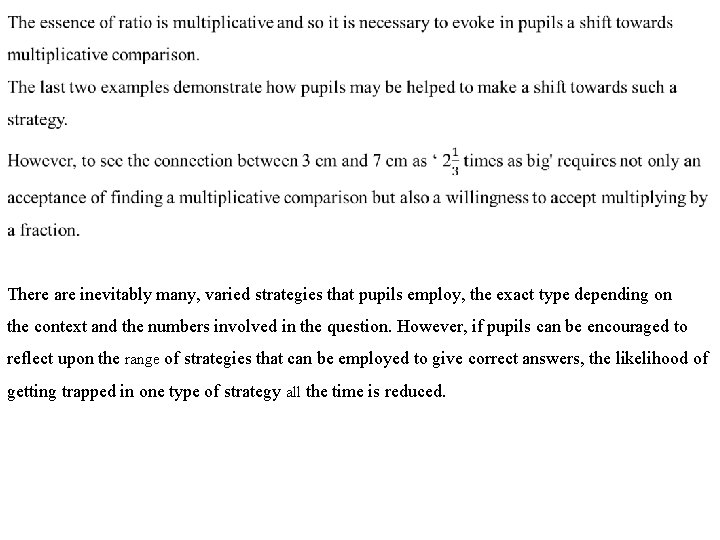
There are inevitably many, varied strategies that pupils employ, the exact type depending on the context and the numbers involved in the question. However, if pupils can be encouraged to reflect upon the range of strategies that can be employed to give correct answers, the likelihood of getting trapped in one type of strategy all the time is reduced.
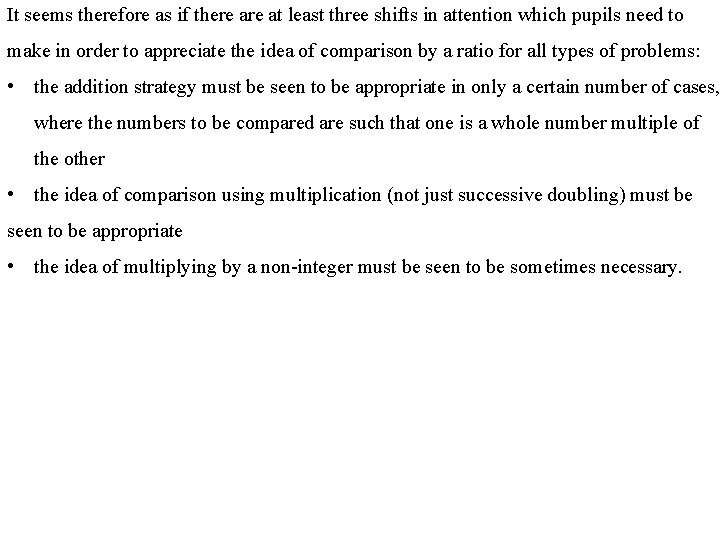
It seems therefore as if there at least three shifts in attention which pupils need to make in order to appreciate the idea of comparison by a ratio for all types of problems: • the addition strategy must be seen to be appropriate in only a certain number of cases, where the numbers to be compared are such that one is a whole number multiple of the other • the idea of comparison using multiplication (not just successive doubling) must be seen to be appropriate • the idea of multiplying by a non-integer must be seen to be sometimes necessary.
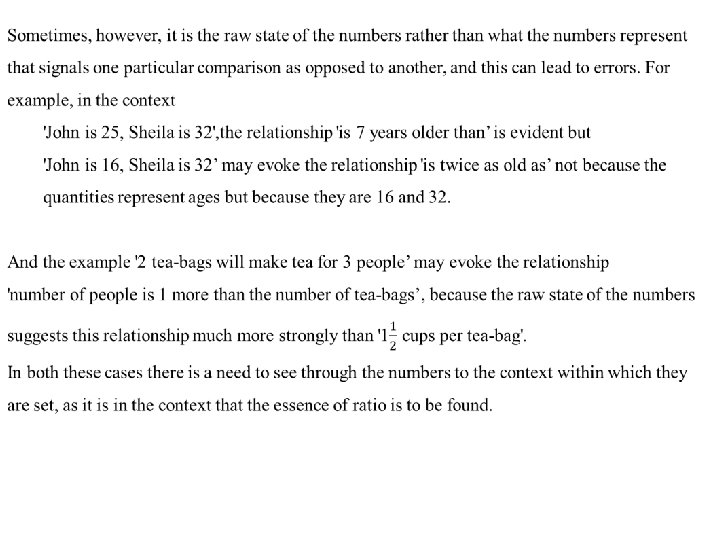
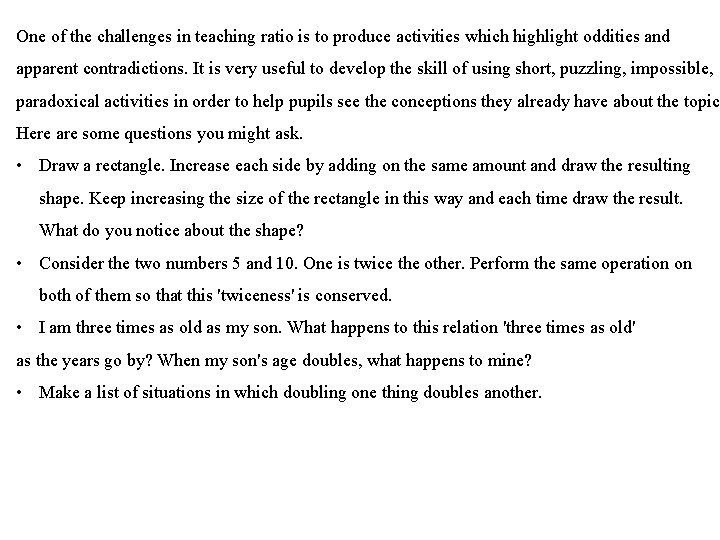
One of the challenges in teaching ratio is to produce activities which highlight oddities and apparent contradictions. It is very useful to develop the skill of using short, puzzling, impossible, paradoxical activities in order to help pupils see the conceptions they already have about the topic. Here are some questions you might ask. • Draw a rectangle. Increase each side by adding on the same amount and draw the resulting shape. Keep increasing the size of the rectangle in this way and each time draw the result. What do you notice about the shape? • Consider the two numbers 5 and 10. One is twice the other. Perform the same operation on both of them so that this 'twiceness' is conserved. • I am three times as old as my son. What happens to this relation 'three times as old' as the years go by? When my son's age doubles, what happens to mine? • Make a list of situations in which doubling one thing doubles another.
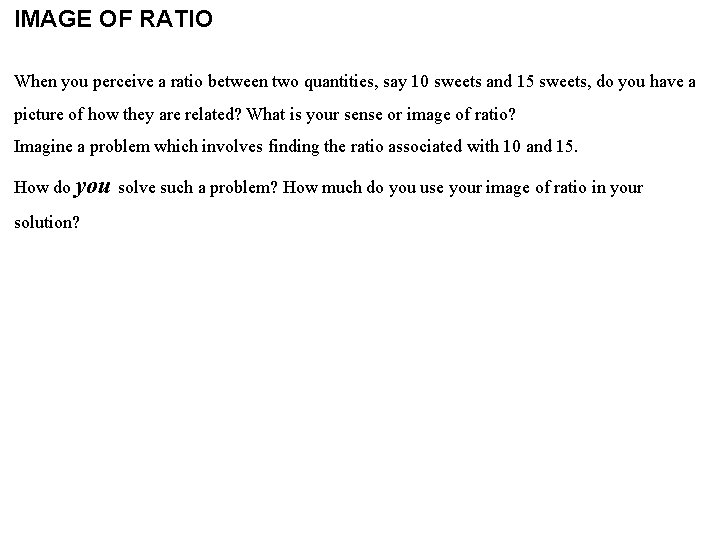
IMAGE OF RATIO When you perceive a ratio between two quantities, say 10 sweets and 15 sweets, do you have a picture of how they are related? What is your sense or image of ratio? Imagine a problem which involves finding the ratio associated with 10 and 15. How do you solve such a problem? How much do you use your image of ratio in your solution?
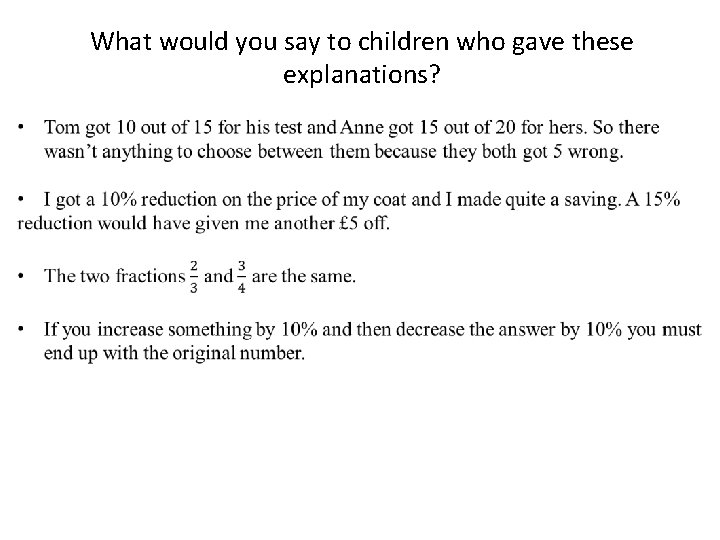
What would you say to children who gave these explanations?
Favourite tables… Cutting a line… Imagine a line, divide it into two pieces by cutting git one third of the way along. Compare the two lines you now have. What is the ratio between them?
- Slides: 62