
Link Let G be a digraph and r
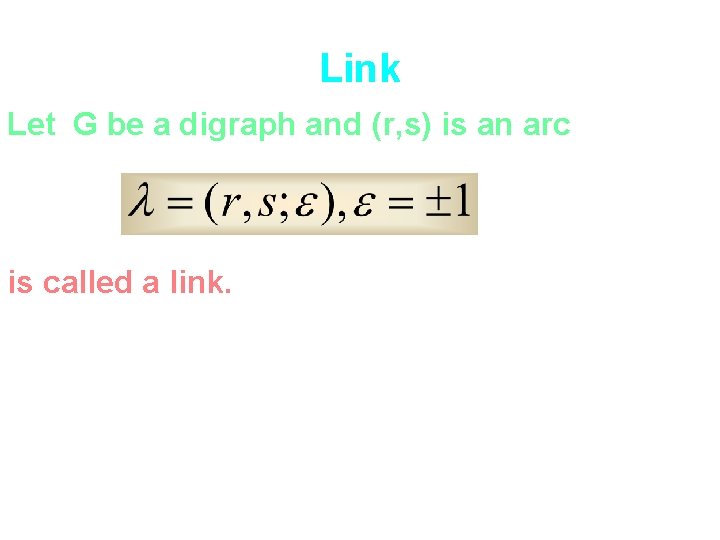
Link Let G be a digraph and (r, s) is an arc is called a link.
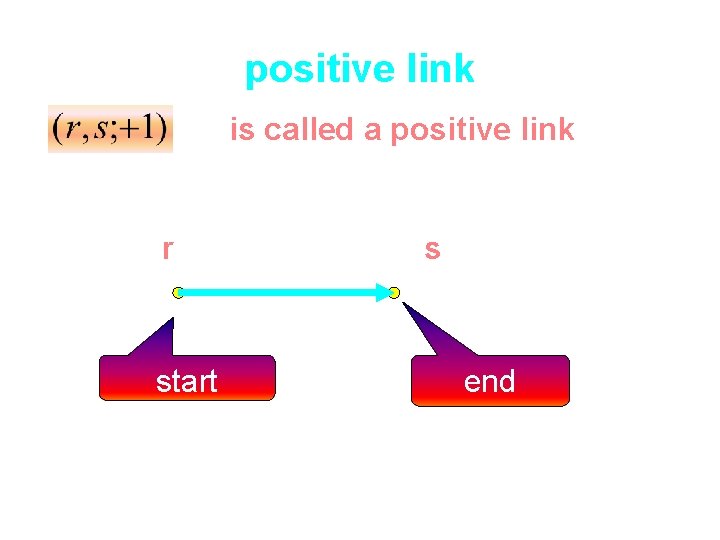
positive link is called a positive link r start s end

negative link is called a negative link s start r end
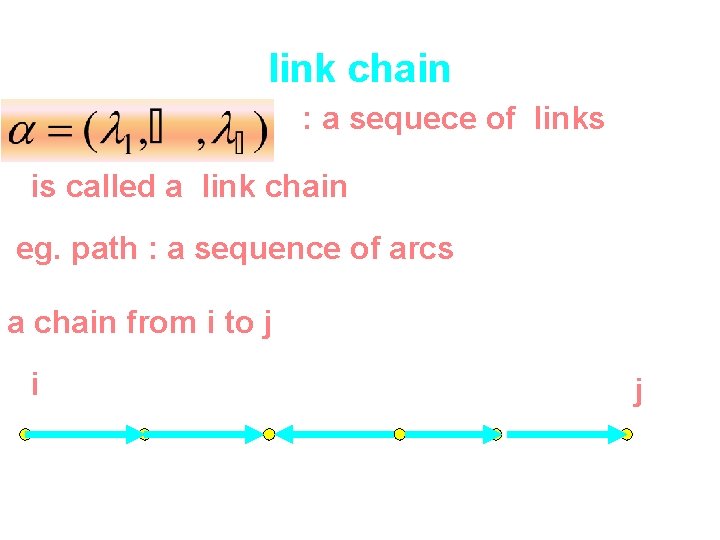
link chain : a sequece of links is called a link chain eg. path : a sequence of arcs a chain from i to j i j
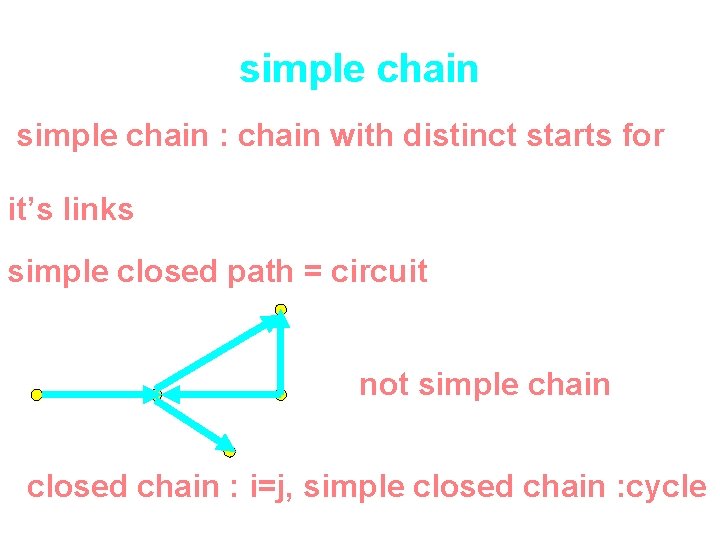
simple chain : chain with distinct starts for it’s links simple closed path = circuit not simple chain closed chain : i=j, simple closed chain : cycle
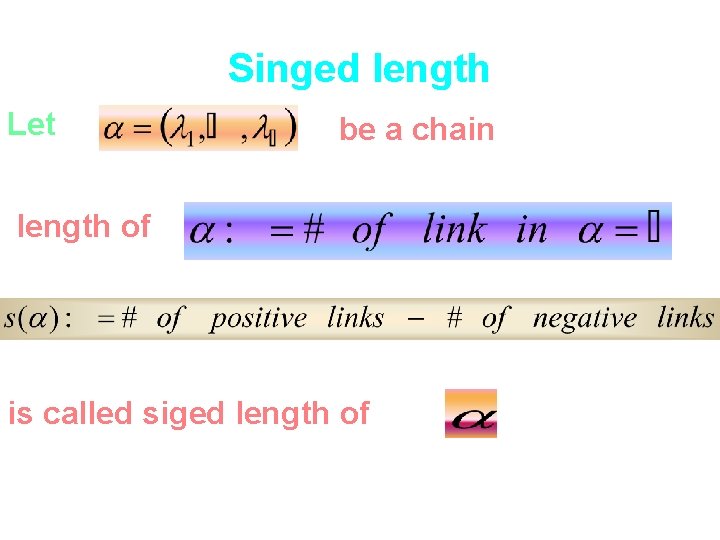
Singed length Let be a chain length of is called siged length of
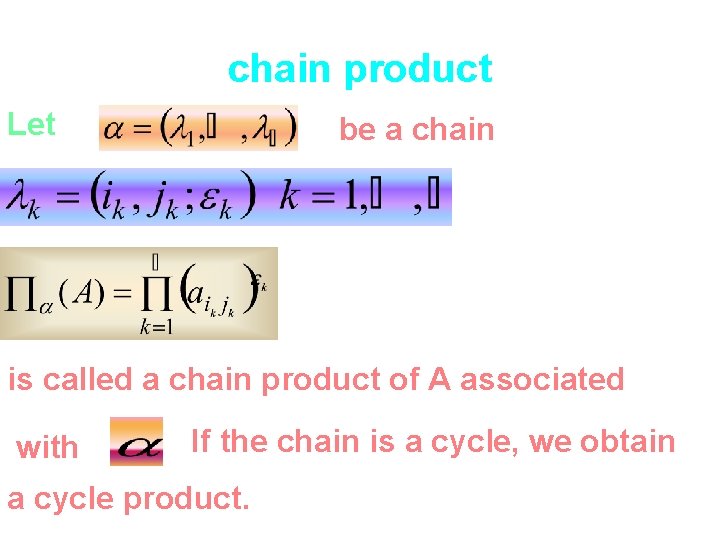
chain product Let be a chain is called a chain product of A associated with If the chain is a cycle, we obtain a cycle product.
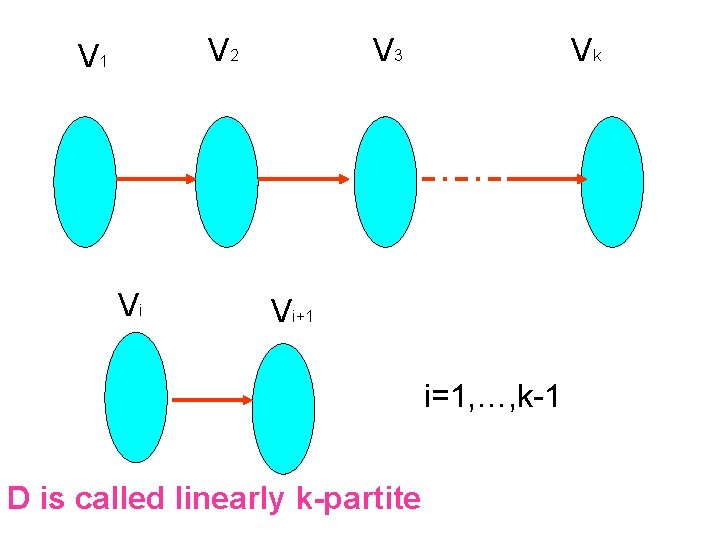
V 2 V 1 Vi V 3 Vk Vi+1 i=1, …, k-1 D is called linearly k-partite
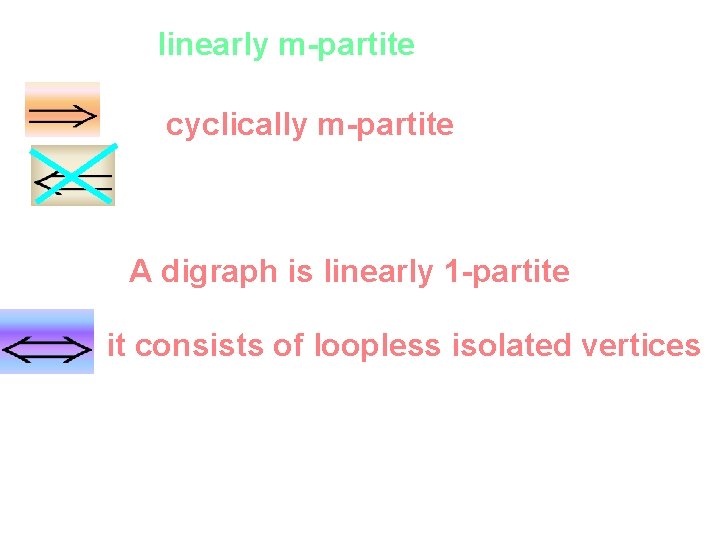
linearly m-partite cyclically m-partite A digraph is linearly 1 -partite it consists of loopless isolated vertices
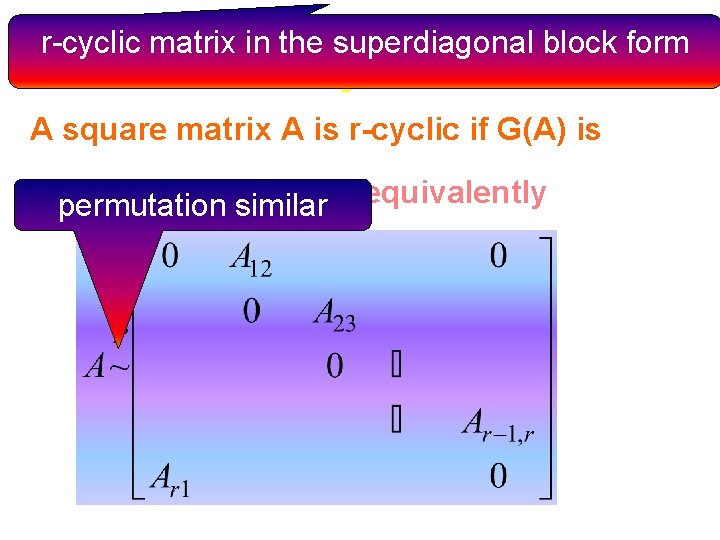
r-cyclic matrix in the superdiagonal block form r-cyclic A square matrix A is r-cyclic if G(A) is cyclically r-partite or equivalently permutation similar

block-shift matrix A block-shift matrix is a square matrix in block form with square diagonal blocks s. t. whenever
block-shift matrix A square matrix of size greater than one is permutationally similar to a block-shift matrix iff it’s digraph is linearly partite.
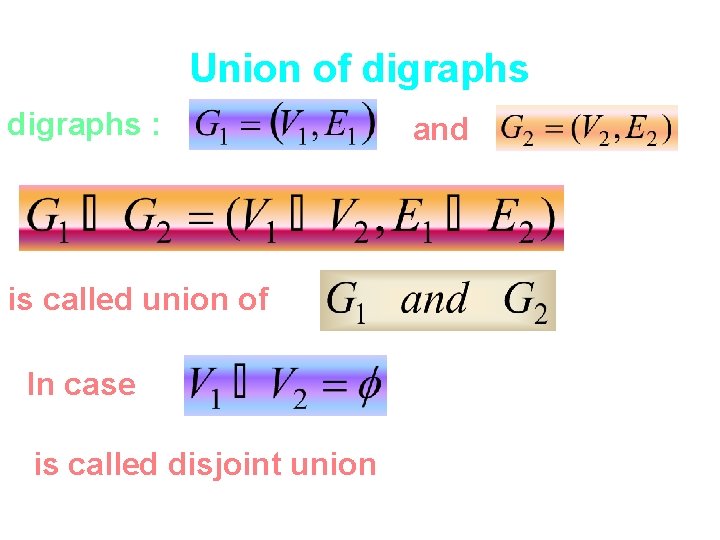
Union of digraphs : is called union of In case is called disjoint union and
Remark 3. 1 The disjoint union of two cyclically m-partite digraphs is cyclically m-partite
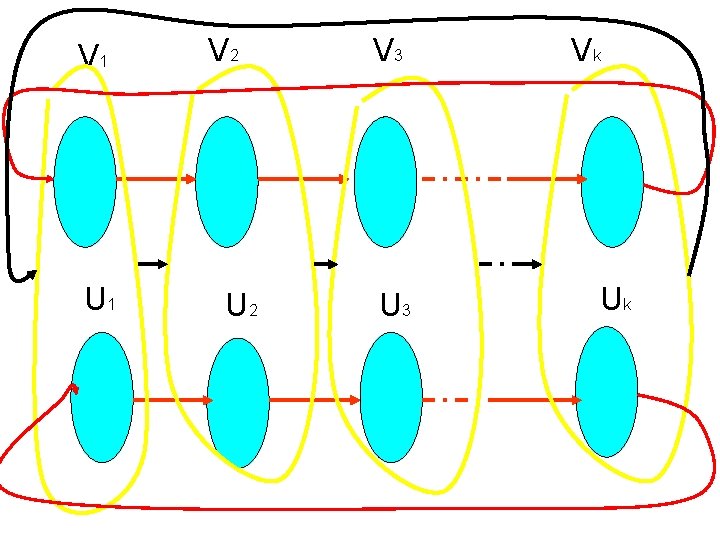
V 1 U 1 V 2 U 2 V 3 U 3 Vk Uk
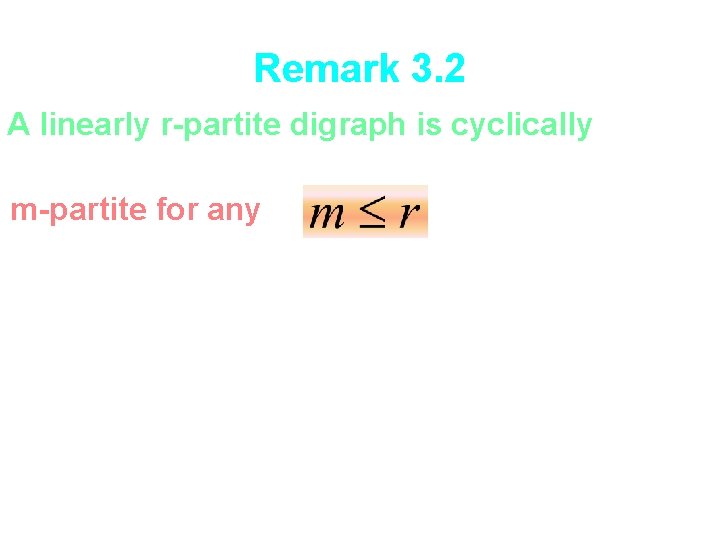
Remark 3. 2 A linearly r-partite digraph is cyclically m-partite for any
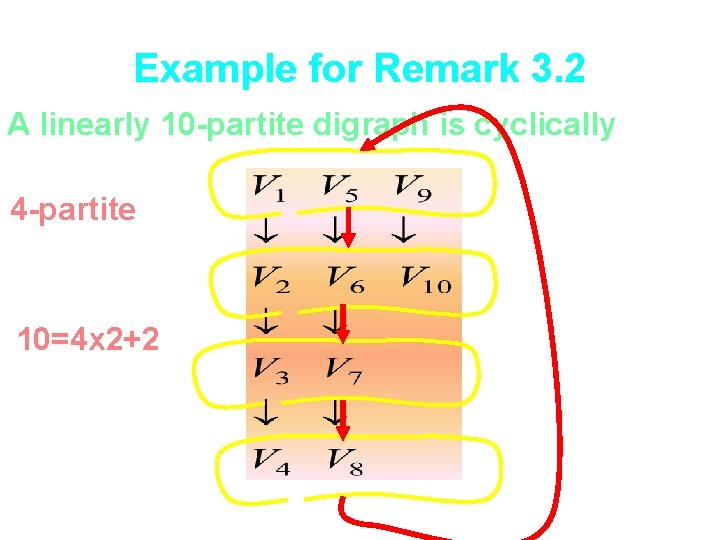
Example for Remark 3. 2 A linearly 10 -partite digraph is cyclically 4 -partite 10=4 x 2+2
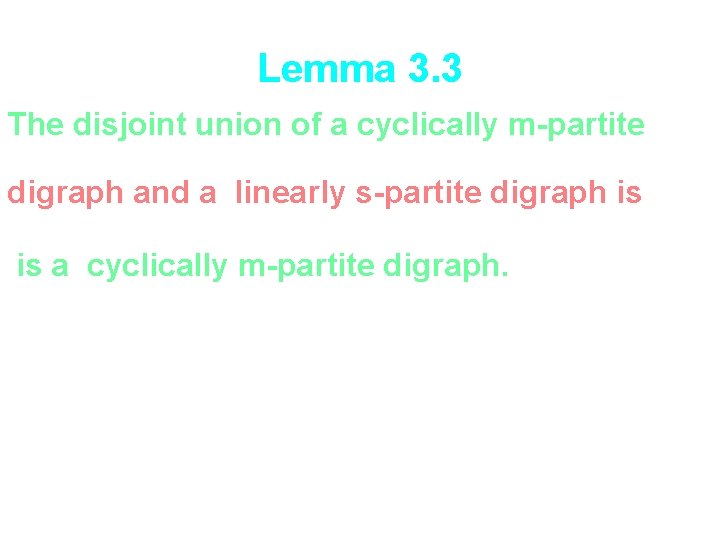
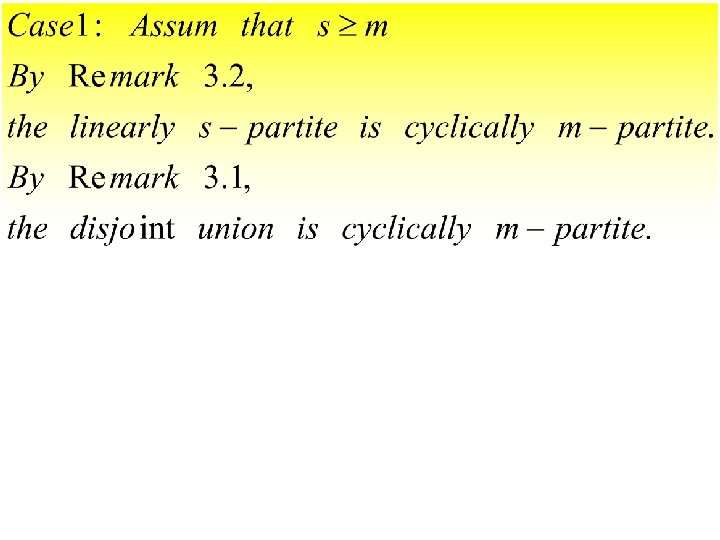
Lemma 3. 3 The disjoint union of a cyclically m-partite digraph and a linearly s-partite digraph is is a cyclically m-partite digraph.
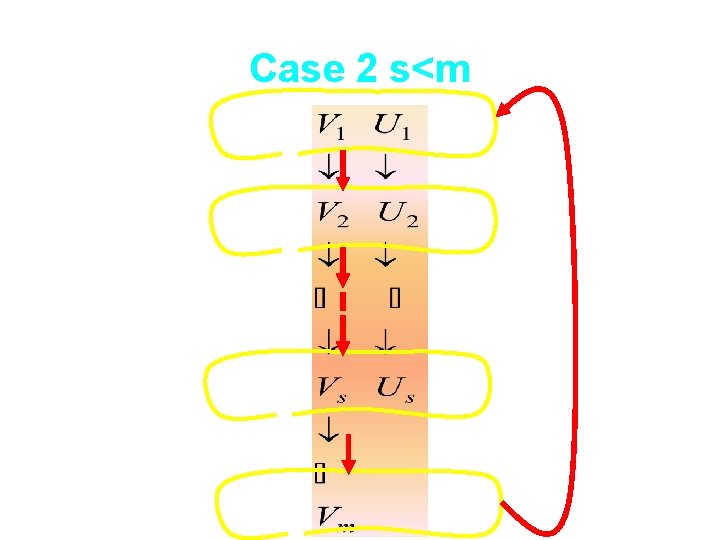
Case 2 s<m
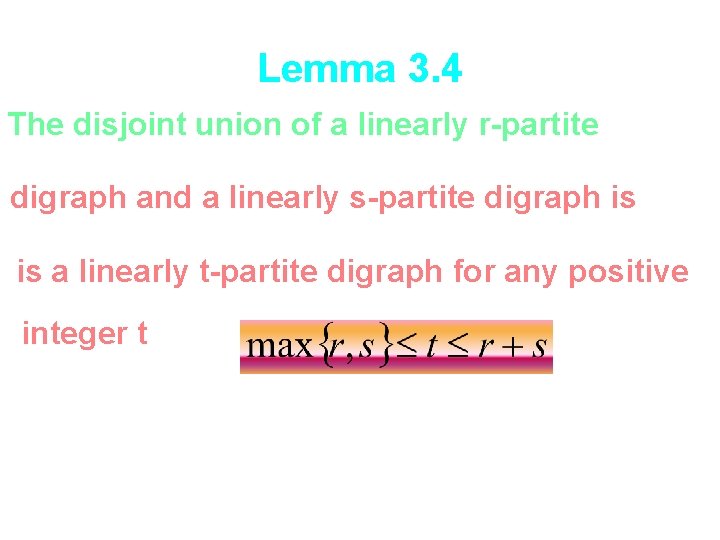
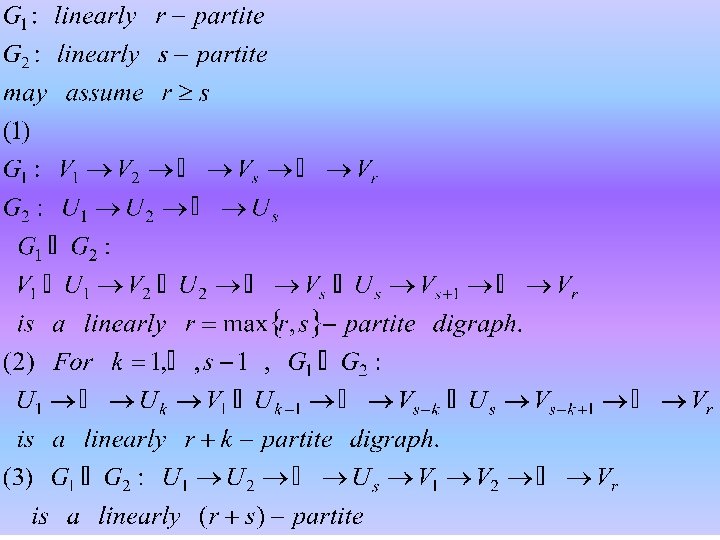
Lemma 3. 4 The disjoint union of a linearly r-partite digraph and a linearly s-partite digraph is is a linearly t-partite digraph for any positive integer t
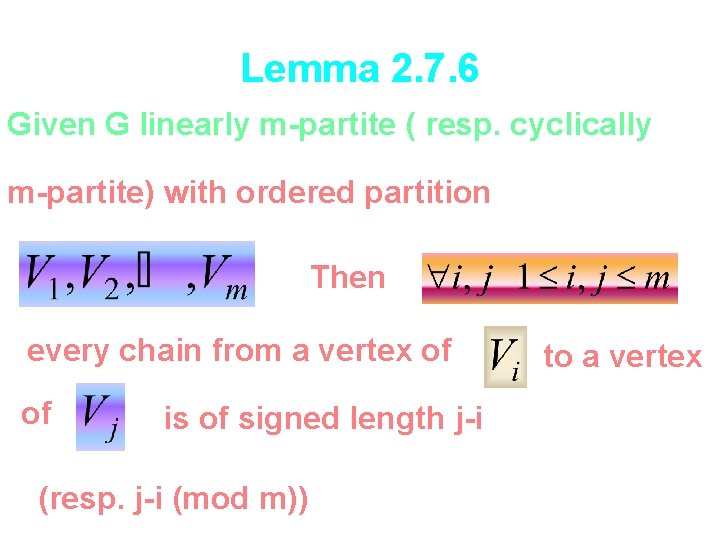
Lemma 2. 7. 6 Given G linearly m-partite ( resp. cyclically m-partite) with ordered partition Then every chain from a vertex of of is of signed length j-i (resp. j-i (mod m)) to a vertex


Remark Let G be a digraph and each of whose cycles has zero signed length then every strongly connected component of G is a single vertex without loop. G is acyclic
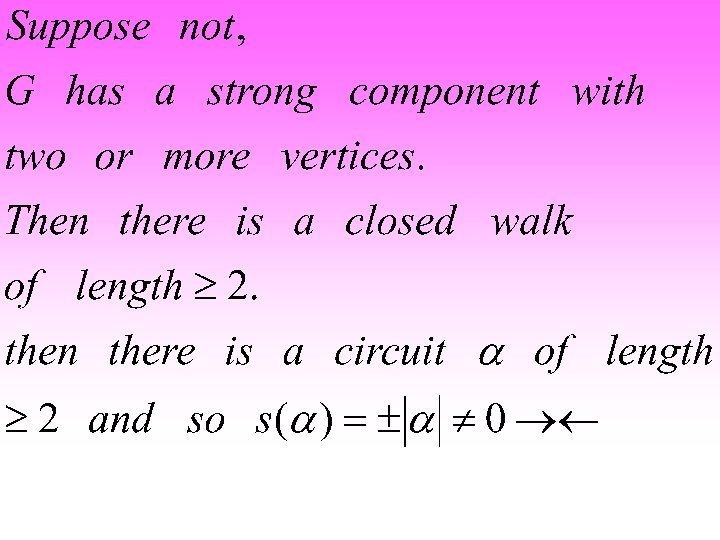
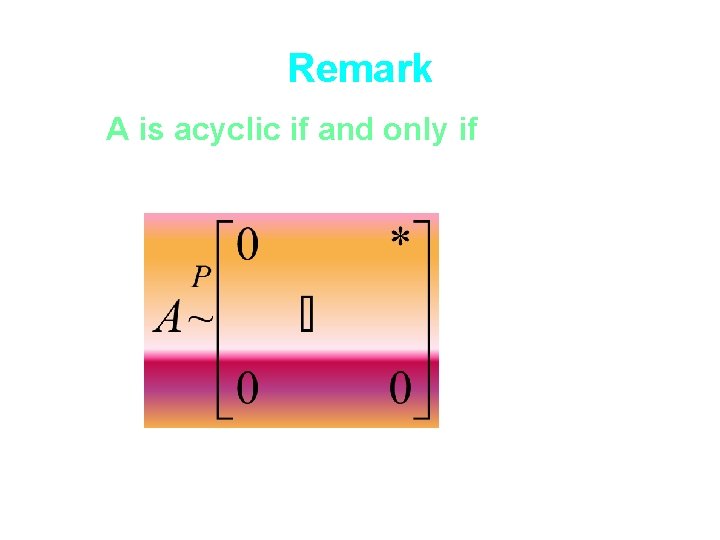
Remark A is acyclic if and only if
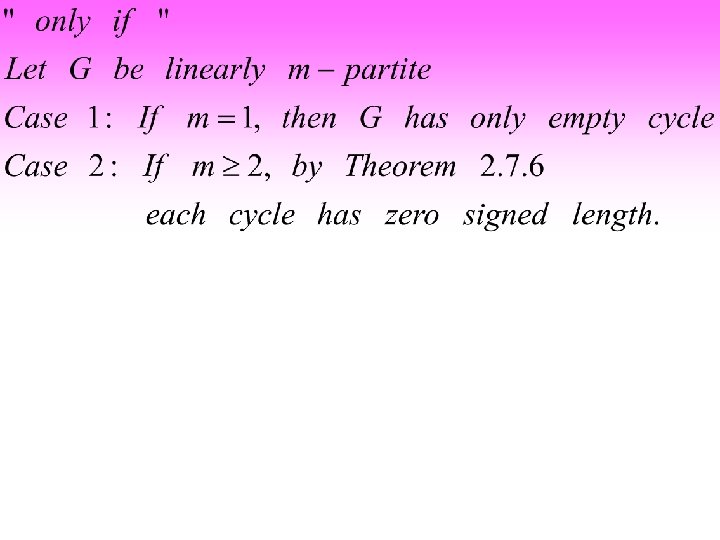
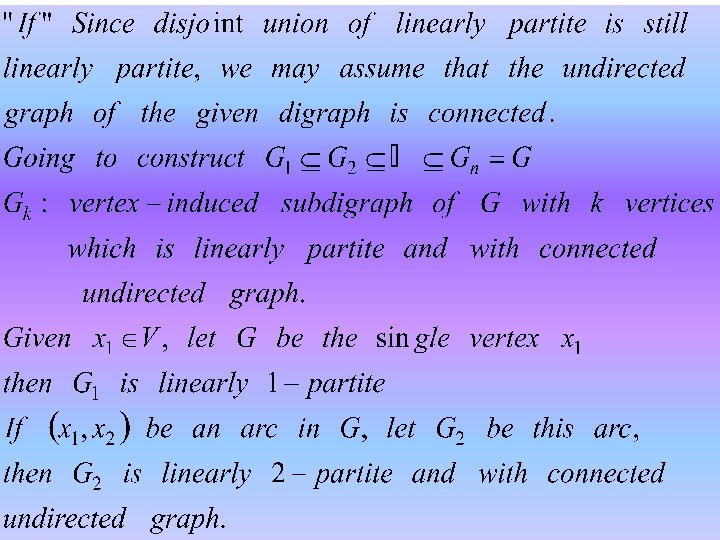
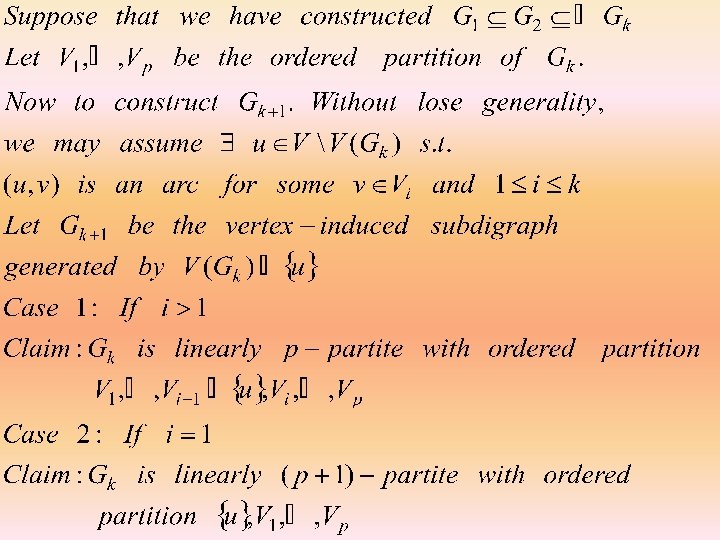
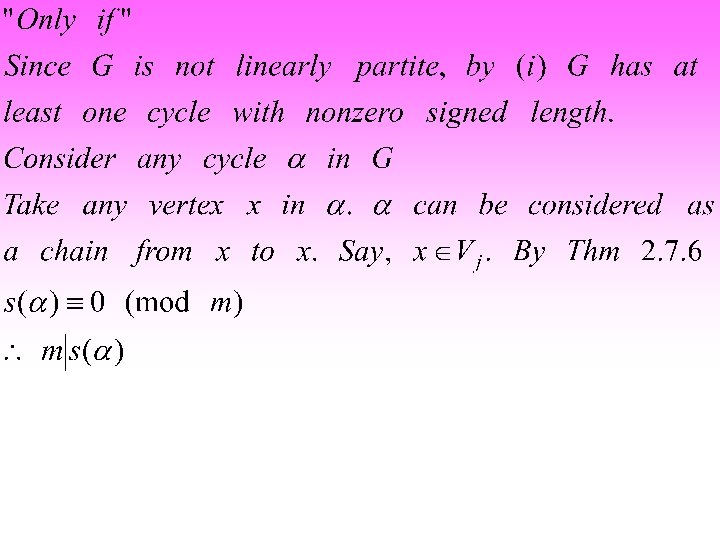
Theorem 2. 7. 7 (i) A digraph is linearly partite if and only if each of cycles has zero signed length.
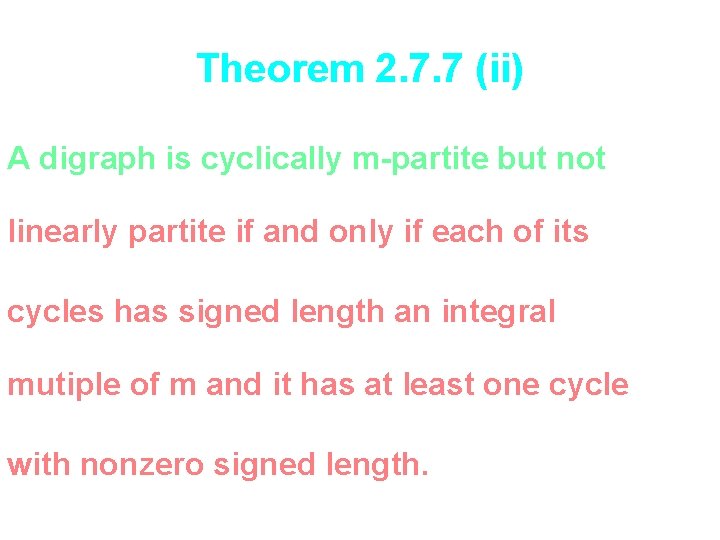
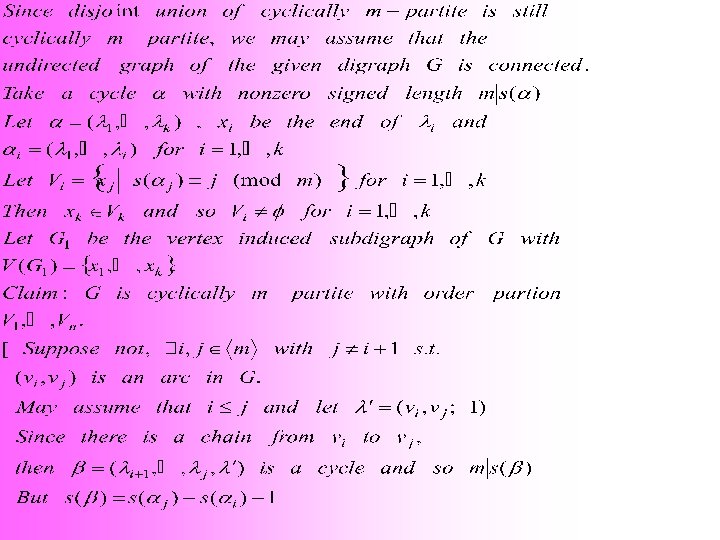
Theorem 2. 7. 7 (ii) A digraph is cyclically m-partite but not linearly partite if and only if each of its cycles has signed length an integral mutiple of m and it has at least one cycle with nonzero signed length.
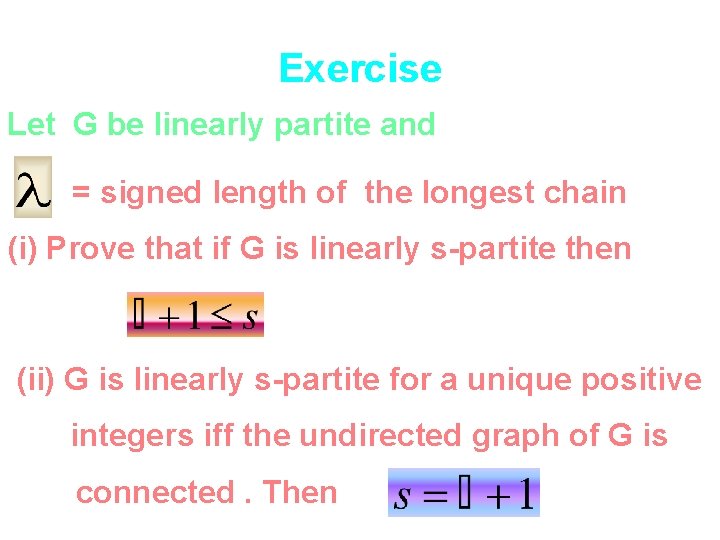
Exercise Let G be linearly partite and = signed length of the longest chain (i) Prove that if G is linearly s-partite then (ii) G is linearly s-partite for a unique positive integers iff the undirected graph of G is connected. Then
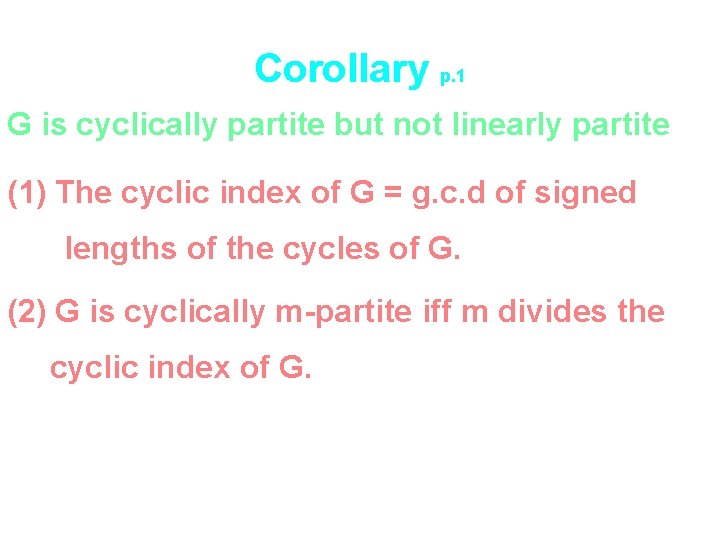
Corollary p. 1 G is cyclically partite but not linearly partite (1) The cyclic index of G = g. c. d of signed lengths of the cycles of G. (2) G is cyclically m-partite iff m divides the cyclic index of G.
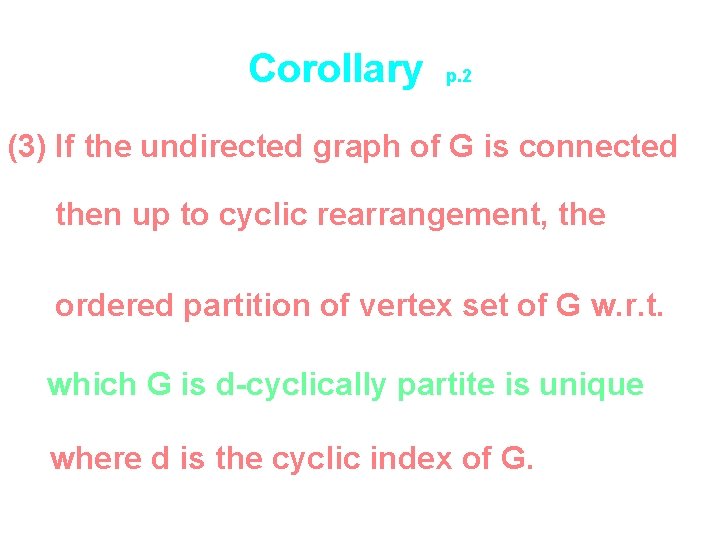
Corollary p. 2 (3) If the undirected graph of G is connected then up to cyclic rearrangement, the ordered partition of vertex set of G w. r. t. which G is d-cyclically partite is unique where d is the cyclic index of G.

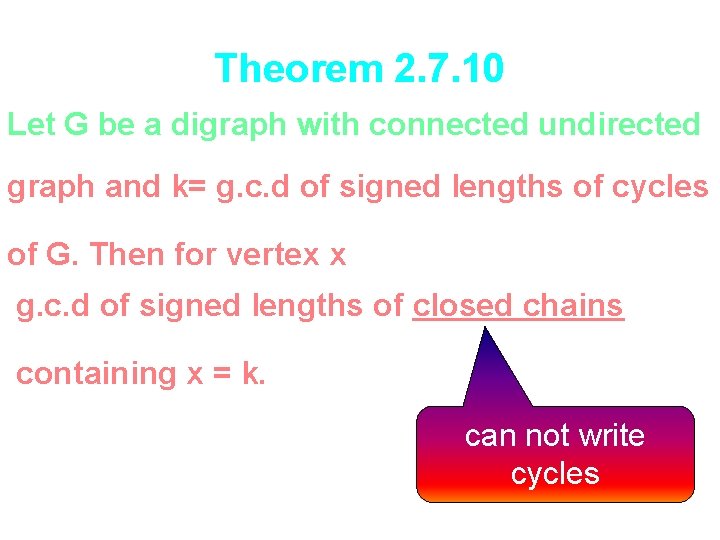
Theorem 2. 7. 10 Let G be a digraph with connected undirected graph and k= g. c. d of signed lengths of cycles of G. Then for vertex x g. c. d of signed lengths of closed chains containing x = k. can not write cycles
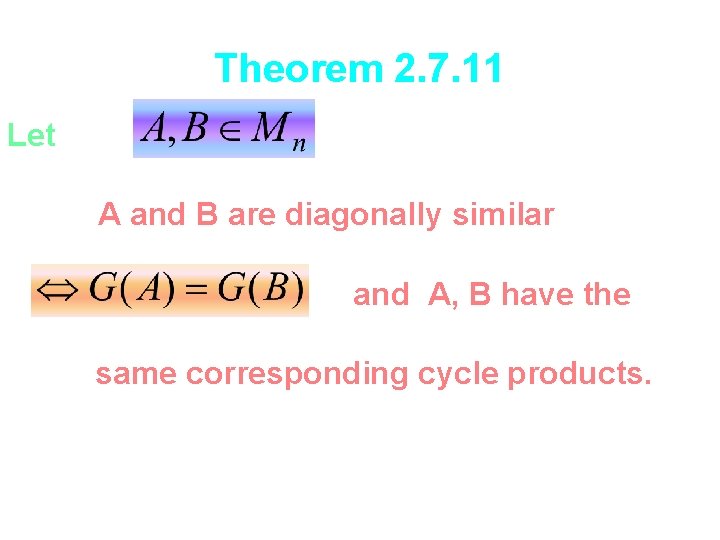
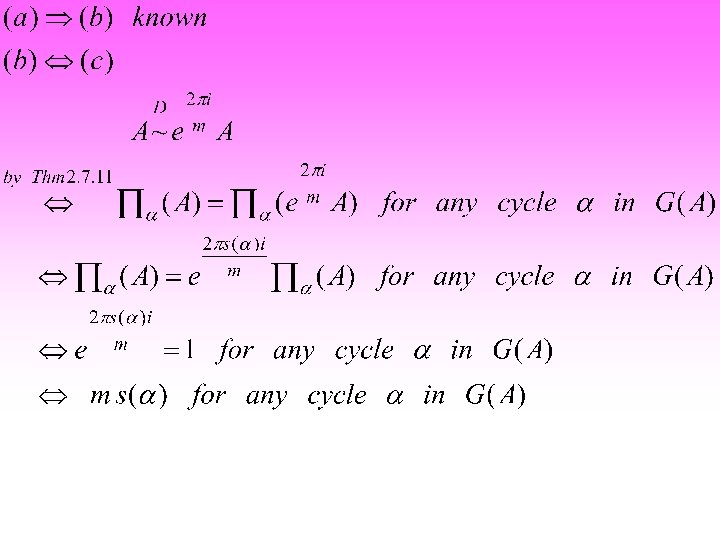
Theorem 2. 7. 11 Let A and B are diagonally similar and A, B have the same corresponding cycle products.
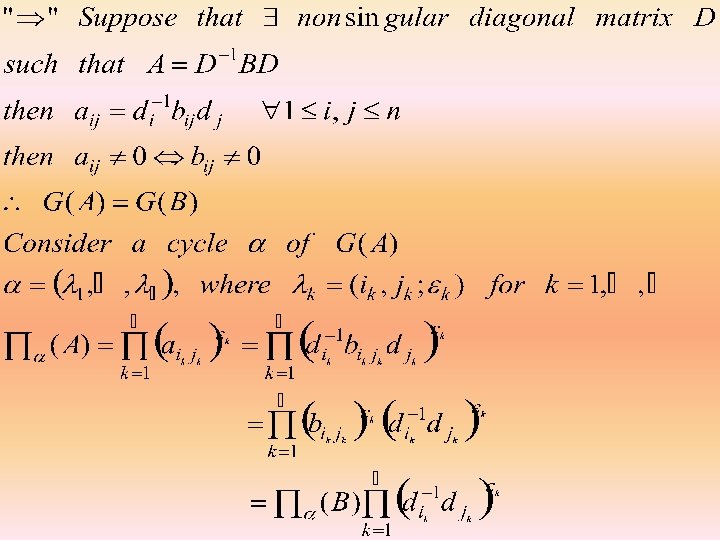
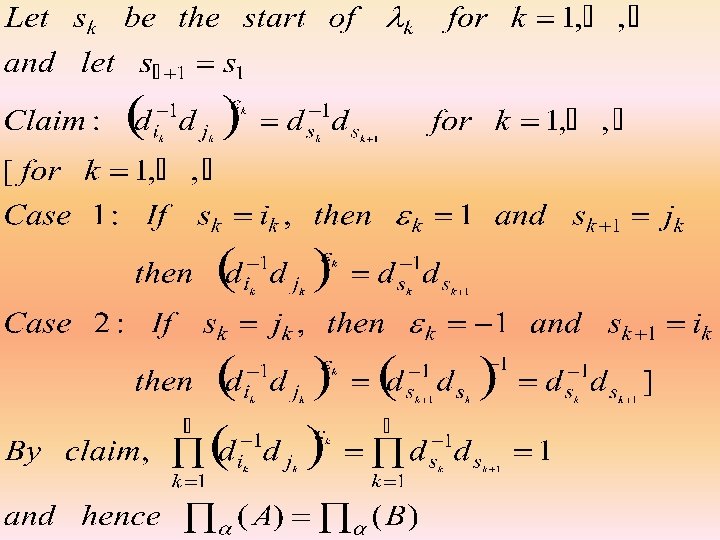
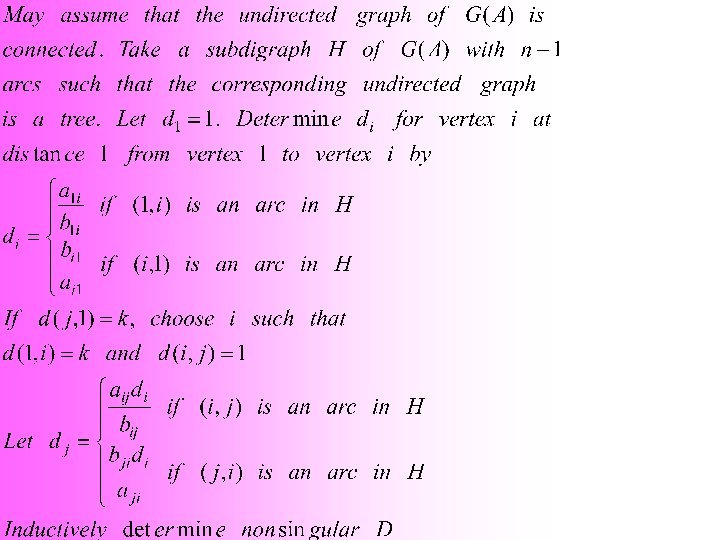
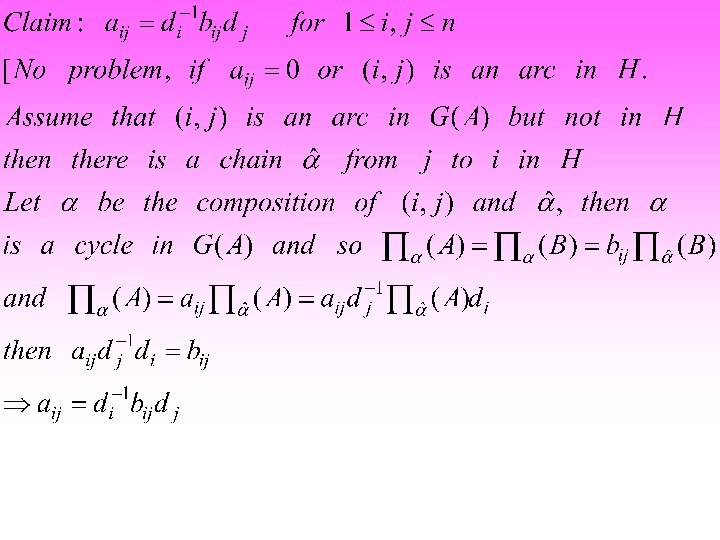
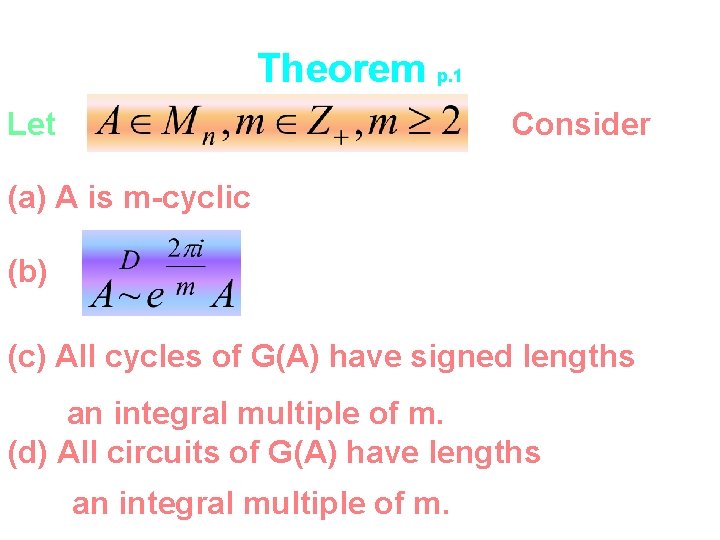
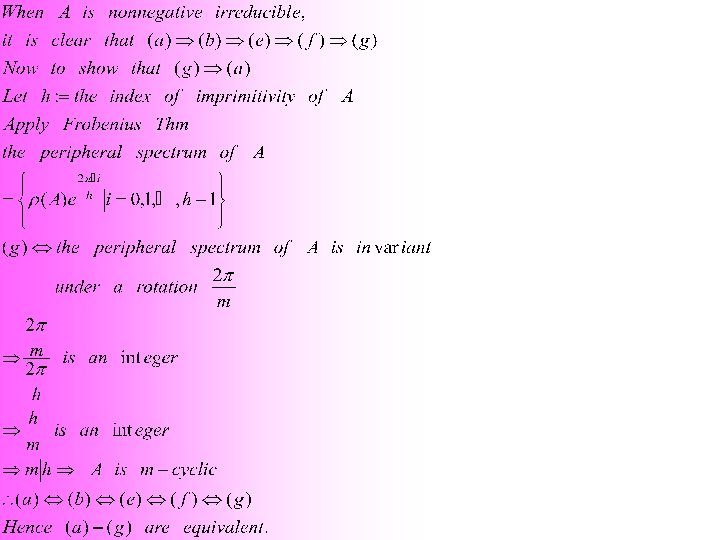
Theorem p. 1 Let Consider (a) A is m-cyclic (b) (c) All cycles of G(A) have signed lengths an integral multiple of m. (d) All circuits of G(A) have lengths an integral multiple of m.
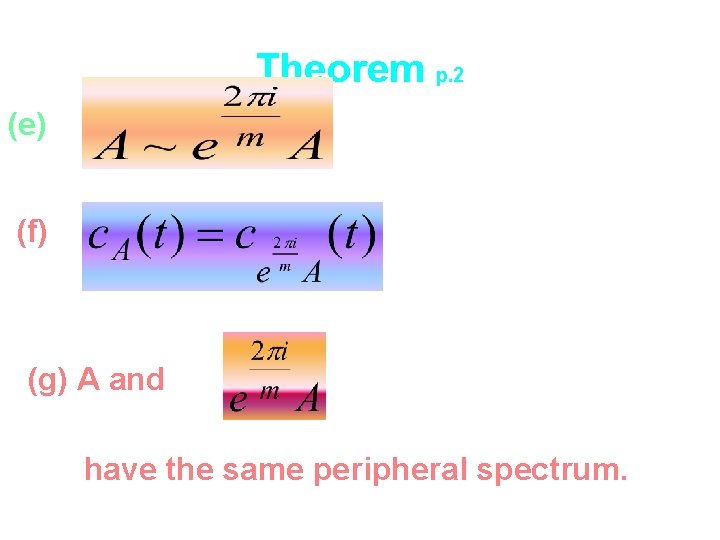
Theorem p. 2 (e) (f) (g) A and have the same peripheral spectrum.
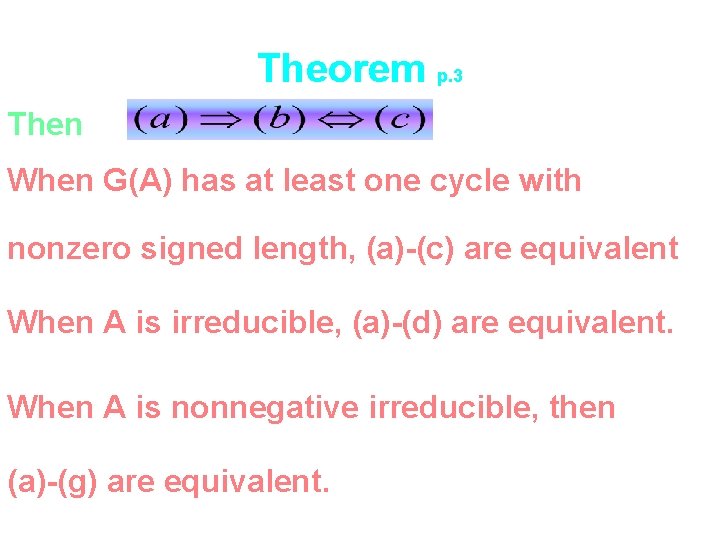
Theorem p. 3 Then When G(A) has at least one cycle with nonzero signed length, (a)-(c) are equivalent When A is irreducible, (a)-(d) are equivalent. When A is nonnegative irreducible, then (a)-(g) are equivalent.

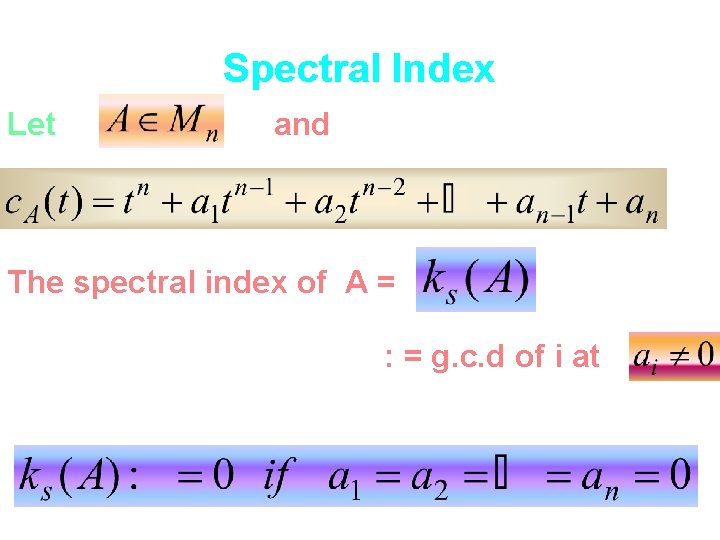
Spectral Index Let and The spectral index of A = : = g. c. d of i at
Combinatorial Spectral Theory of Nonnegative Matrices

- Slides: 54