
Link Layer Multicasting with Smart Antennas No Client




- Slides: 45
Link Layer Multicasting with Smart Antennas: No Client Left Behind Souvik Sen, Jie Xiong, Rahul Ghosh, Romit Roy Choudhury 1
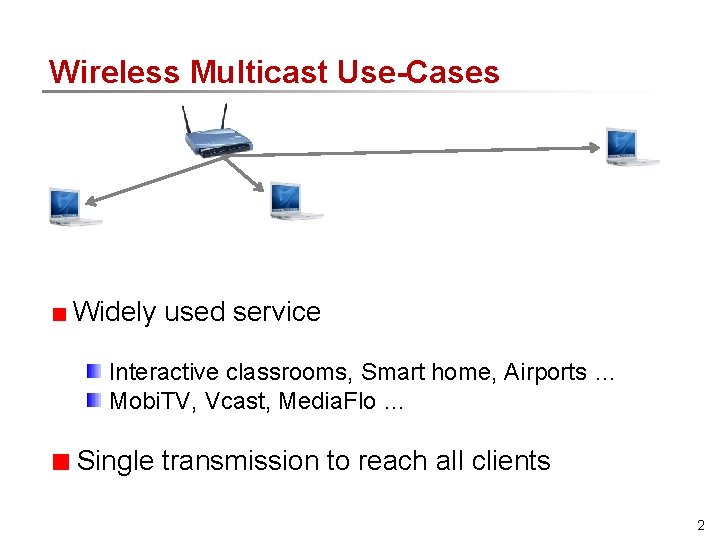
Wireless Multicast Use-Cases Widely used service Interactive classrooms, Smart home, Airports … Mobi. TV, Vcast, Media. Flo … Single transmission to reach all clients 2
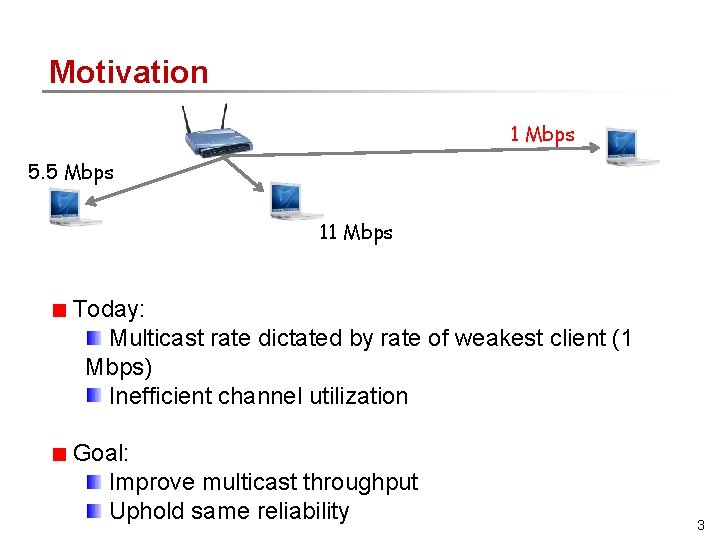
Motivation 1 Mbps 5. 5 Mbps 11 Mbps Today: Multicast rate dictated by rate of weakest client (1 Mbps) Inefficient channel utilization Goal: Improve multicast throughput Uphold same reliability 3
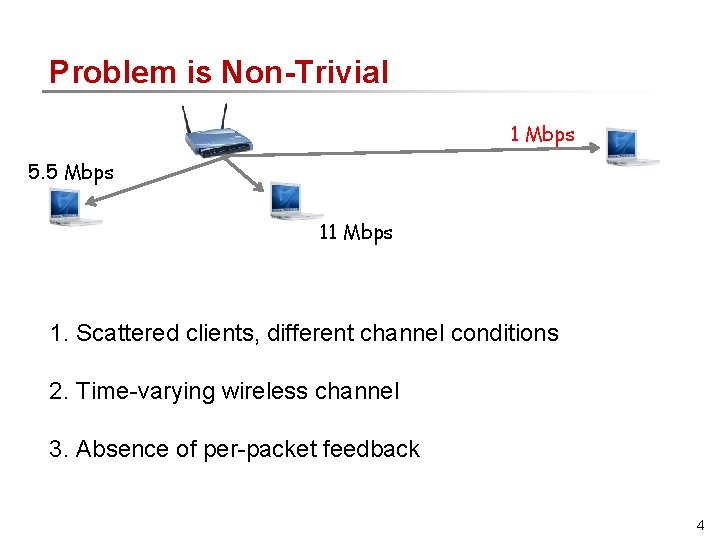
Problem is Non-Trivial 1 Mbps 5. 5 Mbps 11 Mbps 1. Scattered clients, different channel conditions 2. Time-varying wireless channel 3. Absence of per-packet feedback 4
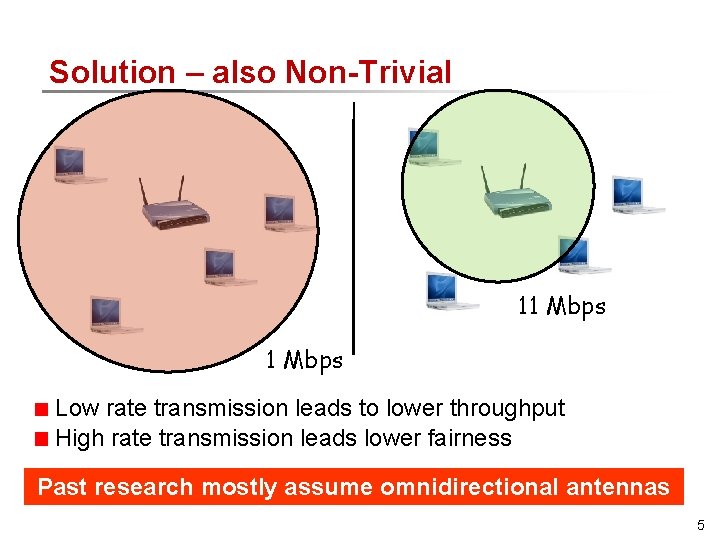
Solution – also Non-Trivial 11 Mbps Low rate transmission leads to lower throughput High rate transmission leads lower fairness Past research mostly assume omnidirectional antennas 5
Problem Validation through Measurements 6
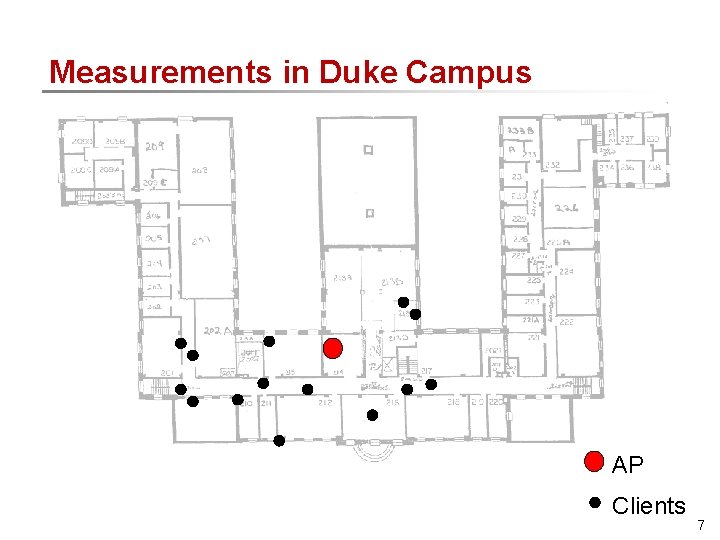
Measurements in Duke Campus AP Clients 7
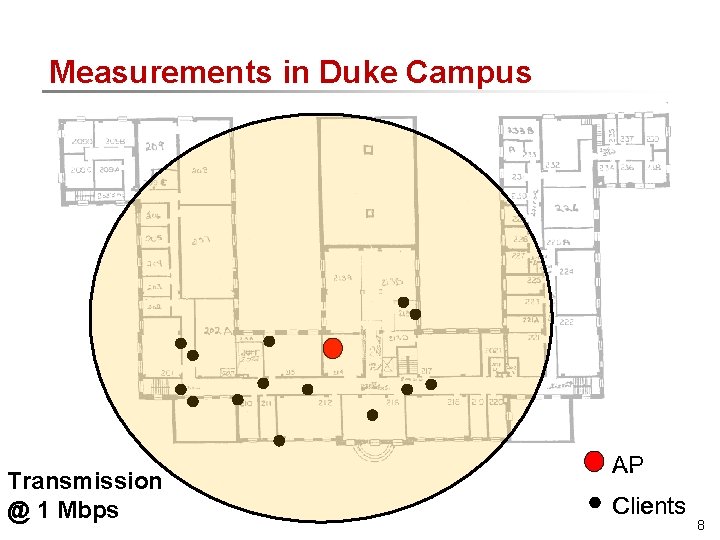
Measurements in Duke Campus Transmission @ 1 Mbps AP Clients 8
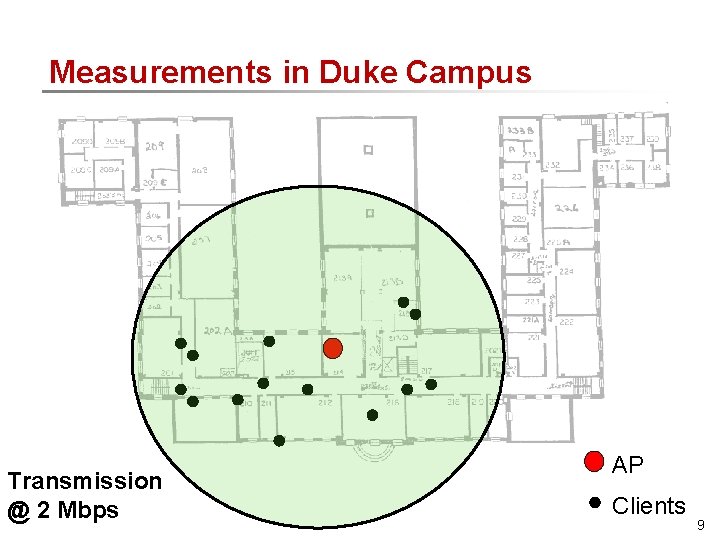
Measurements in Duke Campus Transmission @ 2 Mbps AP Clients 9
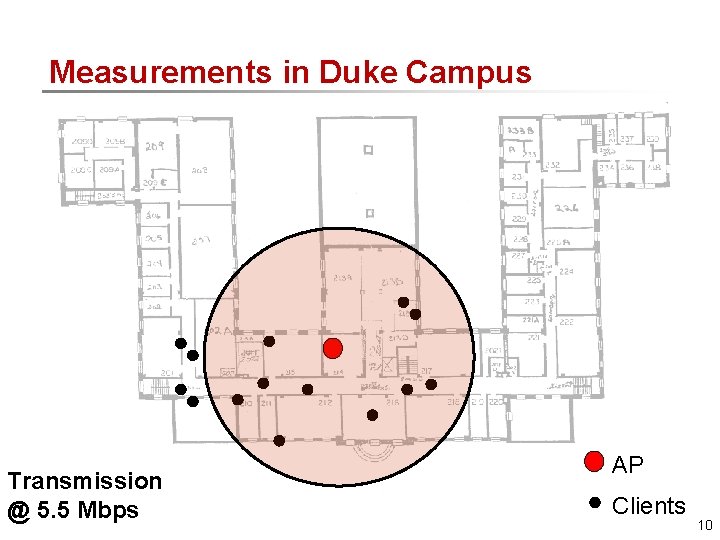
Measurements in Duke Campus Transmission @ 5. 5 Mbps AP Clients 10
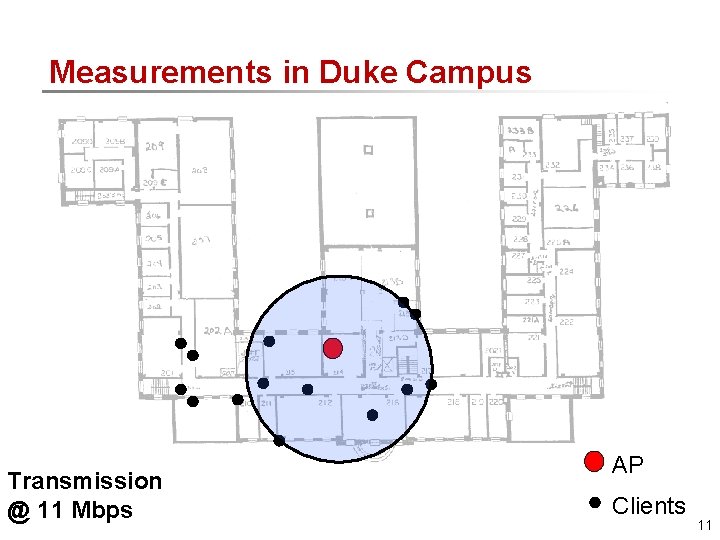
Measurements in Duke Campus Transmission @ 11 Mbps AP Clients 11
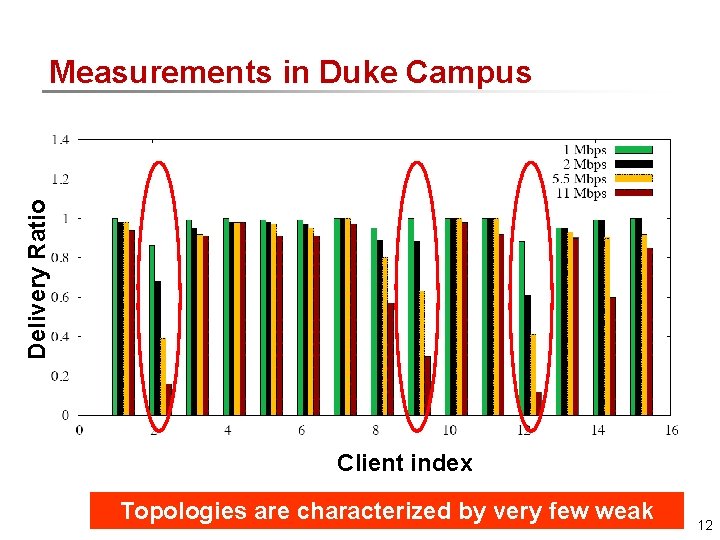
Delivery Ratio Measurements in Duke Campus Client index Topologies are characterized by very few weak 12
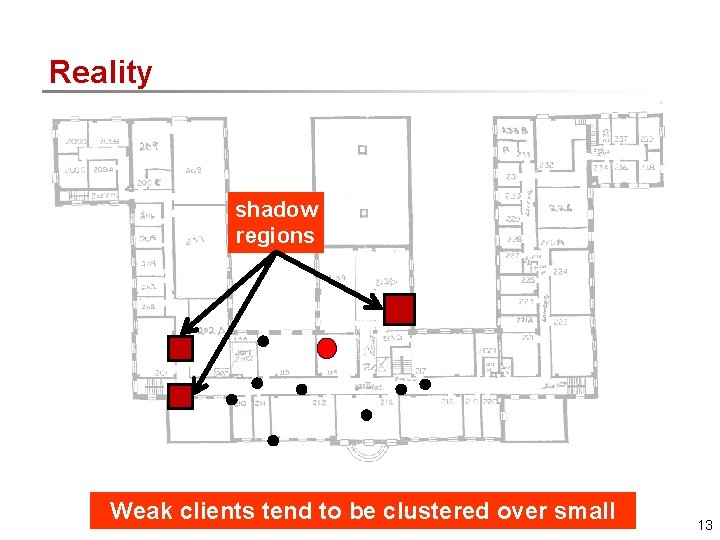
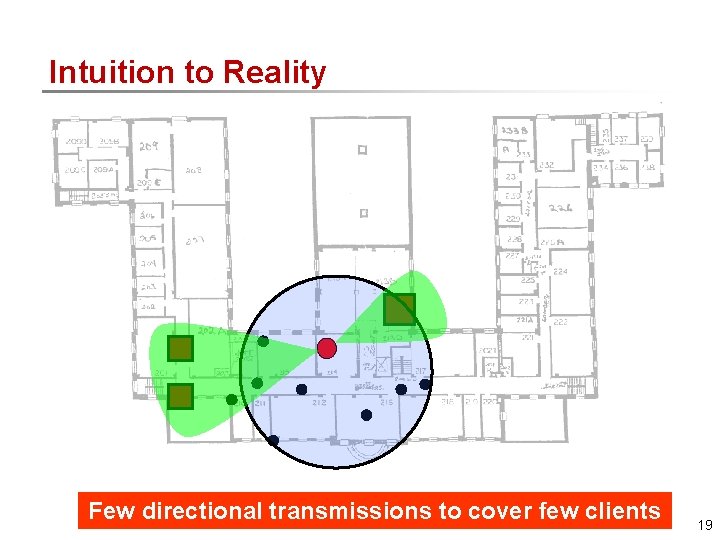
Reality shadow regions Weak clients tend to be clustered over small 13
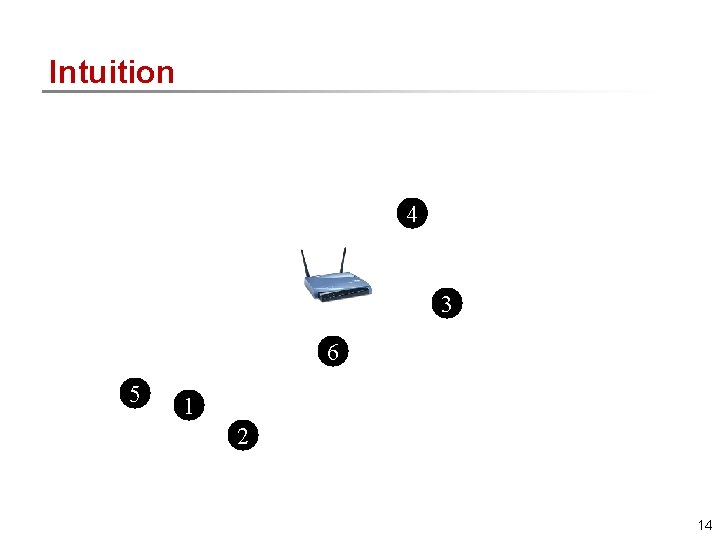
Intuition 4 3 6 5 1 2 14
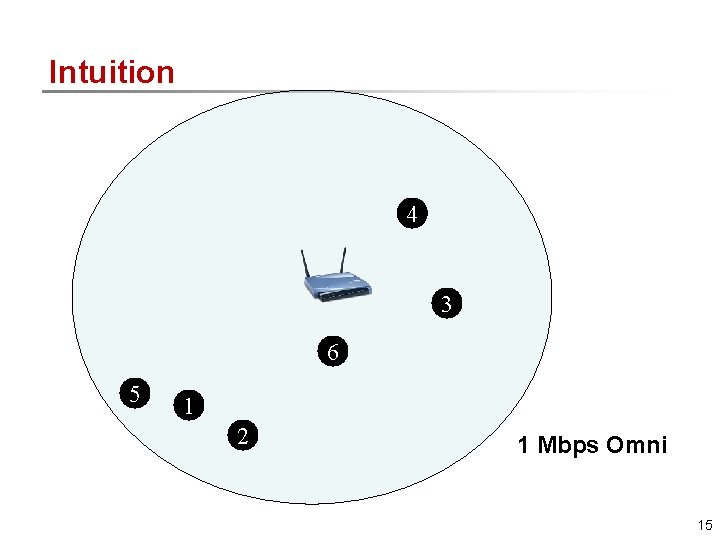
Intuition 4 3 6 5 1 2 1 Mbps Omni 15
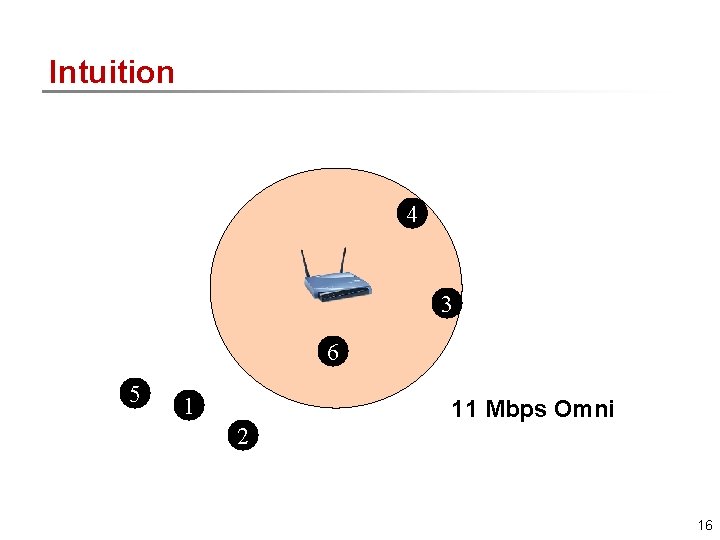
Intuition 4 3 6 5 1 11 Mbps Omni 2 16
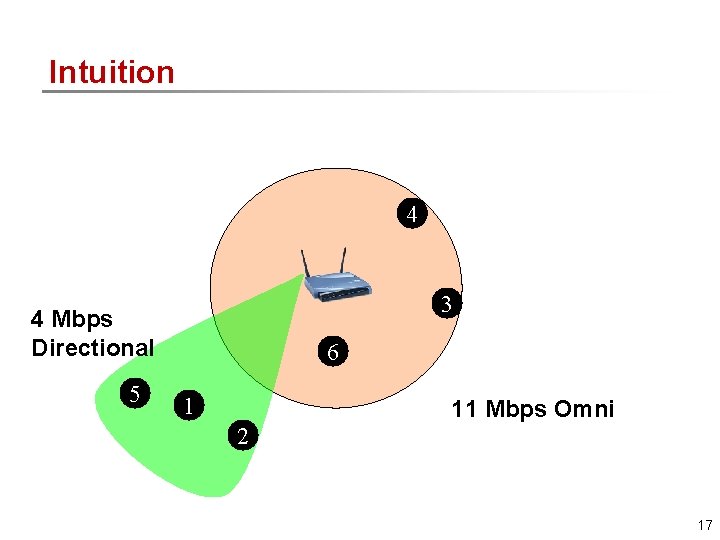
Intuition 4 3 4 Mbps Directional 5 6 1 11 Mbps Omni 2 17
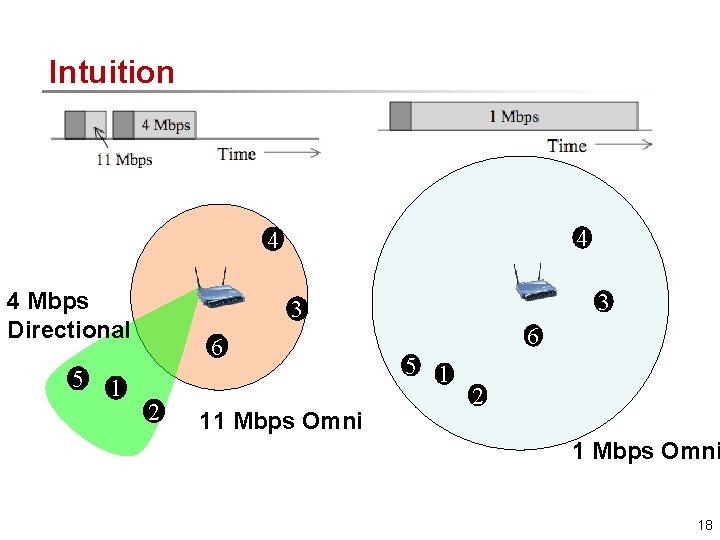
Intuition 4 4 4 Mbps Directional 5 1 3 3 6 2 11 Mbps Omni 6 5 1 2 1 Mbps Omni 18
Intuition to Reality Few directional transmissions to cover few clients 19
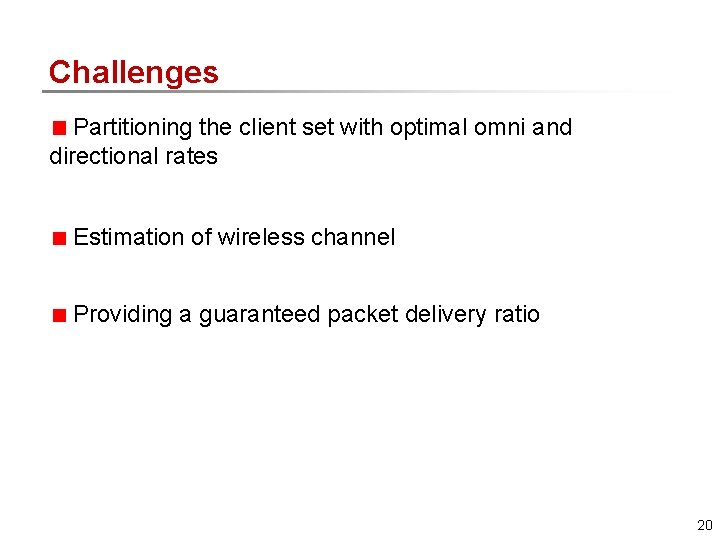
Challenges Partitioning the client set with optimal omni and directional rates Estimation of wireless channel Providing a guaranteed packet delivery ratio 20
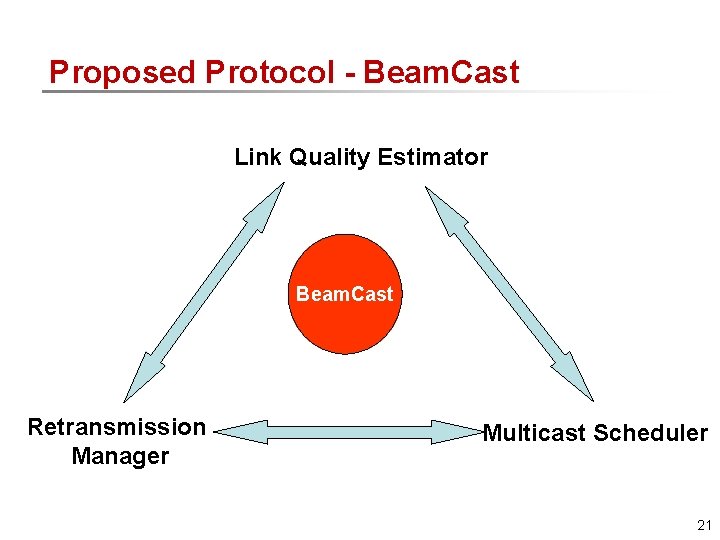
Proposed Protocol - Beam. Cast Link Quality Estimator Beam. Cast Retransmission Manager Multicast Scheduler 21
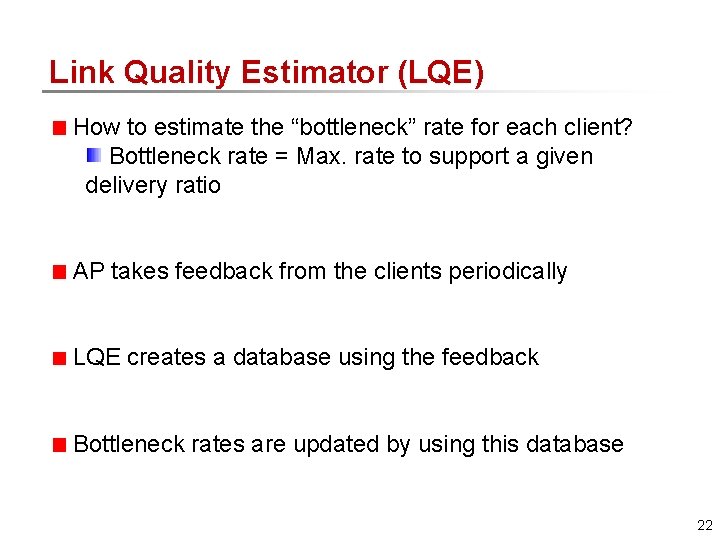
Link Quality Estimator (LQE) How to estimate the “bottleneck” rate for each client? Bottleneck rate = Max. rate to support a given delivery ratio AP takes feedback from the clients periodically LQE creates a database using the feedback Bottleneck rates are updated by using this database 22
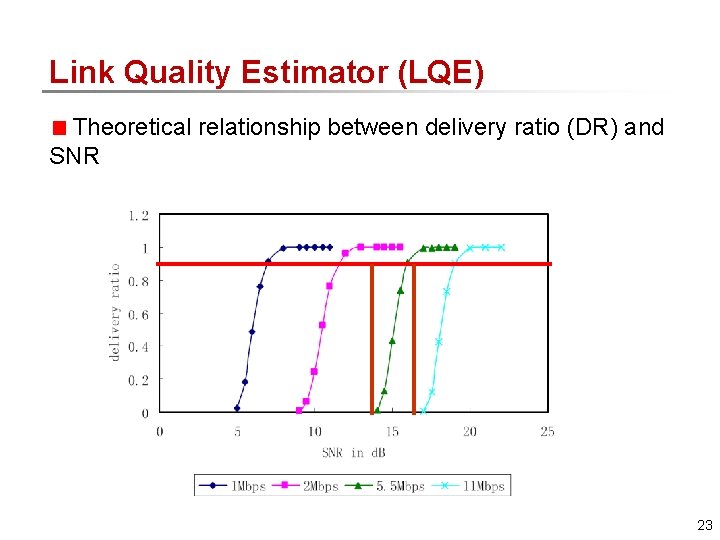
Link Quality Estimator (LQE) Theoretical relationship between delivery ratio (DR) and SNR 23
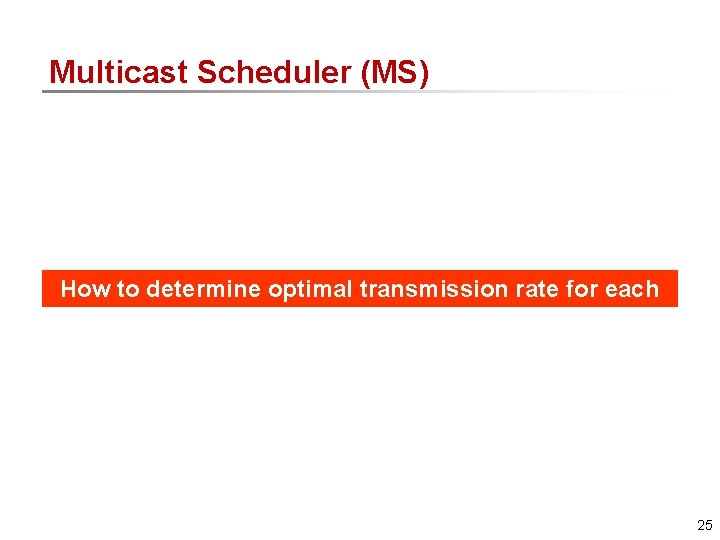
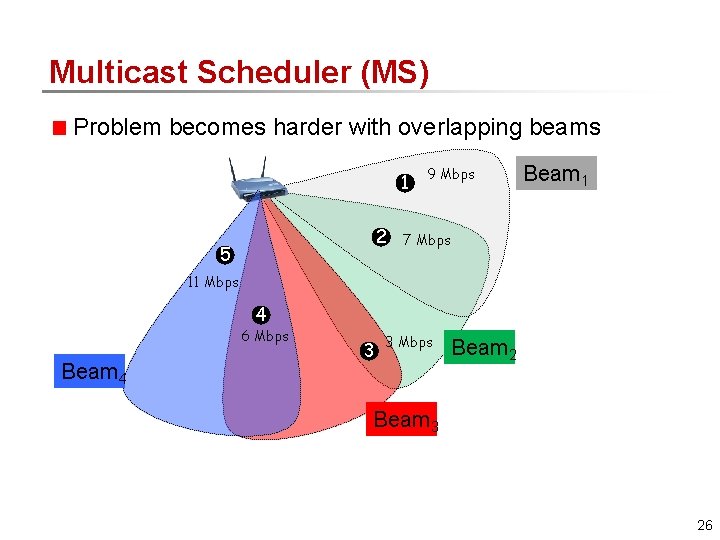
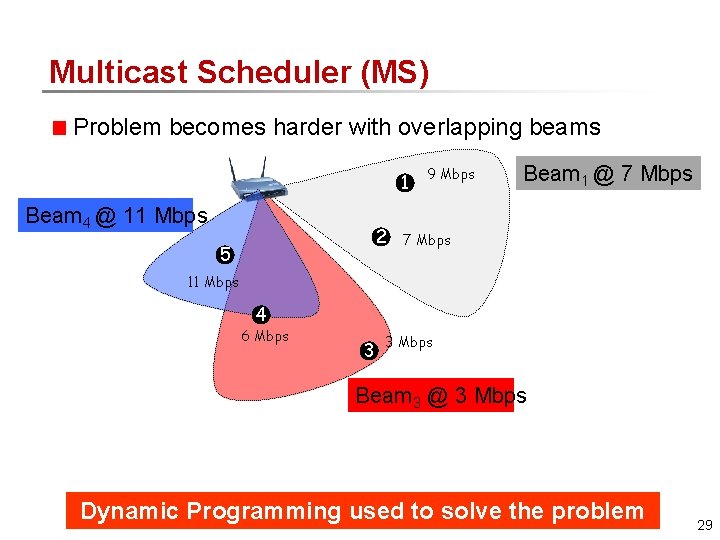
Multicast Scheduler (MS) How to determine optimal transmission schedule? A schedule = 1 omni + many directional transmissions Optimal schedule = Schedule with minimum transmission time MS extracts distinct client data rates from feedback We assume, Beamforming rate = F x Omnidirectional rate ; F> 24
Multicast Scheduler (MS) How to determine optimal transmission rate for each beam? 25
Multicast Scheduler (MS) Problem becomes harder with overlapping beams 1 2 5 9 Mbps Beam 1 7 Mbps 11 Mbps 4 6 Mbps Beam 4 3 3 Mbps Beam 2 Beam 3 26
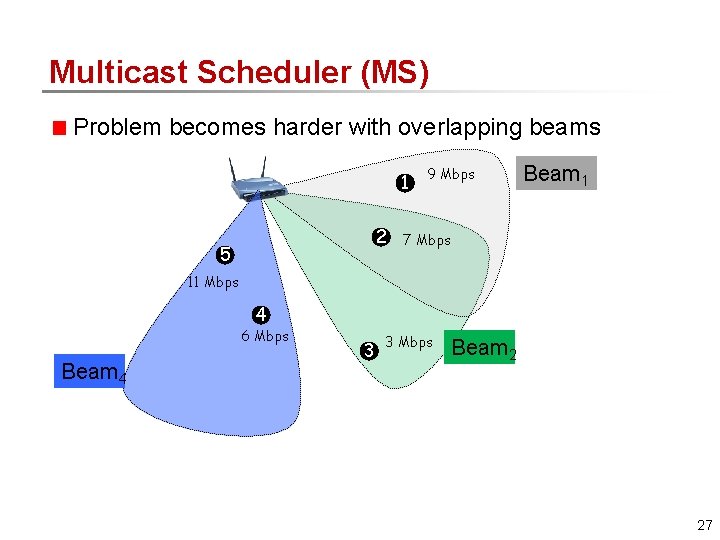
Multicast Scheduler (MS) Problem becomes harder with overlapping beams 1 2 5 9 Mbps Beam 1 7 Mbps 11 Mbps 4 6 Mbps Beam 4 3 3 Mbps Beam 2 27
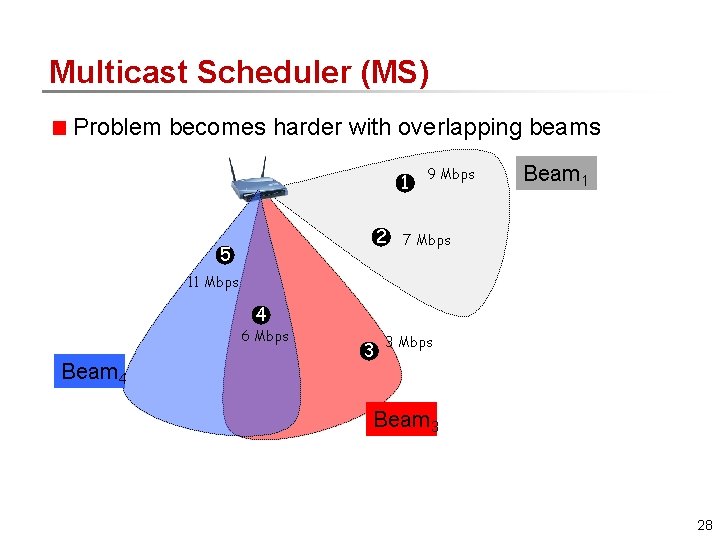
Multicast Scheduler (MS) Problem becomes harder with overlapping beams 1 2 5 9 Mbps Beam 1 7 Mbps 11 Mbps 4 6 Mbps Beam 4 3 3 Mbps Beam 3 28
Multicast Scheduler (MS) Problem becomes harder with overlapping beams 1 Beam 4 @ 11 Mbps 2 5 9 Mbps Beam 1 @ 7 Mbps 11 Mbps 4 6 Mbps 3 3 Mbps Beam 3 @ 3 Mbps Dynamic Programming used to solve the problem 29
Retransmission Manager To cope with packet loss Receives lost packet information from the clients periodically Retransmits a subset of lost packets Choose packets using a simple heuristic 30
Evaluation Qualnet simulation Comparison with Feedback enabled 802. 11 Main Parameters : 1. Dynamic channels : Rayleigh, Rician fading; External interference 2. Antenna beamwidth: 45 o, 60 o, 90 o 3. Factor of rate improvement with beamforming: 3, 4 Metrics : Throughput, Delivery Ratio, Fairness Application specified Minimum Delivery Ratio: 90% 31
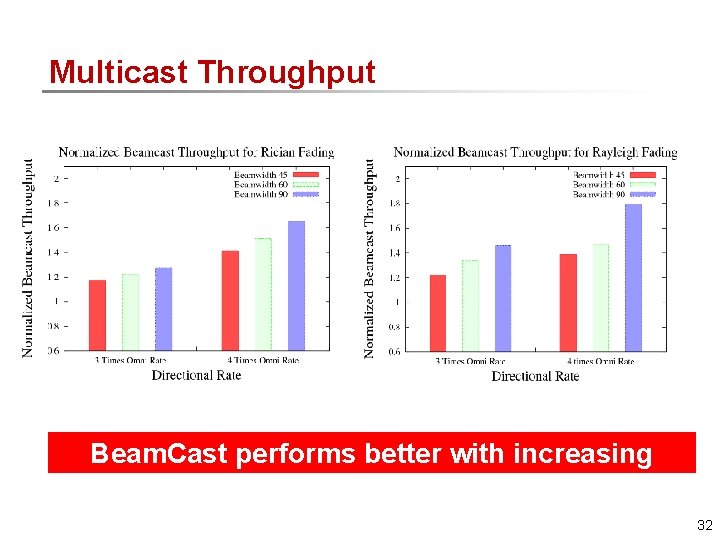
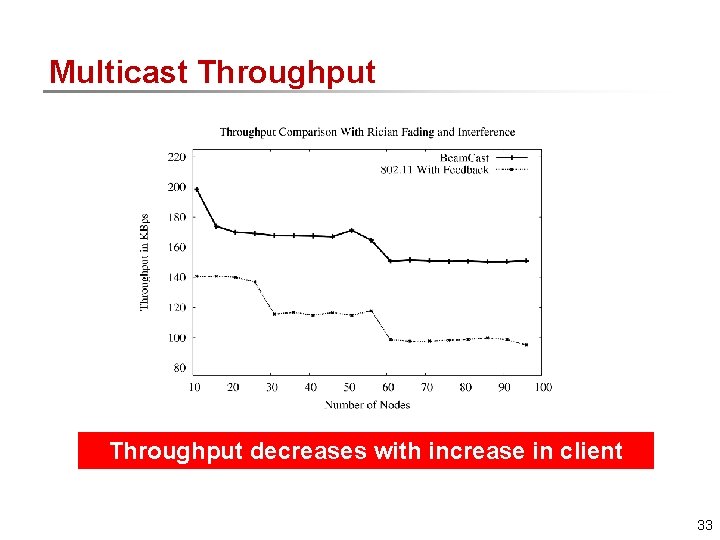
Multicast Throughput Beam. Cast performs better with increasing Fading ! 32
Multicast Throughput decreases with increase in client density 33
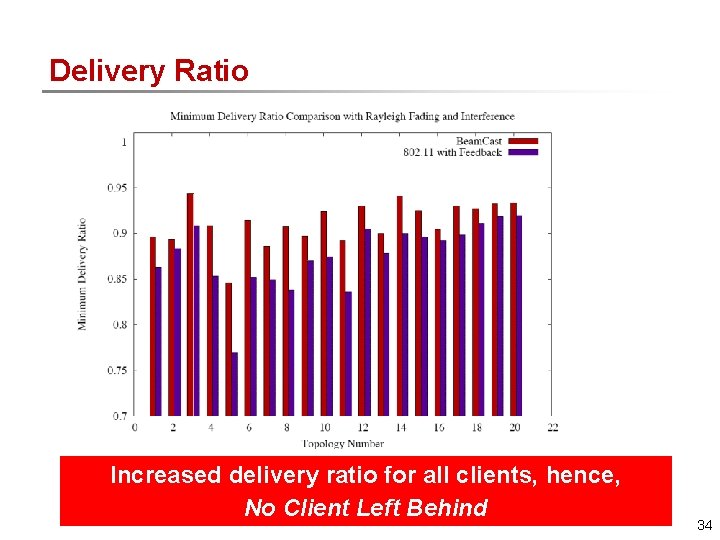
Delivery Ratio Increased delivery ratio for all clients, hence, No Client Left Behind 34
Limitations Switching delay has been assumed to be negligible Rate reduction for both fading and interference Requires link layer loss discrimination Focuses on “one-AP-many-clients” scenario Multi-AP environment will require coordination Ideas can be extended to EWLAN architectures Controller assisted scheduling – better interference mitigation 35
Conclusions Opportunistic beamforming for wireless multicasting Multiple high rate directional vs. a single omni transmission Rate estimation, scheduling and retransmission to achieve high throughput at a specified delivery ratio A potential tool for next generation wireless multicast 36
Thanks ! 37
Questions or Thoughts ? ? 38
Smart Antennas in Multicast Jaikeo et. al talk about multicasting in ad-hoc networks -Assume multi-beam antenna model -Provide an analysis for collision probability -Do not consider asymmetry in transmission range Ge et. al characterize optimal transmission rates -Discuss throughput and stability tradeoff Papathanasiou et. al discuss multicast in IEEE 802. 11 n based network -Minimize total Tx power but still provides a guaranteed SNR -Assume perfect channel state information is available 39
System Settings We assume IEEE 802. 11 based WLANs Beamforming antennas are mounted on access points (AP) Clients are equipped with simple omnidirectional antennas Clients are scattered around AP and remain stationary Surrounding is characterized by wireless multipath and shadowing effects 40
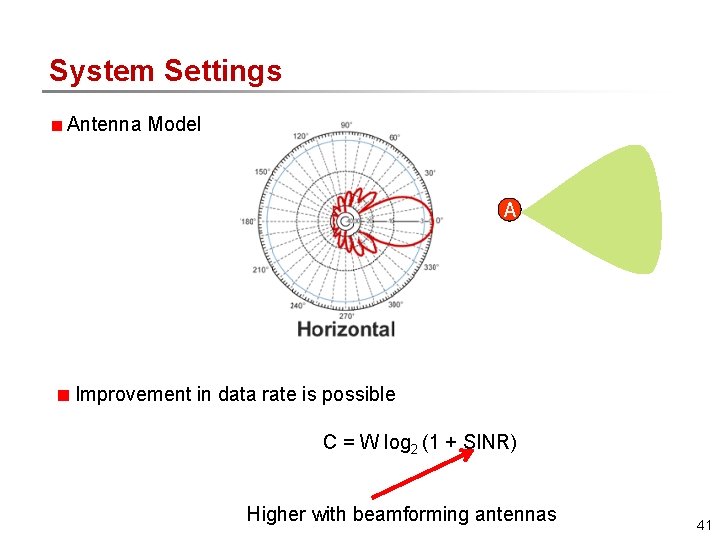
System Settings Antenna Model A Improvement in data rate is possible C = W log 2 (1 + SINR) Higher with beamforming antennas 41
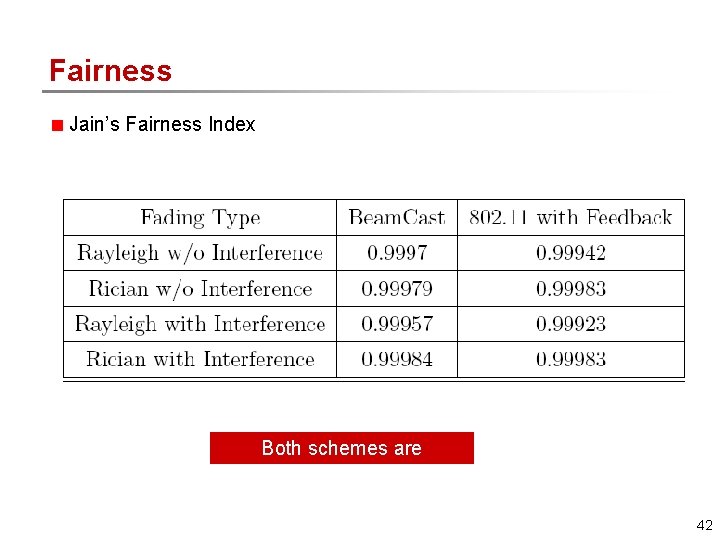
Fairness Jain’s Fairness Index Both schemes are comparable 42
Title Body 43
Title Body 44
Title Body 45