
Linguistics of Kinyarwanda Kyle Jerro University of Texas



- Slides: 11
Linguistics of Kinyarwanda Kyle Jerro University of Texas at Austin MURI Annual Meeting November 2, 2012
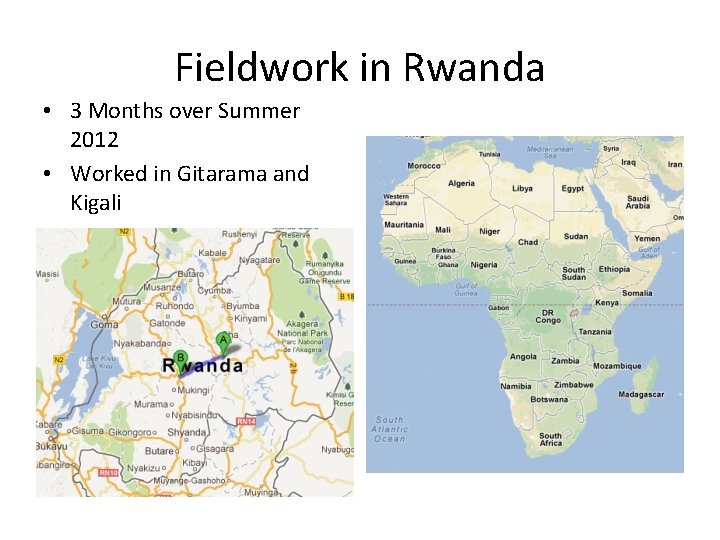
Fieldwork in Rwanda • 3 Months over Summer 2012 • Worked in Gitarama and Kigali
What We’ve Learned About Kinyarwanda: • Locative morphology has lost its prior grammatical function • Disentangled phonological processes on certain lexical stems • Serial verbs 1) exist and 2) are more complicated than in other Bantu • Animals are actually humans
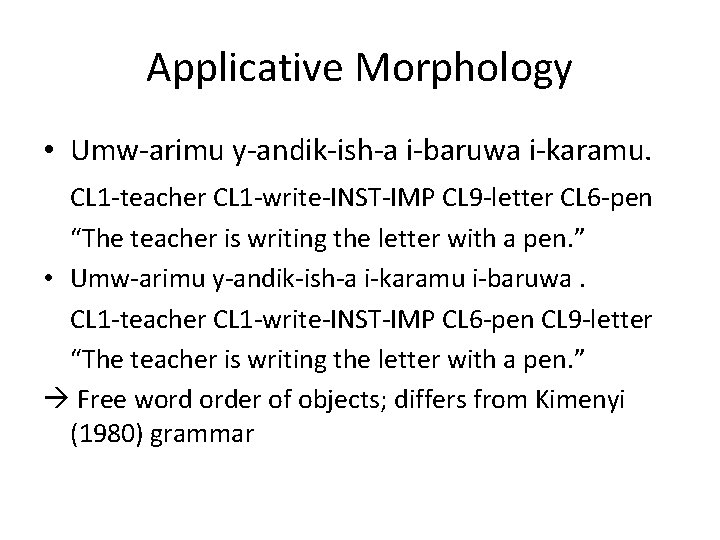
Applicative Morphology • Umw-arimu y-andik-ish-a i-baruwa i-karamu. CL 1 -teacher CL 1 -write-INST-IMP CL 9 -letter CL 6 -pen “The teacher is writing the letter with a pen. ” • Umw-arimu y-andik-ish-a i-karamu i-baruwa. CL 1 -teacher CL 1 -write-INST-IMP CL 6 -pen CL 9 -letter “The teacher is writing the letter with a pen. ” Free word order of objects; differs from Kimenyi (1980) grammar
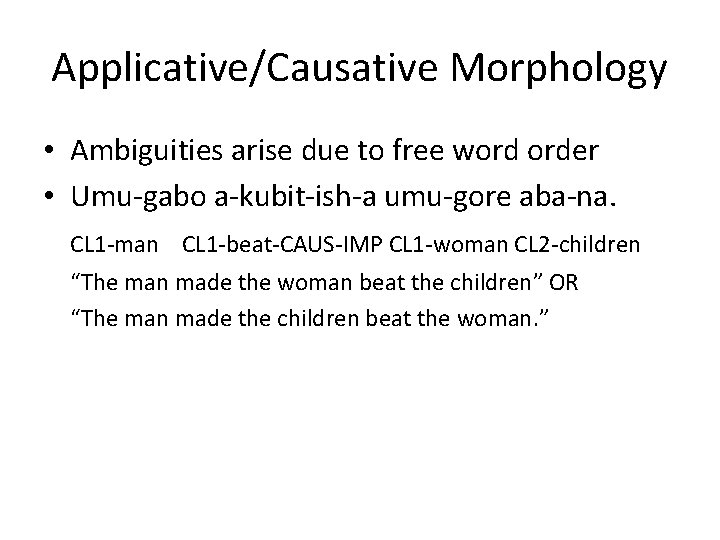
Applicative/Causative Morphology • Ambiguities arise due to free word order • Umu-gabo a-kubit-ish-a umu-gore aba-na. CL 1 -man CL 1 -beat-CAUS-IMP CL 1 -woman CL 2 -children “The man made the woman beat the children” OR “The man made the children beat the woman. ”
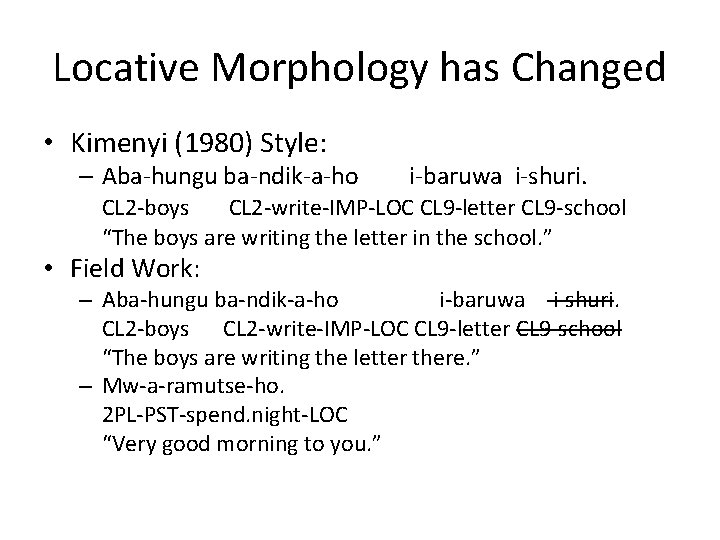
Locative Morphology has Changed • Kimenyi (1980) Style: – Aba-hungu ba-ndik-a-ho i-baruwa i-shuri. CL 2 -boys CL 2 -write-IMP-LOC CL 9 -letter CL 9 -school “The boys are writing the letter in the school. ” • Field Work: – Aba-hungu ba-ndik-a-ho i-baruwa i-shuri. CL 2 -boys CL 2 -write-IMP-LOC CL 9 -letter CL 9 -school “The boys are writing the letter there. ” – Mw-a-ramutse-ho. 2 PL-PST-spend. night-LOC “Very good morning to you. ”
Lexical Stems • Lexical stem alternation of transitivity marked with /r/ (intransitive) and /z/ (transitive) – E. g. kw-icar-a `to sit (intr)’ kw-icaz-a `to seat (tr)’ kw-itsamur-a `sneeze (intr)’ kw-itsamuz-a `sneeze (tr)’ Spans a variety of lexical classes, verb types, lexical alternations
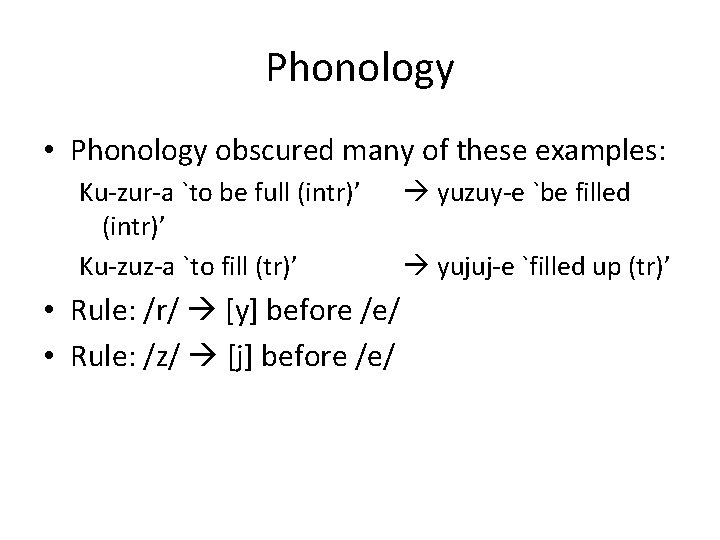
Phonology • Phonology obscured many of these examples: Ku-zur-a `to be full (intr)’ Ku-zuz-a `to fill (tr)’ • Rule: /r/ [y] before /e/ • Rule: /z/ [j] before /e/ yuzuy-e `be filled yujuj-e `filled up (tr)’
Serial Verbs • Umu-hungu a-ra-ririmbir-a a-ra-rangur-a. CL 1 -boy CL 1 -PRES-sing-IMP CL 1 -PRES-loudly-IMP “The boy is singing loudly. ” • Only a handful of English-style adverbs exist – Cyane (many), ejo (yesterday/tomorrow)
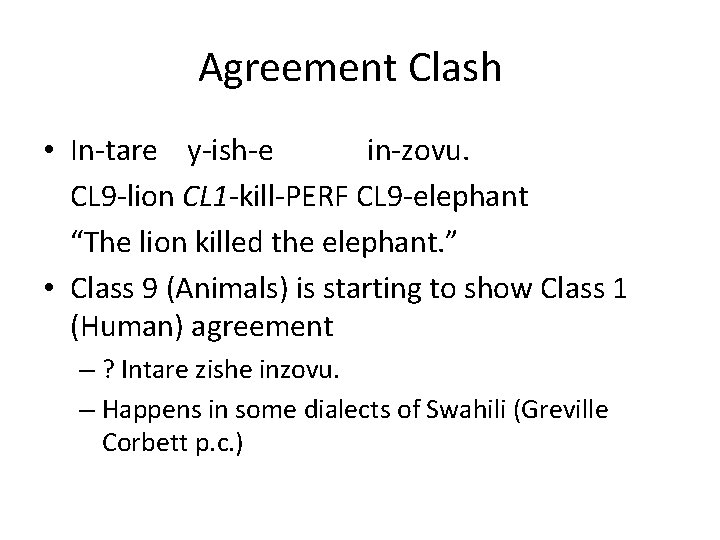
Agreement Clash • In-tare y-ish-e in-zovu. CL 9 -lion CL 1 -kill-PERF CL 9 -elephant “The lion killed the elephant. ” • Class 9 (Animals) is starting to show Class 1 (Human) agreement – ? Intare zishe inzovu. – Happens in some dialects of Swahili (Greville Corbett p. c. )
Conclusion • Fieldwork and corpora studies have illuminated an array of undocumented structures. • This new linguistic knowledge is crucial for correctly modeling the language, be it for theoretic or computational purposes.