
LINGUISTICS OF GERMAN AND FRENCH By MarcalJoachim Lucas
LINGUISTICS OF GERMAN AND FRENCH By Marcal/Joachim Lucas Verardo
Some Important Terms Phonology- The study of sound patterns in a language Morphology- The study of word formation of a language Case- Any addition to a noun stem to change its meaning Syntax- General term for layout of grammar and word order
Indo-European Evolved 7000 B. C. in present-day Ukraine Spread to Europe and Asia by 2500 B. C. Became the root of many major languages Proto-Indo-European Common Indo-European
Characteristics Case System 3 voices: Active, Consisted of 8 cases. passive, and middle (reflexive) 5 vowel sounds 5 Moods: Indicative, Inflected Subjunctive, pronunciation Optative, Imperative, Six verb tenses Injunctive Flexible word order 3 Genders (SOV)
Branches of Indo-European Twelve major branches, only ten have surviving languages Celtic, Germanic, Slavic, Baltic, Hellenic, Illyric, Thracian, Iranian, Indic, and Romance Two extinct branches; Anatolian and Tokharian

Proto-Germanic Earliest evolution of Germanic branch languages Believed to have used a system of runes as ideographs Elder Futhark Eventually evolved an alphabet No writings ever found
German Considered a root language of the Germanic branch Broke apart- First and Second Germanic Sound Shifts cause a number of distinct dialects to appear
German vs. Indo-European Germanic contains three genders Only contains 4 cases: Nominative, Accusative, Genitive and Dative Verbs conjugate into three moods, two voices, and six tenses Word order Separable prefixes
German Dialects High German. Spoken by a majority of Germans Low German. Evolved in the Lowlands. Different enough in form to be regarded bilingual. Four main varieties: Hochdeutch (High German), Mitteldeutch (Middle German), Niederdeutch (Low German) and Plattdeutch (Flat German)
French First language of 77 million speakers 3 rd most spoken language in the EU after German and English Sixteen possible vowel sounds Five distinct accents: aigu, grave, le trema, la circonflex, and la cedille
French Evolution Began evolving in 57 B. C. Romans invade area known as Gaul, populated by Celts at the time. Later, Germanic Franks invaded Northern France. Surviving Latin combined with Frankish and Celtic languages
French vs. Indo-European Only two genders for nouns No surviving case system Verbs are conjugated with 7 moods, 5 tenses, and 3 voices. Moderate inflection Semi-rigid word order
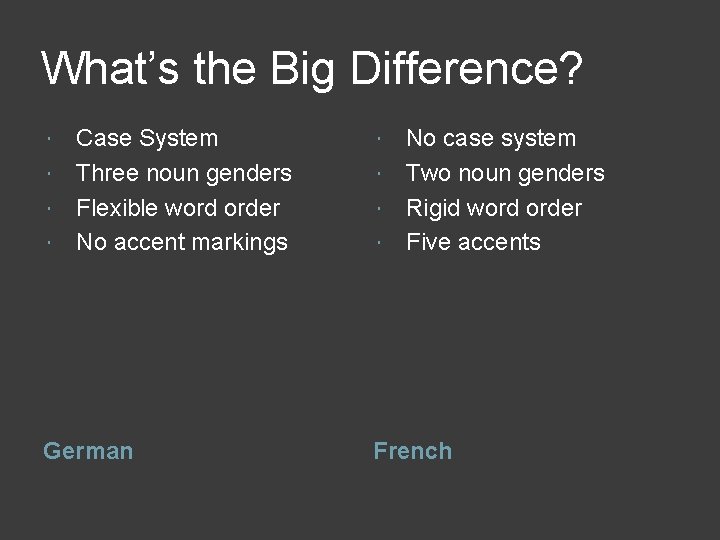
What’s the Big Difference? Case System Three noun genders Flexible word order No accent markings No case system Two noun genders Rigid word order Five accents German French
Similarities French and German have several similarities. Phonologically similar Morphological similarities- mostly shared vocabulary Verb tenses and moods Sentence structure
Works cited http: //www. lrz-muenchen. de/~hr/lang/dthist. html http: //www. alsintl. com/resources/languages /German/ http: //www. krysstal. com/langfams_indoeuro. html http: //www. discoverfrance. net/France/Lang uage/DF_language. shtml http: //f 99. middlebury. edu/RU 232 A/STUDE NTS/matranga/history. htm http: //www. frenchlanguageguide. com/frenc h/facts/history/
- Slides: 15