
Linguistics Basic Grammatical Terminology Review Home Educ 4683
Linguistics: Basic Grammatical Terminology Review Home Educ 4683 Dr. David Piper & Krista Yetman
Select for Review • Definitions of terms • Word classes • Nouns, pronouns & determiners • Adjectives, verbs & adverbs Home • Prepositions, conjunctions & exclamations • Subject, predicate & object • Transitivity • Other rules & definitions
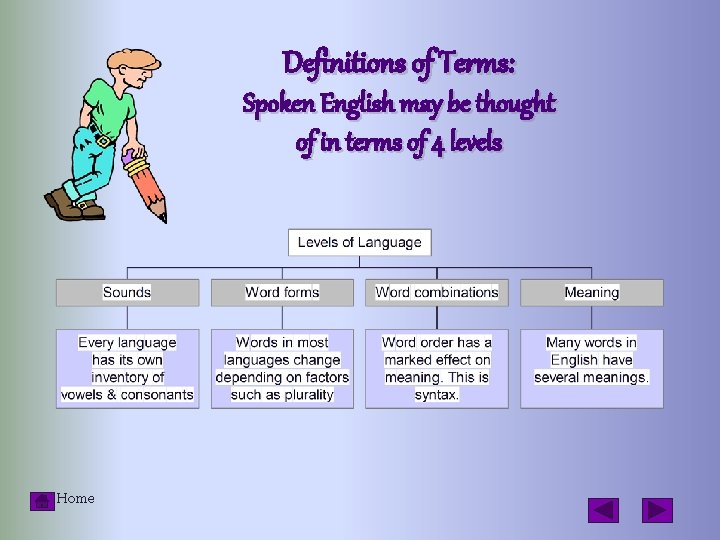
Definitions of Terms: Spoken English may be thought of in terms of 4 levels Home
Word Classes Home Examples
Nouns, determiners & pronouns Click button of choice: • Nouns • Determiners • Pronouns • Skip to Adjectives Home
Nouns (in English) • Nouns can be singular or plural (‘s’) i. e: ant + s = ants, city + s = cities, glass + s = glasses, mouse + s = mice, life + s = lives, deer + s = deer • Nouns are either masculine (man, bull, boxer), feminine (woman, mare, actress), or neuter (table, flower, book) • Nouns can be possessive i. e. : boy’s, boys’, Charles’s • Nouns are common (book, fly, tree) or proper (Erica, Acadia University, Nigerian, French) Home Return to Noun menu
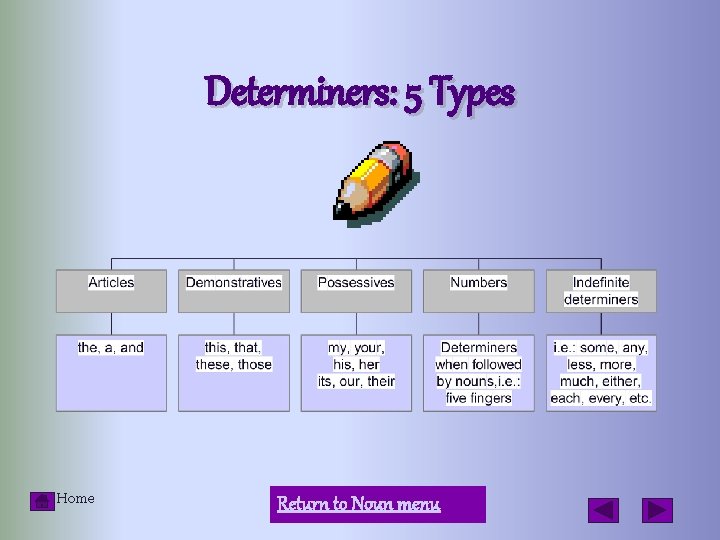
Determiners: 5 Types Home Return to Noun menu
8 types of Pronouns: Select below • • • Home Return to Noun menu Personal Possessive Reflexive Demonstrative Interrogative Relative Distributive Indefinite Skip pronouns
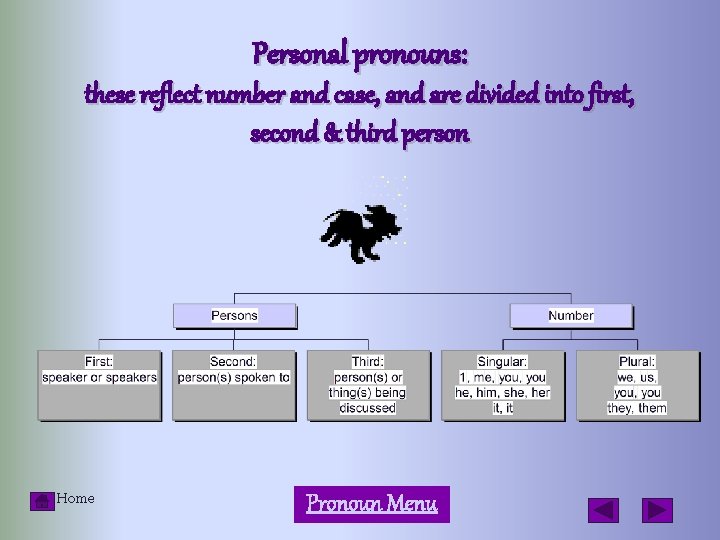
Personal pronouns: these reflect number and case, and are divided into first, second & third person Home Pronoun Menu
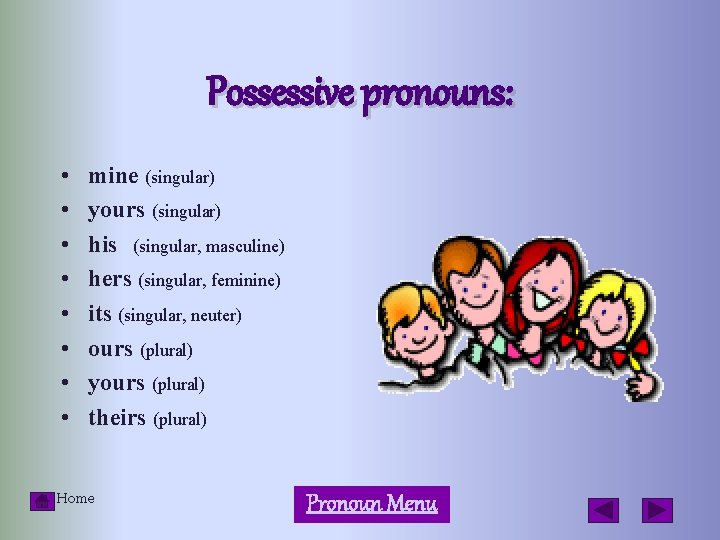
Possessive pronouns: • • mine (singular) yours (singular) his (singular, masculine) hers (singular, feminine) its (singular, neuter) ours (plural) yours (plural) theirs (plural) Home Pronoun Menu
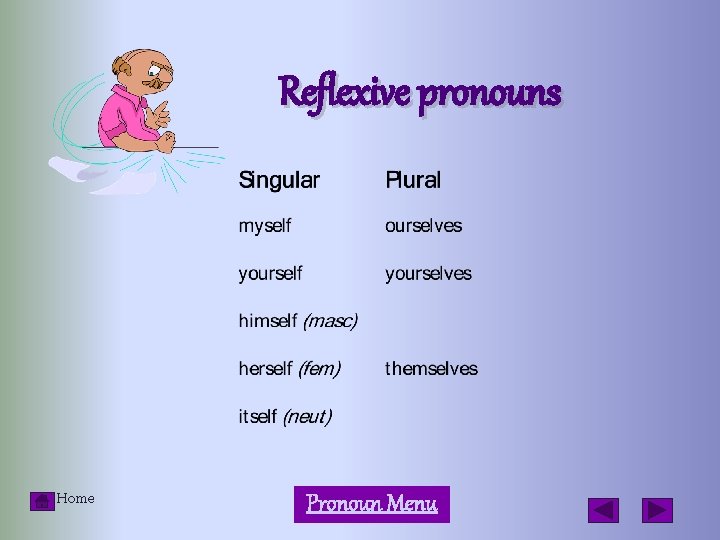
Reflexive pronouns Home Pronoun Menu
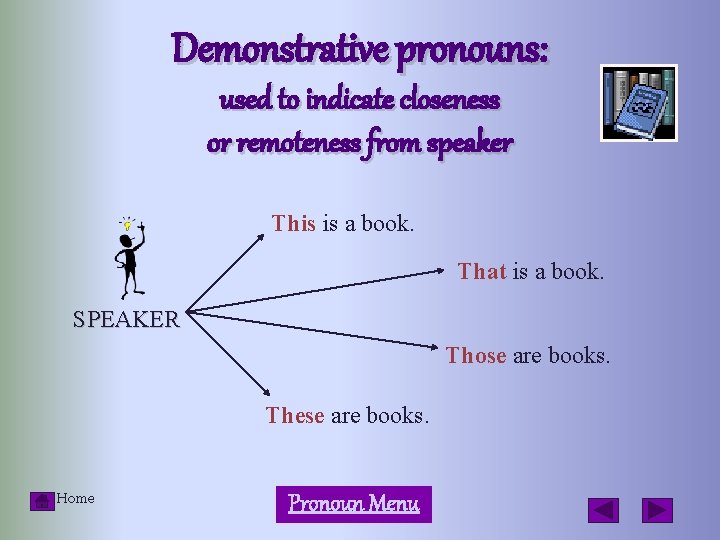
Demonstrative pronouns: used to indicate closeness or remoteness from speaker This is a book. That is a book. SPEAKER Those are books. These are books. Home Pronoun Menu

Interrogative pronouns: Questions words Who Which Whom What Whose Home Pronoun Menu
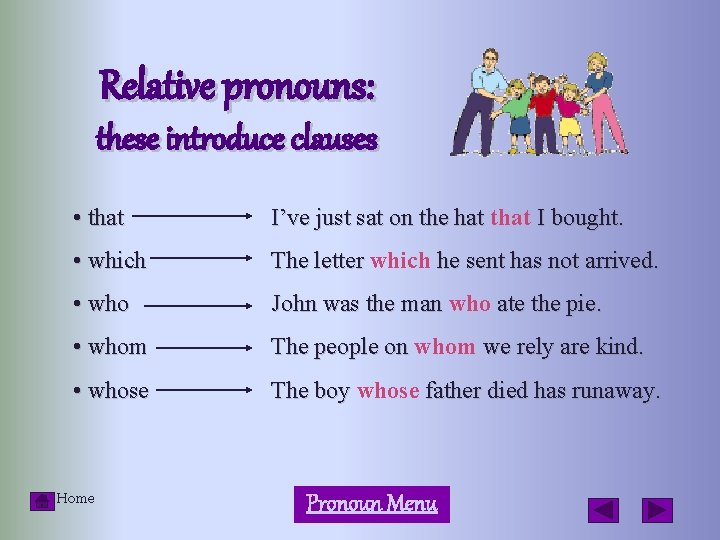
Relative pronouns: these introduce clauses • that I’ve just sat on the hat that I bought. • which The letter which he sent has not arrived. • who John was the man who ate the pie. • whom The people on whom we rely are kind. • whose The boy whose father died has runaway. Home Pronoun Menu
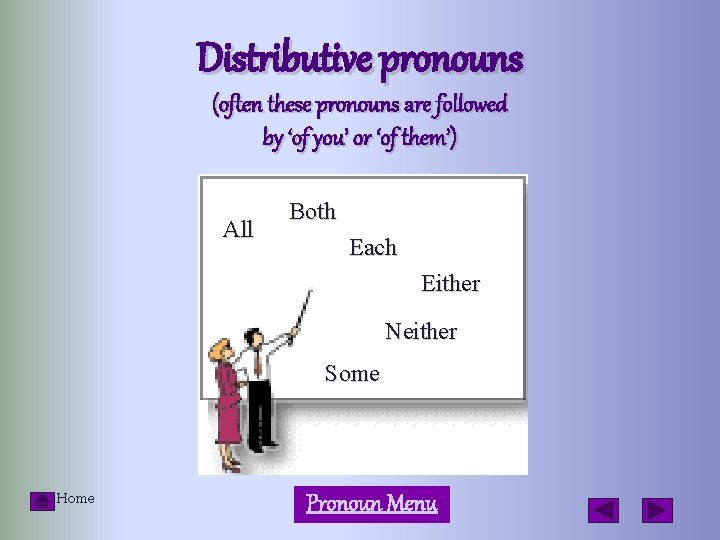
Distributive pronouns (often these pronouns are followed by ‘of you’ or ‘of them’) All Both Each Either Neither Some Home Pronoun Menu
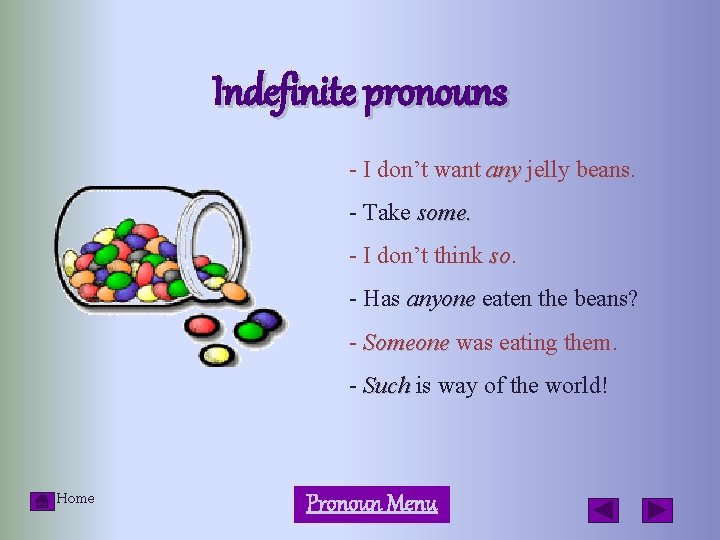
Indefinite pronouns - I don’t want any jelly beans. - Take some. - I don’t think so. so - Has anyone eaten the beans? - Someone was eating them. - Such is way of the world! Home Pronoun Menu
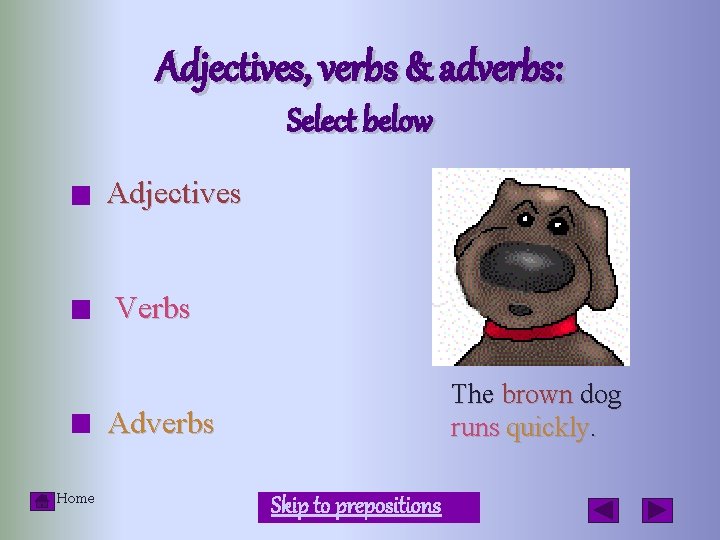
Adjectives, verbs & adverbs: Select below • Adjectives • Verbs The brown dog runs quickly. • Adverbs Home Skip to prepositions
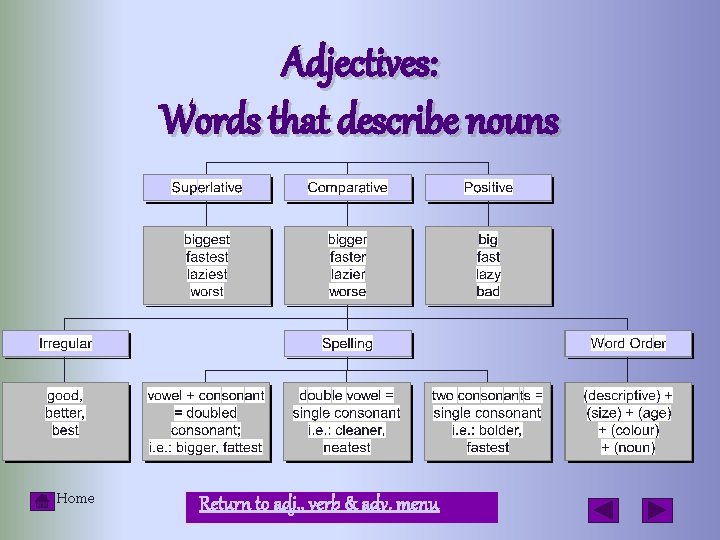
Adjectives: Words that describe nouns Home Return to adj. , verb & adv. menu
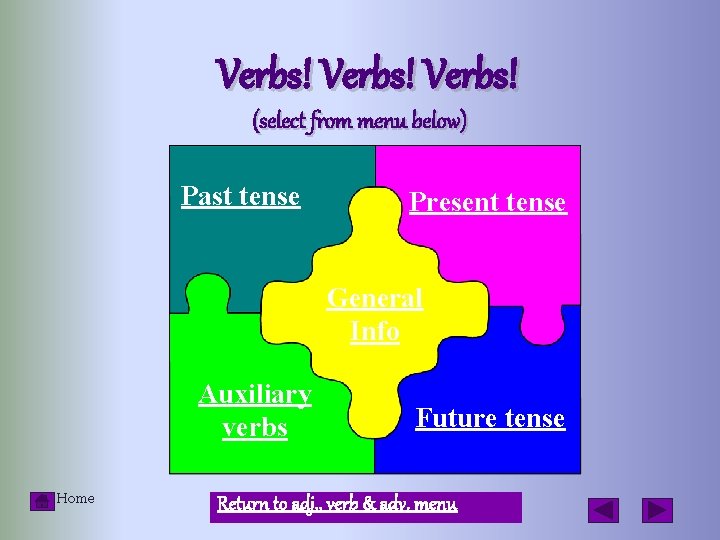
Verbs! (select from menu below) Past tense Present tense General Info Auxiliary verbs Home Future tense Return to adj. , verb & adv. menu
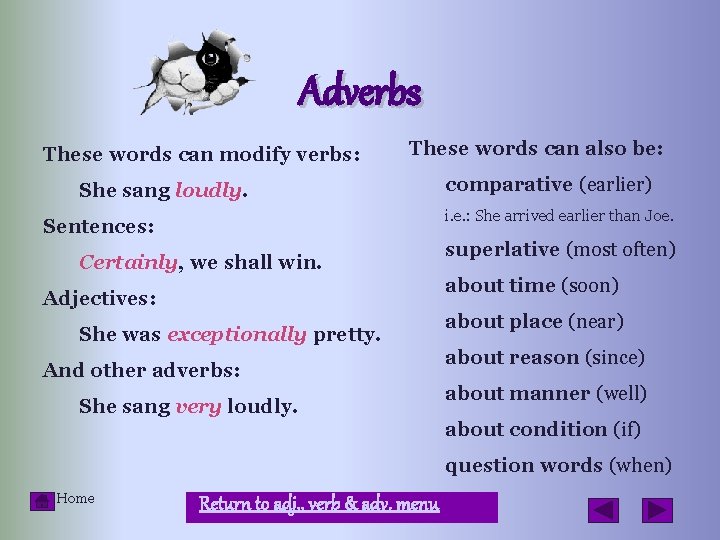
Adverbs These words can modify verbs: These words can also be: She sang loudly. comparative (earlier) i. e. : She arrived earlier than Joe. Sentences: Certainly, we shall win. superlative (most often) about time (soon) Adjectives: She was exceptionally pretty. And other adverbs: She sang very loudly. about place (near) about reason (since) about manner (well) about condition (if) question words (when) Home Return to adj. , verb & adv. menu
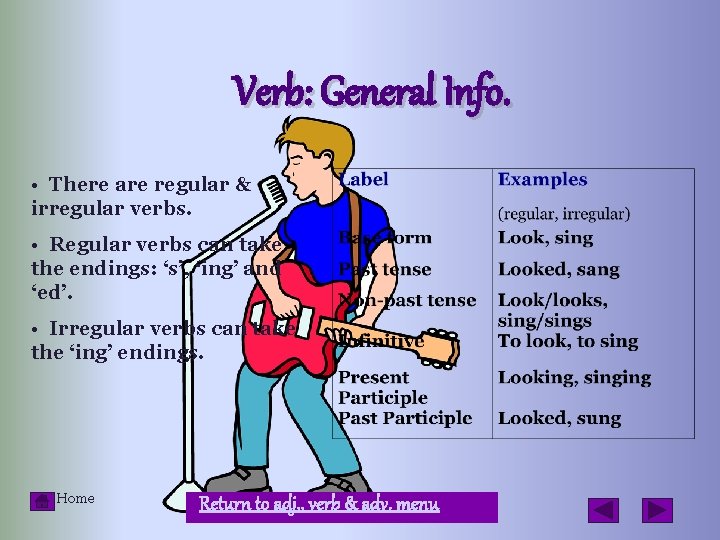
Verb: General Info. • There are regular & irregular verbs. • Regular verbs can take the endings: ‘s’, ‘ing’ and ‘ed’. • Irregular verbs can take the ‘ing’ endings. Home Return to adj. , verb & adv. menu
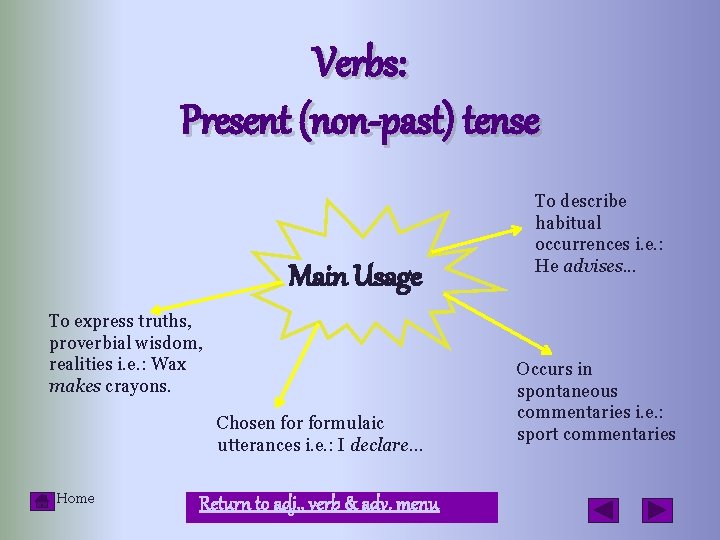
Verbs: Present (non-past) tense Main Usage To express truths, proverbial wisdom, realities i. e. : Wax makes crayons. Chosen formulaic utterances i. e. : I declare. . . Home Return to adj. , verb & adv. menu To describe habitual occurrences i. e. : He advises. . . Occurs in spontaneous commentaries i. e. : sport commentaries
Verbs: Past tense • • • Home Past tense is formed by adding ‘ed’ or ‘d’ to the base form. Past tense does not change according to person or number. Refers to actions, states or events which took place before. Is used in dependent clauses to refer to possibility. Is used in indirect speech i. e. : He said that he sang. Return to adj. , verb & adv. menu
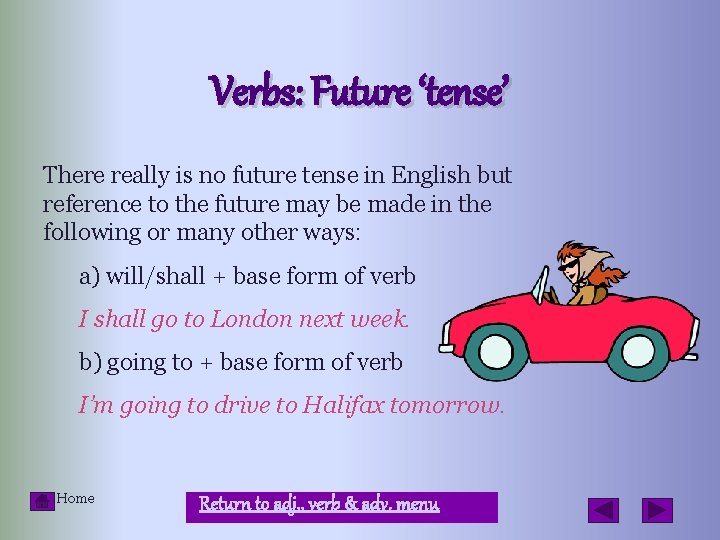
Verbs: Future ‘tense’ There really is no future tense in English but reference to the future may be made in the following or many other ways: a) will/shall + base form of verb I shall go to London next week. b) going to + base form of verb I’m going to drive to Halifax tomorrow. Home Return to adj. , verb & adv. menu
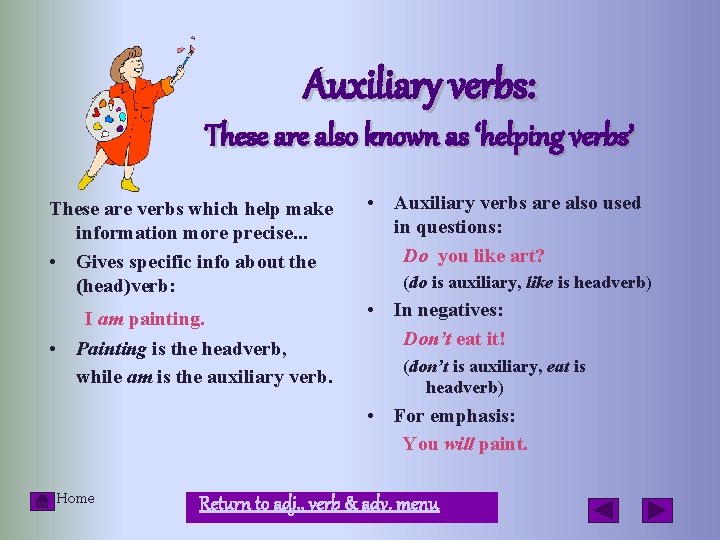
Auxiliary verbs: These are also known as ‘helping verbs’ These are verbs which help make information more precise. . . • Gives specific info about the (head)verb: • Auxiliary verbs are also used in questions: Do you like art? I am painting. • Painting is the headverb, while am is the auxiliary verb. • In negatives: Don’t eat it! (do is auxiliary, like is headverb) (don’t is auxiliary, eat is headverb) • For emphasis: You will paint. Home Return to adj. , verb & adv. menu
Prepositions, conjunctions & exclamations: Select below • Prepositions • Conjunctions • Exclamations • Skip to subject & predicate Home
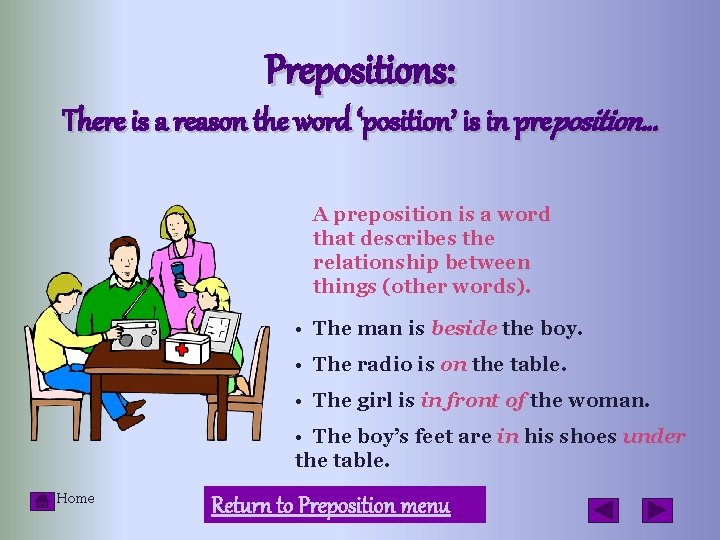
Prepositions: There is a reason the word ‘position’ is in preposition… A preposition is a word that describes the relationship between things (other words). • The man is beside the boy. • The radio is on the table. • The girl is in front of the woman. • The boy’s feet are in his shoes under the table. Home Return to Preposition menu
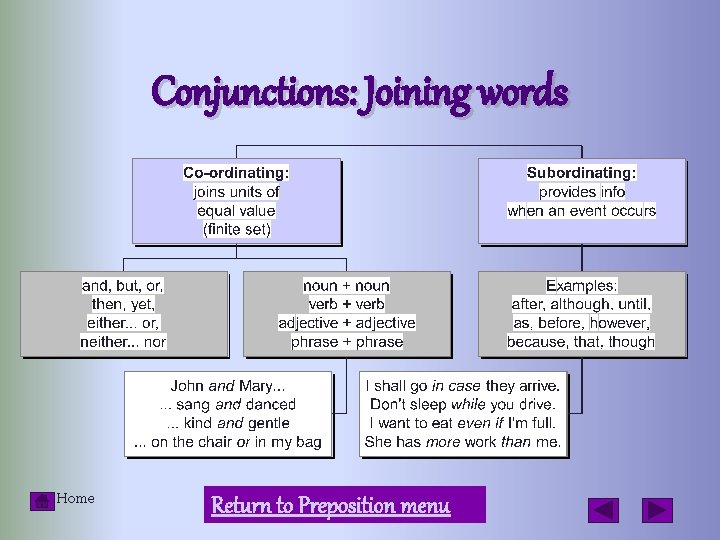
Conjunctions: Joining words Home Return to Preposition menu
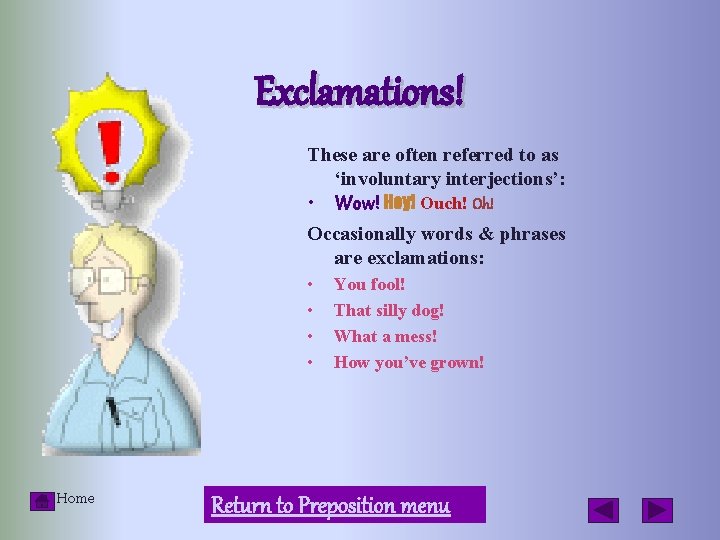
Exclamations! These are often referred to as ‘involuntary interjections’: • Wow! Hey! Ouch! Occasionally words & phrases are exclamations: • • Home You fool! That silly dog! What a mess! How you’ve grown! Return to Preposition menu
Subject, predicate & object • Subject • Predicate • Object • Skip to Transivity Home
Subject Home Return to Subj. , Pred. & Obj. Menu
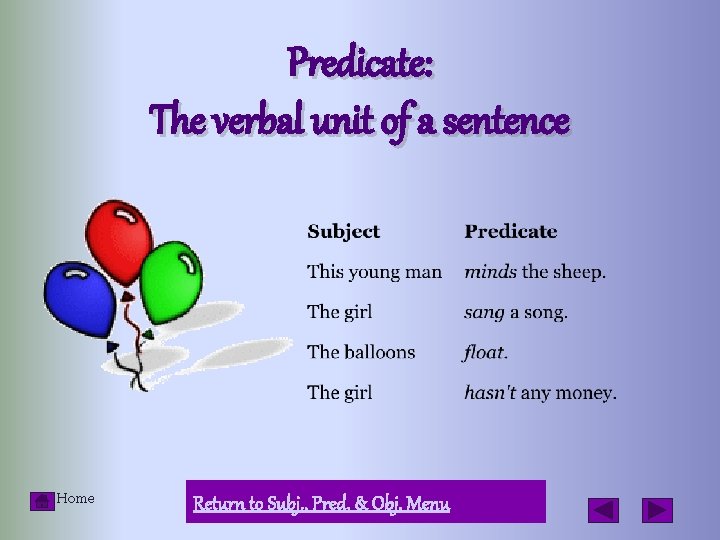
Predicate: The verbal unit of a sentence Home Return to Subj. , Pred. & Obj. Menu
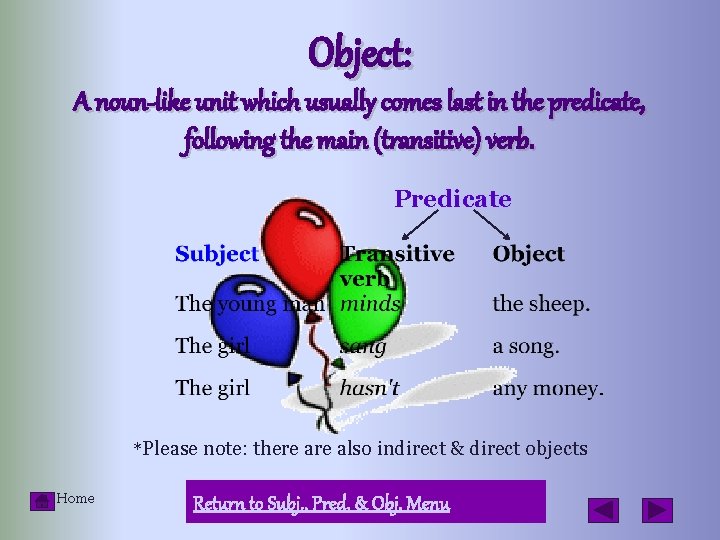
Object: A noun-like unit which usually comes last in the predicate, following the main (transitive) verb. Predicate *Please note: there also indirect & direct objects Home Return to Subj. , Pred. & Obj. Menu
Transitivity • • • Home Nominals Intransitive verbs Transitive verbs Active voice Passive voice Skip to additional info
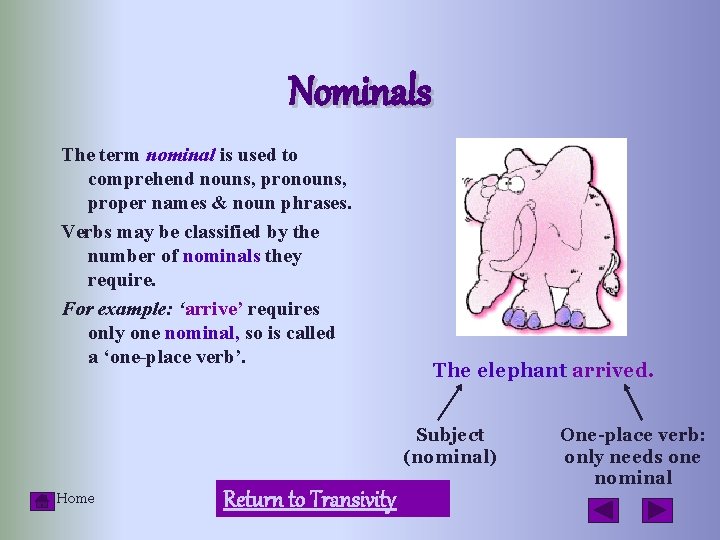
Nominals The term nominal is used to comprehend nouns, proper names & noun phrases. Verbs may be classified by the number of nominals they require. For example: ‘arrive’ requires only one nominal, so is called a ‘one-place verb’. The elephant arrived. Subject (nominal) Home Return to Transivity One-place verb: only needs one nominal
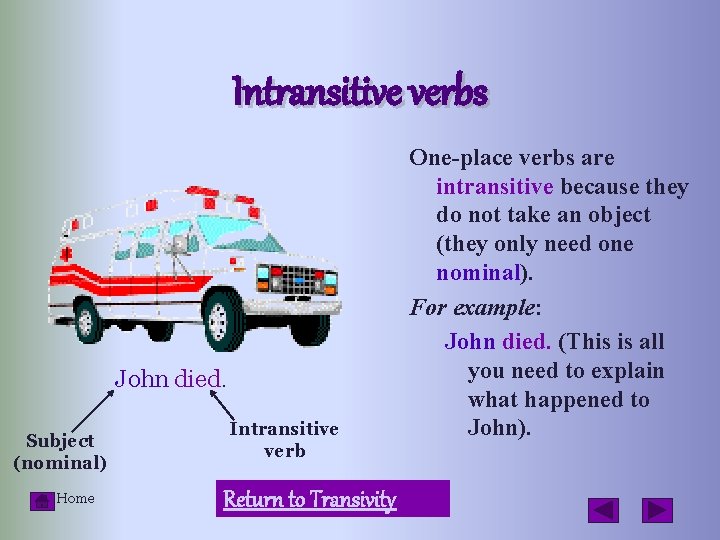
Intransitive verbs John died. Subject (nominal) Home Intransitive verb Return to Transivity One-place verbs are intransitive because they do not take an object (they only need one nominal). For example: John died. (This is all you need to explain what happened to John).
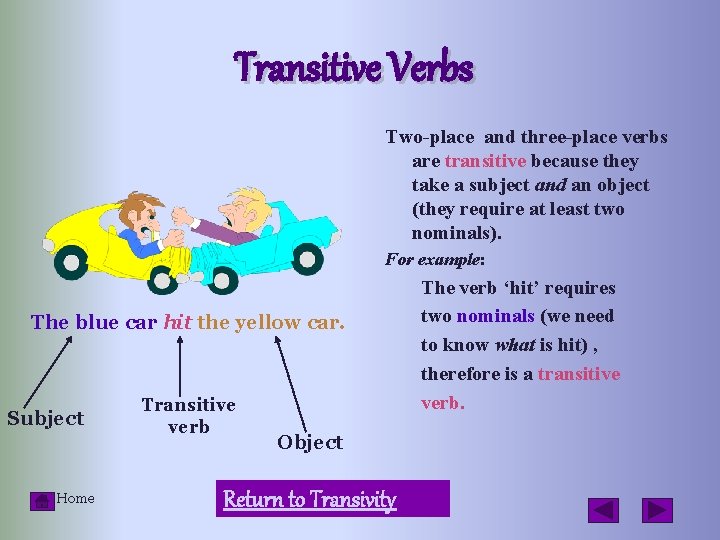
Transitive Verbs Two-place and three-place verbs are transitive because they take a subject and an object (they require at least two nominals). For example: The blue car hit the yellow car. Subject Home Transitive verb Object Return to Transivity The verb ‘hit’ requires two nominals (we need to know what is hit) , therefore is a transitive verb.
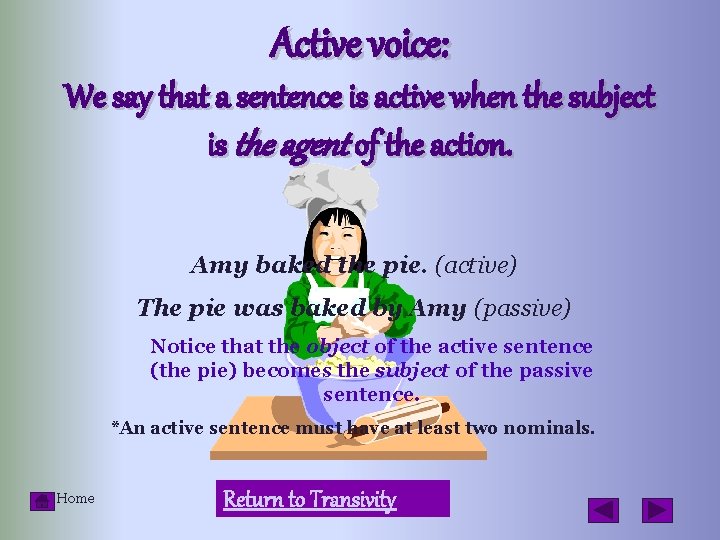
Active voice: We say that a sentence is active when the subject is the agent of the action. Amy baked the pie. (active) The pie was baked by Amy (passive) Notice that the object of the active sentence (the pie) becomes the subject of the passive sentence. *An active sentence must have at least two nominals. Home Return to Transivity
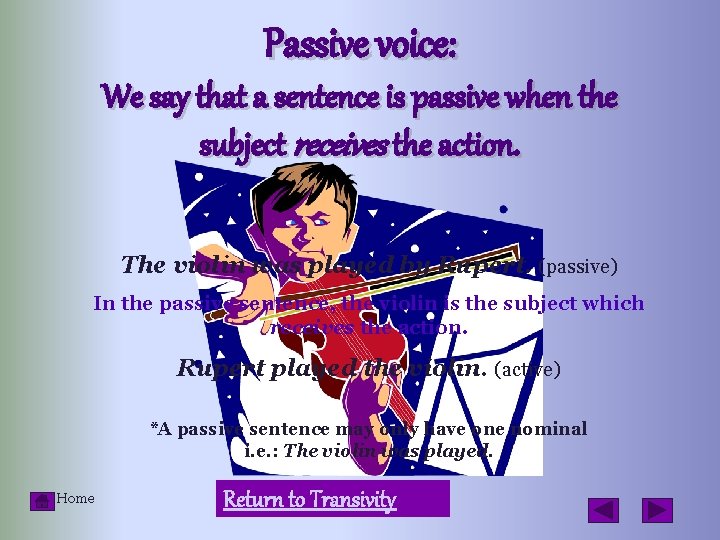
Passive voice: We say that a sentence is passive when the subject receives the action. The violin was played by Rupert. (passive) In the passive sentence, the violin is the subject which receives the action. Rupert played the violin. (active) *A passive sentence may only have one nominal i. e. : The violin was played. Home Return to Transivity
Additional Information: The information in this Power. Point has been very basic. It has been designed to provide you with basic definitions only. Many of these definitions will be covered in more detail, and elaborated, within the course itself. Home Meanwhile, if you have any remaining questions about basic grammatical terms, please note them down and bring them to class for discussion. Hope all this was useful…Try to enjoy the course! END
- Slides: 40