
Linguistics 21 Language and Thinking Spring 2013 Professor
- Slides: 21
Linguistics 21: Language and Thinking Spring 2013 Professor Thom Huebner Office Hours: MW 8: 30 -8: 45, 12: 0013: 00, 4: 15 -4: 30 and by appointment Office: Clark 402 A Telephone: 408 -924 -1315 Email: thom. huebner@sjsu. edu
Lecture 1: Critical Thinking – What is it? § When you hear the term ‘critical thinking, ’ what does that mean to you?
CRITICAL THINKING Involving or exercising skilled judgment or observation Wide range of cognitive skills and intellectual dispositions needed to – analyze and evaluate arguments and truth claims: Examples: Slide 4 overcome personal prejudices and biases: Example: language accents make reasonable and intelligent decisions about what to believe and what to do.
INTELLIGENT DECISIONS Critical Thinking - What are the characteristics of a critical thinker? - What is an argument? - Why is critical thinking important in the world today?
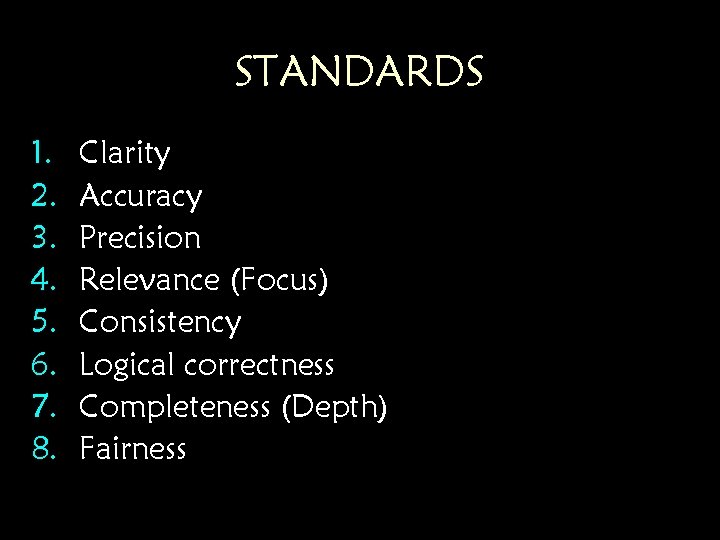
STANDARDS 1. 2. 3. 4. 5. 6. 7. 8. Clarity Accuracy Precision Relevance (Focus) Consistency Logical correctness Completeness (Depth) Fairness
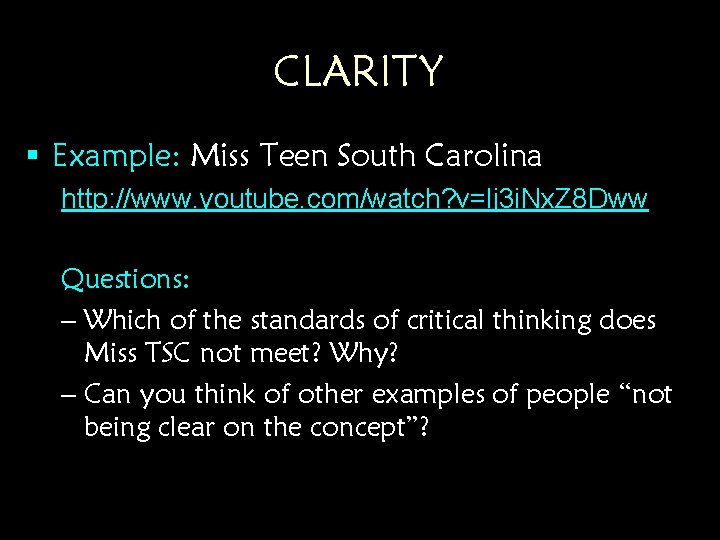
CLARITY § Example: Miss Teen South Carolina http: //www. youtube. com/watch? v=lj 3 i. Nx. Z 8 Dww Questions: – Which of the standards of critical thinking does Miss TSC not meet? Why? – Can you think of other examples of people “not being clear on the concept”?
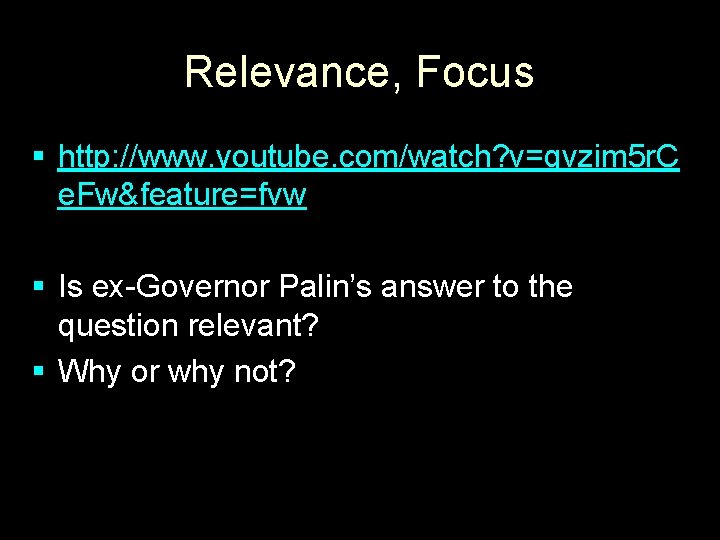
Relevance, Focus § http: //www. youtube. com/watch? v=qvzim 5 r. C e. Fw&feature=fvw § Is ex-Governor Palin’s answer to the question relevant? § Why or why not?
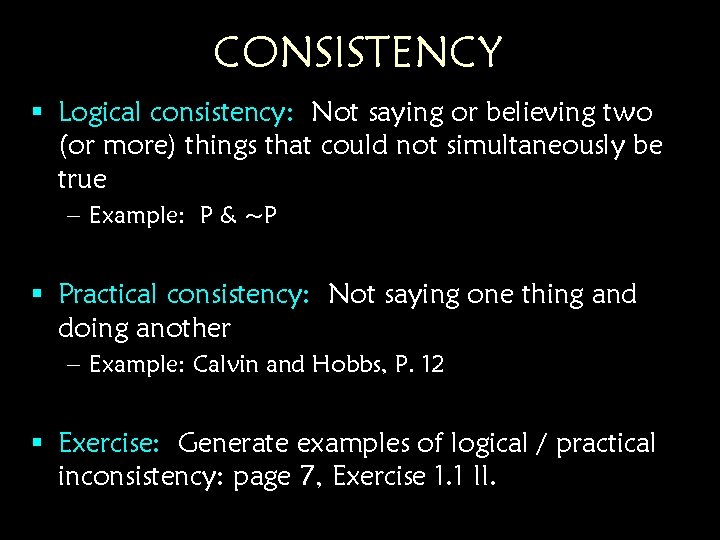
CONSISTENCY § Logical consistency: Not saying or believing two (or more) things that could not simultaneously be true – Example: P & ~P § Practical consistency: Not saying one thing and doing another – Example: Calvin and Hobbs, P. 12 § Exercise: Generate examples of logical / practical inconsistency: page 7, Exercise 1. 1 II.
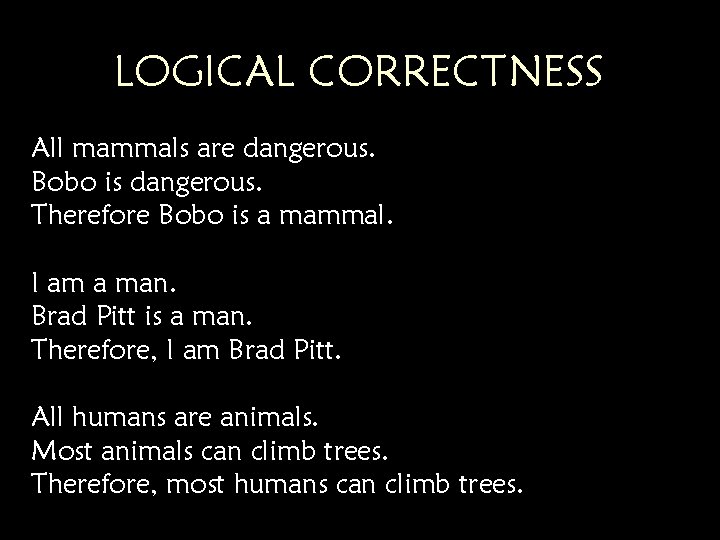
LOGICAL CORRECTNESS All mammals are dangerous. Bobo is dangerous. Therefore Bobo is a mammal. I am a man. Brad Pitt is a man. Therefore, I am Brad Pitt. All humans are animals. Most animals can climb trees. Therefore, most humans can climb trees.
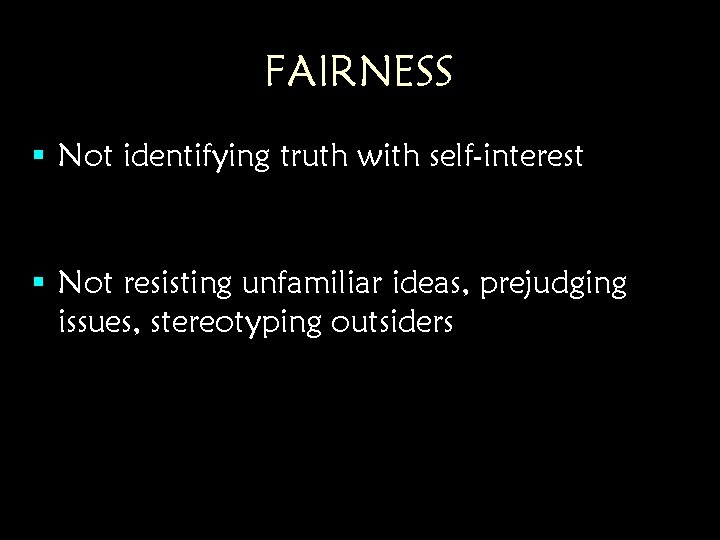
FAIRNESS § Not identifying truth with self-interest § Not resisting unfamiliar ideas, prejudging issues, stereotyping outsiders
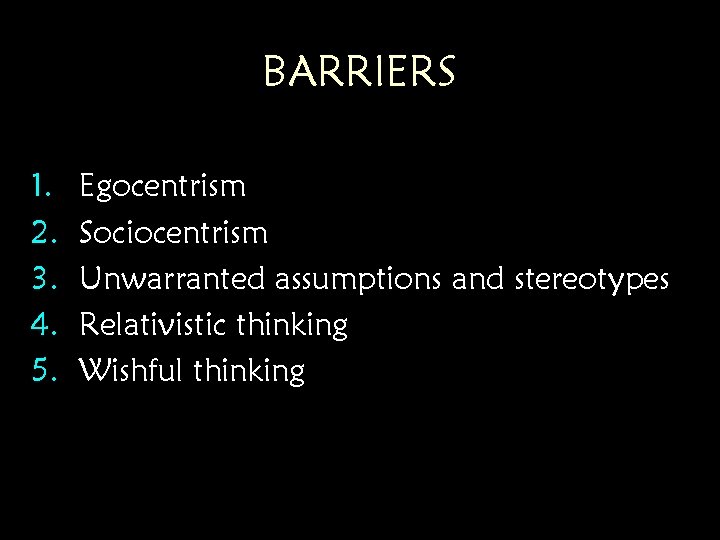
BARRIERS 1. 2. 3. 4. 5. Egocentrism Sociocentrism Unwarranted assumptions and stereotypes Relativistic thinking Wishful thinking
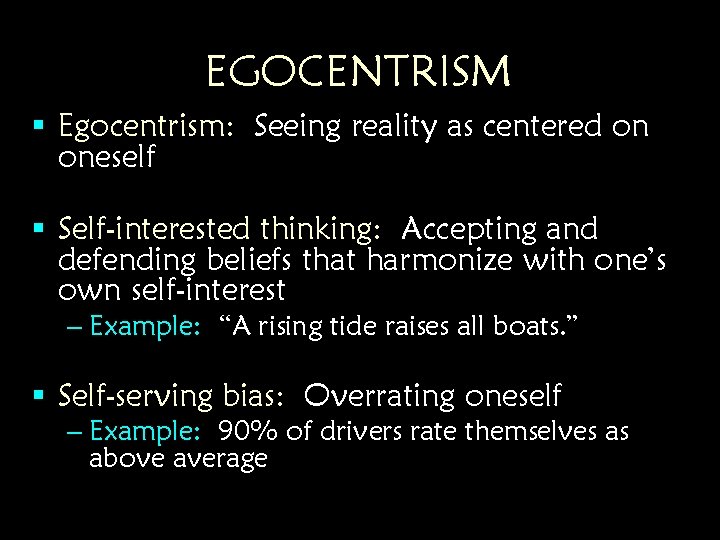
EGOCENTRISM § Egocentrism: Seeing reality as centered on oneself § Self-interested thinking: Accepting and defending beliefs that harmonize with one’s own self-interest – Example: “A rising tide raises all boats. ” § Self-serving bias: Overrating oneself – Example: 90% of drivers rate themselves as above average
SOCIOCENTRISM § Sociocentrism: Group-centered thinking § Group bias: Seeing One’s own group, tribe, sect, sex as better – Example: “Girls are better than boys. ” § Conformism: Following the crowd, conforming uncritically to group standards of conduct and belief – Example: The lines experiment: page 16.
RELATIVISTIC THINKING § Relativism: “There is no objective absolute standard of truth. ” § Subjectivism: “Truth is a matter of individual opinion. ” Exercise: List areas where truth may be a matter of opinion. § Cultural relativism: “What is true for person A is what person A’s culture of society believes is true. ” Examples: drinking wine in France/Iran; polygamy
MORAL RELATIVISM § Moral subjectivism: What is morally right and good for an individual A is what A believes is morally right and good. – Example: § Premarital sex – – Premarital sex is always wrong. – Premarital sex is not always wrong
PROBLEMS § Relativism makes it impossible to criticize others’ / our own cultural practices, i. e. , cannibalism / racism § It rules out the idea of moral progress, i. e. , meaning of equality § It can lead to conflicting moral duties: – When an individual holds beliefs in conflict with those of her society; – When an individual belongs to two or more cultures. Discussion: Are you bi-cultural in any sense (do you belong to two or more groups that hold conflicting beliefs on a topic)?
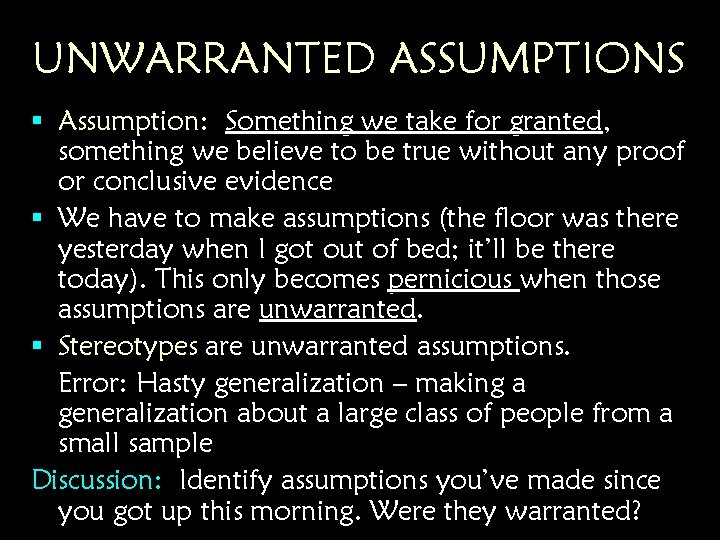
UNWARRANTED ASSUMPTIONS § Assumption: Something we take for granted, something we believe to be true without any proof or conclusive evidence § We have to make assumptions (the floor was there yesterday when I got out of bed; it’ll be there today). This only becomes pernicious when those assumptions are unwarranted. § Stereotypes are unwarranted assumptions. Error: Hasty generalization – making a generalization about a large class of people from a small sample Discussion: Identify assumptions you’ve made since you got up this morning. Were they warranted?
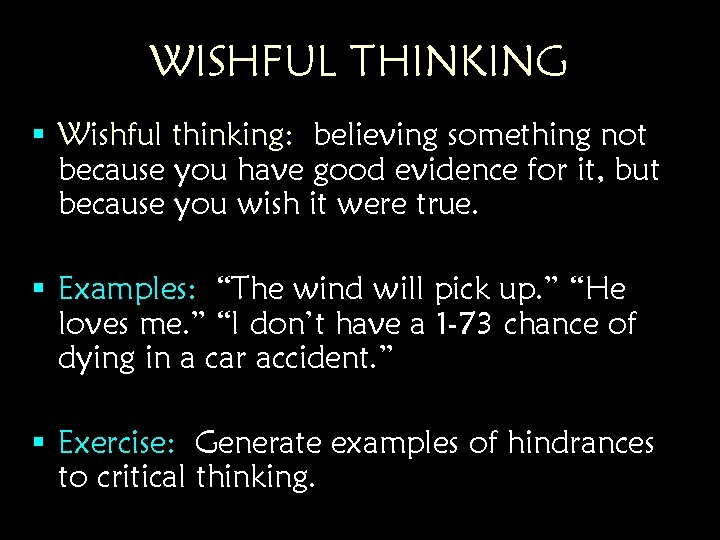
WISHFUL THINKING § Wishful thinking: believing something not because you have good evidence for it, but because you wish it were true. § Examples: “The wind will pick up. ” “He loves me. ” “I don’t have a 1 -73 chance of dying in a car accident. ” § Exercise: Generate examples of hindrances to critical thinking.
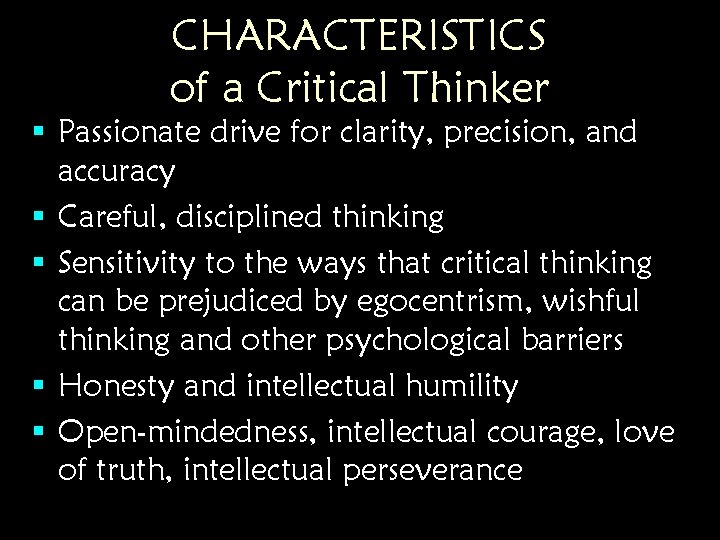
CHARACTERISTICS of a Critical Thinker § Passionate drive for clarity, precision, and accuracy § Careful, disciplined thinking § Sensitivity to the ways that critical thinking can be prejudiced by egocentrism, wishful thinking and other psychological barriers § Honesty and intellectual humility § Open-mindedness, intellectual courage, love of truth, intellectual perseverance
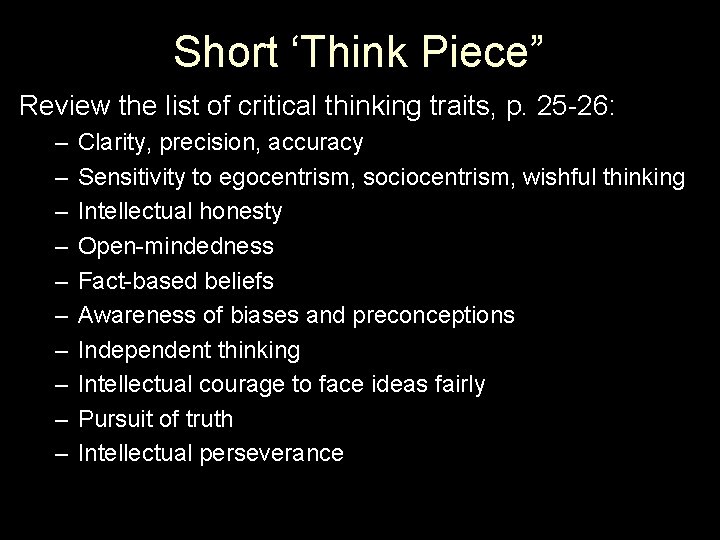
Short ‘Think Piece” Review the list of critical thinking traits, p. 25 -26: – – – – – Clarity, precision, accuracy Sensitivity to egocentrism, sociocentrism, wishful thinking Intellectual honesty Open-mindedness Fact-based beliefs Awareness of biases and preconceptions Independent thinking Intellectual courage to face ideas fairly Pursuit of truth Intellectual perseverance
Short ‘Think Piece” § Jot down short responses to the following questions: – Which of the traits listed do you think is your strongest critical thinking trait? Why? – Which is your weakest? Why? – What could you do to improve in this latter regard?