
Linguistic relativity and Second language acquisition Q 1






- Slides: 21
Linguistic relativity and Second language acquisition
Q 1: What is ‘linguistic relativity’?
While we all see the same objective reality, we interpret and classify it differently, based on the categories made available in our language. Speakers of different languages think and reason about the perceived world differently (Whorf 1940).
Q 2: Do you believe that your first language (or possibly second language) shapes how you perceive the world?
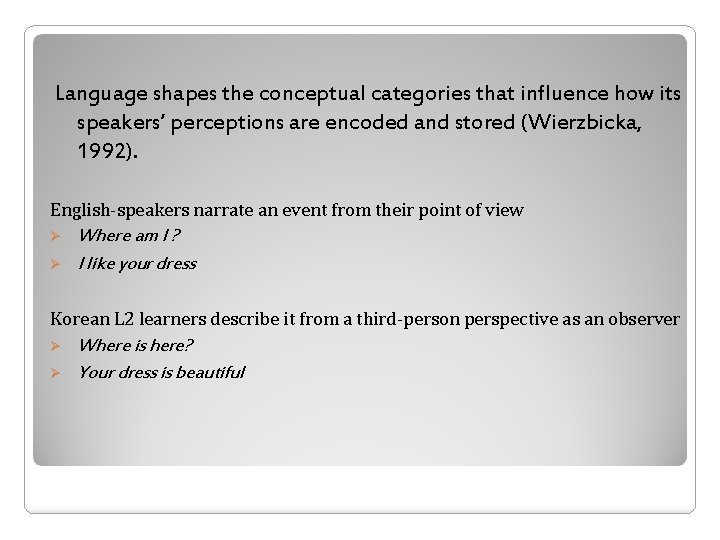
Language shapes the conceptual categories that influence how its speakers’ perceptions are encoded and stored (Wierzbicka, 1992). English-speakers narrate an event from their point of view Ø Ø Where am I ? I like your dress Korean L 2 learners describe it from a third-person perspective as an observer Ø Ø Where is here? Your dress is beautiful
Q 3: Do your first and second language use different categories to organize concepts, events, and objects around you? Provide any examples of the language-specific categorization.
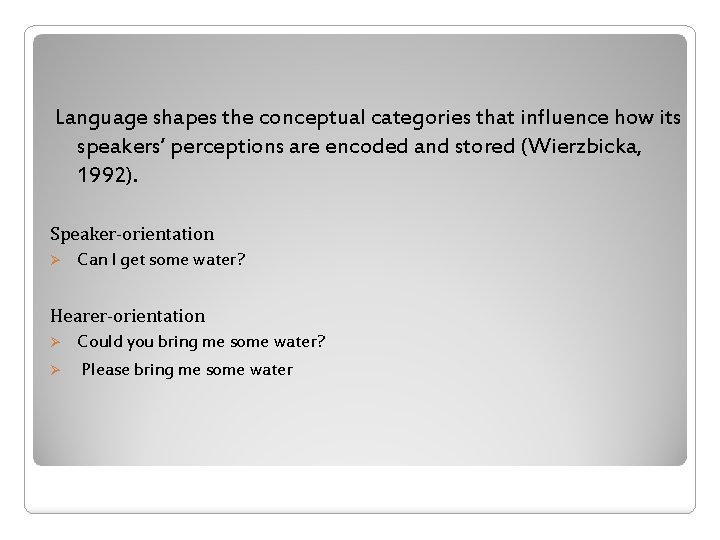
Language shapes the conceptual categories that influence how its speakers’ perceptions are encoded and stored (Wierzbicka, 1992). Speaker-orientation Ø Can I get some water? Hearer-orientation Ø Could you bring me some water? Ø Please bring me some water
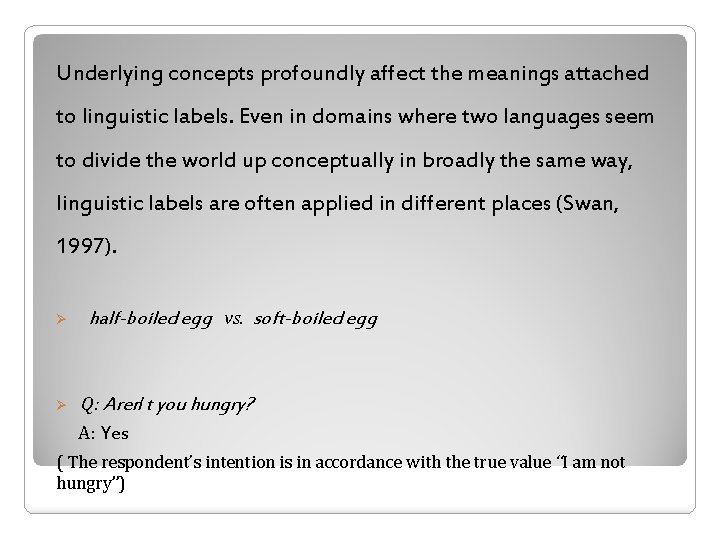
Underlying concepts profoundly affect the meanings attached to linguistic labels. Even in domains where two languages seem to divide the world up conceptually in broadly the same way, linguistic labels are often applied in different places (Swan, 1997). Ø Ø half-boiled egg vs. soft-boiled egg Q: Aren’t you hungry? A: Yes ( The respondent’s intention is in accordance with the true value “I am not hungry”)
In SLA, After experience with language, cognitive patterns are restructured according to language-specific partitions of reality (Levinson 2001) Ø Are cognitive patterns permanently fixed by the L 1? or Ø May second language learning affect those patterns?
Major domains of the research Ø Grammatical Ø Color number and object classification categorization Ø Grammatical gender Ø Time Ø Action events
Grammatical number and object classification Ø Count /mass distinction (Similarity judgement task) Ø Speakers of English favored shape and speakers of Japanese favored material, because noun class languages draw speakers’ attention to discreteness of entities and classifier languages to material(Lucy 1992; Imai & Gentner 1997).
Color categorization Ø Japanese uses different terms to distinguish two shades of blue. Both groups were living in the UK Ø Japanese L 2 speakers of English who used the L 2 more frequently did not distinguish between light and dark blue color stimuli as much as Japanese L 2 speakers of English who used the L 1 more frequently (Athanasopoulos, Damjanovic, Krajciova, and Sasaki 2011).
Grammatical gender Ø Participants were shown pictures of objects and asked to assign a male or female voice to them if they were to come to life. Ø Shift in cognition resulted from the language learning increases with the L 2 proficiency (Kurinski & Sera 2011)
Time Ø In English, reference to time –horizontal spatial metaphors (e. g. , Let’s push the meeting back/forward) In Mandarin, reference to time- vertical spatial (e. g. , up –earlier events, down – later events) Ø The younger the L 2 users were when they started learning English, the less likely they were to follow the L 1 pattern of thinking about time (Boroditshy 2001)
Action events Ø English uses tense markers but there is no obligatory grammatical distinction of temporality in Indonesian Ø Participants were shown pictures of people performing actions with different tenses Ø English speakers were better than Indonesian speakers at remembering the tense in the picture (Boroditshy, Ham, and Ramscar 2002)