
Linguistic relativity A K A Whorfian hypothesis That
![to-strike-with-foot in Navajo and English [k. HIk] Navajo [yizta¬] The horse kicked the mule.](https://slidetodoc.com/presentation_image_h2/9810a5174571488142e7d5f51ecf22bd/image-17.jpg "to-strike-with-foot in Navajo and English [k. HIk] Navajo [yizta¬] The horse kicked the mule.")
![Navajo and striking-with-foot Navajo “kicking” [yizta¬] The horse “kicked” the man. The horse controlled](https://slidetodoc.com/presentation_image_h2/9810a5174571488142e7d5f51ecf22bd/image-19.jpg "Navajo and striking-with-foot Navajo “kicking” [yizta¬] The horse “kicked” the man. The horse controlled")
- Slides: 37
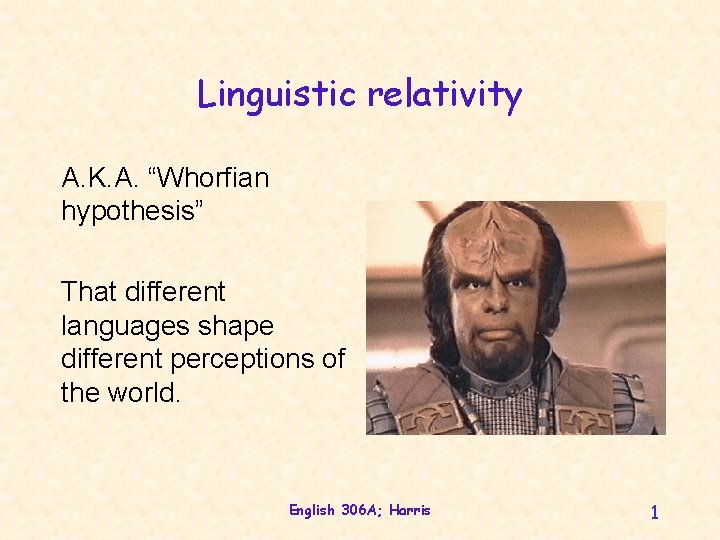
Linguistic relativity A. K. A. “Whorfian hypothesis” That different languages shape different perceptions of the world. English 306 A; Harris 1
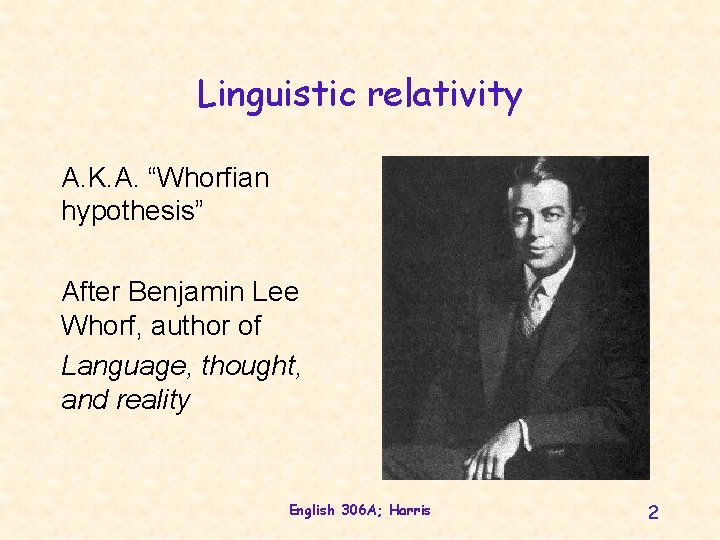
Linguistic relativity A. K. A. “Whorfian hypothesis” After Benjamin Lee Whorf, author of Language, thought, and reality English 306 A; Harris 2
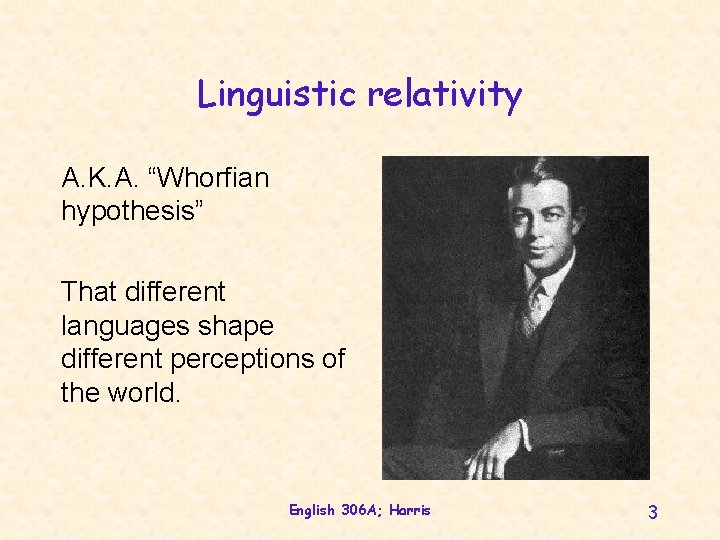
Linguistic relativity A. K. A. “Whorfian hypothesis” That different languages shape different perceptions of the world. English 306 A; Harris 3
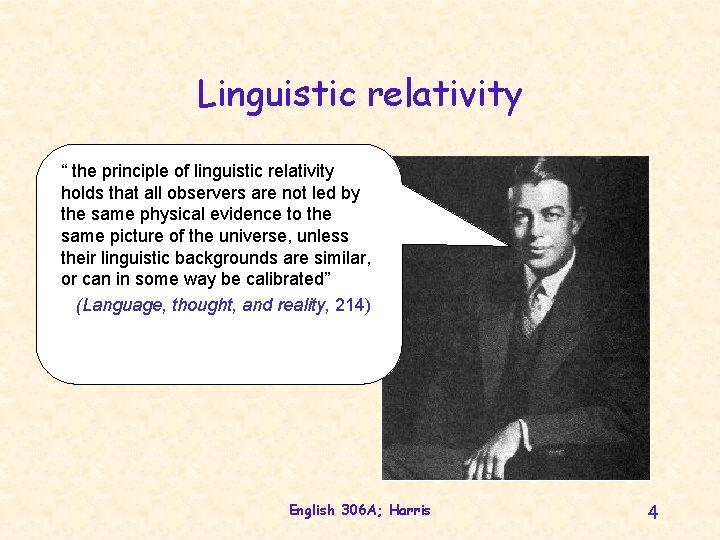
Linguistic relativity “ the principle of linguistic relativity holds that all observers are not led by the same physical evidence to the same picture of the universe, unless their linguistic backgrounds are similar, or can in some way be calibrated” (Language, thought, and reality, 214) English 306 A; Harris 4
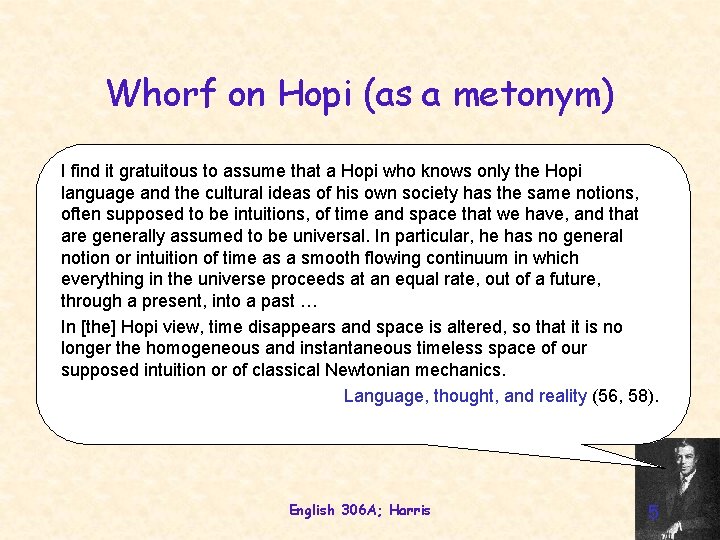
Whorf on Hopi (as a metonym) I find it gratuitous to assume that a Hopi who knows only the Hopi language and the cultural ideas of his own society has the same notions, often supposed to be intuitions, of time and space that we have, and that are generally assumed to be universal. In particular, he has no general notion or intuition of time as a smooth flowing continuum in which everything in the universe proceeds at an equal rate, out of a future, through a present, into a past … In [the] Hopi view, time disappears and space is altered, so that it is no longer the homogeneous and instantaneous timeless space of our supposed intuition or of classical Newtonian mechanics. Language, thought, and reality (56, 58). English 306 A; Harris 5
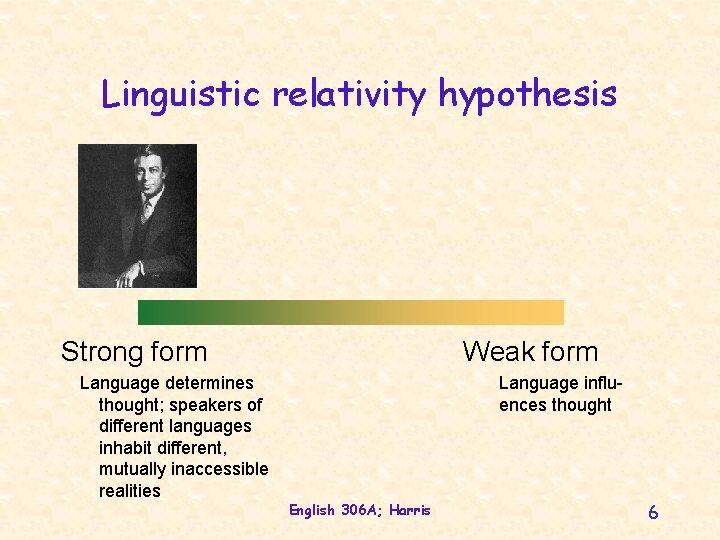
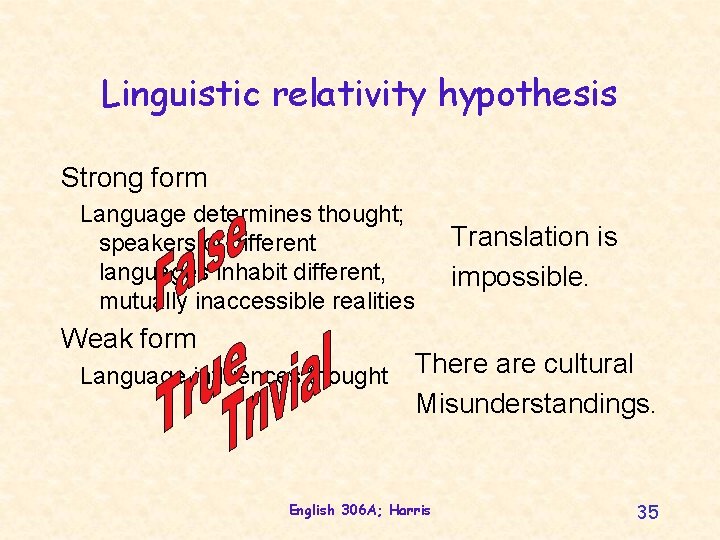
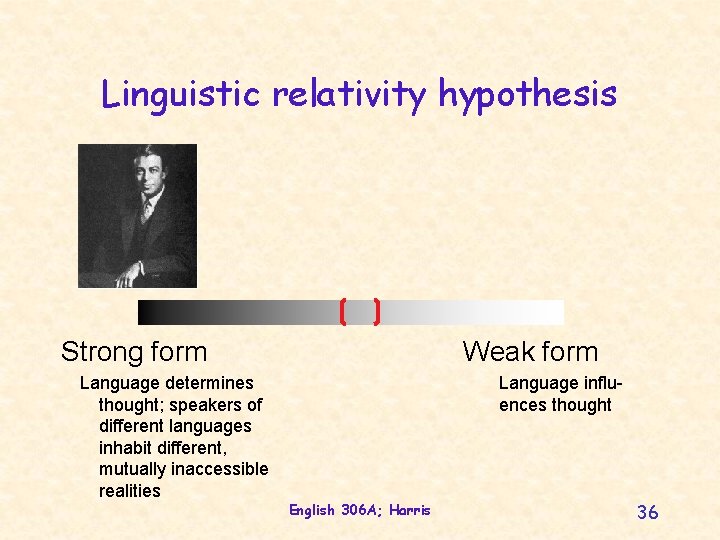
Linguistic relativity hypothesis Strong form Language determines thought; speakers of different languages inhabit different, mutually inaccessible realities Weak form Language influences thought English 306 A; Harris 6
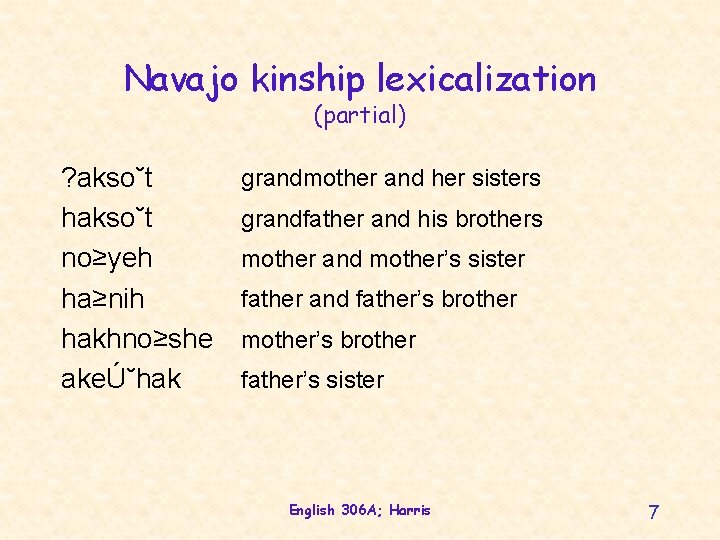
Navajo kinship lexicalization (partial) ? akso˘t hakso˘t no≥yeh ha≥nih hakhno≥she akeÚ˘hak grandmother and her sisters grandfather and his brothers mother and mother’s sister father and father’s brother mother’s brother father’s sister English 306 A; Harris 7
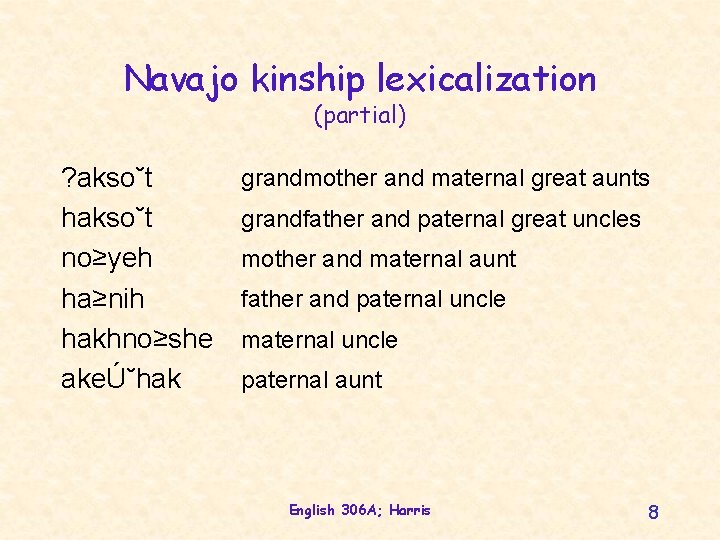
Navajo kinship lexicalization (partial) ? akso˘t hakso˘t no≥yeh ha≥nih hakhno≥she akeÚ˘hak grandmother and maternal great aunts grandfather and paternal great uncles mother and maternal aunt father and paternal uncle maternal uncle paternal aunt English 306 A; Harris 8
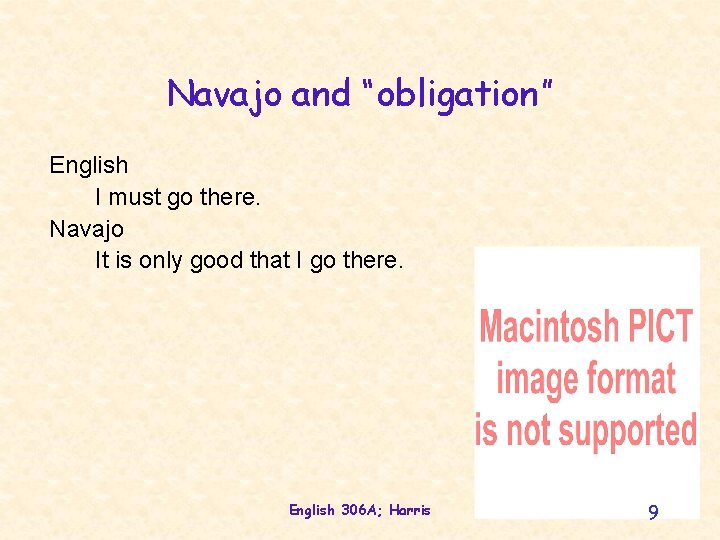
Navajo and “obligation” English I must go there. Navajo It is only good that I go there. English 306 A; Harris 9
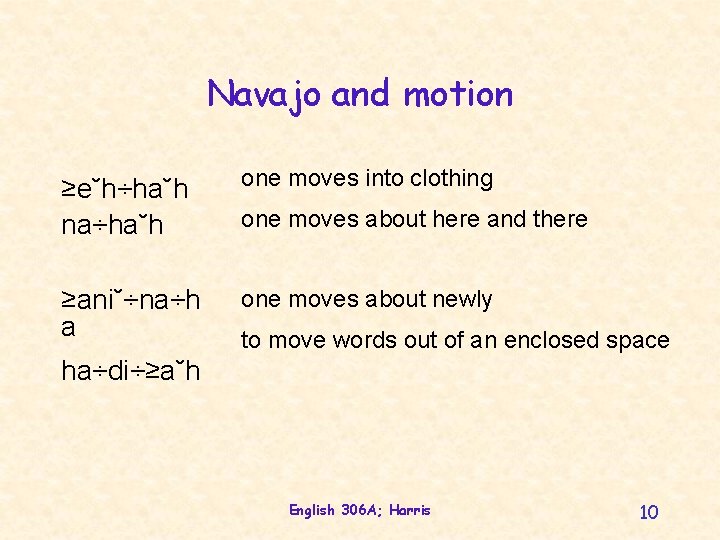
Navajo and motion ≥e˘h÷ha˘h na÷ha˘h one moves into clothing ≥ani˘÷na÷h a one moves about newly one moves about here and there to move words out of an enclosed space ha÷di÷≥a˘h English 306 A; Harris 10
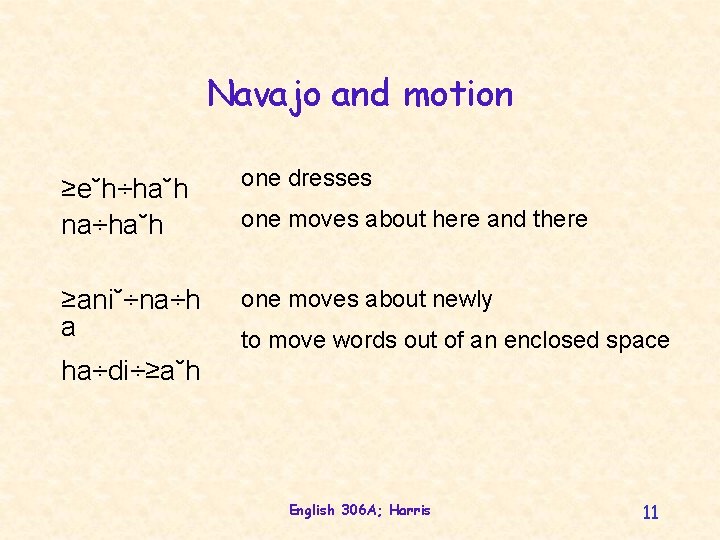
Navajo and motion ≥e˘h÷ha˘h na÷ha˘h one dresses ≥ani˘÷na÷h a one moves about newly one moves about here and there to move words out of an enclosed space ha÷di÷≥a˘h English 306 A; Harris 11
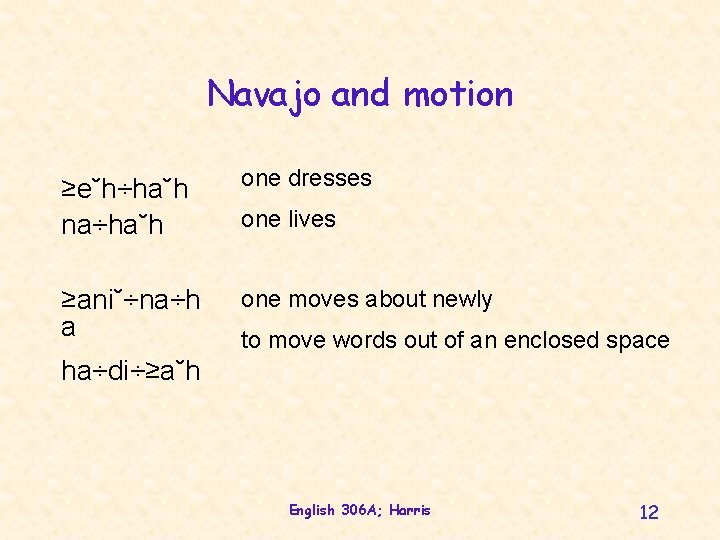
Navajo and motion ≥e˘h÷ha˘h na÷ha˘h one dresses ≥ani˘÷na÷h a one moves about newly one lives to move words out of an enclosed space ha÷di÷≥a˘h English 306 A; Harris 12
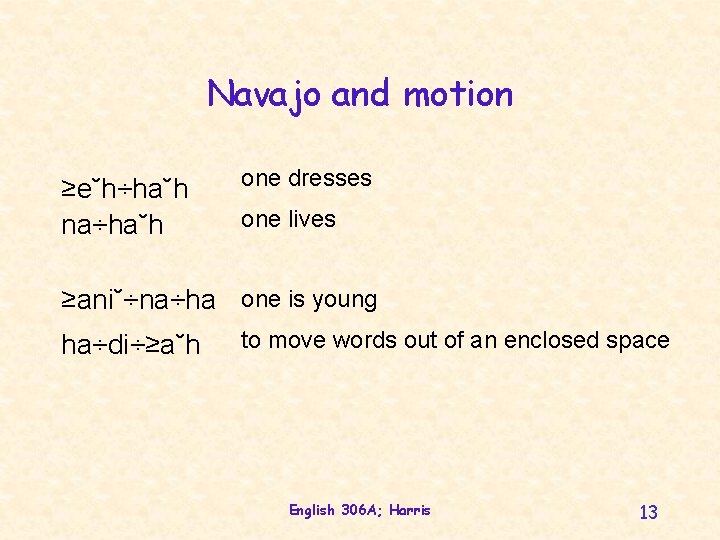
Navajo and motion ≥e˘h÷ha˘h na÷ha˘h one dresses one lives ≥ani˘÷na÷ha one is young ha÷di÷≥a˘h to move words out of an enclosed space English 306 A; Harris 13
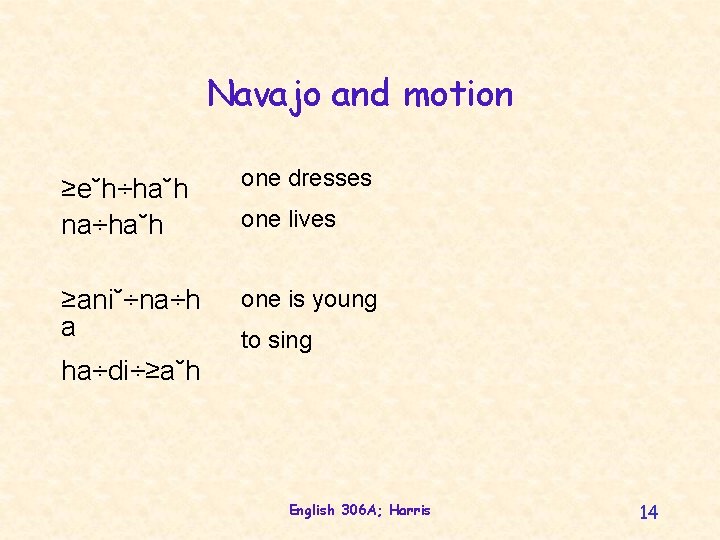
Navajo and motion ≥e˘h÷ha˘h na÷ha˘h one dresses ≥ani˘÷na÷h a one is young one lives to sing ha÷di÷≥a˘h English 306 A; Harris 14
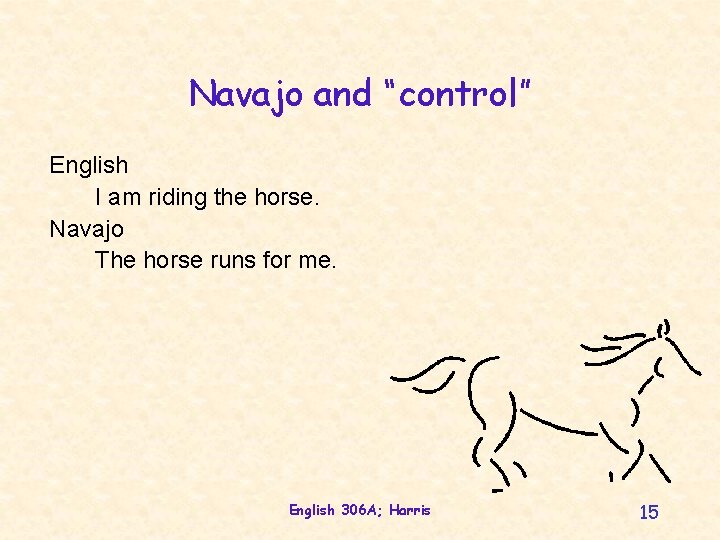
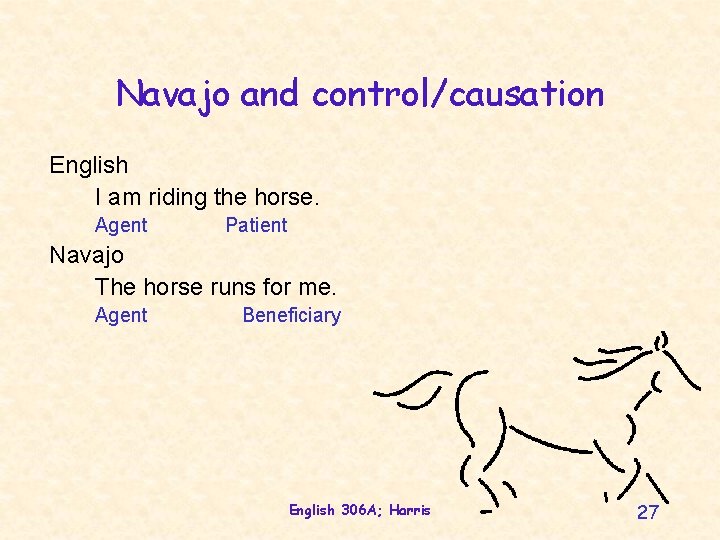
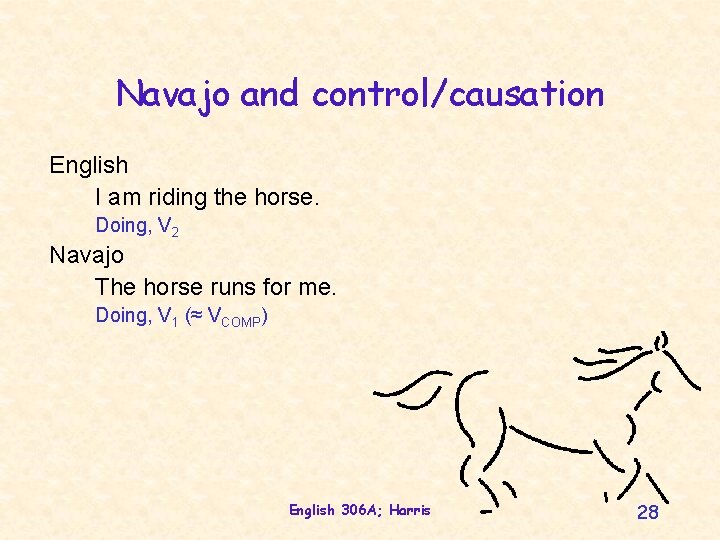
Navajo and “control” English I am riding the horse. Navajo The horse runs for me. English 306 A; Harris 15
Navajo worldview (Weltsicht) What is it? Who knows? Is it the same as the SAE worldview? No. Is it compatible with the SAE worldview? Sometimes, sometimes not. English 306 A; Harris 16
to-strike-with-foot in Navajo and English [k. HIk] Navajo [yizta¬] The horse kicked the mule. The mule kicked the horse. The man kicked the horse. The horse kicked the man. English 306 A; Harris 17
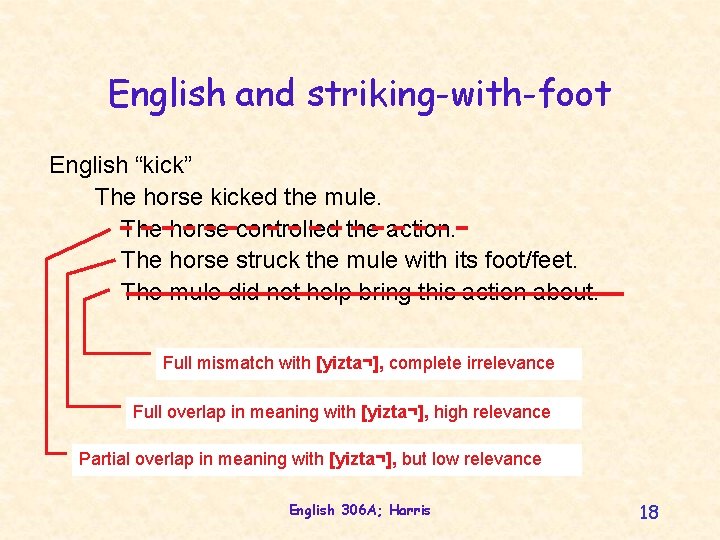
English and striking-with-foot English “kick” The horse kicked the mule. The horse controlled the action. The horse struck the mule with its foot/feet. The mule did not help bring this action about. Full mismatch with [yizta¬], complete irrelevance Full overlap in meaning with [yizta¬], high relevance Partial overlap in meaning with [yizta¬], but low relevance English 306 A; Harris 18
Navajo and striking-with-foot Navajo “kicking” [yizta¬] The horse “kicked” the man. The horse controlled the action. The horse struck the mule with its foot/feet. The man did not help bring this action about. Semantically anomalous: horses can’t control actions that impact humans English 306 A; Harris 19
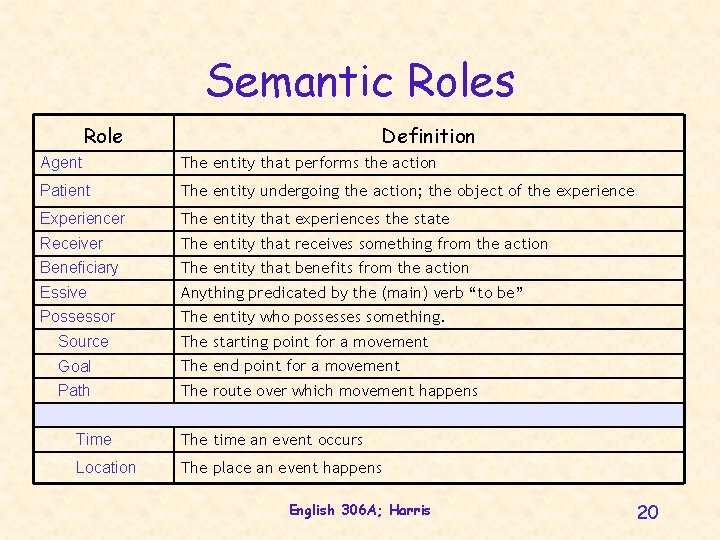
Semantic Roles Role Definition Agent The entity that performs the action Patient The entity undergoing the action; the object of the experience Experiencer The entity that experiences the state Receiver The entity that receives something from the action Beneficiary The entity that benefits from the action Essive Anything predicated by the (main) verb “to be” Possessor The entity who possesses something. Source The starting point for a movement Goal The end point for a movement Path The route over which movement happens Time The time an event occurs Location The place an event happens English 306 A; Harris 20
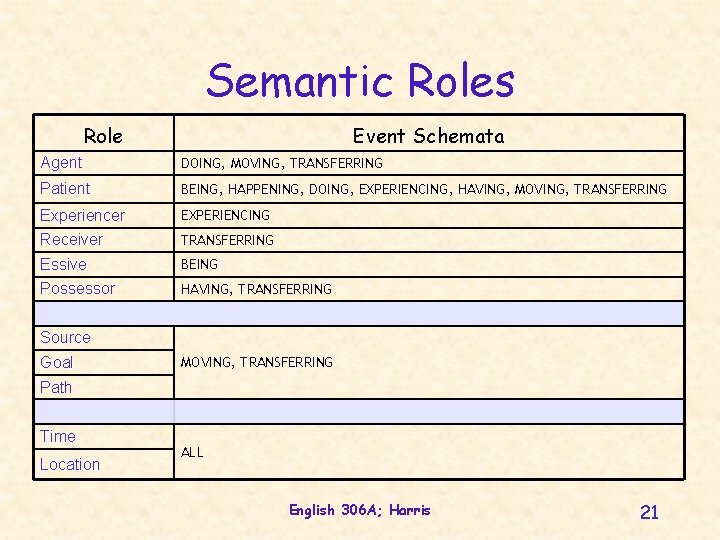
Semantic Roles Role Event Schemata Agent DOING, MOVING, TRANSFERRING Patient BEING, HAPPENING, DOING, EXPERIENCING, HAVING, MOVING, TRANSFERRING Experiencer EXPERIENCING Receiver TRANSFERRING Essive BEING Possessor HAVING, TRANSFERRING Source Goal MOVING, TRANSFERRING Path Time Location ALL English 306 A; Harris 21
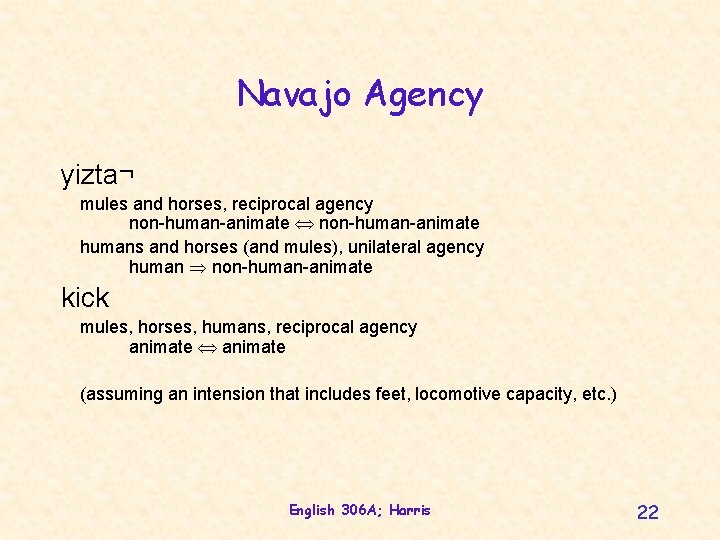
Navajo Agency yizta¬ mules and horses, reciprocal agency non-human-animate humans and horses (and mules), unilateral agency human non-human-animate kick mules, horses, humans, reciprocal agency animate (assuming an intension that includes feet, locomotive capacity, etc. ) English 306 A; Harris 22
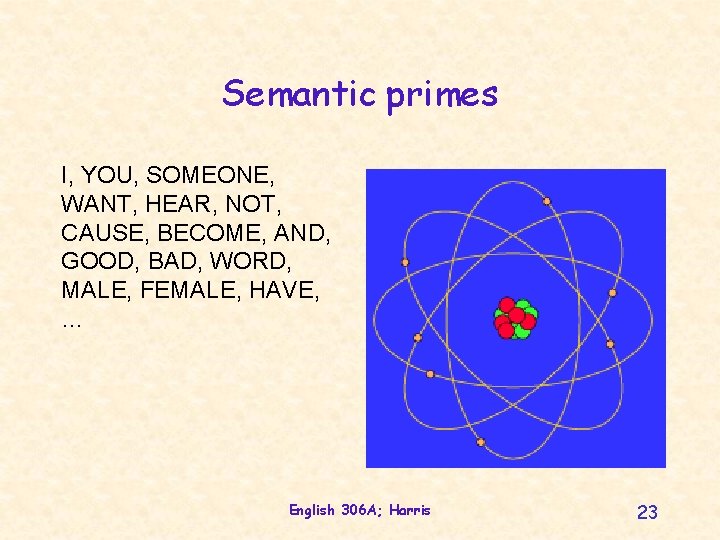
Semantic primes I, YOU, SOMEONE, WANT, HEAR, NOT, CAUSE, BECOME, AND, GOOD, BAD, WORD, MALE, FEMALE, HAVE, … English 306 A; Harris 23
Semantic primes Barney is dead BARNEY BE NOT-ALIVE Barney died. BARNEY BECOME-PAST NOT-ALIVE Fred killed Barney FRED CAUSE-PAST (BARNEY BECOME NOT-ALIVE) Fred murdered Barney FRED CAUSE-PAST (BARNEY BECOME NOT-ALIVE) WITH BADINTENT WITH PLAN English 306 A; Harris 24
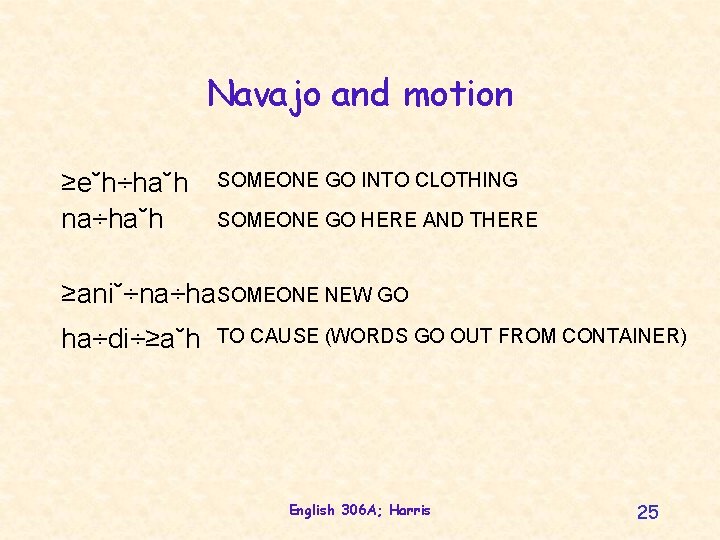
Navajo and motion ≥e˘h÷ha˘h na÷ha˘h SOMEONE GO INTO CLOTHING SOMEONE GO HERE AND THERE ≥ani˘÷na÷ha SOMEONE NEW GO ha÷di÷≥a˘h TO CAUSE (WORDS GO OUT FROM CONTAINER) English 306 A; Harris 25
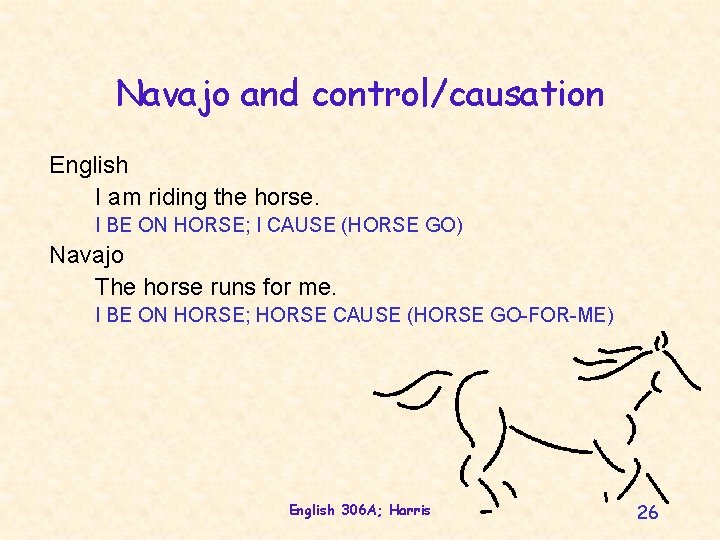
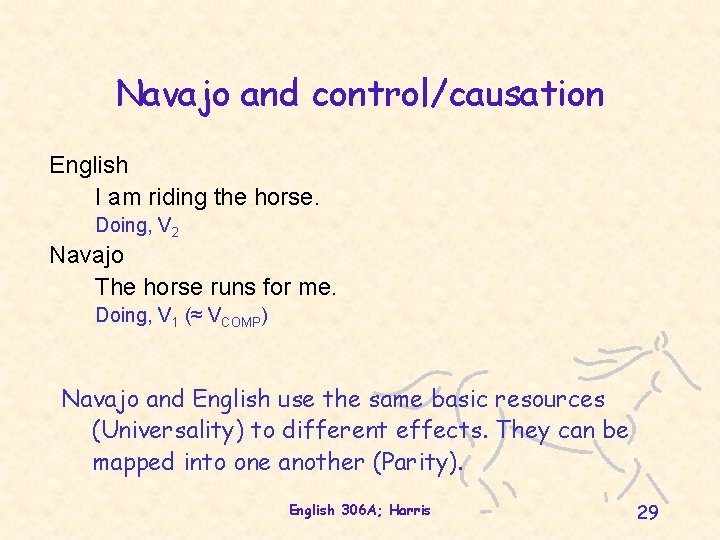
Navajo and control/causation English I am riding the horse. I BE ON HORSE; I CAUSE (HORSE GO) Navajo The horse runs for me. I BE ON HORSE; HORSE CAUSE (HORSE GO-FOR-ME) English 306 A; Harris 26
Navajo and control/causation English I am riding the horse. Agent Patient Navajo The horse runs for me. Agent Beneficiary English 306 A; Harris 27
Navajo and control/causation English I am riding the horse. Doing, V 2 Navajo The horse runs for me. Doing, V 1 (≈ VCOMP) English 306 A; Harris 28
Navajo and control/causation English I am riding the horse. Doing, V 2 Navajo The horse runs for me. Doing, V 1 (≈ VCOMP) Navajo and English use the same basic resources (Universality) to different effects. They can be mapped into one another (Parity). English 306 A; Harris 29
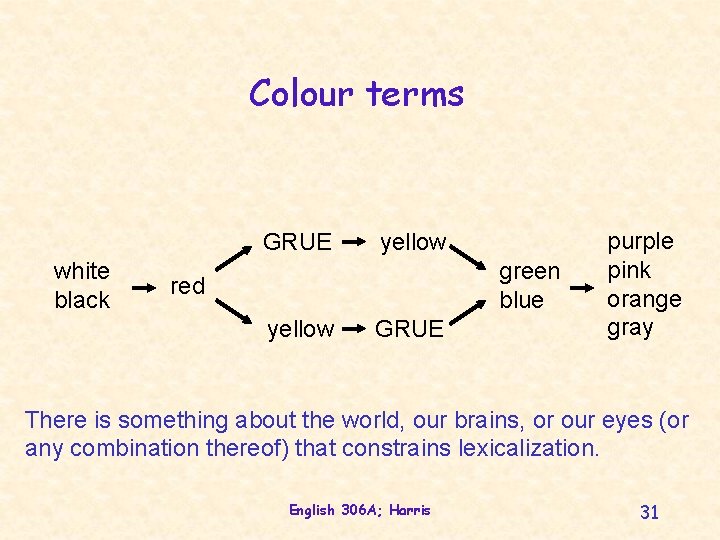
Colour terms 2 -color system: black, white 3 -color system: black, white, red 4 -color system: black, white, red, yellow or GRUE 5 -color system: black, white, red, yellow, GRUE 6 -color system: black, white, red, yellow, green, blue then purple, pink, orange, gray English 306 A; Harris 30
Colour terms GRUE white black yellow green blue red yellow GRUE purple pink orange gray There is something about the world, our brains, or our eyes (or any combination thereof) that constrains lexicalization. English 306 A; Harris 31
Linguistic relativity “ the principle of linguistic relativity holds that all observers are not led by the same physical evidence to the same picture of the universe, unless their linguistic backgrounds are similar, or can in some way be calibrated” (Language, thought, and reality, 214) English 306 A; Harris 32
Linguistic relativity “ the principle of linguistic relativity holds that all observers are not led by the same physical evidence to the same picture of the universe, unless their linguistic backgrounds are similar, or can in some way be calibrated” (Language, thought, and reality, 214) English 306 A; Harris 33
Cross-linguistic calibrators Semantic primes. Semantic roles. Event schemata. Verb-argument structure Perception. (goodwill, common-interests, …) English 306 A; Harris 34
Linguistic relativity hypothesis Strong form Language determines thought; speakers of different languages inhabit different, mutually inaccessible realities Weak form Language influences thought Translation is impossible. There are cultural Misunderstandings. English 306 A; Harris 35
Linguistic relativity hypothesis Strong form Language determines thought; speakers of different languages inhabit different, mutually inaccessible realities Weak form Language influences thought English 306 A; Harris 36
Semantics The proposition and truth conditions. Entailment Denotation Intension Extension Event schemata and semantic roles redux Semantic primes Ambiguity Linguistic relativity Universality Semantic roles Semantic primes Cognitive and experiential universals Colour systems Parity (calibration) English 306 A; Harris 37