
LINGUISTIC MODEL OF LANGUAGE PROCESSING DR CHANDER SHEKHAR
![LINGUISTIC MODEL OF LANGUAGE PROCESSING Figure-1 [which was in its previous form published in[21]](https://slidetodoc.com/presentation_image_h2/458e6a1bd1d93d69a0b768a371226536/image-6.jpg "LINGUISTIC MODEL OF LANGUAGE PROCESSING Figure-1 [which was in its previous form published in[21]")
![Phonetic representation of lexical elements and sentences is received by the Hearer [H] who](https://slidetodoc.com/presentation_image_h2/458e6a1bd1d93d69a0b768a371226536/image-8.jpg "Phonetic representation of lexical elements and sentences is received by the Hearer [H] who")

- Slides: 12
LINGUISTIC MODEL OF LANGUAGE PROCESSING DR. CHANDER SHEKHAR SINGH 12/31/2021 1
INTRODUCTION The unexpected developments in the area of language and Linguistics in the twentieth century have not only made an honorable place in the syllabi of schools and colleges but also have affected the ultimate aims of education at the school, college and university levels. The sign of development appeared in the field of language teaching was due to the emergence of several new Linguistic theories, models, methods and approaches. 12/31/2021 2
Certain Linguistic theories claim that the inborn knowledge of language is responsible for the acquisition of a language. Chomsky insisted that a child is born with a Language Acquisition Device due to that a child develops competence in learning a first language in a society. Lenneberg (1967) claimed that language is species specific behavior. He provided a biological support and interpretation to Chomsky’s claims. Interestingly, there is another name of that legendary decade (1960 s) and the name is J. J. Katz (1964) who tried to show the difference between the old conception of Linguistics and the Chomskyan conception of Linguistics. 12/31/2021 3
THREE FUNDAMENTAL QUESTIONS Katz (1964: 371) says that there are three fundamental questions with which a synchronic description of a particular language deals. These are: 1. What is known by a speaker who is fluent in a natural language? That is, what facts about a language of a speaker underlie his ability to communicate with others in that language? 2. How is such linguistic knowledge put into operation to achieve communication? That is, how does a speaker use such linguistic knowledge to convey his thoughts, opinions, wishes, demands, questions, emotions, and so on to other speakers? 12/31/2021 4
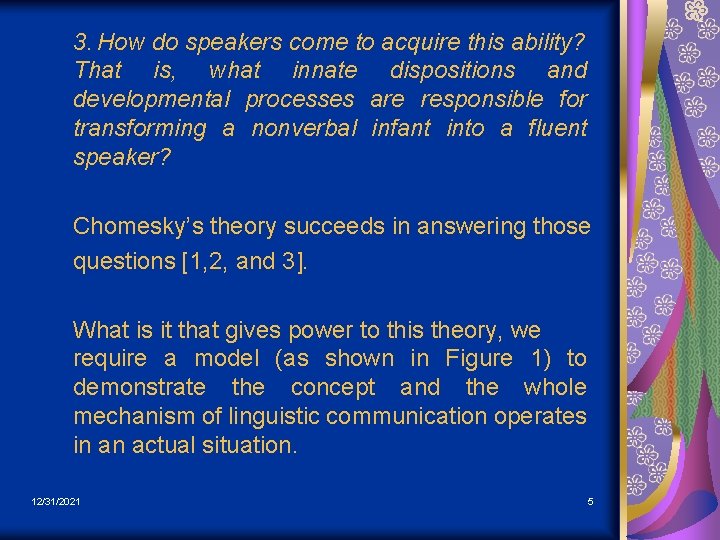
3. How do speakers come to acquire this ability? That is, what innate dispositions and developmental processes are responsible for transforming a nonverbal infant into a fluent speaker? Chomesky’s theory succeeds in answering those questions [1, 2, and 3]. What is it that gives power to this theory, we require a model (as shown in Figure 1) to demonstrate the concept and the whole mechanism of linguistic communication operates in an actual situation. 12/31/2021 5
LINGUISTIC MODEL OF LANGUAGE PROCESSING Figure-1 [which was in its previous form published in[21] IJHSS, Volume 2. 4, 2012. in my article]. {based on the viewpoints of many linguists (including my own teachers of Department of Linguistics, University of Delhi- Prof. Ravinder Gargesh, Prof. R. K. Agnihotri , Prof. R. C. Sharma and Prof. Tista Bagchi)Katz (1964), Gargesh [class lectures on Generative Phonology in M. A. (Linguistics), 2000], Sharma [class lectures on Psycholinguistics in M. A. (Linguistics), 2000], Agnihotri [class lectures on Research Methodology in M. Phil. (Linguistics), 2001], Bagchi [class lectures in M. A. (Linguistics), 1998 ] and created by me with many significant modifications} 12/31/2021 6
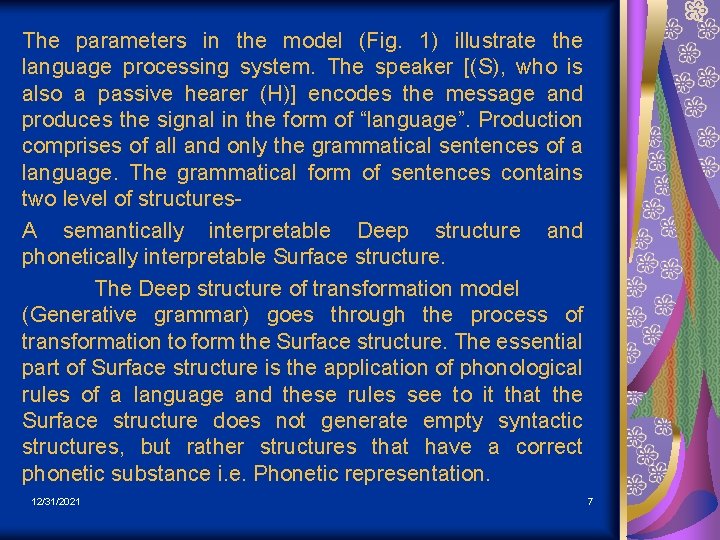
The parameters in the model (Fig. 1) illustrate the language processing system. The speaker [(S), who is also a passive hearer (H)] encodes the message and produces the signal in the form of “language”. Production comprises of all and only the grammatical sentences of a language. The grammatical form of sentences contains two level of structures. A semantically interpretable Deep structure and phonetically interpretable Surface structure. The Deep structure of transformation model (Generative grammar) goes through the process of transformation to form the Surface structure. The essential part of Surface structure is the application of phonological rules of a language and these rules see to it that the Surface structure does not generate empty syntactic structures, but rather structures that have a correct phonetic substance i. e. Phonetic representation. 12/31/2021 7
Phonetic representation of lexical elements and sentences is received by the Hearer [H] who is also a passive speaker [(S)]. Hearer relates the sound signals of a number of sentences to his/her respective semantic interpretations with message decoding. The whole process in the model (Fig. 1) has its object of linguistic competence. The linguistic competence is present in the speaker-hearer in the form of an internalized grammar, i. e. a system of rules by means of which the speaker and hearer are able to relate the sound-signals of an indefinite number of sentences to their respective semantic interpretations and vice-versa. Humans use language to communicate ideas and feelings, now the question is: How are such communications processed and understood? 12/31/2021 8
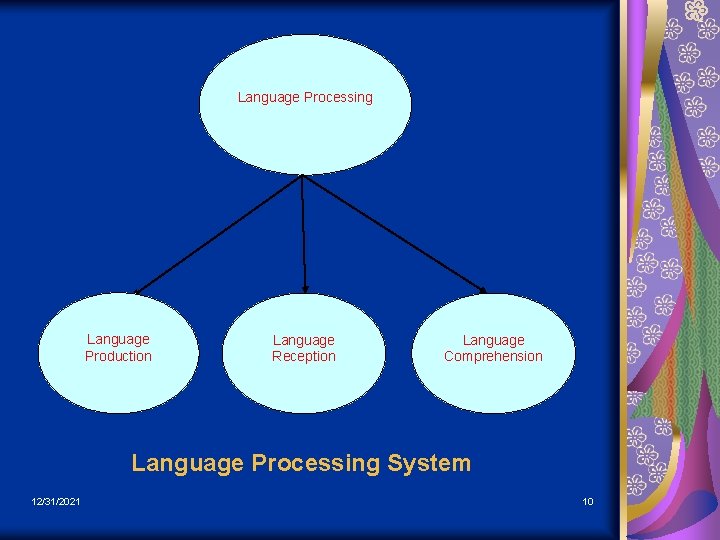
Language processing is considered to be a unique human ability that involves the process of understanding as well as producing language with perception. Language processing consists of three different processes: 1. Language Production 2. Language Reception 3. Language Comprehension 12/31/2021 9
Language Processing Language Production Language Reception Language Comprehension Language Processing System 12/31/2021 10
1. Language Production: Language Production is a process involved in connection with the production of spoken language. This process includes planning the utterance with regard to what to say, retrieving the words and integrating them into a sentence, articulating the sentence and monitoring the output. 2. Language Reception: It includes the reception of the speech sound signals with the help of ears. Inner ear sends the sound signals to the brain through the nerves connected to it. 3. Language Comprehension: Language Comprehension relies on the ability to correctly process word and phrase meanings, sentence grammar, and discourse or text structure. This process is connected with the decoding of the message. 12/31/2021 11
THE END 12/31/2021 12