
Linguistic Linked Open Data Insight Center for Data
- Slides: 25
Linguistic Linked Open Data Insight Center for Data Analytics National University of Ireland, Galway John P. Mc. Crae
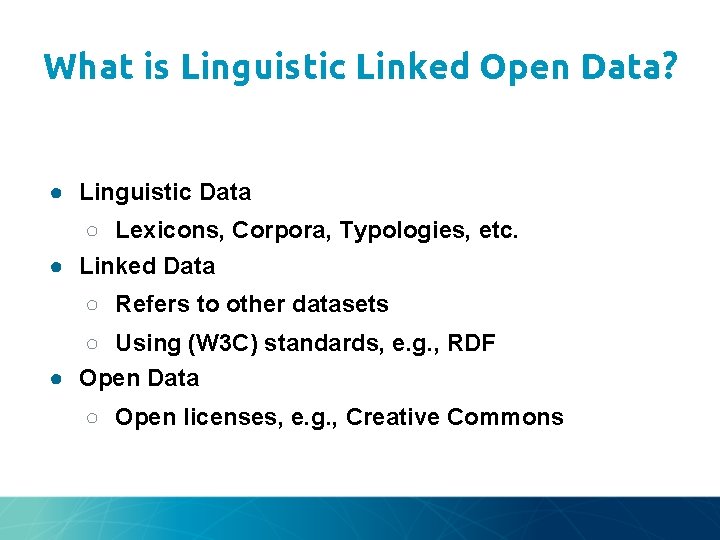
What is Linguistic Linked Open Data? ● Linguistic Data ○ Lexicons, Corpora, Typologies, etc. ● Linked Data ○ Refers to other datasets ○ Using (W 3 C) standards, e. g. , RDF ● Open Data ○ Open licenses, e. g. , Creative Commons
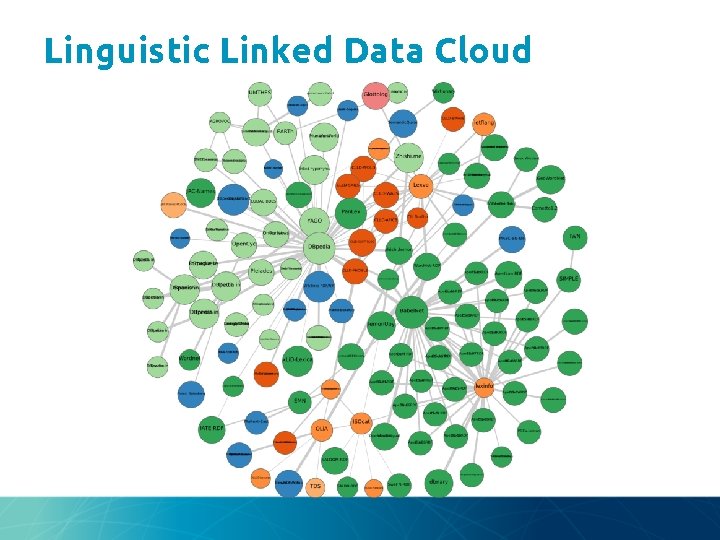
Linguistic Linked Data Cloud
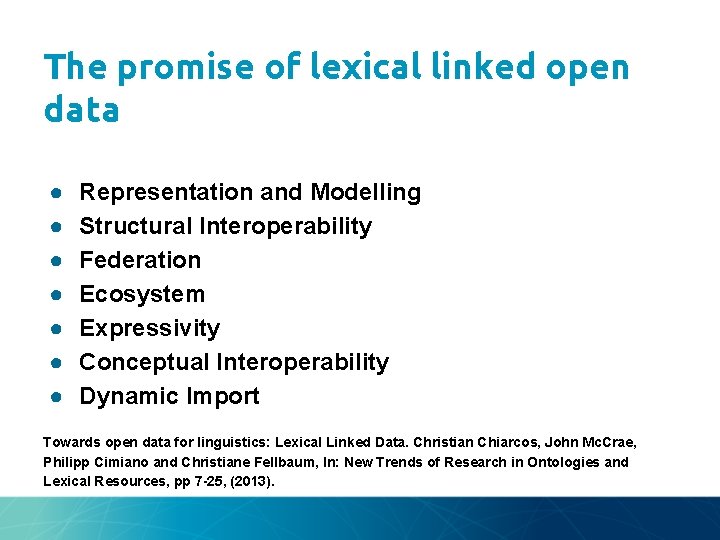
The promise of lexical linked open data ● ● ● ● Representation and Modelling Structural Interoperability Federation Ecosystem Expressivity Conceptual Interoperability Dynamic Import Towards open data for linguistics: Lexical Linked Data. Christian Chiarcos, John Mc. Crae, Philipp Cimiano and Christiane Fellbaum, In: New Trends of Research in Ontologies and Lexical Resources, pp 7 -25, (2013).
Representation and Modelling Claim: Lexical-semantic resources are best described as labeled directed graphs such as RDF. https: //www. w 3. org/2016/05/ontolex/
Structural Interoperability Claim: Using a common data model eases the integration of different resources
Federation Claim: In contrast to traditional methods, where it may be difficult to query across even multiple parts of the same resource, linked data allows for federated querying across multiple, distributed databases maintained by different data providers ~
Ecosystem Claim: Linked data is supported by a community of developers in other fields beyond linguistics, and the ability to build on existing tools and systems is clearly an advantage. ~
Expressivity Claim: Semantic Web languages (OWL in particular) support the definition of axioms that allow to constrain the usage of the vocabulary, thus introducing the possibility of checking a lexicon or annotated corpus for consistency.
Conceptual Interoperability Claim: The use of globally unique identifiers for concepts or categories can be used to define the vocabulary that we use and these URIs can be used by many parties who have the same interpretation of the concept ~
Dynamic Import Claim: URIs can be used to refer to external resources such that one can thus import other linguistic resources “dynamically”. By using URIs to point to external content, the URIs can be resolved when needed. ~
Newly identified problems ● ● Availability Data Quality Linking Verbosity
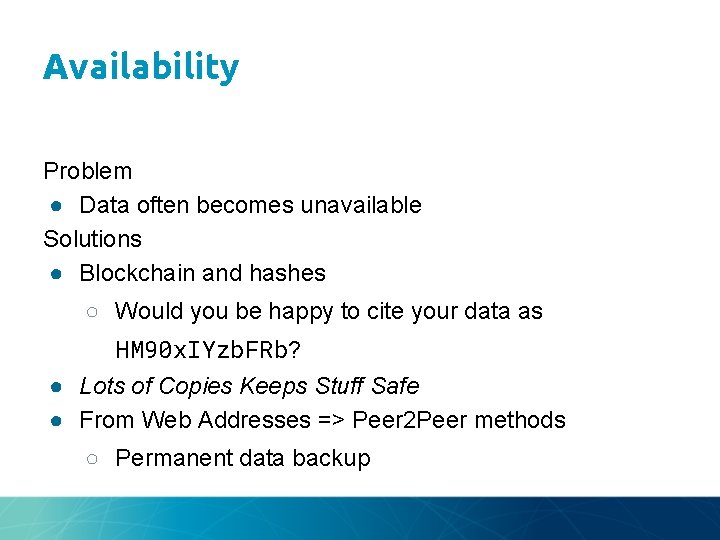
Availability Problem ● Data often becomes unavailable Solutions ● Blockchain and hashes ○ Would you be happy to cite your data as HM 90 x. IYzb. FRb? ● Lots of Copies Keeps Stuff Safe ● From Web Addresses => Peer 2 Peer methods ○ Permanent data backup
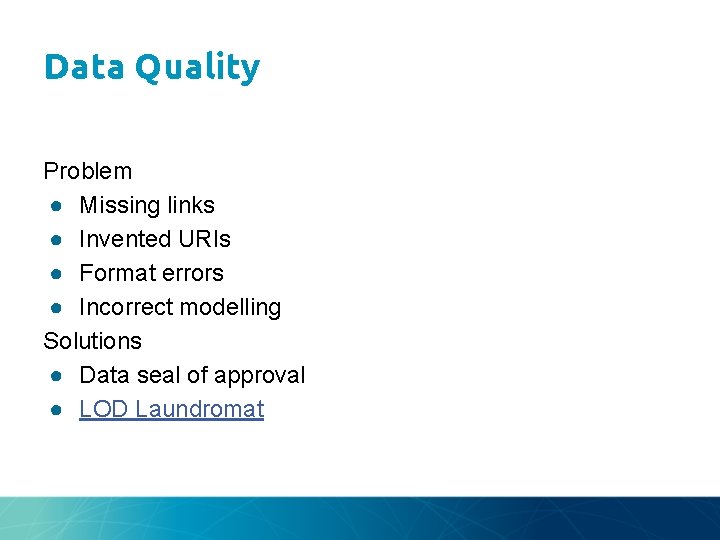
Data Quality Problem ● Missing links ● Invented URIs ● Format errors ● Incorrect modelling Solutions ● Data seal of approval ● LOD Laundromat
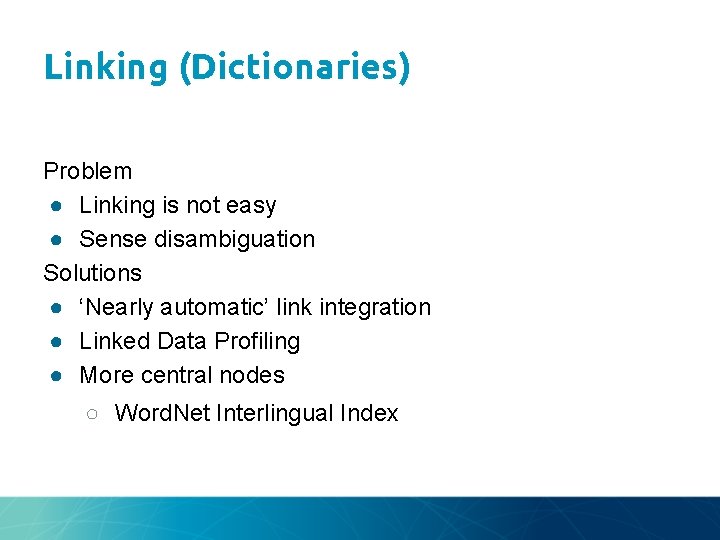
Linking (Dictionaries) Problem ● Linking is not easy ● Sense disambiguation Solutions ● ‘Nearly automatic’ link integration ● Linked Data Profiling ● More central nodes ○ Word. Net Interlingual Index
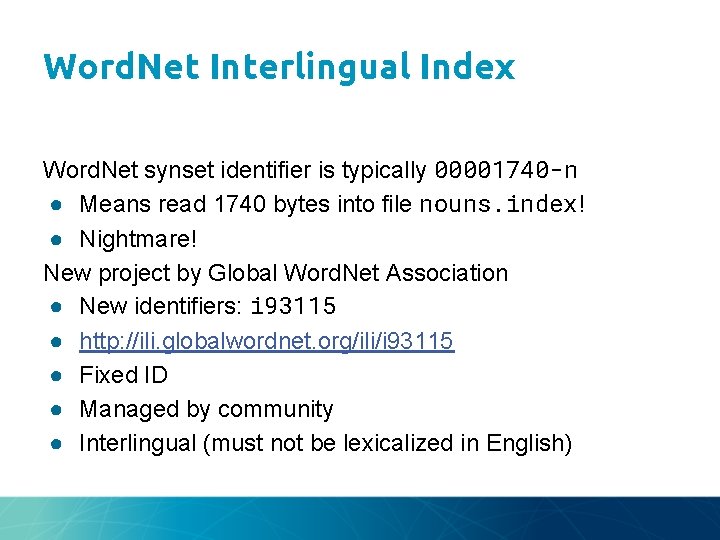
Word. Net Interlingual Index Word. Net synset identifier is typically 00001740 -n ● Means read 1740 bytes into file nouns. index! ● Nightmare! New project by Global Word. Net Association ● New identifiers: i 93115 ● http: //ili. globalwordnet. org/ili/i 93115 ● Fixed ID ● Managed by community ● Interlingual (must not be lexicalized in English)
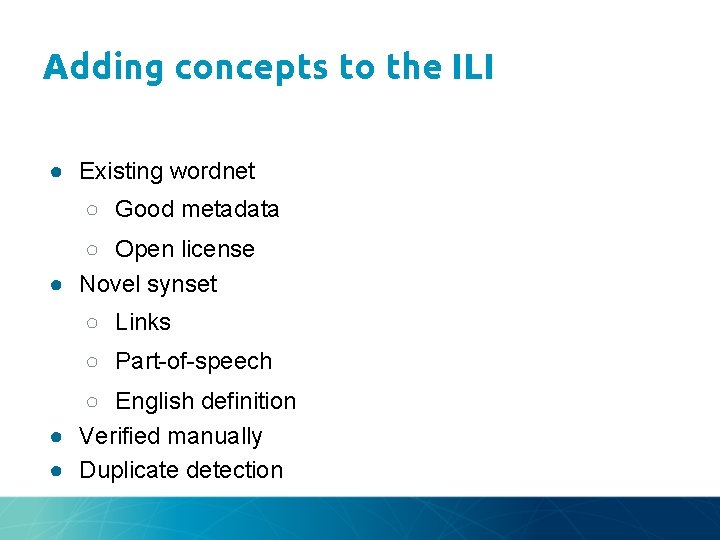
Adding concepts to the ILI ● Existing wordnet ○ Good metadata ○ Open license ● Novel synset ○ Links ○ Part-of-speech ○ English definition ● Verified manually ● Duplicate detection
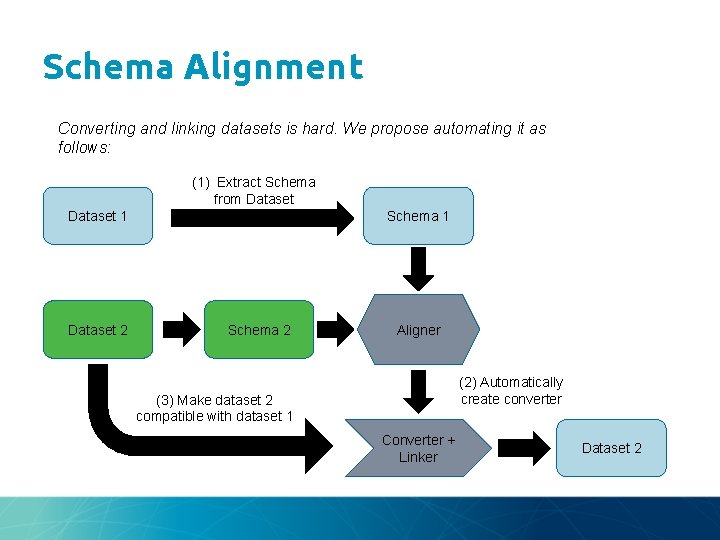
Schema Alignment Converting and linking datasets is hard. We propose automating it as follows: (1) Extract Schema from Dataset 1 Dataset 2 Schema 1 Schema 2 Aligner (2) Automatically create converter (3) Make dataset 2 compatible with dataset 1 Converter + Linker Dataset 2
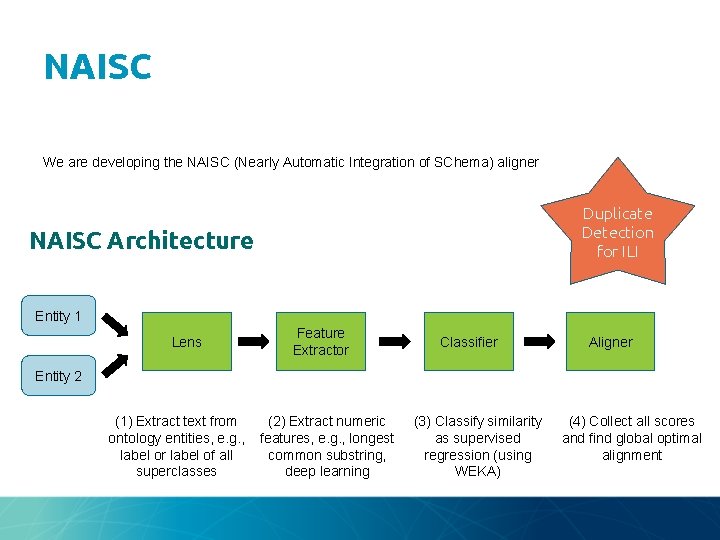
NAISC We are developing the NAISC (Nearly Automatic Integration of SChema) aligner Duplicate Detection for ILI NAISC Architecture Entity 1 Lens Feature Extractor Classifier Aligner Entity 2 (1) Extract text from ontology entities, e. g. , label or label of all superclasses (2) Extract numeric features, e. g. , longest common substring, deep learning (3) Classify similarity as supervised regression (using WEKA) (4) Collect all scores and find global optimal alignment
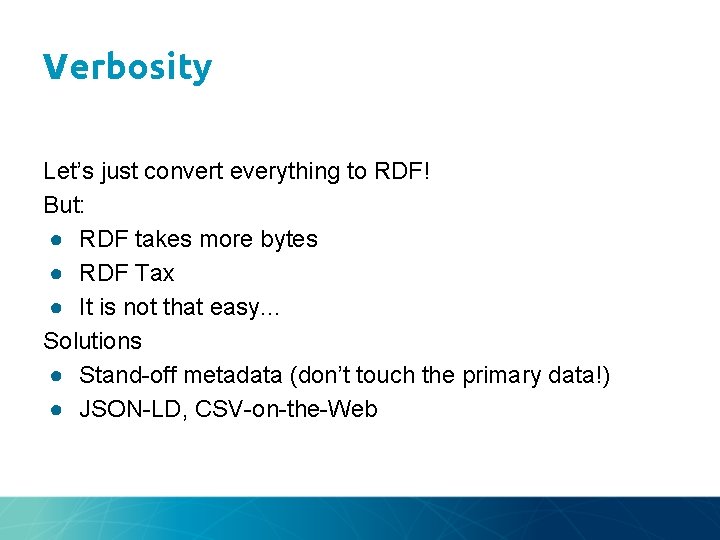
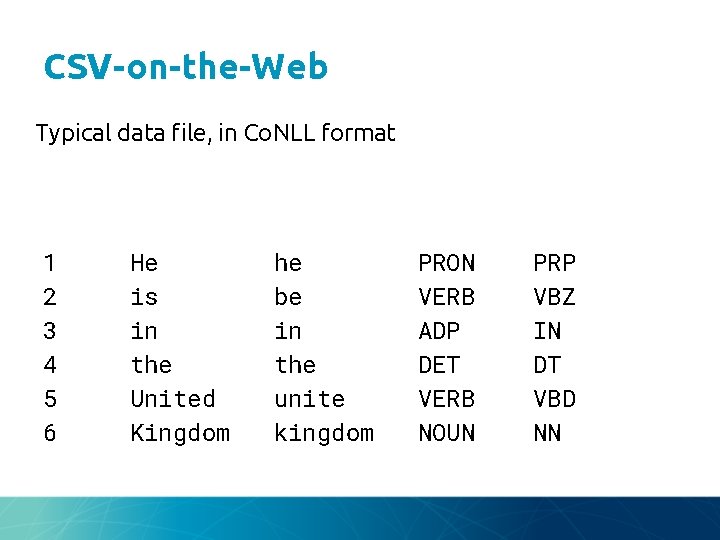
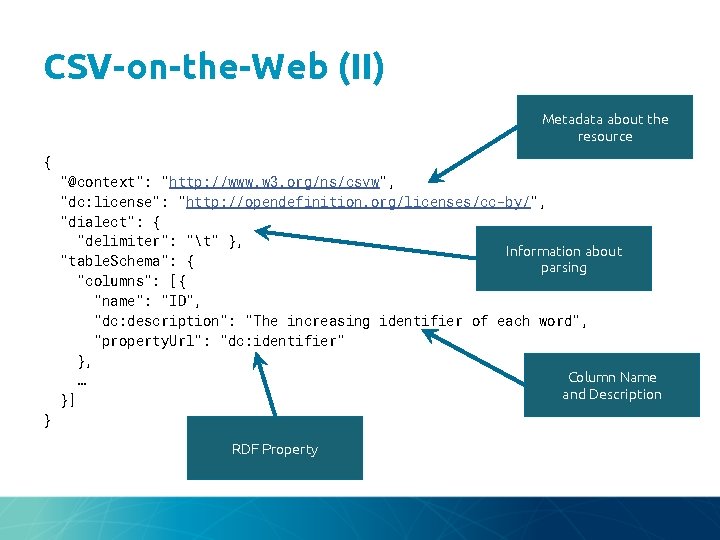
Verbosity Let’s just convert everything to RDF! But: ● RDF takes more bytes ● RDF Tax ● It is not that easy. . . Solutions ● Stand-off metadata (don’t touch the primary data!) ● JSON-LD, CSV-on-the-Web
CSV-on-the-Web Typical data file, in Co. NLL format 1 2 3 4 5 6 He is in the United Kingdom he be in the unite kingdom PRON VERB ADP DET VERB NOUN PRP VBZ IN DT VBD NN
CSV-on-the-Web (II) Metadata about the resource { "@context": "http: //www. w 3. org/ns/csvw", "dc: license": "http: //opendefinition. org/licenses/cc-by/", "dialect": { "delimiter": "t" }, Information about "table. Schema": { parsing "columns": [{ "name": "ID", "dc: description": "The increasing identifier of each word", "property. Url": "dc: identifier" }, Column Name … and Description }] } RDF Property
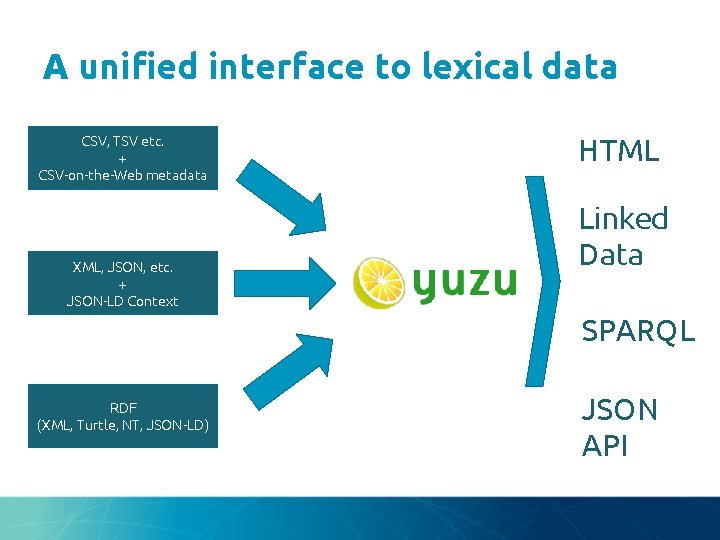
A unified interface to lexical data CSV, TSV etc. + CSV-on-the-Web metadata XML, JSON, etc. + JSON-LD Context HTML Linked Data SPARQL RDF (XML, Turtle, NT, JSON-LD) JSON API
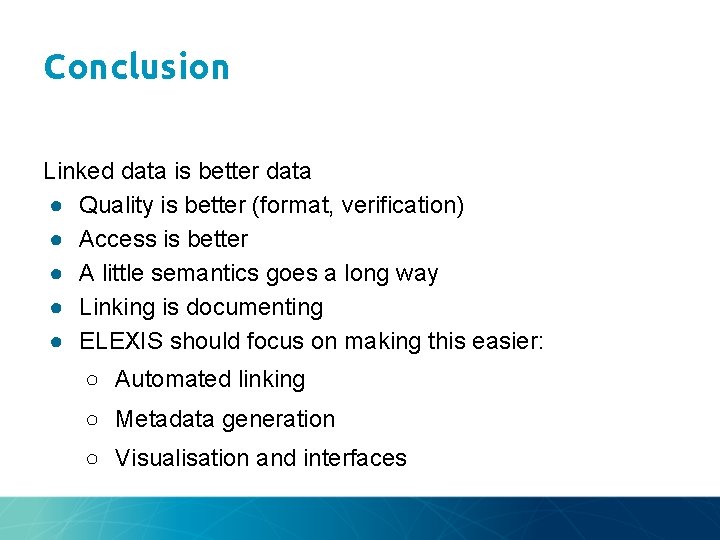
Conclusion Linked data is better data ● Quality is better (format, verification) ● Access is better ● A little semantics goes a long way ● Linking is documenting ● ELEXIS should focus on making this easier: ○ Automated linking ○ Metadata generation ○ Visualisation and interfaces
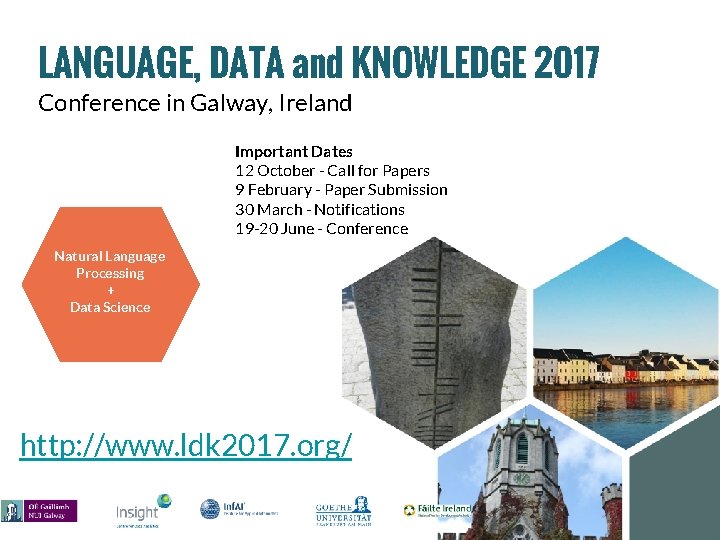
LANGUAGE, DATA and KNOWLEDGE 2017 Conference in Galway, Ireland Important Dates 12 October - Call for Papers 9 February - Paper Submission 30 March - Notifications 19 -20 June - Conference Natural Language Processing + Data Science http: //www. ldk 2017. org/