
Linguistic Interpretations of the Middle Voice III Benveniste
Linguistic Interpretations of the Middle Voice – III. : Benveniste on the Indo-European Voice Systems The Structure of the Presentation: 1) Benveniste’s Theses on the Primordial Voice Systems 2) Insight into ‘Mediality’ as Reflected in Primordial Voice Systems 3) The Philosophical Significance of ‘Mediality’ -------------------------------------------------------------------- The described study was carried out as part of the EFOP-3. 6. 1 -16 -2016 -00011 “Younger and Renewing University – Innovative Knowledge City – institutional development of the University of Miskolc aiming at intelligent specialisation” project implemented in the framework of the Szechenyi 2020 program. The realization of this project is supported by the European Union, cofinanced by the European Social Fund. ”

Benveniste on Middle Voice – 1 Problems in general linguistics (1966) a) The distinction between active & passive is confusing: ‒ appears necessary ↔ yet, many languages do not have it ‒ simple ↔ we have great difficulty in interpreting it ‒ symmetrical ↔ yet, it abounds in conflicting expressions is “indispensable as a fundamental determination of thought” in the Occidental languages ↔ is “inessential to the Indo-European verbal system”: it emerged “in the course of a not so ancient history” b) Prior to this opposition, there was a triple division: active, middle, and passive but “only for a given period in the history of Greek. ” c) The passive voice stems from the middle: it is “a modality of the middle, … with which it keeps close ties even when it has reached the state of a distinct category. ” d) The primordial verbal system consisted of two voices, active & middle

Benveniste on Middle Voice – 2 e) The terms and categorizations of the diatheses stem from the Greek grammarians → they give expression only to “a peculiarity of a certain stage of the language” → “the signification of this [A-M] opposition must be completely different” f) From ‘primordiality, ’ historical origin one is not to infer to ‘authenticity’: both distinctions [A-M / A-P] “are governed by the necessities of a linguistic system” g) The two oppositions [A-M / A-P] are distinct in nature: → they cannot be compared along their seemingly common term, the ‘active’ h) The generally accepted meaning of the middle voice (derived from Pānini): “the middle indicates only a certain relationship of the action with the subject, or an ‘interest’ of the subject in the action” ↔ It is „a rather vague formula”, for the „linguistic nature of that reference still escapes us” i) The middle is not to be defined in the usual manner ‒ “by starting with the forms that admit the two series of endings”
Benveniste on Middle Voice – 3 j) One should start with the classes of activa tantum & media tantum: “to find out what makes each one unsuited to the diathesis of the other. ” „I. Only active: be [!]; go; live; flow; bend; blow; eat; drink; give. II. Only middle: be born; die; follow, yield to a notion; be master [!]; lie; sit; enjoy, benefit; suffer [!], endure; experience mental disturbance; take measures; speak; etc. ” k) The principle of distinction turns on the relationship between subject & process: Active verbs “denote a process that is accomplished outside the subject” Middle verbs “indicate a process centering in the subject, the subject being inside the process” l) This definitions is i) valid “without regard to the semantic nature of the verbs” ii) may go against our “’instinctive’ mental image that we form of certain notions” The A-M difference do not coincide with that between verbs of action & verbs of condition. E. g. : ‘to be’ (activa tantum ) ‒ “is a process in which the participation of the subject is not required” ‘being born, sleeping, imagining, growing’ (media tantum) ‒ the subject is “the center as well as the agent of the process; he achieves something which is being achieved in him”
Benveniste on Middle Voice – 4 m) Checking the principle: a middle verb endowed secondarily with an active form → “the subject, in becoming exterior to the process, will become agent of it, and the process, no longer taking place within the subject, will be transferred to another term that will become the object of it. The middle will be converted into a transitive. ” E. g. : choimatai (middle) ‘he sleeps’ → choima (active) ‘he puts (someone) to sleep’ ‘I hope’ → ‘I produce hope (in another) ‘I dance’ → ‘I make (another) dance’ n) The principle also accounts for verbs with a double diathesis: E. g. : ‘to establish laws’ → ‘to establish laws and include oneself therein’ (= to give oneself laws) ‘he produces the war’ (= he provides the occasion for it) → ‘he makes war in which he takes part’ Ʃ: the active reveals “the exterior position of the subject in relation to the process” the middle defines the “subject as interior to the process” o) The definition does not lean on the notion of ‘interest’: “this formulation … frees us from resorting to the elusive and, moreover, extra-linguistic notion of the ‘interest’ of the subject in the process”
Benveniste on Middle Voice – 5 p) Benveniste suggests that we must “substitute the notions of ‘external diathesis’ and ‘internal diathesis’ for the terms ‘active’ and ‘middle’. q) As a consequence, the passive must be re-defined: “But that is a problem which cannot be discussed in passing. ” r) The place of diathesis in the Indo-European verb system: diathesis, person, and number define “the positional field of the subject”: person, according to whether the S enters into the ‘I-you’ person relationship or is a ‘non-person’ number, according to whether it is individual or plural diathesis, according to whether it is exterior or interior to the process” Ʃ: merged in a single ending, they “indicate the relationship of the subject to the process”
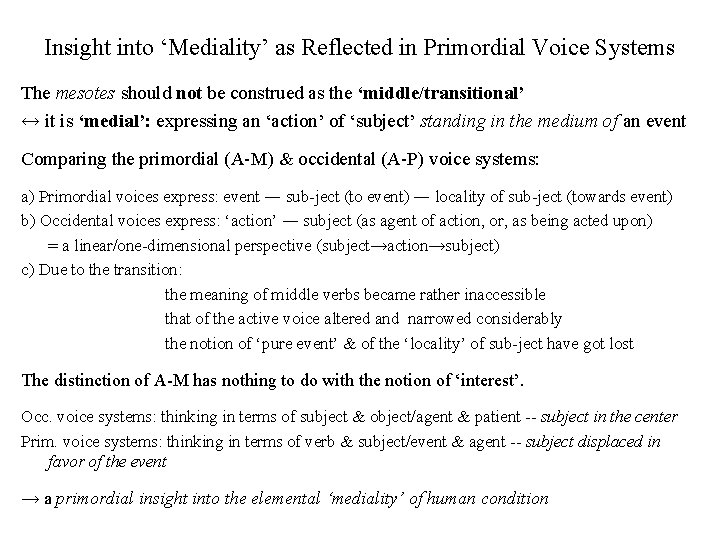
Insight into ‘Mediality’ as Reflected in Primordial Voice Systems The mesotes should not be construed as the ‘middle/transitional’ ↔ it is ‘medial’: expressing an ‘action’ of ‘subject’ standing in the medium of an event Comparing the primordial (A-M) & occidental (A-P) voice systems: a) Primordial voices express: event ― sub-ject (to event) ― locality of sub-ject (towards event) b) Occidental voices express: ‘action’ ― subject (as agent of action, or, as being acted upon) = a linear/one-dimensional perspective (subject→action→subject) c) Due to the transition: the meaning of middle verbs became rather inaccessible that of the active voice altered and narrowed considerably the notion of ‘pure event’ & of the ‘locality’ of sub-ject have got lost The distinction of A-M has nothing to do with the notion of ‘interest’. Occ. voice systems: thinking in terms of subject & object/agent & patient -- subject in the center Prim. voice systems: thinking in terms of verb & subject/event & agent -- subject displaced in favor of the event → a primordial insight into the elemental ‘mediality’ of human condition
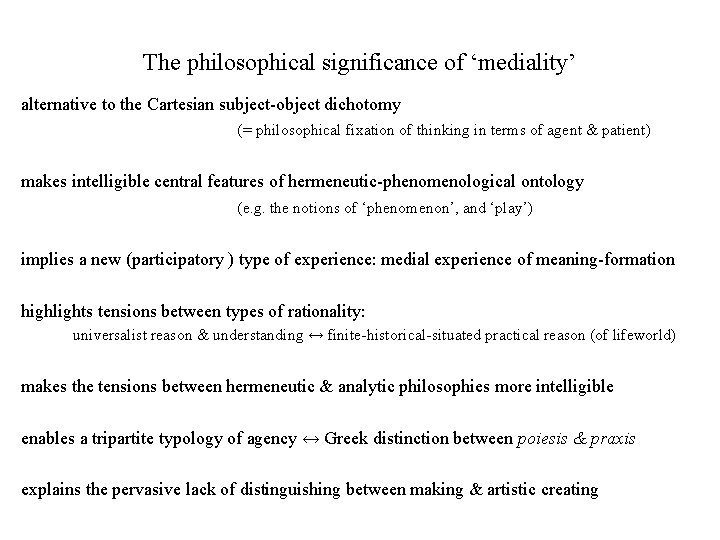
The philosophical significance of ‘mediality’ alternative to the Cartesian subject-object dichotomy (= philosophical fixation of thinking in terms of agent & patient) makes intelligible central features of hermeneutic-phenomenological ontology (e. g. the notions of ‘phenomenon’, and ‘play’) implies a new (participatory ) type of experience: medial experience of meaning-formation highlights tensions between types of rationality: universalist reason & understanding ↔ finite-historical-situated practical reason (of lifeworld) makes the tensions between hermeneutic & analytic philosophies more intelligible enables a tripartite typology of agency ↔ Greek distinction between poiesis & praxis explains the pervasive lack of distinguishing between making & artistic creating
- Slides: 8