
LINGUISTIC AND COMBINATION APPROACHES TO INTERVENTION I BASIC
LINGUISTIC AND COMBINATION APPROACHES TO INTERVENTION
I. BASIC PRINCIPLES** Linguistic approaches are focused on the rules of language, including sound contrasts and appropriate phonological patterns We are reorganizing the child’s phonological system Best for children with multiple errors Assumes they have the motor ability to make the sounds
II. PHONOLOGICAL CONTRAST APPROACHES** A. Introduction These approaches have become popular and are supported by research

B. Minimal contrast training** Use minimal pairs which only differ by one feature such as voicing (to-do, pan-ban) Place of articulation (tea-key)
Method: (p. 261)** 1. Select pictures of the contrast words (e. g. , tea-key) 2. Tell the child “Pick up _____” 3. Pretest the child’s motor production of each word; if it’s wrong, teach her how to produce it
4. Have the client produce each word by imitating your model 5. Have the client tell you which picture to pick up 6. Have the child use a carrier phrase—e. g. “I see a ___. ” 7. Continue with the carrier phrase with both words (e. g. , “I see a tea and a key. ”
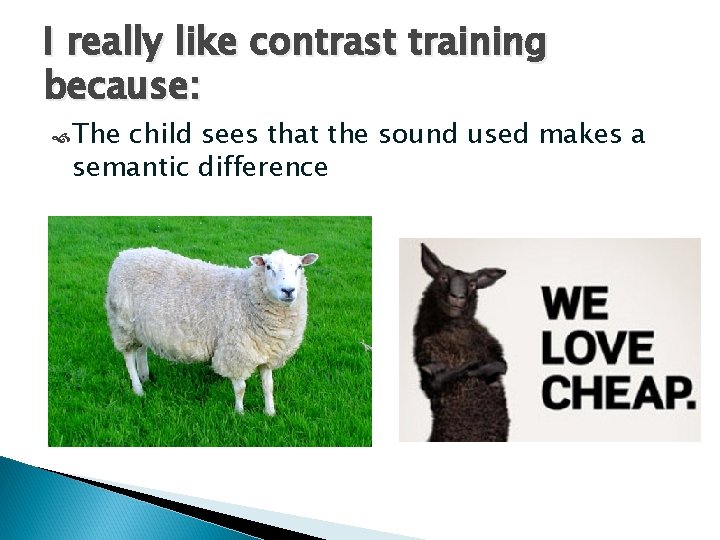
I really like contrast training because: The child sees that the sound used makes a semantic difference

If the child struggles with minimal pair therapy, we can use metaphon therapy Focuses on overtly teaching feature differences between sounds Develops ch’s awareness that sounds can be classified by: 1. Duration (e. g. , long vs. short) 2. Manner (e. g. , noisy vs. whisper) 3. Place (front vs. back)
C. Maximal contrast training** Sounds differ by at least 2 features Cane-lane: /k/ is a voiceless linguavelar stop; /l/ is a voiced lingual-alveolar glide Ten-men: /t/ is a voiceless tip-alveolar plosive; /m/ is a voiced bilabial nasal
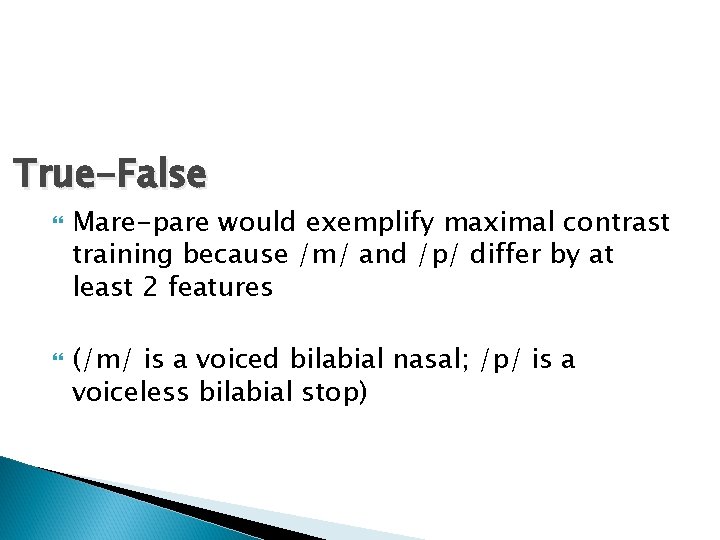
True-False Mare-pare would exemplify maximal contrast training because /m/ and /p/ differ by at least 2 features (/m/ is a voiced bilabial nasal; /p/ is a voiceless bilabial stop)
V. MAXIMAL OPPOSITIONS/COMPLEXITY THERAPY** Most research done with individual children in a university setting (not tried in schools w/ diverse groups) Best for children with individual sound errors (e. g. , w/r; j/l)
Complexity therapy…** Assumes that the complex sounds are affricates, fricatives, and clusters and sounds that are not stimulable Also assumes that later-developing sounds (e. g. , /tʃ/, /r/ ) are more complex than earlier-developing sounds (e. g. , /m/ and /p/)
Premise: Start with hardest sounds for ch Assumes: if train hardest sounds first, automatic generalization to easier sounds E. g. , ch produces /j/ 30% accuracy, /s/ 20% accuracy, /ð/ with 0% accuracy Start with /ð/ and assume that /s/ and /j/ will be positively impacted
VI. HODSON’S CYCLES APPROACH (emphasized on exam!)** A. Introduction General Procedures 1. Stimulation—use of auditory, tactile, visual cues to ↑awareness of target sounds 2. Production training —produce correct sound 3. Semantic awareness contrasts —minimal pair training
In this approach…. The SLP does NOT work to criterion— e. g. 80% accuracy You introduce new sounds or patterns and then move on
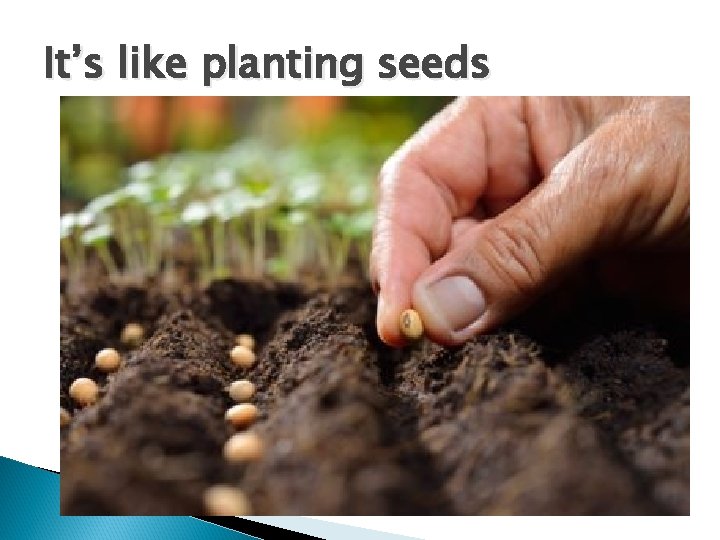
It’s like planting seeds
Remediation program planned around a cycle** Cycle: time period required for child to focus on each deficient phonological pattern for 2 -6 hours Pattern = phonological process Focuses on teaching stimulable sounds Early on, stick to simple CVC words
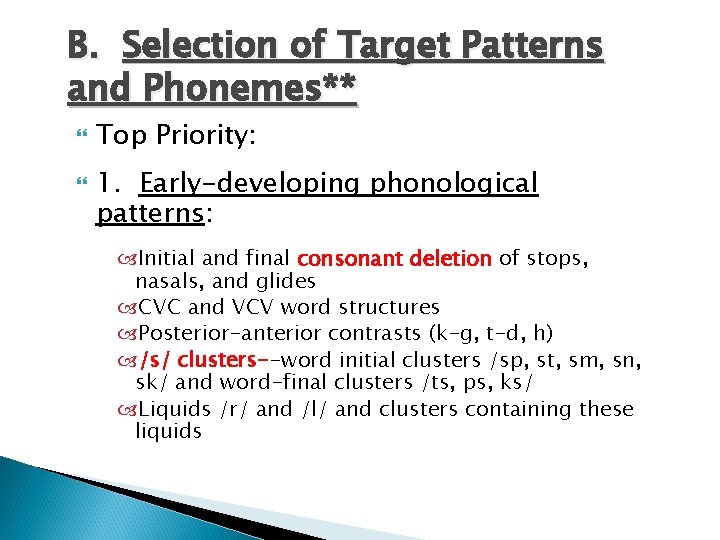
B. Selection of Target Patterns and Phonemes** Top Priority: 1. Early-developing phonological patterns: Initial and final consonant deletion of stops, nasals, and glides CVC and VCV word structures Posterior-anterior contrasts (k-g, t-d, h) /s/ clusters--word initial clusters /sp, st, sm, sn, sk/ and word-final clusters /ts, ps, ks/ Liquids /r/ and /l/ and clusters containing these liquids
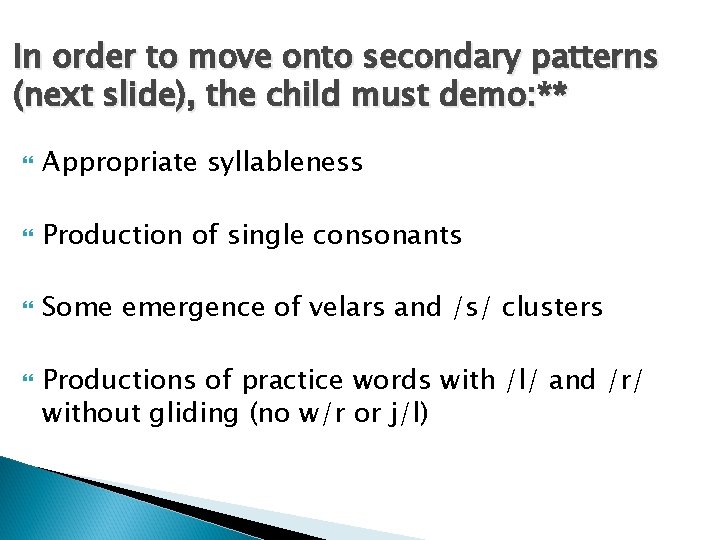
In order to move onto secondary patterns (next slide), the child must demo: ** Appropriate syllableness Production of single consonants Some emergence of velars and /s/ clusters Productions of practice words with /l/ and /r/ without gliding (no w/r or j/l)
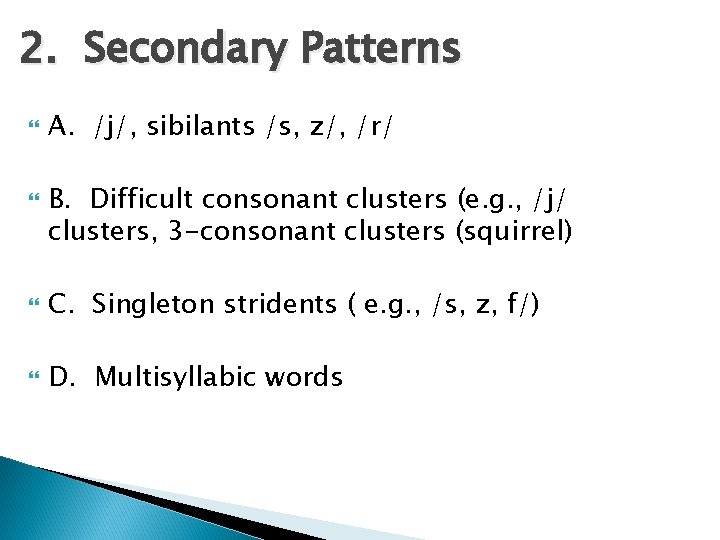
2. Secondary Patterns A. /j/, sibilants /s, z/, /r/ B. Difficult consonant clusters (e. g. , /j/ clusters, 3 -consonant clusters (squirrel) C. Singleton stridents ( e. g. , /s, z, f/) D. Multisyllabic words
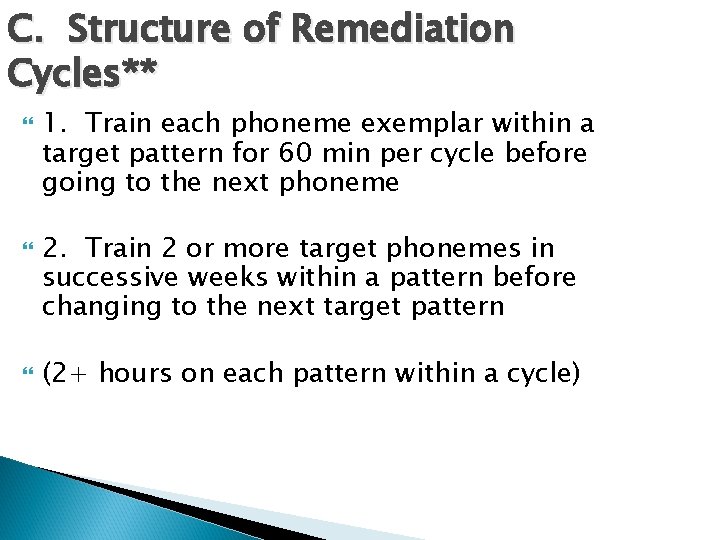
C. Structure of Remediation Cycles** 1. Train each phoneme exemplar within a target pattern for 60 min per cycle before going to the next phoneme 2. Train 2 or more target phonemes in successive weeks within a pattern before changing to the next target pattern (2+ hours on each pattern within a cycle)
3. Target only one phonological pattern per session 4. When all target patterns have been taught, a cycle is complete 5. Initiate second cycle. Review patterns not yet corrected, intro new ones as necessary **to become intelligible, most ch need 3 -6 cycles of therapy
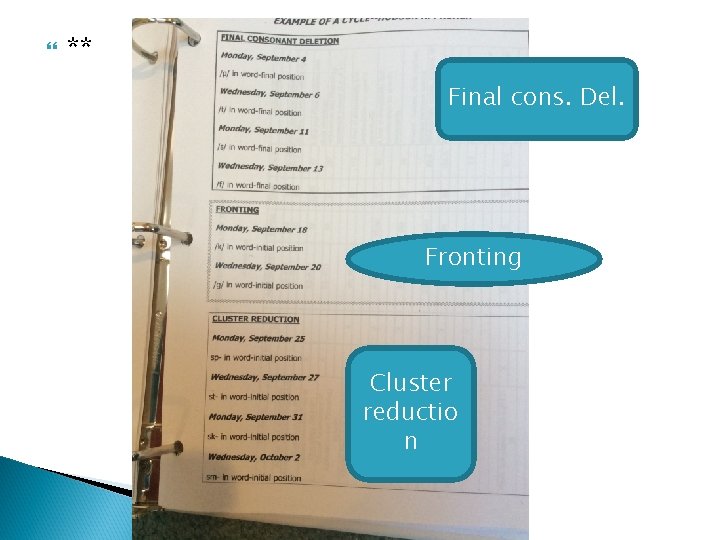
** Final cons. Del. Fronting Cluster reductio n
D. Structure of Therapy Sessions 1. Review word cards from previous session 2. Auditory bombardment (use amplification!) SLP reads list of 12 words for about 2 min. , 2 x if ch paying attention. Don’t overexaggerate words. 3. Target word cards— 3 -5 new target words. Ch draws, colors etc. and SLP writes name of pic on card.
4. Production practice—games, shift activities every 5 -7 minutes 5. Stimulability probing—check if ch stimulable for phoneme planned for next session 6. Repeat auditory bombardment w/ 12 item word list used at beginning of session
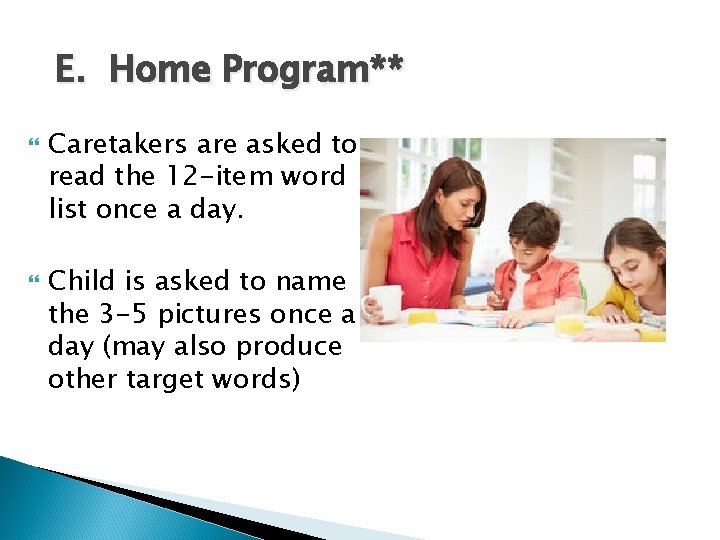
E. Home Program** Caretakers are asked to read the 12 -item word list once a day. Child is asked to name the 3 -5 pictures once a day (may also produce other target words)
Hodson’s cycles approach says: A. Select 2 patterns per session (e. g. , fronting, final consonant deletion) but no more. B. An early-developing phonological pattern that is important is /s/ clusters C. During auditory bombardment, the SLP exaggerates the sounds D. A, B E. A, C
VII. NATURALISTIC APPROACH** (uses both motor and linguistic principles) A. Introduction Focuses on improving child’s overall intelligibility and whole-word accuracy first, then works on individual phonemes in error For severely involved children like preschoolers, those with Down Syndrome, autism spectrum disorder, cerebral palsy Approximations of sounds OK
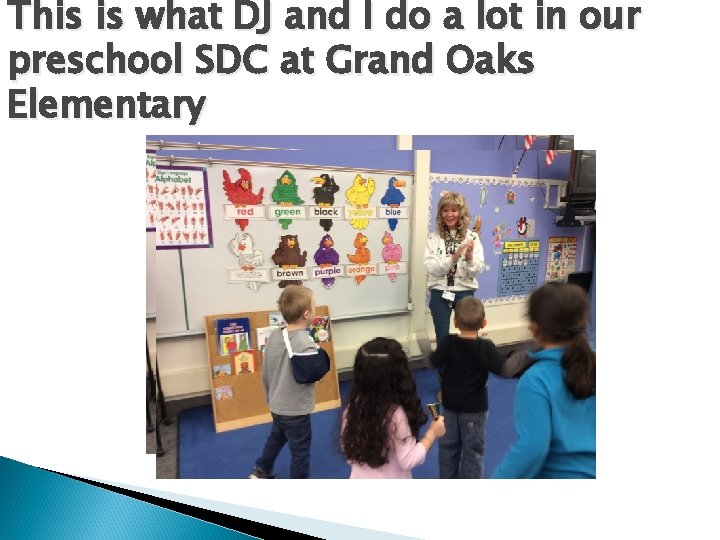
This is what DJ and I do a lot in our preschool SDC at Grand Oaks Elementary
Work in the child’s natural settings —and have fun!** Establish word and sound approximations so the listener understands the child better Use natural recasts —corrective feedback given in naturalistic fashion—correct model given without the child being interrupted and asked to repeat
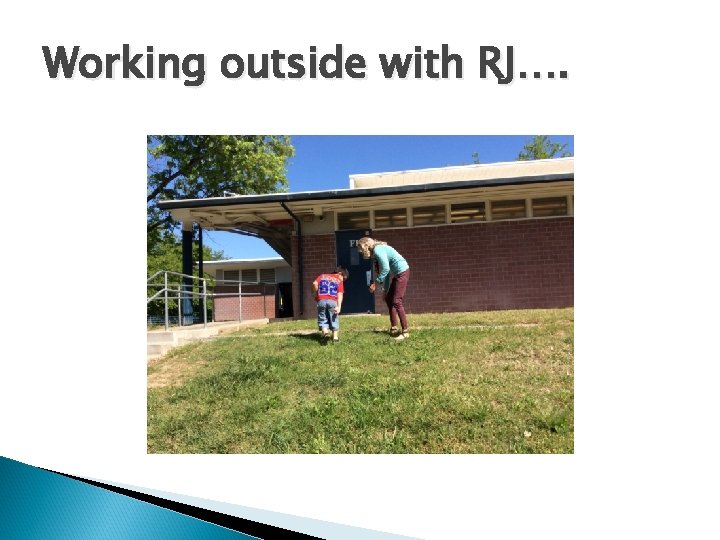
Working outside with RJ….
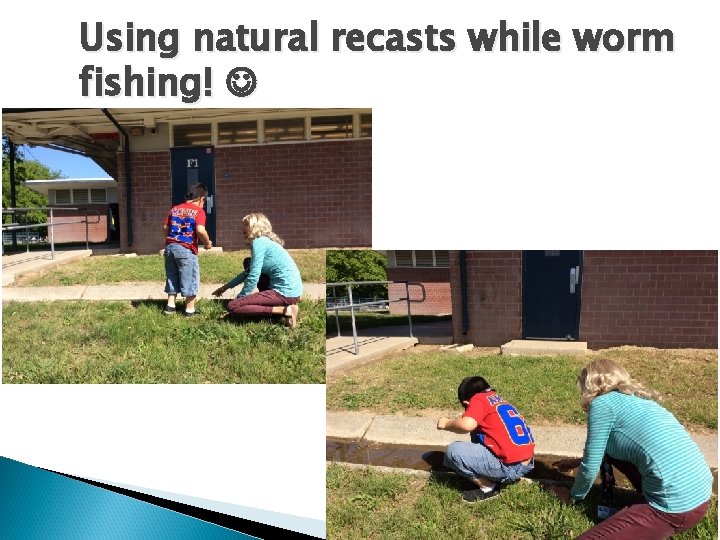
Using natural recasts while worm fishing!
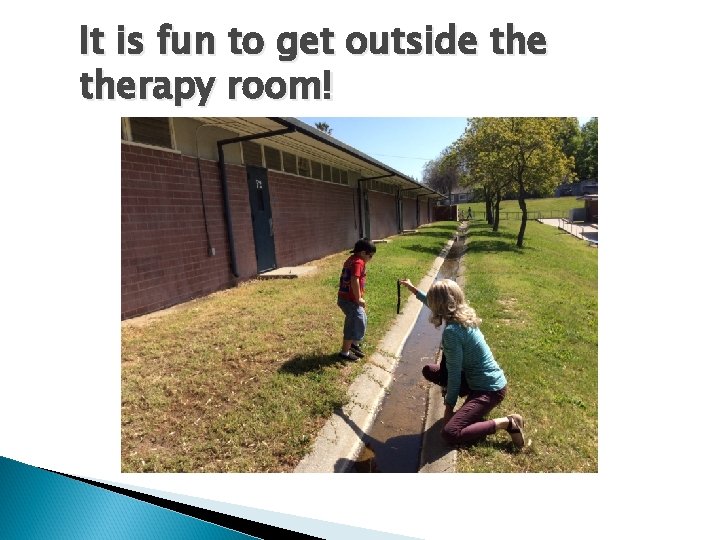
It is fun to get outside therapy room!
Speech recast: Adult feedback that immediately follows a ch’s utterance and provides an exact or reduced imitation of the ch’s words Uses adult pronunciation
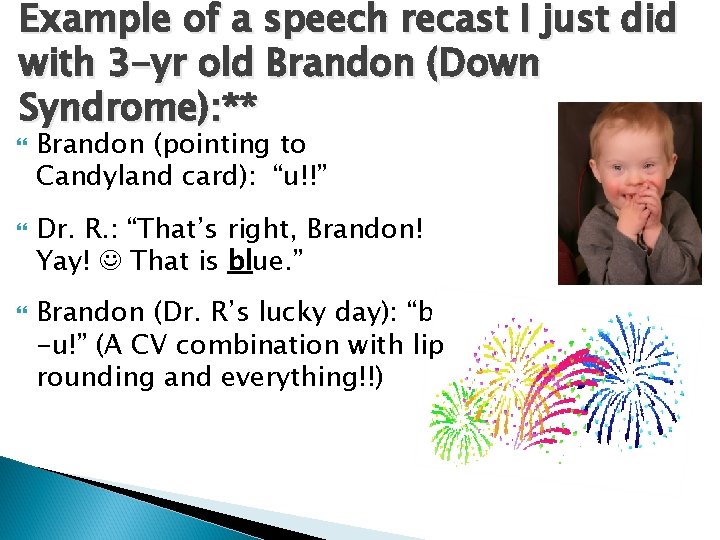
Example of a speech recast I just did with 3 -yr old Brandon (Down Syndrome): ** Brandon (pointing to Candyland card): “u!!” Dr. R. : “That’s right, Brandon! Yay! That is blue. ” Brandon (Dr. R’s lucky day): “b -u!” (A CV combination with lip rounding and everything!!)
IX. Combining Therapy for Language and Speech Sound Disorders** We can connect speech sound production to children’s morphosyntactic skills If children have final consonant deletion or cluster reduction, they will have problems with some morphemes
Ann Tyler—ASHA (The phonologymorphology interface in children with SSD: Development, assessment, and treatment considerations. ** Concomitant SSD and language impairment (LI) is the strongest predictor of literacy outcomes Children with both SSD and LI have many omissions, while children with just SSD have many more substitutions
Tyler: Eliminating error patterns like FCD and cluster reduction will improve production of grammatical morphemes
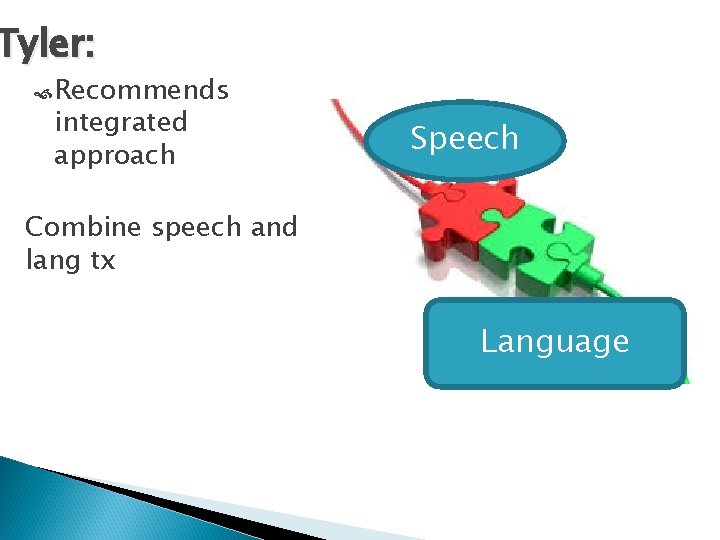
Tyler: Recommends integrated approach Speech Combine speech and lang tx Language
These morphemes include: ** Past tense –ed (jumped, scared) Plural –s (pots, sidewalks) Regular 3 rd person –s (eats, runs) Possessive –s (Grant’s, Bob’s)
Therapy suggestions: If ch has FCD, use minimal pairs which include grammatical morphemes
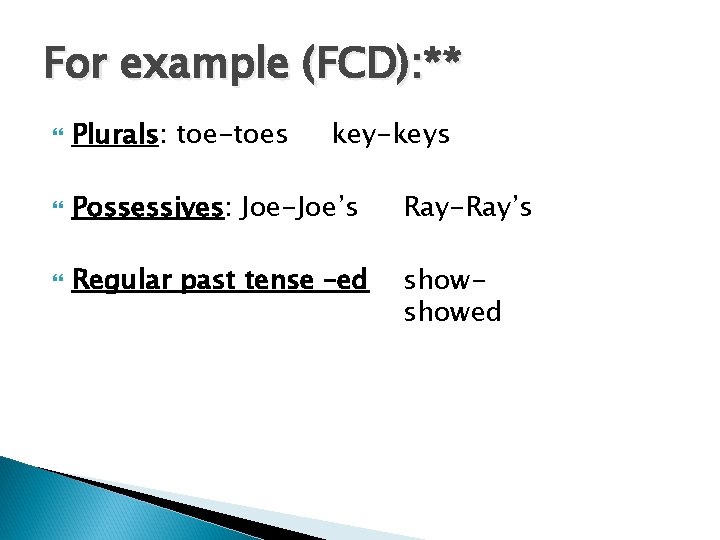
For example (FCD): ** Plurals: toe-toes key-keys Possessives: Joe-Joe’s Ray-Ray’s Regular past tense –ed showed
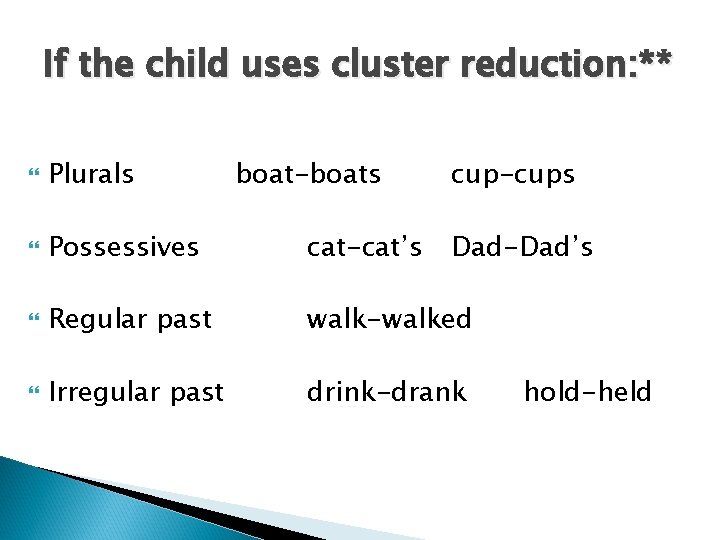
If the child uses cluster reduction: ** Plurals boat-boats cup-cups Possessives cat-cat’s Regular past walk-walked Irregular past drink-drank Dad-Dad’s hold-held
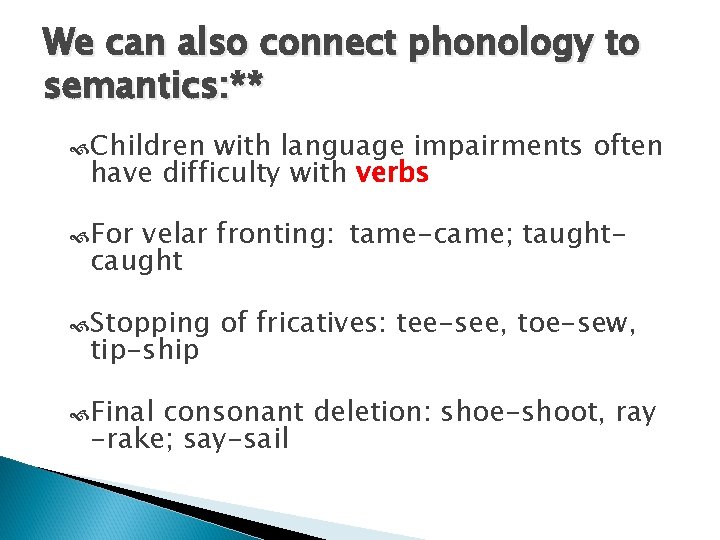
We can also connect phonology to semantics: ** Children with language impairments often have difficulty with verbs For velar fronting: tame-came; taughtcaught Stopping tip-ship Final of fricatives: tee-see, toe-sew, consonant deletion: shoe-shoot, ray -rake; say-sail
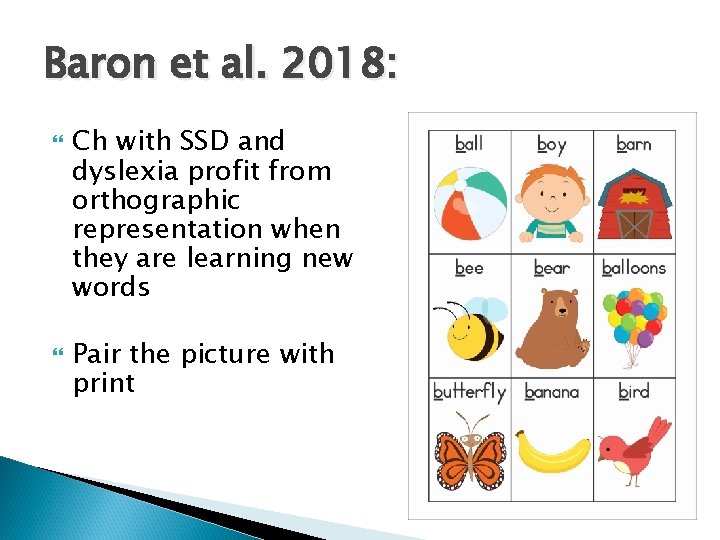
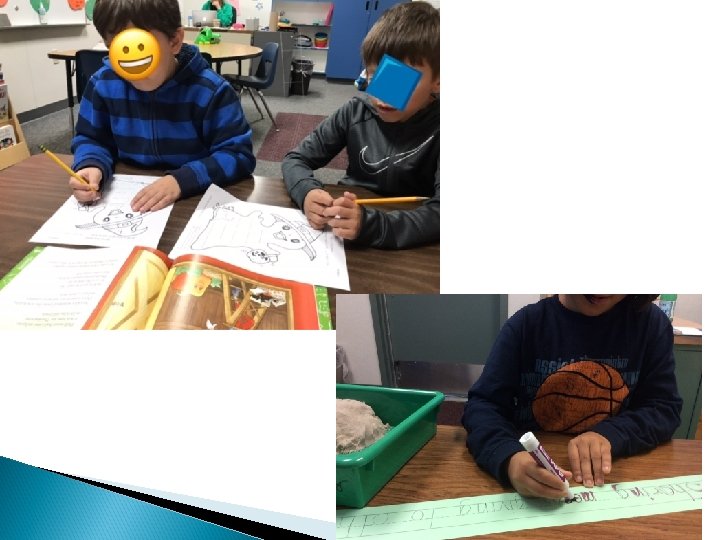
Baron et al. 2018: Ch with SSD and dyslexia profit from orthographic representation when they are learning new words Pair the picture with print
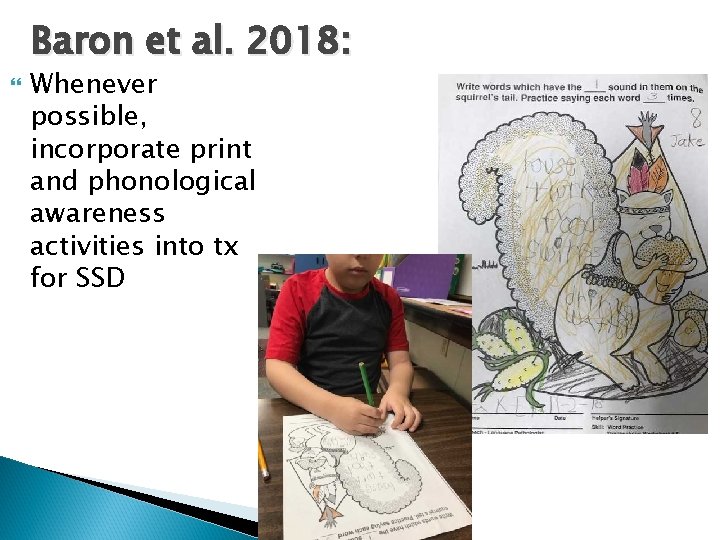
Baron et al. 2018: Whenever possible, incorporate print and phonological awareness activities into tx for SSD
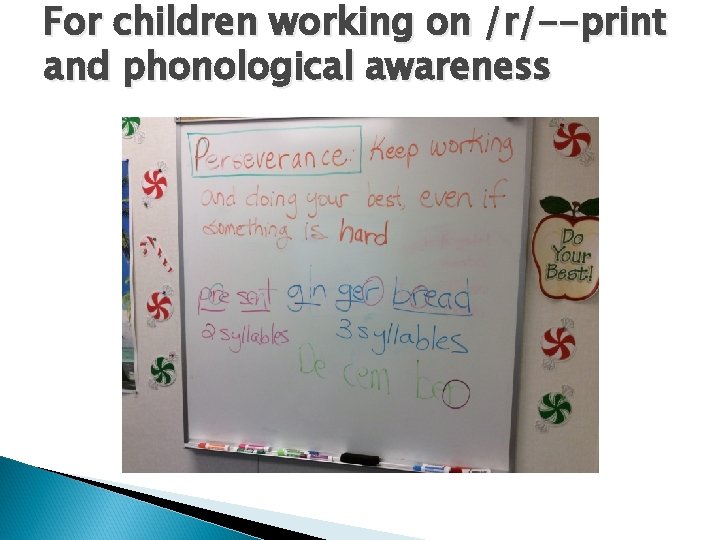
For children working on /r/--print and phonological awareness
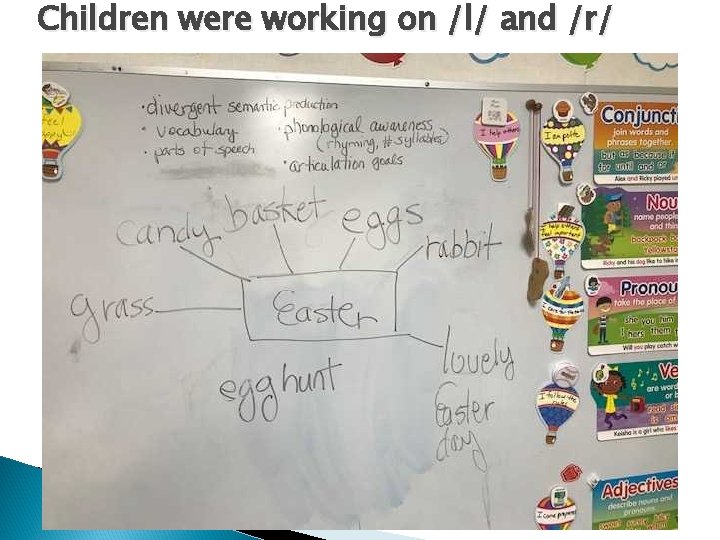
Children were working on /l/ and /r/

Connecting /r/ to print
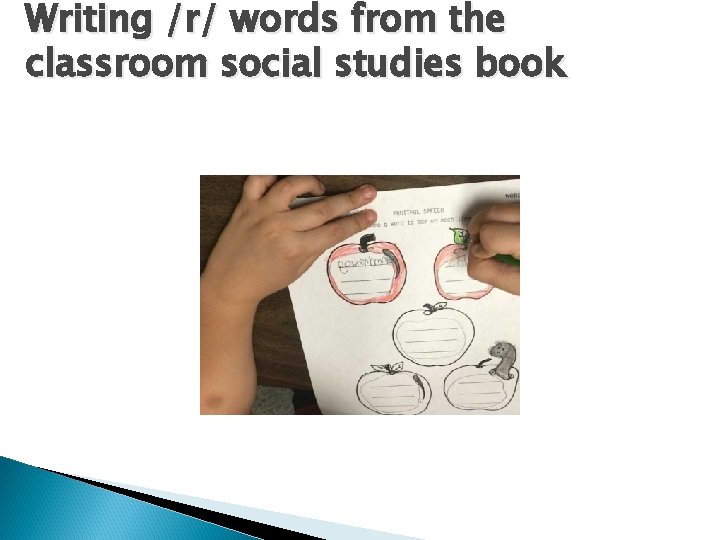
Writing /r/ words from the classroom social studies book
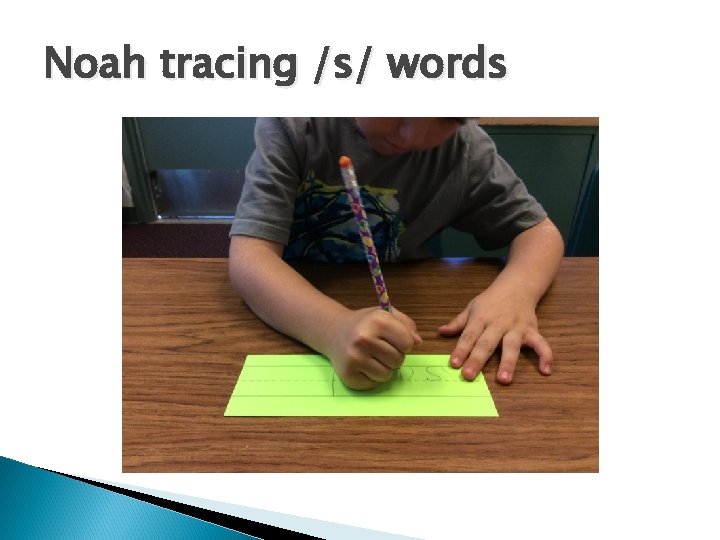
Noah tracing /s/ words
You are treating Amanda, an unintelligible 4 -year old. What will you remember? A. If you are using the naturalistic approach, you’ll focus on improving overall intelligibility before you work on individual sounds B. You’ll only use the core vocabulary approach if she has CAS C. If she has a language impairment, she will specifically have difficulty with verbs D. A, B E. A, C
- Slides: 54