
Ling 411 15 Right Hemisphere in Language Processing

- Slides: 47
Ling 411 – 15 Right Hemisphere in Language Processing Coarse and Fine Coding
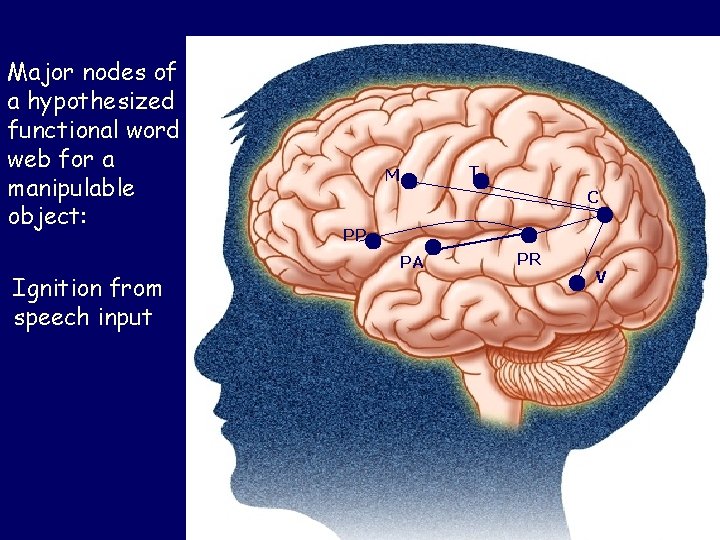
Major nodes of a hypothesized functional word web for a manipulable object: Ignition from speech input T M C PP PA PR V
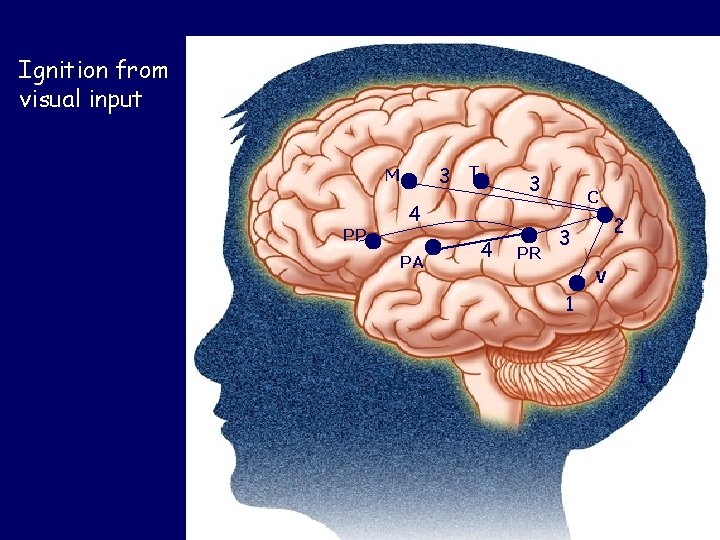
Ignition from visual input 3 M PP T 3 4 PA 4 PR C 2 3 V 1 1
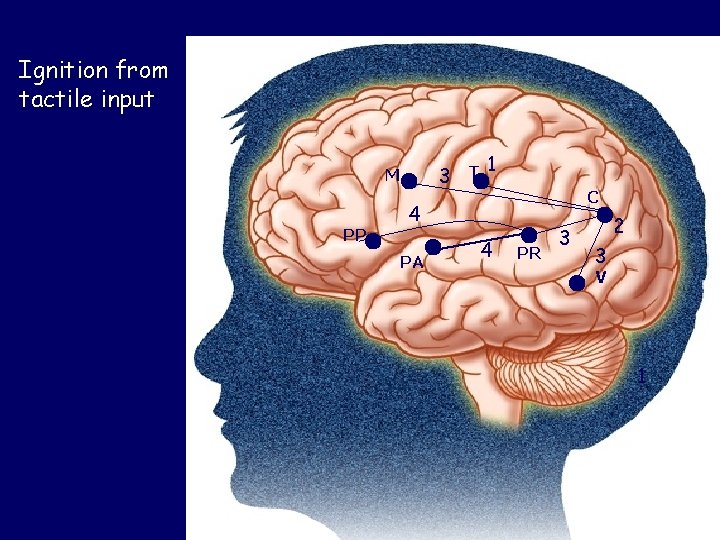
Ignition from tactile input 3 M PP T 1 C 4 PA 4 PR 3 2 3 V 1
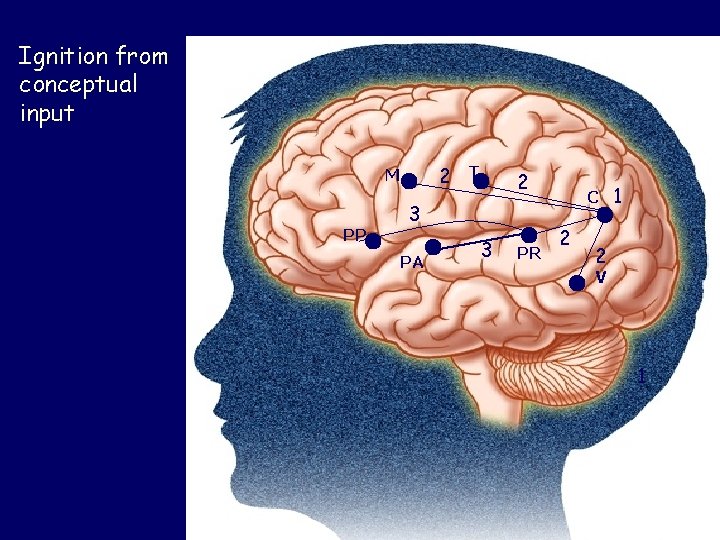
Ignition from conceptual input 2 M PP T 2 3 PA 3 PR C 2 1 2 V 1
RH Linguistic Functions § Inference, Metaphor § Coarse coding § Music
Some findings w. r. t. RH speech perception § Vowel qualities § Intonation § Tones in tone languages
Possible bases for RH/LH difference § Higher ratio of white to gray matter in RH • Therefore, higher degree of connectivity in RH § Difference in dendritic branching § Different density of interneurons § Evoked potentials (EEG) are more diffuse over the RH than over LH Beeman 257
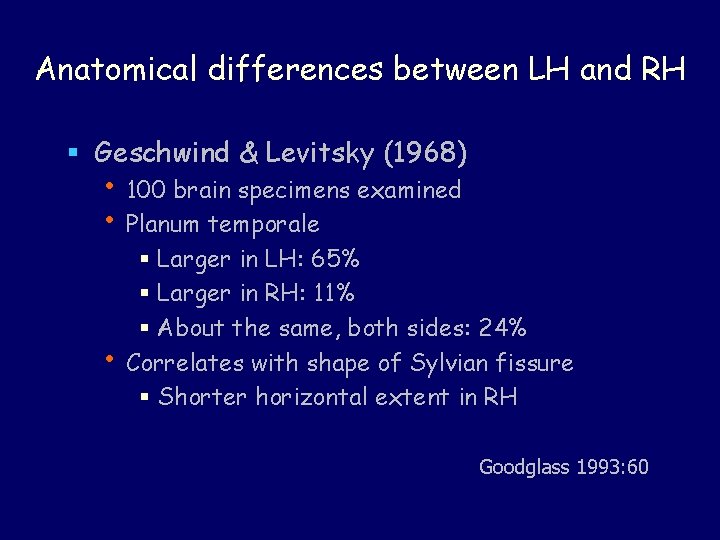
Anatomical differences between LH and RH § Geschwind & Levitsky (1968) • 100 brain specimens examined • Planum temporale • § Larger in LH: 65% § Larger in RH: 11% § About the same, both sides: 24% Correlates with shape of Sylvian fissure § Shorter horizontal extent in RH Goodglass 1993: 60
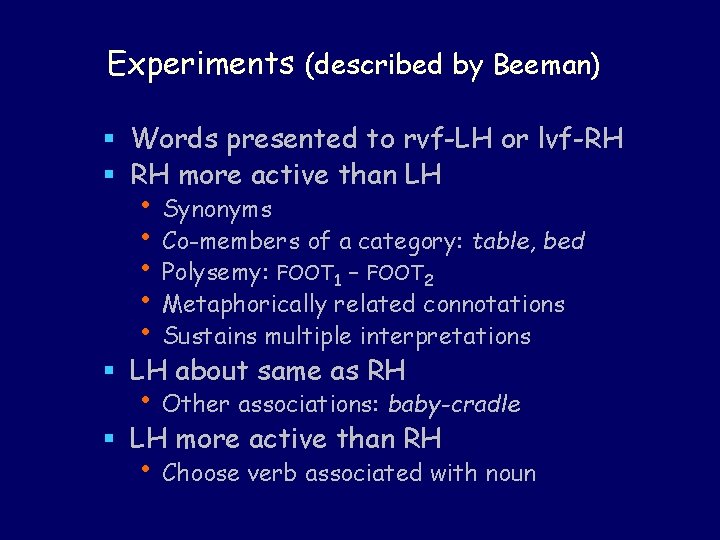
Experiments (described by Beeman) § Words presented to rvf-LH or lvf-RH § RH more active than LH • Synonyms • Co-members of a category: table, bed • Polysemy: FOOT 1 – FOOT 2 • Metaphorically related connotations • Sustains multiple interpretations § LH about same as RH • Other associations: baby-cradle § LH more active than RH • Choose verb associated with noun
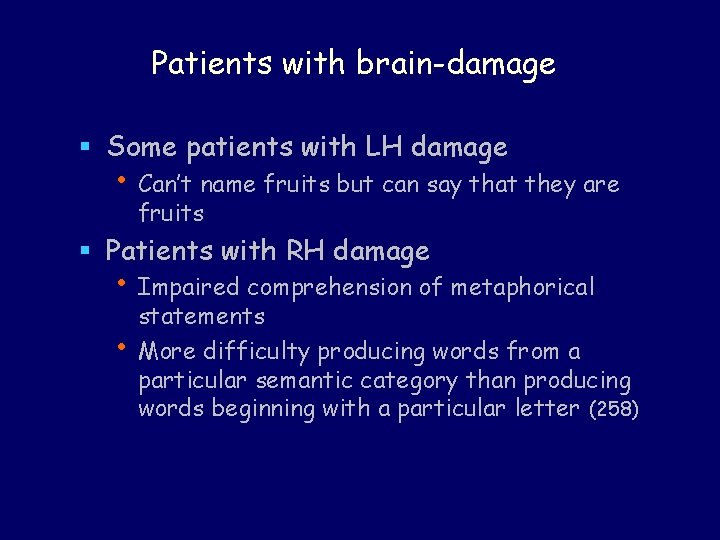
Patients with brain-damage § Some patients with LH damage • Can’t name fruits but can say that they are fruits § Patients with RH damage • Impaired comprehension of metaphorical • statements More difficulty producing words from a particular semantic category than producing words beginning with a particular letter (258)
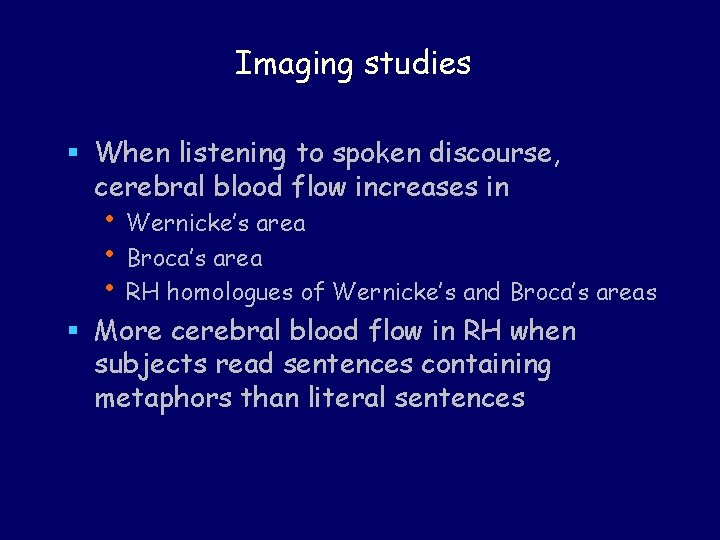
Imaging studies § When listening to spoken discourse, cerebral blood flow increases in • Wernicke’s area • Broca’s area • RH homologues of Wernicke’s and Broca’s areas § More cerebral blood flow in RH when subjects read sentences containing metaphors than literal sentences
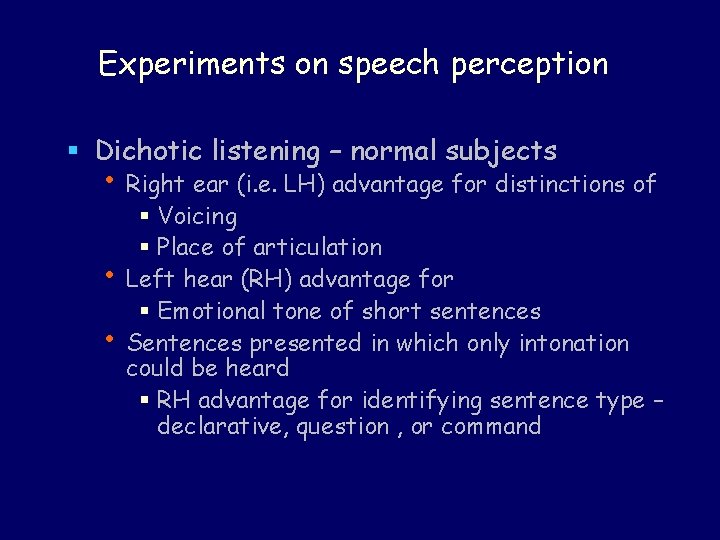
Experiments on speech perception § Dichotic listening – normal subjects • Right ear (i. e. LH) advantage for distinctions of • • § Voicing § Place of articulation Left hear (RH) advantage for § Emotional tone of short sentences Sentences presented in which only intonation could be heard § RH advantage for identifying sentence type – declarative, question , or command
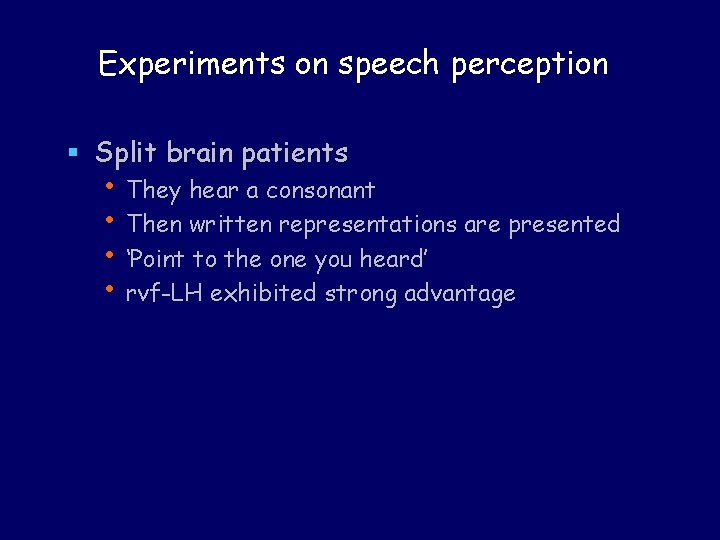
Experiments on speech perception § Split brain patients • They hear a consonant • Then written representations are presented • ‘Point to the one you heard’ • rvf-LH exhibited strong advantage
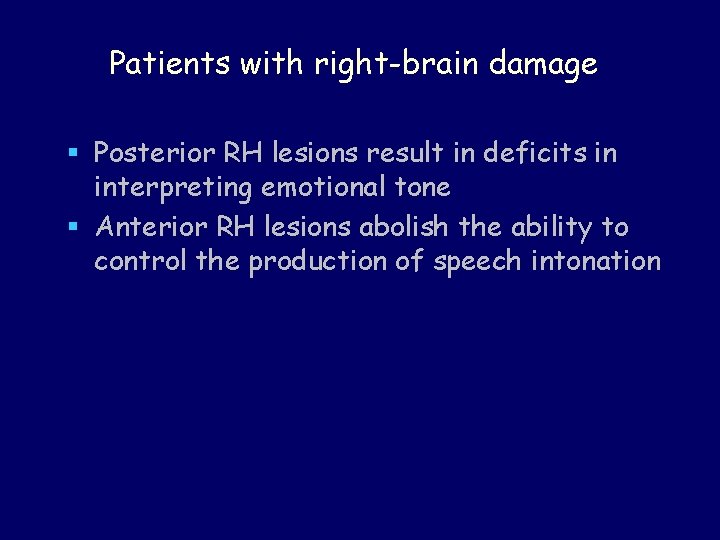
Patients with right-brain damage § Posterior RH lesions result in deficits in interpreting emotional tone § Anterior RH lesions abolish the ability to control the production of speech intonation
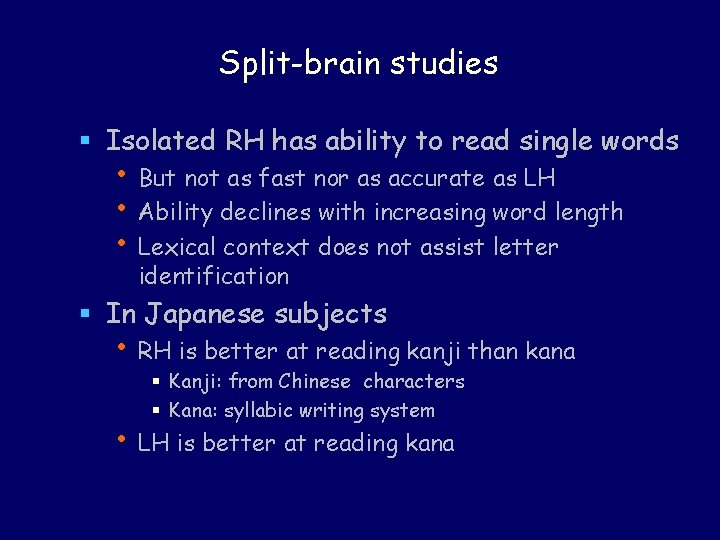
Split-brain studies § Isolated RH has ability to read single words • But not as fast nor as accurate as LH • Ability declines with increasing word length • Lexical context does not assist letter identification § In Japanese subjects • RH is better at reading kanji than kana § Kanji: from Chinese characters § Kana: syllabic writing system • LH is better at reading kana
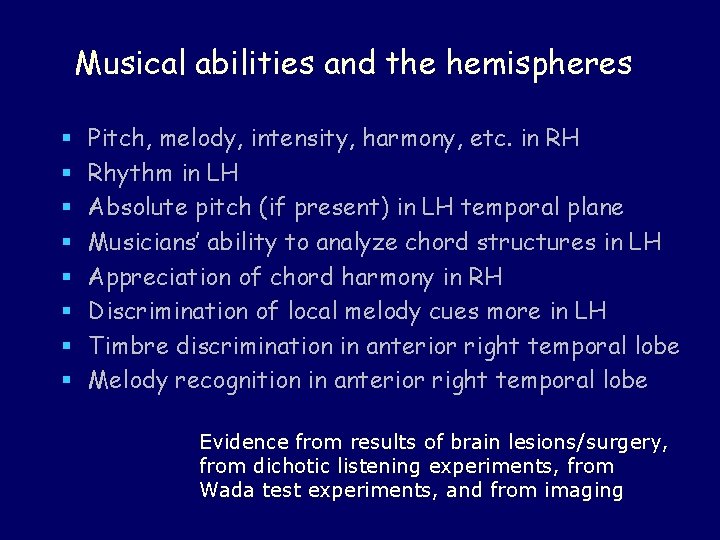
Musical abilities and the hemispheres § § § § Pitch, melody, intensity, harmony, etc. in RH Rhythm in LH Absolute pitch (if present) in LH temporal plane Musicians’ ability to analyze chord structures in LH Appreciation of chord harmony in RH Discrimination of local melody cues more in LH Timbre discrimination in anterior right temporal lobe Melody recognition in anterior right temporal lobe Evidence from results of brain lesions/surgery, from dichotic listening experiments, from Wada test experiments, and from imaging
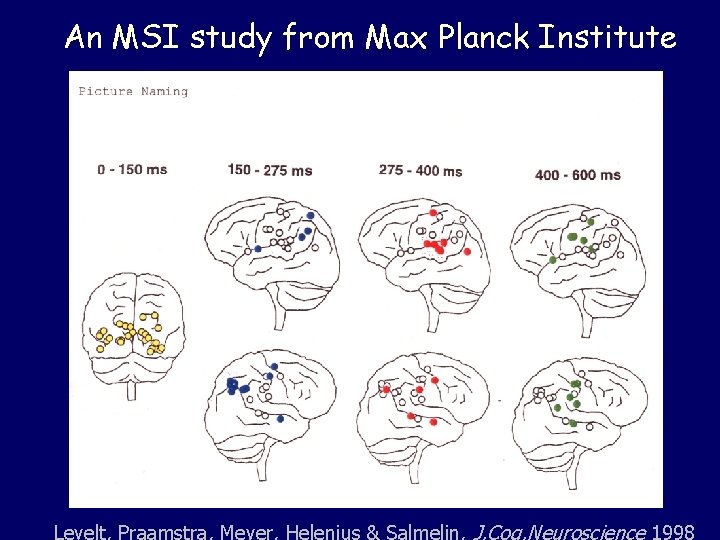
An MSI study from Max Planck Institute Levelt, Praamstra, Meyer, Helenius & Salmelin, J. Cog. Neuroscience 1998
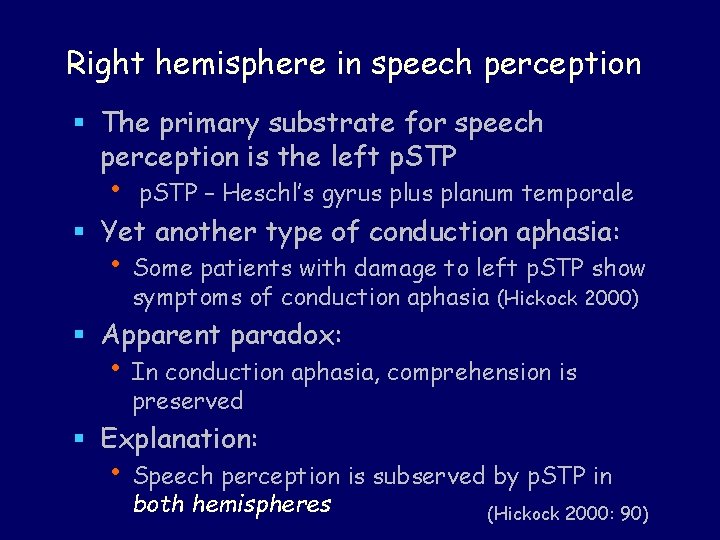
Right hemisphere in speech perception § The primary substrate for speech perception is the left p. STP • p. STP – Heschl’s gyrus planum temporale § Yet another type of conduction aphasia: • Some patients with damage to left p. STP show symptoms of conduction aphasia (Hickock 2000) § Apparent paradox: • In conduction aphasia, comprehension is preserved § Explanation: • Speech perception is subserved by p. STP in both hemispheres (Hickock 2000: 90)
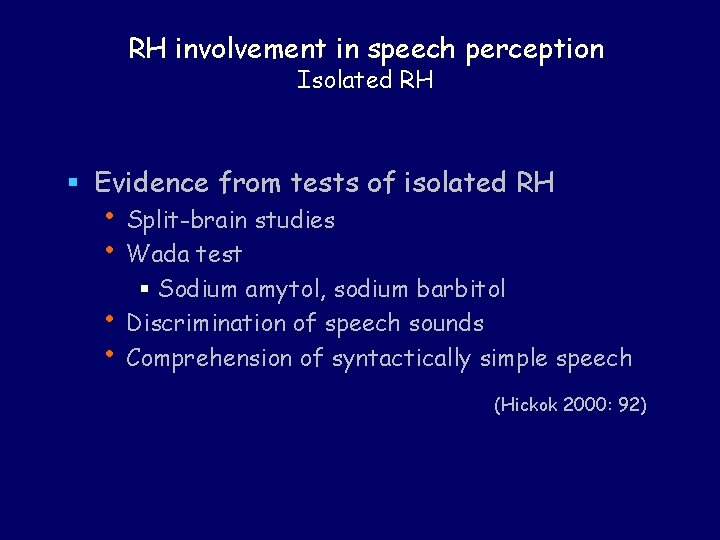
RH involvement in speech perception Isolated RH § Evidence from tests of isolated RH • Split-brain studies • Wada test • • § Sodium amytol, sodium barbitol Discrimination of speech sounds Comprehension of syntactically simple speech (Hickok 2000: 92)
Caution – Split-Brain Studies § These patients are generally epileptics § Usually the onset of seizures is several to many years before the surgery § Often the onset of seizures was during childhood § Therefore the brain has had time to adapt – perhaps reorganize some linguistic functions
RH involvement in speech perception Intra-operative recording § Evidence from intraoperative recording § Sites found in STG of both hemispheres for • Phoneme clusters • Distinguishing speech from backwards speech • Distinguishing mono- from polysyllabic words (Hickok 2000: 92 -3)
RH involvement in speech perception Imaging § Evidence from imaging • • • PET f. MRI MEG • More activity in LH § Subjects passively listen to speech § Both hemispheres show activity § Some evidence for differential contributions of the two hemispheres (Hickok & Poeppel, another publication) (Hickok 2000: 93)
Coarse and fine coding § Coarsely coded node • Responds to a relatively large range of values § Finely coded node • Responds to a narrow range • Needed for sharp contrasts • Examples § Phonology § Morphology § Mathematics
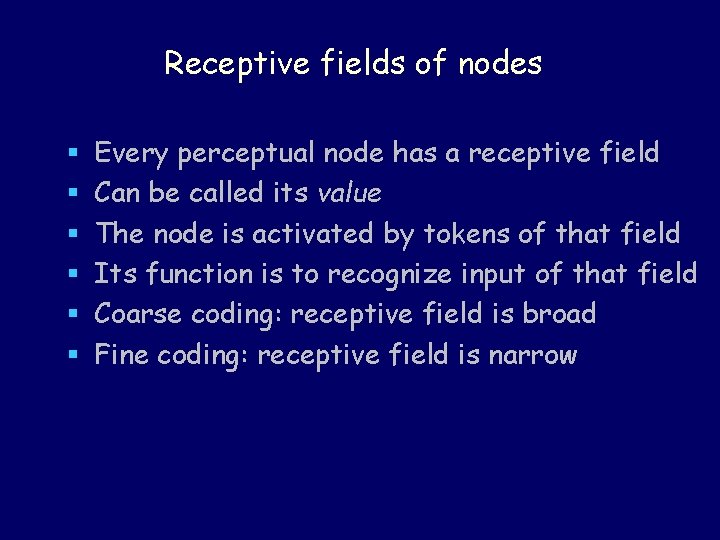
Receptive fields of nodes § § § Every perceptual node has a receptive field Can be called its value The node is activated by tokens of that field Its function is to recognize input of that field Coarse coding: receptive field is broad Fine coding: receptive field is narrow
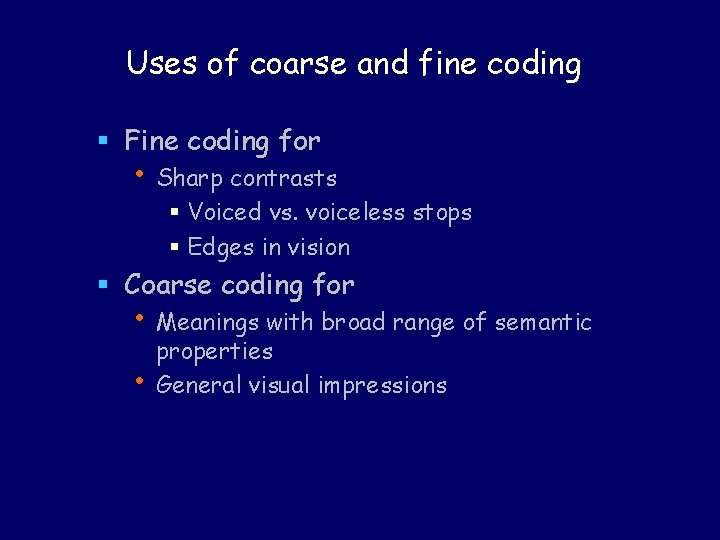
Uses of coarse and fine coding § Fine coding for • Sharp contrasts § Voiced vs. voiceless stops § Edges in vision § Coarse coding for • Meanings with broad range of semantic • properties General visual impressions
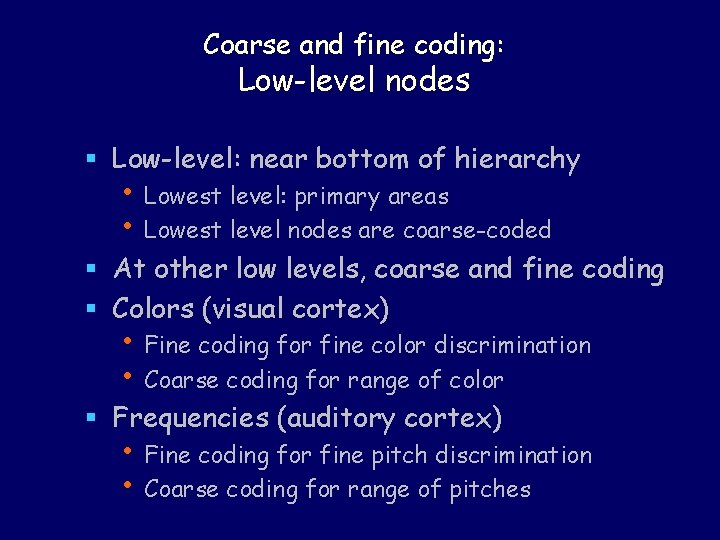
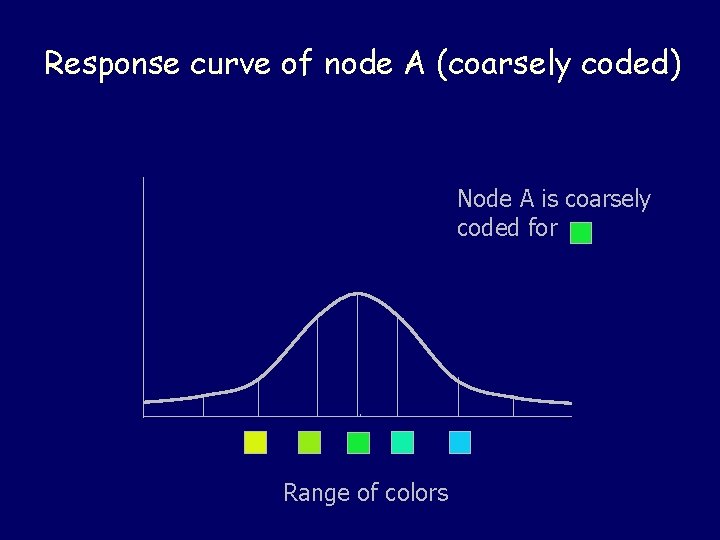
Coarse and fine coding: Low-level nodes § Low-level: near bottom of hierarchy • Lowest level: primary areas • Lowest level nodes are coarse-coded § At other low levels, coarse and fine coding § Colors (visual cortex) • Fine coding for fine color discrimination • Coarse coding for range of color § Frequencies (auditory cortex) • Fine coding for fine pitch discrimination • Coarse coding for range of pitches
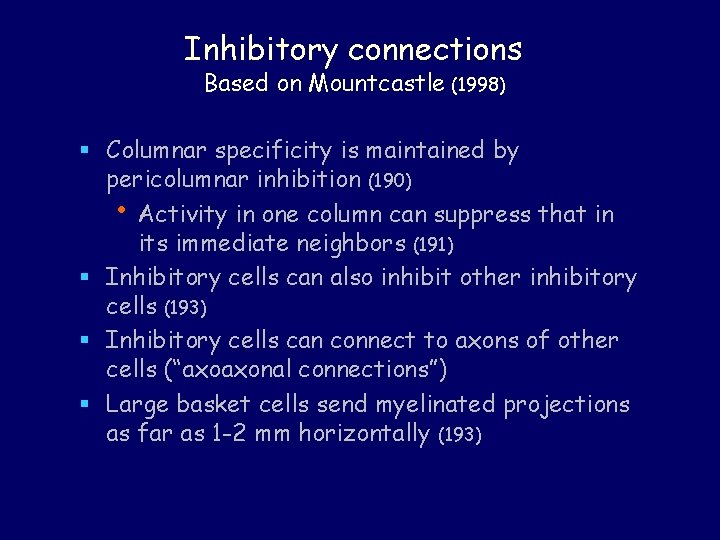
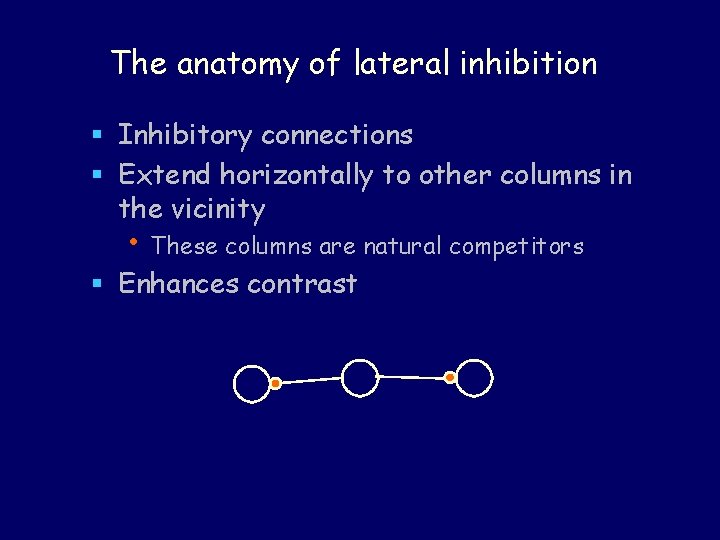
Inhibitory connections Based on Mountcastle (1998) § Columnar specificity is maintained by pericolumnar inhibition (190) • Activity in one column can suppress that in its immediate neighbors (191) § Inhibitory cells can also inhibit other inhibitory cells (193) § Inhibitory cells can connect to axons of other cells (“axoaxonal connections”) § Large basket cells send myelinated projections as far as 1 -2 mm horizontally (193)
The anatomy of lateral inhibition § Inhibitory connections § Extend horizontally to other columns in the vicinity • These columns are natural competitors § Enhances contrast
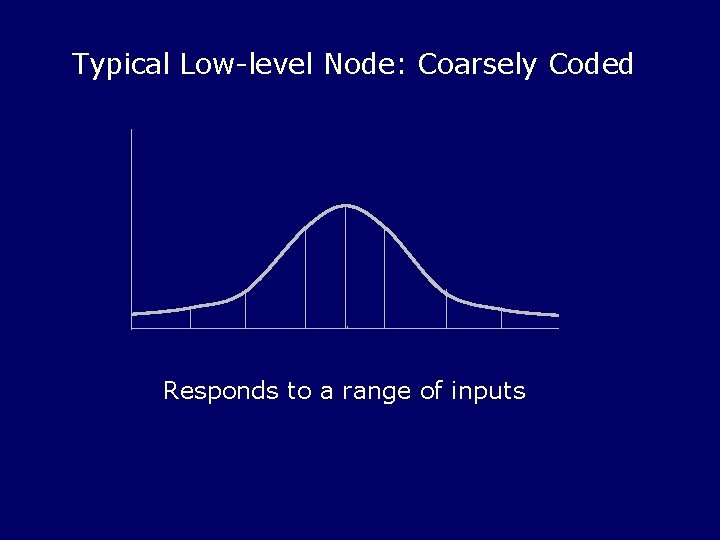
Coarse coding at low levels § Typical situation for sensory neurons § Neurons fire. . • Occasionally at random even when not • • receiving activation More strongly when receiving activation More strongly yet when receiving a lot of activation § Hence, low level nodes have broad receptive fields • Locally, they are coarsely coded
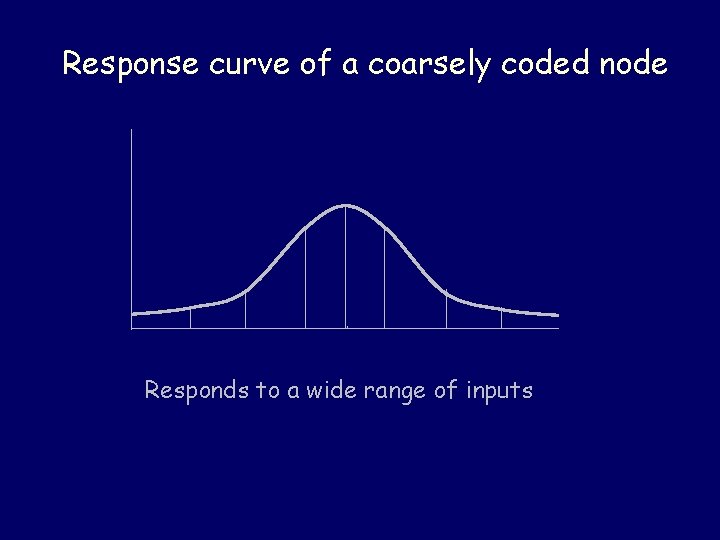
Typical Low-level Node: Coarsely Coded Responds to a range of inputs
How to get fine coding § Neurons (hence also columns, presumably) are inherently, locally, coarse-coded § For linguistic processing we often need much greater precision: fine coding § Problem: How to get finely coded nodes if neurons are inherently coarsely coded?
Response curve of a coarsely coded node Responds to a wide range of inputs
Response curve of node A (coarsely coded) Node A is coarsely coded for Range of colors
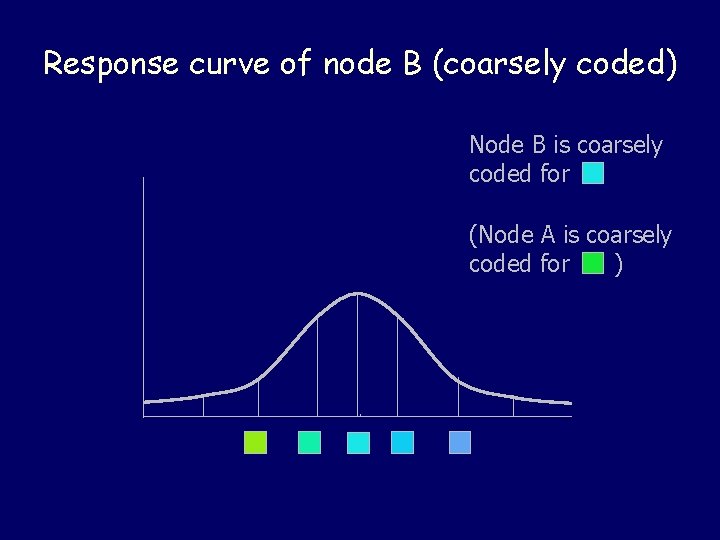
Response curve of node B (coarsely coded) Node B is coarsely coded for (Node A is coarsely coded for )
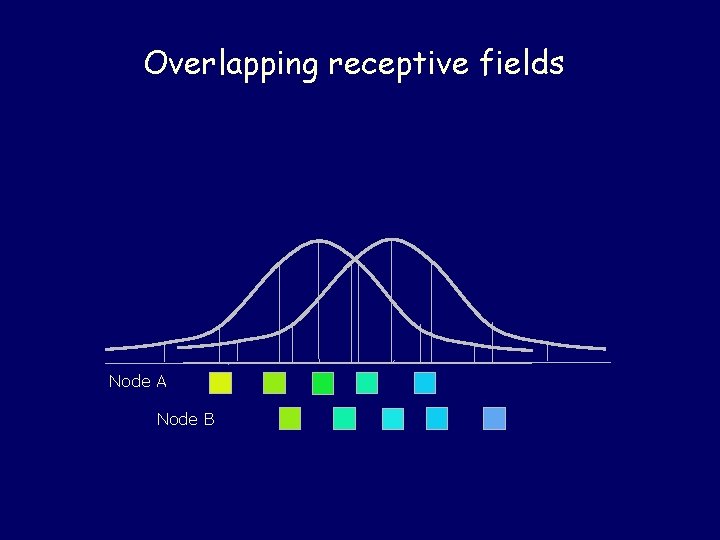
Overlapping receptive fields “…each individual representation (e. g. receptive field) is inexact, or coarse, but … the overall system of overlapping representations can provide precise interpretations. Mark Beeman (1998), 256
Overlapping receptive fields Node A Node B
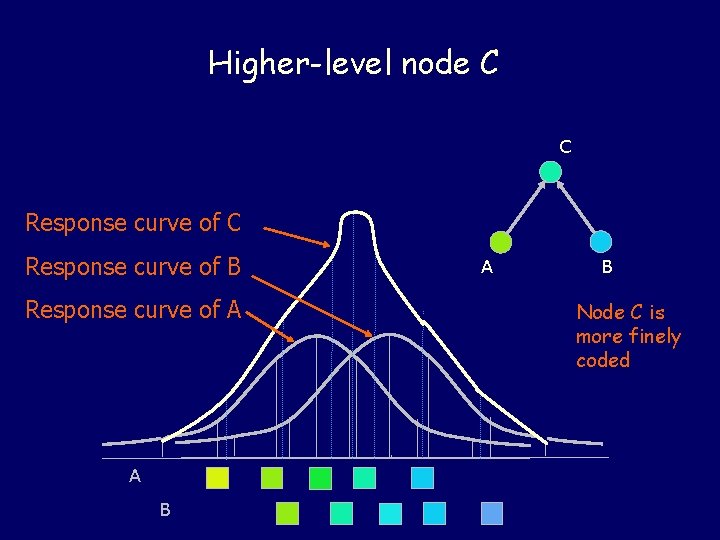
Higher-level node C C Response curve of B Response curve of A A B Node C is more finely coded
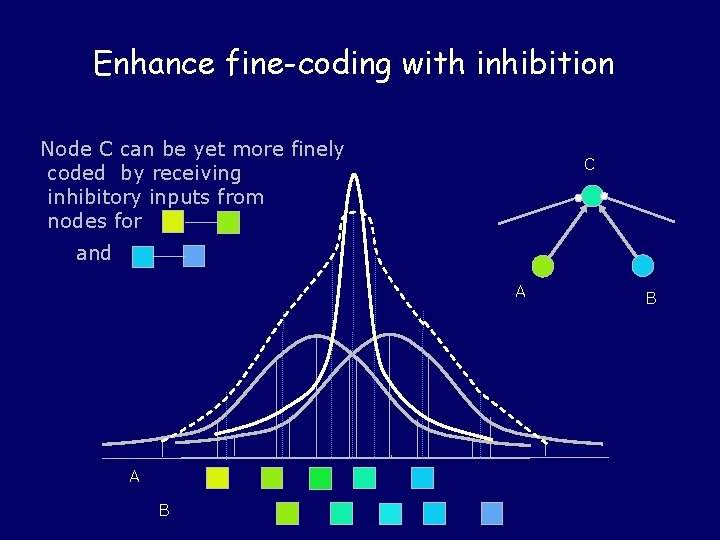
Enhance fine-coding with inhibition Node C can be yet more finely coded by receiving inhibitory inputs from nodes for C and A A B B
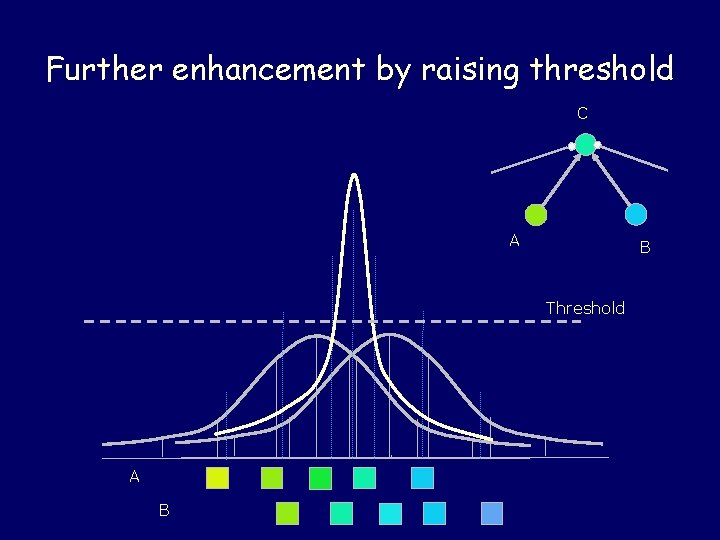
Further enhancement by raising threshold C A B Threshold A B
Coarse coding at higher levels § A node with a large number of incoming connections and a relatively low threshold § This arrangement allows it to respond to any of a broad range of situations § Coarse coding is the usual situation at the conceptual level • A concept node generally represents a category, not just a single thing • Different members of the category, with differing features, activate the category node
Coarse and fine coding: High-level nodes § High-level nodes – concepts, meanings • Coarse coding • § More coarse in RH § Broad range of semantic properties § In RH, not necessarily logical Fine coding § Mainly in LH § Narrow range of semantic properties
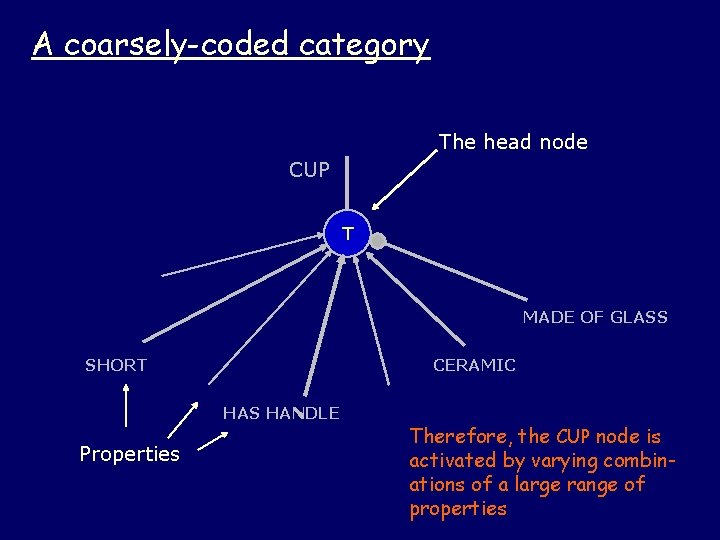
A coarsely-coded category The head node CUP T MADE OF GLASS SHORT CERAMIC HAS HANDLE Properties Therefore, the CUP node is activated by varying combinations of a large range of properties
Coarse coding and RH § Coarse coding is particularly prominent in RH § Beeman: “diffuse activation” in RH (as opposed to “focused activation” in LH)
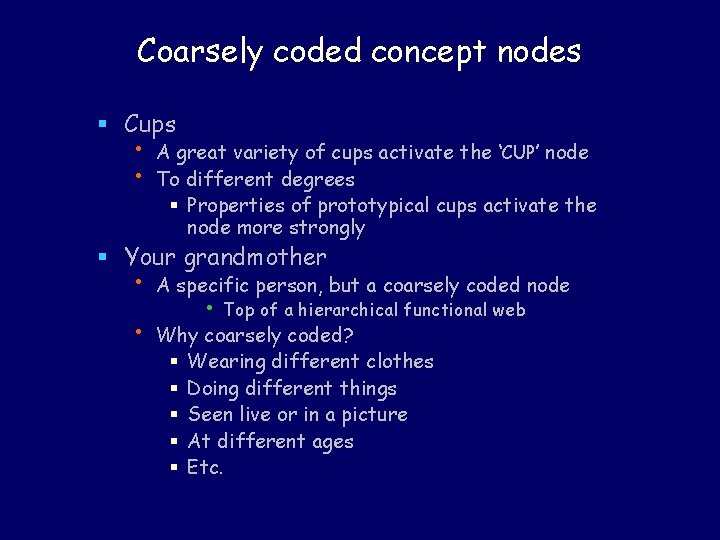
Coarsely coded concept nodes § Cups • • A great variety of cups activate the ‘CUP’ node To different degrees § Properties of prototypical cups activate the node more strongly § Your grandmother • A specific person, but a coarsely coded node • Why coarsely coded? § Wearing different clothes § Doing different things § Seen live or in a picture § At different ages § Etc. • Top of a hierarchical functional web
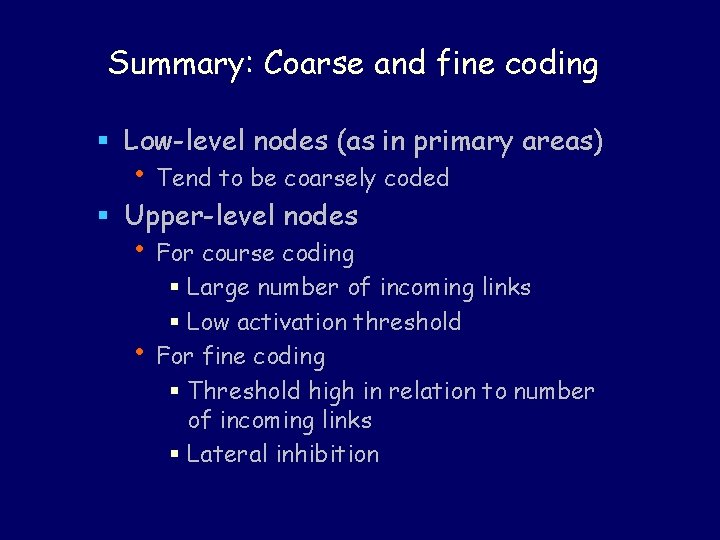
Summary: Coarse and fine coding § Low-level nodes (as in primary areas) • Tend to be coarsely coded § Upper-level nodes • For course coding • § Large number of incoming links § Low activation threshold For fine coding § Threshold high in relation to number of incoming links § Lateral inhibition
end