
Ling 001 Spring 2009 Language and the Brain
Ling 001, Spring 2009 Language and the Brain
Background • Remember some things we have seen thus far: – Abilities in grammar are not directly correlated with general intelligence – Grammars are extraordinarily complex and function in terms of abstract representations and rules – Language acquisition occurs in a biologically determined window – The nature of the evidence available to learners suggests that they need innate structure to ensure acquisition
Basic Questions • Concentrating on the idea that humans have an innate capacity for language • Questions: – In what sense are brain areas specialized for language? – Can brain areas be associated with specific subparts of grammar? – What does it mean for brain areas to be specialized in this way?
Plan • Basics of the brain • Brain structures relevant for language: the standard/traditional/classic view • Deficit studies: using aphasia as a window on language in the brain • Neuroimaging: using various techniques to look at brain function – Syntax – Sound • Prospects: is the standard view the view of the future? What are the prospects for unifying linguistic studies and brain science?
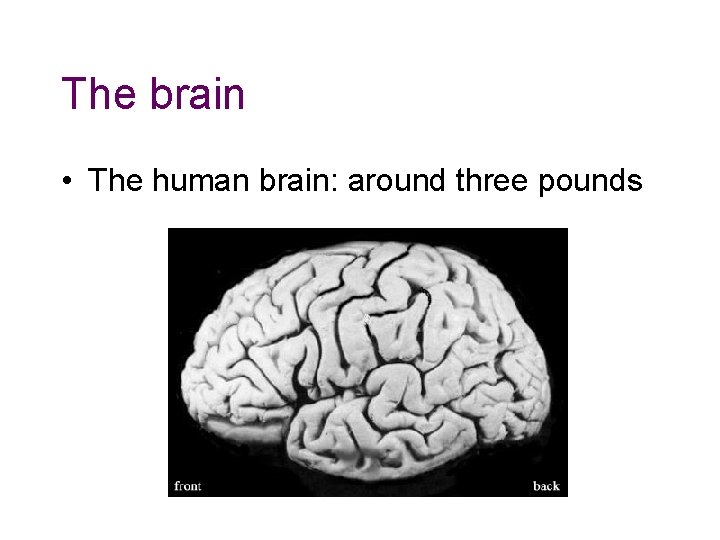
The brain • The human brain: around three pounds

Why this is difficult Linguistics Neuroscience Fundamental elements of representation distinctive feature syllable morpheme noun phrase clause dendrites, spines neuron cell-assembly/ensemble population cortical column ? Fundamental operations on primitives concatenation linearization phrase-structure generation semantic composition ? long-term potentiation receptive field oscillation synchronization
Connections • Linguistics has its own ontology of representations and computations • Neuroscience has its own ontology, consisting of neurobiological structures etc. • There are no obvious ways of drawing lines between the two ontologies. Right now, we are only at the beginning of asking how the brain might compute language
More Detail: Basic structures • The outer layer of the is the cerebral cortex; often thought of as a kind of (folded) sheet • This part of the brain is responsible for most higher cognitive functions • This means that damage (even relatively shallow) to the brain can result in severe impairments in cognitive function
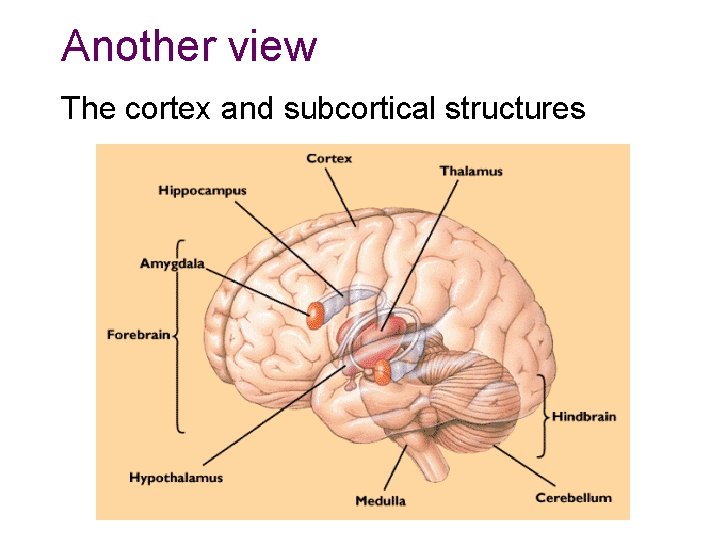
Another view The cortex and subcortical structures
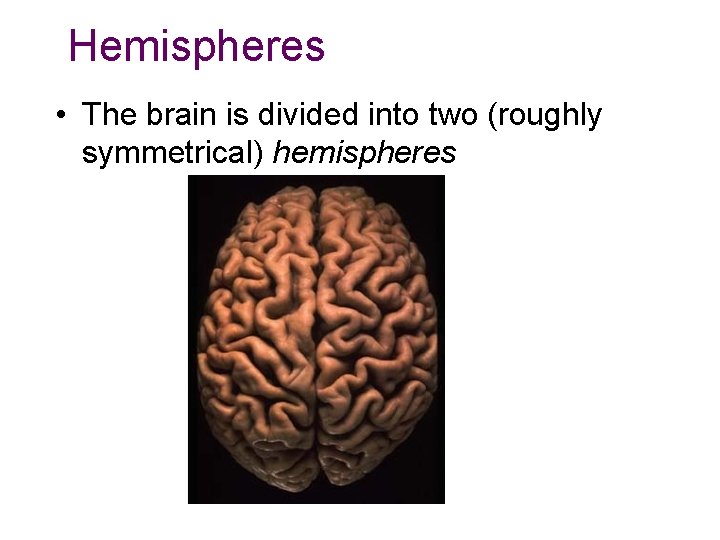
Hemispheres • The brain is divided into two (roughly symmetrical) hemispheres
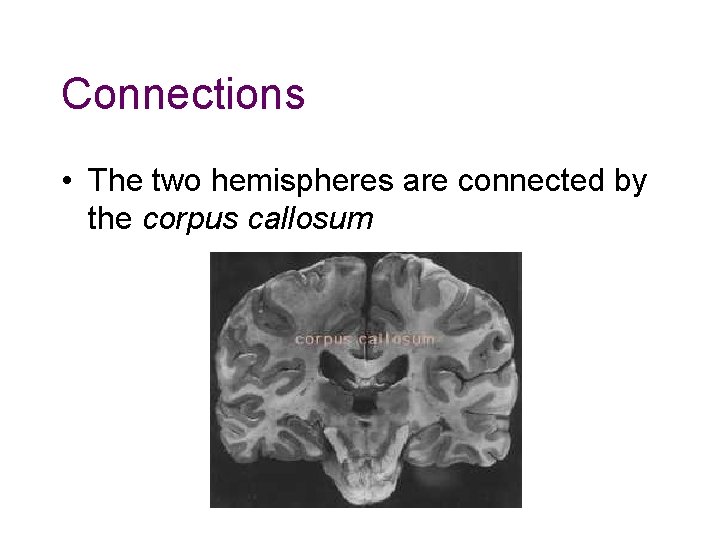
Connections • The two hemispheres are connected by the corpus callosum
Lateralization • Some things that the brain does are lateralized: performed primarily by one hemisphere as opposed to the other • In the case of language, the dominant hemisphere is the left hemisphere for the great majority of righthanded people
The cortex • As mentioned above, he cortex is a kind of folded sheet ; the folded configuration allows for more surface area inside the confines of the skull • Structures: – Gyrus (plural gyri): a bump or convolution – Sulcus (plural sulci): groove or ‘valley’ between gyri
Structures • The folds (gyri and sulci) in the brain can be used to identify common anatomical areas of the brain • While some details of brain anatomy differ from individual to individual, the same common structures are found across individuals
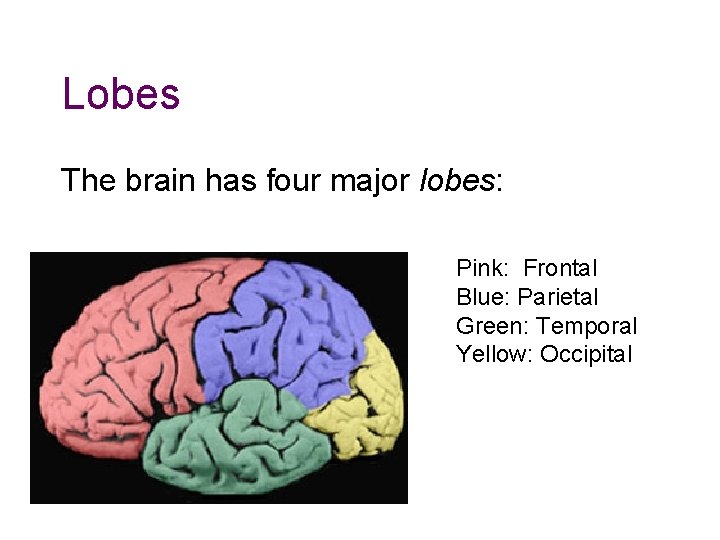
Lobes The brain has four major lobes: Pink: Frontal Blue: Parietal Green: Temporal Yellow: Occipital
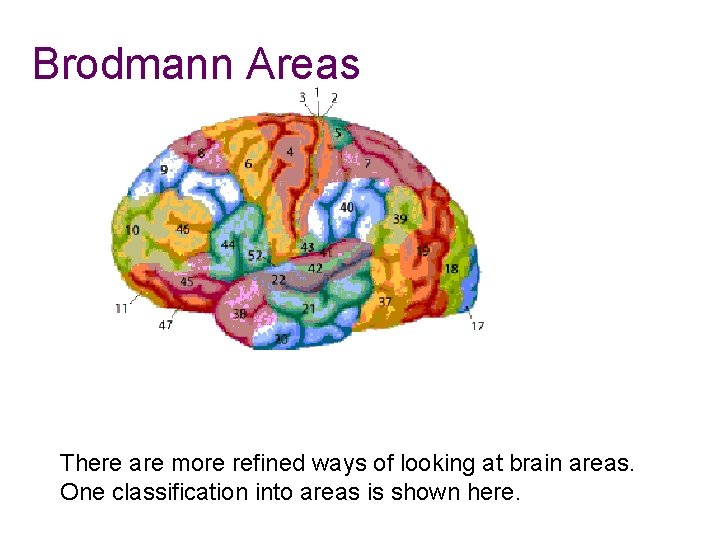
Brodmann Areas There are more refined ways of looking at brain areas. One classification into areas is shown here.
Space… • When we look at the question of language areas, we (implicitly? ) assume that knowing where something happens tells us how something happens • Why would we assume this? • There are some analogies….
Function • How to think about correlations between brains as objects in space, and more abstract representations – Certain areas of the brain are known to be responsible for motor control and for sensory processing – These areas define a kind of map on the cortical surface, where different areas of the cortex correspond to different parts of the body
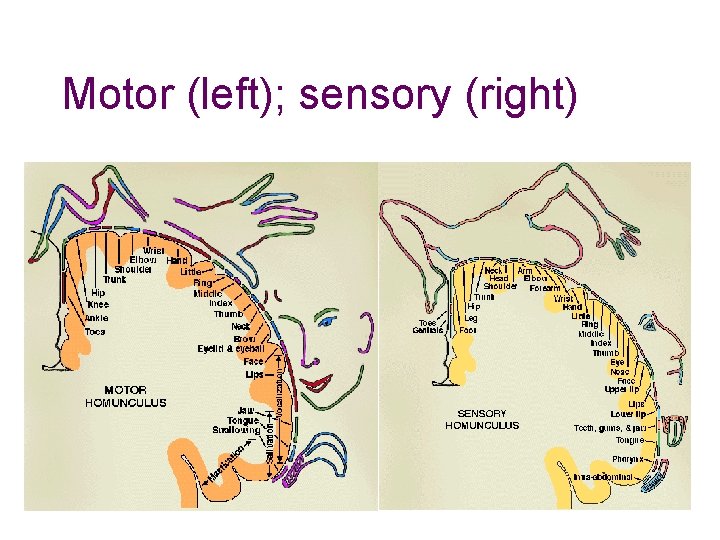
Motor (left); sensory (right)
Language areas • According to a picture that has developed over a long period of time, primarily through the study of aphasia, there are two primary language areas – Broca’s Area – Wernicke’s Area • While current research suggests that this original picture is oversimplied in many respects (and wrong in others), it’s the starting point for all current research
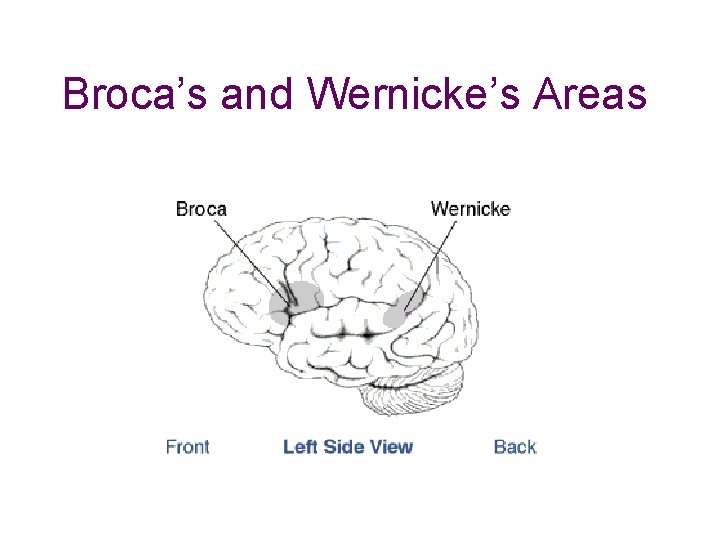
Broca’s and Wernicke’s Areas
Aphasia • Prior to the advent of neuroimaging, brain studies were restricted to cases in which patients showed language disorders after e. g. strokes • Early approaches to characterizing the relationship between lesion (damage) location and behavior concentrated on production versus comprehension
Symptoms • Broca’s Aphasia – Agrammatism: halting speech, consisting typically of short utterances – Absence of function words and of e. g. pieces of morphology (e. g. past tense, plural, etc. ) – At least at a first glance, relatively good comprehension of language; this is probably misleading, though.
Example • Remember: labored speech: – Ah. . . Monday. . . ah, Dad and Paul Haney [himself] and Dad. . . hospital. Two. . . ah, doctors. . . and ah . . . thirty minutes. . . and yes. . . ah. . . hospital. And, er, Wednesday. . . nine o'clock. And er Thursday, ten o'clock. . . doctors. Two doctors. . . and ah. . . teeth. Yeah, . . . fine.
Symptoms 2 • Wernicke’s aphasia – inability to grasp the meaning of spoken words – easy production of connected speech – normally-intoned stream of grammatical markers, pronouns, prepositions, articles, and auxiliaries – difficulty in recalling correct content words, especially nouns (anomia) – words may be meaningless neologisms (paraphasia) – Comprehension impaired
Example • Note the nature of the difficulties here: Examiner. What kind of work have you done? -- We, the kids, all of us, and I, we were working for a long time in the. . . You know. . . it's the kind of space, I mean place rear to the spedawn. . . Examiner. Excuse me, but I wanted to know what kind of work you have been doing. -- If you had said that, we had said that, poomer, near the fortunate, porpunate, tamppoo, all around the fourth of martz. Oh, I get all confused.
Basic Picture • The picture that emerged in light of these differences focussed on production (impaired with Broca’s aphasia) and comprehension (impaired in Wernicke’s) • As we will see, more detailed examinations reveal that Broca’s aphasics have difficulties with comprehension also-- notably, when the syntax is ‘complex’, in ways which relate to what we have seen in the past
A Further Claim • Remember that the basic components of language are – Some set of primitives (e. g. ‘words’) – Rules for putting these together • Sometimes the former is called the Lexicon, and the latter is ‘syntax’ • It appears that these components of language are affected differently in aphasia
So… • Another view, which correlates with neuroimaging findings, is that Wernicke’s Area is crucial for Lexical matters, and Broca’s for syntax • What ‘crucial for’ means is a matter for investigation
- Slides: 29