
Lines of best fit 1 of 11 Boardworks
Lines of best fit 1 of 11 © Boardworks 2012
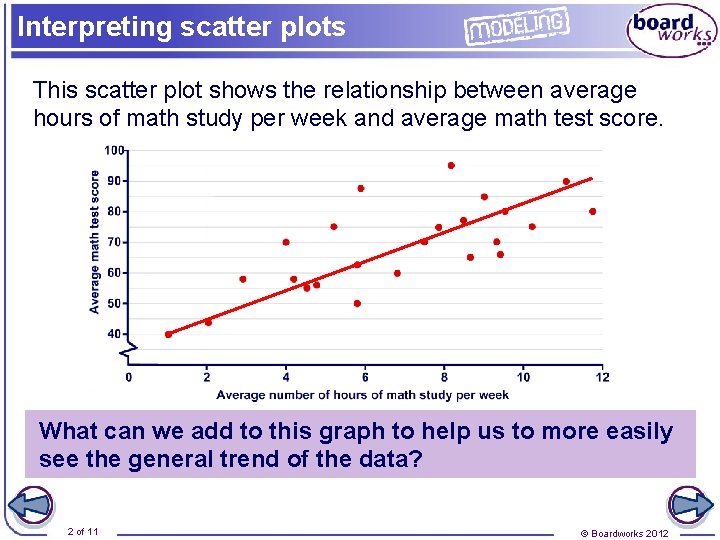
Interpreting scatter plots This scatter plot shows the relationship between average hours of math study per week and average math test score. What can we add to this graph to help us to more easily see the general trend of the data? 2 of 11 © Boardworks 2012
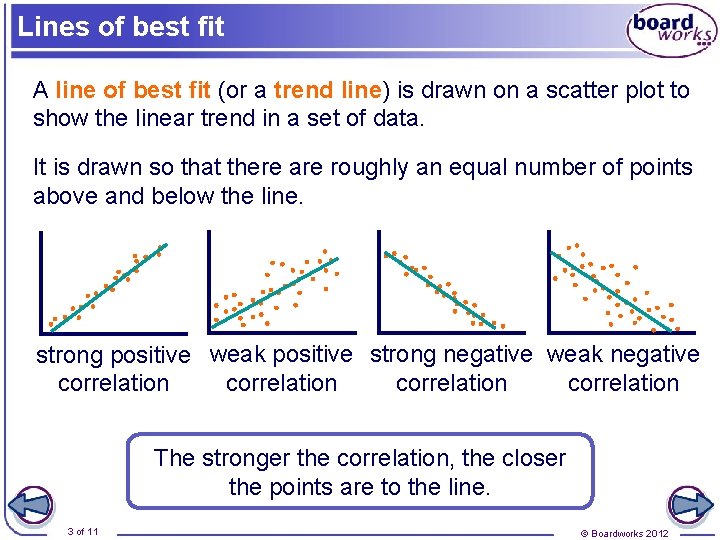
Lines of best fit A line of best fit (or a trend line) is drawn on a scatter plot to show the linear trend in a set of data. It is drawn so that there are roughly an equal number of points above and below the line. strong positive weak positive strong negative weak negative correlation The stronger the correlation, the closer the points are to the line. 3 of 11 © Boardworks 2012
Lines of best fit When drawing a line of best fit, remember: ● The line does not have to pass through the origin. ● For a more accurate line of best fit, find the mean of each variable. This forms a coordinate pair, which can be plotted. The line of best fit should pass through this mean point. ● The equation of the line of best fit can be found using the slope and y-intercept. ● The line of best fit can be used to estimate one variable using another, within the range of data used. This is called interpolation. 4 of 11 © Boardworks 2012
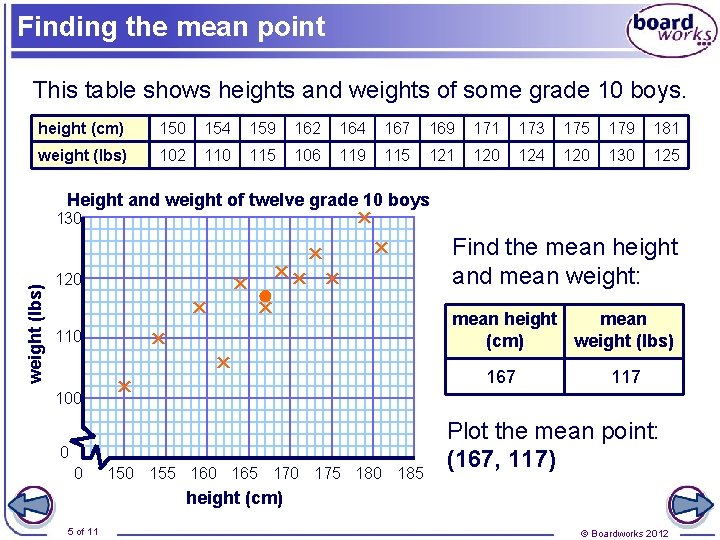
Finding the mean point This table shows heights and weights of some grade 10 boys. height (cm) 150 154 159 162 164 167 169 171 173 175 179 181 weight (lbs) 102 110 115 106 119 115 121 120 124 120 130 125 Height and weight of twelve grade 10 boys × 130 weight (lbs) × 120 × 110 100 × × ●× × × × 0 0 155 160 165 170 175 180 185 Find the mean height and mean weight: mean height mean (cm) weight (lbs) 167 117 Plot the mean point: (167, 117) height (cm) 5 of 11 © Boardworks 2012
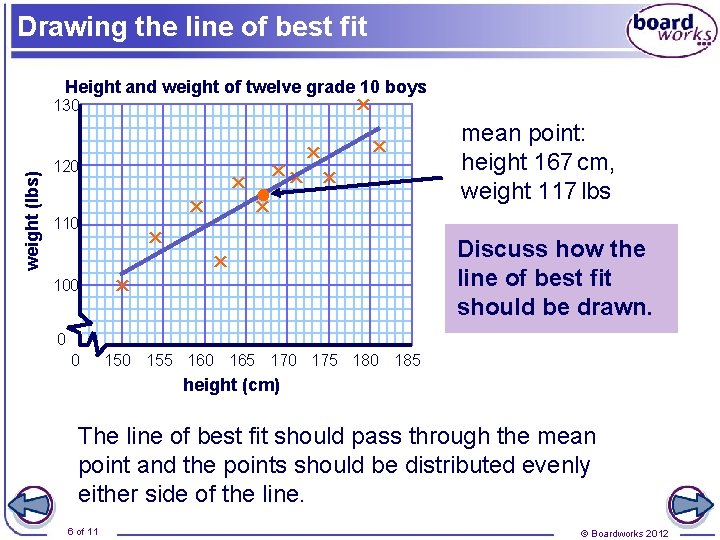
Drawing the line of best fit Height and weight of twelve grade 10 boys × weight (lbs) 130 × 120 110 100 × × × ●× × × × mean point: height 167 cm, weight 117 lbs Discuss how the line of best fit should be drawn. 0 0 155 160 165 170 175 180 185 height (cm) The line of best fit should pass through the mean point and the points should be distributed evenly either side of the line. 6 of 11 © Boardworks 2012
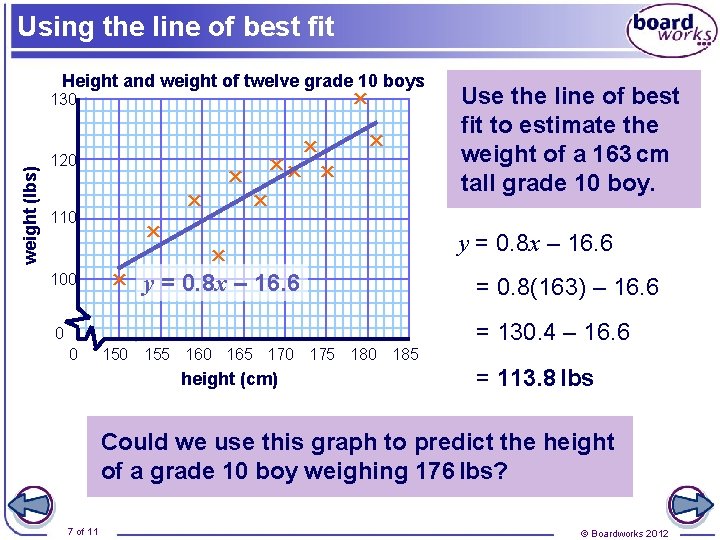
Using the line of best fit Height and weight of twelve grade 10 boys weight (lbs) 130 × 120 110 100 × × × y = 0. 8 x – 16. 6 Use the line of best fit to estimate the weight of a 163 cm tall grade 10 boy. y = 0. 8 x – 16. 6 = 0. 8(163) – 16. 6 = 130. 4 – 16. 6 0 0 155 160 165 170 175 180 185 height (cm) = 113. 8 lbs Could we use this graph to predict the height of a grade 10 boy weighing 176 lbs? 7 of 11 © Boardworks 2012
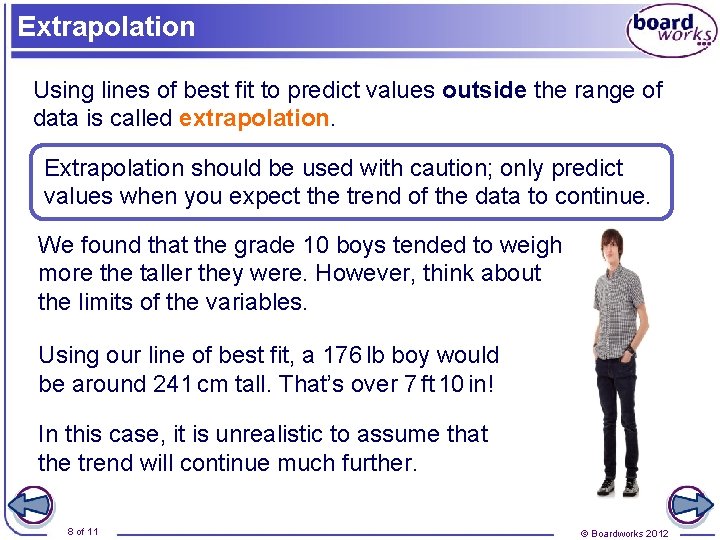
Extrapolation Using lines of best fit to predict values outside the range of data is called extrapolation. Extrapolation should be used with caution; only predict values when you expect the trend of the data to continue. We found that the grade 10 boys tended to weigh more the taller they were. However, think about the limits of the variables. Using our line of best fit, a 176 lb boy would be around 241 cm tall. That’s over 7 ft 10 in! In this case, it is unrealistic to assume that the trend will continue much further. 8 of 11 © Boardworks 2012
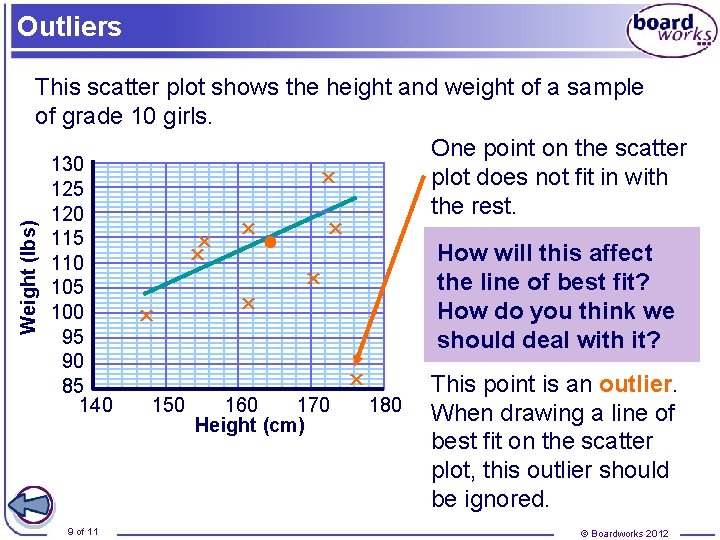
Outliers Weight (lbs) This scatter plot shows the height and weight of a sample of grade 10 girls. One point on the scatter 130 plot does not fit in with × 125 the rest. 120 115 110 105 100 95 90 85 140 9 of 11 ×● × × × 150 × × How will this affect the line of best fit? How do you think we should deal with it? × 160 170 Height (cm) × 180 This point is an outlier. When drawing a line of best fit on the scatter plot, this outlier should be ignored. © Boardworks 2012
- Slides: 9