
Lines and Angles Geometry Chapter 3 Section 1
- Slides: 10
Lines and Angles Geometry Chapter 3, Section 1
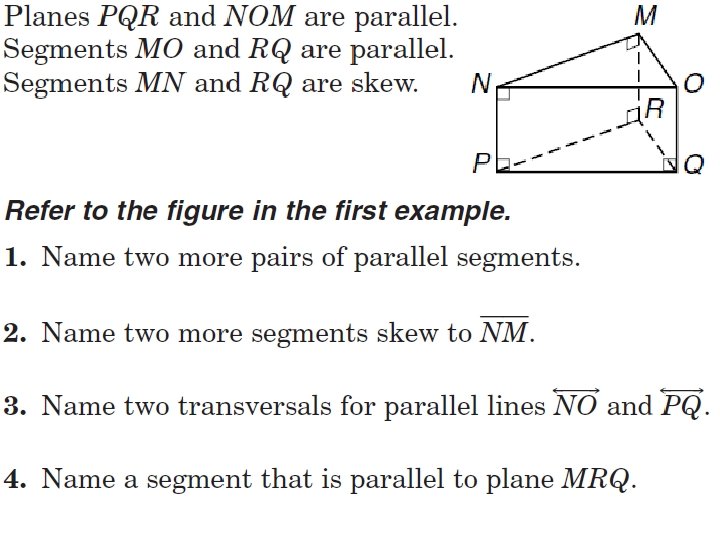
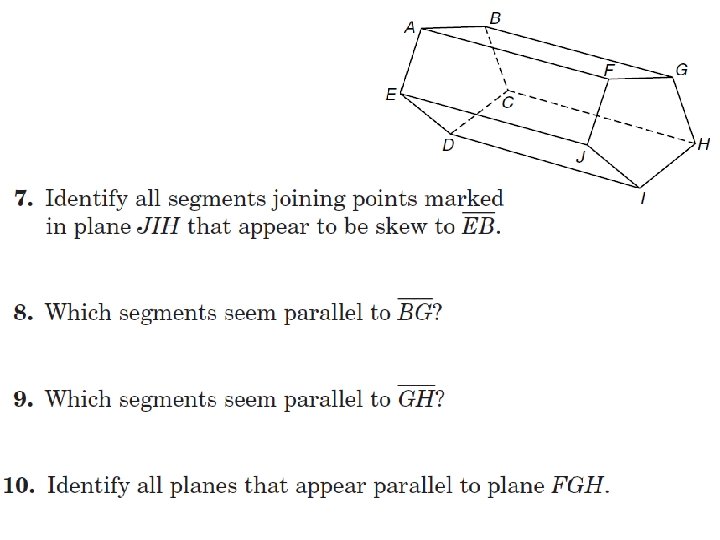
Notes l What does it mean for two lines to be parallel? l l What about lines that do not intersect and are not coplanar? l l Parallel lines: Lines that do not intersect and are coplanar. Skew Lines: Lines that do not intersect and are not coplanar. What does it mean for two planes to be parallel? l l Parallel Planes: planes that do not intersect. Example: the planes containing the ceiling and floor are parallel
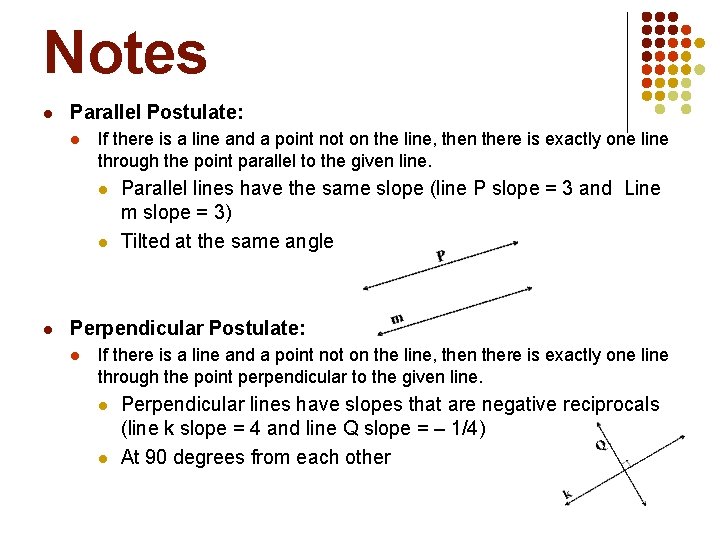
Notes l Parallel Postulate: l If there is a line and a point not on the line, then there is exactly one line through the point parallel to the given line. l l l Parallel lines have the same slope (line P slope = 3 and Line m slope = 3) Tilted at the same angle Perpendicular Postulate: l If there is a line and a point not on the line, then there is exactly one line through the point perpendicular to the given line. l l Perpendicular lines have slopes that are negative reciprocals (line k slope = 4 and line Q slope = – 1/4) At 90 degrees from each other
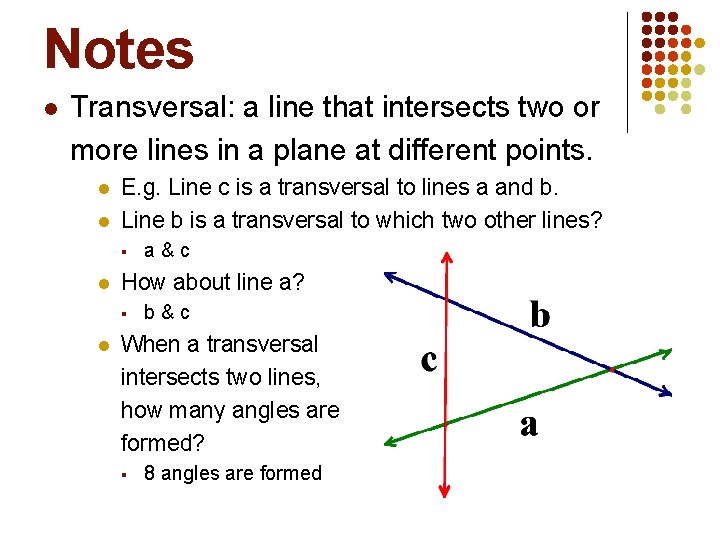
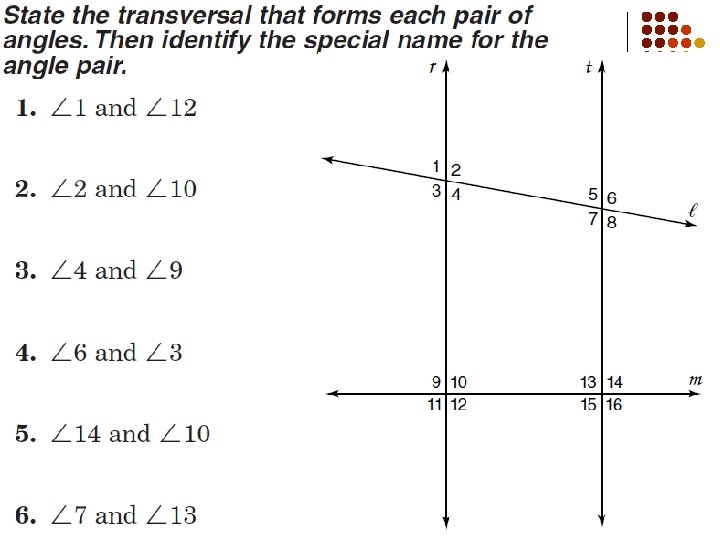
Notes l Transversal: a line that intersects two or more lines in a plane at different points. l l E. g. Line c is a transversal to lines a and b. Line b is a transversal to which two other lines? § l How about line a? § l a&c b&c When a transversal intersects two lines, how many angles are formed? § 8 angles are formed
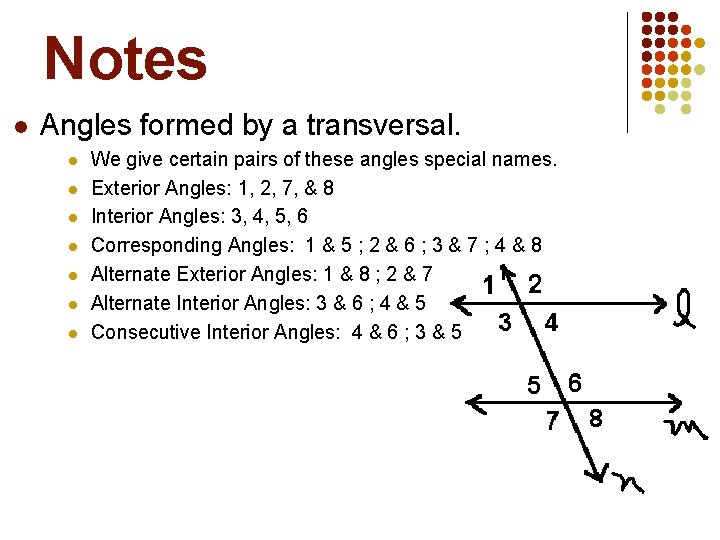
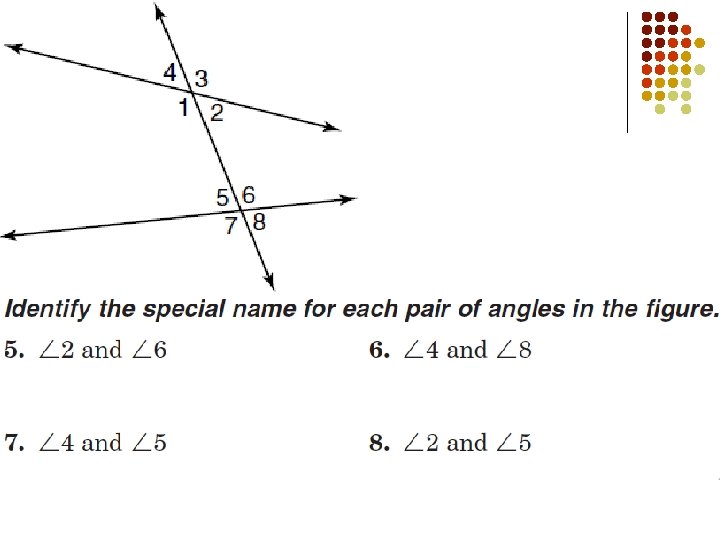
Notes l Angles formed by a transversal. l l l l We give certain pairs of these angles special names. Exterior Angles: 1, 2, 7, & 8 Interior Angles: 3, 4, 5, 6 Corresponding Angles: 1 & 5 ; 2 & 6 ; 3 & 7 ; 4 & 8 Alternate Exterior Angles: 1 & 8 ; 2 & 7 Alternate Interior Angles: 3 & 6 ; 4 & 5 Consecutive Interior Angles: 4 & 6 ; 3 & 5
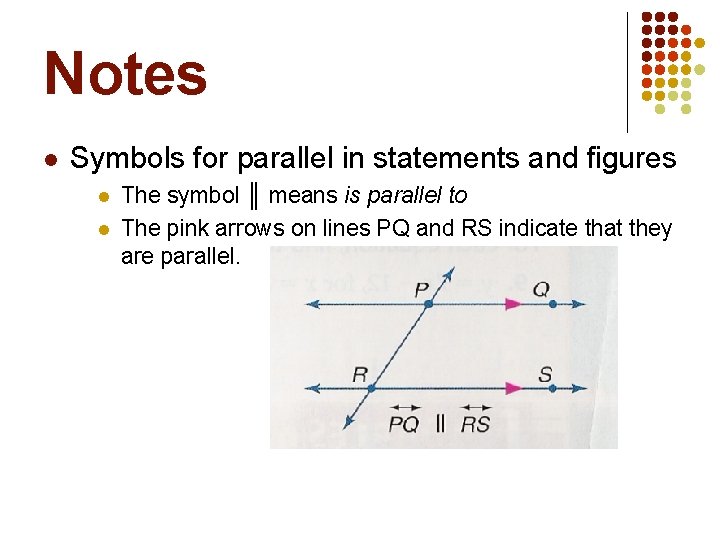
Notes l Symbols for parallel in statements and figures l l The symbol ║ means is parallel to The pink arrows on lines PQ and RS indicate that they are parallel.