
Linear Transformations AP Statistics 1 Find the mean
- Slides: 10
Linear Transformations AP Statistics
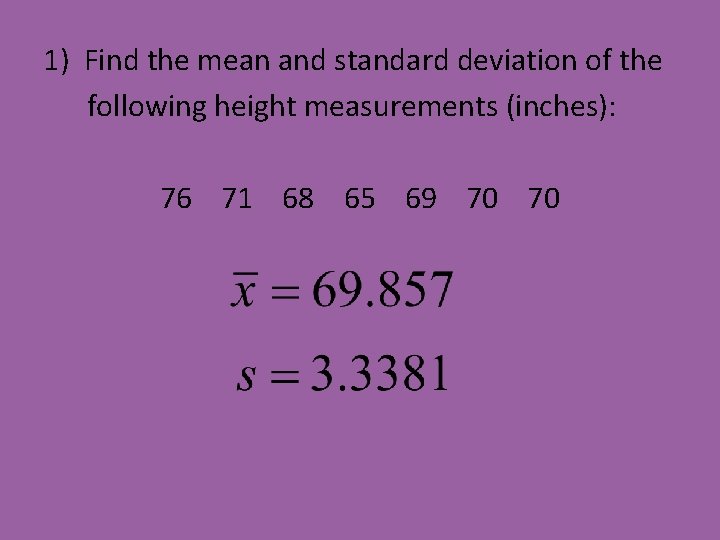
1) Find the mean and standard deviation of the following height measurements (inches): 76 71 68 65 69 70 70
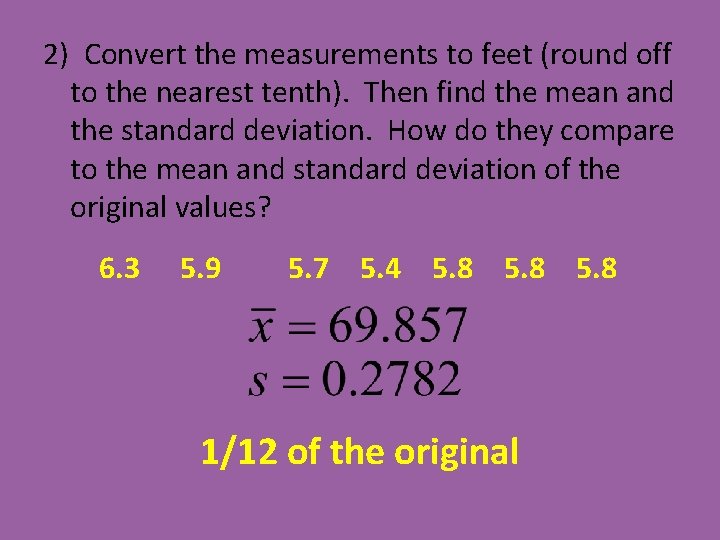
2) Convert the measurements to feet (round off to the nearest tenth). Then find the mean and the standard deviation. How do they compare to the mean and standard deviation of the original values? 6. 3 5. 9 5. 7 5. 4 5. 8 1/12 of the original
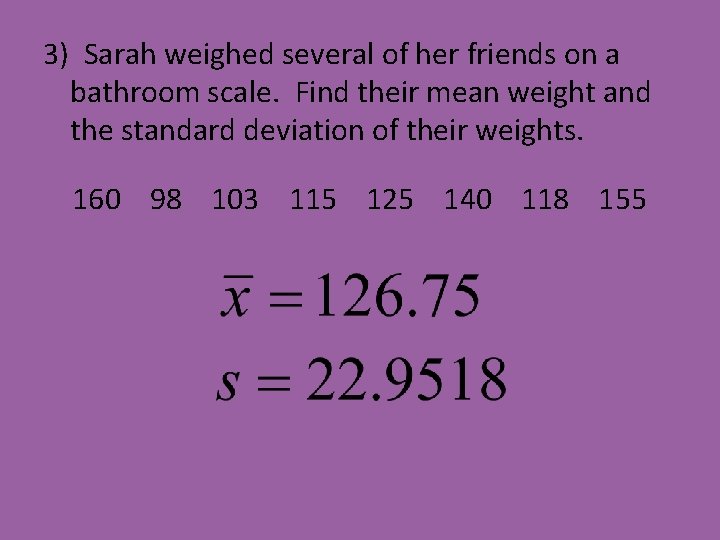
3) Sarah weighed several of her friends on a bathroom scale. Find their mean weight and the standard deviation of their weights. 160 98 103 115 125 140 118 155
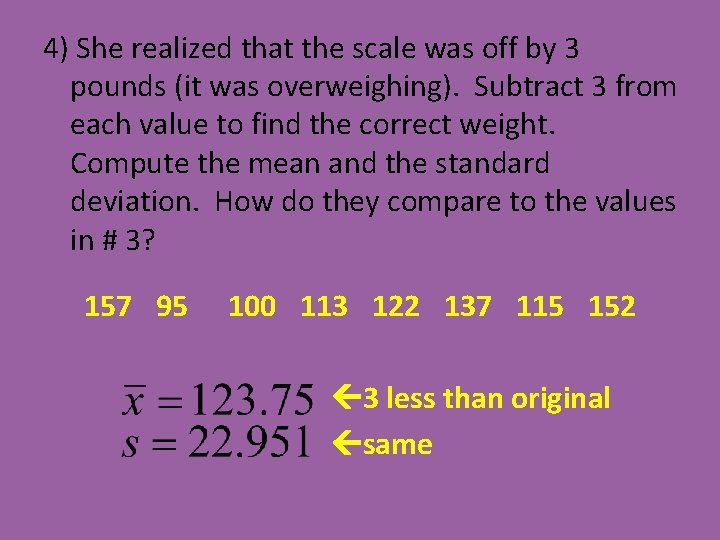
4) She realized that the scale was off by 3 pounds (it was overweighing). Subtract 3 from each value to find the correct weight. Compute the mean and the standard deviation. How do they compare to the values in # 3? 157 95 100 113 122 137 115 152 3 less than original same
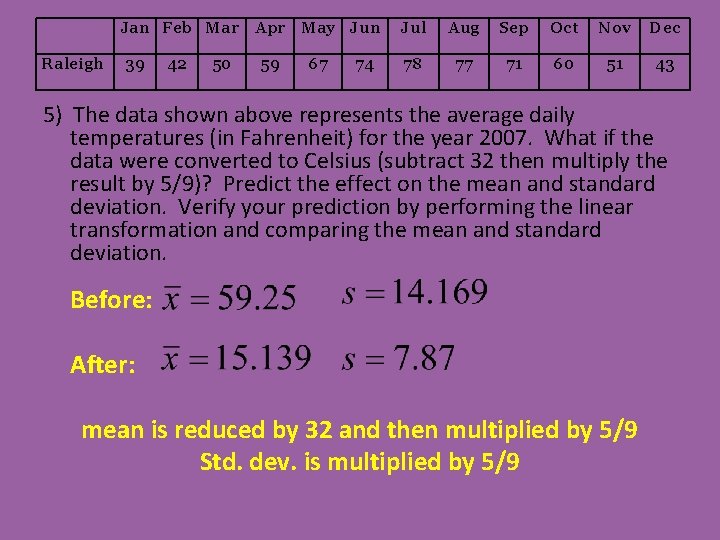
Jan Feb Mar Apr May Jun Raleigh 39 42 50 59 67 74 Jul Aug Sep Oct Nov Dec 78 77 71 60 51 43 5) The data shown above represents the average daily temperatures (in Fahrenheit) for the year 2007. What if the data were converted to Celsius (subtract 32 then multiply the result by 5/9)? Predict the effect on the mean and standard deviation. Verify your prediction by performing the linear transformation and comparing the mean and standard deviation. Before: After: mean is reduced by 32 and then multiplied by 5/9 Std. dev. is multiplied by 5/9
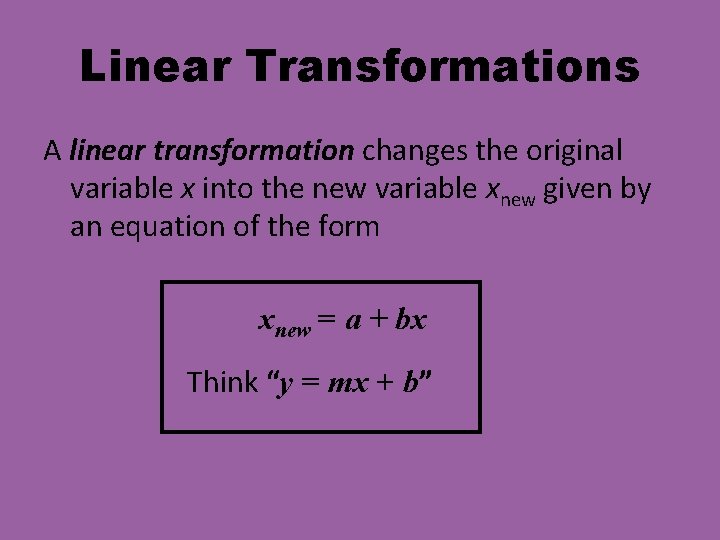
Linear Transformations A linear transformation changes the original variable x into the new variable xnew given by an equation of the form xnew = a + bx Think “y = mx + b”
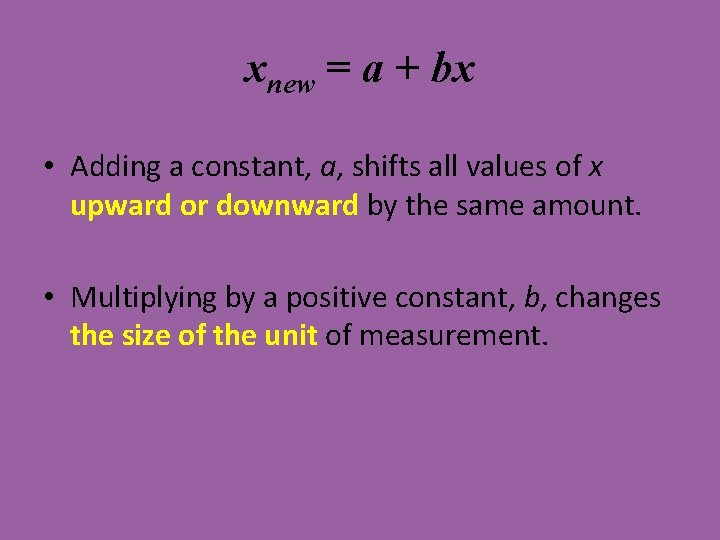
xnew = a + bx • Adding a constant, a, shifts all values of x upward or downward by the same amount. • Multiplying by a positive constant, b, changes the size of the unit of measurement.
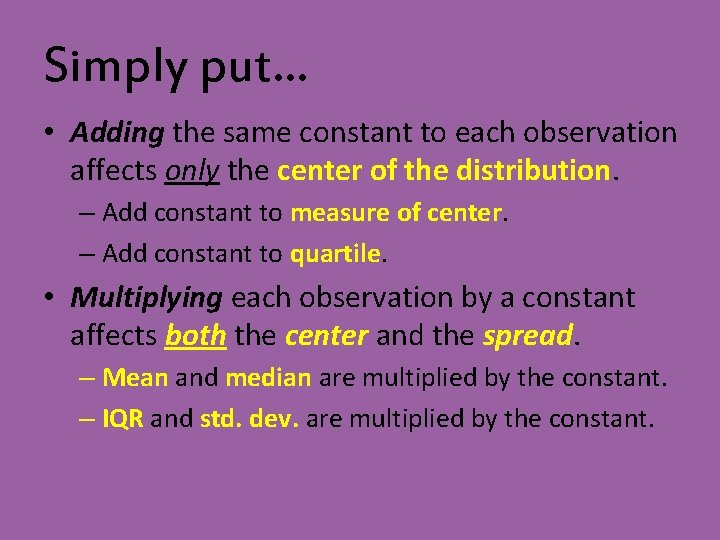
Simply put… • Adding the same constant to each observation affects only the center of the distribution. – Add constant to measure of center. – Add constant to quartile. • Multiplying each observation by a constant affects both the center and the spread. – Mean and median are multiplied by the constant. – IQR and std. dev. are multiplied by the constant.
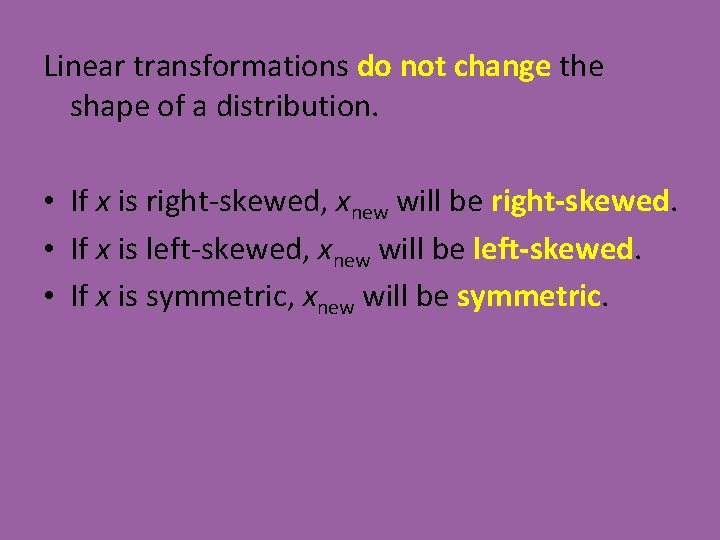
Linear transformations do not change the shape of a distribution. • If x is right-skewed, xnew will be right-skewed. • If x is left-skewed, xnew will be left-skewed. • If x is symmetric, xnew will be symmetric.