
Linear Structural Analysis of the NCSX Modular Coil
- Slides: 20
Linear Structural Analysis of the NCSX Modular Coil & Shell Leonard Myatt NCSX Final Design Review May 19 -20, 2004 PPPL May 19 -20, 2004 NCSX FDR 1
Back-Up Documentation This work is captured more completely in the project memo entitled: Leonard Myatt, “Linear Structural Analysis of the NCSX Modular Coil & Shell, ” 17 -May, 2004 May 19 -20, 2004 NCSX FDR 2
Nomenclature CS = Central Solenoid CTE = Coefficient of Thermal Expansion E = Young’s Elastic Modulus EB = Electrical Breaks (insulated shims) EM = Electromagnetic EOP = End of Pulse FE = Finite Element MC = Modular Coils PF = Poloidal Field RT = Room Temperature SI = Stress Intensity or Tresca Stress (S 1 – S 3) Sy = Yield Stress TF = Toroidal Field U = Displacements VPI = Vacuum-Pressure Impregnation WF = Winding Form and Integral Shell WP = Winding Pack R 0 = Major Radius S 1 = 1 st Principal Stress (max tension) S 3 = 3 rd Principal Stress (max compression) May 19 -20, 2004 NCSX FDR 3
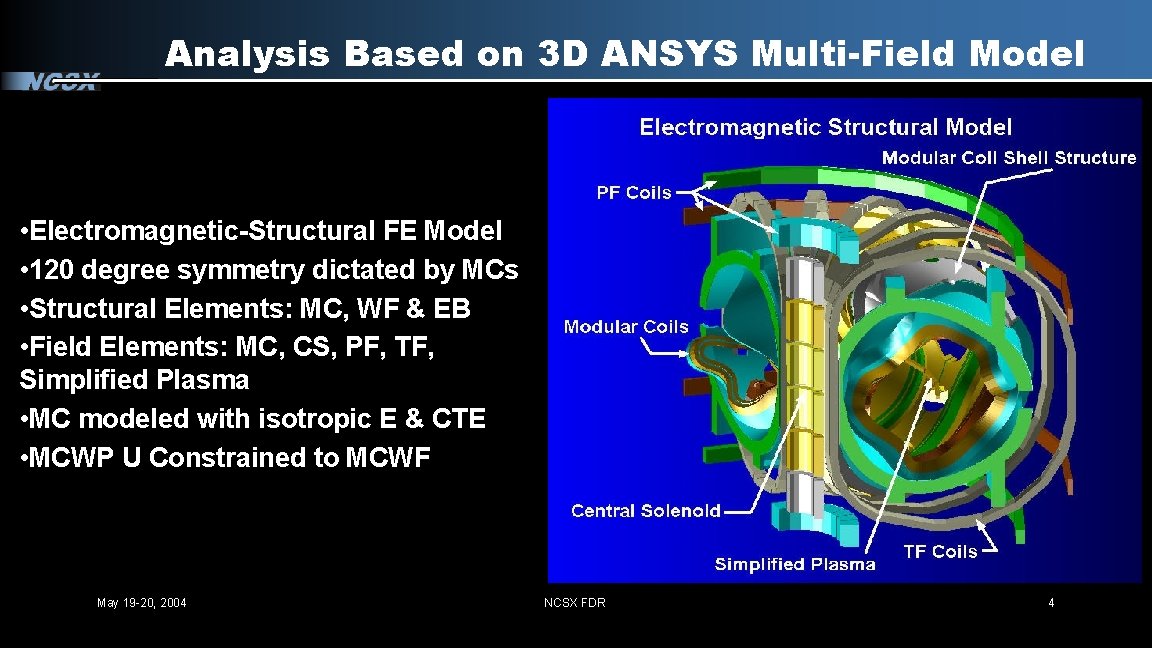
Analysis Based on 3 D ANSYS Multi-Field Model • Electromagnetic-Structural FE Model • 120 degree symmetry dictated by MCs • Structural Elements: MC, WF & EB • Field Elements: MC, CS, PF, TF, Simplified Plasma • MC modeled with isotropic E & CTE • MCWP U Constrained to MCWF May 19 -20, 2004 NCSX FDR 4
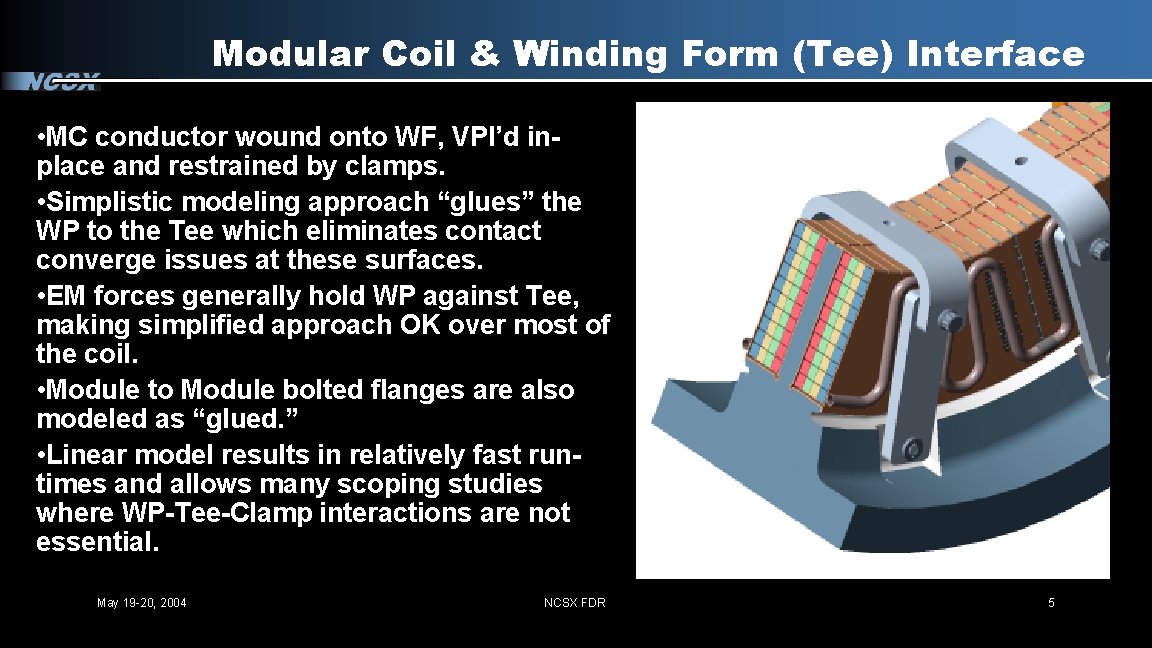
Modular Coil & Winding Form (Tee) Interface • MC conductor wound onto WF, VPI’d inplace and restrained by clamps. • Simplistic modeling approach “glues” the WP to the Tee which eliminates contact converge issues at these surfaces. • EM forces generally hold WP against Tee, making simplified approach OK over most of the coil. • Module to Module bolted flanges are also modeled as “glued. ” • Linear model results in relatively fast runtimes and allows many scoping studies where WP-Tee-Clamp interactions are not essential. May 19 -20, 2004 NCSX FDR 5
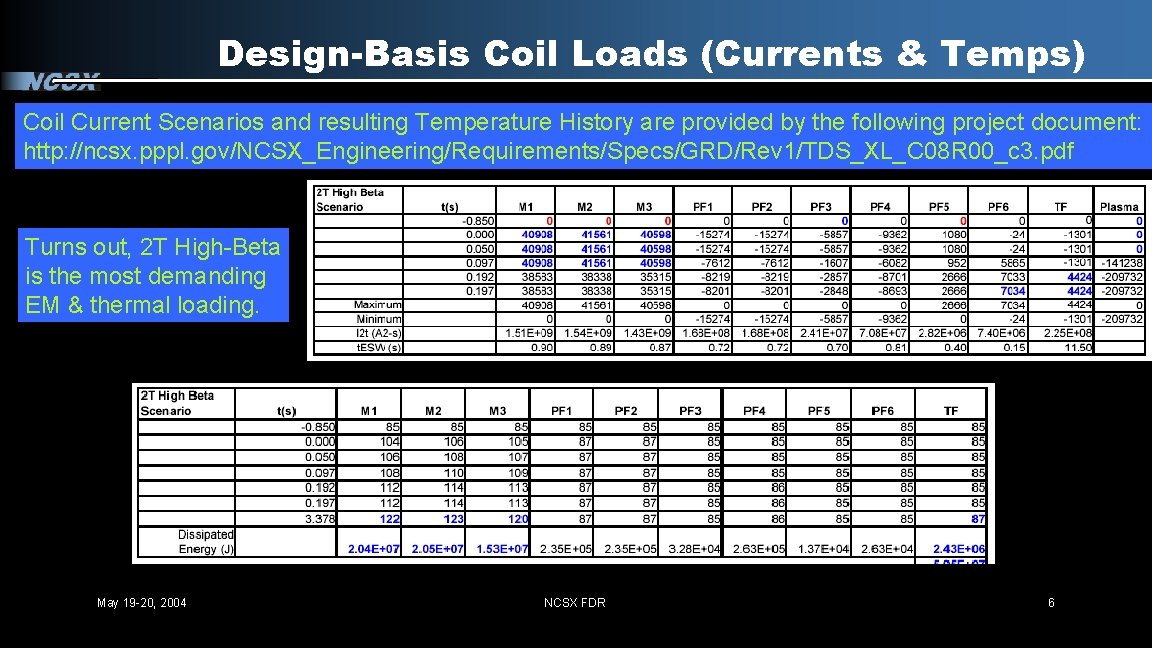
Design-Basis Coil Loads (Currents & Temps) Coil Current Scenarios and resulting Temperature History are provided by the following project document: http: //ncsx. pppl. gov/NCSX_Engineering/Requirements/Specs/GRD/Rev 1/TDS_XL_C 08 R 00_c 3. pdf Turns out, 2 T High-Beta is the most demanding EM & thermal loading. May 19 -20, 2004 NCSX FDR 6
Linear Model Provides Some Insights • Poloidal Breaks and Coil-to-Coil joints are exposed to tensile running loads of up to 9 kips/in and 3 kips/in, respectively. (Bolts must be sized accordingly. ) • Stiffness of MCWF to opening displacements at Poloidal Breaks is 22 -57 kips/in. (Useful for MCWF manufacturing processes) • Effects of MC Type C-C mechanical continuity in the inaccessible inboard region are studied and show that only toroidal continuity (produced by EM loads) provides any benefit. In-plane restraints (i. e. , shear keys) provide essentially no benefit. • An increase in the shell stiffness could result in a 20% reduction in the WP strain. However, only local changes to the shell are achievable, which would greatly diminish this expected benefit. May 19 -20, 2004 NCSX FDR 7
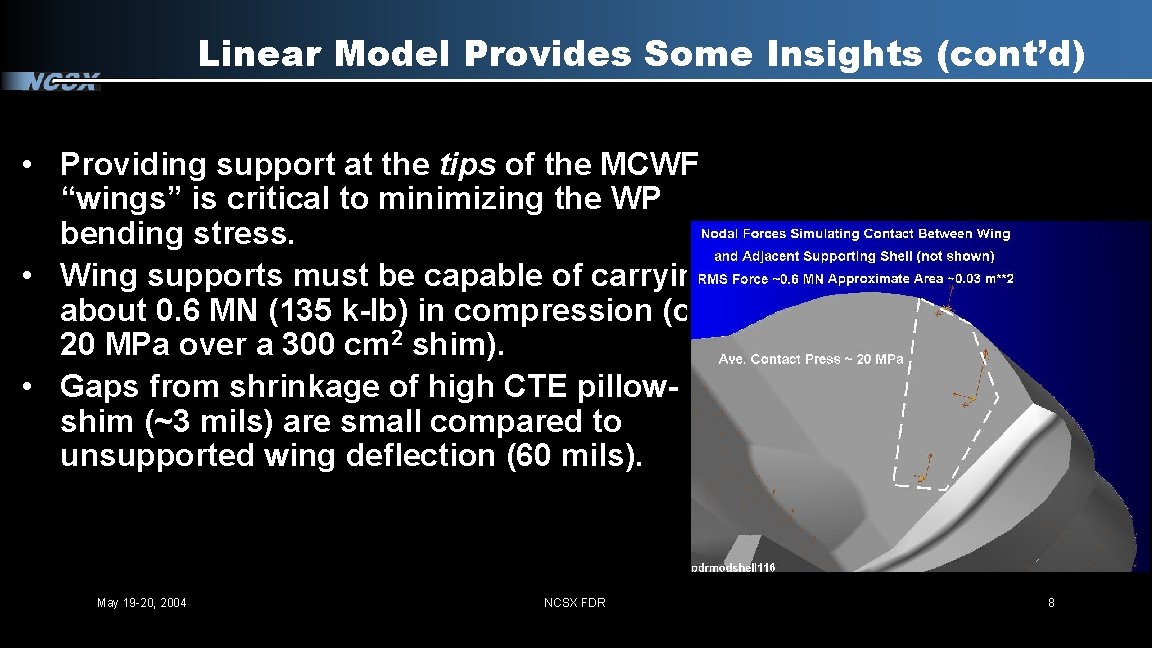
Linear Model Provides Some Insights (cont’d) • Providing support at the tips of the MCWF “wings” is critical to minimizing the WP bending stress. • Wing supports must be capable of carrying about 0. 6 MN (135 k-lb) in compression (or 20 MPa over a 300 cm 2 shim). • Gaps from shrinkage of high CTE pillowshim (~3 mils) are small compared to unsupported wing deflection (60 mils). May 19 -20, 2004 NCSX FDR 8
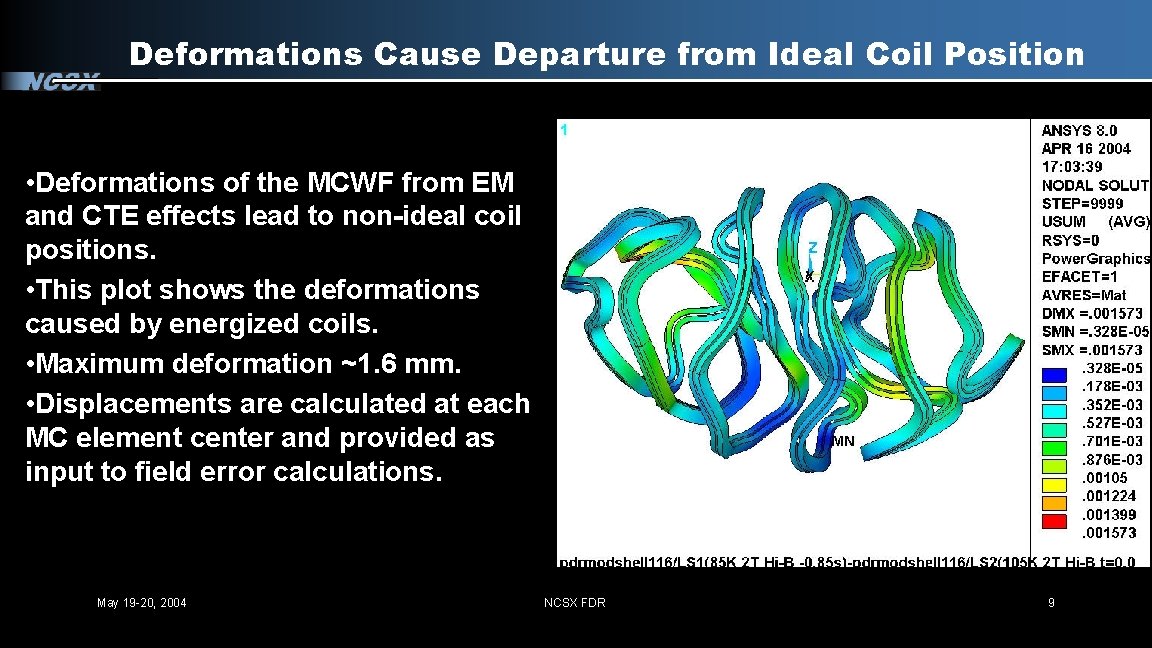
Deformations Cause Departure from Ideal Coil Position • Deformations of the MCWF from EM and CTE effects lead to non-ideal coil positions. • This plot shows the deformations caused by energized coils. • Maximum deformation ~1. 6 mm. • Displacements are calculated at each MC element center and provided as input to field error calculations. May 19 -20, 2004 NCSX FDR 9
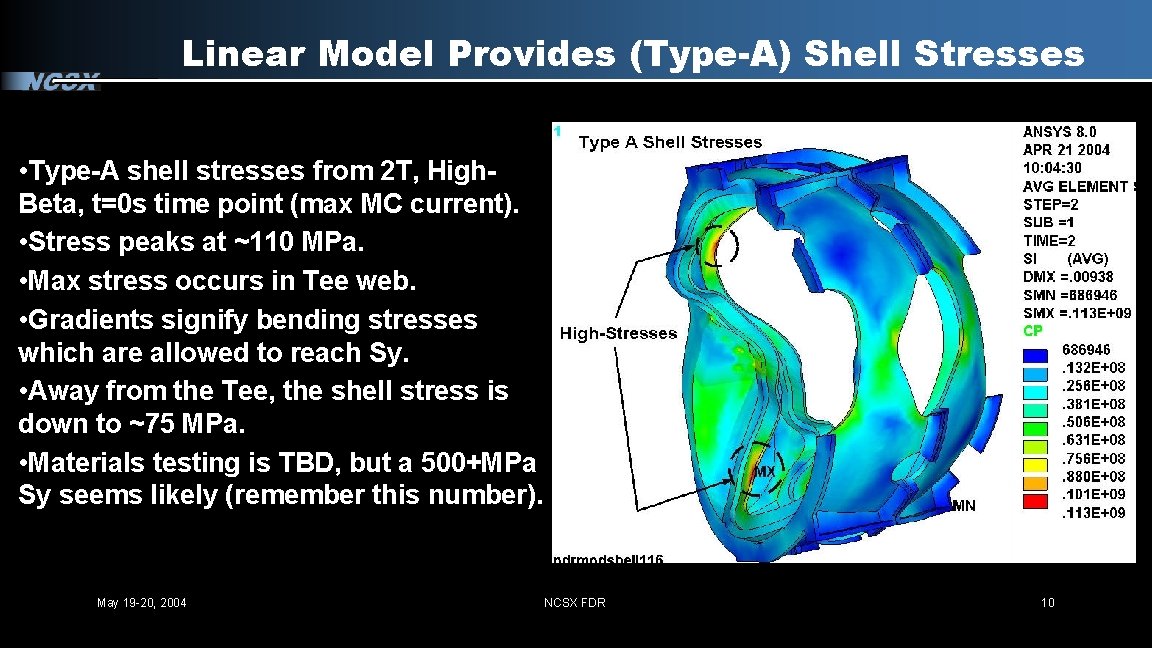
Linear Model Provides (Type-A) Shell Stresses • Type-A shell stresses from 2 T, High. Beta, t=0 s time point (max MC current). • Stress peaks at ~110 MPa. • Max stress occurs in Tee web. • Gradients signify bending stresses which are allowed to reach Sy. • Away from the Tee, the shell stress is down to ~75 MPa. • Materials testing is TBD, but a 500+MPa Sy seems likely (remember this number). May 19 -20, 2004 NCSX FDR 10
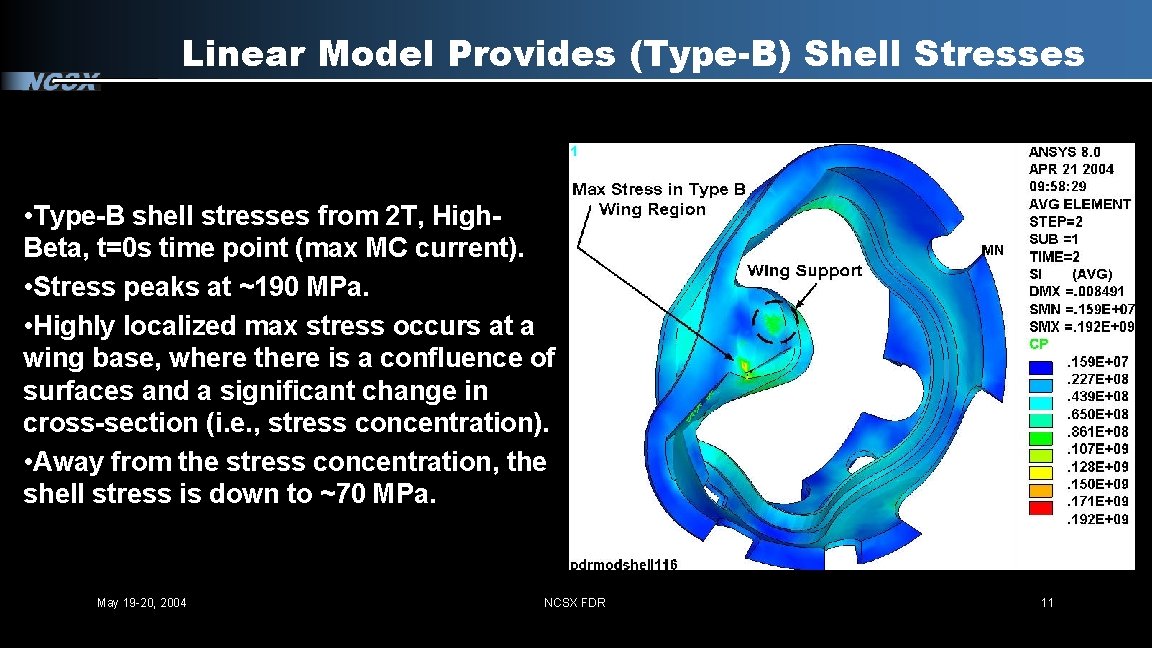
Linear Model Provides (Type-B) Shell Stresses • Type-B shell stresses from 2 T, High. Beta, t=0 s time point (max MC current). • Stress peaks at ~190 MPa. • Highly localized max stress occurs at a wing base, where there is a confluence of surfaces and a significant change in cross-section (i. e. , stress concentration). • Away from the stress concentration, the shell stress is down to ~70 MPa. May 19 -20, 2004 NCSX FDR 11
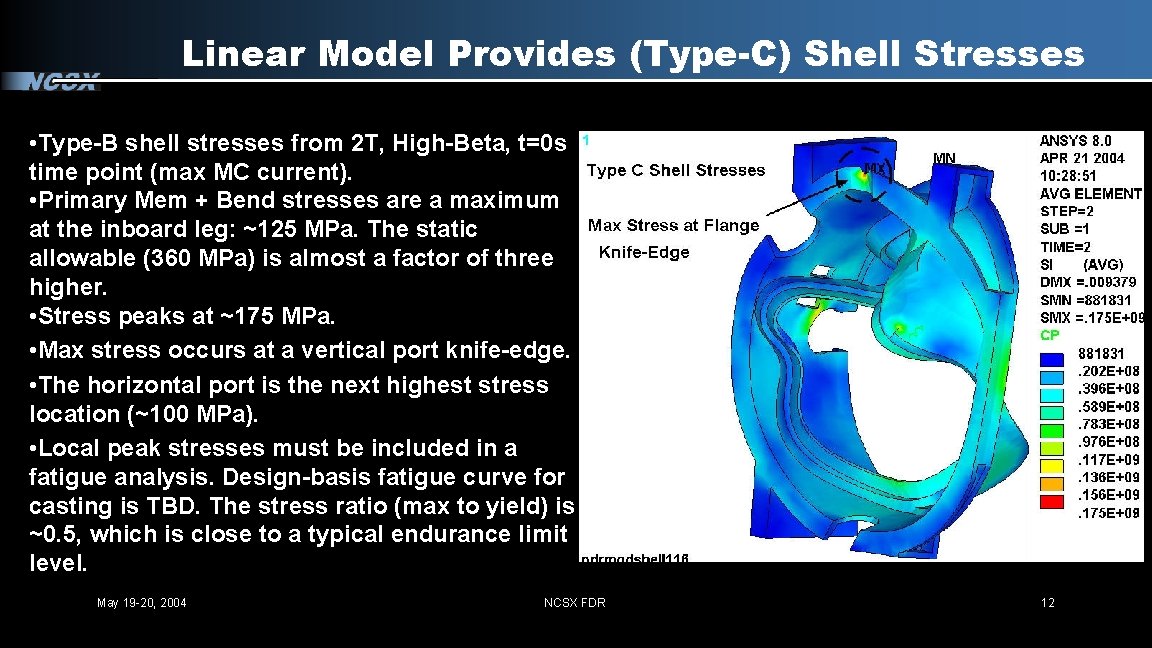
Linear Model Provides (Type-C) Shell Stresses • Type-B shell stresses from 2 T, High-Beta, t=0 s time point (max MC current). • Primary Mem + Bend stresses are a maximum at the inboard leg: ~125 MPa. The static allowable (360 MPa) is almost a factor of three higher. • Stress peaks at ~175 MPa. • Max stress occurs at a vertical port knife-edge. • The horizontal port is the next highest stress location (~100 MPa). • Local peak stresses must be included in a fatigue analysis. Design-basis fatigue curve for casting is TBD. The stress ratio (max to yield) is ~0. 5, which is close to a typical endurance limit level. May 19 -20, 2004 NCSX FDR 12
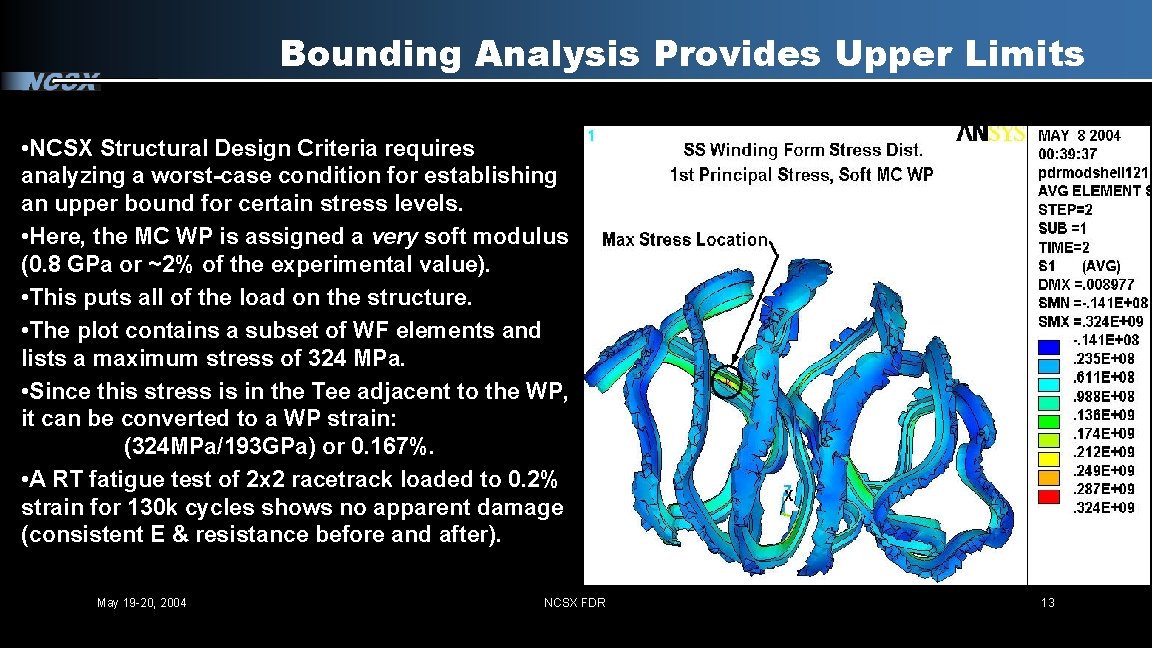
Bounding Analysis Provides Upper Limits • NCSX Structural Design Criteria requires analyzing a worst-case condition for establishing an upper bound for certain stress levels. • Here, the MC WP is assigned a very soft modulus (0. 8 GPa or ~2% of the experimental value). • This puts all of the load on the structure. • The plot contains a subset of WF elements and lists a maximum stress of 324 MPa. • Since this stress is in the Tee adjacent to the WP, it can be converted to a WP strain: (324 MPa/193 GPa) or 0. 167%. • A RT fatigue test of 2 x 2 racetrack loaded to 0. 2% strain for 130 k cycles shows no apparent damage (consistent E & resistance before and after). May 19 -20, 2004 NCSX FDR 13
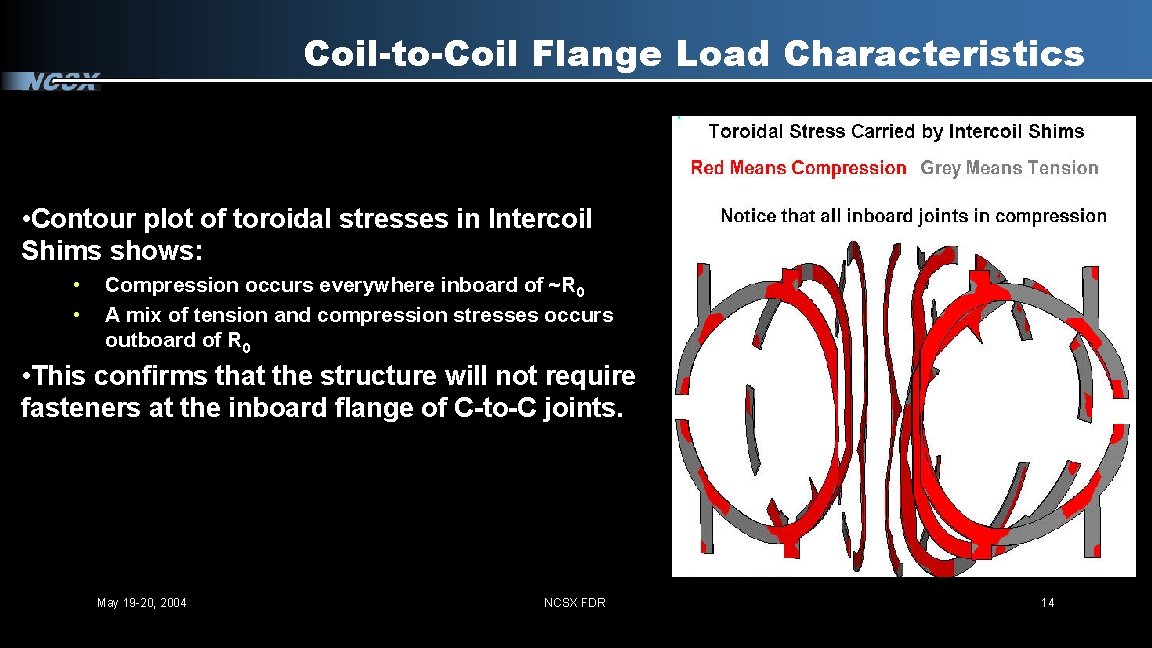
Coil-to-Coil Flange Load Characteristics • Contour plot of toroidal stresses in Intercoil Shims shows: • • Compression occurs everywhere inboard of ~R 0 A mix of tension and compression stresses occurs outboard of R 0 • This confirms that the structure will not require fasteners at the inboard flange of C-to-C joints. May 19 -20, 2004 NCSX FDR 14
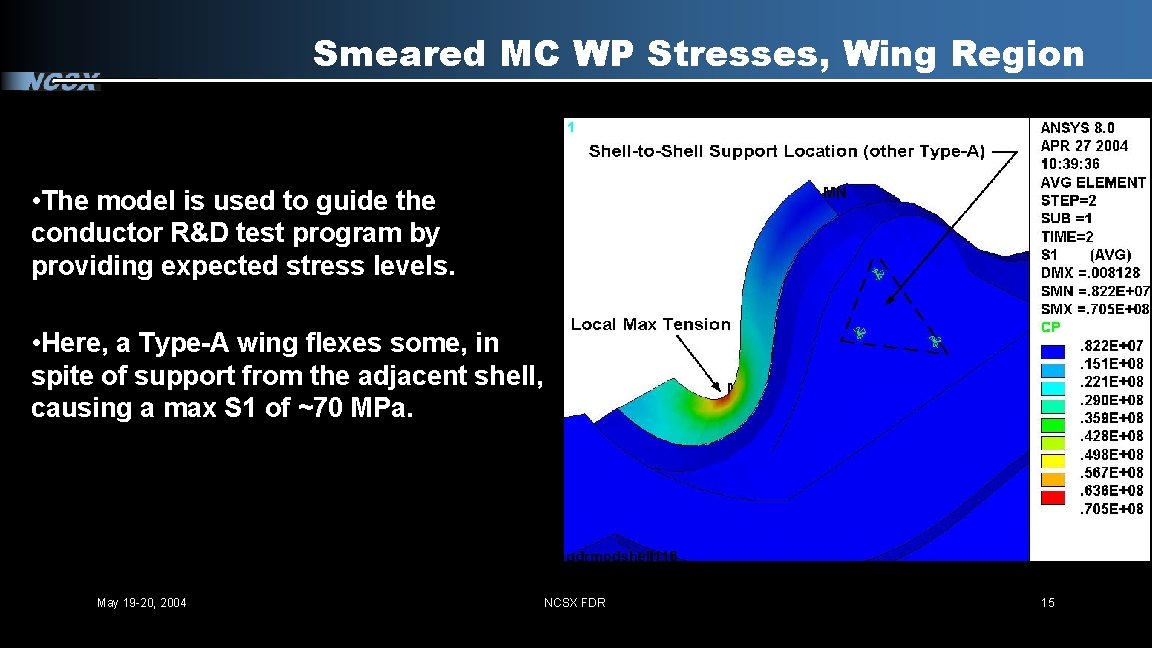
Smeared MC WP Stresses, Wing Region • The model is used to guide the conductor R&D test program by providing expected stress levels. • Here, a Type-A wing flexes some, in spite of support from the adjacent shell, causing a max S 1 of ~70 MPa. May 19 -20, 2004 NCSX FDR 15
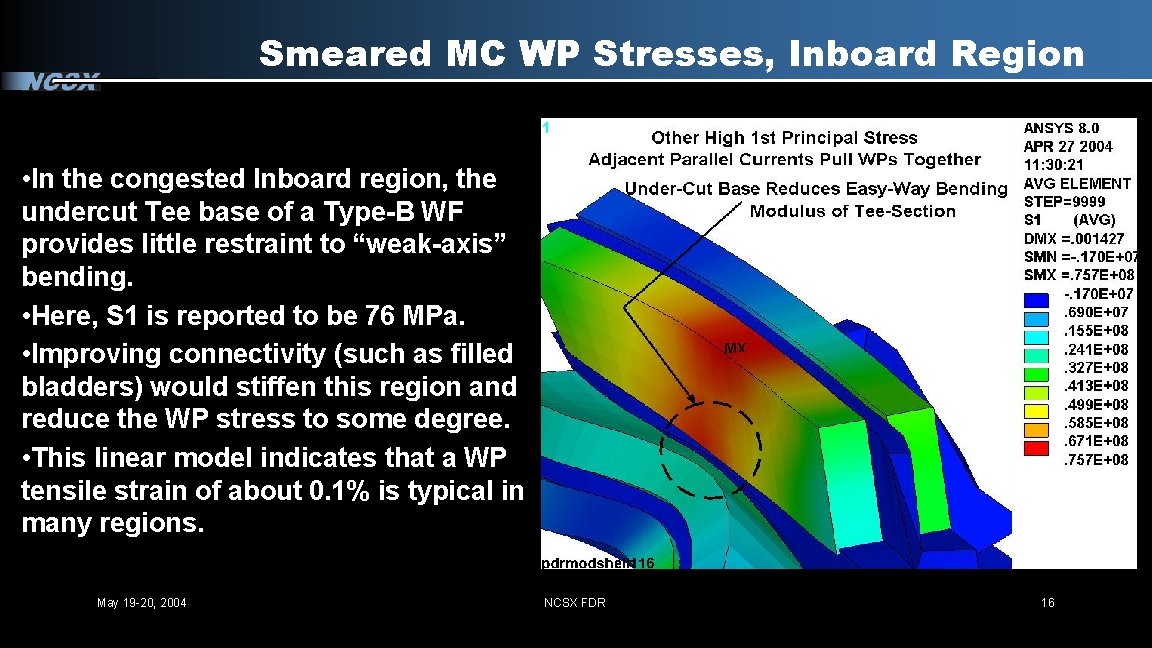
Smeared MC WP Stresses, Inboard Region • In the congested Inboard region, the undercut Tee base of a Type-B WF provides little restraint to “weak-axis” bending. • Here, S 1 is reported to be 76 MPa. • Improving connectivity (such as filled bladders) would stiffen this region and reduce the WP stress to some degree. • This linear model indicates that a WP tensile strain of about 0. 1% is typical in many regions. May 19 -20, 2004 NCSX FDR 16
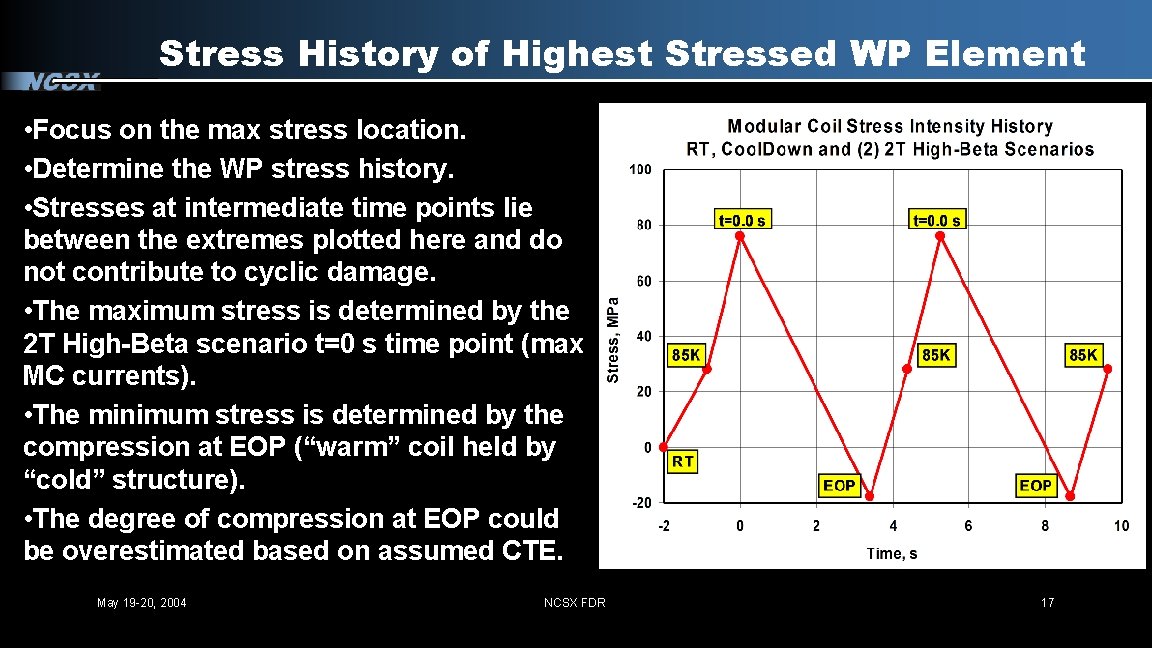
Stress History of Highest Stressed WP Element • Focus on the max stress location. • Determine the WP stress history. • Stresses at intermediate time points lie between the extremes plotted here and do not contribute to cyclic damage. • The maximum stress is determined by the 2 T High-Beta scenario t=0 s time point (max MC currents). • The minimum stress is determined by the compression at EOP (“warm” coil held by “cold” structure). • The degree of compression at EOP could be overestimated based on assumed CTE. May 19 -20, 2004 NCSX FDR 17
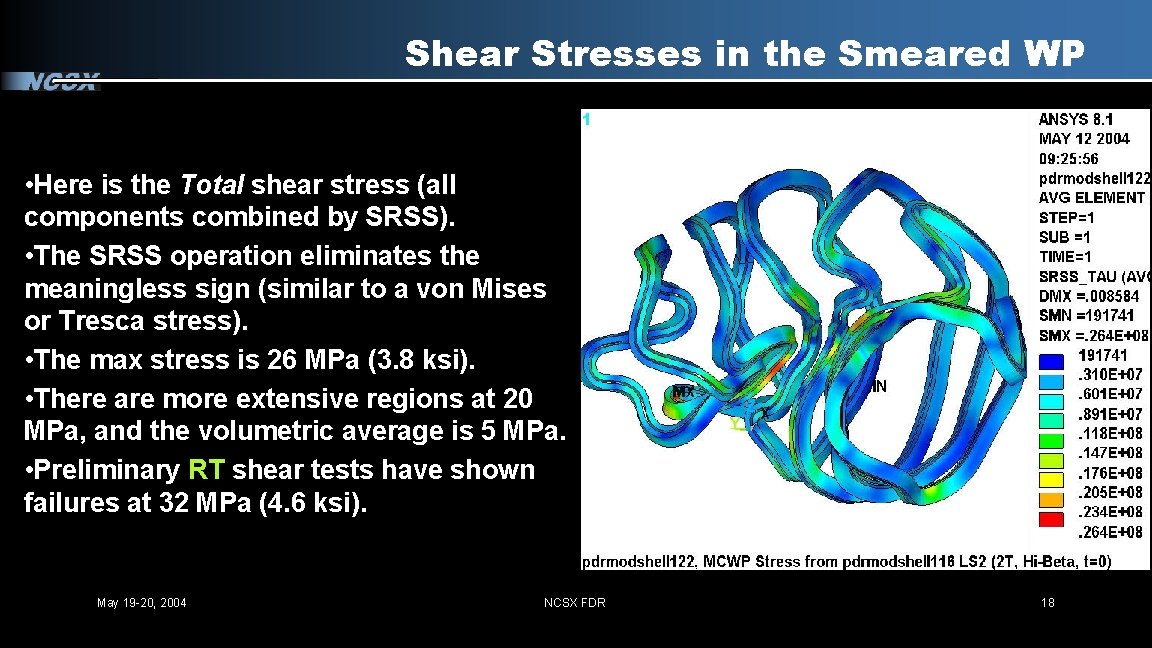
Shear Stresses in the Smeared WP • Here is the Total shear stress (all components combined by SRSS). • The SRSS operation eliminates the meaningless sign (similar to a von Mises or Tresca stress). • The max stress is 26 MPa (3. 8 ksi). • There are more extensive regions at 20 MPa, and the volumetric average is 5 MPa. • Preliminary RT shear tests have shown failures at 32 MPa (4. 6 ksi). May 19 -20, 2004 NCSX FDR 18
Linear Analysis Summary Linear model is used to study various design issues: • Flange loads for bolting specs, Poloidal Break opening stiffness, Type C -C continuity effects, influence of shell stiffness, displacements for field error calculations, wing support specs, Shell stresses and smeared WP stresses/strains for conductor testing. May 19 -20, 2004 NCSX FDR 19
Linear Analysis Summary (cont’d) • Accepting its limitations (isotropic smeared WP, no clamps, contact surfaces or poloidal breaks) the Linear Model provides: • Nominal & Upper Bound WP Tensile Strains: ~0. 1% & 0. 17% • RT test specimen has survived 0. 0 to 0. 2% strain range for 130 k cycles • MC WP Shear stresses <26 MPa • Close to 32 MPa failure from very preliminary RT shear stress tests • Below more common epoxy-glass design goal of 30+ MPa (needs some work) • Nominal, Max and Upper Bound Shell Stress: 75, 190 and 320 MPa • Well below the 360 MPa Sy • FYI: Upper Bound stress is very conservatively based on a dead-soft WP. • MCWF Fatigue evaluation is TBD. May 19 -20, 2004 NCSX FDR 20