
Linear Programming DR SYAMALA KRISHNANNAIR UNIVERSITY OF ZULULAND


- Slides: 65
Linear Programming DR SYAMALA KRISHNANNAIR UNIVERSITY OF ZULULAND krishnannairs@unizulu. ac. za
Module Outline þ Introduction þ The Linear Programming Model þ Examples of Linear Programming Problems þ Developing Linear Programming Models þ Graphical Solution to LP Problems þ The Simplex Method þ Simplex Tableau for Maximization Problem þ Marginal Values of Additional Resources þ Sensitivity Analysis þ Complications in Applying the Simplex Method þ Duality
Introduction • Mathematical programming is used to find the best or optimal solution to a problem that requires a decision or set of decisions about how best to use a set of limited resources to achieve a state goal of objectives. • Steps involved in mathematical programming • Conversion of stated problem into a mathematical model that abstracts all the essential elements of the problem. • Exploration of different solutions of the problem. • Finding out the most suitable or optimum solution. • Linear programming requires that all the mathematical functions in the model be linear functions.
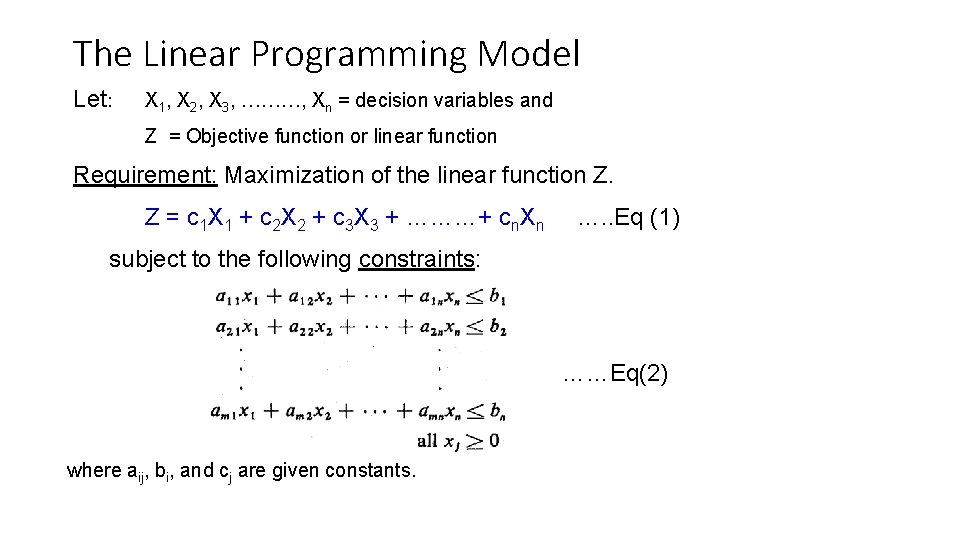
The Linear Programming Model Let: X 1, X 2, X 3, ………, Xn = decision variables and Z = Objective function or linear function Requirement: Maximization of the linear function Z. Z = c 1 X 1 + c 2 X 2 + c 3 X 3 + ………+ cn. Xn …. . Eq (1) subject to the following constraints: ……Eq(2) where aij, bi, and cj are given constants.
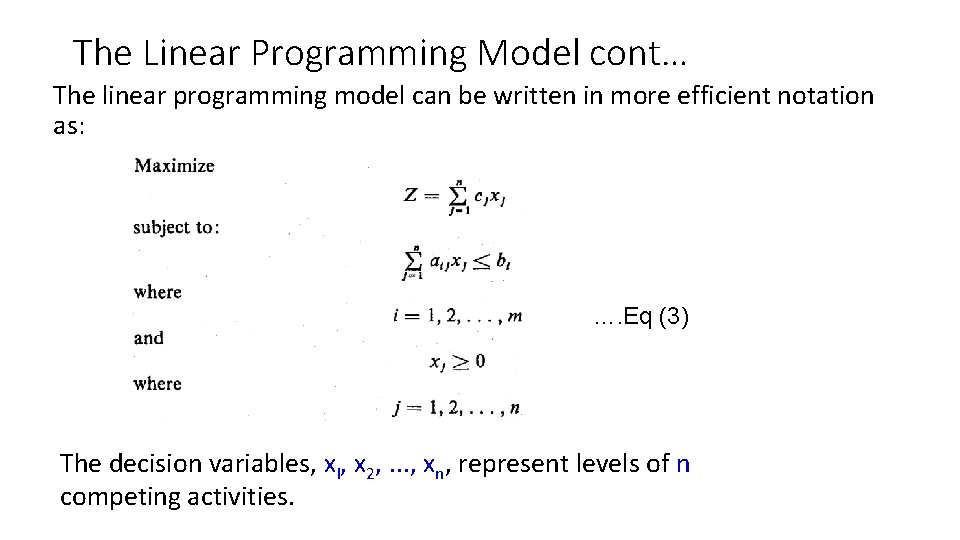
The Linear Programming Model cont… The linear programming model can be written in more efficient notation as: …. Eq (3) The decision variables, x. I, x 2, . . . , xn, represent levels of n competing activities.
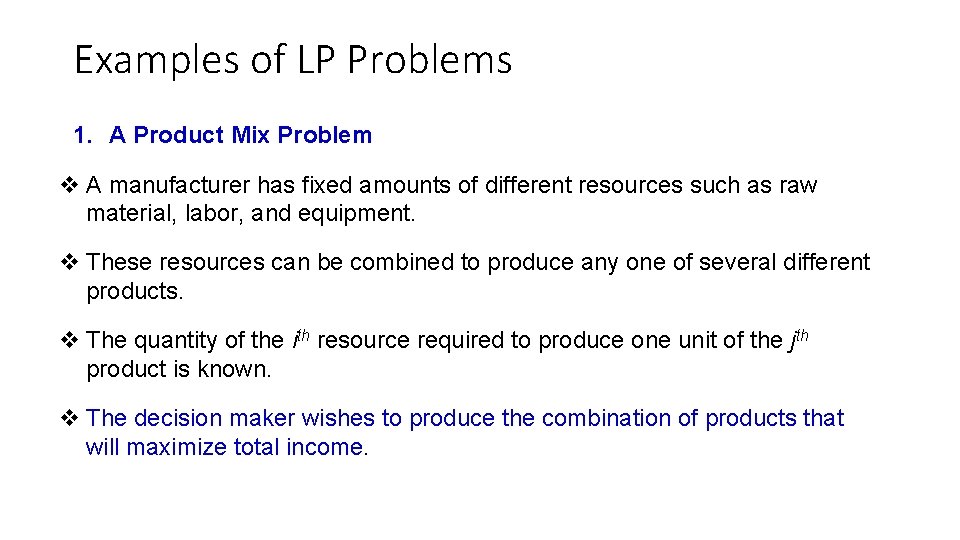
Examples of LP Problems 1. A Product Mix Problem v A manufacturer has fixed amounts of different resources such as raw material, labor, and equipment. v These resources can be combined to produce any one of several different products. v The quantity of the ith resource required to produce one unit of the jth product is known. v The decision maker wishes to produce the combination of products that will maximize total income.
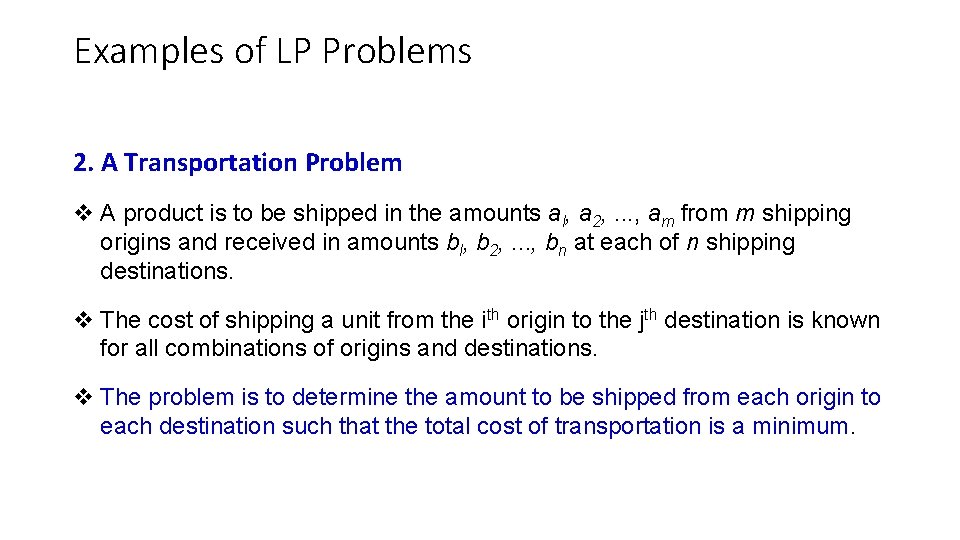
Examples of LP Problems 2. A Transportation Problem v A product is to be shipped in the amounts al, a 2, . . . , am from m shipping origins and received in amounts bl, b 2, . . . , bn at each of n shipping destinations. v The cost of shipping a unit from the ith origin to the jth destination is known for all combinations of origins and destinations. v The problem is to determine the amount to be shipped from each origin to each destination such that the total cost of transportation is a minimum.
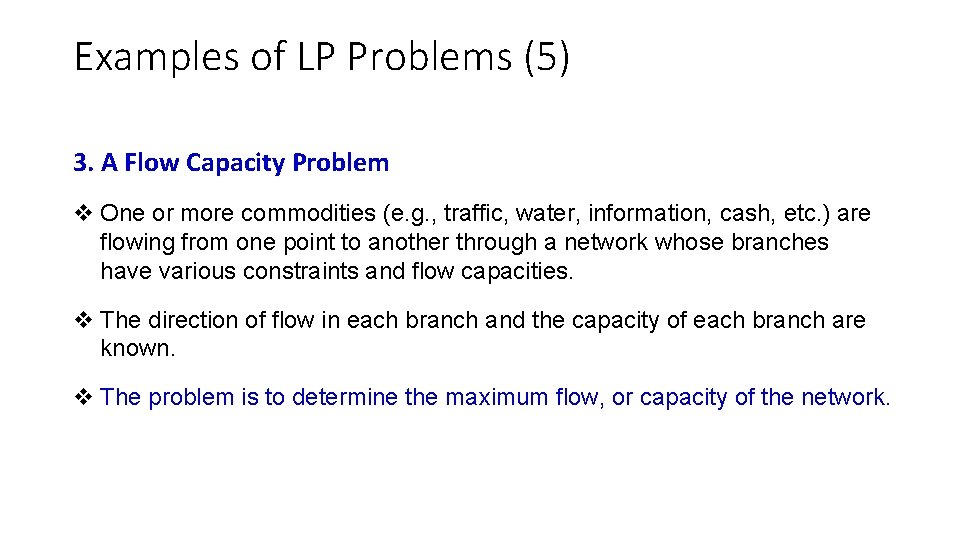
Examples of LP Problems (5) 3. A Flow Capacity Problem v One or more commodities (e. g. , traffic, water, information, cash, etc. ) are flowing from one point to another through a network whose branches have various constraints and flow capacities. v The direction of flow in each branch and the capacity of each branch are known. v The problem is to determine the maximum flow, or capacity of the network.
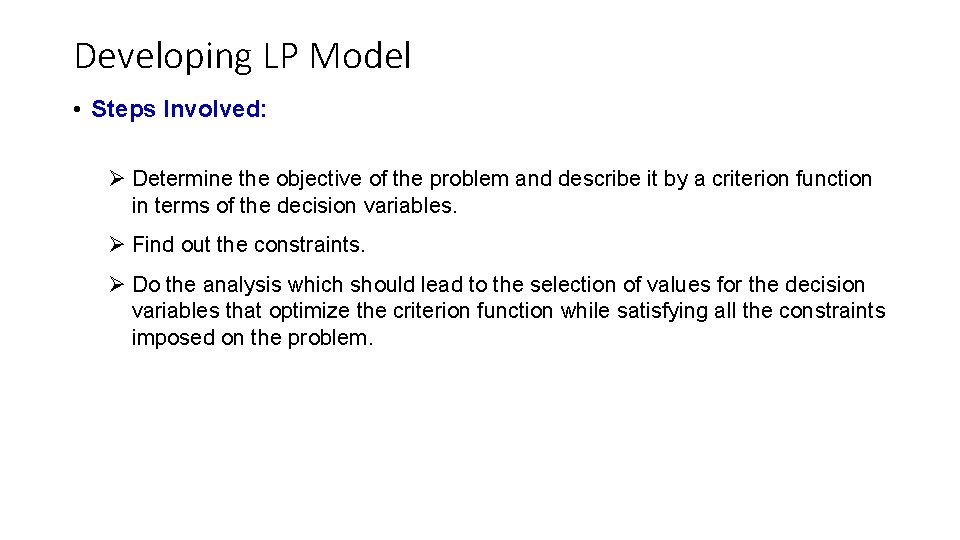
Developing LP Model • Steps Involved: Ø Determine the objective of the problem and describe it by a criterion function in terms of the decision variables. Ø Find out the constraints. Ø Do the analysis which should lead to the selection of values for the decision variables that optimize the criterion function while satisfying all the constraints imposed on the problem.
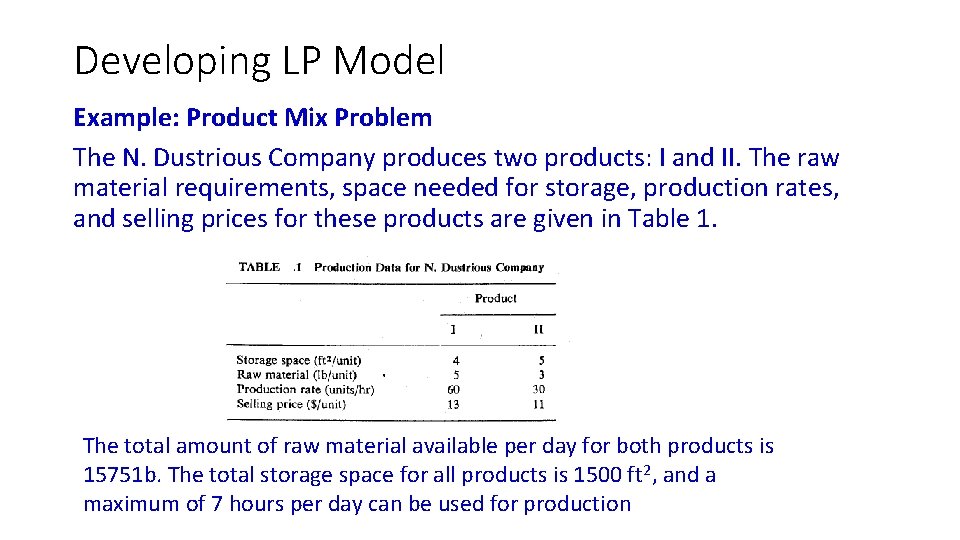
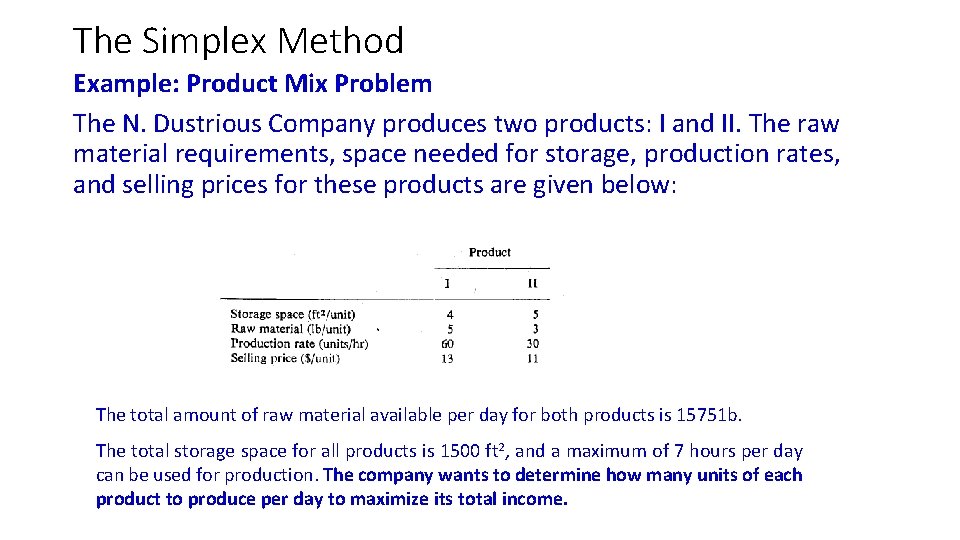
Developing LP Model Example: Product Mix Problem The N. Dustrious Company produces two products: I and II. The raw material requirements, space needed for storage, production rates, and selling prices for these products are given in Table 1. The total amount of raw material available per day for both products is 15751 b. The total storage space for all products is 1500 ft 2, and a maximum of 7 hours per day can be used for production
Developing LP Model Example Problem All products manufactured are shipped out of the storage area at the end of the day. Therefore, the two products must share the total raw material, storage space, and production time. The company wants to determine how many units of each product to produce per day to maximize its total income. Solution • The company has decided that it wants to maximize its sale income, which depends on the number of units of product I and II that it produces. • Therefore, the decision variables, x 1 and x 2 can be the number of units of products I and II, respectively, produced per day.
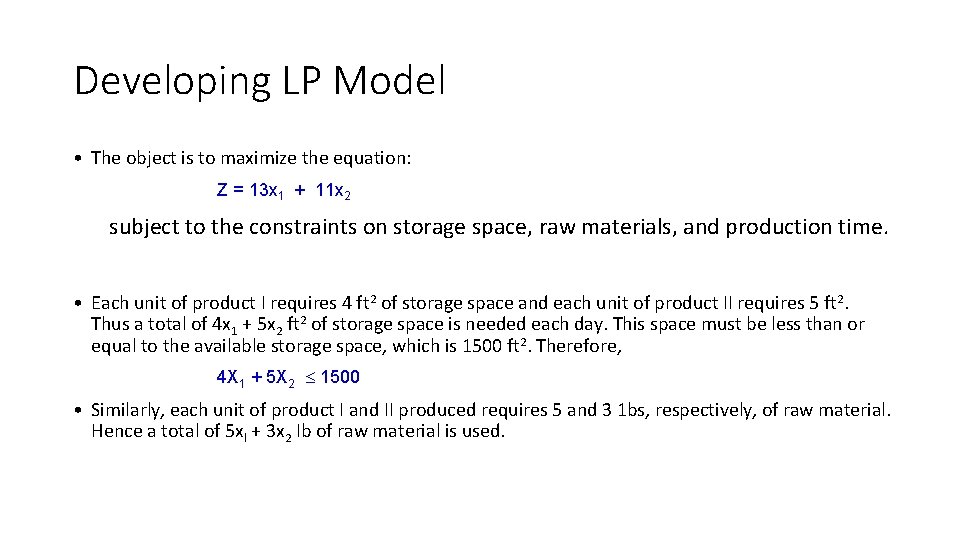
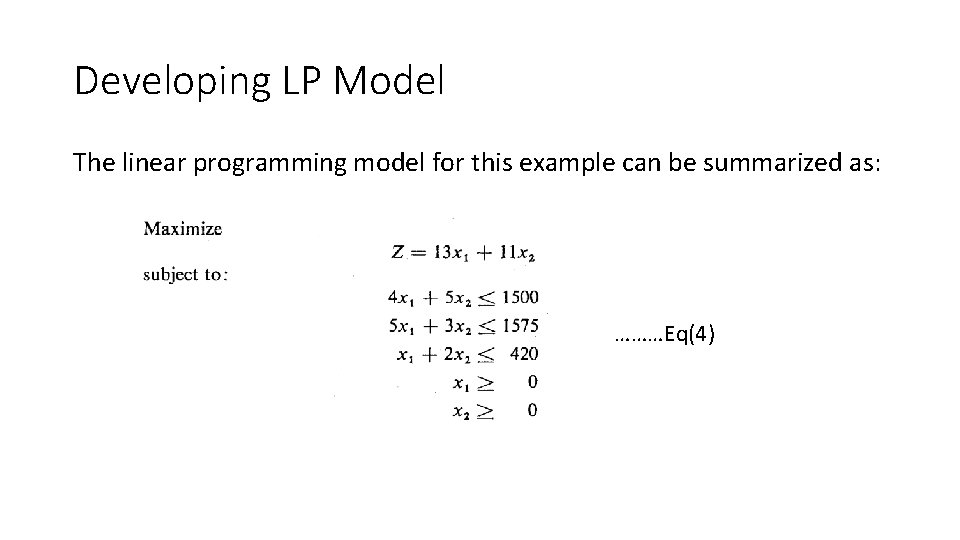
Developing LP Model • The object is to maximize the equation: Z = 13 x 1 + 11 x 2 subject to the constraints on storage space, raw materials, and production time. • Each unit of product I requires 4 ft 2 of storage space and each unit of product II requires 5 ft 2. Thus a total of 4 x 1 + 5 x 2 ft 2 of storage space is needed each day. This space must be less than or equal to the available storage space, which is 1500 ft 2. Therefore, 4 X 1 + 5 X 2 1500 • Similarly, each unit of product I and II produced requires 5 and 3 1 bs, respectively, of raw material. Hence a total of 5 xl + 3 x 2 Ib of raw material is used.
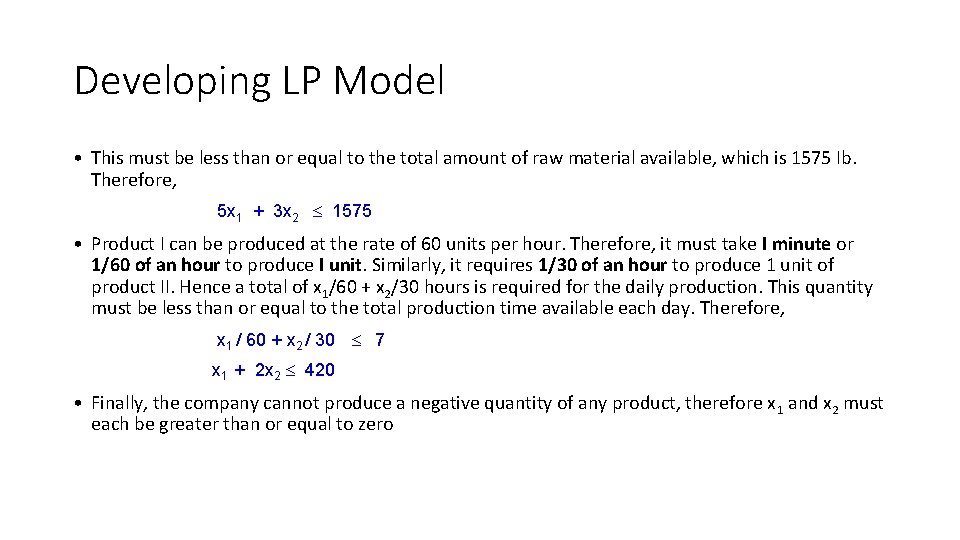
Developing LP Model • This must be less than or equal to the total amount of raw material available, which is 1575 Ib. Therefore, 5 x 1 + 3 x 2 1575 • Product I can be produced at the rate of 60 units per hour. Therefore, it must take I minute or 1/60 of an hour to produce I unit. Similarly, it requires 1/30 of an hour to produce 1 unit of product II. Hence a total of x 1/60 + x 2/30 hours is required for the daily production. This quantity must be less than or equal to the total production time available each day. Therefore, x 1 / 60 + x 2 / 30 7 or x 1 + 2 x 2 420 • Finally, the company cannot produce a negative quantity of any product, therefore x 1 and x 2 must each be greater than or equal to zero
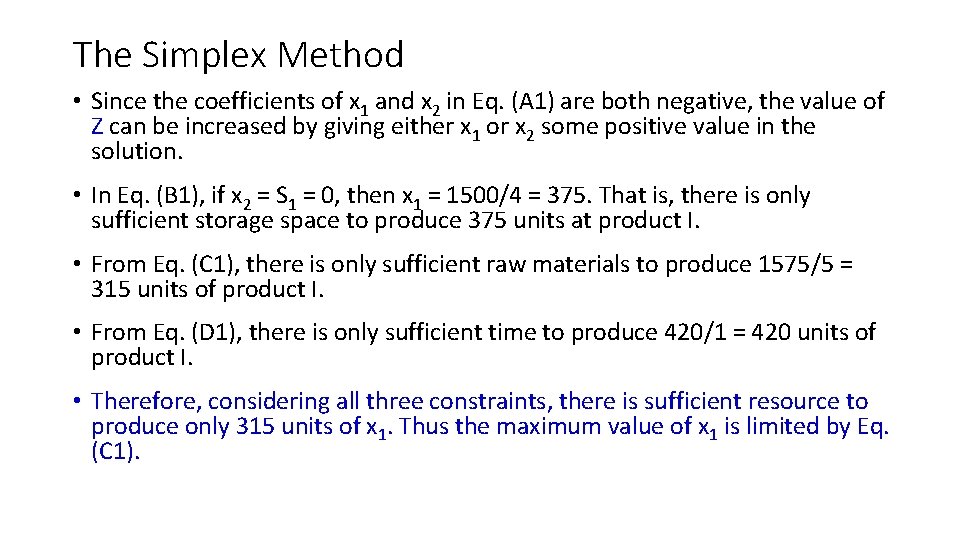
Developing LP Model The linear programming model for this example can be summarized as: ………Eq(4)
Graphical Solution to LP Problems
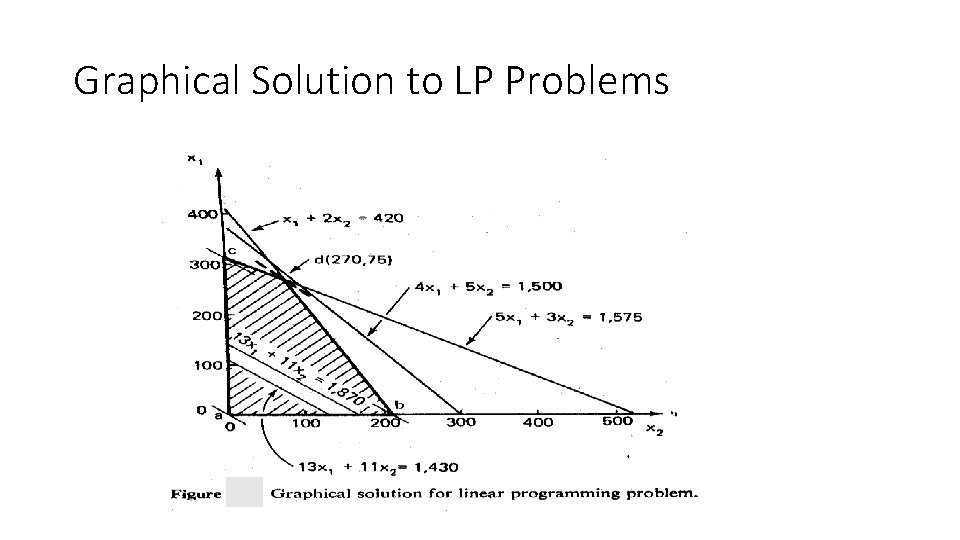
Graphical Solution to LP Problems • An equation of the form 4 x 1 + 5 x 2 = 1500 defines a straight line in the x 1 -x 2 plane. An inequality defines an area bounded by a straight line. Therefore, the region below and including the line 4 x 1 + 5 x 2 = 1500 in the Figure represents the region defined by 4 x 1 + 5 x 2 1500. • Same thing applies to other equations as well. • The shaded area of the figure comprises the area common to all the regions defined by the constraints and contains all pairs of x. I and x 2 that are feasible solutions to the problem. • This area is known as the feasible region or feasible solution space. The optimal solution must lie within this region.
Graphical Solution to LP Problems • Trying different solutions, the optimal solution will be: X 1 = 270 X 2 = 75 • This indicates that maximum income of $4335 is obtained by producing 270 units of product I and 75 units of product II. • In this solution, all the raw material and available time are used, because the optimal point lies on the two constraint lines for these resources. • However, 1500 - [4(270) + 5(75)], or 45 ft 2 of storage space, is not used. Thus the storage space is not a constraint on the optimal solution; that is, more products could be produced before the company ran out of storage space. Thus this constraint is said to be slack.
Graphical Solution to LP Problems • If the objective function happens to be parallel to one of the edges of the feasible region, any point along this edge between the two extreme points may be an optimal solution that maximizes the objective function. When this occurs, there is no unique solution, but there is an infinite number of optimal solutions. • The graphical method of solution may be extended to a case in which there are three variables. In this case, each constraint is represented by a plane in three dimensions, and the feasible region bounded by these planes is a polyhedron.
The Simplex Method • When decision variables are more than 2, it is always advisable to use Simplex Method to avoid lengthy graphical procedure. • The simplex method is not used to examine all the feasible solutions. • It deals only with a small and unique set of feasible solutions, the set of vertex points (i. e. , extreme points) of the convex feasible space that contains the optimal solution.
The Simplex Method Example: Product Mix Problem The N. Dustrious Company produces two products: I and II. The raw material requirements, space needed for storage, production rates, and selling prices for these products are given below: The total amount of raw material available per day for both products is 15751 b. The total storage space for all products is 1500 ft 2, and a maximum of 7 hours per day can be used for production. The company wants to determine how many units of each product to produce per day to maximize its total income.
Definition of Slasck, Surplus and Artificial Variable • Slack Variables : ØSlack variable represents an unused quaintly of resources ; it is added to less than or equal (<) to type constraints in order to get an equality constraint. • Surplus Variables : ØA surplus variable represents the amount by which solution values exceed a resource. These variables are also called ‘Negative Slack Variables’. Surplus variables like slack variables carry a zero coefficient in the objective function. it is added to greater than or equal to (>) type constraints in order to get an equality constraint. • Artificial Variables : ØArtificial variables are added to those constraints with equality (=) and greater than or equal to ( > ) sign. An Artificial variable is added to the constraints to get an initial solution to an LP problem. Artificial variables have no meaning in a physical sense and are not only used as a tool for generating an initial solution to an LP problem.
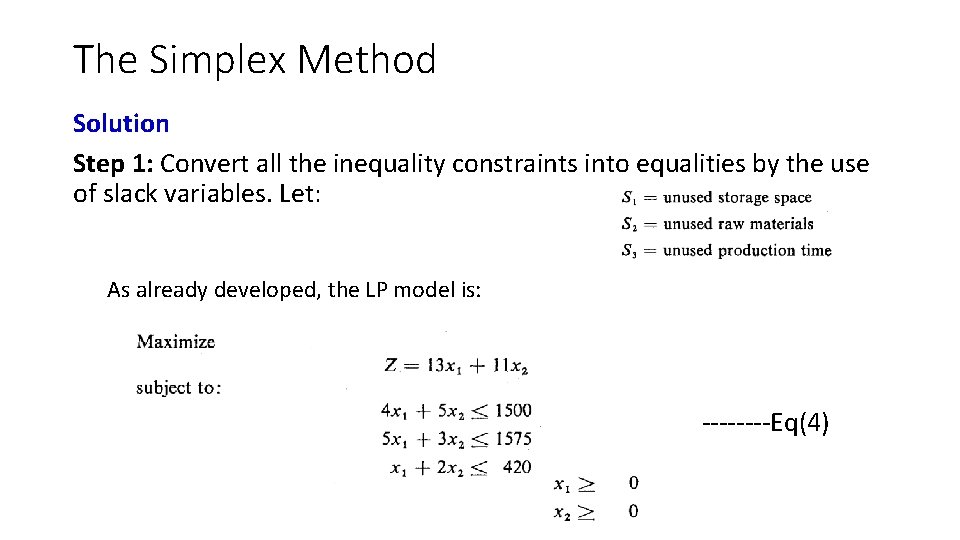
The Simplex Method Solution Step 1: Convert all the inequality constraints into equalities by the use of slack variables. Let: As already developed, the LP model is: ----Eq(4)
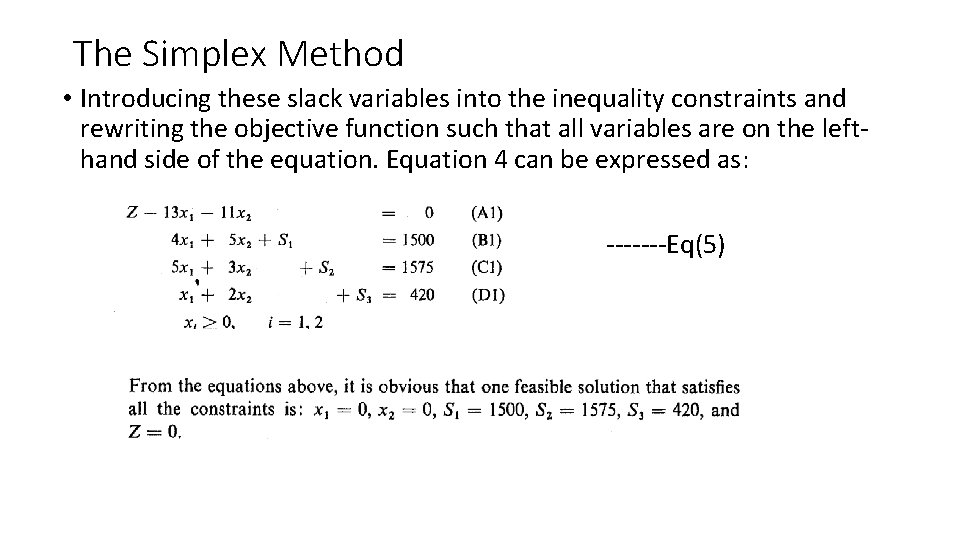
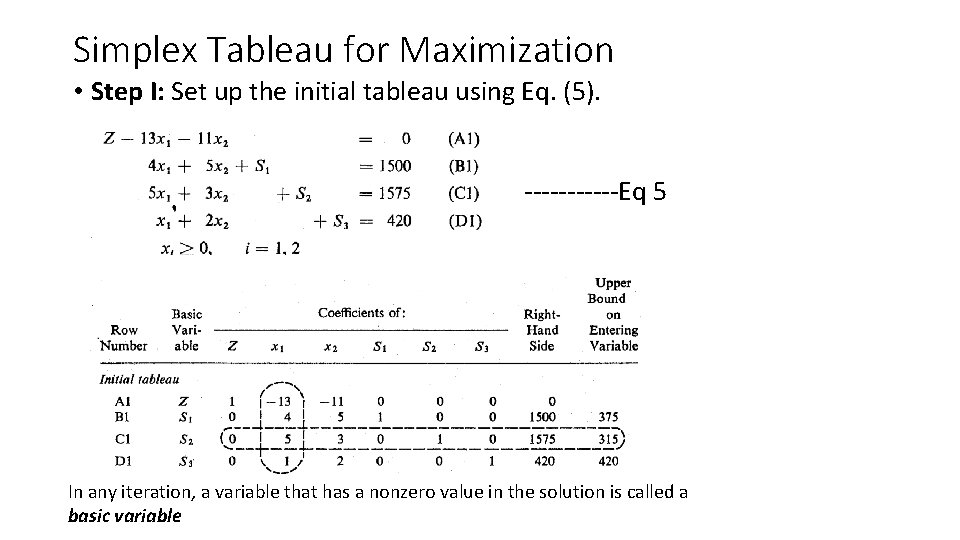
The Simplex Method • Introducing these slack variables into the inequality constraints and rewriting the objective function such that all variables are on the lefthand side of the equation. Equation 4 can be expressed as: -------Eq(5)
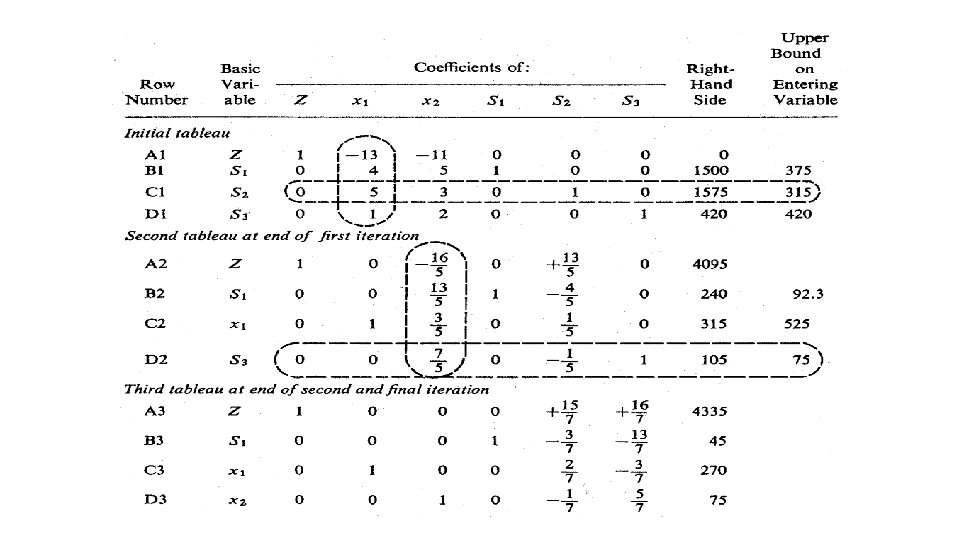
The Simplex Method • Since the coefficients of x 1 and x 2 in Eq. (A 1) are both negative, the value of Z can be increased by giving either x 1 or x 2 some positive value in the solution. • In Eq. (B 1), if x 2 = S 1 = 0, then x 1 = 1500/4 = 375. That is, there is only sufficient storage space to produce 375 units at product I. • From Eq. (C 1), there is only sufficient raw materials to produce 1575/5 = 315 units of product I. • From Eq. (D 1), there is only sufficient time to produce 420/1 = 420 units of product I. • Therefore, considering all three constraints, there is sufficient resource to produce only 315 units of x 1. Thus the maximum value of x 1 is limited by Eq. (C 1).
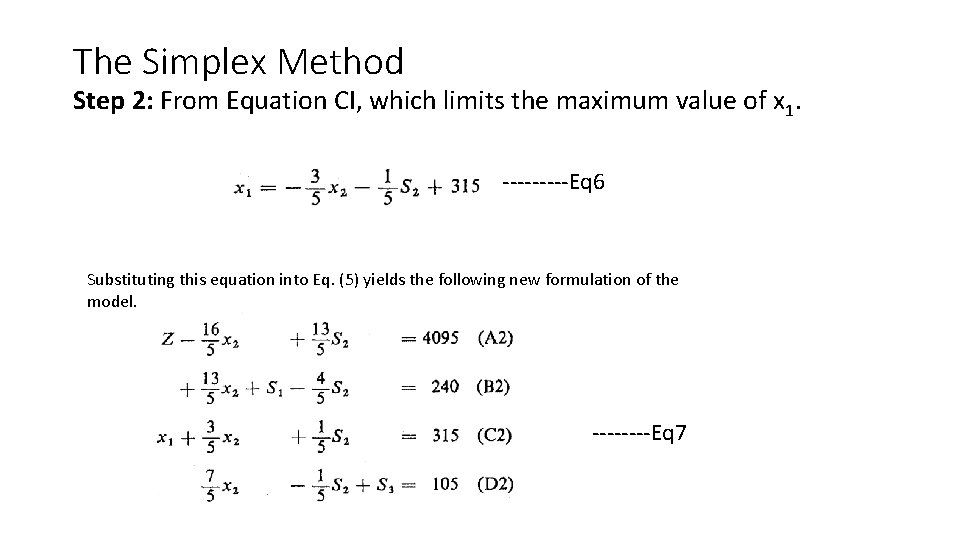
The Simplex Method Step 2: From Equation CI, which limits the maximum value of x 1. -----Eq 6 Substituting this equation into Eq. (5) yields the following new formulation of the model. ----Eq 7
The Simplex Method • It is now obvious from these equations that the new feasible solution is: x 1 = 315, x 2 = 0, S 1 = 240, S 2 = 0, S 3 = 105, and Z = 4095 • It is also obvious from Eq. (A 2) that it is also not the optimum solution. The coefficient of x 2 in the objective function represented by A 2 is negative ( -16/5), which means that the value of Z can be further increased by giving x 2 some positive value.
The Simplex Method • Following the same analysis procedure used in step 1, it is clear that: • In Eq. (B 2), if S 1 = 0, then x 2 = (5/13)(240) = 92. 3. • From Eq. (C 2), x 2 can take on the value (5/3 )(315) = 525 if 0 x 1 = S 2 = • From Eq. (D 2), x 2 can take on the value (5/7)(105) = 75 if 0 S 2 = S 3 = • Therefore, constraint D 2 limits the maximum value of x 2 to 75. Thus a new feasible solution includes x 2 = 75, S 2 = S 3 = 0.
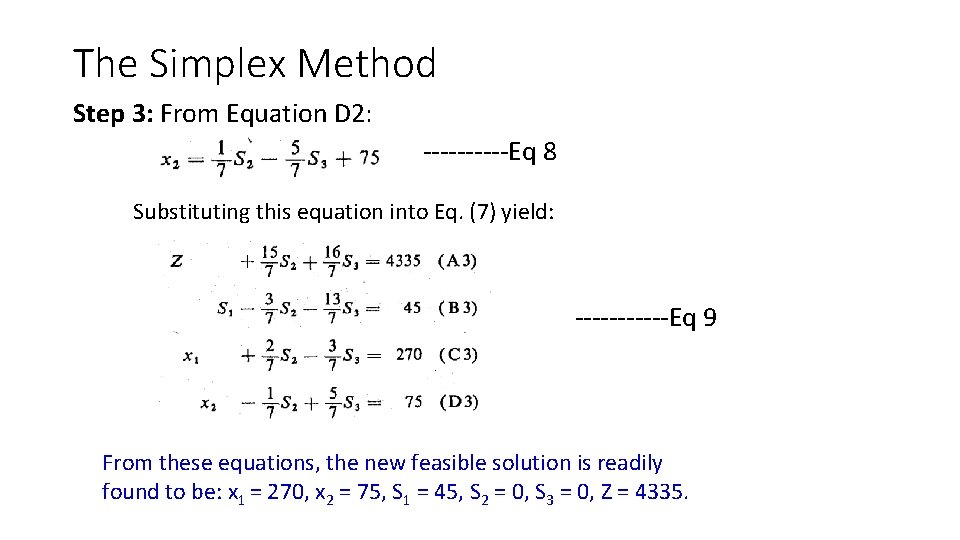
The Simplex Method Step 3: From Equation D 2: -----Eq 8 Substituting this equation into Eq. (7) yield: ------Eq 9 From these equations, the new feasible solution is readily found to be: x 1 = 270, x 2 = 75, S 1 = 45, S 2 = 0, S 3 = 0, Z = 4335.
The Simplex Method Because the coefficients in the objective function represented by Eq. (A 3) are all positive, this new solution is also the optimum solution.
Simplex Tableau for Maximization • Step I: Set up the initial tableau using Eq. (5). ------Eq 5 In any iteration, a variable that has a nonzero value in the solution is called a basic variable
Simplex Tableau for Maximization • Step II: . Identify the variable that will be assigned a nonzero value in the next iteration so as to increase the value of the objective function. This variable is called the entering variable. • It is that nonbasic variable which is associated with the smallest negative coefficient in the objective function. • If two or more nonbasic variables are tied with the smallest coefficients, select one of these arbitrarily and continue. • Step III: Identify the variable, called the leaving variable, which will be changed from a nonzero to a zero value in the next solution. Compute the ratios of the right- hand side of the equation (Solution-column) to the corresponding constraint coefficients under the entering variable. • Step IV : Identify pivot column, pivot row and pivot element
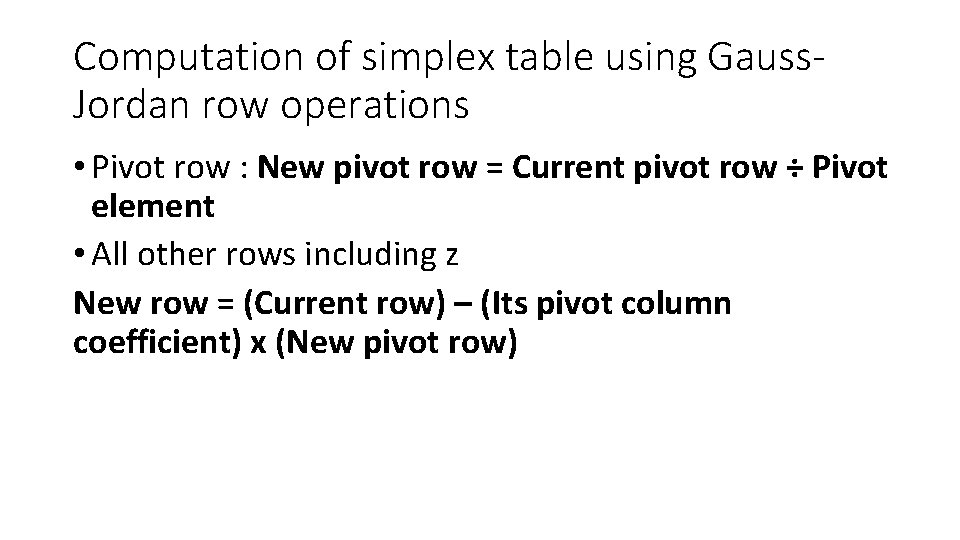
Computation of simplex table using Gauss. Jordan row operations • Pivot row : New pivot row = Current pivot row ÷ Pivot element • All other rows including z New row = (Current row) – (Its pivot column coefficient) x (New pivot row)
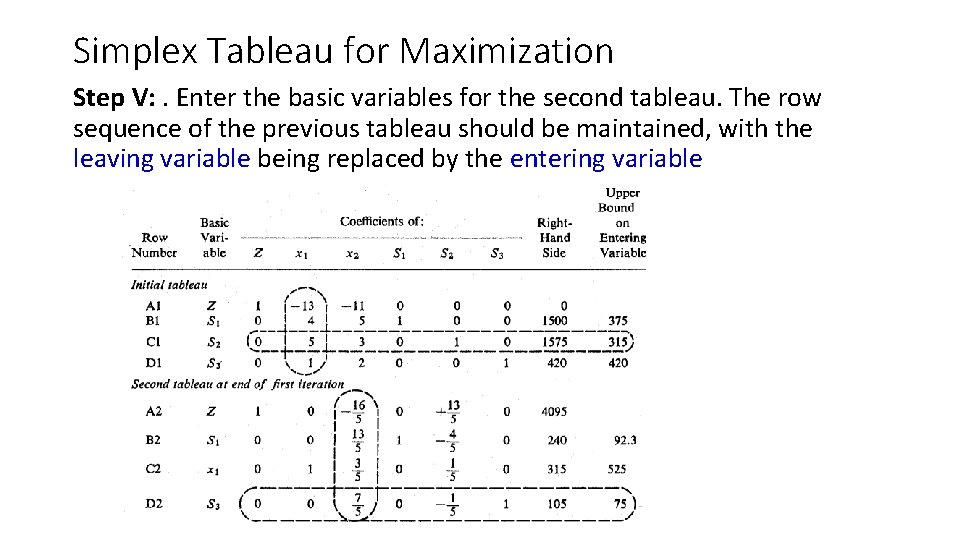
Simplex Tableau for Maximization Step V: . Enter the basic variables for the second tableau. The row sequence of the previous tableau should be maintained, with the leaving variable being replaced by the entering variable
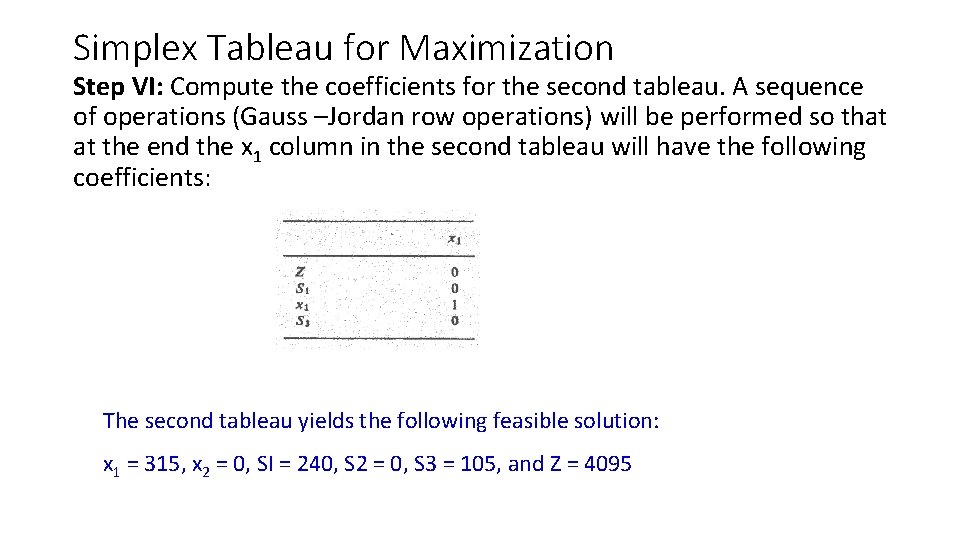
Simplex Tableau for Maximization Step VI: Compute the coefficients for the second tableau. A sequence of operations (Gauss –Jordan row operations) will be performed so that at the end the x 1 column in the second tableau will have the following coefficients: The second tableau yields the following feasible solution: x 1 = 315, x 2 = 0, SI = 240, S 2 = 0, S 3 = 105, and Z = 4095
Simplex Tableau for Maximization • The row operations proceed as fo 1 lows: • The coefficients in row C 2 ( New Pivot Row) are obtained by dividing the corresponding coefficients in row C 1 by 5 • The coefficients in row A 2 are obtained by multiplying the coefficients of row C 2 by 13 and adding the products to the corresponding coefficients in row Al. • The coefficients in row B 2 are obtained by multiplying the coefficients of row C 2 by -4 and adding the products to the corresponding coefficients in row Bl. • The coefficients in row D 2 are obtained by multiplying the coefficients of row C 2 by -1 and adding the products to the corresponding coefficients in row Dl.
Simplex Tableau for Maximization • Step VII: Check for optimality. The second feasible solution is also not optimal, because the objective function (row A 2) contains a negative coefficient. Another iteration beginning with step 2 is necessary. • In the third tableau (next slide), all the coefficients in the objective function (row A 3) are positive. Thus an optimal solution has been reached and it is as follows: x 1 = 270, x 2 = 75, SI = 45, S 2 = 0, S 3 = 0, and Z = 4335
Marginal Values of Additional Resources • The simplex solution yields the optimum production program for N. Dustrious Company. • The company can maximize its sale income to $4335 by producing 270 units of product I and 75 units of product II. • There will be no surplus of raw materials or production time. • But there will be 45 units of unused storage space. • The managers are interested to know if it is worthwhile to increase its production by purchasing additional units of raw materials and by either expanding its production facilities or working overtime.
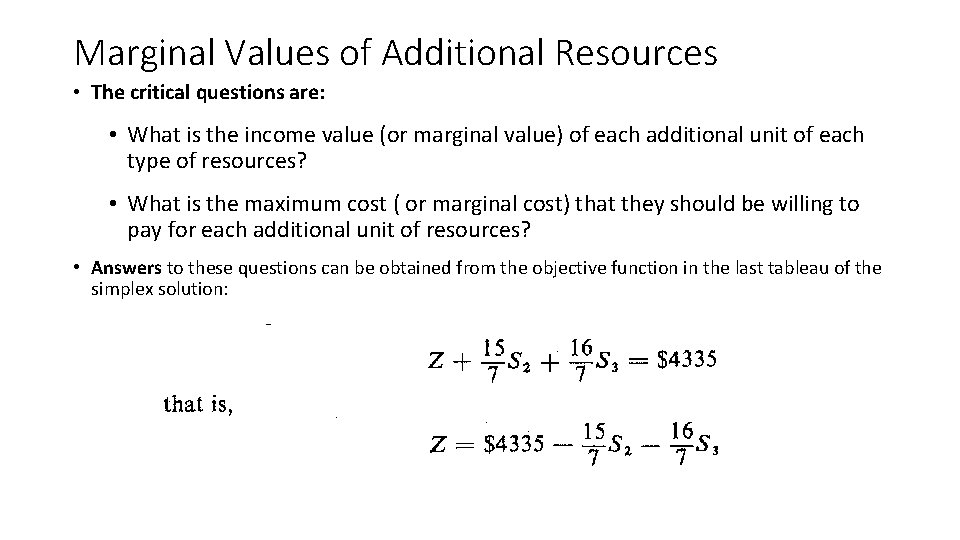
Marginal Values of Additional Resources • The critical questions are: • What is the income value (or marginal value) of each additional unit of each type of resources? • What is the maximum cost ( or marginal cost) that they should be willing to pay for each additional unit of resources? • Answers to these questions can be obtained from the objective function in the last tableau of the simplex solution:
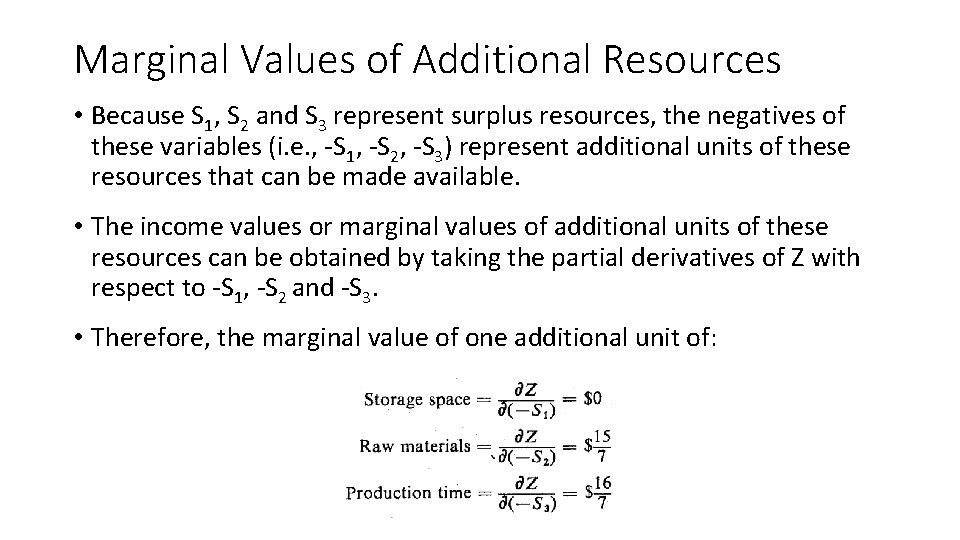
Marginal Values of Additional Resources • Because S 1, S 2 and S 3 represent surplus resources, the negatives of these variables (i. e. , -S 1, -S 2, -S 3) represent additional units of these resources that can be made available. • The income values or marginal values of additional units of these resources can be obtained by taking the partial derivatives of Z with respect to -S 1, -S 2 and -S 3. • Therefore, the marginal value of one additional unit of:
Marginal Values of Additional Resources • Thus, the marginal values of additional units of resources can be obtained directly from the coefficients of the objective function in the last tableau of a simplex solution. • The N. Dustrious Company should be willing to pay up to $15/7 for an additional unit of raw materials and $16/7 for an additional unit of production time. • If the actual cost of an additional unit (i. e. , marginal cost) of these resources are smaller than the marginal value, the company should be able to increase its income by increasing production. • The marginal values above are valid, however, only as long as there is surplus storage space available.
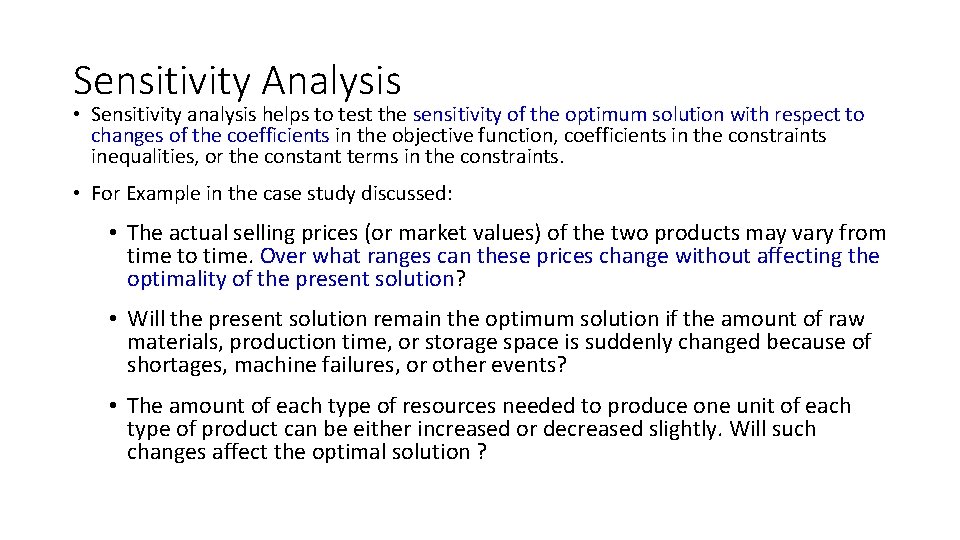
Sensitivity Analysis • Sensitivity analysis helps to test the sensitivity of the optimum solution with respect to changes of the coefficients in the objective function, coefficients in the constraints inequalities, or the constant terms in the constraints. • For Example in the case study discussed: • The actual selling prices (or market values) of the two products may vary from time to time. Over what ranges can these prices change without affecting the optimality of the present solution? • Will the present solution remain the optimum solution if the amount of raw materials, production time, or storage space is suddenly changed because of shortages, machine failures, or other events? • The amount of each type of resources needed to produce one unit of each type of product can be either increased or decreased slightly. Will such changes affect the optimal solution ?
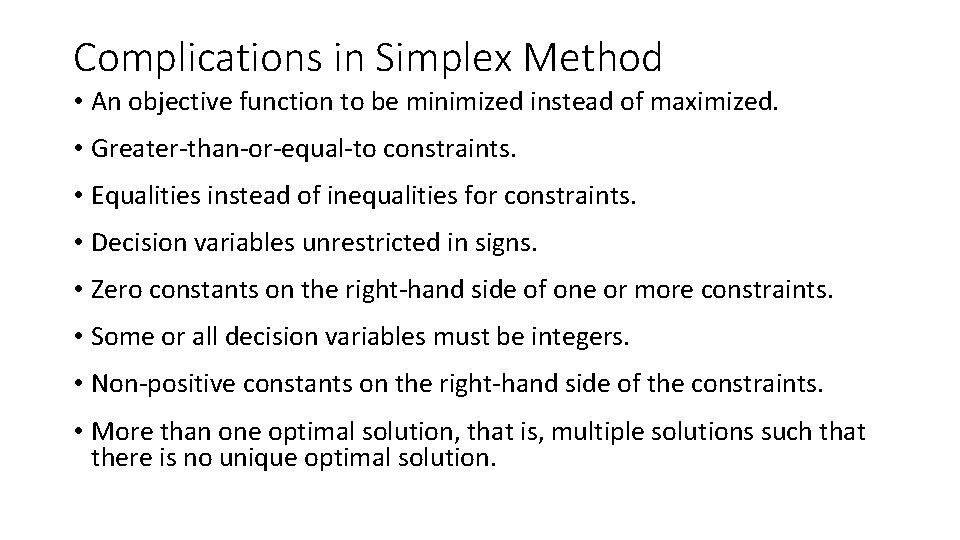
Complications in Simplex Method • An objective function to be minimized instead of maximized. • Greater-than-or-equal-to constraints. • Equalities instead of inequalities for constraints. • Decision variables unrestricted in signs. • Zero constants on the right-hand side of one or more constraints. • Some or all decision variables must be integers. • Non-positive constants on the right-hand side of the constraints. • More than one optimal solution, that is, multiple solutions such that there is no unique optimal solution.
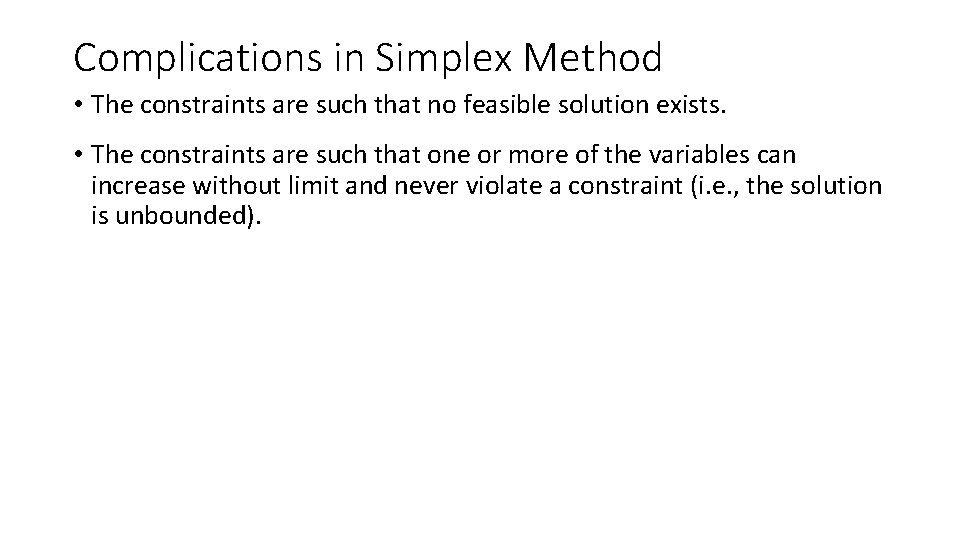
Complications in Simplex Method • The constraints are such that no feasible solution exists. • The constraints are such that one or more of the variables can increase without limit and never violate a constraint (i. e. , the solution is unbounded).
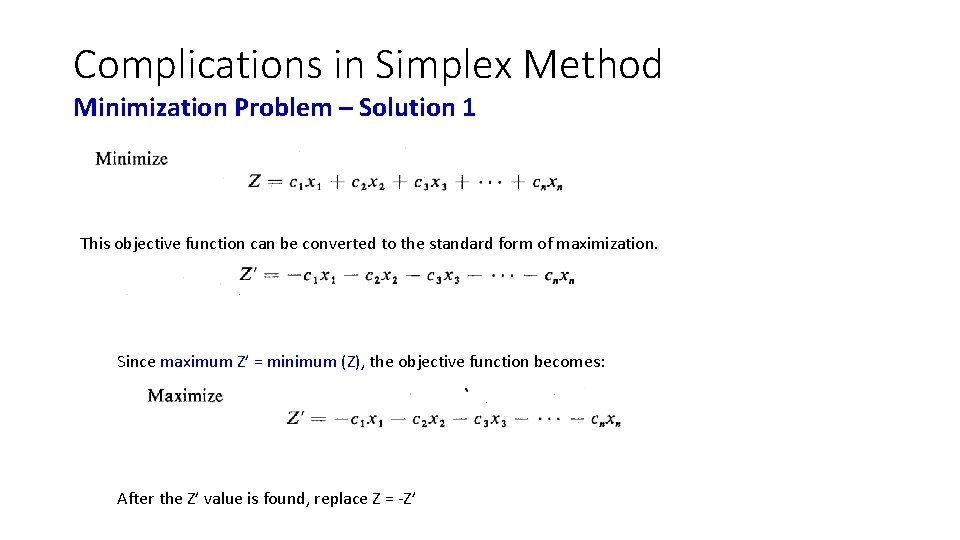
Complications in Simplex Method Minimization Problem – Solution 1 This objective function can be converted to the standard form of maximization. Let Z’ = -Z, so: Since maximum Z’ = minimum (Z), the objective function becomes: After the Z’ value is found, replace Z = -Z’
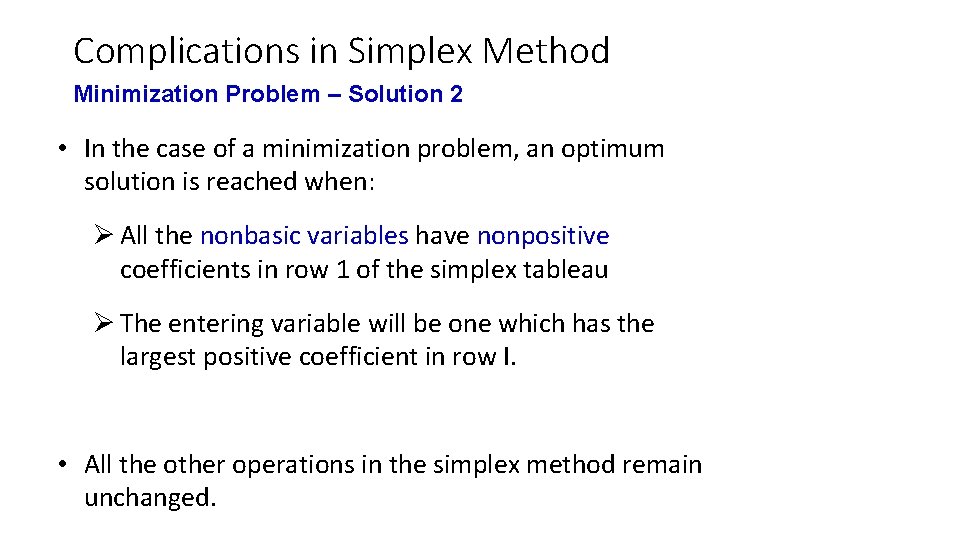
Complications in Simplex Method Minimization Problem – Solution 2 • In the case of a minimization problem, an optimum solution is reached when: Ø All the nonbasic variables have nonpositive coefficients in row 1 of the simplex tableau Ø The entering variable will be one which has the largest positive coefficient in row I. • All the other operations in the simplex method remain unchanged.
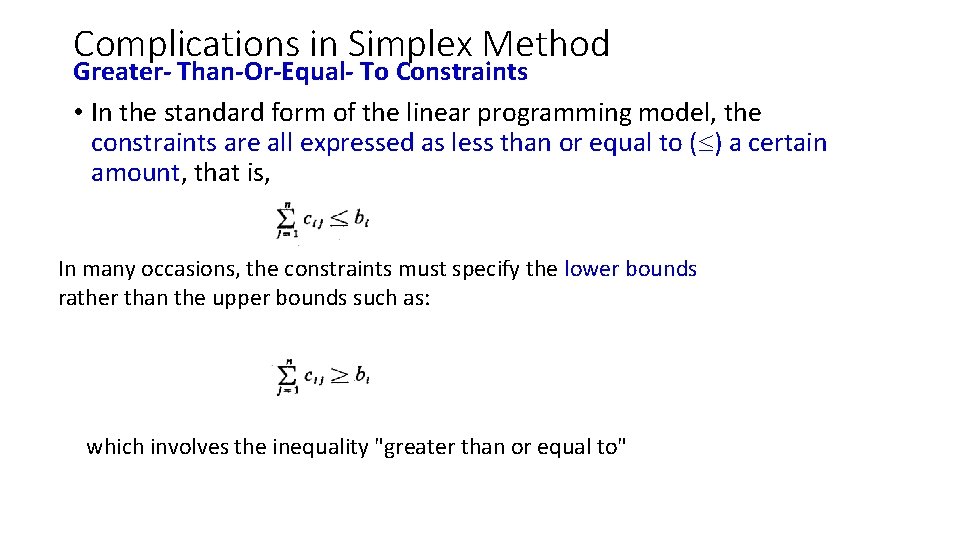
Complications in Simplex Method Greater- Than-Or-Equal- To Constraints • In the standard form of the linear programming model, the constraints are all expressed as less than or equal to ( ) a certain amount, that is, In many occasions, the constraints must specify the lower bounds rather than the upper bounds such as: which involves the inequality "greater than or equal to"
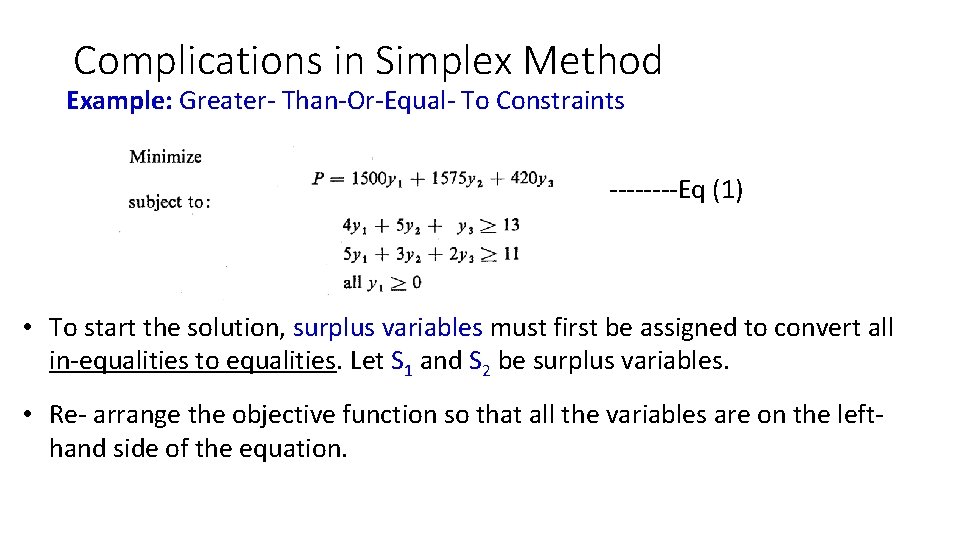
Complications in Simplex Method Example: Greater- Than-Or-Equal- To Constraints ----Eq (1) • To start the solution, surplus variables must first be assigned to convert all in-equalities to equalities. Let S 1 and S 2 be surplus variables. • Re- arrange the objective function so that all the variables are on the lefthand side of the equation.
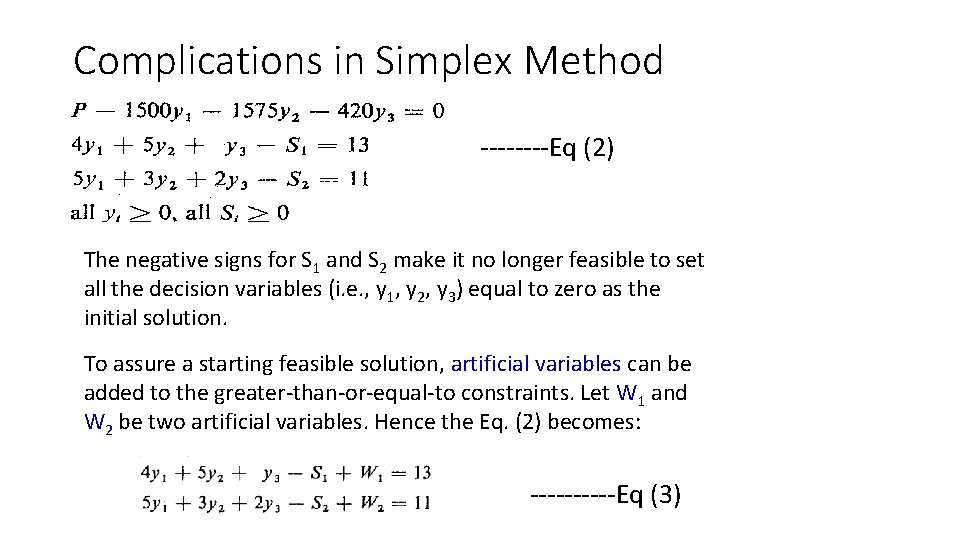
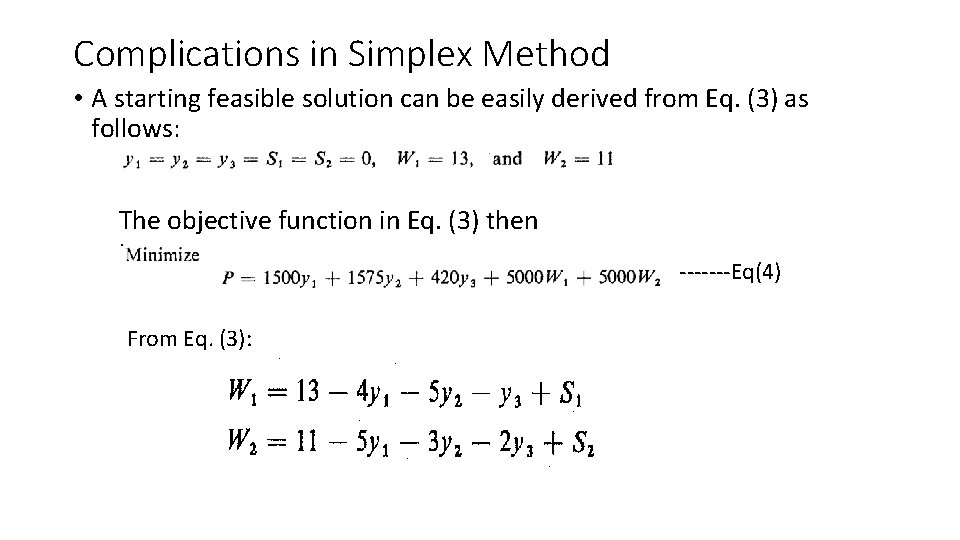
Complications in Simplex Method ----Eq (2) The negative signs for S 1 and S 2 make it no longer feasible to set all the decision variables (i. e. , y 1, y 2, y 3) equal to zero as the initial solution. To assure a starting feasible solution, artificial variables can be added to the greater-than-or-equal-to constraints. Let W 1 and W 2 be two artificial variables. Hence the Eq. (2) becomes: -----Eq (3)
Complications in Simplex Method • A starting feasible solution can be easily derived from Eq. (3) as follows: The objective function in Eq. (3) then becomes: From Eq. (3): -------Eq(4)
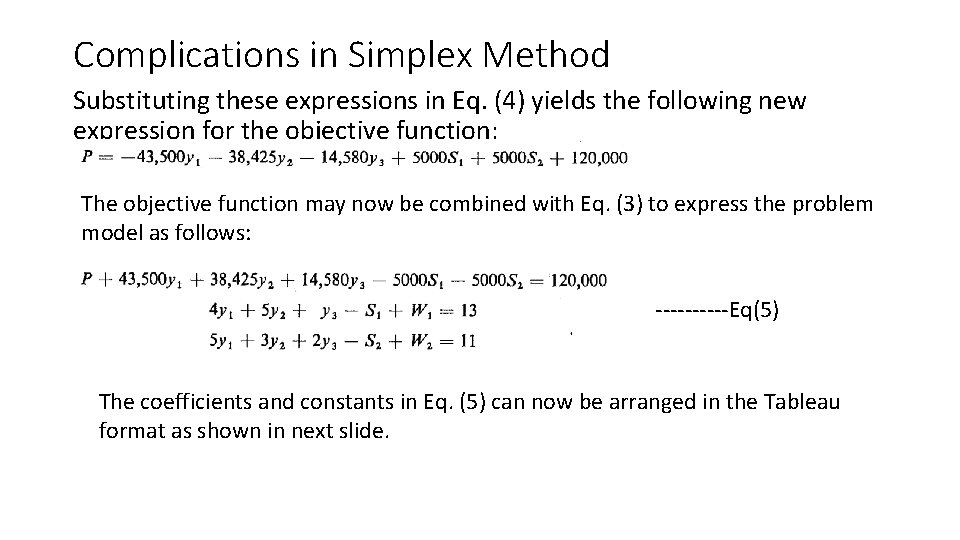
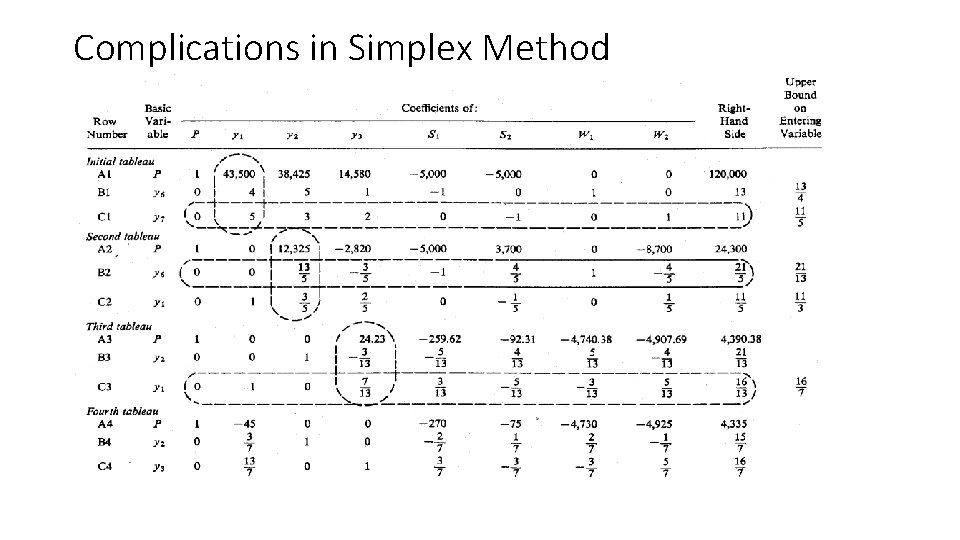
Complications in Simplex Method Substituting these expressions in Eq. (4) yields the following new expression for the objective function: The objective function may now be combined with Eq. (3) to express the problem model as follows: -----Eq(5) The coefficients and constants in Eq. (5) can now be arranged in the Tableau format as shown in next slide.
Complications in Simplex Method
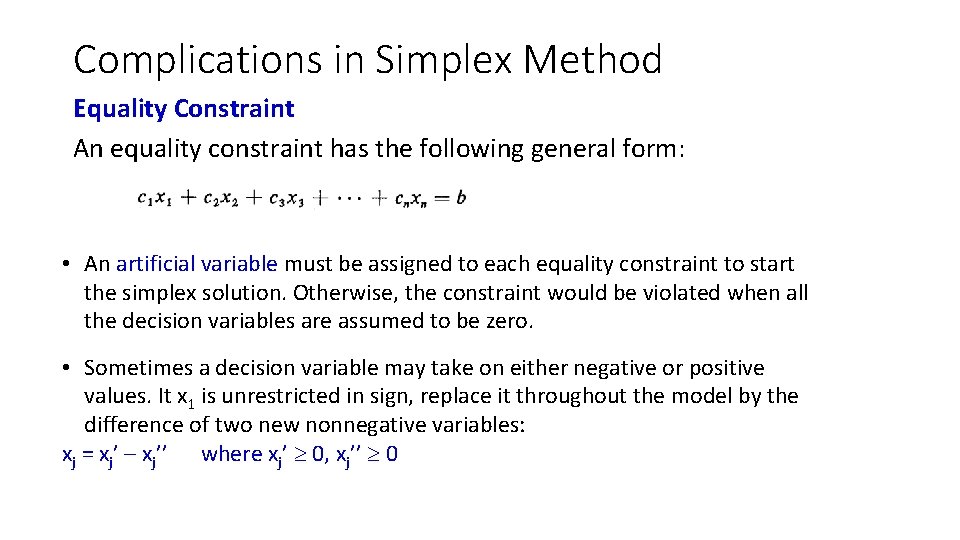
Complications in Simplex Method Equality Constraint An equality constraint has the following general form: • An artificial variable must be assigned to each equality constraint to start the simplex solution. Otherwise, the constraint would be violated when all the decision variables are assumed to be zero. • Sometimes a decision variable may take on either negative or positive values. It x 1 is unrestricted in sign, replace it throughout the model by the difference of two new nonnegative variables: xj = xj’ – xj’’ where xj’ 0, xj’’ 0
Complications in Simplex Method Equality Constraint Because xj’ and xj’’ can have any nonnegative values their difference (xj’ –xj’’) can have any value (positive or negative). After substitution, the simplex method can proceed with just nonnegative variables.
Complications in Simplex Method Degenerate Solution • If the number of basic variables is fewer than the number of constraints in a solution, the solution is said to be degenerate. • A zero constant term for one or more basic variables in any iteration of the simplex solution would be a clear indication of a degenerate solution.
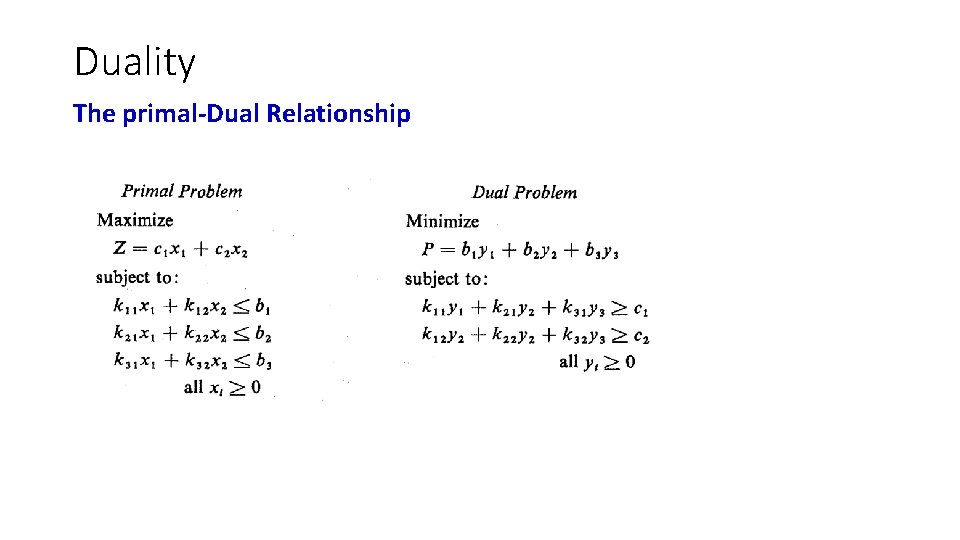
Duality With every linear programming problem, there is associated another linear programming problem which is called the dual of the original (or the primal) problem. Formulating the Dual problem • Consider again the production mix problem of N. Dustrious Company. • Suppose that the company is considering leasing out the entire production facility to another company, and it must decide on the minimum daily rental price that will be acceptable. • This decision problem can also be formulated as a linear programming problem.
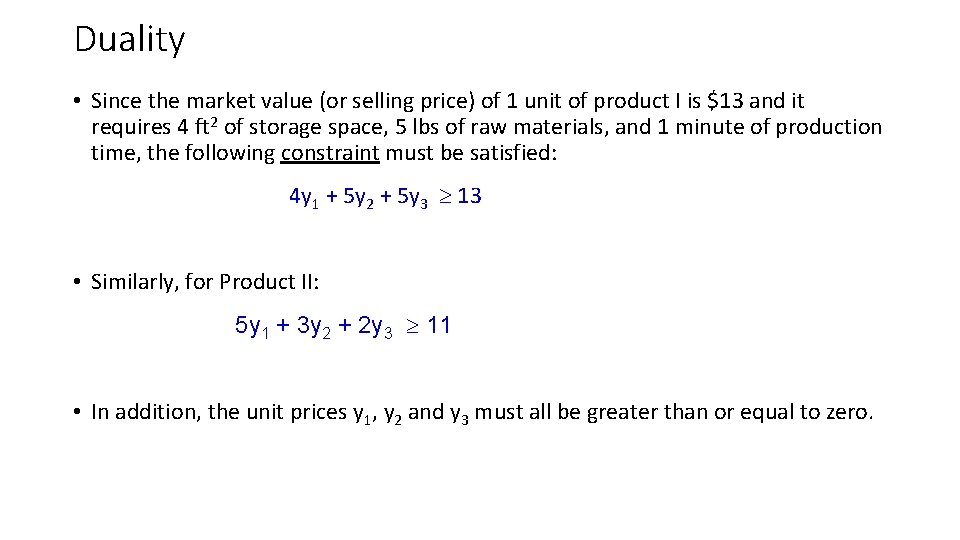
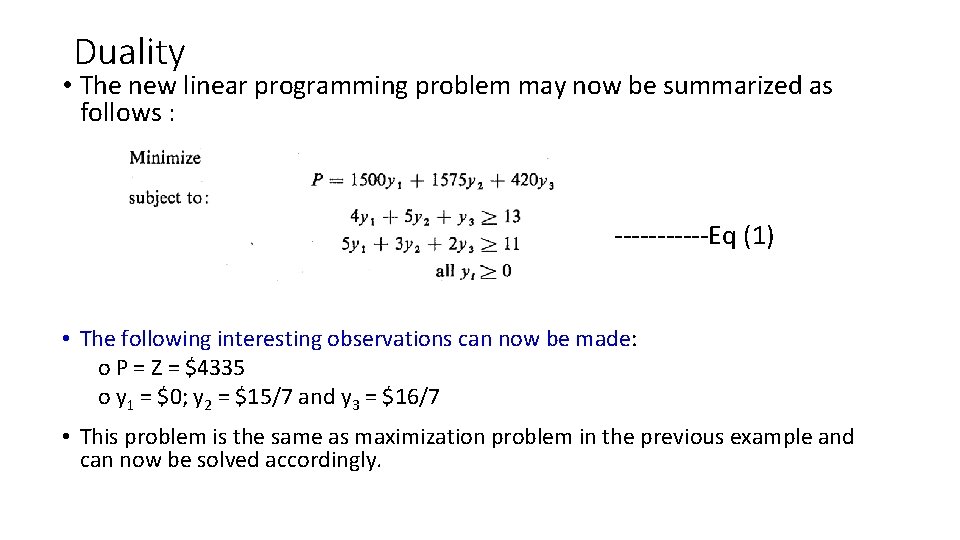
Duality • Let y 1, y 2 and y 3 represent the unit price of each unit of storage space, raw materials, and production time, respectively. • The unit prices are in fact the income values of each unit of resource to the N. Dustrious Company. • There available 500 ft 2 of storage space, 1575 lb of raw materials, and 420 minutes of production time per day. • Thus the total income value (P) of all the available resources may be expressed as follows : P = 1500 y 1 + 1575 y 2 + 420 y 3 • The objective of the problem is to minimize P subject to the condition that the N. Dustrious Company will earn at least as much income as when it operates the production facility itself.
Duality • Since the market value (or selling price) of 1 unit of product I is $13 and it requires 4 ft 2 of storage space, 5 lbs of raw materials, and 1 minute of production time, the following constraint must be satisfied: 4 y 1 + 5 y 2 + 5 y 3 13 • Similarly, for Product II: 5 y 1 + 3 y 2 + 2 y 3 11 • In addition, the unit prices y 1, y 2 and y 3 must all be greater than or equal to zero.
Duality • The new linear programming problem may now be summarized as follows : ------Eq (1) • The following interesting observations can now be made: o P = Z = $4335 o y 1 = $0; y 2 = $15/7 and y 3 = $16/7 • This problem is the same as maximization problem in the previous example and can now be solved accordingly.
Duality The primal-Dual Relationship
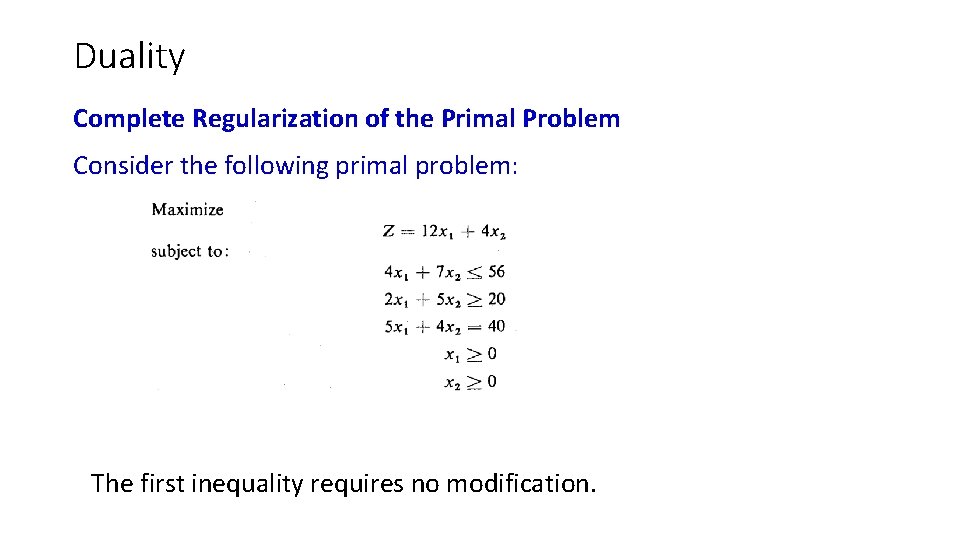
Duality Complete Regularization of the Primal Problem Consider the following primal problem: The first inequality requires no modification.
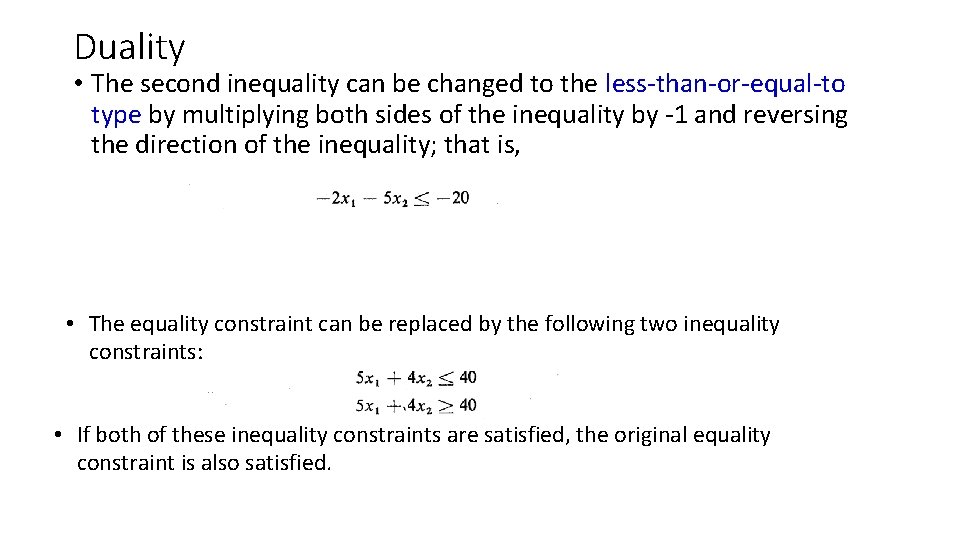
Duality • The second inequality can be changed to the less-than-or-equal-to type by multiplying both sides of the inequality by -1 and reversing the direction of the inequality; that is, • The equality constraint can be replaced by the following two inequality constraints: • If both of these inequality constraints are satisfied, the original equality constraint is also satisfied.
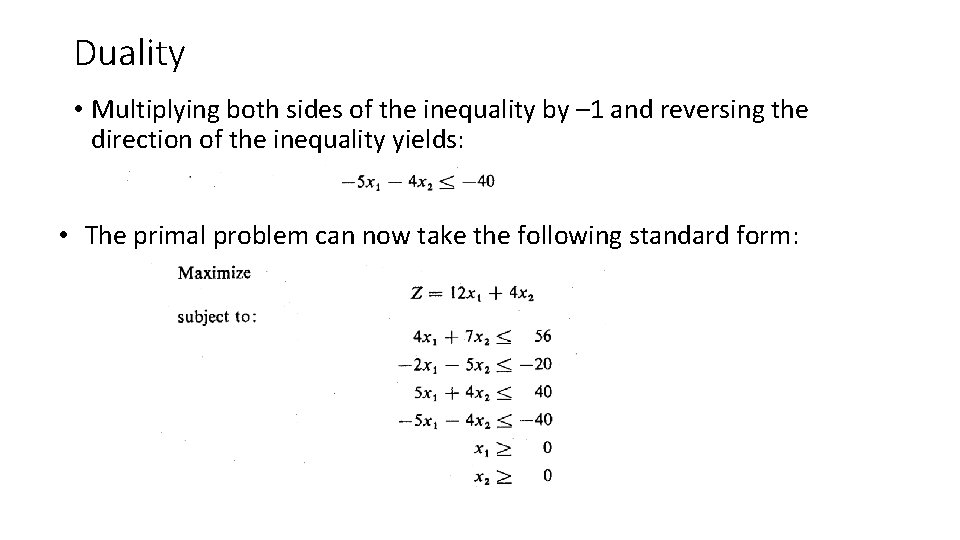
Duality • Multiplying both sides of the inequality by – 1 and reversing the direction of the inequality yields: • The primal problem can now take the following standard form:
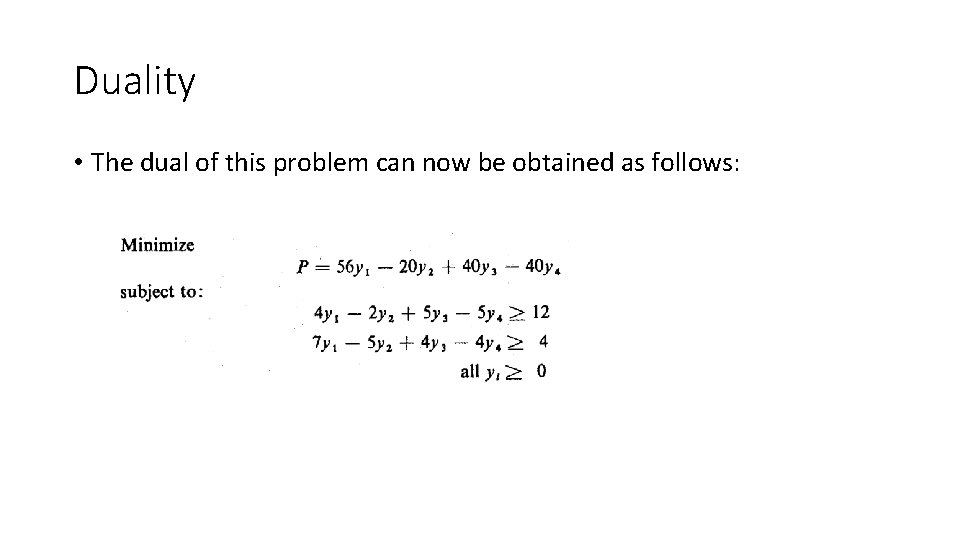
Duality • The dual of this problem can now be obtained as follows:
Questions? THANK YOU