
Linear Programming 2 Starter Linear Programming Last lesson

- Slides: 13
Linear Programming (2)
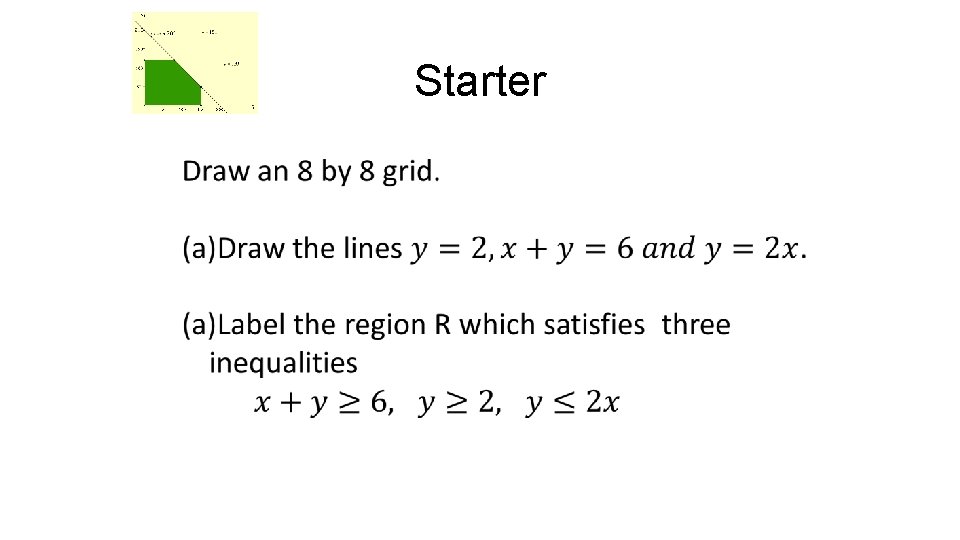
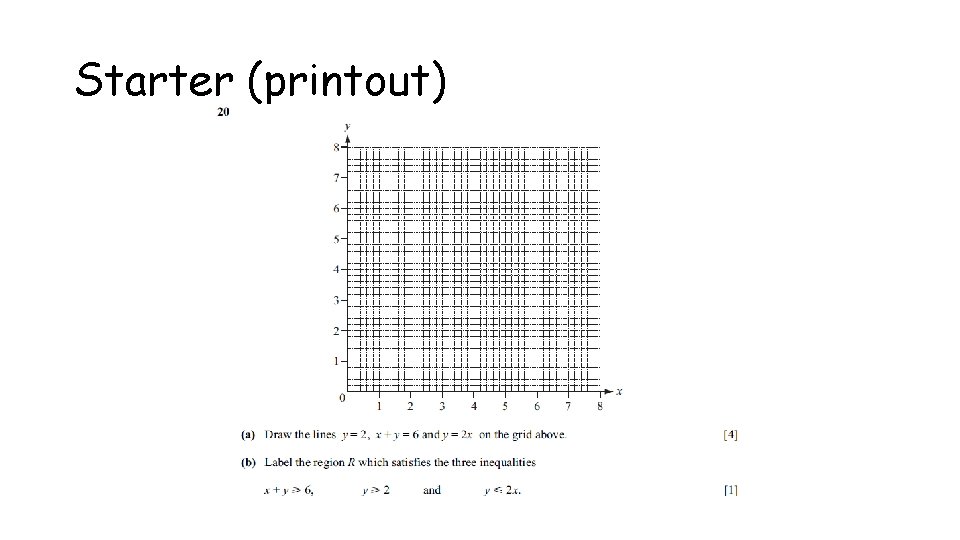
Starter
Linear Programming • Last lesson you saw how we can use Linear Programming to help decision making processes • Today we will extend this a little further and use it to find the optimal solution to a problem • The key extra part here is to decide which area in the wanted region is the best!
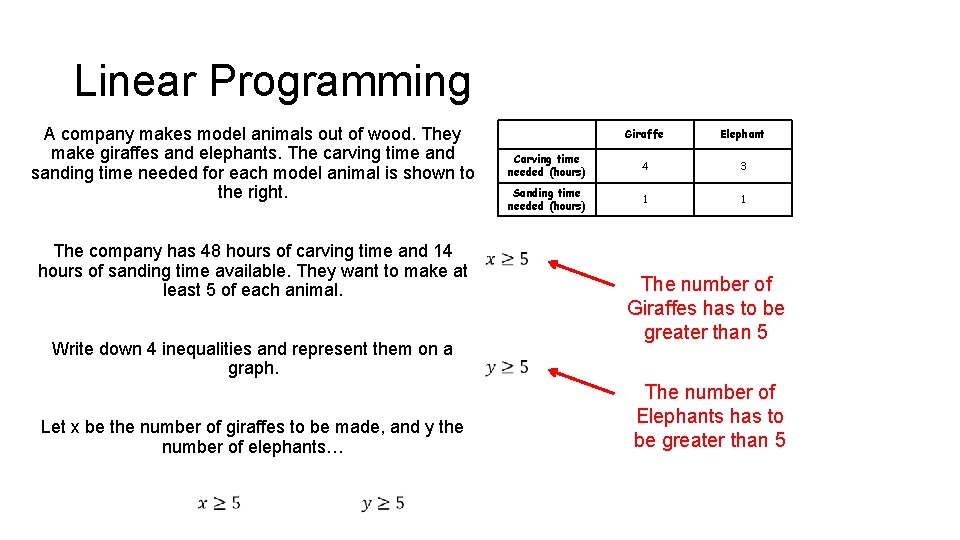
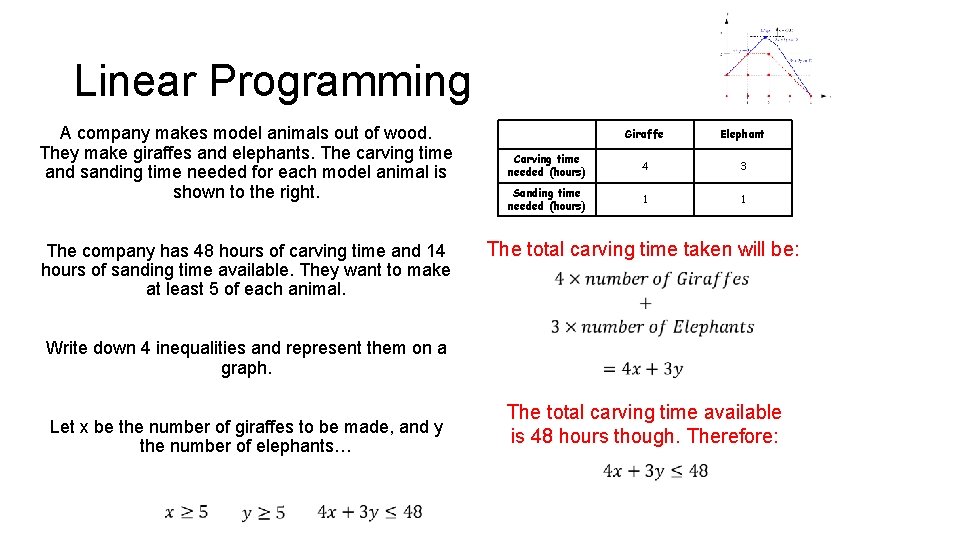
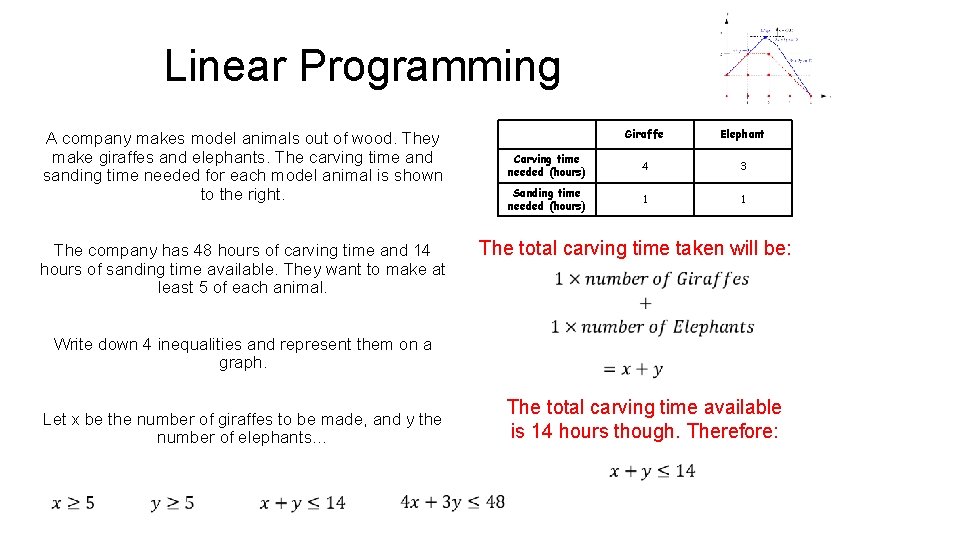
Linear Programming A company makes model animals out of wood. They make giraffes and elephants. The carving time and sanding time needed for each model animal is shown to the right. The company has 48 hours of carving time and 14 hours of sanding time available. They want to make at least 5 of each animal. Write down 4 inequalities and represent them on a graph. Let x be the number of giraffes to be made, and y the number of elephants… Giraffe Elephant Carving time needed (hours) 4 3 Sanding time needed (hours) 1 1 The number of Giraffes has to be greater than 5 The number of Elephants has to be greater than 5
Linear Programming A company makes model animals out of wood. They make giraffes and elephants. The carving time and sanding time needed for each model animal is shown to the right. The company has 48 hours of carving time and 14 hours of sanding time available. They want to make at least 5 of each animal. Giraffe Elephant Carving time needed (hours) 4 3 Sanding time needed (hours) 1 1 The total carving time taken will be: Write down 4 inequalities and represent them on a graph. Let x be the number of giraffes to be made, and y the number of elephants… The total carving time available is 48 hours though. Therefore:
Linear Programming A company makes model animals out of wood. They make giraffes and elephants. The carving time and sanding time needed for each model animal is shown to the right. The company has 48 hours of carving time and 14 hours of sanding time available. They want to make at least 5 of each animal. Giraffe Elephant Carving time needed (hours) 4 3 Sanding time needed (hours) 1 1 The total carving time taken will be: Write down 4 inequalities and represent them on a graph. Let x be the number of giraffes to be made, and y the number of elephants… The total carving time available is 14 hours though. Therefore:
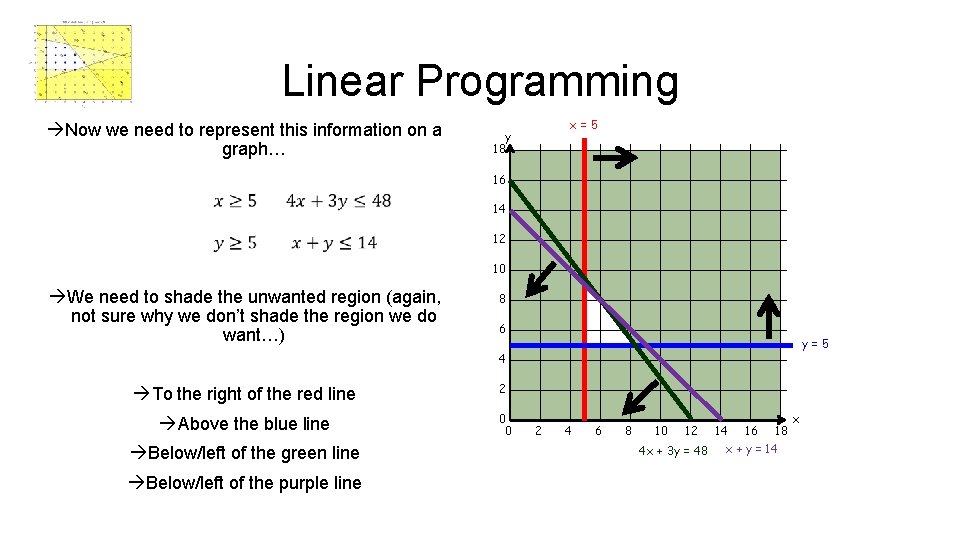
Linear Programming àNow we need to represent this information on a graph… x=5 y 18 16 14 12 10 àWe need to shade the unwanted region (again, not sure why we don’t shade the region we do want…) 8 6 y=5 4 àTo the right of the red line 2 àAbove the blue line 0 0 àBelow/left of the green line àBelow/left of the purple line 2 4 6 8 10 12 4 x + 3 y = 48 14 16 18 x + y = 14 x
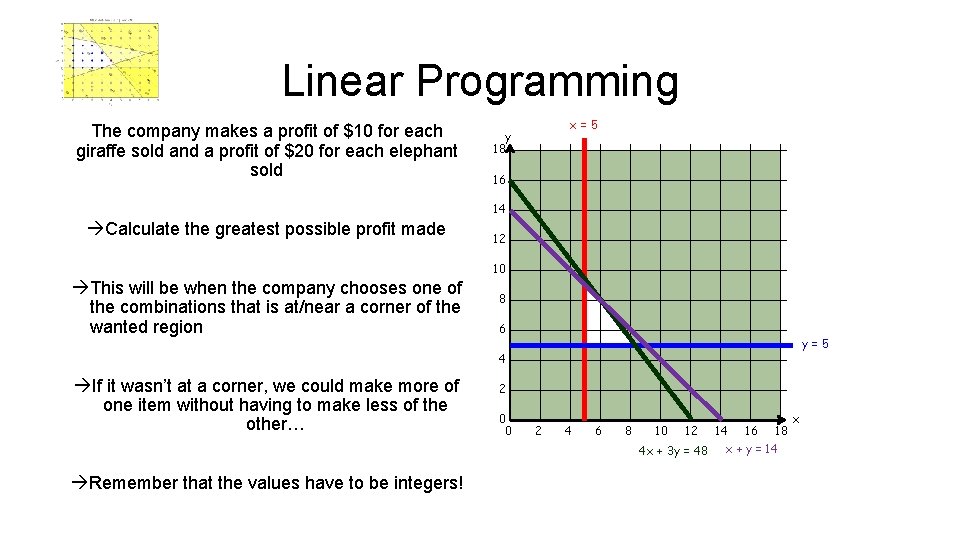
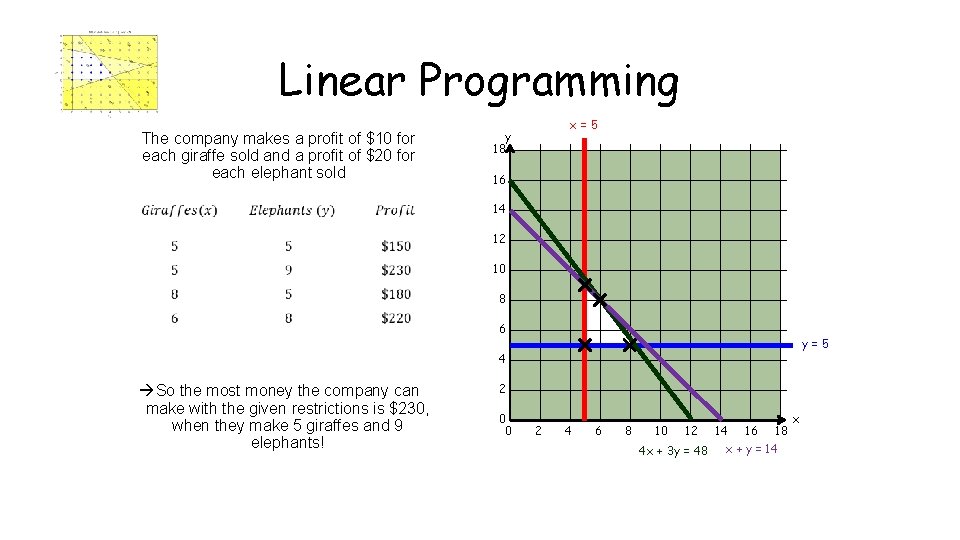
Linear Programming The company makes a profit of $10 for each giraffe sold and a profit of $20 for each elephant sold x=5 y 18 16 14 àCalculate the greatest possible profit made 12 10 àThis will be when the company chooses one of the combinations that is at/near a corner of the wanted region 8 6 y=5 4 àIf it wasn’t at a corner, we could make more of one item without having to make less of the other… 2 0 0 2 4 6 8 10 12 4 x + 3 y = 48 àRemember that the values have to be integers! 14 16 18 x + y = 14 x
Linear Programming The company makes a profit of $10 for each giraffe sold and a profit of $20 for each elephant sold x=5 y 18 16 14 12 10 8 6 y=5 4 à So the most money the company can make with the given restrictions is $230, when they make 5 giraffes and 9 elephants! 2 0 0 2 4 6 8 10 12 4 x + 3 y = 48 14 16 18 x + y = 14 x
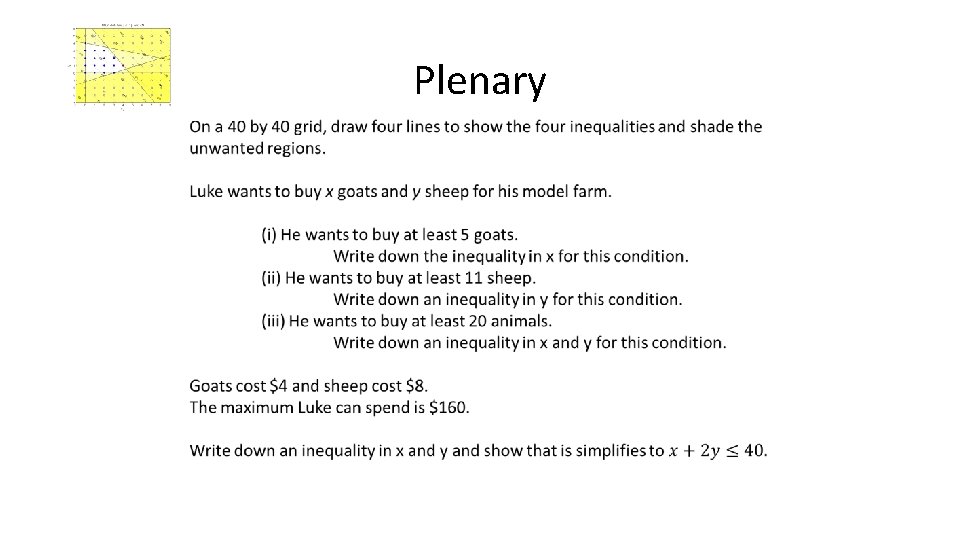
Plenary
Summary • We have continued learning about Linear Programming • We have seen how to make decisions involving optimisation
Starter (printout)
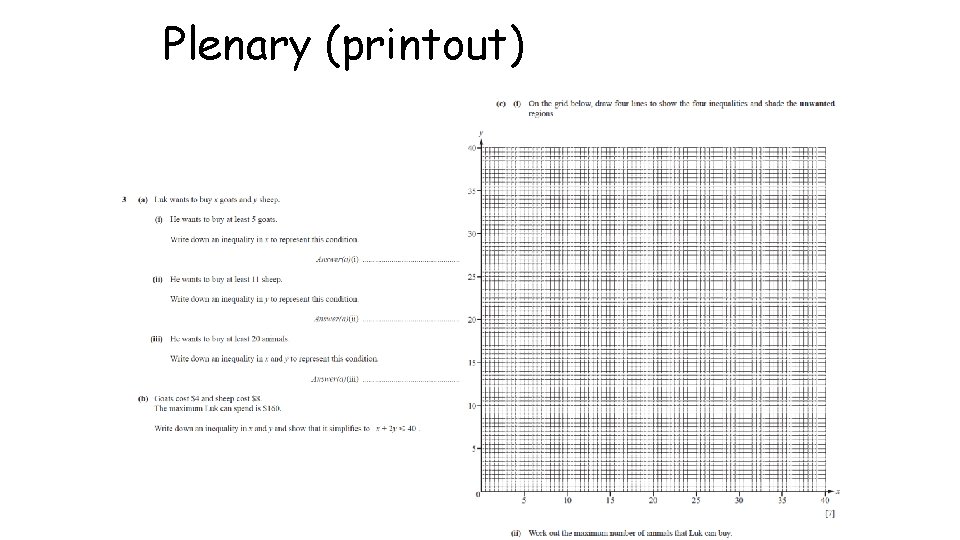
Plenary (printout)