
Linear Models and Effect Magnitudes for Research Clinical

- Slides: 37
Linear Models and Effect Magnitudes for Research, Clinical and Practical Applications Will G Hopkins Edited version of Sportscience 14, 4957, 2010 AUT University, Auckland, NZ (sportsci. org/2010/wghlinmod) · Importance of Effect Magnitudes r = 0. 57 · Getting Effects from Models Activity · Linear models; adjusting for covariates; interactions; polynomials post · Effects for a continuous dependent pre 100 · Difference between means; Age “slope”; correlation d Chanceslinear regression; c · General linear models: t tests; multiple selected b ANOVA… · Uniformity of error; log transformation; (%) within-subject a and strength mixed models 0 · Effects for a nominal or count dependent Fitness
Background: The Rise of Magnitude of Effects · Research is all about the effect of something on something else. · The somethings are variables, such as measures of physical activity, health, training, performance. · An effect is a relationship between the values of the variables, for example between physical activity and health. • We think of an effect as causal: more active more healthy. • But it may be only an association: more active more healthy. · Effects provide us with evidence for changing our lives. · The magnitude of an effect is important. · In clinical or practical settings: could the effect be harmful, trivial or beneficial? Is the benefit likely to be
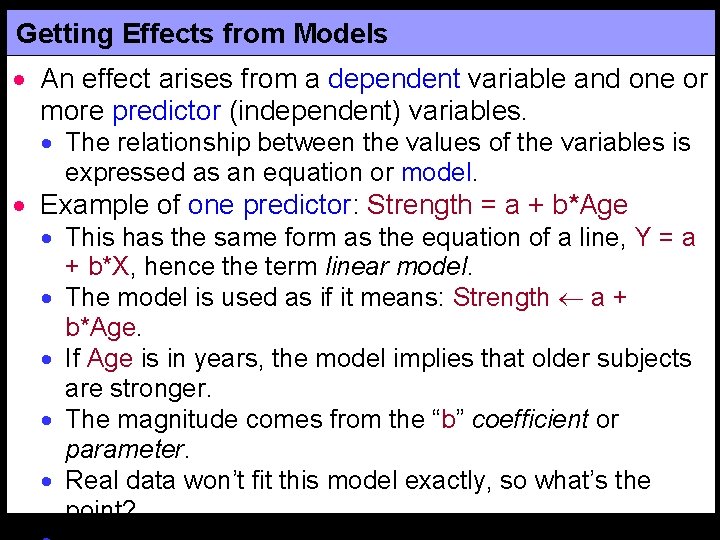
Getting Effects from Models · An effect arises from a dependent variable and one or more predictor (independent) variables. · The relationship between the values of the variables is expressed as an equation or model. · Example of one predictor: Strength = a + b*Age · This has the same form as the equation of a line, Y = a + b*X, hence the term linear model. · The model is used as if it means: Strength a + b*Age. · If Age is in years, the model implies that older subjects are stronger. · The magnitude comes from the “b” coefficient or parameter. · Real data won’t fit this model exactly, so what’s the point?
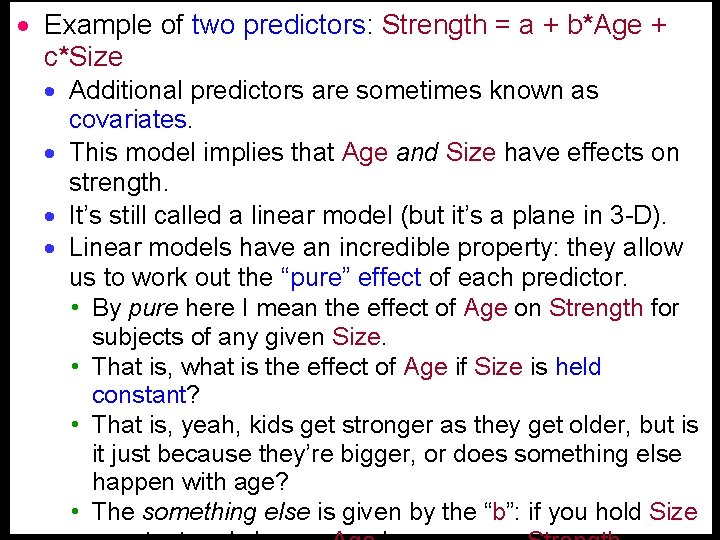
· Example of two predictors: Strength = a + b*Age + c*Size · Additional predictors are sometimes known as covariates. · This model implies that Age and Size have effects on strength. · It’s still called a linear model (but it’s a plane in 3 -D). · Linear models have an incredible property: they allow us to work out the “pure” effect of each predictor. • By pure here I mean the effect of Age on Strength for subjects of any given Size. • That is, what is the effect of Age if Size is held constant? • That is, yeah, kids get stronger as they get older, but is it just because they’re bigger, or does something else happen with age? • The something else is given by the “b”: if you hold Size
· With kids, inclusion of Size would reduce the effect of Age. • Kids of the same size who differ in age have similar strength. • To that extent, Size is a mechanism or mediator of Age. · But sometimes a covariate is a confounder rather than a mediator. • Example: Physical Activity (predictor) has a strong relationship with Health (dependent) in a sample of old folk. Age is a confounder of the relationship, because Age causes bad health and inactivity. • Again, including potential confounders as covariates produces the pure effect of a predictor. • Think carefully when interpreting the effect of including a covariate: is the covariate a mechanism or a confounder? · If you are concerned that the effect of Age might differ
· You still use this model to adjust the effect of Age for the effect of Size, but the adjusted effect changes with different values of Size. · Another example of an interaction: Strength = a + b*Age + c*Age 2 · By interacting Age with itself, you get a non-linear effect of Age, here a quadratic. · If c turns out to be negative, this model implies strength rises to a maximum, then comes down again for older subjects. · To model something falling to a minimum, c would be positive. · To model more complex curvature, add d*Age 3, e*Age 4… • These are cubics, quartics…, but it’s rare to go above a quadratic.
· Group, factor, classification or nominal variables as predictors: · We have been treating Age as a number of years, but we could instead use Age. Group, with several levels; e. g. , child, adult, elderly. · Stats packages turn each level into a dummy variable with values of 0 and 1, then treat each as a numeric variable. Example: • Strength = a + b*Age. Group is treated as Strength = a + b 1*Child + b 2*Adult + b 3*Elderly, where Child=1 for children and 0 otherwise, Adult=1 for adults and 0 otherwise, and Elderly=1 for old folk and 0 otherwise. • The model estimates the mean value of the dependent for each level of the predictor: mean strength of children = a + b 1. • And the difference in strength of adults and children is
· Linear models for controlled trials · For a study of strength training without a control group: Strength = a + b*Trial, where Trial has values pre, post or whatever. • b*Trial is really b 1*Pre + b 2*Post, with Pre=1 or 0 and Post=1 or 0. • The effect of training on mean strength is given by b 2 – b 1. · For a study with a control group: Strength = a + b*Group*Trial, where Group has values expt, cont. • b*Group*Trial is really b 1*Cont. Pre + b 2*Cont. Post + b 3*Expt. Pre + b 4*Expt. Post. • The changes in the groups are given by b 2 – b 1 and b 4 – b 3. • The net effect of training is given by (b 4 – b 3) – (b 2 – b 1).
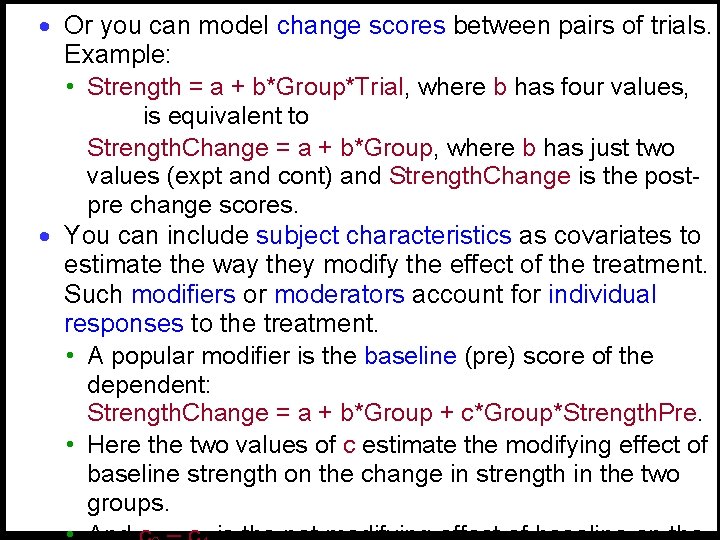
· Or you can model change scores between pairs of trials. Example: • Strength = a + b*Group*Trial, where b has four values, is equivalent to Strength. Change = a + b*Group, where b has just two values (expt and cont) and Strength. Change is the postpre change scores. · You can include subject characteristics as covariates to estimate the way they modify the effect of the treatment. Such modifiers or moderators account for individual responses to the treatment. • A popular modifier is the baseline (pre) score of the dependent: Strength. Change = a + b*Group + c*Group*Strength. Pre. • Here the two values of c estimate the modifying effect of baseline strength on the change in strength in the two groups.
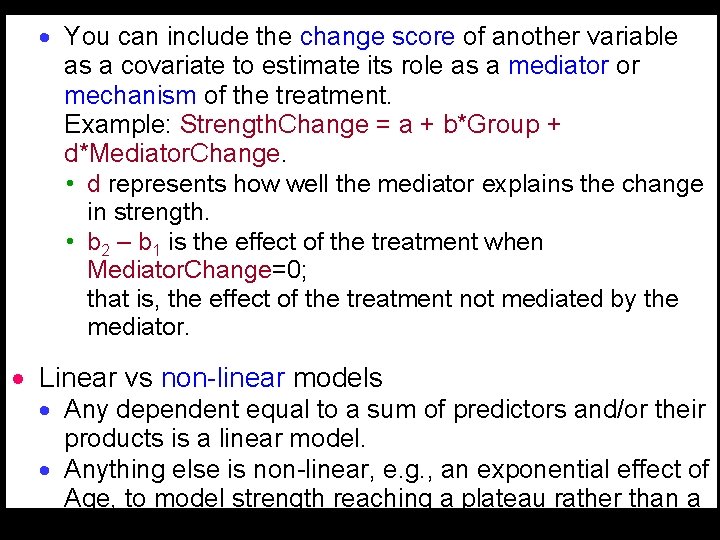
· You can include the change score of another variable as a covariate to estimate its role as a mediator or mechanism of the treatment. Example: Strength. Change = a + b*Group + d*Mediator. Change. • d represents how well the mediator explains the change in strength. • b 2 – b 1 is the effect of the treatment when Mediator. Change=0; that is, the effect of the treatment not mediated by the mediator. · Linear vs non-linear models · Any dependent equal to a sum of predictors and/or their products is a linear model. · Anything else is non-linear, e. g. , an exponential effect of Age, to model strength reaching a plateau rather than a maximum.
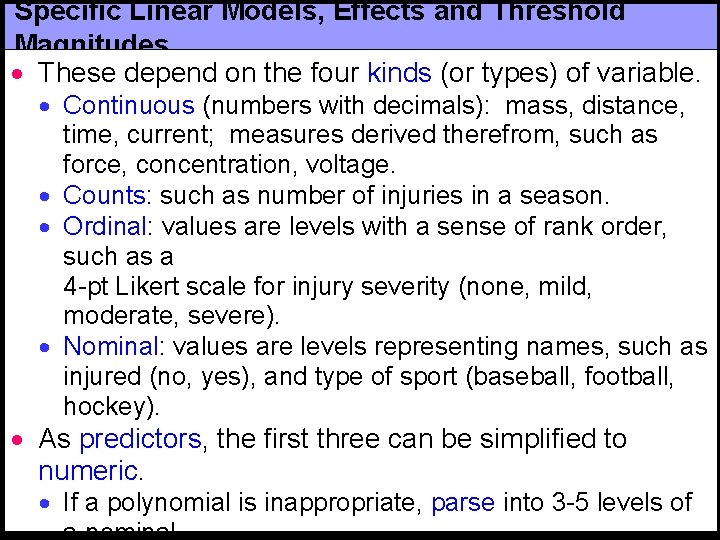
Specific Linear Models, Effects and Threshold Magnitudes · These depend on the four kinds (or types) of variable. · Continuous (numbers with decimals): mass, distance, time, current; measures derived therefrom, such as force, concentration, voltage. · Counts: such as number of injuries in a season. · Ordinal: values are levels with a sense of rank order, such as a 4 -pt Likert scale for injury severity (none, mild, moderate, severe). · Nominal: values are levels representing names, such as injured (no, yes), and type of sport (baseball, football, hockey). · As predictors, the first three can be simplified to numeric. · If a polynomial is inappropriate, parse into 3 -5 levels of
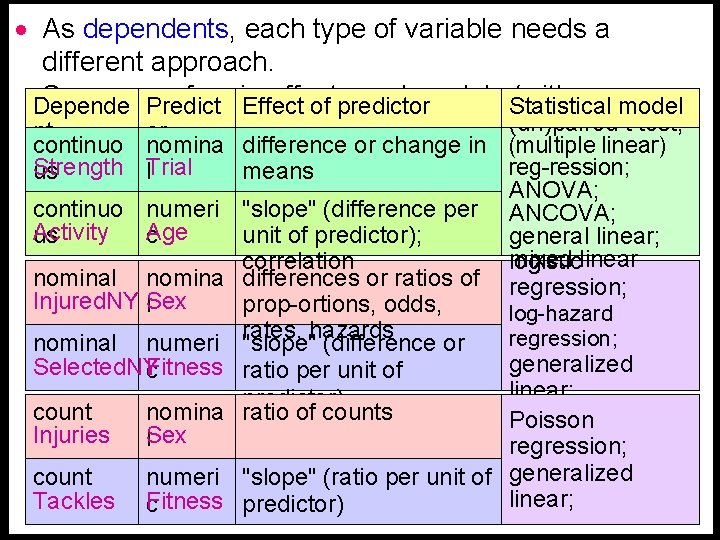
· As dependents, each type of variable needs a different approach. Summary of main effects and models Statistical (with Depende Predict Effect of predictor model (un)paired t test; ntexamples): or continuo nomina difference or change in (multiple linear) Strength Trial reg-ression; us l means ANOVA; continuo numeri "slope" (difference per ANCOVA; Activity Age us c unit of predictor); general linear; mixed correlation logisticlinear nominal nomina differences or ratios of regression; Injured. NY Sex l prop-ortions, odds, log-hazard rates, hazards regression; nominal numeri "slope" (difference or generalized Selected. NY Fitness c ratio per unit of linear; predictor) count nomina ratio of counts Poisson Injuries Sex l regression; count numeri "slope" (ratio per unit of generalized linear; Tackles Fitness c predictor)
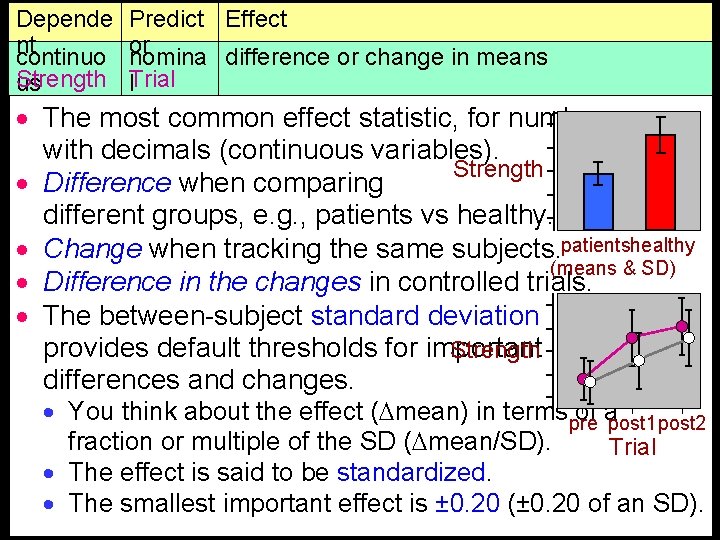
Depende nt continuo Strength us Predict Effect or nomina difference or change in means Trial l · The most common effect statistic, for numbers with decimals (continuous variables). Strength · Difference when comparing different groups, e. g. , patients vs healthy. · Change when tracking the same subjects. patientshealthy (means & SD) · Difference in the changes in controlled trials. · The between-subject standard deviation provides default thresholds for important Strength differences and changes. · You think about the effect ( mean) in termspre of apost 1 post 2 fraction or multiple of the SD ( mean/SD). Trial · The effect is said to be standardized. · The smallest important effect is ± 0. 20 (± 0. 20 of an SD).
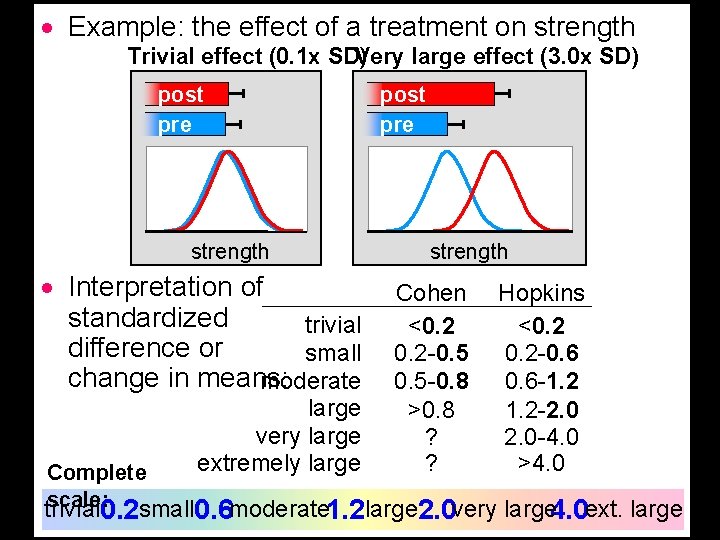
· Example: the effect of a treatment on strength Trivial effect (0. 1 x SD) Very large effect (3. 0 x SD) post pre strength · Interpretation of standardized trivial difference or small change in means: moderate Complete scale: small trivial 0. 2 large very large extremely large post pre strength Cohen <0. 2 -0. 5 -0. 8 >0. 8 ? ? Hopkins <0. 2 -0. 6 -1. 2 -2. 0 -4. 0 >4. 0 0. 6 moderate 1. 2 large 2. 0 very large 4. 0 ext. large
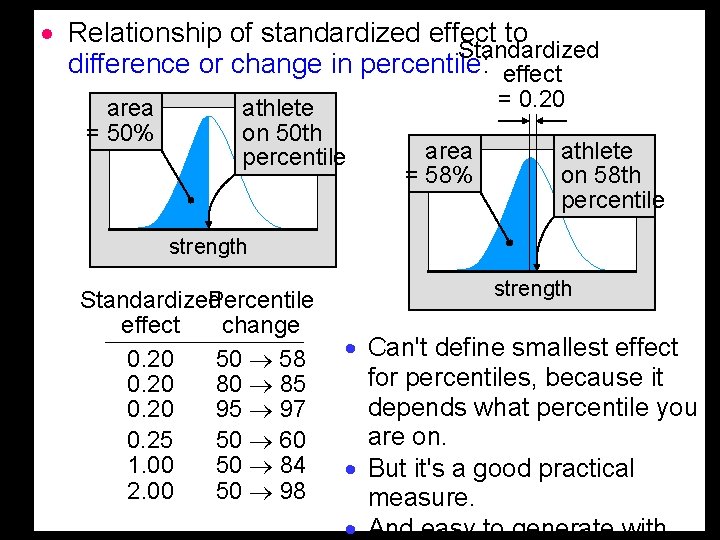
· Relationship of standardized effect to Standardized difference or change in percentile: effect area = 50% athlete on 50 th percentile = 0. 20 area = 58% athlete on 58 th percentile strength Standardized Percentile effect change 0. 20 50 58 0. 20 80 85 0. 20 95 97 0. 25 50 60 1. 00 50 84 2. 00 50 98 strength · Can't define smallest effect for percentiles, because it depends what percentile you are on. · But it's a good practical measure. · And easy to generate with
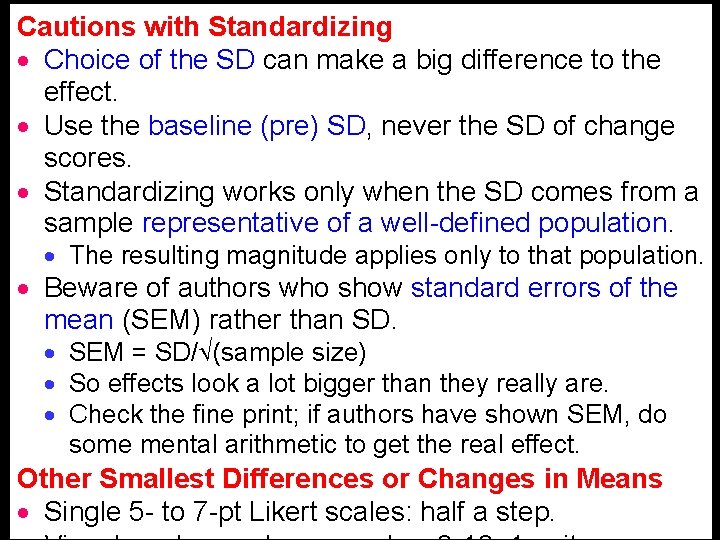
Cautions with Standardizing · Choice of the SD can make a big difference to the effect. · Use the baseline (pre) SD, never the SD of change scores. · Standardizing works only when the SD comes from a sample representative of a well-defined population. · The resulting magnitude applies only to that population. · Beware of authors who show standard errors of the mean (SEM) rather than SD. · SEM = SD/ (sample size) · So effects look a lot bigger than they really are. · Check the fine print; if authors have shown SEM, do some mental arithmetic to get the real effect. Other Smallest Differences or Changes in Means · Single 5 - to 7 -pt Likert scales: half a step.
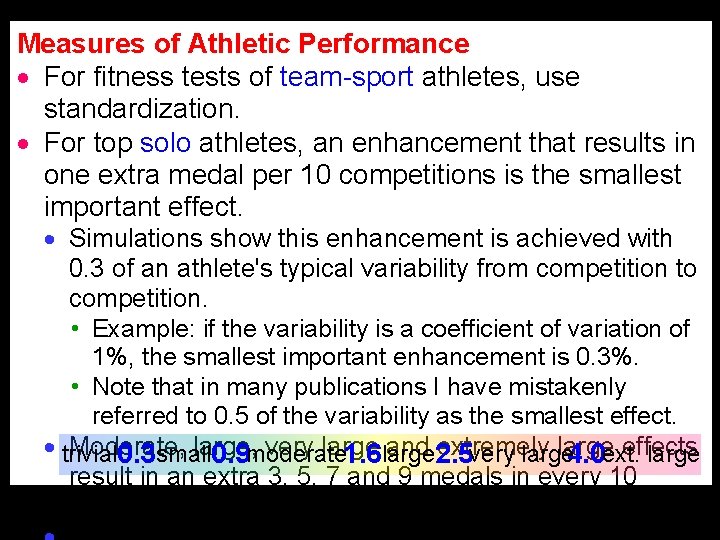
Measures of Athletic Performance · For fitness tests of team-sport athletes, use standardization. · For top solo athletes, an enhancement that results in one extra medal per 10 competitions is the smallest important effect. · Simulations show this enhancement is achieved with 0. 3 of an athlete's typical variability from competition to competition. • Example: if the variability is a coefficient of variation of 1%, the smallest important enhancement is 0. 3%. • Note that in many publications I have mistakenly referred to 0. 5 of the variability as the smallest effect. · trivial Moderate, large, very large and 2. 5 extremely large effects very large 0. 3 small 0. 9 moderate 1. 6 large 4. 0 ext. result in an extra 3, 5, 7 and 9 medals in every 10 competitions.
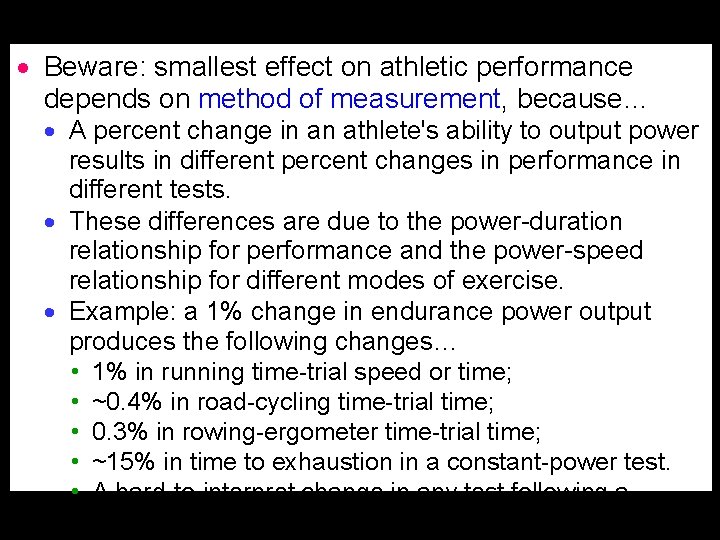
· Beware: smallest effect on athletic performance depends on method of measurement, because… · A percent change in an athlete's ability to output power results in different percent changes in performance in different tests. · These differences are due to the power-duration relationship for performance and the power-speed relationship for different modes of exercise. · Example: a 1% change in endurance power output produces the following changes… • 1% in running time-trial speed or time; • ~0. 4% in road-cycling time-trial time; • 0. 3% in rowing-ergometer time-trial time; • ~15% in time to exhaustion in a constant-power test. • A hard-to-interpret change in any test following a fatiguing pre-load.
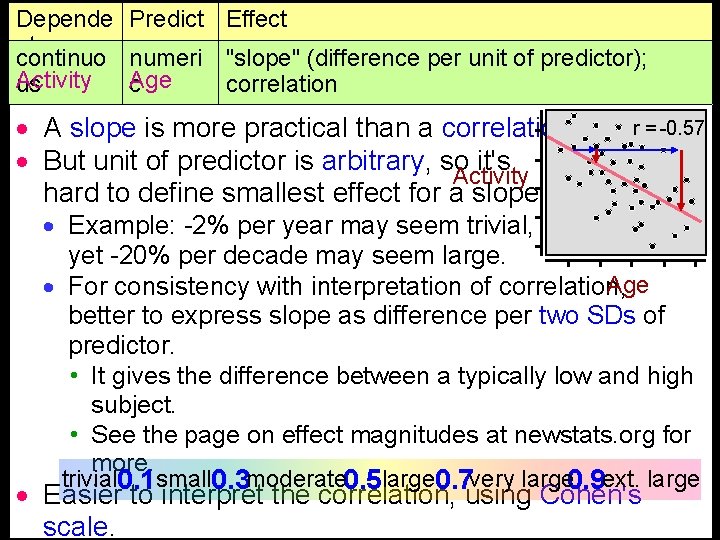
Depende nt continuo Activity us Predict Effect or numeri "slope" (difference per unit of predictor); Age c correlation · A slope is more practical than a correlation. · But unit of predictor is arbitrary, so it's Activity hard to define smallest effect for a slope. r = -0. 57 · Example: -2% per year may seem trivial, yet -20% per decade may seem large. Age · For consistency with interpretation of correlation, better to express slope as difference per two SDs of predictor. • It gives the difference between a typically low and high subject. • See the page on effect magnitudes at newstats. org for more. trivial 0. 1 small 0. 3 moderate 0. 5 large 0. 7 very large 0. 9 ext. large · Easier to interpret the correlation, using Cohen's scale.
· The effect of a nominal predictor can also be expressed as a correlation = √(fraction of “variance explained”). · A 2 -level predictor scored as 0 and 1 gives the same correlation. • With equal number of subjects in each group, the scales for correlation and standardized difference match up. · For >2 levels, the correlation can’t be applied to individuals. Avoid. · Correlations when controlling for something… · Interpreting slopes and differences in means is no great problem when you have other predictors in the model. • Be careful about which SD you use to standardize. · But correlations are a challenge. · The correlation is either partial or semi-partial (SPSS: "part"). · Partial = effect of the predictor within a virtual subgroup
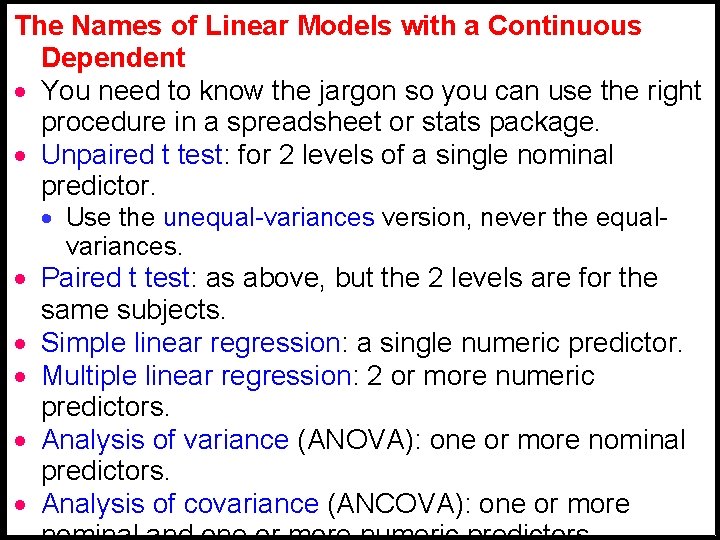
The Names of Linear Models with a Continuous Dependent · You need to know the jargon so you can use the right procedure in a spreadsheet or stats package. · Unpaired t test: for 2 levels of a single nominal predictor. · Use the unequal-variances version, never the equalvariances. · Paired t test: as above, but the 2 levels are for the same subjects. · Simple linear regression: a single numeric predictor. · Multiple linear regression: 2 or more numeric predictors. · Analysis of variance (ANOVA): one or more nominal predictors. · Analysis of covariance (ANCOVA): one or more
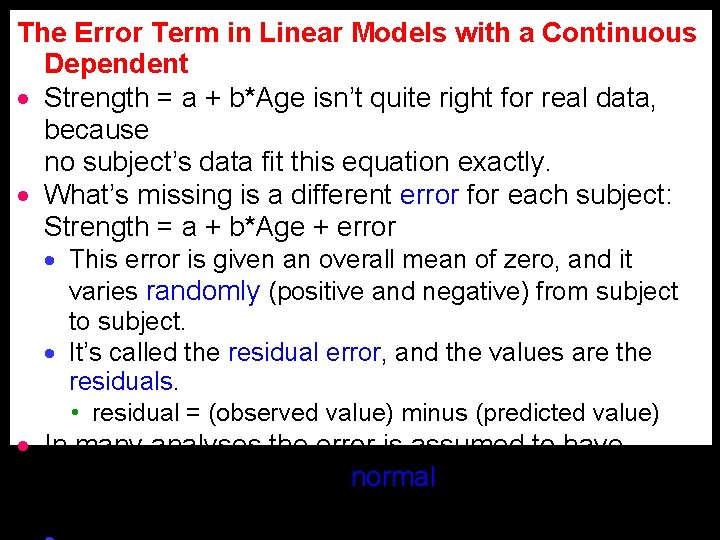
The Error Term in Linear Models with a Continuous Dependent · Strength = a + b*Age isn’t quite right for real data, because no subject’s data fit this equation exactly. · What’s missing is a different error for each subject: Strength = a + b*Age + error · This error is given an overall mean of zero, and it varies randomly (positive and negative) from subject to subject. · It’s called the residual error, and the values are the residuals. • residual = (observed value) minus (predicted value) · In many analyses the error is assumed to have values that come from a normal (bell-shaped) distribution.
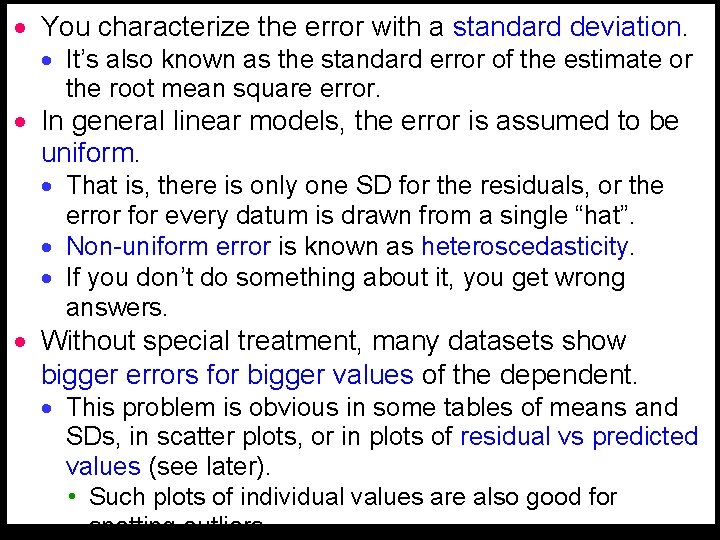
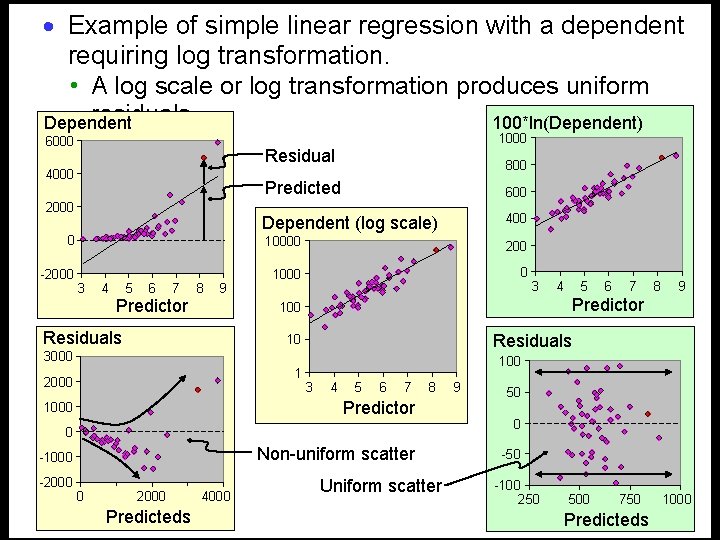
· You characterize the error with a standard deviation. · It’s also known as the standard error of the estimate or the root mean square error. · In general linear models, the error is assumed to be uniform. · That is, there is only one SD for the residuals, or the error for every datum is drawn from a single “hat”. · Non-uniform error is known as heteroscedasticity. · If you don’t do something about it, you get wrong answers. · Without special treatment, many datasets show bigger errors for bigger values of the dependent. · This problem is obvious in some tables of means and SDs, in scatter plots, or in plots of residual vs predicted values (see later). • Such plots of individual values are also good for spotting outliers.
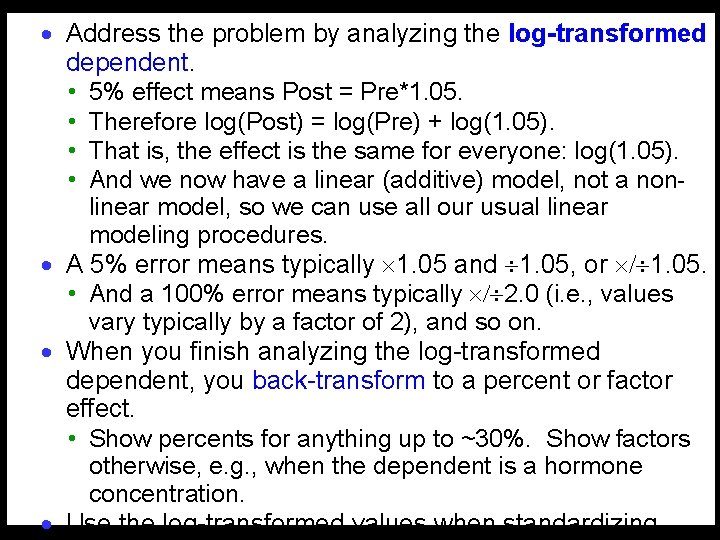
· Address the problem by analyzing the log-transformed dependent. • 5% effect means Post = Pre*1. 05. • Therefore log(Post) = log(Pre) + log(1. 05). • That is, the effect is the same for everyone: log(1. 05). • And we now have a linear (additive) model, not a non- linear model, so we can use all our usual linear modeling procedures. · A 5% error means typically 1. 05 and 1. 05, or 1. 05. • And a 100% error means typically 2. 0 (i. e. , values vary typically by a factor of 2), and so on. · When you finish analyzing the log-transformed dependent, you back-transform to a percent or factor effect. • Show percents for anything up to ~30%. Show factors otherwise, e. g. , when the dependent is a hormone concentration. · Use the log-transformed values when standardizing.
· Example of simple linear regression with a dependent requiring log transformation. • A log scale or log transformation produces uniform residuals. Dependent 100*ln(Dependent) 6000 1000 Residual 4000 800 Predicted 600 Dependent (log scale) 400 0 10000 200 -2000 1000 0 2000 3 4 5 6 7 8 9 Predictor 3000 2000 3 4 5 6 7 8 0 Non-uniform scatter -1000 0 2000 Predicteds 4000 6 7 8 9 100 Predictor 1000 5 Residuals 10 1 4 Predictor 100 Residuals -2000 3 Uniform scatter 9 50 0 -50 -100 250 500 750 Predicteds 1000
· Rank transformation is another way to deal with nonuniformity. · You sort all the values of the dependent variable, then rank them (i. e. , number them 1, 2, 3, …). · You then use this rank in all further analyses. · The resulting analyses are sometimes called nonparametric. • But it’s still linear modeling, so it’s really parametric. • They have names like Wilcoxon and Kruskal-Wallis. • Some are truly non-parametric: the sign test; neural-net modeling. · Some researchers think you have to use this approach when “the data are not normally distributed”. · In fact, the rank-transformed dependent is anything but normally distributed: it has a uniform (flat) distribution!!! · So it’s really an approach to try to get uniformity of effects and error.
· Non-uniformity also arises with different groups and time points. · Example: a simple comparison of means of males and females, with different SD for males and females (even after log transformation). • Hence the unequal-variances t statistic or test. • To include covariates here, you can’t use the general linear model: you have to keep the groups separate, as in my spreadsheets. · Example: a controlled trial, with different errors at different time points arising from individual responses and changes with time. • MANOVA and repeated-measures ANOVA can give wrong answers. • Address by reducing or combining repeated measurements into a single change score for each
· Mixed modeling is the cutting-edge approach to the error term. · Mixed = fixed effects + random effects. · Fixed effects are the usual terms in the model; they estimate means. • Fixed, because they have the same value for everyone in a group or subgroup; they are not sampled randomly. · Random effects are error terms and anything else randomly chosen from some population; each is summarized with an SD. · The general linear model allows only one error. Mixed models allow: • specification of different errors between and within subjects; • within-subject covariates (GLM allows only subject characteristics or other covariates that do not change between trials);
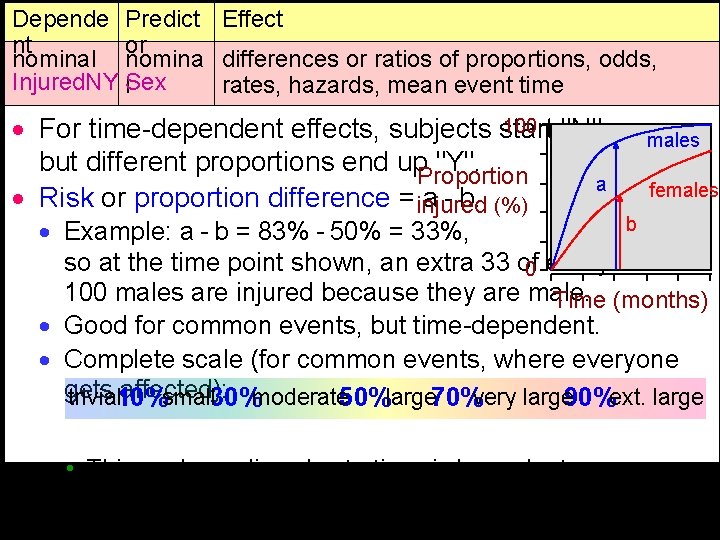
Depende Predict Effect nt or nominal nomina differences or ratios of proportions, odds, Injured. NY Sex l rates, hazards, mean event time 100 "N" · For time-dependent effects, subjects start but different proportions end up. Proportion "Y". a · Risk or proportion difference = injured a - b. (%) males females b · Example: a - b = 83% - 50% = 33%, so at the time point shown, an extra 33 of 0 every 100 males are injured because they are male. Time (months) · Good for common events, but time-dependent. · Complete scale (for common events, where everyone gets affected): trivial 10% small 30%moderate 50%large 70%very large 90%ext. large • This scale applies also to time-independent common classifications.
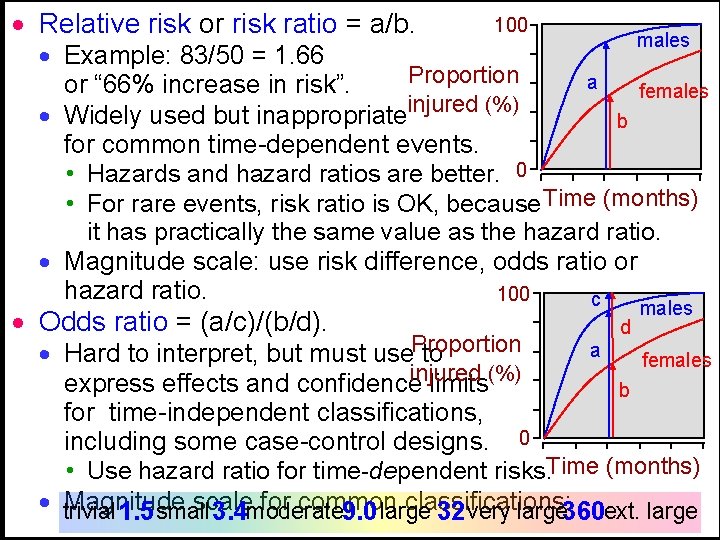
· Relative risk or risk ratio = a/b. 100 males · Example: 83/50 = 1. 66 Proportion a or “ 66% increase in risk”. females · Widely used but inappropriateinjured (%) b for common time-dependent events. • Hazards and hazard ratios are better. 0 • For rare events, risk ratio is OK, because Time (months) it has practically the same value as the hazard ratio. · Magnitude scale: use risk difference, odds ratio or hazard ratio. 100 c · Odds ratio = (a/c)/(b/d). d males a · Hard to interpret, but must use. Proportion to females express effects and confidenceinjured limits(%) b for time-independent classifications, including some case-control designs. 0 • Use hazard ratio for time-dependent risks. Time (months) · trivial Magnitude scale for common classifications: 1. 5 small 3. 4 moderate 9. 0 large 32 very large 360 ext. large
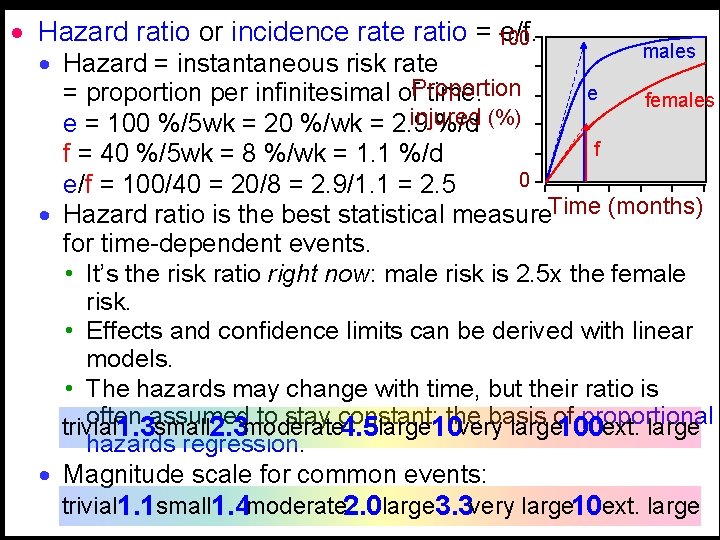
· Hazard ratio or incidence ratio = 100 e/f. males · Hazard = instantaneous risk rate e = proportion per infinitesimal of. Proportion time. females injured e = 100 %/5 wk = 20 %/wk = 2. 9 %/d (%) f f = 40 %/5 wk = 8 %/wk = 1. 1 %/d 0 e/f = 100/40 = 20/8 = 2. 9/1. 1 = 2. 5 · Hazard ratio is the best statistical measure. Time (months) for time-dependent events. • It’s the risk ratio right now: male risk is 2. 5 x the female risk. • Effects and confidence limits can be derived with linear models. • The hazards may change with time, but their ratio is often to stay constant: the basis proportional trivial small 2. 3 moderate very largeof ext. large 1. 3 assumed 4. 5 large 10 100 hazards regression. · Magnitude scale for common events: trivial 1. 1 small 1. 4 moderate 2. 0 large 3. 3 very large 10 ext. large
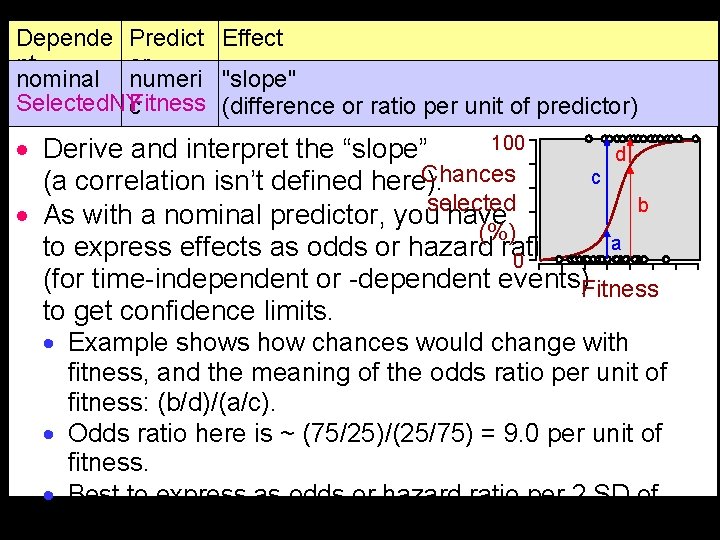
Depende Predict Effect nt or nominal numeri "slope" Selected. NY Fitness c (difference or ratio per unit of predictor) 100 · Derive and interpret the “slope” d Chances c (a correlation isn’t defined here). b · As with a nominal predictor, youselected have (%) a to express effects as odds or hazard ratios 0 (for time-independent or -dependent events)Fitness to get confidence limits. · Example shows how chances would change with fitness, and the meaning of the odds ratio per unit of fitness: (b/d)/(a/c). · Odds ratio here is ~ (75/25)/(25/75) = 9. 0 per unit of fitness. · Best to express as odds or hazard ratio per 2 SD of predictor.
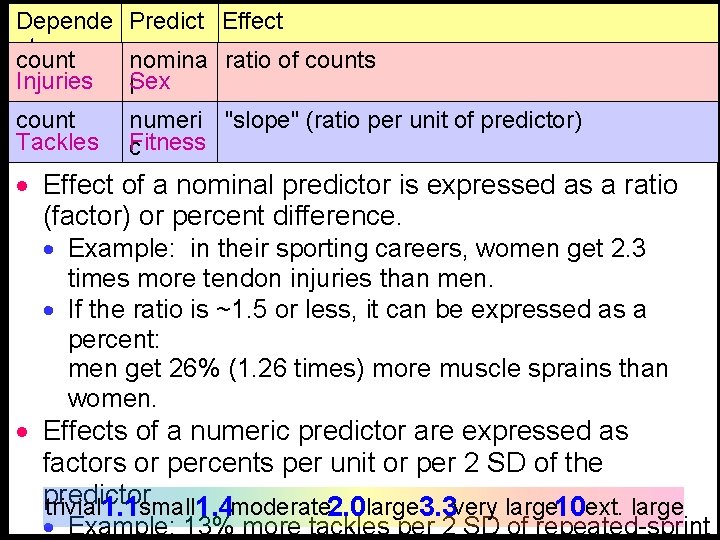
Depende nt count Injuries Predict Effect or nomina ratio of counts Sex l count Tackles numeri "slope" (ratio per unit of predictor) Fitness c · Effect of a nominal predictor is expressed as a ratio (factor) or percent difference. · Example: in their sporting careers, women get 2. 3 times more tendon injuries than men. · If the ratio is ~1. 5 or less, it can be expressed as a percent: men get 26% (1. 26 times) more muscle sprains than women. · Effects of a numeric predictor are expressed as factors or percents per unit or per 2 SD of the predictor. trivial 1. 1 small 1. 4 moderate 2. 0 large 3. 3 very large 10 ext. large · Example: 13% more tackles per 2 SD of repeated-sprint
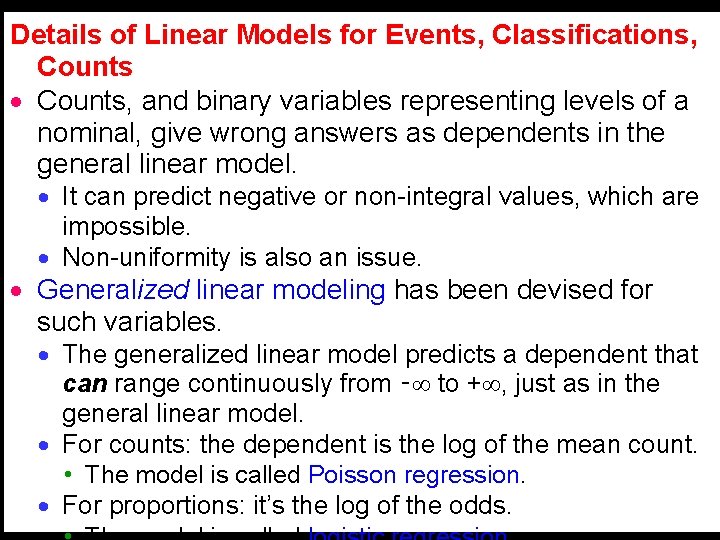
Details of Linear Models for Events, Classifications, Counts · Counts, and binary variables representing levels of a nominal, give wrong answers as dependents in the general linear model. · It can predict negative or non-integral values, which are impossible. · Non-uniformity is also an issue. · Generalized linear modeling has been devised for such variables. · The generalized linear model predicts a dependent that can range continuously from ‑ to + , just as in the general linear model. · For counts: the dependent is the log of the mean count. • The model is called Poisson regression. · For proportions: it’s the log of the odds.
Main Points · An effect is a relationship between a dependent and predictor. · Effect magnitudes have key roles in research and practice. · Magnitudes are provided by linear models, which allow for adjustment, interactions, and polynomial curvature. · Continuous dependents need various general linear models. · Examples: t tests, multiple linear regression, ANOVA… · Within-subject and mixed modeling allow for nonuniformity of error arising from different errors with different groups or time points. · Effects for continuous dependents are mean differences, slopes (expressed as 2 SD of the
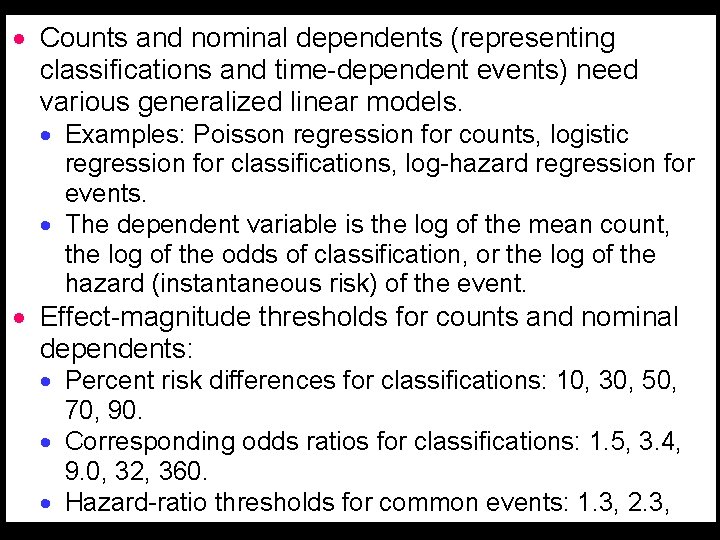
· Counts and nominal dependents (representing classifications and time-dependent events) need various generalized linear models. · Examples: Poisson regression for counts, logistic regression for classifications, log-hazard regression for events. · The dependent variable is the log of the mean count, the log of the odds of classification, or the log of the hazard (instantaneous risk) of the event. · Effect-magnitude thresholds for counts and nominal dependents: · Percent risk differences for classifications: 10, 30, 50, 70, 90. · Corresponding odds ratios for classifications: 1. 5, 3. 4, 9. 0, 32, 360. · Hazard-ratio thresholds for common events: 1. 3, 2. 3,
This presentation was downloaded from: See Sportscience 14, 2010