
LINEAR FUNCTIONS Eureka Math 8 th Grade Module


















- Slides: 78
LINEAR FUNCTIONS Eureka Math 8 th Grade Module 6 Topic A
LESSON 1 Recall, workshop, discussion
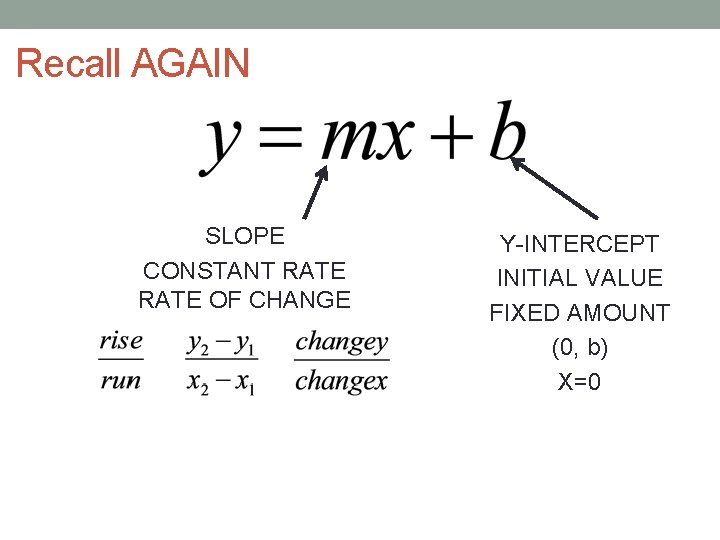
Recall AGAIN SLOPE CONSTANT RATE OF CHANGE Y-INTERCEPT INITIAL VALUE FIXED AMOUNT (0, b) X=0
Workshop Must Do • Lesson 1 cw #1 -16 May Do • Khan academy • Independent work packet • Test rewrites • Slope practice • Linear equation practice • Exponents review • PARCC tasks
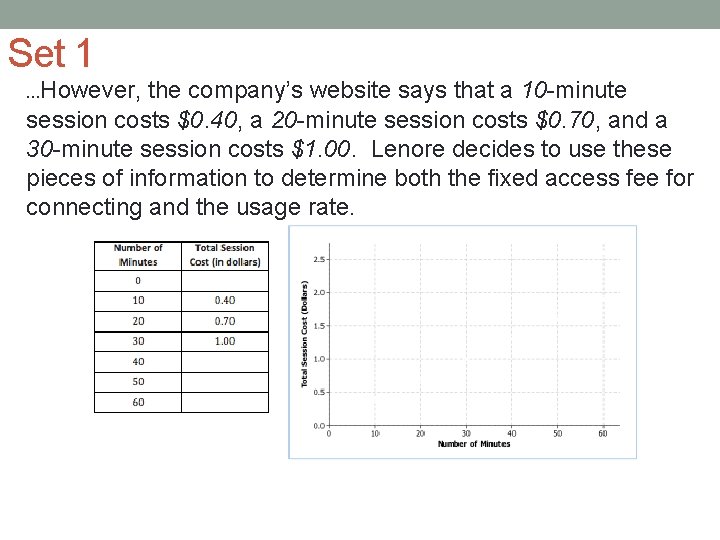
Set 1 …However, the company’s website says that a 10 -minute session costs $0. 40, a 20 -minute session costs $0. 70, and a 30 -minute session costs $1. 00. Lenore decides to use these pieces of information to determine both the fixed access fee for connecting and the usage rate.
Set 2 A second wireless access company has a similar method for computing its costs. Unlike the first company that Lenore was considering, this second company explicitly states its access fee is $0. 15, and its usage rate is $0. 04 per minute.
LESSON 2 Example, recall, workshop
Recall AGAIN SLOPE CONSTANT RATE OF CHANGE Positive - increasing line/rate Negative - decreasing line/rate Steeper - faster rate Y-INTERCEPT INITIAL VALUE FIXED AMOUNT (0, b) X=0
Example - COPY In the last lesson, you encountered an MP 3 download site that offers downloads of individual songs with the following price structure: a $3 fixed fee for a monthly subscription plus a fee of $0. 25 per song. The linear function that models the relationship can be written as y=0. 25 x+3. • In your own words, explain the meaning of 0. 25 within the context of the problem. • In your own words, explain the meaning of 3 within the context of the problem.
Workshop Must Do • Lesson 2 cw #1 -9 May Do • Khan academy • Independent work packet • Test rewrites • Slope practice • Linear equation practice • Exponents review • PARCC tasks • Linear equation extra credit project
LESSON 3 Example, workshop, discussion
Warm Up Write the linear equation for the line that goes through the point (0, 4) and has a slope of 3. Write the linear equation for the line that goes through the point (3, 5) and has a slope of -2.
Example - COPY A truck rental company charges a $150 rental fee in addition to a charge of $0. 50 per mile driven. Graph the linear function relating the total cost of the rental in dollars, C, to the number of miles driven, m, on the axes below. • If the truck is driven 0 miles, what is the cost to the customer? How is this shown on the graph? ’ • What is the rate of change? Explain what it means within the context of the problem. • Write the equation.
Workshop Must Do May Do • Exit ticket #1 -2 • Khan academy • Lesson 3 cw #1 -10 • Independent work packet • Test rewrites • Slope practice • Linear equation practice • Exponents review • PARCC tasks • Linear equation extra credit project
LESSON 4 Notes, Opening/example, workshop
Warm Up Write the equation for each line: 1) Through the point (0, -3) and has slope 2 2) Through the point (0, 5) and has slope -4 3) Through the point (3, 0) and has slope 1 4) Through the point (5, 2) and has slope -3 5) Through the point (2, -4) and has the slope ½
Recall AGAIN SLOPE CONSTANT RATE OF CHANGE Positive - increasing line/rate Negative - decreasing line/rate Zero – flat, horizontal line Steeper - faster rate Y-INTERCEPT INITIAL VALUE FIXED AMOUNT (0, b) x=0
Example • 1) 2) 3) 4)
Example • 1) 2) 3) 4)
Workshop Must Do • Lesson 4 cw #1 -3 May Do • Khan academy • Independent work packet • Test rewrites • Slope practice • Linear equation practice • Exponents review • PARCC tasks • Linear equation extra credit project
LESSON 5 Examples(1), Notes, video, workshop
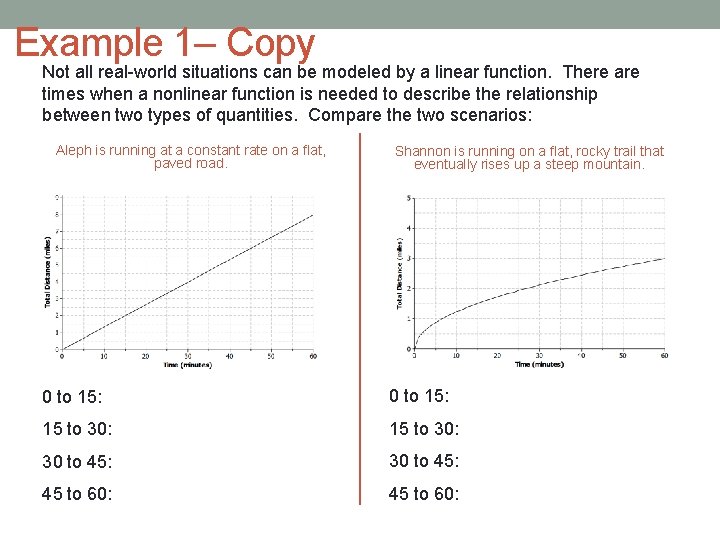
Example 1– Copy Not all real-world situations can be modeled by a linear function. There are times when a nonlinear function is needed to describe the relationship between two types of quantities. Compare the two scenarios: Aleph is running at a constant rate on a flat, paved road. Shannon is running on a flat, rocky trail that eventually rises up a steep mountain. 0 to 15: 15 to 30: 30 to 45: 45 to 60:
Video www. graphingstories. com Note - the classwork problem about ferris wheels connects to this video AND science!
Workshop Must Do • Lesson 5 cw #1 -4 May Do • Khan academy • Independent work packet • PARCC practice • Carnival Bears/Crossing the River • Extra credit project • Complete classwork 1 -4
LINEAR FUNCTIONS Eureka Math 8 th Grade Module 6 Topic B
LESSON 6 Notes, Examples(1), workshop
Notes- Scatterplots Vocabulary: Bivariate data set: observations made on two variables Scatterplot: a graph of numerical data on two variables. • A pattern in a scatterplot suggests that there might be a relationship between the variables. • If the two variables seem to vary together in a predictable (linear) way, then they have a statistical relationship. • A statistical relationship does NOT mean that one variable causes the other to change. • A MODEL that lies CLOSE to the data can be used for approximate predictions.
Example – Copy Say you collect data on 13 cars. For each, you observe: x: the weight of the car and y: the fuel efficiency of the car Model Weight (pounds) Fuel Efficiency (mpg)
Workshop Must Do May Do • Quiz • Khan academy • Lesson 6 cw #1 -7 • Independent work packet • PARCC practice • Carnival Bears/Crossing the River • Extra credit project • Complete classwork 1 -5 • Start homework
LESSON 7 Notes, examples(2), workshop
Notes- Relationships in Scatterplots Vocabulary: Cluster - when there are two or more clouds of points Outlier - points that seem unusual or far away from the others When looking at scatterplot, ask/answer 3 questions: 1) Does it look like there is a relationship between the variables? In other words, is there a pattern or are the points totally scattered randomly. 2) If there’s a pattern, does the relationship look linear? 3) Does the relationship appear positive or negative?
Example 1 - Copy Is there a relationship? If there is a relationship, does it appear to be linear? If the relationship appears to be linear, is it a positive or a negative linear relationship?
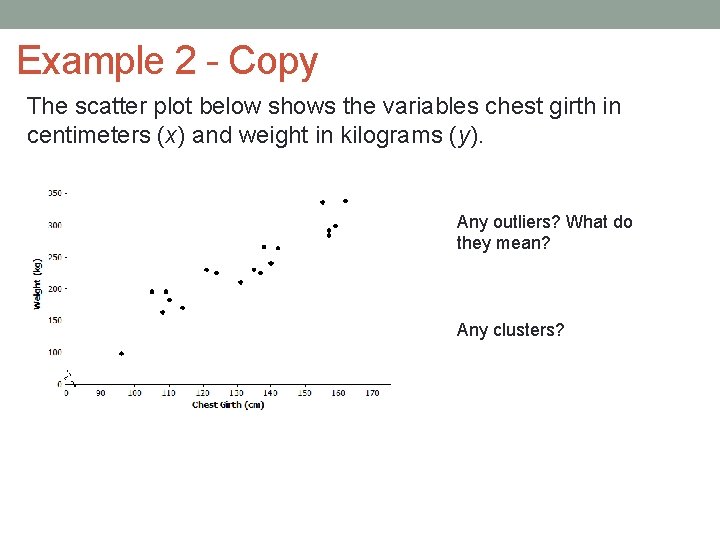
Example 2 - Copy The scatter plot below shows the variables chest girth in centimeters (x) and weight in kilograms (y). Any outliers? What do they mean? Any clusters?
Workshop Must Do May Do • Lesson 7 cw #1 -10 • Khan academy • Lesson 6 cw #1 -7 • Independent work packet • PARCC practice • Carnival Bears/Crossing the River • Extra credit project • Complete classwork 1 -6
LESSON 8 Notes, example (1 long one), workshop
Notes- Lines of Best Fit When the scatterplot is approximately linear: • A line can be used to describe the linear relationship • A line that describes the relationship can be used to make predictions about the data (it won’t necessarily be exact) • When informally drawing the line, try to find the placement where the most points tend to be closest to the line. • Once the line is drawn, the actual data points are ignored and the line is used for analysis/prediction.
Example 1 - Copy In a midwestern town, data was collected comparing house size to the price it sold for.
Example 1 continued • What can you tell about the price of large homes compared to the price of small homes? • What is the cost of the most expensive house, and where is that point on the scatter plot? • Estimate the cost of a 3, 000 -square-foot house. Draw a line in the plot that you think would fit the trend in the data. Use your line to answer the following questions: • What is your prediction of the price of a 3, 000 -square-foot house? • What is the prediction of the price of a 1, 500 -square-foot house? Consider the following general strategies students use for drawing a line. • Laure used the very first point and the very last point. • Phil wants to have the same number of points above and below the line. • Sandie tried to get a line that had the most points right on it. • Maree tried to get her line as close to as many of the points as possible.
Workshop Must Do May Do • Lesson 6 -7 exit ticket • Khan academy • Lesson 8 cw #1 -2 • Independent work packet • PARCC practice • Carnival Bears/Crossing the River • Extra credit project
LESSON 9 Example, notes, workshop
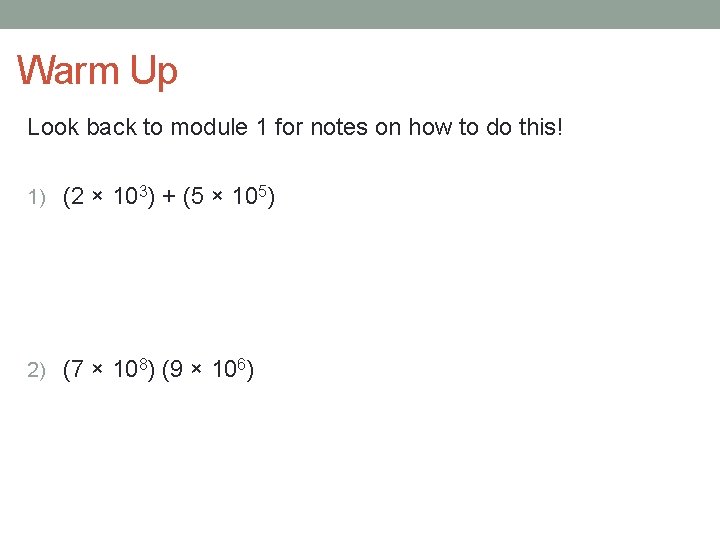
Warm Up Look back to module 1 for notes on how to do this! 1) (2 × 10³) + (5 × 10⁵) 2) (7 × 10⁸) (9 × 10⁶)
Example - Copy 1) Draw the line of best fit. 2) Write an equation for the line you drew. 1) Compare the line’s predicted value to the observed value for: a) 2 hours b) 4 hours c) 1 hour
Notes- Lines of Best Fit When the scatterplot is approximately linear: • A line can be used to describe the linear relationship • A line that describes the relationship can be used to make predictions about the data (it won’t necessarily be exact) • When informally drawing the line, try to find the placement where the most points tend to be closes to the line. • A line of best fit does NOT need to go through the origin • Since you are drawing a line, the equation should be y=mx+b
Workshop Must Do • Lesson 9 cw #1 -7 May Do • Independent work packet • PARCC practice • Carnival Bears/Crossing the River • Extra credit project • Finish all 1 -9 • Notes sheet • Folder organize • Generally study
LINEAR FUNCTIONS Eureka Math 8 th Grade Module 6 Topic C
LESSON 10 Notes, examples (2), workshop
Notes- Lines of Best Fit Some new, unnecessary vocabulary: • Independent variable - in statistics it can also be called the explanatory variable or predictor variable • Dependent variable - in statistics it can also be called the response variable or predicted variable
Example 1 - Don’t Copy When doing statistics (like science actually), you often need to identify two variables you think have a relationship and determine independent and dependent variables. Suppose you want to predict how well you are going to do on an upcoming statistics quiz. That would be the predicted variable (dependent). What are some potential independent variables connected? Alternatively, if you know the cost age of a person, what are some dependent variables that might be related?
Example 2 - Copy Omar and Olivia were curious about the size of coins. They measured the diameter and circumference of several coins and found the following data. Do diameter and circumference seem related? Find the equation. What does the slope value look like? What is the y-intercept?
Workshop Must Do • Lesson 10 cw #1 -8 May Do • Khan academy • Independent work packet • PARCC practice • Carnival Bears/Crossing the River • Extra credit project • Complete classwork 1 -4
LESSON 11 Warm Up, workshop, discussion
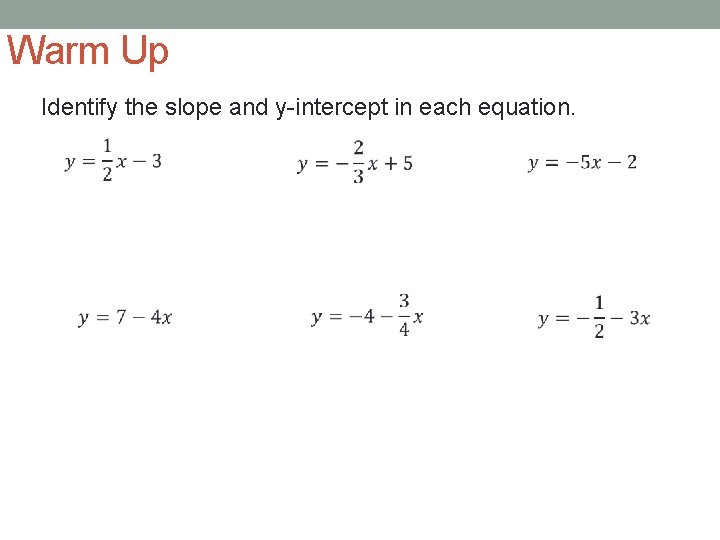
Warm Up Identify the slope and y-intercept in each equation.
Remember… Summary. In the real world, it is rare that two numerical variables are exactly linearly related. If the data are roughly linear, a line can be drawn through the data to model it. This line can then be used to make approximate predictions to answer questions. For now this line is informally drawn, but in later grades you will use more formal methods for placing the line in the best -fitting place.
Workshop Must Do May Do • Lesson 10 cw #1 -8 • Independent work • Lesson 11 cw #1 -2 • Extra credit project • Writing equations • Slope practice • Crossing the River/Carnival Bears • Inky Puzzles
Discussion The data in #2 can be modified to make the y-intercept make sense….
LESSON 12 Example, summary, workshop
Example – Don’t Copy •
Example - Don’t Copy •
Remember… Summary. In the real world, it is rare that two numerical variables are exactly linearly related. If the data are roughly linear, a line can be drawn through the data to model it. This line and rate of change can then be used to make approximate predictions to answer questions. For now this line is informally drawn, but in later grades you will use more formal methods for placing the line in the best -fitting place. When data do NOT follow a linear pattern, there is no constant rate of change.
Workshop Must Do May Do • Exit ticket 10 -11 • Khan academy • Lesson 12 cw #1 -14 • Independent work packet • PARCC practice • Carnival Bears/Crossing the River • Extra credit project • Complete classwork 1 -4
LINEAR FUNCTIONS Eureka Math 8 th Grade Module 6 Topic D
LESSON 13 Notes, Warm up, example, classwork, example, classwork
Notes – Categorical Data When one of your variables is CATEGORICAL, and NOT numerical (number-related) you cannot use a graph. • Examples of Categorical Data: seasons, colors, boys/girls Univariate categorical data are displayed in a one-way table Bivariate categorical data are displayed in a two-way table Relative frequency is the frequency divided by the total
Warm Up Complete #1 -5 on your classwork.
Example - Copy The table below shows the ice cream flavors and the number of students who chose each flavor for a different class. This table is called a one-way frequency table because it shows the counts of a univariate categorical variable. We compute the relative frequency for each ice cream flavor by dividing the count by the total number of observations.
Work Complete #6 -7 on your classwork.
Example, continued - Copy •
Work Complete #8 -12 on your classwork.
Example, continued - Copy Sometimes we use row or column totals to calculate relative frequencies. Calculate the proportion of male students who prefer chocolate ice cream.
Work Complete #13 -16 on your classwork.
LESSON 14 Warm Up, Notes, examples (1), workshop
Warm Up Suppose a random group of people are surveyed about their use of smartphones. The results of the survey are summarized in the tables below.
Notes – Association When determining if two variables are related or have an association: • If relative frequencies are the same no association • If relative frequencies are different yes association **Relative frequencies are found by using row or column totals rather than the entire group total.
Example - Don’t Copy In the survey described in Example 2, gender for each of the 400 participants was also recorded. Some results of the survey are given below: • 160 participants preferred action movies. • 80 participants preferred drama movies. • 40 participants preferred science fiction movies. • 240 participants were females. • 78 female participants preferred drama movies. • 32 male participants preferred science fiction movies. • 60 female participants preferred action movies.
Example continued - Copy this part 60 100 160 78 2 80 8 94 32 40 96 120 240 160 400 ß Row Relative Frequencies Column Relative Frequencies
Workshop Must Do • Lesson 14 cw #1 -12 May Do • Khan academy • Independent work packet • PARCC practice • Extra credit project • Notes sheet • Complete all CW and HW • Study • Folder organize
End of Module Test 1 a) Positive or negative association – why IN CONTEXT does that make sense? 1 b) Linear or nonlinear – why IN CONEXT does that make sense? 1 c) Outlier – IN CONTEXT what does it mean? 2 a) Make two-way table from data 2 b) Use frequencies to determine if the variables are related 3 a) Interpret the meaning of the given slope IN CONTEXT 3 b) Based on equations, which variable has biggest impact on the other 3 c) Which option is the worst fit and why