
Linear Colliders Lecture 3 Subsystems II Frank Tecker
Linear Colliders Lecture 3 Subsystems II Frank Tecker – CERN Main Linac (cont. ) RF system and technology Accelerating gradient Beam / bunch structure Beam Delivery System Alignment and Stabilization Frank Tecker Linear Colliders John Adams Institute
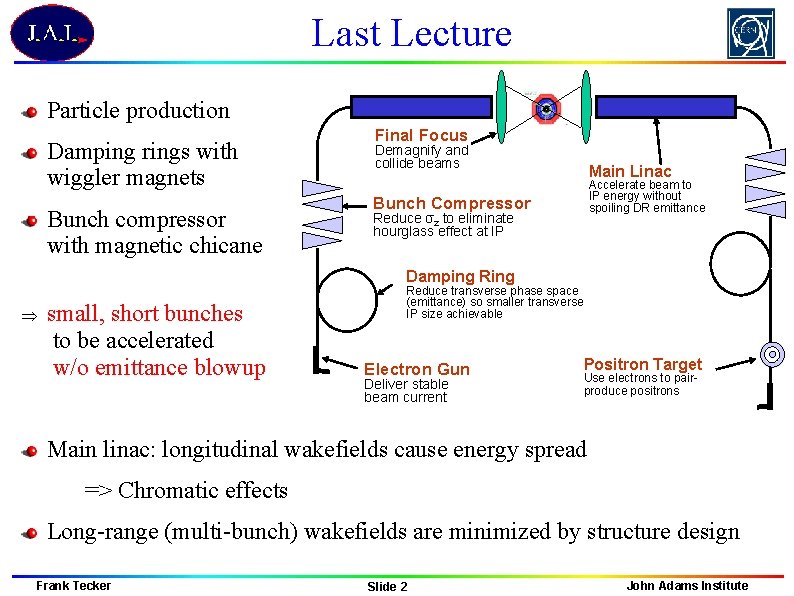
Last Lecture Particle production Damping rings with wiggler magnets Bunch compressor with magnetic chicane Final Focus Demagnify and collide beams Main Linac Accelerate beam to IP energy without spoiling DR emittance Bunch Compressor Reduce σz to eliminate hourglass effect at IP Damping Ring small, short bunches to be accelerated w/o emittance blowup Reduce transverse phase space (emittance) so smaller transverse IP size achievable Electron Gun Deliver stable beam current Positron Target Use electrons to pairproduce positrons Main linac: longitudinal wakefields cause energy spread => Chromatic effects Long-range (multi-bunch) wakefields are minimized by structure design Frank Tecker Slide 2 John Adams Institute
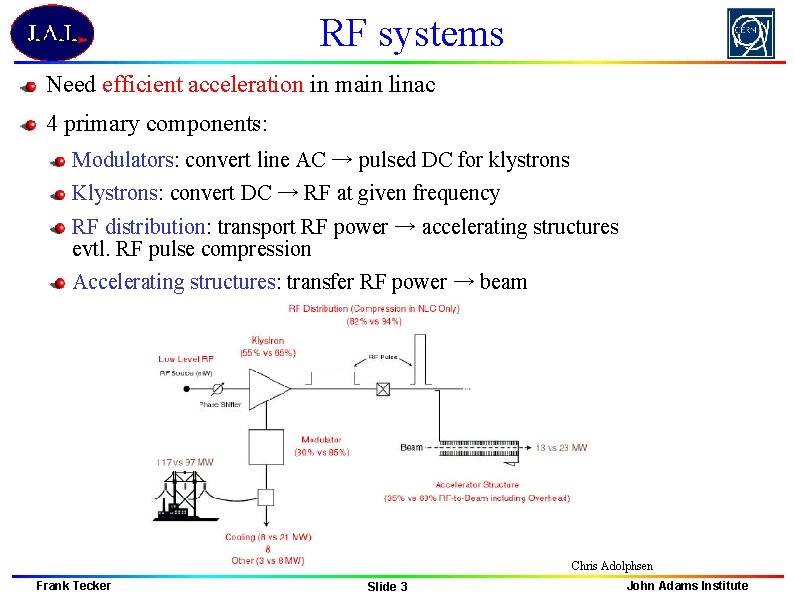
RF systems Need efficient acceleration in main linac 4 primary components: Modulators: convert line AC → pulsed DC for klystrons Klystrons: convert DC → RF at given frequency RF distribution: transport RF power → accelerating structures evtl. RF pulse compression Accelerating structures: transfer RF power → beam Chris Adolphsen Frank Tecker Slide 3 John Adams Institute
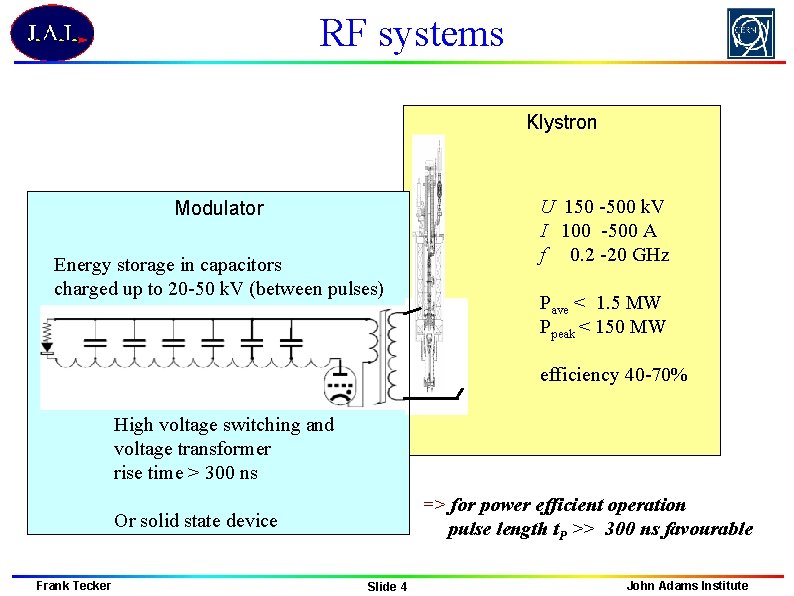
RF systems Klystron Modulator Energy storage in capacitors charged up to 20 -50 k. V (between pulses) U 150 -500 k. V I 100 -500 A f 0. 2 -20 GHz Pave < 1. 5 MW Ppeak < 150 MW efficiency 40 -70% High voltage switching and voltage transformer rise time > 300 ns => for power efficient operation pulse length t. P >> 300 ns favourable Or solid state device Frank Tecker Slide 4 John Adams Institute
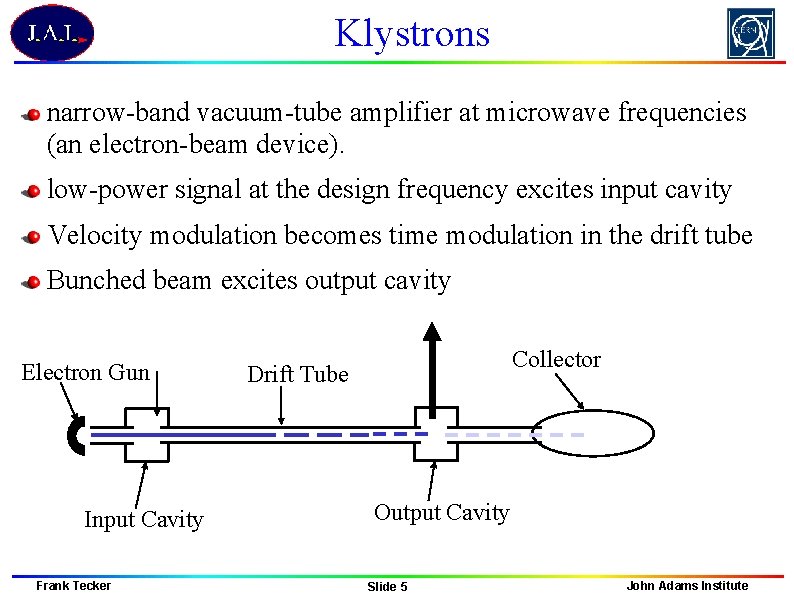
Klystrons narrow-band vacuum-tube amplifier at microwave frequencies (an electron-beam device). low-power signal at the design frequency excites input cavity Velocity modulation becomes time modulation in the drift tube Bunched beam excites output cavity Electron Gun Input Cavity Frank Tecker Collector Drift Tube Output Cavity Slide 5 John Adams Institute
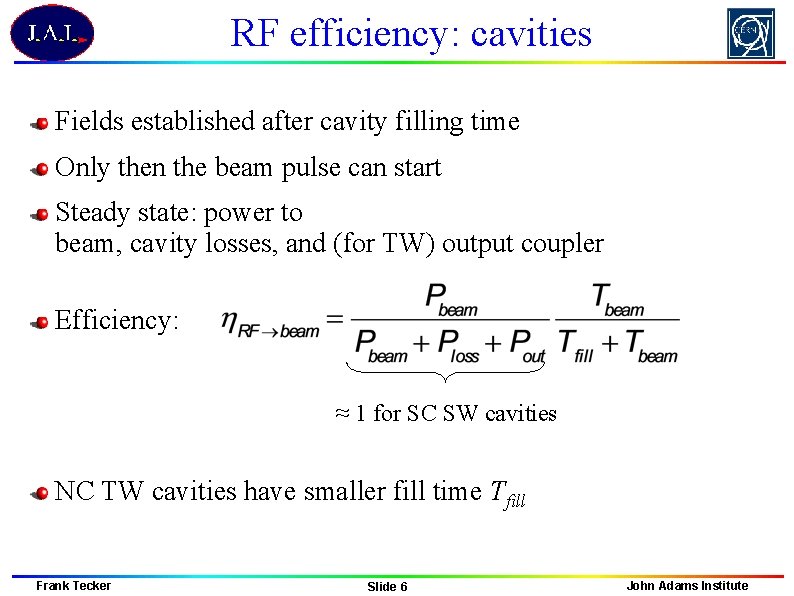
RF efficiency: cavities Fields established after cavity filling time Only then the beam pulse can start Steady state: power to beam, cavity losses, and (for TW) output coupler Efficiency: ≈ 1 for SC SW cavities NC TW cavities have smaller fill time Tfill Frank Tecker Slide 6 John Adams Institute
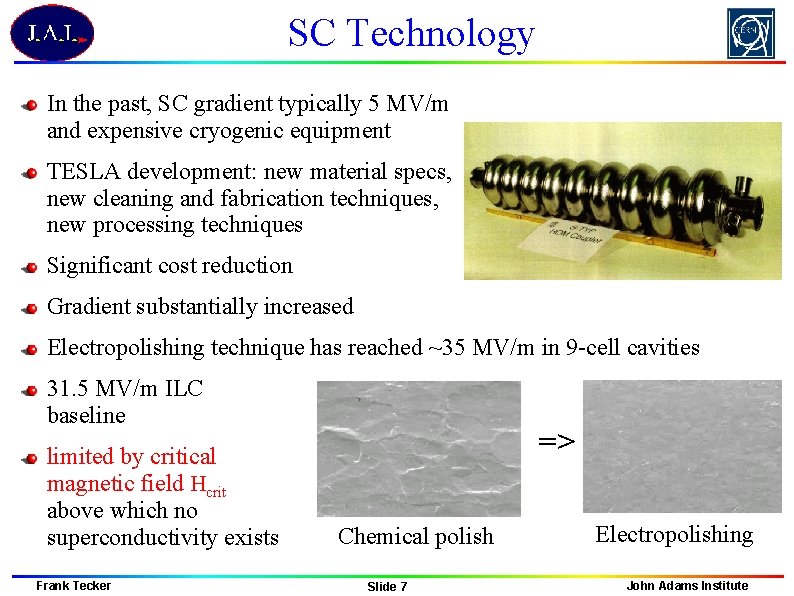
SC Technology In the past, SC gradient typically 5 MV/m and expensive cryogenic equipment TESLA development: new material specs, new cleaning and fabrication techniques, new processing techniques Significant cost reduction Gradient substantially increased Electropolishing technique has reached ~35 MV/m in 9 -cell cavities 31. 5 MV/m ILC baseline limited by critical magnetic field Hcrit above which no superconductivity exists Frank Tecker => Chemical polish Slide 7 Electropolishing John Adams Institute
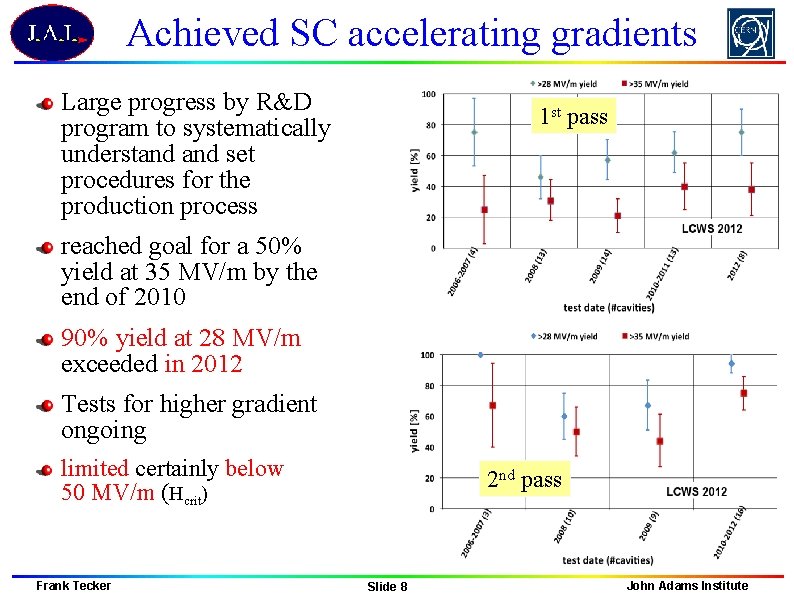
Achieved SC accelerating gradients Large progress by R&D program to systematically understand set procedures for the production process 1 st pass reached goal for a 50% yield at 35 MV/m by the end of 2010 90% yield at 28 MV/m exceeded in 2012 Tests for higher gradient ongoing limited certainly below 50 MV/m (Hcrit) Frank Tecker 2 nd pass Slide 8 John Adams Institute
Limitations of Gradient Eacc Surface magnetic field SC structures become normal conducting above Hcrit NC: Pulsed surface heating => material fatigue => cracks Field emission due to surface electric field Vacuum arcs - RF break downs Break down rate => Operation efficiency Local plasma triggered by field emission => Erosion of surface Dark current capture => Efficiency reduction, activation, detector backgrounds RF power flow and/or iris aperture apparently have a strong impact on achievable Eacc and on surface erosion. Mechanism not fully understood Frank Tecker Slide 9 John Adams Institute
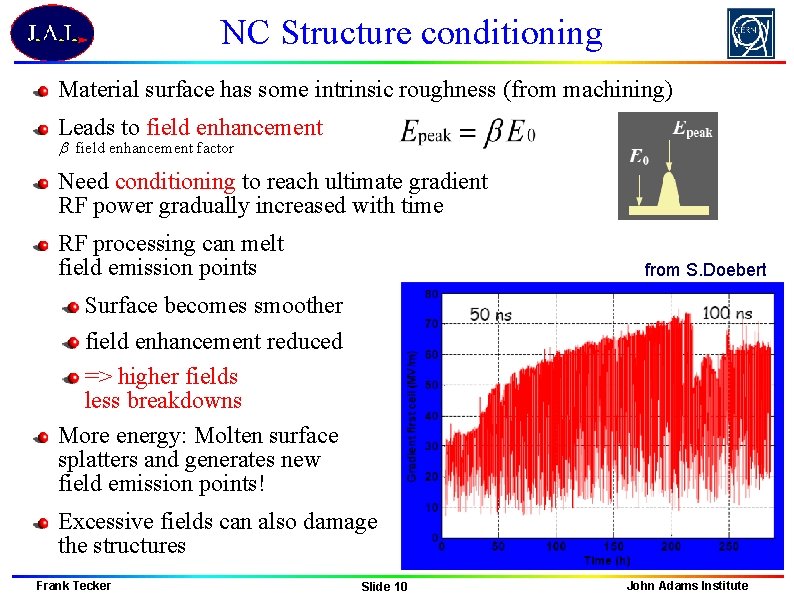
NC Structure conditioning Material surface has some intrinsic roughness (from machining) Leads to field enhancement b field enhancement factor Need conditioning to reach ultimate gradient RF power gradually increased with time RF processing can melt field emission points from S. Doebert Surface becomes smoother field enhancement reduced => higher fields less breakdowns More energy: Molten surface splatters and generates new field emission points! Excessive fields can also damage the structures Frank Tecker Slide 10 John Adams Institute

Breakdown-rate vs gradient Strong increase of breakdown rate for higher gradient C. Adolphsen /SLAC Frank Tecker Slide 11 John Adams Institute
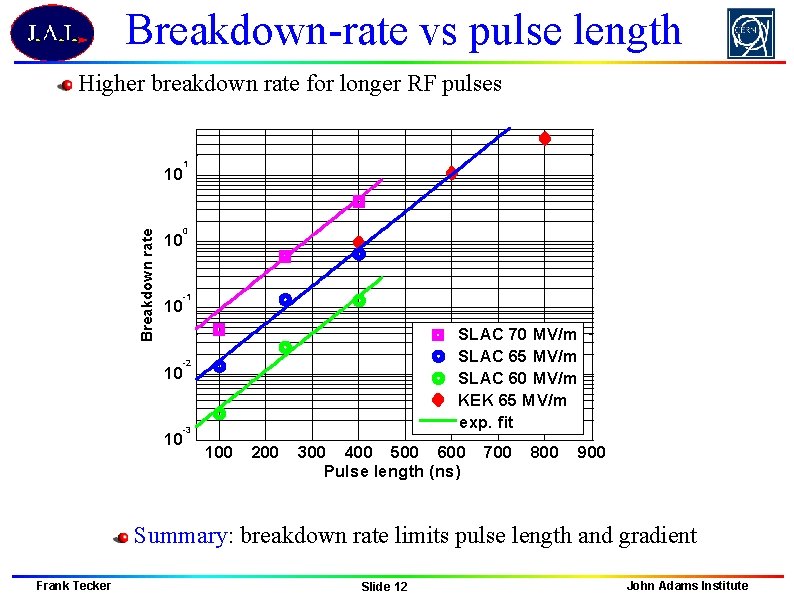
Breakdown-rate vs pulse length Higher breakdown rate for longer RF pulses Breakdown rate 10 10 10 1 0 -1 SLAC 70 MV/m SLAC 65 MV/m SLAC 60 MV/m KEK 65 MV/m exp. fit -2 -3 100 200 300 400 500 600 Pulse length (ns) 700 800 900 Summary: breakdown rate limits pulse length and gradient Frank Tecker Slide 12 John Adams Institute

Accelerating gradient Normal conducting cavities have higher gradient with shorter RF pulse length Superconducting cavities have lower gradient (fundamental limit) with long RF pulse Frank Tecker WARM Slide 13 SC John Adams Institute
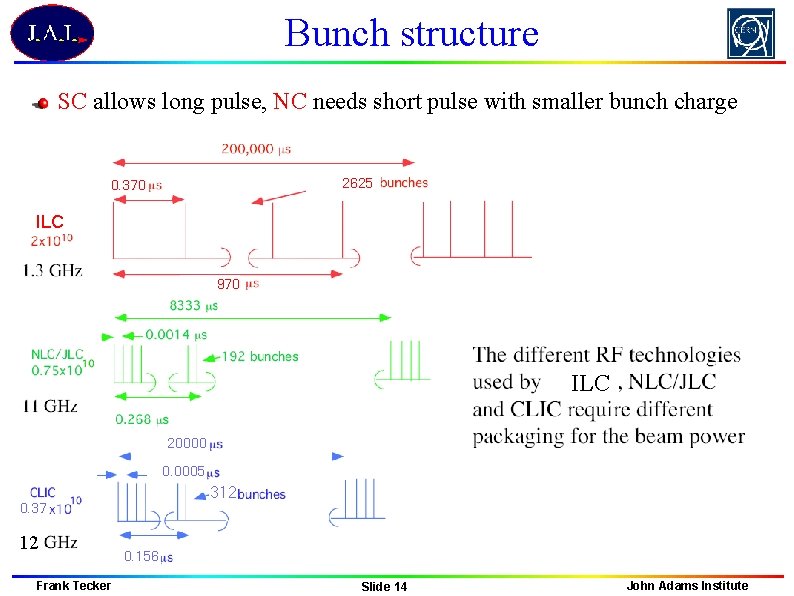
Bunch structure SC allows long pulse, NC needs short pulse with smaller bunch charge 2625 0. 370 ILC 970 ILC 20000 0. 0005 312 0. 37 12 Frank Tecker 0. 156 Slide 14 John Adams Institute
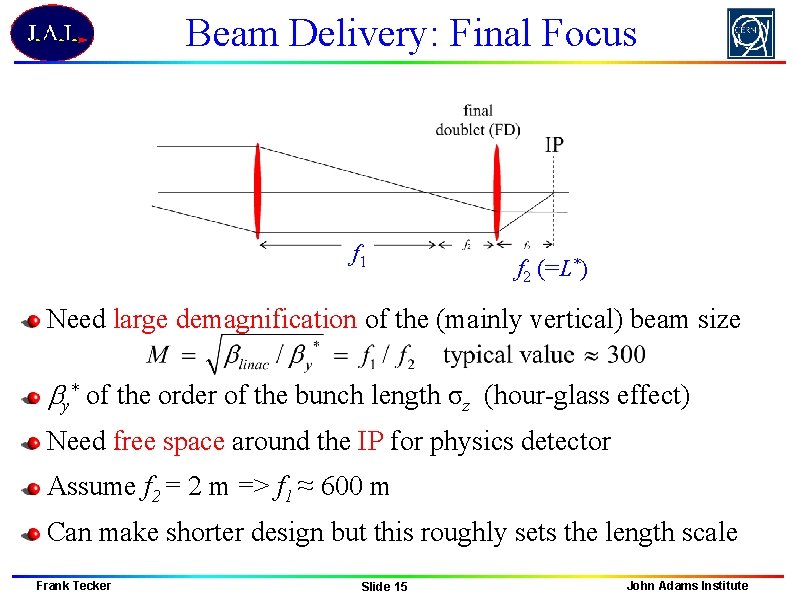
Beam Delivery: Final Focus f 1 f 2 (=L*) Need large demagnification of the (mainly vertical) beam size by* of the order of the bunch length σz (hour-glass effect) Need free space around the IP for physics detector Assume f 2 = 2 m => f 1 ≈ 600 m Can make shorter design but this roughly sets the length scale Frank Tecker Slide 15 John Adams Institute
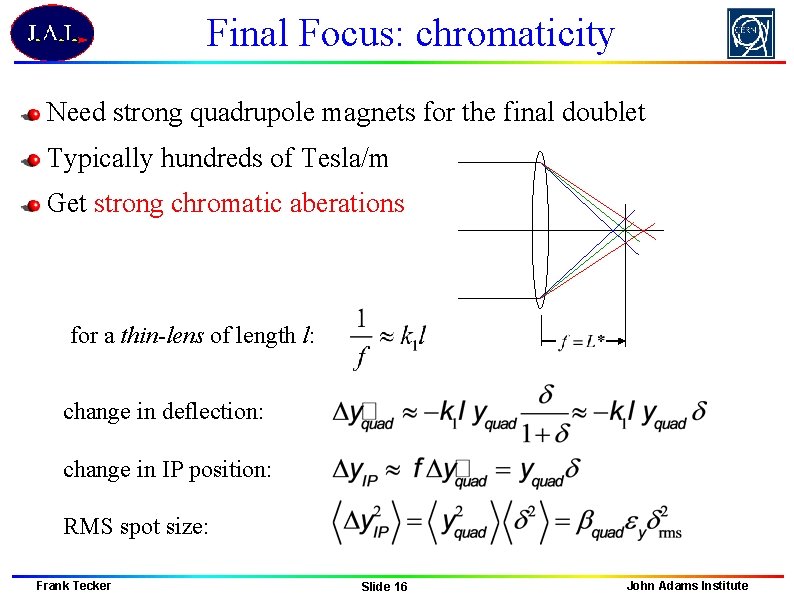
Final Focus: chromaticity Need strong quadrupole magnets for the final doublet Typically hundreds of Tesla/m Get strong chromatic aberations for a thin-lens of length l: change in deflection: change in IP position: RMS spot size: Frank Tecker Slide 16 John Adams Institute
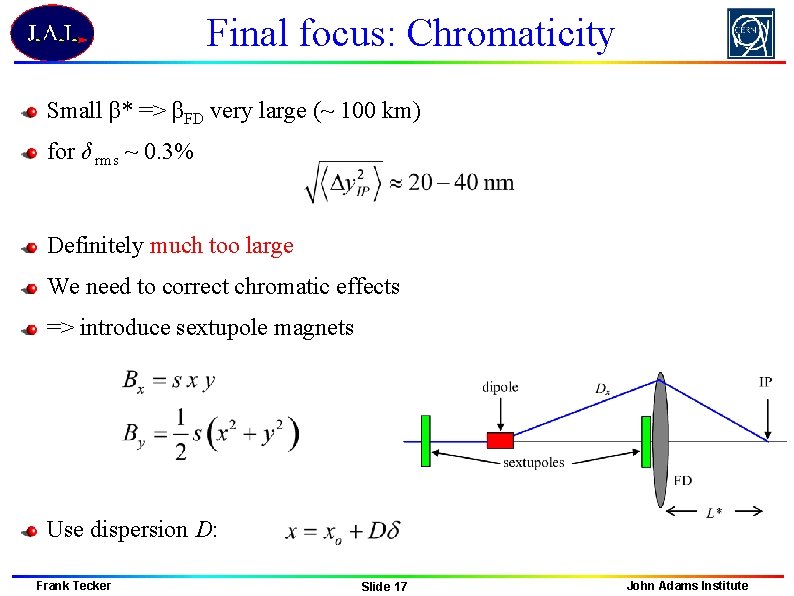
Final focus: Chromaticity Small β* => βFD very large (~ 100 km) for δ rms ~ 0. 3% Definitely much too large We need to correct chromatic effects => introduce sextupole magnets Use dispersion D: Frank Tecker Slide 17 John Adams Institute
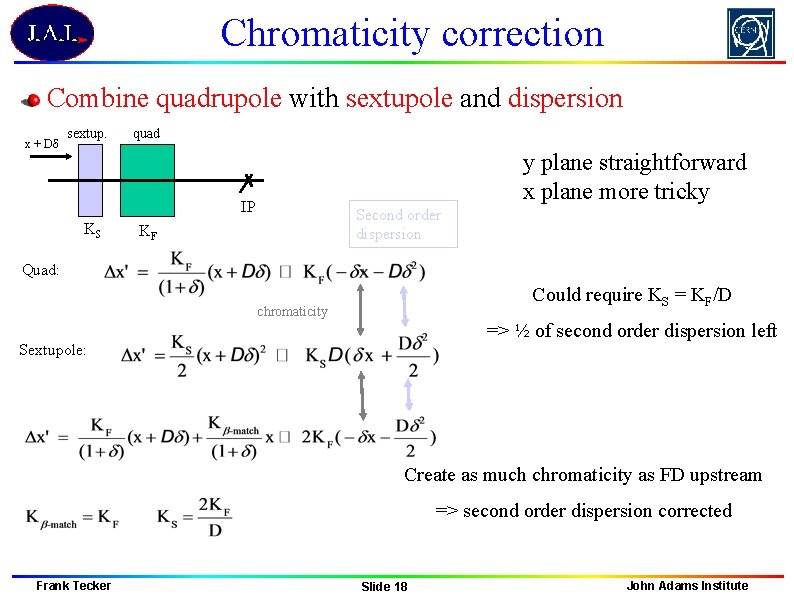
Chromaticity correction Combine quadrupole with sextupole and dispersion x + Dδ sextup. quad y plane straightforward x plane more tricky IP KS Second order dispersion KF Quad: Could require KS = KF/D chromaticity => ½ of second order dispersion left Sextupole: Create as much chromaticity as FD upstream => second order dispersion corrected Frank Tecker Slide 18 John Adams Institute
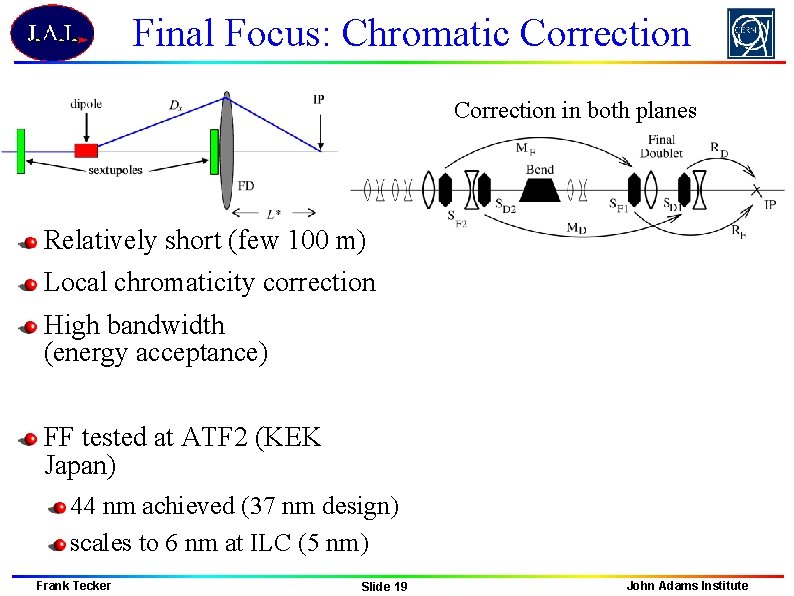
Final Focus: Chromatic Correction in both planes Relatively short (few 100 m) Local chromaticity correction High bandwidth (energy acceptance) FF tested at ATF 2 (KEK Japan) 44 nm achieved (37 nm design) scales to 6 nm at ILC (5 nm) Frank Tecker Slide 19 John Adams Institute
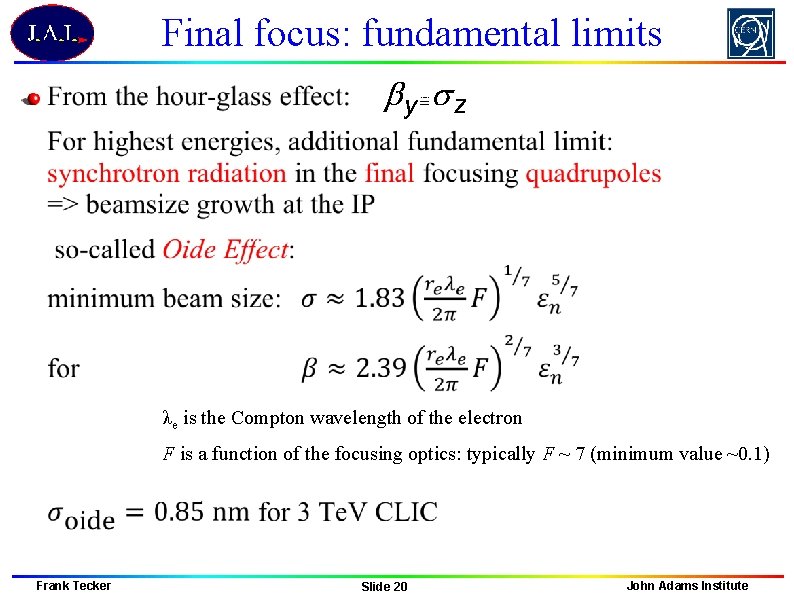
Final focus: fundamental limits λe is the Compton wavelength of the electron F is a function of the focusing optics: typically F ~ 7 (minimum value ~0. 1) Frank Tecker Slide 20 John Adams Institute
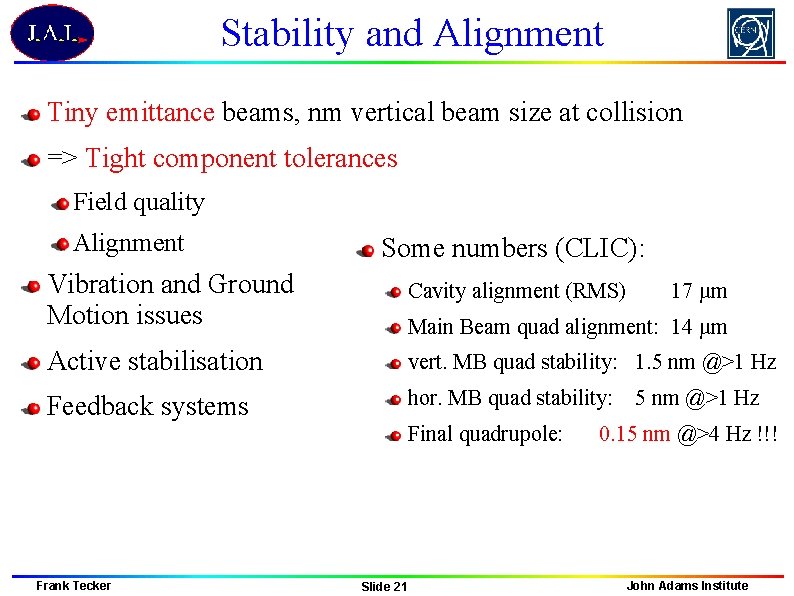
Stability and Alignment Tiny emittance beams, nm vertical beam size at collision => Tight component tolerances Field quality Alignment Some numbers (CLIC): Vibration and Ground Motion issues Cavity alignment (RMS) Active stabilisation vert. MB quad stability: 1. 5 nm @>1 Hz Feedback systems hor. MB quad stability: Main Beam quad alignment: 14 µm Final quadrupole: Frank Tecker 17 µm Slide 21 5 nm @>1 Hz 0. 15 nm @>4 Hz !!! John Adams Institute
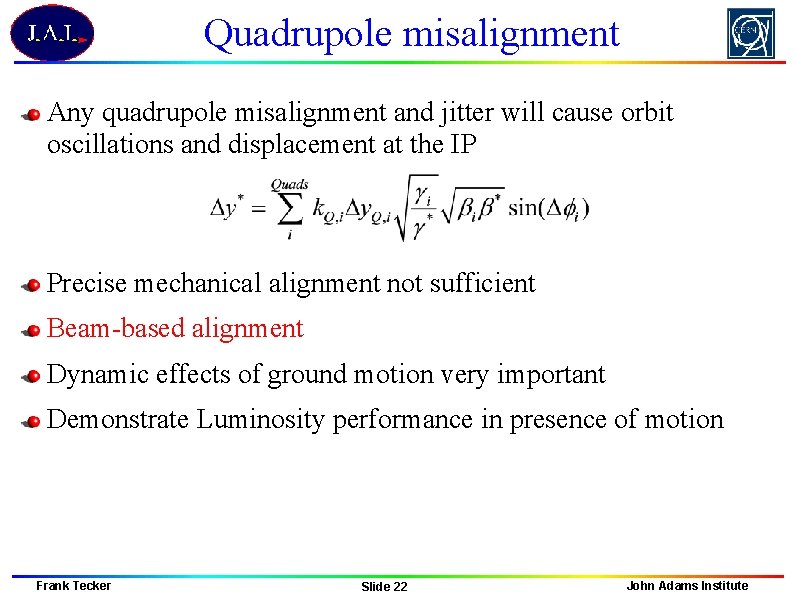
Quadrupole misalignment Any quadrupole misalignment and jitter will cause orbit oscillations and displacement at the IP Precise mechanical alignment not sufficient Beam-based alignment Dynamic effects of ground motion very important Demonstrate Luminosity performance in presence of motion Frank Tecker Slide 22 John Adams Institute
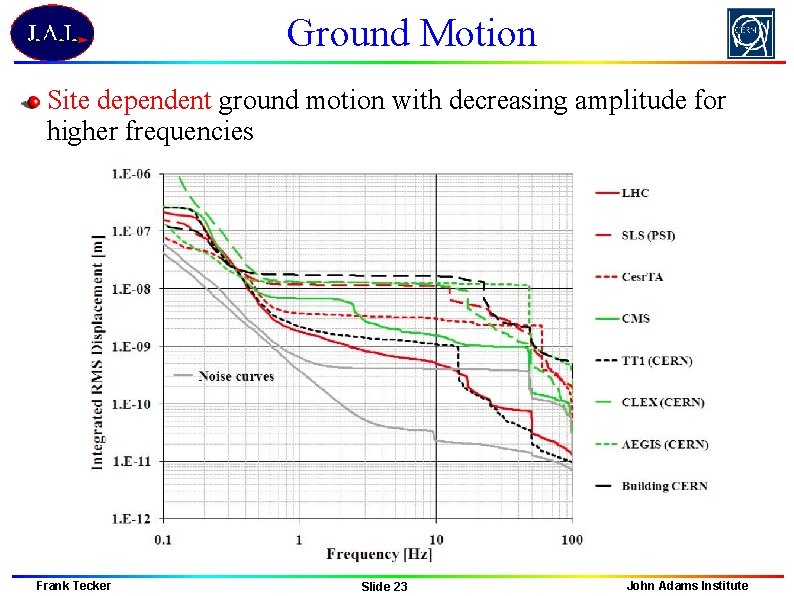
Ground Motion Site dependent ground motion with decreasing amplitude for higher frequencies Frank Tecker Slide 23 John Adams Institute
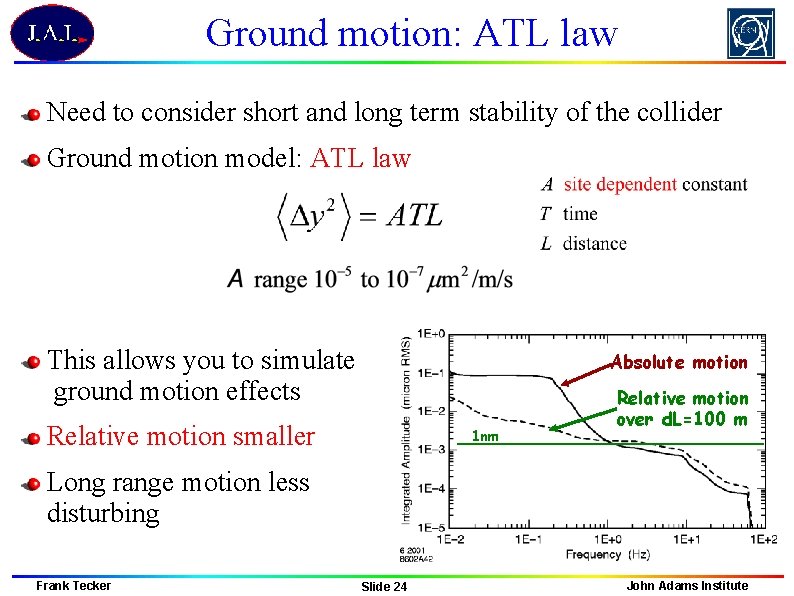
Ground motion: ATL law Need to consider short and long term stability of the collider Ground motion model: ATL law This allows you to simulate ground motion effects Absolute motion Relative motion smaller 1 nm Relative motion over d. L=100 m Long range motion less disturbing Frank Tecker Slide 24 John Adams Institute
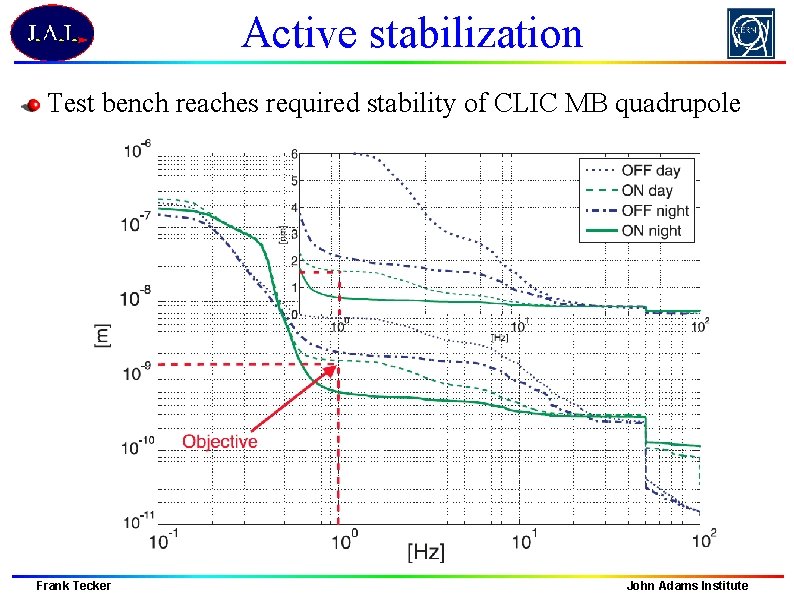
Active stabilization Test bench reaches required stability of CLIC MB quadrupole Frank Tecker John Adams Institute
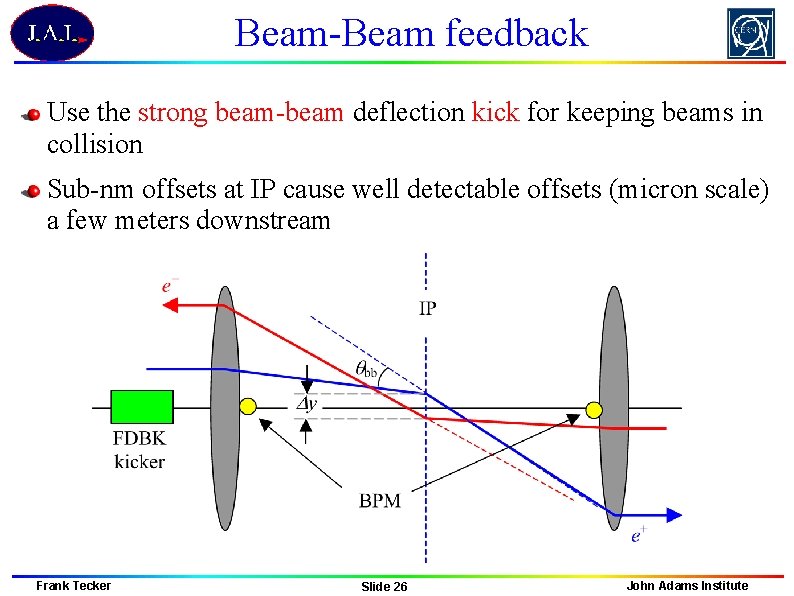
Beam-Beam feedback Use the strong beam-beam deflection kick for keeping beams in collision Sub-nm offsets at IP cause well detectable offsets (micron scale) a few meters downstream Frank Tecker Slide 26 John Adams Institute
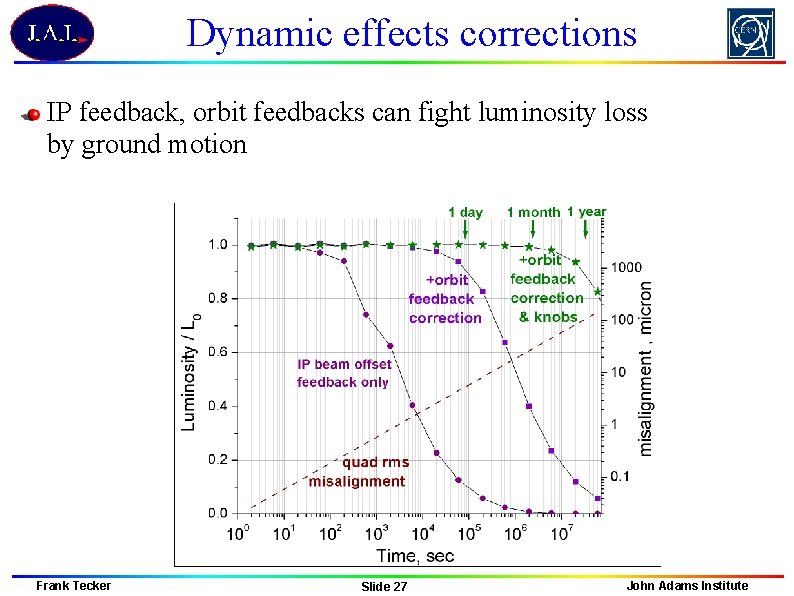
Dynamic effects corrections IP feedback, orbit feedbacks can fight luminosity loss by ground motion Frank Tecker Slide 27 John Adams Institute
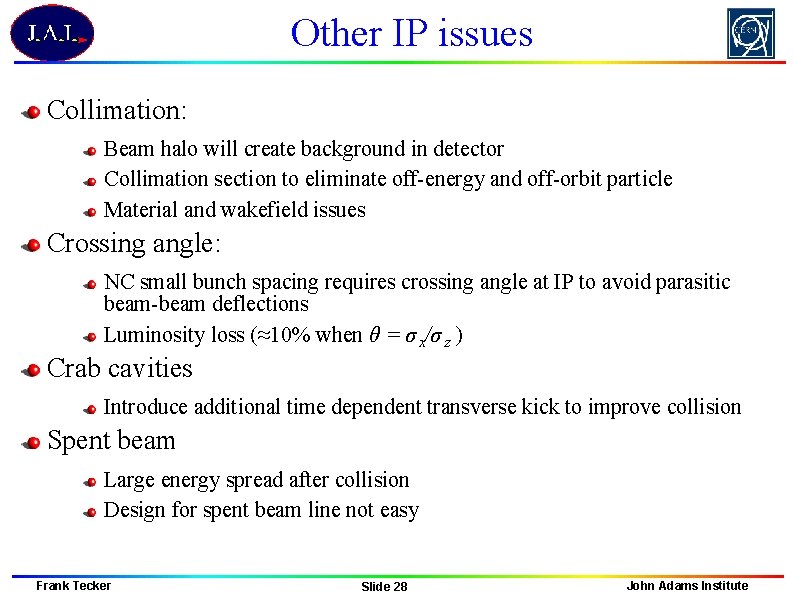
Other IP issues Collimation: Beam halo will create background in detector Collimation section to eliminate off-energy and off-orbit particle Material and wakefield issues Crossing angle: NC small bunch spacing requires crossing angle at IP to avoid parasitic beam-beam deflections Luminosity loss (≈10% when θ = σ x/σ z ) Crab cavities Introduce additional time dependent transverse kick to improve collision Spent beam Large energy spread after collision Design for spent beam line not easy Frank Tecker Slide 28 John Adams Institute
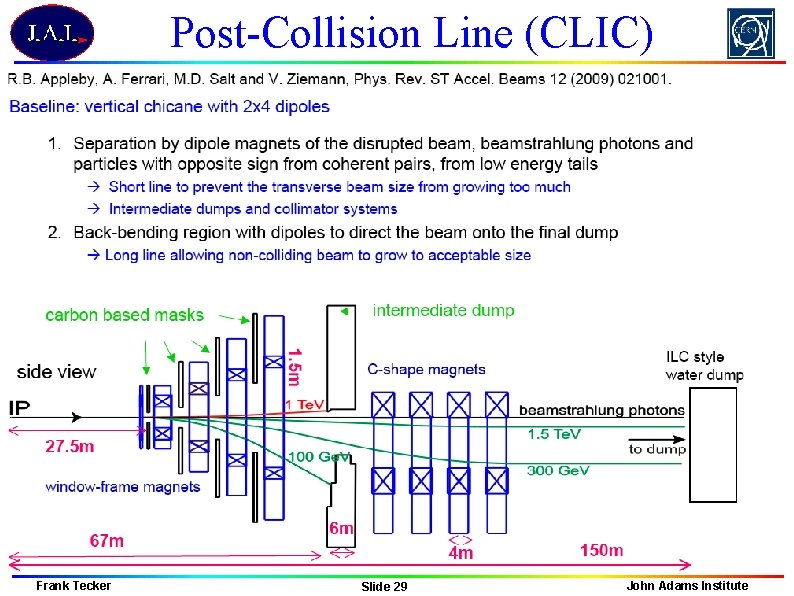
Post-Collision Line (CLIC) Frank Tecker Slide 29 John Adams Institute
- Slides: 29