
Linear Algebra and Geometric Approaches to Meaning 3
Linear Algebra and Geometric Approaches to Meaning 3 b. Distributed Semantics ESSLLI Summer School 2011, Ljubljana August 1 – August 7, 2011 Reinhard Blutner Universiteit van Amsterdam Reinhard Blutner 1
Acknowledgement • We thank Stefan Evert for allowing us to use some of his slides presented at the “Tandem Workshop on Optimality in Language and Geometric Approaches to Cognition” (Berlin, December 11 13, 2010) for parts of this course. • Links – http: //wordspace. collocations. de/doku. php/course: start – http: //www. blutner. de/tandem/index. htm Reinhard Blutner 2
nhard Blutner 1 1. Meaning and Distribution 2. Distributional semantic models 3. Word vectors and search engines 4. Latent semantic analysis 3
Meaning & distribution • “Die Bedeutung eines Wortes ist sein Gebrauch in der Sprache. ” — Ludwig Wittgenstein) • “You shall know a word by the company it keeps!” — J. R. Firth (1957) • Distributional hypothesis (Zellig Harris 1954) Stefan Evert 2010 4
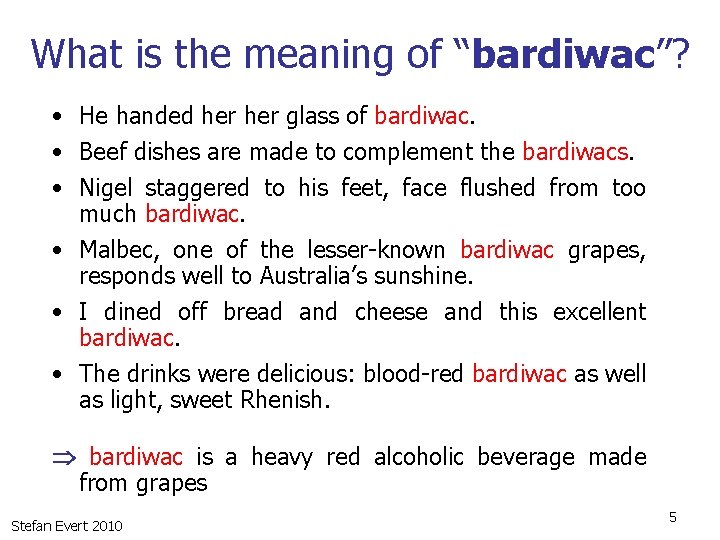
What is the meaning of “bardiwac”? • He handed her glass of bardiwac. • Beef dishes are made to complement the bardiwacs. • Nigel staggered to his feet, face flushed from too much bardiwac. • Malbec, one of the lesser known bardiwac grapes, responds well to Australia’s sunshine. • I dined off bread and cheese and this excellent bardiwac. • The drinks were delicious: blood red bardiwac as well as light, sweet Rhenish. bardiwac is a heavy red alcoholic beverage made from grapes Stefan Evert 2010 5
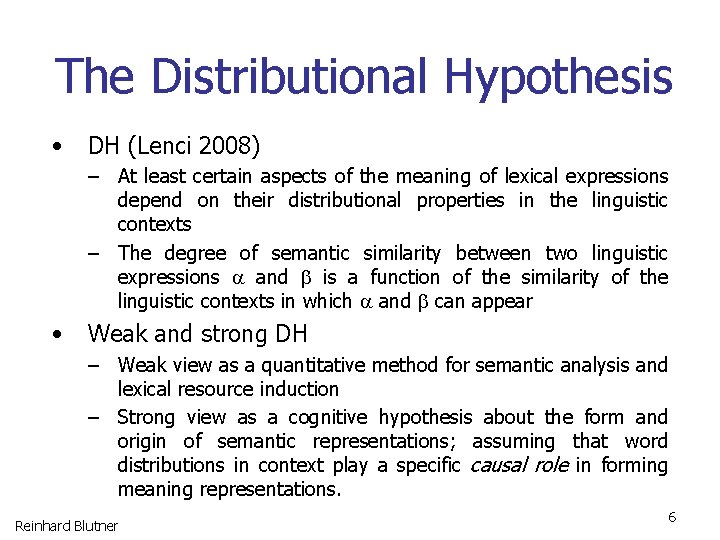
The Distributional Hypothesis • DH (Lenci 2008) – At least certain aspects of the meaning of lexical expressions depend on their distributional properties in the linguistic contexts – The degree of semantic similarity between two linguistic expressions and is a function of the similarity of the linguistic contexts in which and can appear • Weak and strong DH – Weak view as a quantitative method for semantic analysis and lexical resource induction – Strong view as a cognitive hypothesis about the form and origin of semantic representations; assuming that word distributions in context play a specific causal role in forming meaning representations. Reinhard Blutner 6
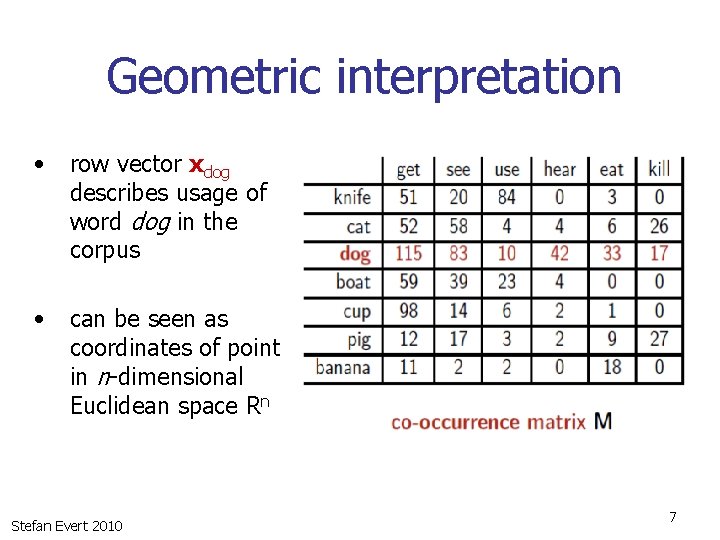
Geometric interpretation • row vector xdog describes usage of word dog in the corpus • can be seen as coordinates of point in n dimensional Euclidean space Rn Stefan Evert 2010 7
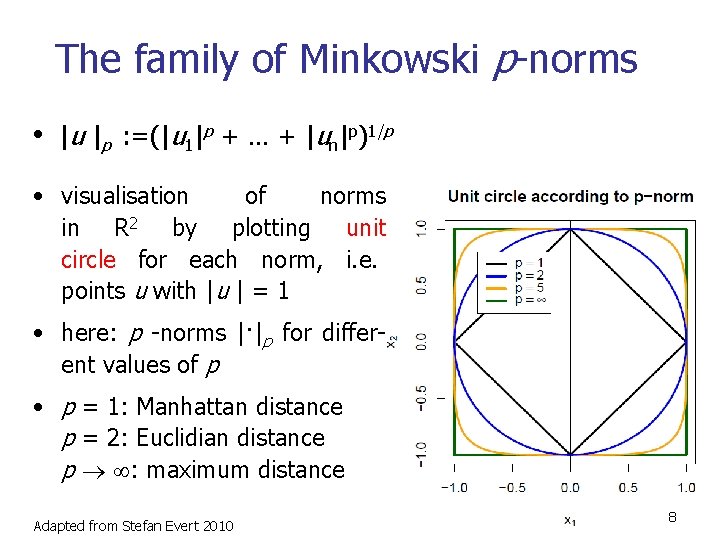
The family of Minkowski p norms • |u. |p : =(|u 1|p + … + |un|p)1/p • visualisation of norms in R 2 by plotting unit circle for each norm, i. e. points u with |u | = 1 • here: p norms |·|p for differ ent values of p • p = 1: Manhattan distance p = 2: Euclidian distance p : maximum distance Adapted from Stefan Evert 2010 8
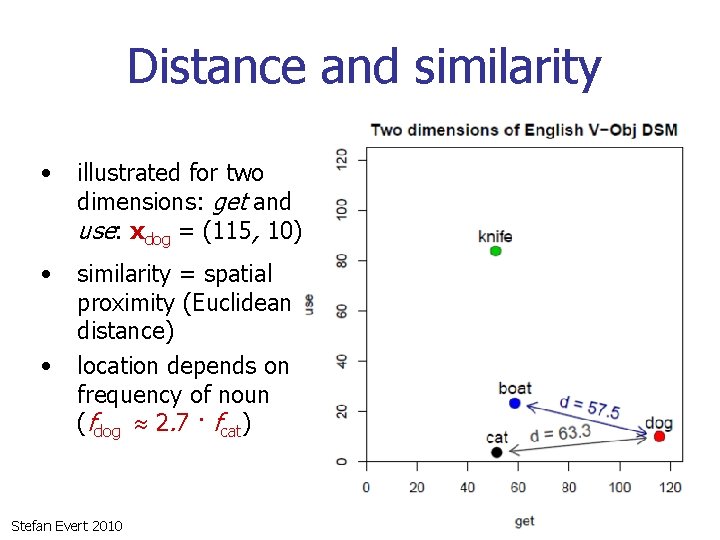
Distance and similarity • illustrated for two dimensions: get and use: xdog = (115, 10) • similarity = spatial proximity (Euclidean distance) location depends on frequency of noun (fdog 2. 7 · fcat) • Stefan Evert 2010 9
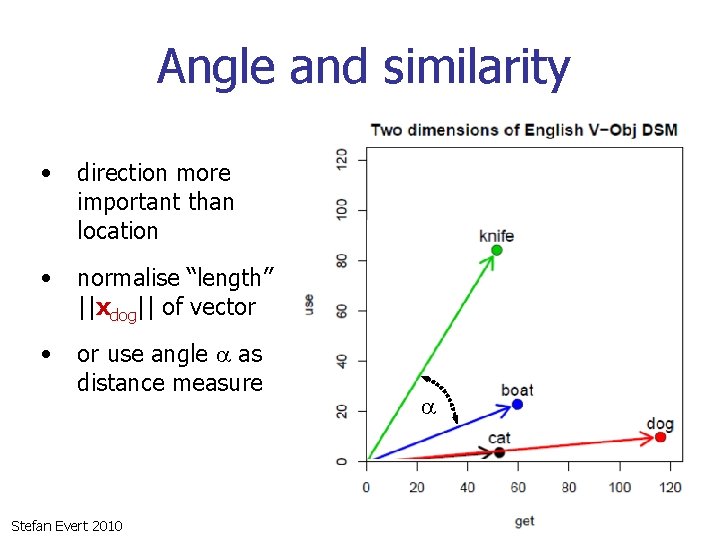
Angle and similarity • direction more important than location • normalise “length” ||xdog|| of vector • or use angle as distance measure Stefan Evert 2010 10
2 1. Meaning and Distribution 2. Distributional semantic models 3. Word vectors and search engines 4. Latent semantic analysis Reinhard Blutner 11
A very brief history • Introduced to computational linguistics in early 1990 s following the probabilistic revolution (Schütze 1992, 1998) • Other early work in psychology (Landauer and Dumais 1997; Lund and Burgess 1996) influenced by Latent Semantic Indexing (Dumais et al. 1988) and efficient software implementations (Berry 1992) • Renewed interest in recent years – see http: //wordspace. collocations. de/doku. php/course: start Adapted from Stefan Evert 2010 12
Some applications in computational linguistics • Unsupervised part of speech induction (Schütze 1995) • Word sense disambiguation (Schütze 1998) • Synonym tasks & other language tests (Landauer and Dumais 1997; Turney et al. 2003) • Ontology & wordnet expansion (Pantel et al. 2009) • Probabilistic language models (Bengio et al. 2003) • Subsymbolic input representation for neural networks • Many other tasks in computational semantics: entailment detection, noun compound interpretation, … Adapted from Stefan Evert 2010 13
Example: Word Space (Schütze) • Corpus: 60 million words of news messages (New York Times News Service) • Word word co occurrence matrix (20, 000 target words & 2, 000 context words as features) • Row vector records how often each context word occurs close to the target word (co occurrence) • Co occurrence window: left/right 50 words (Schütze 1998) or 1000 characters (Schütze 1992) • Normalization determine “meaning” of a context • Reduced to 100 Singular Value dimensions (mainly for efficiency) Stefan Evert 2010 14
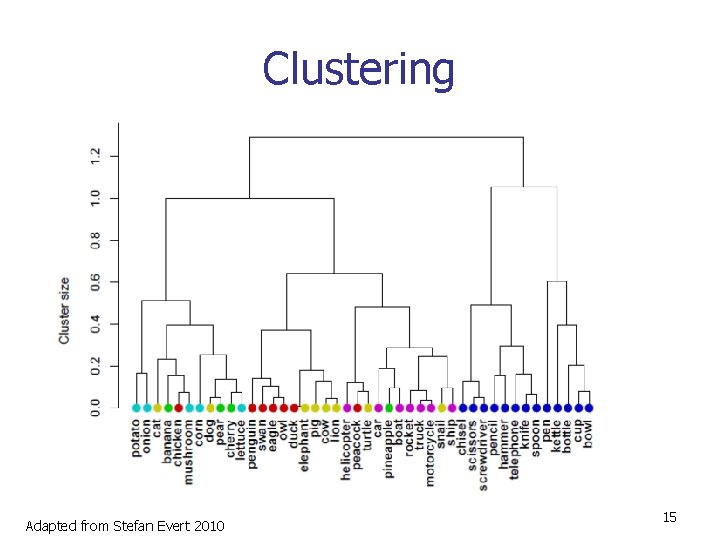
Clustering Adapted from Stefan Evert 2010 15
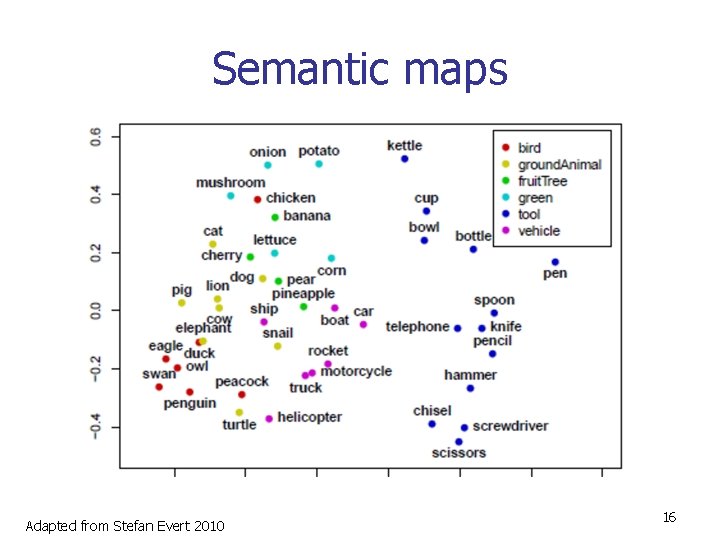
Semantic maps Adapted from Stefan Evert 2010 16
3 1. Meaning and Distribution 2. Distributional semantic models 3. Word vectors and search engines 4. Latent semantic analysis Reinhard Blutner 17
Basic references • Dominic Widdows, Geometry of Meaning, CSLI, 2004 • Keith van Rijsbergen, The Geometry of Information Retrieval, Cambridge University Press, 2004 • D. Widdows & S. Peters, Word vectors and quantum logic, in Mo. L 8, 2003. Reinhard Blutner 18
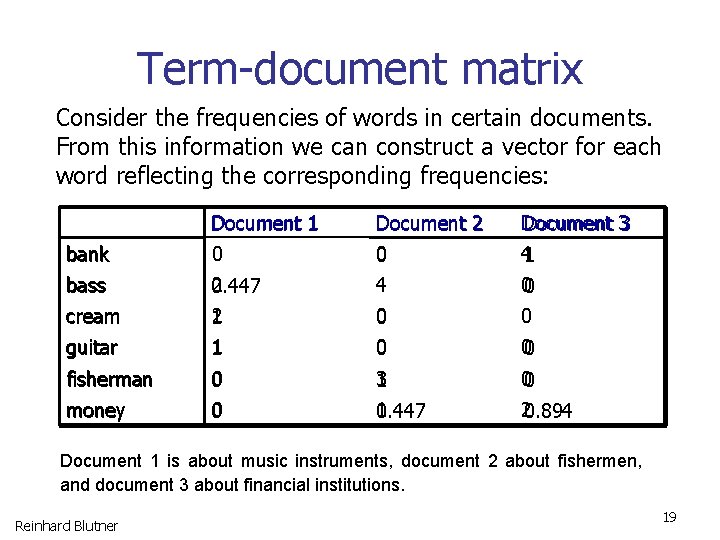
Term document matrix Consider the frequencies of words in certain documents. From this information we can construct a vector for each word reflecting the corresponding frequencies: Document 1 Document 2 Document 33 bank 0 0 41 bass 2 0. 447 4 0. 894 00 cream 2 1 0 00 guitar 1 0 00 fisherman 0 3 1 00 money 0 1 0. 447 20. 894 Document 1 is about music instruments, document 2 about fishermen, and document 3 about financial institutions. Reinhard Blutner 19
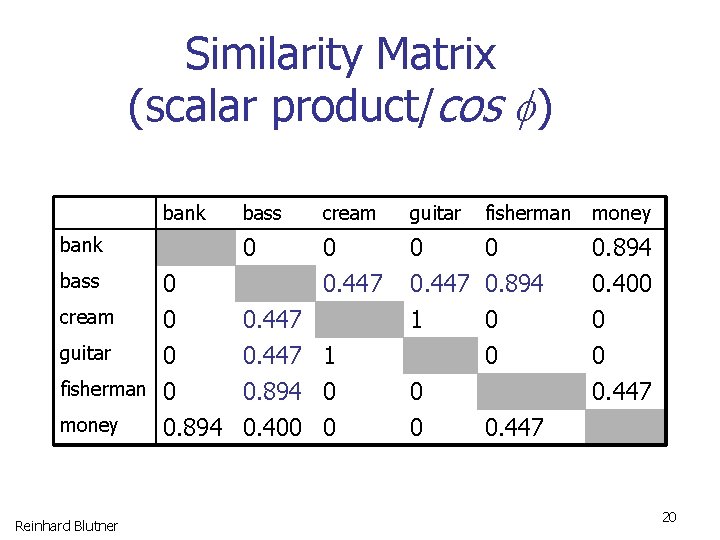
Similarity Matrix (scalar product/cos ) bank bass cream 0 0 bass cream guitar 0 0 0. 447 0. 894 1 0 0. 447 1 fisherman 0 0. 894 0 money 0. 894 0. 400 0 0 guitar Reinhard Blutner fisherman 0 0 money 0. 894 0. 400 0 0 0. 447 20
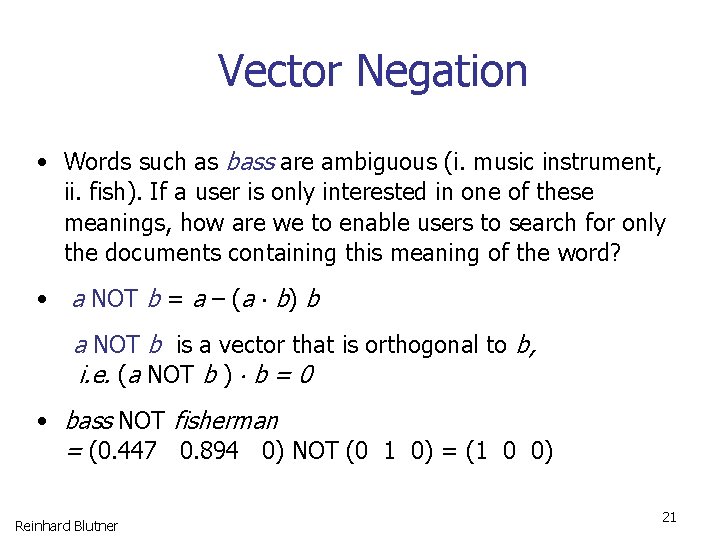
Vector Negation • Words such as bass are ambiguous (i. music instrument, ii. fish). If a user is only interested in one of these meanings, how are we to enable users to search for only the documents containing this meaning of the word? • a NOT b = a – (a b) b a NOT b is a vector that is orthogonal to b, i. e. (a NOT b ) b = 0 • bass NOT fisherman = (0. 447 0. 894 0) NOT (0 1 0) = (1 0 0) Reinhard Blutner 21
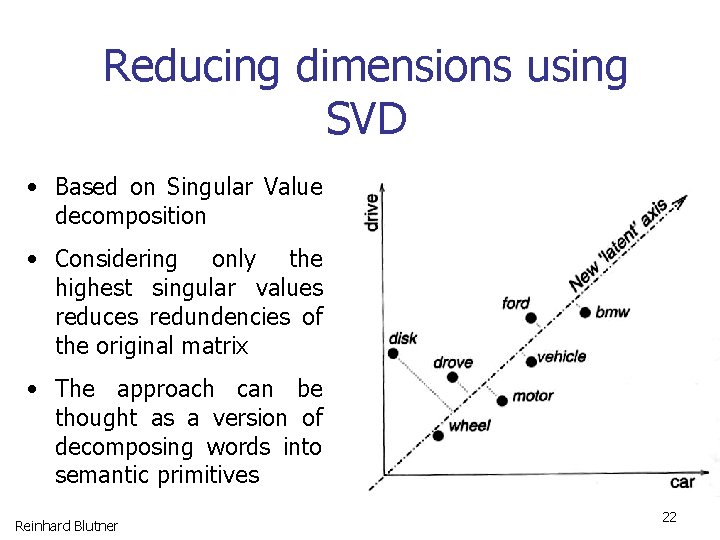
Reducing dimensions using SVD • Based on Singular Value decomposition • Considering only the highest singular values reduces redundencies of the original matrix • The approach can be thought as a version of decomposing words into semantic primitives Reinhard Blutner 22
3 1. Meaning and Distribution 2. Distributional semantic models 3. Word vectors and search engines 4. Latent semantic analysis Reinhard Blutner 23
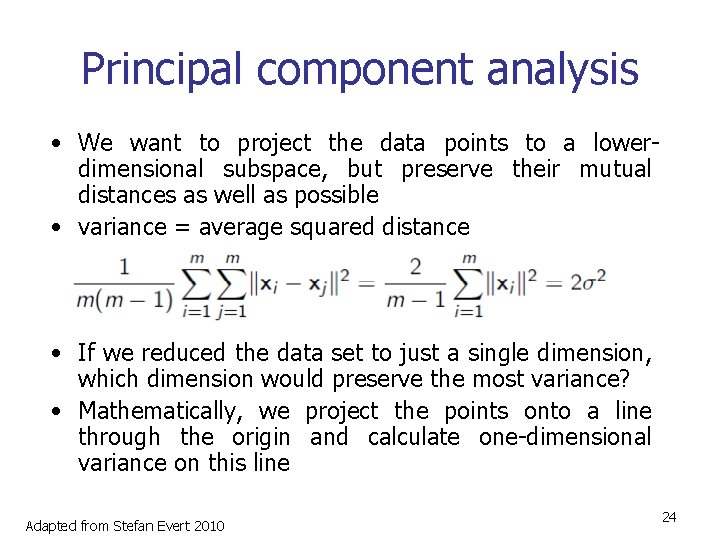
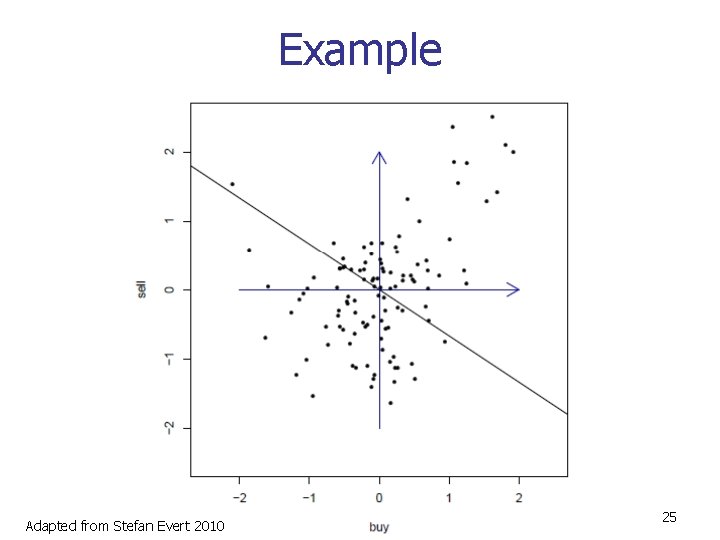
Principal component analysis • We want to project the data points to a lower dimensional subspace, but preserve their mutual distances as well as possible • variance = average squared distance • If we reduced the data set to just a single dimension, which dimension would preserve the most variance? • Mathematically, we project the points onto a line through the origin and calculate one dimensional variance on this line Adapted from Stefan Evert 2010 24
Example Adapted from Stefan Evert 2010 25
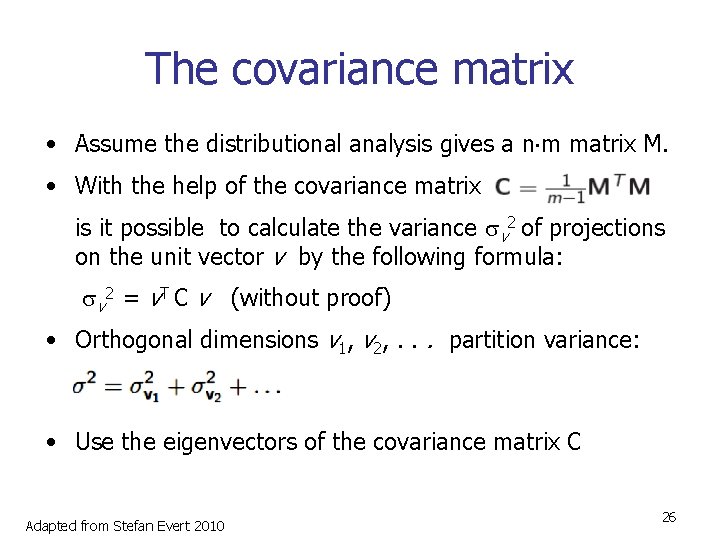
The covariance matrix • Assume the distributional analysis gives a n m matrix M. • With the help of the covariance matrix is it possible to calculate the variance v 2 of projections on the unit vector v by the following formula: v 2 = v. T C v (without proof) • Orthogonal dimensions v 1, v 2, . . . partition variance: • Use the eigenvectors of the covariance matrix C Adapted from Stefan Evert 2010 26
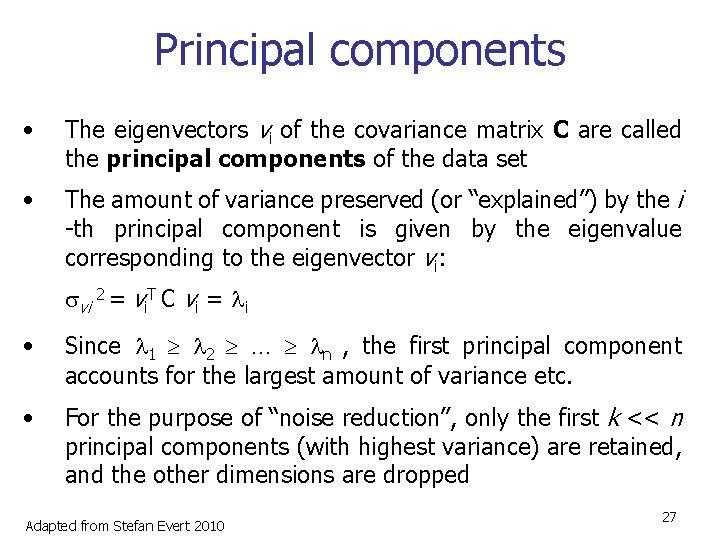
Principal components • The eigenvectors vi of the covariance matrix C are called the principal components of the data set • The amount of variance preserved (or “explained”) by the i th principal component is given by the eigenvalue corresponding to the eigenvector vi: vi 2 = vi. T C vi = i • Since 1 2 … n , the first principal component accounts for the largest amount of variance etc. • For the purpose of “noise reduction”, only the first k << n principal components (with highest variance) are retained, and the other dimensions are dropped Adapted from Stefan Evert 2010 27
Singular Value Decomposition (SVD) • The SVD can be seen as a generalization of the spectral theorem, which says that normal matrices can be unitarily diagonalized using a basis of eigenvectors, to arbitrary, not necessarily square, matrices. • SVD: Any m n matrix A can be factorized as the product U V* of three matrixes where U is an m m unitary matrix over K (i. e. , the columns of U are orthonormal), the matrix Σ is m n with nonnegative numbers on the diagonal (called the singular values) and zeros off the diagonal, and V* denotes the conjugate transpose of V, an n n unitary matrix over K. Such a factorization is called a singular value decomposition of A. Reinhard Blutner 28
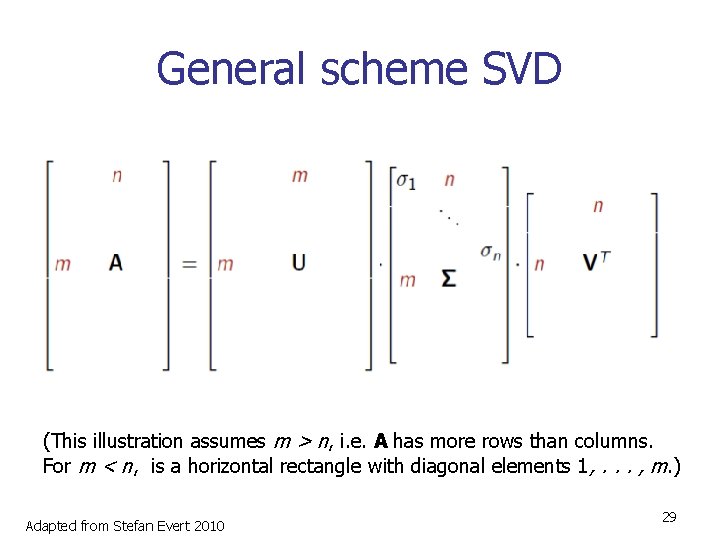
General scheme SVD (This illustration assumes m > n, i. e. A has more rows than columns. For m < n, is a horizontal rectangle with diagonal elements 1 , . . . , m. ) Adapted from Stefan Evert 2010 29
SVD: Some links • http: //en. wikipedia. org/wiki/Singular_value_dec omposition • http: //users. pandora. be/paul. larmuseau/SVD. ht m (for per forming online computations) • http: //mathworld. wolfram. com/Singular. Value. De composition. html • Distributed semantic model tutorial & other materials available from http: //wordspace. collocations. de/ Reinhard Blutner 30
Conclusions • At least certain aspects of the meaning of lexical expressions depend on their distributional properties in the linguistic contexts • Weak distributional hypothesis as a quantitative method for semantic analysis and lexical resource induction • PCA and SVD as methods to reduce the dimension of the primary semantic space. • SVD as an empirical method for calculating relevant meaning components. When does it work and when not? nhard Blutner 31
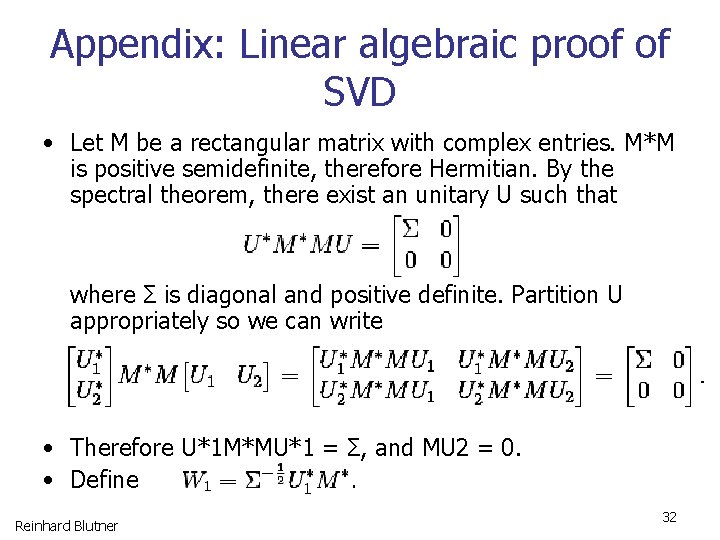
Appendix: Linear algebraic proof of SVD • Let M be a rectangular matrix with complex entries. M*M is positive semidefinite, therefore Hermitian. By the spectral theorem, there exist an unitary U such that where Σ is diagonal and positive definite. Partition U appropriately so we can write • Therefore U*1 M*MU*1 = Σ, and MU 2 = 0. • Define Reinhard Blutner 32
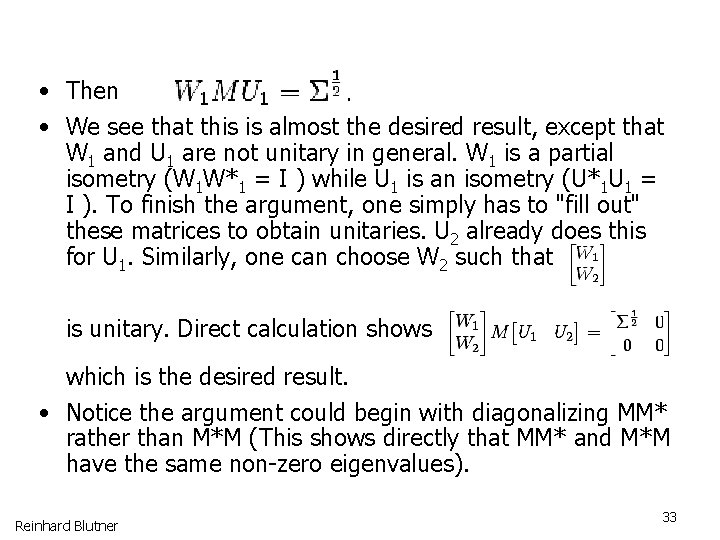
• Then • We see that this is almost the desired result, except that W 1 and U 1 are not unitary in general. W 1 is a partial isometry (W 1 W*1 = I ) while U 1 is an isometry (U*1 U 1 = I ). To finish the argument, one simply has to "fill out" these matrices to obtain unitaries. U 2 already does this for U 1. Similarly, one can choose W 2 such that is unitary. Direct calculation shows which is the desired result. • Notice the argument could begin with diagonalizing MM* rather than M*M (This shows directly that MM* and M*M have the same non zero eigenvalues). Reinhard Blutner 33
- Slides: 33